India Sustainable Apparel Market Size & Growth Rate
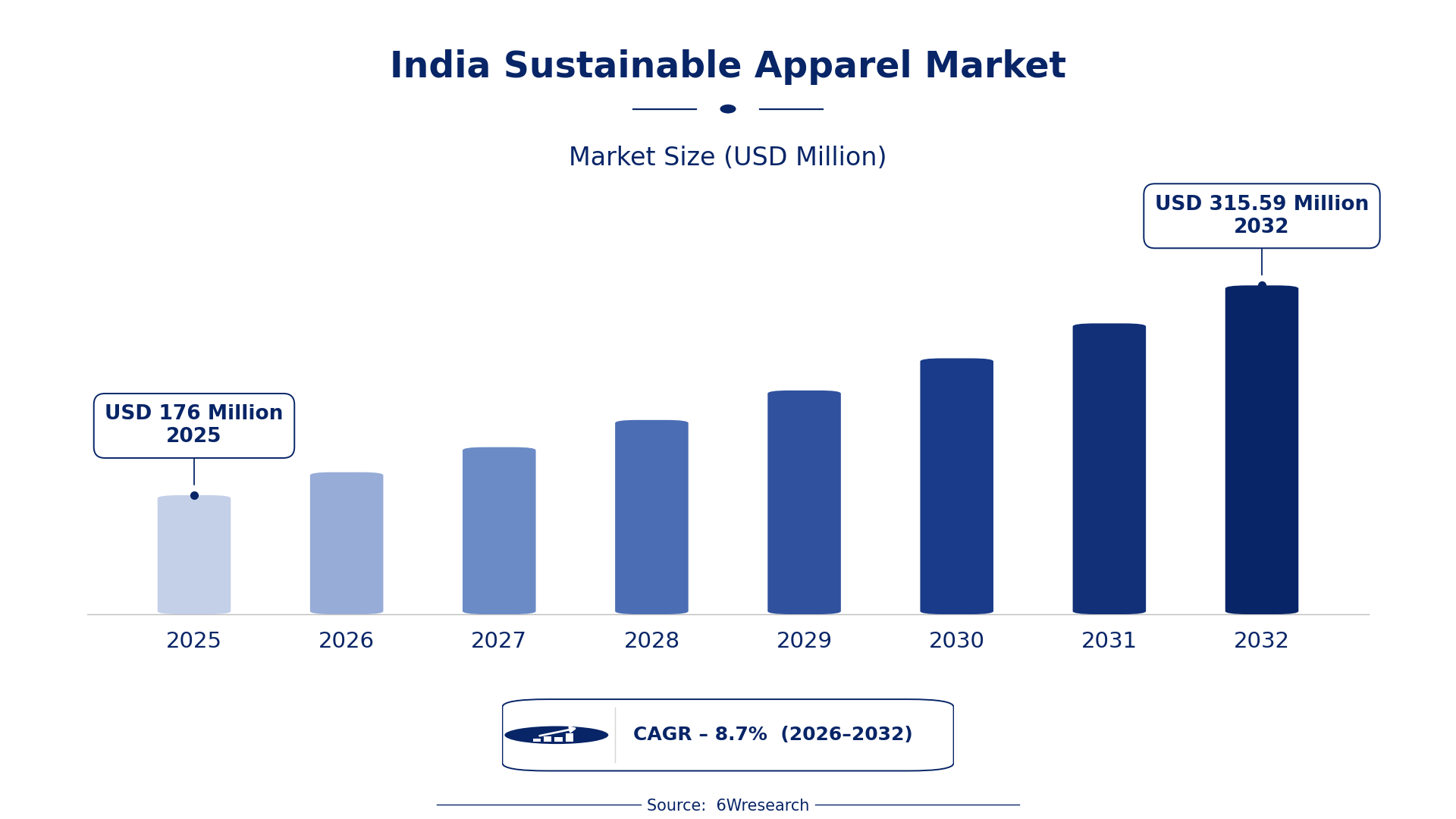
According to 6Wresearch internal database and industry insights, the India Sustainable Apparel Market was valued at USD 176.0 million in 2025 and is projected to reach USD 315.59 million by 2032, growing at a CAGR of approximately 8.7% during 2026–2032.
India Sustainable Apparel Market Highlights
| Report Metric | Details |
| Report Name | India Sustainable Apparel Market |
| Market Size 2025 | USD 176.0 million |
| Market Size 2032 | USD 315.59 million |
| Absolute Growth 2025–2032 | USD 139.59 million |
| CAGR 2026–2032 | 8.7% |
| Peak Annual Growth | 10.5% in 2026 |
| Forecast Period | 2026–2032 |
| Historical Data | 2022–2025 |
| Base Year | 2025 |
| Leading Apparel Type, 2025 | Organic Cotton Wear (45% share) |
| Leading Material Source, 2025 | GOTS Certified (36% share) |
| Leading Sustainability Focus, 2025 | Low Water Use (42% share) |
| Leading End User, 2025 | Eco-Friendly Brands (51% share) |
| Fastest-Growing Apparel Type | Recycled Polyester Gear (11.3% CAGR) |
| Fastest-Growing Material Source | Natural Fiber (11.1% CAGR) |
| Fastest-Growing Sustainability Focus | Waste Reduction (10.2% CAGR) |
| Fastest-Growing End User | Sustainable Fashion Labels (11.1% CAGR) |
| Growing Sector | Sustainable Fashion Labels |
| Key End Users | 3-4 buyer categories, comma separated, no company names (never empty) |
India Sustainable Apparel Market Year-wise Growth Rate and Key Drivers (2022–2032)
This graph illustrates the annual growth rates of the market from 2022 to 2032, highlighting a steady upward trajectory and projected market expansion over the forecast period.
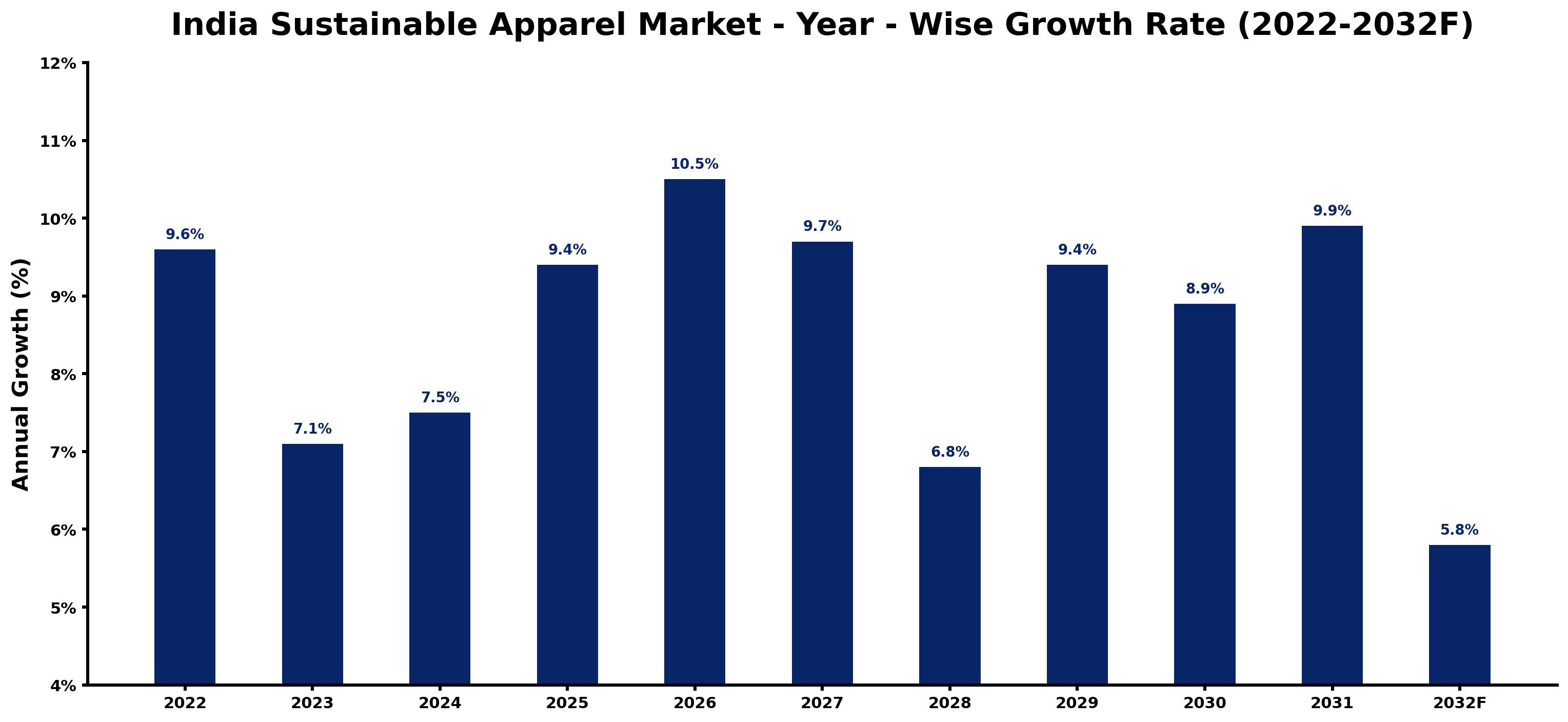
Below, each year's estimated growth is shown next to the factor that most influenced it.
| Year | Estimated Annual Growth (%) | Market Rationale |
| 2022 | 9.6 | The market experienced strong demand from eco-conscious consumers and increased awareness of sustainable practices, particularly driven by the 'Textiles Mission'. |
| 2023 | 7.1 | Growth slowed as the market adjusted to rising production costs and supply chain challenges, influenced by fluctuating raw material prices. |
| 2024 | 7.5 | Demand for sustainable apparel increased as more brands adopted eco-friendly practices and materials, supported by the Eco-Friendly Fashion Association. |
| 2025 | 9.4 | The market saw a resurgence due to successful promotional campaigns by eco-friendly brands, boosting consumer interest in sustainable products. |
| 2026 | 10.5 | Peak growth is expected to be driven by heightened consumer awareness and government support for sustainable initiatives, particularly through the 'Sustainable Textiles Initiative'. |
| 2027 | 9.7 | Growth is projected to slow as competition intensifies among sustainable apparel brands, impacting market dynamics. |
| 2028 | 6.8 | Market expansion is anticipated to face challenges from fluctuating raw material prices affecting production, particularly in organic cotton. |
| 2029 | 9.4 | Demand is expected to accelerate again as consumer preferences shift towards sustainable fashion choices, driven by increased marketing efforts from eco-friendly brands. |
| 2030 | 8.9 | Growth is projected to slow due to market saturation and increased competition among brands, particularly in the eco-friendly segment. |
| 2031 | 9.9 | Demand is expected to rise as eco-friendly brands expand their product lines and marketing efforts, attracting more consumers. |
| 2032 | 5.8 | Growth is projected to slow as the market stabilises, focusing on quality and sustainability, particularly in the organic cotton sector. |
Note: Market size estimations and growth projections presented in this report are based on 6Wresearch's proprietary forecasting methodology, utilizing the latest available industry data, government publications, and primary research inputs.
India Sustainable Apparel Market Synopsis
The India Sustainable Apparel Market includes eco-friendly clothing made through sustainable practices that reduce environmental impact. This encompasses garments crafted from organic or recycled materials, primarily used in fashion and activewear. The market is expanding due to heightened consumer awareness, with the organic cotton market valued at approximately 1.5 billion USD in 2022. Initiatives like the 'Textiles Mission' and growing international demand for sustainable products are propelling this growth. Eco-friendly brands are broadening their offerings, further stimulating market activity.
Market Dynamics Impact Analysis (2026–2032)
| Factor | Type | Impact | Primary Segment Affected |
| Increasing consumer awareness of sustainability drives demand for eco-friendly clothing. | Driver | High | Organic Cotton Wear |
| Government initiatives promote sustainable practices in the textile industry, boosting production. | Driver | High | Recycled Polyester Gear |
| Growing interest in eco-friendly brands creates opportunities for sustainable product offerings. | Opportunity | High | Eco-Friendly Brands |
| The expanding market for bamboo-based fabrics presents a niche opportunity for suppliers. | Opportunity | Medium | Bamboo-Based Fabrics |
| Limited awareness of sustainable options constrains the growth of hemp clothing. | Restraint | Medium | Hemp Clothing |
| The high cost of sustainable materials can deter manufacturers from adopting eco-friendly practices. | Restraint | High | Recycled Polyester Gear |
| The Sustainable Apparel Market in India faces challenges from rising production costs. | Challenge | High | Organic Cotton Wear |
| Competition from conventional apparel brands poses a challenge to market growth. | Challenge | Medium | Eco-Friendly Brands |
Evaluation of Drivers in India Sustainable Apparel Market (2026–2032)
Key forces behind demand, with the segment each one moves most, are listed below.
| Drivers | Primary Segment Affected | Why It Matters (Evidence) |
| Rising demand for organic cotton drives production and sales. | Organic Cotton Wear | The organic cotton market in India was valued at approximately 1.5 billion USD, encouraging more brands to adopt this material. |
| Government support for sustainable practices boosts market growth. | Recycled Polyester Gear | The 'Sustainable Textiles Initiative' aims to reduce water usage by 30% by 2025, encouraging sustainable practices. |
| Consumer preference for sustainable fashion boosts market opportunities. | Eco-Friendly Brands | India's textile exports reached 44 billion USD in 2021, with a growing share of sustainable products. |
| Increased awareness of environmental issues drives demand for sustainable apparel. | Natural Fiber | The Indian textile industry generates around 45 million tons of waste annually, prompting a shift towards sustainable practices. |
| The rise of eco-friendly fashion associations encourages collaboration among brands. | Sustainable Fashion Labels | The Eco-Friendly Fashion Association promotes sustainable practices, encouraging brands to adopt eco-friendly materials. |
The organic cotton market was valued at approximately 1.5 billion USD in 2022, driving more brands to adopt sustainable materials. The 'Textiles Mission' launched in 2021 promotes eco-friendly production methods, increasing market growth. The Indian textile industry generates around 45 million tons of waste annually, prompting a shift towards sustainable practices. The Eco-Friendly Fashion Association promotes collaboration among brands, encouraging the adoption of eco-friendly materials and practices.
Evaluation of Restraints in India Sustainable Apparel Market
The table below lists the restraints and the evidence behind each.
| Market Restraint | Primary Segment Affected | Why It Matters (Evidence) |
| Limited consumer awareness restricts the growth of hemp clothing. | Hemp Clothing | Despite its eco-friendly properties, hemp clothing remains underutilised due to low consumer awareness. |
| High production costs deter manufacturers from adopting sustainable practices. | Recycled Polyester Gear | The cost of sustainable materials can be higher than conventional options, limiting adoption rates in the market. |
| Competition from conventional apparel brands hinders market growth. | Eco-Friendly Brands | Established brands have strong supply chains and customer bases, making it challenging for sustainable brands to compete effectively. |
| Fluctuating raw material prices create uncertainty for producers. | Organic Cotton Wear | Price volatility in organic cotton can affect production planning and profitability for manufacturers, complicating operations. |
| Limited availability of certified sustainable materials can constrain production. | GOTS Certified | The availability of GOTS certified materials is essential for sustainable apparel production, but supply can be inconsistent. |
India Sustainable Apparel Market Challenges
The India Sustainable Apparel Market encounters several practical issues, starting with technology limitations that impede production efficiency. Many producers depend on outdated manufacturing processes, which can inflate production costs by up to 20%, making it challenging to compete with cheaper alternatives. Buyers face fluctuating prices for sustainable materials like organic cotton, which can vary by 15% annually, complicating budgeting and procurement. A lack of skilled workers in sustainable textile practices delays production timelines, causing producers to miss valuable market opportunities. Compliance with new sustainability regulations increases operational costs for manufacturers, further straining their resources.
Trends in the India Sustainable Apparel Market
Several trends are reshaping the India Sustainable Apparel Market; the most important are set out below.
- Shift Towards Organic Materials: The organic cotton market in India is valued at approximately 1.5 billion USD, indicating a shift towards organic materials in apparel production. This trend is driven by increasing consumer demand for eco-friendly options.
- Rise of Eco-Friendly Brands: Eco-Friendly Brands are gaining traction in India, with a growing share of textile exports reaching 44 billion USD in 2021. This reflects a shift in consumer preferences towards sustainable fashion.
- Expansion of Bamboo-Based Fabrics: The Indian market for bamboo-based fabrics is expanding, supported by several startups focusing on this material. This niche market is attracting attention due to its eco-friendly properties.
- Focus on Waste Reduction: Waste Reduction is becoming a key principle in sustainable apparel manufacturing, with many brands adopting practices to minimise waste. The 'Eco-Friendly Fashion Promotion Program' aims to increase market share by 20% by 2025.
Investment Opportunities in the India Sustainable Apparel Market
Some of the investment opportunities in the India Sustainable Apparel Market are mentioned below.
- Supply of Organic Cotton: The demand for organic cotton is rising, with the market valued at approximately 1.5 billion USD. Suppliers can focus on eco-friendly brands looking to expand their product offerings.
- Investment in Recycled Polyester: The market for recycled polyester in India is projected to grow due to increased awareness. Investing in this segment can attract eco-conscious consumers seeking sustainable options.
- Focus on Bamboo-Based Fabrics: The expanding market for bamboo-based fabrics presents a unique opportunity for suppliers. With several startups focusing on this material, there is potential for growth in this niche sector.
- Support for Eco-Friendly Brands: Eco-Friendly Brands are looking to expand their product lines, creating opportunities for suppliers of sustainable materials. Collaborating with these brands can strengthen market presence.
Government Initiatives in the India Sustainable Apparel Market
The 'National Policy on Textiles' was updated in 2022 to include sustainability as a key focus area, aiming to improve the competitiveness of the Indian textile sector. This policy encourages manufacturers to adopt eco-friendly practices and materials, ensuring compliance with sustainability standards. The 'Sustainable Textiles Initiative' was launched by the Ministry of Textiles in 2021 to promote eco-friendly production methods, targeting a 30% reduction in water usage by 2025. This initiative aims to improve resource efficiency and reduce environmental impact in the textile industry. The 'Green Textile Scheme' approved in 2023 by the Ministry of Environment provides financial assistance for sustainable textile projects, with a budget of 500 million INR, supporting manufacturers in adopting sustainable practices and technologies.
The 'Eco-Friendly Fashion Promotion Program' initiated in 2022 aims to support brands adopting sustainable practices, targeting a 20% increase in market share by 2025. This funding helps brands enhance their visibility and competitiveness in the market.
Future Insight of the India Sustainable Apparel Market
Several forward-looking factors should support the India Sustainable Apparel Market over the coming years. The government's 'Textiles Mission' promotes sustainable practices, enhancing production efficiency across the sector. By 2024, the market for recycled polyester is projected to grow by 30%, reflecting rising consumer awareness and demand. The expansion of bamboo-based fabric startups will provide diverse material options, appealing to eco-conscious buyers. The 'Sustainable Textiles Initiative' subsidy will encourage producers to adopt innovative, eco-friendly technologies, supporting long-term market development.
Market Segmentation Analysis
The report offers a comprehensive study of the following market segments and their leading categories in the market.
By Apparel Type – Organic Cotton Wear Dominated, Recycled Polyester Gear Expected to Grow Fastest
According to Sumit Sagar, AM at 6Wresearch, with a 45% revenue share in 2025, Organic Cotton Wear was the largest apparel type category. Organic Cotton Wear dominates the Indian sustainable apparel market as consumers increasingly seek eco-friendly clothing options. The backing of over 100 GOTS certified facilities ensures a robust supply chain that meets the growing demand for sustainable textiles. Over 2026–2032, Recycled Polyester Gear is expected to post the fastest growth, at a CAGR of 11.3%. Recycled Polyester Gear is experiencing rapid growth, driven by rising consumer awareness about waste reduction and sustainable practices. The anticipated surge in the recycled polyester market in 2023 reflects a broader commitment to sustainable materials within the apparel sector. This indicates that suppliers should focus on expanding their sustainable apparel offerings to meet the evolving demands of environmentally conscious consumers.
By Material Source – GOTS Certified Dominated, Natural Fiber Expected to Grow Fastest
GOTS Certified held a 36% share of the India Sustainable Apparel Market by material source in 2025. GOTS Certified materials lead the market as certification ensures sustainability, making products more appealing to environmentally conscious buyers. With over 100 GOTS certified facilities in India, this segment is well-established and trusted. Natural Fiber is projected to grow fastest, at a CAGR of 11.1% during 2026–2032. Natural Fiber is gaining traction due to its properties that align with sustainable textile practices, making it a preferred choice among manufacturers. The increasing use of natural fibers in sustainable apparel is indicative of changing consumer preferences. Buyers will benefit from sourcing GOTS certified and natural fiber products as they align with sustainability goals.
By Sustainability Focus – Low Water Use Dominated, Waste Reduction Expected to Grow Fastest
The largest sustainability focus category in 2025 was Low Water Use, with a 42% share of total revenue. Low Water Use is critical in the sustainable apparel market as it addresses the environmental impact of conventional cotton production. This focus is essential given that conventional cotton requires 7,000 liters of water per kg, making low water use a priority for manufacturers. The quickest growth will come from Waste Reduction, forecast to expand at a CAGR of 10.2% between 2026 and 2032. Waste Reduction is becoming a key principle in sustainable apparel manufacturing, driven by the industry's need to minimise its environmental footprint. This focus is supported by initiatives like the 'Textiles Mission' launched by the Indian government. Suppliers must prioritise low water use and waste reduction practices to remain competitive in the sustainable apparel market.
By End User – Eco-Friendly Brands Dominated, Sustainable Fashion Labels Expected to Grow Fastest
Eco-Friendly Brands took a 51% share of end user in 2025, more than any other category. Eco-Friendly Brands hold the largest share in the sustainable apparel market as they represent major players committed to sustainability. Their influence and consumer loyalty drive the demand for sustainable products in India. Sustainable Fashion Labels are set to record the highest CAGR in this split, 11.1% over 2026–2032. Sustainable Fashion Labels are rapidly growing, catering to eco-conscious consumers who seek environmentally friendly options. This increasing focus on sustainability among fashion labels indicates a shift in consumer behaviour towards more responsible purchasing. Suppliers should target eco-friendly brands and sustainable fashion labels to capitalise on the expanding market for sustainable apparel.
Key Attractiveness of the Report
- 10 Years of Market Numbers
- Historical Data Starting from 2022 to 2025
- Base Year 2025
- Forecast Data until 2032
- Key Performance Indicators Impacting the Market
- Major Upcoming Developments and Projects
Key Highlights of the Report:
- India Sustainable Apparel Market Outlook
- Market Size of India Sustainable Apparel Market, 2025
- Forecast of India Sustainable Apparel Market, 2032
- Historical Data and Forecast of India Sustainable Apparel Revenues & Volume for the Period 2022 - 2032F
- India Sustainable Apparel Market Trend Evolution
- India Sustainable Apparel Market Drivers and Challenges
- India Sustainable Apparel Price Trends
- India Sustainable Apparel Porter's Five Forces
- India Sustainable Apparel Industry Life Cycle
- Historical Data and Forecast of India Sustainable Apparel Market Revenues & Volume By Apparel Type for the Period 2022 - 2032F
- Historical Data and Forecast of India Sustainable Apparel Market Revenues & Volume By Organic Cotton Wear for the Period 2022 - 2032F
- Historical Data and Forecast of India Sustainable Apparel Market Revenues & Volume By Recycled Polyester Gear for the Period 2022 - 2032F
- Historical Data and Forecast of India Sustainable Apparel Market Revenues & Volume By Hemp Clothing for the Period 2022 - 2032F
- Historical Data and Forecast of India Sustainable Apparel Market Revenues & Volume By Bamboo-Based Fabrics for the Period 2022 - 2032F
- Historical Data and Forecast of India Sustainable Apparel Market Revenues & Volume By Material Source for the Period 2022 - 2032F
- Historical Data and Forecast of India Sustainable Apparel Market Revenues & Volume By GOTS Certified for the Period 2022 - 2032F
- Historical Data and Forecast of India Sustainable Apparel Market Revenues & Volume By PET Bottles for the Period 2022 - 2032F
- Historical Data and Forecast of India Sustainable Apparel Market Revenues & Volume By Natural Fiber for the Period 2022 - 2032F
- Historical Data and Forecast of India Sustainable Apparel Market Revenues & Volume By Renewable Resource for the Period 2022 - 2032F
- Historical Data and Forecast of India Sustainable Apparel Market Revenues & Volume By Sustainability Focus for the Period 2022 - 2032F
- Historical Data and Forecast of India Sustainable Apparel Market Revenues & Volume By Low Water Use for the Period 2022 - 2032F
- Historical Data and Forecast of India Sustainable Apparel Market Revenues & Volume By Waste Reduction for the Period 2022 - 2032F
- Historical Data and Forecast of India Sustainable Apparel Market Revenues & Volume By Biodegradable for the Period 2022 - 2032F
- Historical Data and Forecast of India Sustainable Apparel Market Revenues & Volume By Antimicrobial for the Period 2022 - 2032F
- Historical Data and Forecast of India Sustainable Apparel Market Revenues & Volume By End User for the Period 2022 - 2032F
- Historical Data and Forecast of India Sustainable Apparel Market Revenues & Volume By Eco-Friendly Brands for the Period 2022 - 2032F
- Historical Data and Forecast of India Sustainable Apparel Market Revenues & Volume By Activewear Companies for the Period 2022 - 2032F
- Historical Data and Forecast of India Sustainable Apparel Market Revenues & Volume By Niche Apparel Retailers for the Period 2022 - 2032F
- Historical Data and Forecast of India Sustainable Apparel Market Revenues & Volume By Sustainable Fashion Labels for the Period 2022 - 2032F
- India Sustainable Apparel Import Export Trade Statistics
- Market Opportunity Assessment By Apparel Type
- Market Opportunity Assessment By Material Source
- Market Opportunity Assessment By Sustainability Focus
- Market Opportunity Assessment By End User
- India Sustainable Apparel Top Companies Market Share
- India Sustainable Apparel Competitive Benchmarking By Technical and Operational Parameters
- India Sustainable Apparel Company Profiles
- India Sustainable Apparel Key Strategic Recommendations
Market Covered
Segments analysed in this report are listed below.
By Apparel Type
- Organic Cotton Wear
- Recycled Polyester Gear
- Hemp Clothing
- Bamboo-Based Fabrics
By Material Source
- GOTS Certified
- PET Bottles
- Natural Fiber
- Renewable Resource
By Sustainability Focus
- Low Water Use
- Waste Reduction
- Biodegradable
- Antimicrobial
By End User
- Eco-Friendly Brands
- Activewear Companies
- Niche Apparel Retailers
- Sustainable Fashion Labels































