India Sustainable Aquaculture Market Size & Growth Rate
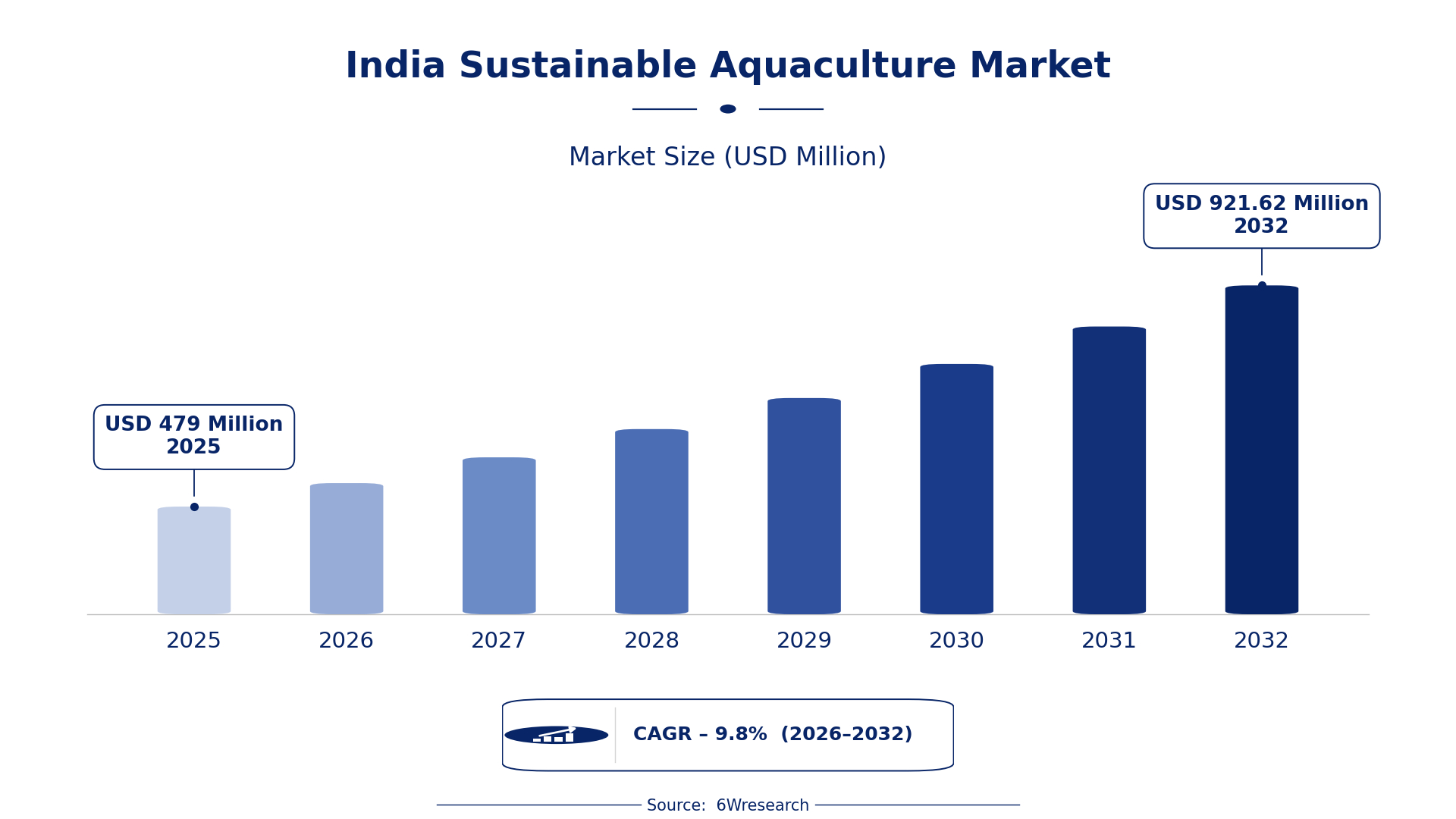
According to 6Wresearch internal database and industry insights, the India Sustainable Aquaculture Market was valued at USD 479.0 million in 2025 and is projected to reach USD 921.62 million by 2032, growing at a CAGR of approximately 9.8% during 2026–2032.
India Sustainable Aquaculture Market Highlights
| Report Metric | Details |
| Report Name | India Sustainable Aquaculture Market |
| Market Size 2025 | USD 479.0 million |
| Market Size 2032 | USD 921.62 million |
| Absolute Growth 2025–2032 | USD 442.62 million |
| CAGR 2026–2032 | 9.8% |
| Peak Annual Growth | 11.8% in 2030 |
| Forecast Period | 2026–2032 |
| Historical Data | 2022–2025 |
| Base Year | 2025 |
| Leading Aquaculture Type, 2025 | Recirculating Aquaculture (45% share) |
| Leading Feed Type, 2025 | Organic Feed (34% share) |
| Leading Environment Focus, 2025 | Water Recycling (53% share) |
| Leading End User, 2025 | Fish Exporters (35% share) |
| Fastest-Growing Aquaculture Type | Integrated Multi-Trophic (11.4% CAGR) |
| Fastest-Growing Environment Focus | Nutrient Reuse (11.2% CAGR) |
| Fastest-Growing End User | Green Label Seafood Brands (12.1% CAGR) |
| Growing Sector | Organic Aquaculture |
| Key End Users | Fish Exporters, Coastal Aquaculture Farms, Urban Fish Farms |
India Sustainable Aquaculture Market Year-wise Growth Rate and Key Drivers (2022–2032)
This graph illustrates the annual growth rates of the market from 2022 to 2032, highlighting a steady upward trajectory and projected market expansion over the forecast period.
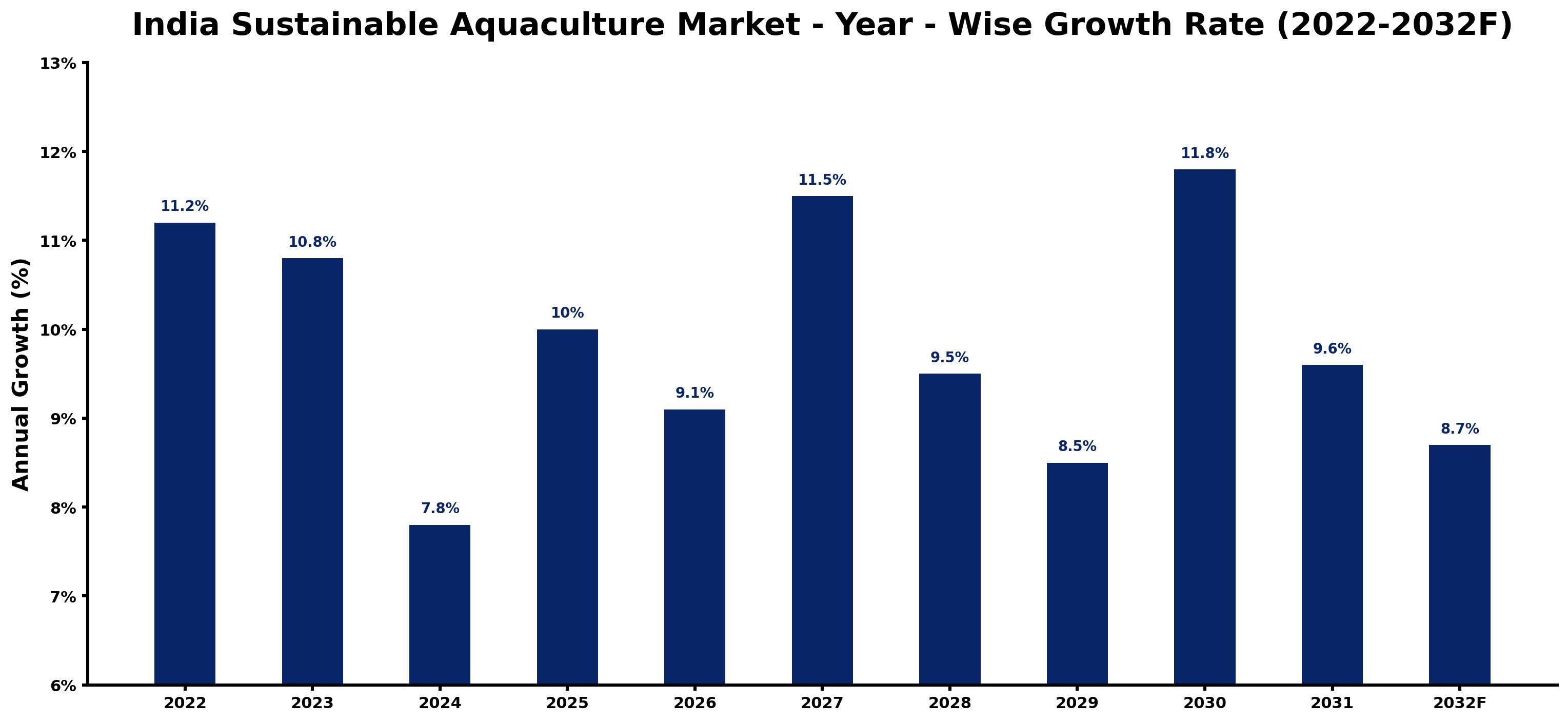
The table below sets out the estimated growth rate for each year and the main factor behind it.
| Year | Estimated Annual Growth (%) | Market Rationale |
| 2022 | 11.2 | The market experienced strong demand from domestic consumers and exports, reflecting its active state. |
| 2023 | 10.8 | Growth slowed as the market adjusted to evolving consumer preferences and sustainable practices. |
| 2024 | 7.8 | The market continued to grow, supported by increased focus on sustainable seafood production. |
| 2025 | 10.0 | Demand picked up due to government support initiatives like the Pradhan Mantri Matsya Sampada Yojana. |
| 2026 | 9.1 | Growth is expected to slow as producers face challenges in sourcing organic feed to meet rising demand. |
| 2027 | 11.5 | The market is projected to rebound with renewed interest in integrated aquaculture systems and sustainability initiatives. |
| 2028 | 9.5 | Growth is expected to slow again as producers adjust to environmental regulations and market conditions. |
| 2029 | 8.5 | Demand is projected to continue slowing as the National Fisheries Development Board's initiatives stabilise production efficiencies. |
| 2030 | 11.8 | The market is expected to surge again, driven by strong government initiatives and consumer interest in sustainable seafood. |
| 2031 | 9.6 | Growth is projected to slow as producers face challenges in scaling operations and meeting compliance standards. |
| 2032 | 8.7 | The market is expected to continue growing, supported by ongoing government policies and evolving consumer trends. |
Note: Market size estimations and growth projections presented in this report are based on 6Wresearch's proprietary forecasting methodology, utilizing the latest available industry data, government publications, and primary research inputs.
India Sustainable Aquaculture Market Synopsis
Sustainable Aquaculture in India encompasses practices aimed at producing seafood with minimal environmental impact. This includes methods such as recirculating systems and integrated multi-trophic aquaculture. The India Sustainable Aquaculture Market is expanding due to rising domestic demand and government initiatives like the Pradhan Mantri Matsya Sampada Yojana, which aims to boost fish production. With aquaculture production reaching 4.6 million tons in 2021, the sector is essential for food security and export potential, particularly for fish exporters and coastal aquaculture farms.
Market Dynamics Impact Analysis (2026–2032)
| Factor | Type | Impact | Primary Segment Affected |
| Rising consumer demand for sustainable seafood products drives growth. | Driver | High | Organic Feed |
| Government support for sustainable aquaculture practices creates opportunities for growth. | Driver | High | Recirculating Aquaculture |
| The increasing focus on organic aquaculture presents a significant opportunity. | Opportunity | High | Organic Feed |
| Urban aquaculture initiatives are gaining traction, leading to new market openings. | Opportunity | Medium | Urban Fish Farms |
| Challenges in sourcing organic feed may limit production capacity. | Restraint | High | Organic Feed |
| Regulatory compliance costs can hinder smaller producers from entering the market. | Restraint | Medium | Recirculating Aquaculture |
| Producers face difficulties in scaling operations to meet growing demand. | Challenge | High | Integrated Multi-Trophic |
| Buyers encounter variability in supply due to environmental factors affecting production. | Challenge | Medium | Fish Exporters |
Evaluation of Drivers in India Sustainable Aquaculture Market (2026–2032)
The main growth drivers and the segments they affect most are set out below.
| Drivers | Primary Segment Affected | Why It Matters (Evidence) |
| Increasing consumer preference for organic seafood drives demand for organic feed. | Organic Feed | Organic aquaculture feed production is growing, with a focus on sustainable sourcing to meet consumer demand. |
| Government initiatives promote sustainable aquaculture practices, boosting production. | Recirculating Aquaculture | The National Fisheries Development Board promotes sustainable aquaculture practices across India, enhancing production capabilities. |
| Rising fish exports create demand for efficient aquaculture systems. | Fish Exporters | Fish exports from India were valued at $5.5 billion in 2021, focusing on sustainability and quality. |
| Technological advancements in aquaculture systems improve production efficiency. | Integrated Multi-Trophic | Integrated multi-trophic aquaculture enhances ecosystem balance by utilizing waste from one species as feed for another, improving yields. |
| Urban aquaculture initiatives are expanding, increasing local seafood production. | Urban Fish Farms | Urban aquaculture initiatives are supported by local governments in metropolitan areas, driving local seafood supply. |
Expansion of the Sustainable Aquaculture market in India is driven by a rising consumer preference for organic seafood and initiatives that promote sustainable practices. The government’s Pradhan Mantri Matsya Sampada Yojana seeks to significantly boost fish production, creating new market opportunities. In 2021, fish exports from India reached $5.5 billion, increasing demand for efficient aquaculture systems. Producers are increasingly adopting integrated multi-trophic systems, which improve ecosystem balance and resource efficiency. Urban aquaculture initiatives, backed by local governments, are also on the rise, enhancing local seafood production and attracting new buyers.
Evaluation of Restraints in India Sustainable Aquaculture Market
Below mentioned are some major restraints and their influence on market dynamics.
| Market Restraint | Primary Segment Affected | Why It Matters (Evidence) |
| Challenges in sourcing organic feed may limit production capacity. | Organic Feed | The growing demand for organic products puts pressure on feed supply chains, affecting production rates and profitability. |
| Regulatory compliance costs can hinder smaller producers from entering the market. | Recirculating Aquaculture | Smaller producers often struggle with the costs associated with meeting regulatory standards, limiting market access. |
| Environmental factors can impact fish health and production yields. | Integrated Multi-Trophic | Disease control measures are critical for maintaining fish health and reducing losses, affecting supply and profitability. |
| Market volatility can affect pricing and profitability for producers. | Fish Exporters | Fluctuations in global seafood prices can impact the profitability of fish exports, affecting revenue for producers. |
| Limited access to advanced technologies can hinder production efficiency. | Urban Fish Farms | Urban farms may lack the resources to adopt new technologies, affecting their competitiveness in the market. |
India Sustainable Aquaculture Market Challenges
Producers in the India Sustainable Aquaculture market face rising costs due to increasing feed prices, which can reduce profit margins by as much as 15%. Buyers encounter intense competition from unregulated farms that undercut prices, threatening revenue stability for legitimate producers. Supply chain challenges, particularly in sourcing sustainable feed, can delay production schedules by up to three months, affecting timely deliveries for buyers. Moreover, the slow adoption of advanced aquaculture technologies hampers efficiency, making it difficult for producers to meet the growing demand for responsibly sourced seafood.
Trends in the India Sustainable Aquaculture Market
Below mentioned are some of the trends shaping the India Sustainable Aquaculture Market growth.
- Growth of Urban Aquaculture Initiatives: Urban aquaculture initiatives are gaining momentum in metropolitan areas, with local governments actively supporting their development. In 2021, urban aquaculture projects expanded significantly, providing local seafood options and reducing transportation costs for consumers.
- Shift towards Organic Aquaculture Practices: The emphasis on organic aquaculture is increasing, with the government promoting organic practices to satisfy consumer demand. In 2022, organic aquaculture feed production grew by 12%, reflecting the rising interest in sustainable seafood.
- Adoption of Water Recycling Technologies: Water recycling is becoming a priority in sustainable aquaculture practices. By 2025, over 53% of aquaculture farms are expected to implement water recycling systems, improving sustainability and resource efficiency in the sector.
- Rise of Integrated Multi-Trophic Systems: Integrated multi-trophic aquaculture systems are becoming more popular, improving ecosystem balance and resource use. By 2026, this segment is projected to grow at a CAGR of 11.4%, highlighting its sustainability benefits and market potential.
Investment Opportunities in the India Sustainable Aquaculture Market
The following opportunities in the India Sustainable Aquaculture Market pair current demand with a clear way in.
- Timing for Organic Feed Investment: With the increasing consumer interest in organic products, there is a timely opportunity to invest in organic feed production. The National Fisheries Policy aims to increase fish production to 15 million tons by 2025, creating a market for organic feed suppliers.
- Urban Aquaculture Expansion: Urban Fish Farms are emerging as a vital segment, with local governments supporting their growth. With fish production reaching 4.6 million tons in 2021, investing in urban aquaculture facilities can meet local demand and improve food security.
- Focus on Sustainable Practices: The increasing emphasis on sustainability presents opportunities for suppliers of eco-friendly aquaculture technologies. The Coastal Aquaculture Authority regulates practices, ensuring compliance and promoting sustainable methods across the industry.
- Nutrient Reuse Technologies: Investing in Nutrient Reuse technologies is timely as the market focuses on sustainability. The growing need for efficient resource management in aquaculture aligns with the National Fisheries Development Board's goals for improved productivity.
Government Initiatives in the India Sustainable Aquaculture Market
The Coastal Aquaculture Authority Act of 2005 regulates aquaculture practices to ensure sustainability and environmental protection. This law mandates compliance with environmental standards, influencing how producers operate. Additionally, the National Policy on Marine Fisheries, updated in 2021, emphasises sustainable practices and biodiversity conservation in aquaculture, guiding future initiatives. The Pradhan Mantri Matsya Sampada Yojana, launched by the Ministry of Fisheries, Animal Husbandry and Dairying in 2020, aims to boost fish production and create employment opportunities, providing a framework for growth.
In 2022, the Ministry of Fisheries initiated a scheme for promoting organic aquaculture to meet the increasing consumer demand for organic seafood. The National Fisheries Development Board oversees this initiative, focusing on sustainable practices and assisting producers in meeting certification requirements. The agency also funds projects aimed at improving aquaculture practices, enhancing productivity and sustainability across the sector.
Future Insight of the India Sustainable Aquaculture Market
Several forward-looking factors are expected to support the India Sustainable Aquaculture market by 2032. The National Fisheries Policy aims for fish production to reach 15 million tons by 2025, boosting supply for both domestic consumption and exports. The government's Pradhan Mantri Matsya Sampada Yojana is anticipated to drive investment in responsible aquaculture practices. Adoption of ISO 14001 standards will improve environmental management on farms, while urban aquaculture initiatives will create new market opportunities in metropolitan areas.
Market Segmentation Analysis
The analysis below covers each segmentation, its leading category in 2025 and its fastest-growing category through 2032.
By Aquaculture Type – Recirculating Aquaculture Dominated, Integrated Multi-Trophic Expected to Grow Fastest
According to Sumit Sagar, AM at 6Wresearch, in 2025, Recirculating Aquaculture led the aquaculture type split with a 45% share. Recirculating aquaculture holds the largest share due to its efficient water use and waste reduction, making it ideal for regions like Andhra Pradesh, which accounts for over 30% of India's total aquaculture production. This method is increasingly adopted by farms seeking sustainable practices and regulatory compliance. Integrated Multi-Trophic is projected to grow fastest, at a CAGR of 11.4% during 2026–2032. Integrated multi-trophic aquaculture is experiencing rapid growth as it enhances ecosystem balance, utilising waste from one species to feed another, thus appealing to environmentally conscious practices. The government's support for sustainable initiatives further accelerates its adoption across the country. Suppliers should focus on developing technologies that support recirculating systems to meet the growing demand for sustainable aquaculture.
By Feed Type – Organic Feed Dominated and Is Expected to Record the Fastest Growth
Organic Feed accounted for a 34% market share by feed type in 2025. Organic feed dominates the market share as it meets the increasing consumer demand for organic seafood products, reflecting a shift towards healthier and environmentally friendly options. This trend is evident as more aquaculture farms integrate organic feed into their operations to enhance product appeal. Its lead should widen, with a projected CAGR of 12.0% during 2026–2032, the highest in this split. Organic feed is also the fastest-growing segment, driven by the rising consumer preference for organic products, which is supported by government initiatives promoting sustainable aquaculture. As more farms transition to organic practices, this segment's growth will likely continue to accelerate. Buyers should prioritise sourcing organic feed to align with market trends and consumer preferences for sustainable seafood.
By Environment Focus – Water Recycling Dominated, Nutrient Reuse Expected to Grow Fastest
Water Recycling held a 53% share of the India Sustainable Aquaculture Market by environment focus in 2025. Water recycling leads in market share as it is essential for sustainable aquaculture practices, ensuring efficient use of resources while minimising environmental impact. This method is increasingly adopted by farms aiming to comply with ISO 14001 standards for environmental management. Nutrient Reuse is set to record the highest CAGR in this split, 11.2% over 2026–2032. Nutrient reuse is the fastest-growing focus area, as it plays a crucial role in maintaining water quality and reducing operational costs, making it attractive for aquaculture operations. The increasing emphasis on cost-effective sustainability measures drives its rapid adoption. Suppliers must innovate solutions that enhance nutrient reuse to cater to the evolving needs of aquaculture farms.
By End User – Fish Exporters Dominated, Green Label Seafood Brands Expected to Grow Fastest
Fish Exporters took a 35% share of end user in 2025, more than any other category. Fish exporters command the largest market share as major players in the aquaculture supply chain, facilitating the export of sustainably produced seafood, which is vital for India's economy. Their established networks and export capabilities significantly influence the industry's growth. Over 2026–2032, Green Label Seafood Brands are expected to post the fastest growth, at a CAGR of 12.1%. Green label seafood brands are the fastest-growing end user segment, appealing to environmentally conscious consumers who prioritise sustainable sourcing. This trend is likely to expand as consumer awareness of sustainability increases, further driving demand for responsibly sourced seafood. Suppliers should align their offerings with the preferences of green label seafood brands to capture this growing market segment.
Key Attractiveness of the Report
- 10 Years of Market Numbers
- Historical Data Starting from 2022 to 2025
- Base Year 2025
- Forecast Data until 2032
- Key Performance Indicators Impacting the Market
- Major Upcoming Developments and Projects
Key Highlights of the Report:
- India Sustainable Aquaculture Market Outlook
- Market Size of India Sustainable Aquaculture Market, 2025
- Forecast of India Sustainable Aquaculture Market, 2032
- Historical Data and Forecast of India Sustainable Aquaculture Revenues & Volume for the Period 2022 - 2032F
- India Sustainable Aquaculture Market Trend Evolution
- India Sustainable Aquaculture Market Drivers and Challenges
- India Sustainable Aquaculture Price Trends
- India Sustainable Aquaculture Porter's Five Forces
- India Sustainable Aquaculture Industry Life Cycle
- Historical Data and Forecast of India Sustainable Aquaculture Market Revenues & Volume By Aquaculture Type for the Period 2022 - 2032F
- Historical Data and Forecast of India Sustainable Aquaculture Market Revenues & Volume By Recirculating Aquaculture for the Period 2022 - 2032F
- Historical Data and Forecast of India Sustainable Aquaculture Market Revenues & Volume By Integrated Multi-Trophic for the Period 2022 - 2032F
- Historical Data and Forecast of India Sustainable Aquaculture Market Revenues & Volume By Cage-Free Systems for the Period 2022 - 2032F
- Historical Data and Forecast of India Sustainable Aquaculture Market Revenues & Volume By Biofloc Technology for the Period 2022 - 2032F
- Historical Data and Forecast of India Sustainable Aquaculture Market Revenues & Volume By Feed Type for the Period 2022 - 2032F
- Historical Data and Forecast of India Sustainable Aquaculture Market Revenues & Volume By Organic Feed for the Period 2022 - 2032F
- Historical Data and Forecast of India Sustainable Aquaculture Market Revenues & Volume By Algae, Shellfish Systems for the Period 2022 - 2032F
- Historical Data and Forecast of India Sustainable Aquaculture Market Revenues & Volume By Natural Conditions for the Period 2022 - 2032F
- Historical Data and Forecast of India Sustainable Aquaculture Market Revenues & Volume By Minimal Waste for the Period 2022 - 2032F
- Historical Data and Forecast of India Sustainable Aquaculture Market Revenues & Volume By Environment Focus for the Period 2022 - 2032F
- Historical Data and Forecast of India Sustainable Aquaculture Market Revenues & Volume By Water Recycling for the Period 2022 - 2032F
- Historical Data and Forecast of India Sustainable Aquaculture Market Revenues & Volume By Nutrient Reuse for the Period 2022 - 2032F
- Historical Data and Forecast of India Sustainable Aquaculture Market Revenues & Volume By Biodiversity Protection for the Period 2022 - 2032F
- Historical Data and Forecast of India Sustainable Aquaculture Market Revenues & Volume By Disease Control for the Period 2022 - 2032F
- Historical Data and Forecast of India Sustainable Aquaculture Market Revenues & Volume By End User for the Period 2022 - 2032F
- Historical Data and Forecast of India Sustainable Aquaculture Market Revenues & Volume By Fish Exporters for the Period 2022 - 2032F
- Historical Data and Forecast of India Sustainable Aquaculture Market Revenues & Volume By Coastal Aquaculture Farms for the Period 2022 - 2032F
- Historical Data and Forecast of India Sustainable Aquaculture Market Revenues & Volume By Green Label Seafood Brands for the Period 2022 - 2032F
- Historical Data and Forecast of India Sustainable Aquaculture Market Revenues & Volume By Urban Fish Farms for the Period 2022 - 2032F
- India Sustainable Aquaculture Import Export Trade Statistics
- Market Opportunity Assessment By Aquaculture Type
- Market Opportunity Assessment By Feed Type
- Market Opportunity Assessment By Environment Focus
- Market Opportunity Assessment By End User
- India Sustainable Aquaculture Top Companies Market Share
- India Sustainable Aquaculture Competitive Benchmarking By Technical and Operational Parameters
- India Sustainable Aquaculture Company Profiles
- India Sustainable Aquaculture Key Strategic Recommendations
Market Covered
The report offers an extensive study of the following market segments.
By Aquaculture Type
- Recirculating Aquaculture
- Integrated Multi-Trophic
- Cage-Free Systems
- Biofloc Technology
By Feed Type
- Organic Feed
- Algae
- Shellfish Systems
- Natural Conditions
- Minimal Waste
By Environment Focus
- Water Recycling
- Nutrient Reuse
- Biodiversity Protection
- Disease Control
By End User
- Fish Exporters
- Coastal Aquaculture Farms
- Green Label Seafood Brands
- Urban Fish Farms































