China Sustainable Aquaculture Market Size & Growth Rate
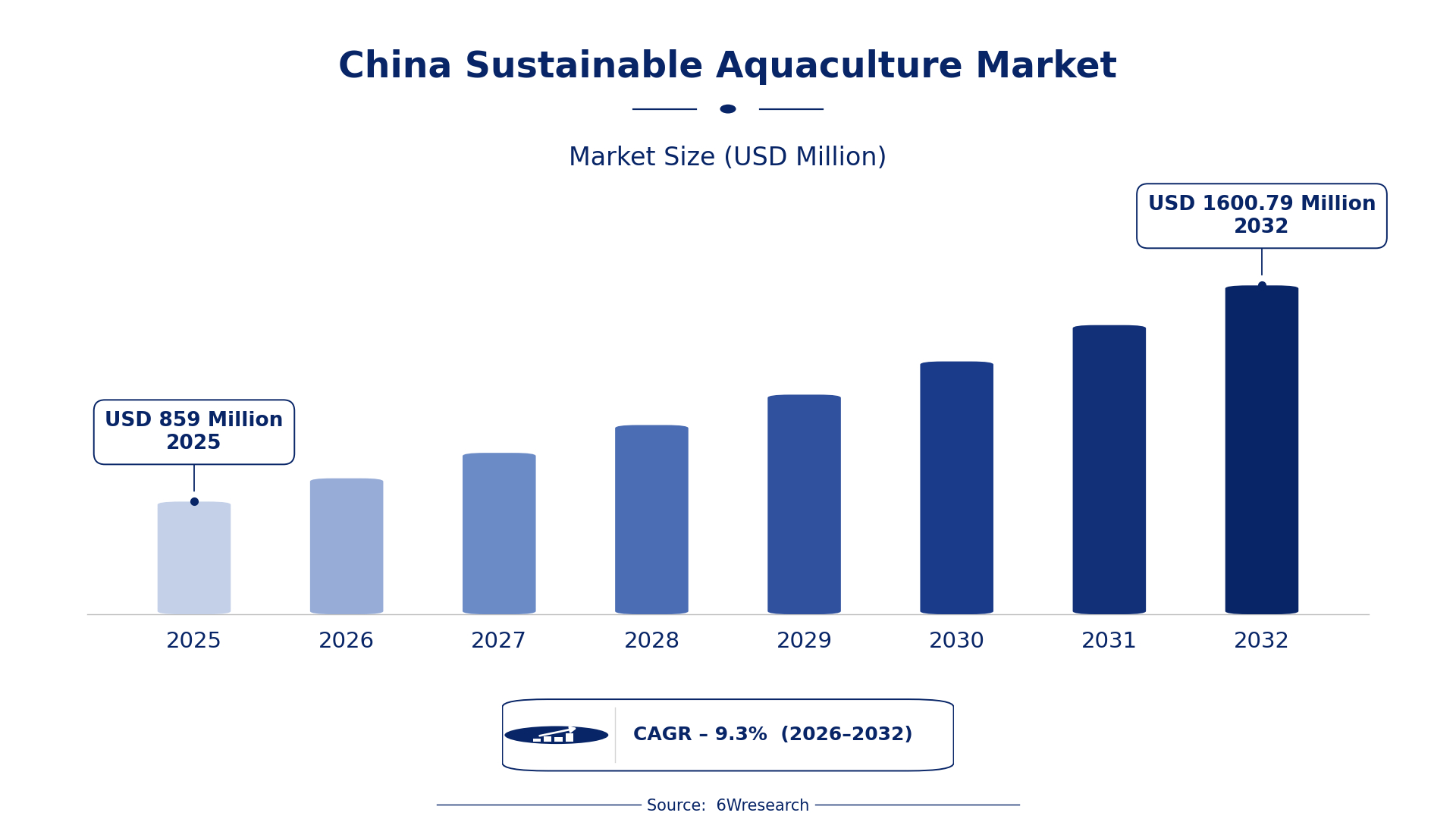
According to 6Wresearch internal database and industry insights, the China Sustainable Aquaculture Market was valued at USD 859.0 million in 2025 and is projected to reach USD 1,600.79 million by 2032, growing at a CAGR of approximately 9.3% during 2026–2032.
China Sustainable Aquaculture Market Highlights
| Report Metric | Details |
| Report Name | China Sustainable Aquaculture Market |
| Market Size 2025 | USD 859.0 million |
| Market Size 2032 | USD 1,600.79 million |
| Absolute Growth 2025–2032 | USD 741.79 million |
| CAGR 2026–2032 | 9.3% |
| Peak Annual Growth | 11.3% in 2029 |
| Forecast Period | 2026–2032 |
| Historical Data | 2022–2025 |
| Base Year | 2025 |
| Leading Aquaculture Type, 2025 | Recirculating Aquaculture (41% share) |
| Leading Feed Type, 2025 | Organic Feed (41% share) |
| Leading Environment Focus, 2025 | Water Recycling (39% share) |
| Leading End User, 2025 | Fish Exporters (42% share) |
| Fastest-Growing Aquaculture Type | Integrated Multi-Trophic (10.3% CAGR) |
| Fastest-Growing Environment Focus | Nutrient Reuse (11.6% CAGR) |
| Fastest-Growing End User | Urban Fish Farms (11.8% CAGR) |
| Growing Sector | Urban Aquaculture |
| Key End Users | Fish Exporters, Coastal Aquaculture Farms, Green Label Seafood Brands, Urban Fish Farms |
China Sustainable Aquaculture Market Year-wise Growth Rate and Key Drivers (2022–2032)
This graph illustrates the annual growth rates of the market from 2022 to 2032, highlighting a steady upward trajectory and projected market expansion over the forecast period.
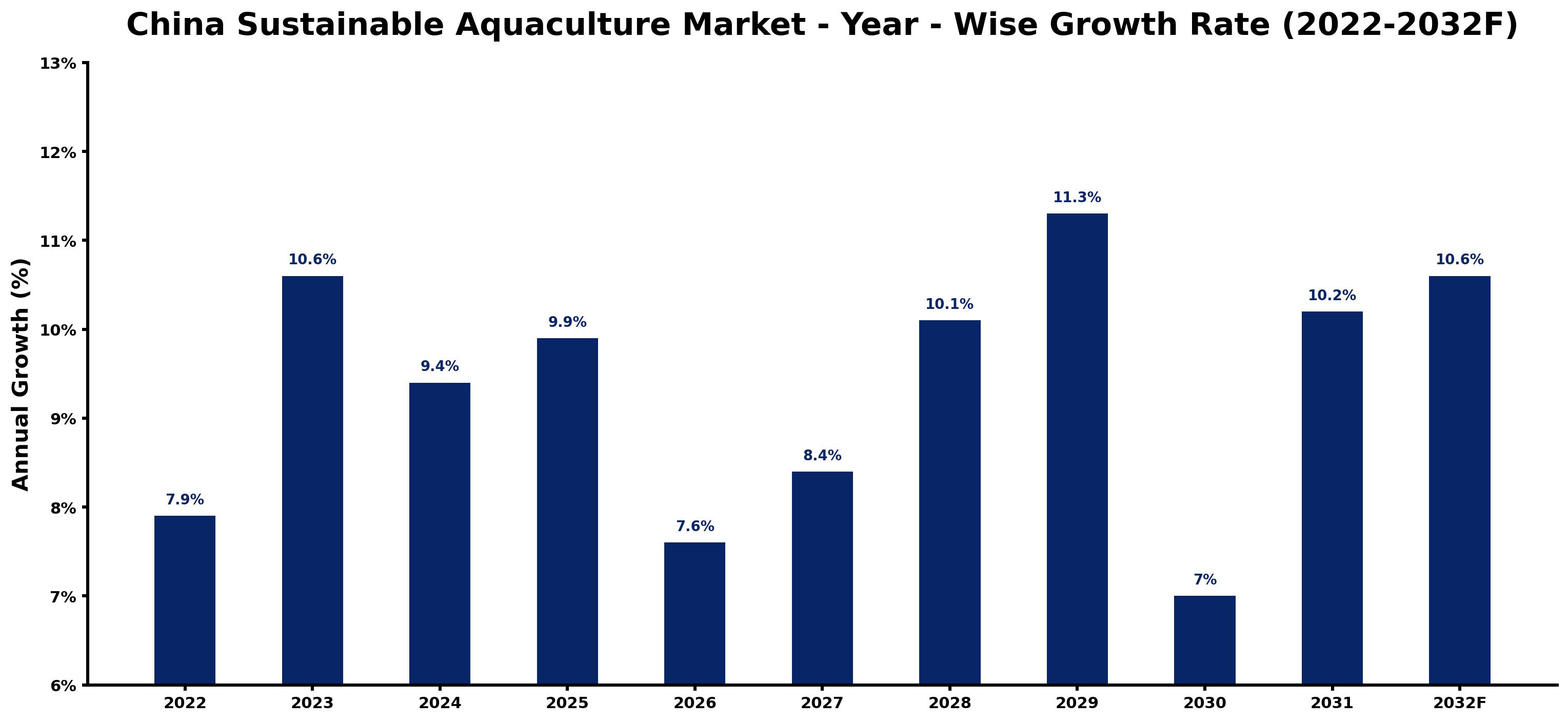
Annual growth estimates for each year appear below with the principal reason behind them, explaining the shifts that set the pace of the market.
| Year | Estimated Annual Growth (%) | Market Rationale |
| 2022 | 7.9 | The market experienced steady growth due to the Aquaculture Green Development Action Plan promoting sustainable practices. |
| 2023 | 10.6 | Increased consumer awareness about sustainability drove faster growth in aquaculture practices, particularly for organic products. |
| 2024 | 9.4 | The growth rate slowed as producers adjusted to the revised National Standard for Organic Aquaculture implemented in 2022. |
| 2025 | 9.9 | Demand for organic aquaculture products rose, boosting growth rates once again as urban initiatives expanded. |
| 2026 | 7.6 | The market is expected to see a slowdown as producers face challenges in integrating advanced technologies. |
| 2027 | 8.4 | Growth is projected to pick up as integrated multi-trophic systems gain popularity among coastal farms. |
| 2028 | 10.1 | The market is expected to expand further due to rising urban aquaculture initiatives in major cities. |
| 2029 | 11.3 | The peak growth rate is projected as investments in sustainable practices surge, driven by government support. |
| 2030 | 7.0 | A slowdown is expected as the market adjusts to new regulatory changes and environmental measures. |
| 2031 | 10.2 | Growth is expected to accelerate again with increased exports of sustainable seafood products. |
| 2032 | 10.6 | The market is projected to maintain strong growth as organic aquaculture production targets are met. |
Note: Market size estimations and growth projections presented in this report are based on 6Wresearch's proprietary forecasting methodology, utilizing the latest available industry data, government publications, and primary research inputs.
China Sustainable Aquaculture Market Synopsis
Sustainable Aquaculture in China refers to farming aquatic organisms with minimal environmental impact. This includes practices such as recirculating systems and integrated multi-trophic aquaculture, primarily for fish and seafood production. The China Sustainable Aquaculture Market is expanding due to rising domestic consumption and export demand. In 2022, aquaculture production reached 66 million tons, with notable contributions from coastal provinces. The government's Green Development Strategy aims to increase organic aquaculture production by 20% by 2025, further driving market growth.
Market Dynamics Impact Analysis (2026–2032)
| Factor | Type | Impact | Primary Segment Affected |
| Rising domestic demand for sustainable seafood products drives growth. | Driver | High | Organic Feed |
| Urban aquaculture initiatives are expanding rapidly in major cities. | Driver | High | Urban Fish Farms |
| Investment in aquaculture technology innovation presents new opportunities. | Opportunity | High | Recirculating Aquaculture |
| Growing interest in eco-friendly practices creates market openings. | Opportunity | Medium | Integrated Multi-Trophic |
| Challenges in implementing advanced technologies limit growth. | Restraint | High | Cage-Free Systems |
| Strict regulations on environmental impact may hinder production. | Restraint | Medium | Biofloc Technology |
| The Sustainable Aquaculture market in China faces significant regulatory hurdles. | Challenge | High | Water Recycling |
| Limited access to funding for small-scale farmers restricts growth potential. | Challenge | Medium | Fish Exporters |
Evaluation of Drivers in China Sustainable Aquaculture Market (2026–2032)
The table below links each growth driver to the segment it affects and the evidence for it.
| Drivers | Primary Segment Affected | Why It Matters (Evidence) |
| Increased consumer demand for sustainable seafood products drives purchases. | Organic Feed | The use of organic feed has increased by 25% in the last five years, reflecting consumer preferences. |
| Urban aquaculture initiatives are expanding, increasing local supply. | Urban Fish Farms | Urban aquaculture initiatives have increased by 30% in major cities like Shanghai and Beijing since 2021. |
| Government support for sustainable practices encourages investment. | Recirculating Aquaculture | The Aquaculture Technology Innovation Program was established with a budget of $50 million to support research. |
| Integrated Multi-Trophic systems improve ecosystem balance and attract buyers. | Integrated Multi-Trophic | Over 15% of coastal farms have adopted Integrated Multi-Trophic Aquaculture systems in recent years. |
| Rising fish export values boost demand for sustainable practices. | Fish Exporters | China's fish export value reached $4 billion in 2022, with growing demand for sustainable seafood products. |
Growth in the Sustainable Aquaculture market in China comes from rising domestic demand for sustainable seafood products, which has increased in recent years. The use of organic feed has surged by 25% over the last five years, reflecting changing consumer preferences. The adoption of integrated multi-trophic systems by over 15% of coastal farms improves production efficiency and attracts buyers, driving further demand.
Evaluation of Restraints in China Sustainable Aquaculture Market
The following restraints limit how fast demand can grow.
| Market Restraint | Primary Segment Affected | Why It Matters (Evidence) |
| Technological implementation challenges limit production efficiency. | Cage-Free Systems | Producers face difficulties in integrating advanced technologies, which can delay production timelines. |
| Regulatory compliance costs can burden small-scale farmers. | Biofloc Technology | Strict regulations on environmental impact require substantial investment in compliance measures. |
| Limited funding access restricts growth for small aquaculture operations. | Fish Exporters | Many small-scale farmers struggle to secure funding, impacting their ability to scale operations. |
| Environmental regulations may limit the expansion of aquaculture farms. | Water Recycling | New environmental standards can restrict the development of new aquaculture facilities. |
| Market volatility affects pricing stability for aquaculture products. | Organic Feed | Fluctuations in global demand can lead to unpredictable pricing for organic feed supplies. |
China Sustainable Aquaculture Market Challenges
The China Sustainable Aquaculture Market faces intense competition from traditional aquaculture practices that often prioritise yield over environmental sustainability, making it difficult for eco-conscious producers to gain traction. Supply chain inefficiencies pose another challenge; for instance, delays in sourcing organic feed can extend production times by up to 15%, impacting farmers' profitability. A lack of skilled workers in sustainable practices further complicates these issues, as approximately 3 million fish farmers struggle without adequate training, limiting their operational capabilities. Buyers are increasingly demanding sustainable seafood, but the current supply falls short, risking revenue losses for producers who cannot meet these expectations.
Trends in the China Sustainable Aquaculture Market
Buyers and suppliers in the China Sustainable Aquaculture Market are adjusting to the following trends.
- Shift towards Urban Aquaculture: Since 2021, urban aquaculture initiatives in cities like Shanghai have increased by 30%, reflecting a growing trend in sustainable food production. This shift allows for local sourcing of seafood, reducing transportation costs and environmental impact.
- Adoption of Integrated Multi-Trophic Systems: The adoption of Integrated Multi-Trophic Aquaculture systems has been embraced by over 15% of coastal farms, improving production efficiency. This shift supports biodiversity and enhances overall sustainability in aquaculture practices.
- Emergence of Organic Feed in Aquaculture: Water Recycling has become a priority for aquaculture farms, with a 39% market share expected by 2025. This focus on resource conservation is essential for sustainable practices and environmental protection.
- Increased Focus on Disease Control: Disease control measures have improved, reducing mortality rates in aquaculture by 10% in recent years. This focus on health management is critical for sustaining production levels.
Investment Opportunities in the China Sustainable Aquaculture Market
Several openings in the China Sustainable Aquaculture Market merit attention from investors.
- Investment in Aquaculture Technology Innovation: The Aquaculture Technology Innovation Program, with a budget of $50 million, presents a timely opportunity for investment in sustainable aquaculture technologies. This funding supports research and development, particularly for coastal farms.
- Growth of Urban Fish Farms: Urban areas like Shanghai are seeing a 30% increase in aquaculture initiatives, creating opportunities for suppliers of sustainable farming equipment. Entering this market could involve partnerships with local governments or organizations.
- Rising Demand for Organic Aquaculture Products: With a target to increase organic aquaculture production by 20% by 2025, there is a notable opportunity for suppliers of organic feed and sustainable farming practices. Collaborating with local producers can facilitate market entry.
- Development of Integrated Multi-Trophic Systems: The rise of Integrated Multi-Trophic Aquaculture systems offers a chance to invest in eco-friendly farming solutions. Engaging with coastal farms adopting these systems can yield profitable partnerships.
Government Initiatives in the China Sustainable Aquaculture Market
The Aquaculture Green Development Action Plan, launched in 2021, aims to improve sustainability and reduce environmental impacts in aquaculture practices. The National Standard for Organic Aquaculture was revised in 2022 by the Ministry of Agriculture, establishing stricter guidelines for organic feed and farming practices. The Aquaculture Technology Innovation Program was established in 2022 with a budget of $50 million to support research and development in sustainable aquaculture technologies. These measures encourage farmers to adopt sustainable methods and improve production efficiency, ensuring compliance with environmental regulations.
The National Fishery Administration oversees the implementation of the Sustainable Aquaculture Development Strategy 2020-2025, promoting eco-friendly practices across the industry. The Aquaculture Association of China provides training and resources for sustainable aquaculture practices, helping farmers meet the new standards. This support enables buyers to access sustainably sourced seafood, aligning with consumer demand for environmentally friendly products.
Future Insight of the China Sustainable Aquaculture Market
The China Sustainable Aquaculture Market is set to evolve significantly by 2032, driven by government policies and heightened consumer awareness. The National Standard for Sustainable Aquaculture will enforce stricter environmental guidelines, encouraging more farms to adopt eco-friendly methods. Urban aquaculture initiatives are expected to grow, particularly in major cities like Beijing, where demand for sustainable practices is rising. By 2025, the government aims to increase the area of sustainable aquaculture farms by 15%, reflecting a commitment to responsible food production for the nation.
Market Segmentation Analysis
Each segment group is reviewed below, with the leader by share and the fastest grower by CAGR.
By Aquaculture Type – Recirculating Aquaculture Dominated, Integrated Multi-Trophic Expected to Grow Fastest
According to Sumit Sagar, AM at 6Wresearch, Recirculating Aquaculture accounted for a 41% market share by aquaculture type in 2025. Recirculating aquaculture commands the largest market share due to its efficient water use and waste reduction, appealing significantly to fish farmers. Its implementation in coastal provinces like Guangdong and Shandong showcases its widespread adoption among aquaculture facilities. Integrated Multi-Trophic is projected to grow fastest, at a CAGR of 10.3% during 2026–2032. Integrated multi-trophic aquaculture is rapidly growing as it enhances ecosystem balance by using multiple species, increasingly recognised for its sustainability. Statistics indicate that over 15% of coastal farms have adopted these systems, marking a shift towards more sustainable practices. This trend suggests that suppliers should focus on developing technologies that support recirculating systems while buyers may benefit from investing in integrated multi-trophic practices.
By Feed Type – Organic Feed Dominated and Is Expected to Record the Fastest Growth
The largest feed type category in 2025 was Organic Feed, with a 41% share of total revenue. Organic feed leads the market share as it supports health and sustainability in aquaculture, resonating with consumer preferences for environmentally friendly products. The 25% increase in organic feed usage over the last five years underscores its strong market position. Its lead should widen, with a projected CAGR of 10.9% during 2026–2032, the highest in this split. Organic feed is also the fastest-growing segment, propelled by rising consumer demand for sustainable seafood products. Its dual role as both leader and fastest indicates that the market for organic feed will continue to expand significantly in the coming years. This scenario presents an opportunity for suppliers to innovate in organic feed production while buyers should prioritise sourcing sustainable feed options.
By Environment Focus – Water Recycling Dominated, Nutrient Reuse Expected to Grow Fastest
Water Recycling took a 39% share of environment focus in 2025, more than any other category. Water recycling holds the largest market share as it is crucial for resource conservation in aquaculture, essential for sustainable practices. The government's focus on enhancing environmental protection measures has further solidified its importance in the industry. Over 2026–2032, Nutrient Reuse is expected to post the fastest growth, at a CAGR of 11.6%. Nutrient reuse is the fastest-growing segment, as it supports sustainable practices by recycling waste, thereby reducing environmental impact. The increasing emphasis on sustainability in aquaculture is expected to drive further adoption of nutrient reuse techniques. Suppliers should invest in technologies that promote water recycling and nutrient reuse, while buyers can enhance their sustainability credentials by adopting these practices.
By End User – Fish Exporters Dominated, Urban Fish Farms Expected to Grow Fastest
With a 42% revenue share in 2025, Fish Exporters was the largest end user category. Fish exporters capture the largest market share as key players in the sustainable seafood market, driving demand for responsibly sourced products. Their pivotal role in connecting aquaculture producers with international markets underscores their significance in the supply chain. Urban Fish Farms are set to record the highest CAGR in this split, 11.8% over 2026–2032. Urban fish farms represent the fastest-growing segment, reflecting an emerging trend in sustainable food production in major cities. The 30% increase in urban aquaculture initiatives since 2021 highlights the shift towards localised, sustainable seafood solutions. This indicates that suppliers should target urban fish farms with tailored solutions, while buyers may find new opportunities in sourcing from these innovative urban aquaculture setups.
Key Attractiveness of the Report
- 10 Years of Market Numbers
- Historical Data Starting from 2022 to 2025
- Base Year 2025
- Forecast Data until 2032
- Key Performance Indicators Impacting the Market
- Major Upcoming Developments and Projects
Key Highlights of the Report:
- China Sustainable Aquaculture Market Outlook
- Market Size of China Sustainable Aquaculture Market, 2025
- Forecast of China Sustainable Aquaculture Market, 2032
- Historical Data and Forecast of China Sustainable Aquaculture Revenues & Volume for the Period 2022 - 2032F
- China Sustainable Aquaculture Market Trend Evolution
- China Sustainable Aquaculture Market Drivers and Challenges
- China Sustainable Aquaculture Price Trends
- China Sustainable Aquaculture Porter's Five Forces
- China Sustainable Aquaculture Industry Life Cycle
- Historical Data and Forecast of China Sustainable Aquaculture Market Revenues & Volume By Aquaculture Type for the Period 2022 - 2032F
- Historical Data and Forecast of China Sustainable Aquaculture Market Revenues & Volume By Recirculating Aquaculture for the Period 2022 - 2032F
- Historical Data and Forecast of China Sustainable Aquaculture Market Revenues & Volume By Integrated Multi-Trophic for the Period 2022 - 2032F
- Historical Data and Forecast of China Sustainable Aquaculture Market Revenues & Volume By Cage-Free Systems for the Period 2022 - 2032F
- Historical Data and Forecast of China Sustainable Aquaculture Market Revenues & Volume By Biofloc Technology for the Period 2022 - 2032F
- Historical Data and Forecast of China Sustainable Aquaculture Market Revenues & Volume By Feed Type for the Period 2022 - 2032F
- Historical Data and Forecast of China Sustainable Aquaculture Market Revenues & Volume By Organic Feed for the Period 2022 - 2032F
- Historical Data and Forecast of China Sustainable Aquaculture Market Revenues & Volume By Algae, Shellfish Systems for the Period 2022 - 2032F
- Historical Data and Forecast of China Sustainable Aquaculture Market Revenues & Volume By Natural Conditions for the Period 2022 - 2032F
- Historical Data and Forecast of China Sustainable Aquaculture Market Revenues & Volume By Minimal Waste for the Period 2022 - 2032F
- Historical Data and Forecast of China Sustainable Aquaculture Market Revenues & Volume By Environment Focus for the Period 2022 - 2032F
- Historical Data and Forecast of China Sustainable Aquaculture Market Revenues & Volume By Water Recycling for the Period 2022 - 2032F
- Historical Data and Forecast of China Sustainable Aquaculture Market Revenues & Volume By Nutrient Reuse for the Period 2022 - 2032F
- Historical Data and Forecast of China Sustainable Aquaculture Market Revenues & Volume By Biodiversity Protection for the Period 2022 - 2032F
- Historical Data and Forecast of China Sustainable Aquaculture Market Revenues & Volume By Disease Control for the Period 2022 - 2032F
- Historical Data and Forecast of China Sustainable Aquaculture Market Revenues & Volume By End User for the Period 2022 - 2032F
- Historical Data and Forecast of China Sustainable Aquaculture Market Revenues & Volume By Fish Exporters for the Period 2022 - 2032F
- Historical Data and Forecast of China Sustainable Aquaculture Market Revenues & Volume By Coastal Aquaculture Farms for the Period 2022 - 2032F
- Historical Data and Forecast of China Sustainable Aquaculture Market Revenues & Volume By Green Label Seafood Brands for the Period 2022 - 2032F
- Historical Data and Forecast of China Sustainable Aquaculture Market Revenues & Volume By Urban Fish Farms for the Period 2022 - 2032F
- China Sustainable Aquaculture Import Export Trade Statistics
- Market Opportunity Assessment By Aquaculture Type
- Market Opportunity Assessment By Feed Type
- Market Opportunity Assessment By Environment Focus
- Market Opportunity Assessment By End User
- China Sustainable Aquaculture Top Companies Market Share
- China Sustainable Aquaculture Competitive Benchmarking By Technical and Operational Parameters
- China Sustainable Aquaculture Company Profiles
- China Sustainable Aquaculture Key Strategic Recommendations
Market Covered
The report offers an extensive study of the following market segments.
By Aquaculture Type
- Recirculating Aquaculture
- Integrated Multi-Trophic
- Cage-Free Systems
- Biofloc Technology
By Feed Type
- Organic Feed
- Algae
- Shellfish Systems
- Natural Conditions
- Minimal Waste
By Environment Focus
- Water Recycling
- Nutrient Reuse
- Biodiversity Protection
- Disease Control
By End User
- Fish Exporters
- Coastal Aquaculture Farms
- Green Label Seafood Brands
- Urban Fish Farms































