India Sustainable Feminine Hygiene Market Size & Growth Rate
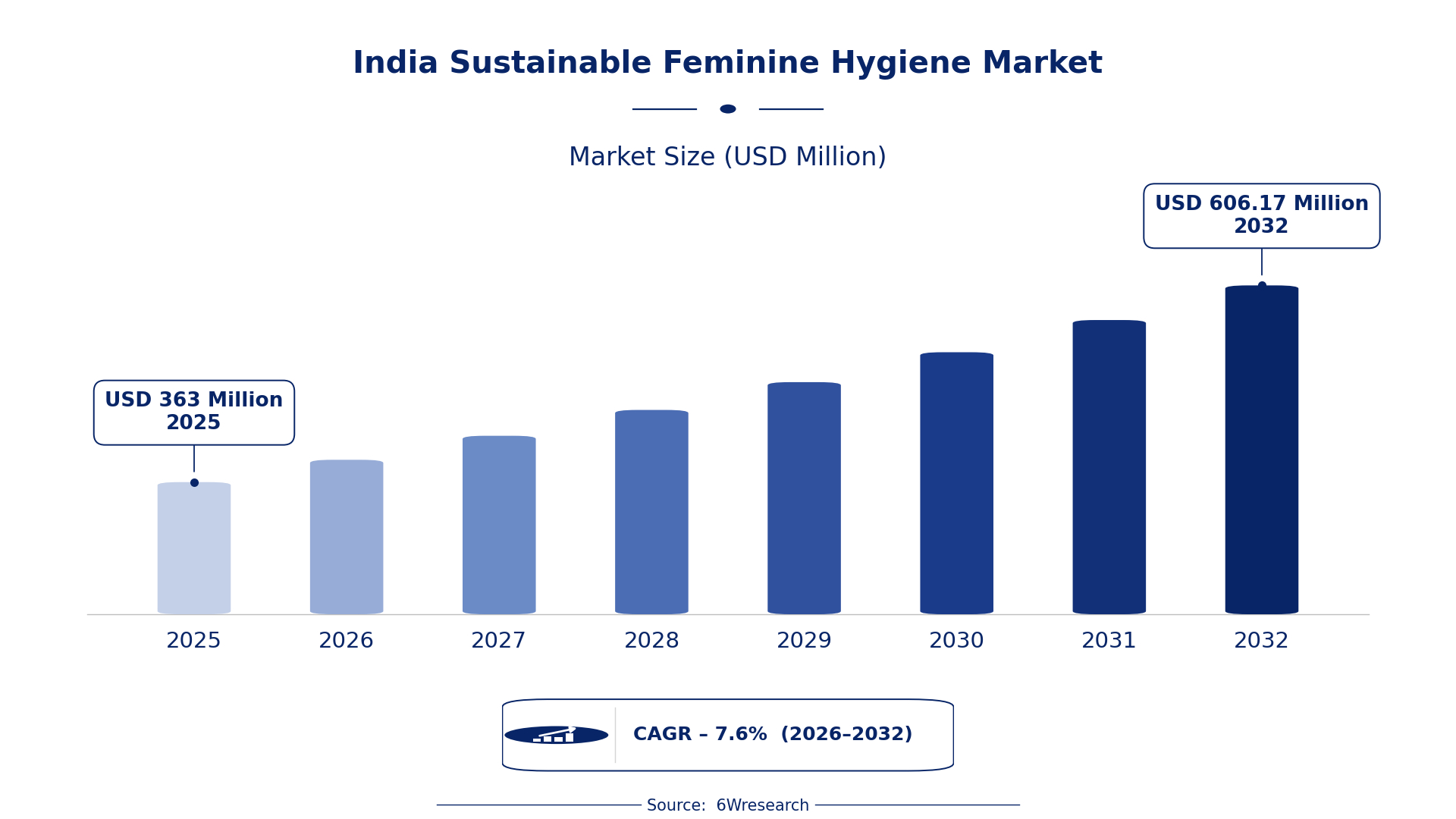
According to 6Wresearch internal database and industry insights, the India Sustainable Feminine Hygiene Market was valued at USD 363.0 million in 2025 and is projected to reach USD 606.17 million by 2032, growing at a CAGR of approximately 7.6% during 2026–2032.
India Sustainable Feminine Hygiene Market Highlights
| Report Metric | Details |
| Report Name | India Sustainable Feminine Hygiene Market |
| Market Size 2025 | USD 363.0 million |
| Market Size 2032 | USD 606.17 million |
| Absolute Growth 2025–2032 | USD 243.17 million |
| CAGR 2026–2032 | 7.6% |
| Peak Annual Growth | 9.8% in 2026 |
| Forecast Period | 2026–2032 |
| Historical Data | 2022–2025 |
| Base Year | 2025 |
| Leading Product Type, 2025 | Organic Cotton Pads (40% share) |
| Leading Material Type, 2025 | Biodegradable Cotton (36% share) |
| Leading Disposal Method, 2025 | Compostable (53% share) |
| Leading End User, 2025 | Retail Chains (42% share) |
| Fastest-Growing Product Type | Period Underwear (10.2% CAGR) |
| Fastest-Growing Disposal Method | Reusable (5+ yrs) (8.7% CAGR) |
| Fastest-Growing End User | Zero-Waste Shoppers (10.2% CAGR) |
| Growing Sector | Retail Chains |
| Key End Users | Zero-Waste Shoppers, Sustainable Brands, Organic Hygiene Brands |
India Sustainable Feminine Hygiene Market Year-wise Growth Rate and Key Drivers (2022–2032)
This graph illustrates the annual growth rates of the market from 2022 to 2032, highlighting a steady upward trajectory and projected market expansion over the forecast period.
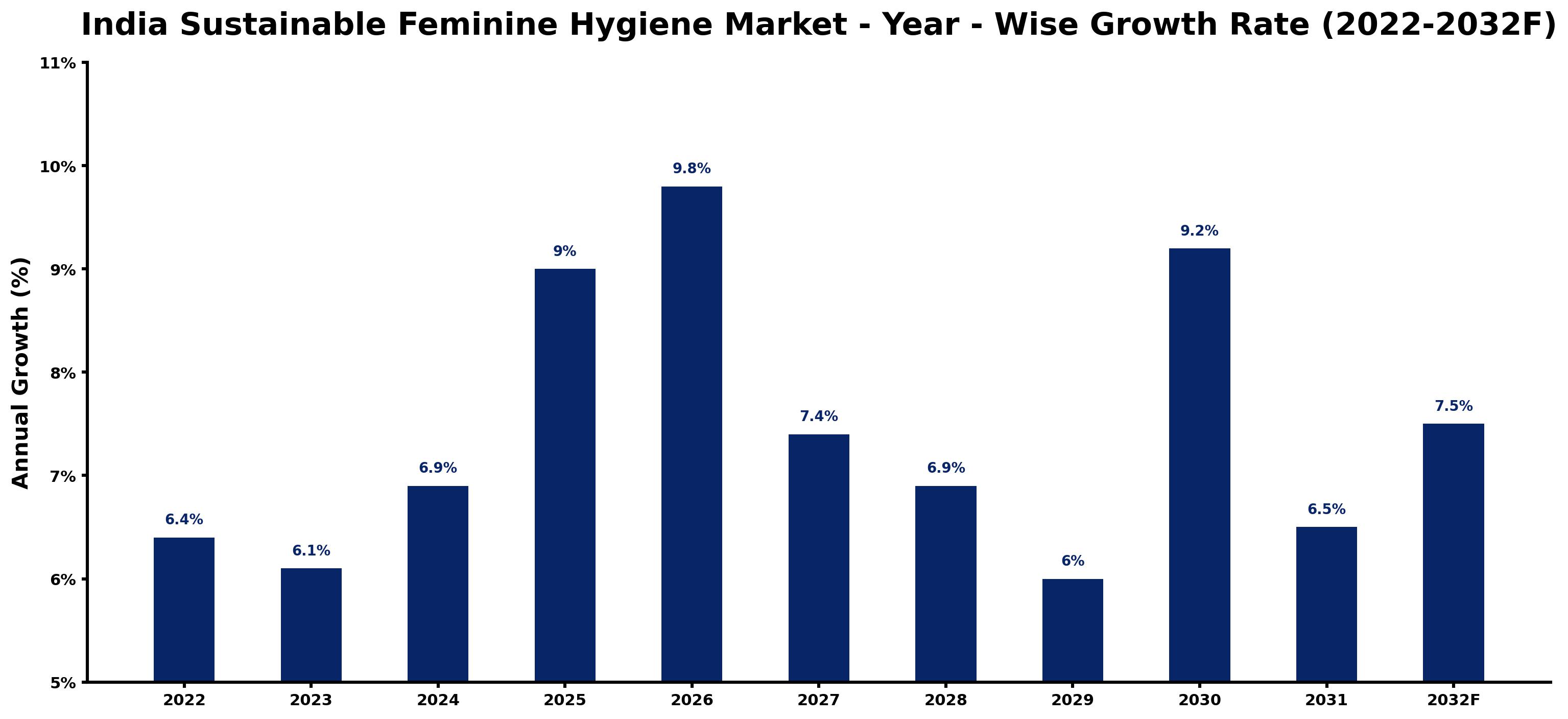
The table below sets out the estimated growth rate for each year and the main factor behind it.
| Year | Estimated Annual Growth (%) | Market Rationale |
| 2022 | 6.4 | The market experienced steady demand as awareness of sustainable options grew among consumers. |
| 2023 | 6.1 | Growth slowed slightly due to economic factors affecting consumer spending on sustainable products. |
| 2024 | 6.9 | Increased marketing efforts for sustainable feminine hygiene products boosted demand among urban women. |
| 2025 | 9.0 | The market saw accelerated growth as retail chains expanded their sustainable product offerings. |
| 2026 | 9.8 | Consumer interest surged, driven by the popularity of period underwear and reusable menstrual cups. |
| 2027 | 7.4 | Growth slowed as competition increased among brands offering similar sustainable products. |
| 2028 | 6.9 | Demand remained steady as zero-waste lifestyle movements continued to influence consumer choices. |
| 2029 | 6.0 | A slowdown occurred as market saturation began to affect growth rates in urban areas. |
| 2030 | 9.2 | Growth rebounded as new products entered the market, attracting environmentally conscious consumers. |
| 2031 | 6.5 | The market experienced a slowdown due to rising prices of sustainable materials affecting production. |
| 2032 | 7.5 | Growth accelerated again as government initiatives further promoted menstrual health and hygiene. |
Note: Market size estimations and growth projections presented in this report are based on 6Wresearch's proprietary forecasting methodology, utilizing the latest available industry data, government publications, and primary research inputs.
India Sustainable Feminine Hygiene Market Synopsis
Sustainable Feminine Hygiene Market in India includes eco-friendly menstrual products crafted from natural materials. These offerings, such as organic cotton pads and reusable menstrual cups, aim to minimise environmental impact while ensuring hygiene. The market is expanding due to heightened consumer awareness and support from initiatives like the 'Swachh Bharat Mission'. Retail chains are broadening their sustainable product lines to meet the growing demand from environmentally aware consumers.
Market Dynamics Impact Analysis (2026–2032)
| Factor | Type | Impact | Primary Segment Affected |
| Growing awareness and demand for eco-friendly products among consumers. | Driver | High | Organic Cotton Pads |
| Expansion of retail chains offering sustainable feminine hygiene products. | Driver | High | Retail Chains |
| Rising demand for biodegradable materials in urban areas. | Opportunity | High | Biodegradable Cotton |
| Increasing interest in reusable menstrual products among urban women. | Opportunity | High | Reusable Menstrual Cups |
| Higher production costs for sustainable materials affecting pricing. | Restraint | Medium | Period Underwear |
| Limited awareness in rural regions about sustainable options. | Restraint | Medium | Organic Cotton Pads |
| Competition from traditional menstrual products affecting market share. | Challenge | High | Reusable Menstrual Cups |
| Economic fluctuations impacting consumer spending on sustainable products. | Challenge | Medium | Sustainable Brands |
Evaluation of Drivers in India Sustainable Feminine Hygiene Market (2026–2032)
Key forces behind demand, with the segment each one moves most, are listed below.
| Drivers | Primary Segment Affected | Why It Matters (Evidence) |
| Increasing urbanisation leading to higher demand for eco-friendly products. | Reusable Menstrual Cups | Urban women are more likely to adopt reusable products, with a growing market share of 25% in urban areas. |
| Government initiatives promoting menstrual health education. | Organic Cotton Pads | The 'National Policy for Women' aims to improve access to sustainable hygiene products, increasing demand. |
| Rising consumer preference for biodegradable materials. | Biodegradable Cotton | The demand for biodegradable materials is increasing, with urban consumers prioritising sustainable options. |
| Growth of online retail platforms facilitating access to sustainable products. | Period Underwear | Online sales channels have increased accessibility, contributing to a 30% growth in this segment. |
| Participation in sustainability events raising awareness. | Sustainable Brands | Events like 'Sustainable Fashion Week' in 2023 have increased visibility and interest in sustainable products. |
Urban women are increasingly adopting reusable menstrual cups, with a market share of 25% in urban areas. The demand for biodegradable materials is rising, as urban consumers prioritise eco-friendly options. Online retail platforms have facilitated access to period underwear, contributing to a 30% growth in this segment. Participation in sustainability events has raised awareness and interest in eco-friendly products, driving further purchases.
Evaluation of Restraints in India Sustainable Feminine Hygiene Market
The following restraints limit how fast demand can grow.
| Market Restraint | Primary Segment Affected | Why It Matters (Evidence) |
| Higher production costs for sustainable materials affecting pricing. | Period Underwear | Production costs for biodegradable materials have increased by 15%, impacting retail prices. |
| Limited awareness in rural regions about sustainable options. | Organic Cotton Pads | Only 20% of rural menstruators are aware of sustainable feminine hygiene products. |
| Competition from traditional menstrual products affecting market share. | Reusable Menstrual Cups | Traditional products still dominate with a market share of 70%, limiting growth for alternatives. |
| Economic fluctuations impacting consumer spending on sustainable products. | Sustainable Brands | Economic downturns have led to a 10% decrease in discretionary spending on hygiene products. |
| Supply chain challenges for sustainable materials. | Biodegradable Cotton | Logistical issues have delayed deliveries, affecting product availability in retail outlets. |
India Sustainable Feminine Hygiene Market Challenges
The India Sustainable Feminine Hygiene Market encounters several practical issues, with regulatory hurdles being foremost. Compliance with ISO 14001 standards can elevate production costs for manufacturers by up to 20%, ultimately affecting pricing for consumers. Many producers struggle with outdated technology, limiting their capacity to develop advanced biodegradable materials, which delays product launches and hampers competitiveness. Competition remains intense, as traditional menstrual product brands dominate the market, making it challenging for sustainable brands to gain visibility and market share. Buyers often face confusion due to the variety of products available, resulting in indecision and slower purchasing decisions.
Trends in the India Sustainable Feminine Hygiene Market
Four trends stand out in the India Sustainable Feminine Hygiene Market.
- Shift towards Reusable Products: Demand for reusable menstrual cups is increasing, with a market share of 25% among urban women. This trend illustrates a growing preference for options that reduce waste.
- Growth of Online Retail Platforms: Online retail platforms are increasingly promoting period underwear, contributing to a 30% growth in this segment. This shift allows consumers easier access to sustainable products.
- Influence of Zero-Waste Movements: Zero-waste lifestyle movements are shaping consumer behaviour, leading to a surge in demand for sustainable feminine hygiene products. Retail chains are expanding their eco-friendly product lines to meet this demand.
- Government Support for Sustainable Products: The 'Swachh Bharat Mission' is advocating for sustainable menstrual products, particularly in rural areas. This initiative aims to improve hygiene and sanitation, influencing consumer choices.
Investment Opportunities in the India Sustainable Feminine Hygiene Market
The following opportunities in the India Sustainable Feminine Hygiene Market pair current demand with a clear way in.
- Retail Chains Expanding Sustainable Lines: Retail chains are increasingly focusing on sustainable feminine hygiene products, with a projected growth of 40% in this sector. Collaborating with these chains can broaden market reach.
- Growing Demand for Biodegradable Materials: The demand for biodegradable materials is rising, with urban consumers prioritising eco-friendly options. Investing in biodegradable cotton can meet this growing market need.
- Partnerships with NGOs for Awareness Campaigns: Collaborating with NGOs can increase awareness of sustainable feminine hygiene products. This approach targets zero-waste shoppers, a demographic showing a 10% increase in interest.
- Expansion into Rural Markets: With only 20% awareness of sustainable options in rural areas, there is an opportunity for market entry. Local partnerships can facilitate distribution and education.
Government Initiatives in the India Sustainable Feminine Hygiene Market
The 'National Policy for Women' (2021) by the Ministry of Women and Child Development aims to improve menstrual hygiene management across India, focusing on accessibility and sustainability. This policy encourages the production and distribution of sustainable feminine hygiene products, ensuring that more women have access to eco-friendly options. Additionally, the 'Swachh Bharat Mission' (2014, updated 2020) promotes sanitation and hygiene, including sustainable menstrual products, particularly in rural areas, enhancing awareness and availability.
The 'Atmanirbhar Bharat Abhiyan' (2020) encourages local production of sustainable hygiene products through various subsidies and support schemes. The Ministry of Women and Child Development oversees these initiatives, aiming to boost local manufacturing and reduce dependency on imports. Furthermore, the 'National Health Mission' (2013, updated 2020) includes initiatives for menstrual health awareness and access to sustainable products, funding educational campaigns and distribution efforts.
Future Insight of the India Sustainable Feminine Hygiene Market
The India Sustainable Feminine Hygiene Market is set to evolve by 2032, influenced by several key factors. Increased government backing for menstrual health education will boost awareness and adoption of eco-friendly products. The expansion of online retail platforms will provide urban consumers with easier access to sustainable feminine hygiene options. As more brands engage in sustainability-focused events, consumer trust in eco-friendly products will likely strengthen. By 2032, the demand for biodegradable materials is expected to rise significantly, reflecting a shift in consumer preferences towards environmentally responsible choices.
Market Segmentation Analysis
The report offers a comprehensive study of the following market segments and their leading categories in the market.
By Product Type – Organic Cotton Pads Dominated, Period Underwear Expected to Grow Fastest
According to Sumit Sagar, AM at 6Wresearch, Organic Cotton Pads took a 40% share of product type in 2025, more than any other category. Organic cotton pads dominate the market share as they are directly utilised for menstrual hygiene management, appealing to a large base of environmentally conscious consumers. Their popularity is particularly pronounced in urban regions where the demand for sustainable options continues to grow. Period Underwear is set to record the highest CAGR in this split, 10.2% over 2026–2032. Period underwear is rapidly gaining traction due to its comfort and sustainability, especially among urban women. The effective marketing strategies employed through online retail platforms are driving this segment's impressive growth. Suppliers should consider expanding their offerings to include period underwear to capture the increasing market share.
By Material Type – Biodegradable Cotton Dominated and Is Expected to Record the Fastest Growth
The largest material type category in 2025 was Biodegradable Cotton, with a 36% share of total revenue. Biodegradable cotton holds the largest market share as it serves as a fundamental material in various sustainable hygiene products, appealing to consumers focused on eco-friendly choices. Its established presence is further strengthened by the rising demand for biodegradable materials across the sector. Its lead should widen, with a projected CAGR of 9.5% during 2026–2032, the highest in this split. Biodegradable cotton is also the fastest-growing material type, benefiting from its versatility and alignment with sustainable practices. The ongoing emphasis on eco-friendly products ensures its robust growth trajectory, reinforcing its market position. Manufacturers must prioritise biodegradable cotton to meet the increasing consumer demand for sustainable materials.
By Disposal Method – Compostable Dominated, Reusable (5+ yrs) Expected to Grow Fastest
Compostable held a 53% share of the India Sustainable Feminine Hygiene Market by disposal method in 2025. Compostable products lead the market as they are a key feature of many sustainable feminine hygiene items, resonating with the zero-waste lifestyle trends. Their appeal is particularly strong among environmentally conscious consumers aiming to minimise their ecological footprint. Reusable (5+ yrs) is projected to grow fastest, at a CAGR of 8.7% during 2026–2032. Reusable products, designed to last over five years, are the fastest-growing disposal method as they significantly contribute to waste reduction and promote sustainability. The rising consumer awareness around waste management practices is driving this segment's growth. Suppliers should invest in developing reusable product lines to leverage the expanding market share of eco-friendly disposal methods.
By End User – Retail Chains Dominated, Zero-Waste Shoppers Expected to Grow Fastest
Retail Chains accounted for a 42% market share by end user in 2025. Retail chains represent the largest share of the market as they serve as the major distribution channel for sustainable products, making them accessible to a broad audience. Their commitment to expanding sustainable product lines reflects the growing consumer demand. Over 2026–2032, Zero-Waste Shoppers are expected to post the fastest growth, at a CAGR of 10.2%. Zero-waste shoppers are the fastest-growing end user group, driven by their commitment to sustainable living and reducing waste. This demographic's increasing influence on purchasing decisions indicates a shift towards more eco-conscious consumer behaviour. Retailers must focus on catering to zero-waste shoppers to capture the expanding market share in sustainable feminine hygiene.
Key Attractiveness of the Report
- 10 Years of Market Numbers
- Historical Data Starting from 2022 to 2025
- Base Year 2025
- Forecast Data until 2032
- Key Performance Indicators Impacting the Market
- Major Upcoming Developments and Projects
Key Highlights of the Report:
- India Sustainable Feminine Hygiene Market Outlook
- Market Size of India Sustainable Feminine Hygiene Market, 2025
- Forecast of India Sustainable Feminine Hygiene Market, 2032
- Historical Data and Forecast of India Sustainable Feminine Hygiene Revenues & Volume for the Period 2022 - 2032F
- India Sustainable Feminine Hygiene Market Trend Evolution
- India Sustainable Feminine Hygiene Market Drivers and Challenges
- India Sustainable Feminine Hygiene Price Trends
- India Sustainable Feminine Hygiene Porter's Five Forces
- India Sustainable Feminine Hygiene Industry Life Cycle
- Historical Data and Forecast of India Sustainable Feminine Hygiene Market Revenues & Volume By Product Type for the Period 2022 - 2032F
- Historical Data and Forecast of India Sustainable Feminine Hygiene Market Revenues & Volume By Organic Cotton Pads for the Period 2022 - 2032F
- Historical Data and Forecast of India Sustainable Feminine Hygiene Market Revenues & Volume By Reusable Menstrual Cups for the Period 2022 - 2032F
- Historical Data and Forecast of India Sustainable Feminine Hygiene Market Revenues & Volume By Period Underwear for the Period 2022 - 2032F
- Historical Data and Forecast of India Sustainable Feminine Hygiene Market Revenues & Volume By Bioplastic Tampons for the Period 2022 - 2032F
- Historical Data and Forecast of India Sustainable Feminine Hygiene Market Revenues & Volume By Material Type for the Period 2022 - 2032F
- Historical Data and Forecast of India Sustainable Feminine Hygiene Market Revenues & Volume By Biodegradable Cotton for the Period 2022 - 2032F
- Historical Data and Forecast of India Sustainable Feminine Hygiene Market Revenues & Volume By Medical Grade Silicone for the Period 2022 - 2032F
- Historical Data and Forecast of India Sustainable Feminine Hygiene Market Revenues & Volume By Bamboo/Cotton Blend for the Period 2022 - 2032F
- Historical Data and Forecast of India Sustainable Feminine Hygiene Market Revenues & Volume By PLA Applicators for the Period 2022 - 2032F
- Historical Data and Forecast of India Sustainable Feminine Hygiene Market Revenues & Volume By Disposal Method for the Period 2022 - 2032F
- Historical Data and Forecast of India Sustainable Feminine Hygiene Market Revenues & Volume By Compostable for the Period 2022 - 2032F
- Historical Data and Forecast of India Sustainable Feminine Hygiene Market Revenues & Volume By Reusable (5+ yrs) for the Period 2022 - 2032F
- Historical Data and Forecast of India Sustainable Feminine Hygiene Market Revenues & Volume By Washable for the Period 2022 - 2032F
- Historical Data and Forecast of India Sustainable Feminine Hygiene Market Revenues & Volume By Flushable/Biodegradable for the Period 2022 - 2032F
- Historical Data and Forecast of India Sustainable Feminine Hygiene Market Revenues & Volume By End User for the Period 2022 - 2032F
- Historical Data and Forecast of India Sustainable Feminine Hygiene Market Revenues & Volume By Retail Chains for the Period 2022 - 2032F
- Historical Data and Forecast of India Sustainable Feminine Hygiene Market Revenues & Volume By Zero-Waste Shoppers for the Period 2022 - 2032F
- Historical Data and Forecast of India Sustainable Feminine Hygiene Market Revenues & Volume By Sustainable Brands for the Period 2022 - 2032F
- Historical Data and Forecast of India Sustainable Feminine Hygiene Market Revenues & Volume By Organic Hygiene Brands for the Period 2022 - 2032F
- India Sustainable Feminine Hygiene Import Export Trade Statistics
- Market Opportunity Assessment By Product Type
- Market Opportunity Assessment By Material Type
- Market Opportunity Assessment By Disposal Method
- Market Opportunity Assessment By End User
- India Sustainable Feminine Hygiene Top Companies Market Share
- India Sustainable Feminine Hygiene Competitive Benchmarking By Technical and Operational Parameters
- India Sustainable Feminine Hygiene Company Profiles
- India Sustainable Feminine Hygiene Key Strategic Recommendations
Market Covered
The report offers an extensive study of the following market segments.
By Product Type
- Organic Cotton Pads
- Reusable Menstrual Cups
- Period Underwear
- Bioplastic Tampons
By Material Type
- Biodegradable Cotton
- Medical Grade Silicone
- Bamboo/Cotton Blend
- PLA Applicators
By Disposal Method
- Compostable
- Reusable (5+ yrs)
- Washable
- Flushable/Biodegradable
By End User
- Retail Chains
- Zero-Waste Shoppers
- Sustainable Brands
- Organic Hygiene Brands































