China Sustainable Feminine Hygiene Market Size & Growth Rate
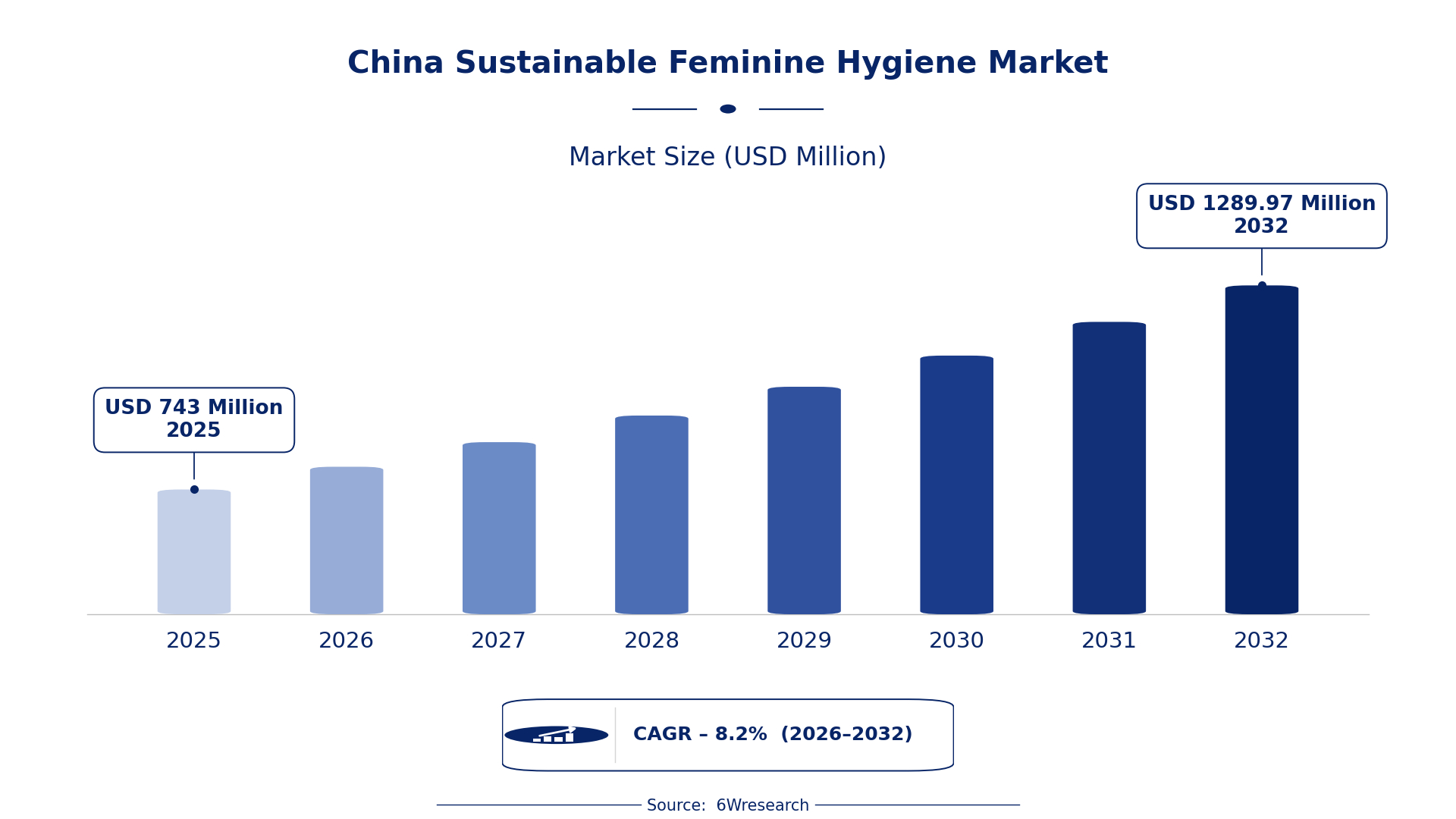
According to 6Wresearch internal database and industry insights, the China Sustainable Feminine Hygiene Market was valued at USD 743.0 million in 2025 and is projected to reach USD 1,289.97 million by 2032, growing at a CAGR of approximately 8.2% during 2026–2032.
China Sustainable Feminine Hygiene Market Highlights
| Report Metric | Details |
| Report Name | China Sustainable Feminine Hygiene Market |
| Market Size 2025 | USD 743.0 million |
| Market Size 2032 | USD 1,289.97 million |
| Absolute Growth 2025–2032 | USD 546.97 million |
| CAGR 2026–2032 | 8.2% |
| Peak Annual Growth | 10.5% in 2029 |
| Forecast Period | 2026–2032 |
| Historical Data | 2022–2025 |
| Base Year | 2025 |
| Leading Product Type, 2025 | Reusable Menstrual Cups (43% share) |
| Leading Material Type, 2025 | Medical Grade Silicone (48% share) |
| Leading Disposal Method, 2025 | Compostable (49% share) |
| Leading End User, 2025 | Retail Chains (47% share) |
| Fastest-Growing Product Type | Period Underwear (10.3% CAGR) |
| Fastest-Growing Material Type | Biodegradable Cotton (9.7% CAGR) |
| Fastest-Growing End User | Zero-Waste Shoppers (10.2% CAGR) |
| Growing Sector | Zero-Waste Shoppers |
| Key End Users | Retail Chains, Sustainable Brands, Zero-Waste Shoppers, Organic Hygiene Brands |
China Sustainable Feminine Hygiene Market Year-wise Growth Rate and Key Drivers (2022–2032)
This graph illustrates the annual growth rates of the market from 2022 to 2032, highlighting a steady upward trajectory and projected market expansion over the forecast period.
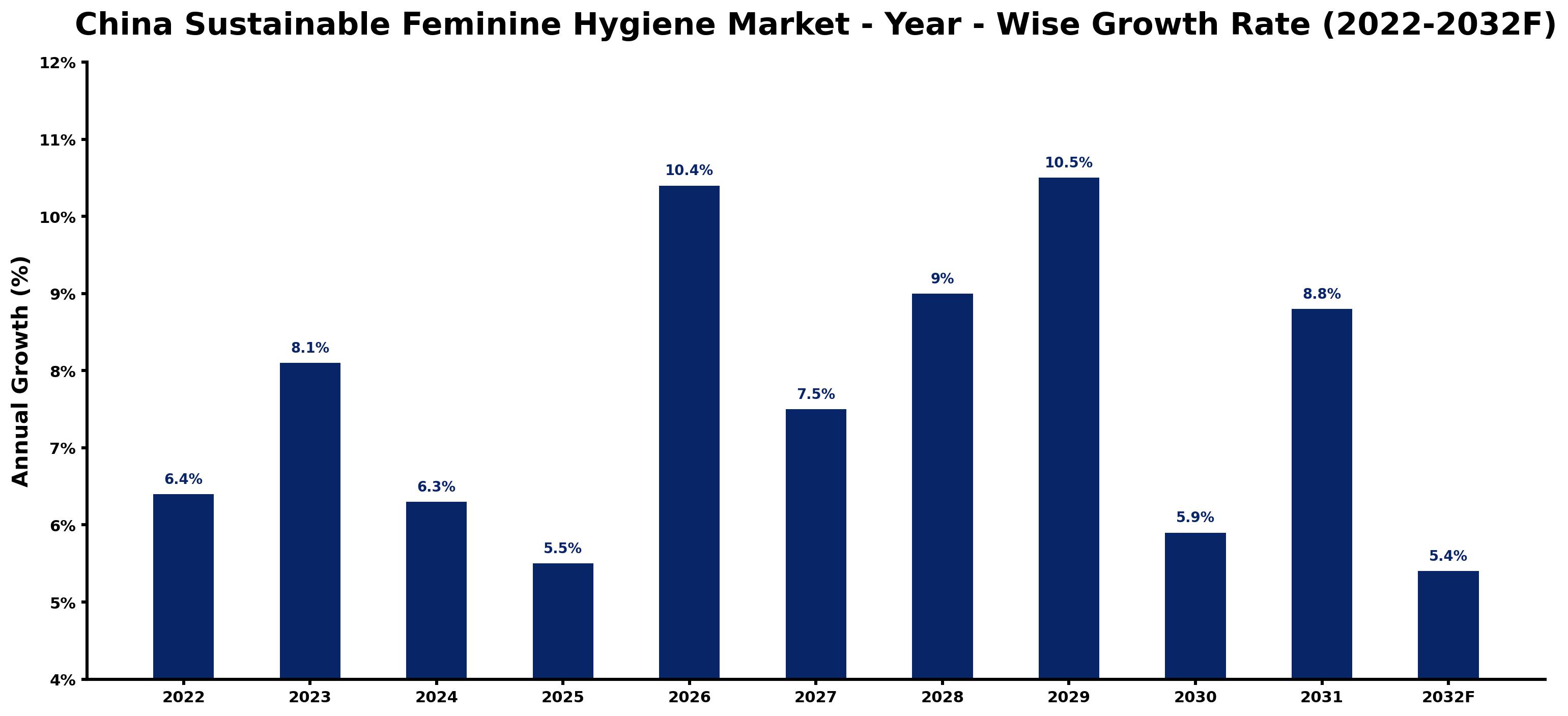
Below, each year's estimated growth is shown next to the factor that most influenced it.
| Year | Estimated Annual Growth (%) | Market Rationale |
| 2022 | 6.4 | The market showed steady interest in sustainable options among consumers. |
| 2023 | 8.1 | Increased awareness of environmental issues drove faster growth compared to 2022. |
| 2024 | 6.3 | Growth slowed as consumer preferences stabilised after the previous year's surge. |
| 2025 | 5.5 | Continued interest in sustainable products maintained market growth, albeit at a slower pace. |
| 2026 | 10.4 | A resurgence in demand for eco-friendly products is expected to lead to faster growth than in 2025 due to the 'Green Consumption Promotion Plan'. |
| 2027 | 7.5 | Market growth is projected to slow as competition intensifies among sustainable brands. |
| 2028 | 9.0 | Rising consumer acceptance of new products is expected to contribute to faster growth, particularly in period underwear. |
| 2029 | 10.5 | The peak growth rate will occur due to heightened awareness and demand for sustainability, driven by the Healthy China 2030 initiative. |
| 2030 | 5.9 | Growth is projected to slow as market maturity sets in and competition increases among retailers. |
| 2031 | 8.8 | Renewed interest in sustainable practices will lead to a faster growth rate than 2030, supported by innovations in biodegradable materials. |
| 2032 | 5.4 | The market continues to grow, but at a slower pace as it approaches saturation, influenced by changing consumer preferences. |
Note: Market size estimations and growth projections presented in this report are based on 6Wresearch's proprietary forecasting methodology, utilizing the latest available industry data, government publications, and primary research inputs.
China Sustainable Feminine Hygiene Market Synopsis
Sustainable Feminine Hygiene in China includes eco-friendly menstrual products made from organic cotton and medical-grade silicone. These products support zero-waste lifestyles and are produced sustainably to reduce environmental impact. The China Sustainable Feminine Hygiene Market is growing due to heightened awareness of environmental issues and increasing health consciousness among consumers. In 2022, the organic cotton market was valued at over 1 billion yuan, highlighting the demand for eco-friendly options. The Zhejiang province acts as a manufacturing hub, facilitating the industry's growth.
Market Dynamics Impact Analysis (2026–2032)
| Factor | Type | Impact | Primary Segment Affected |
| Growing awareness of environmental issues among consumers drives demand for eco-friendly products. | Driver | High | Organic Cotton Pads |
| The increasing popularity of reusable products leads to higher demand for menstrual cups. | Driver | High | Reusable Menstrual Cups |
| The gap in sustainable product offerings creates opportunities for new entrants. | Opportunity | High | Period Underwear |
| The rise of zero-waste shoppers presents a significant market opportunity. | Opportunity | High | Retail Chains |
| Limited consumer knowledge about sustainable options restrains market growth. | Restraint | Medium | Bioplastic Tampons |
| Higher production costs for eco-friendly materials can limit profit margins. | Restraint | Medium | Medical Grade Silicone |
| Regulatory compliance can delay product launches and increase costs. | Challenge | High | Compostable |
| Supply chain disruptions can affect the availability of sustainable materials. | Challenge | Medium | Biodegradable Cotton |
Evaluation of Drivers in China Sustainable Feminine Hygiene Market (2026–2032)
The table below links each growth driver to the segment it affects and the evidence for it.
| Drivers | Primary Segment Affected | Why It Matters (Evidence) |
| Increasing consumer preference for eco-friendly products drives demand for organic cotton pads. | Organic Cotton Pads | In 2022, the organic cotton market in China was valued at over 1 billion yuan, prompting retailers to stock more sustainable options. |
| The popularity of reusable menstrual cups is rising due to their sustainability and cost-effectiveness. | Reusable Menstrual Cups | Research indicates that 60% of young women in urban areas prefer eco-friendly menstrual products, boosting demand. |
| The growing trend towards zero-waste lifestyles increases demand for period underwear. | Period Underwear | The Shanghai International Eco-Friendly Products Expo in 2023 showcased innovations, highlighting consumer interest in sustainable options. |
| The focus on reducing plastic waste encourages the adoption of biodegradable materials. | Bioplastic Tampons | The Ministry of Ecology and Environment aims to reduce plastic waste by 30% by 2025, influencing product development. |
| Retail chains are expanding their sustainable product lines to meet consumer demand. | Retail Chains | The Zhejiang province is a hub for sustainable product manufacturing, supporting retail distribution efforts. |
Market growth in China for Sustainable Feminine Hygiene rests on increasing consumer preference for eco-friendly products, rising demand for organic cotton pads, and the growing trend towards zero-waste lifestyles. In 2022, the organic cotton market was valued at over 1 billion yuan, prompting retailers to stock more sustainable options. Innovations in period underwear are gaining traction as consumers seek sustainable options, with many retailers responding to this trend. The focus on reducing plastic waste is expected to drive further adoption of biodegradable materials among manufacturers. The Zhejiang province's manufacturing capabilities support the expansion of sustainable product lines, creating a favourable environment for growth.
Evaluation of Restraints in China Sustainable Feminine Hygiene Market
The table below lists the restraints and the evidence behind each.
| Market Restraint | Primary Segment Affected | Why It Matters (Evidence) |
| Limited consumer knowledge about sustainable options can hinder market growth. | Bioplastic Tampons | Many consumers remain unaware of the benefits of biodegradable products, leading to lower adoption rates. |
| Higher production costs for eco-friendly materials can limit profit margins. | Medical Grade Silicone | Producers face challenges in sourcing sustainable materials, impacting pricing strategies. |
| Regulatory compliance can delay product launches and increase costs. | Compostable | Manufacturers must adhere to the National Standard for Disposable Sanitary Products, which can slow down the introduction of new products. |
| Supply chain disruptions can affect the availability of sustainable materials. | Biodegradable Cotton | Global supply chain issues have led to shortages, impacting production timelines. |
| Consumer preferences may shift towards cheaper alternatives, affecting market stability. | Reusable Menstrual Cups | Economic factors can lead consumers to prioritise cost over sustainability. |
China Sustainable Feminine Hygiene Market Challenges
The China Sustainable Feminine Hygiene Market encounters a skills shortage, as many manufacturers find it challenging to recruit trained workers knowledgeable about eco-friendly materials. This gap delays the production of sustainable products and raises operational costs for suppliers, ultimately restricting their capacity to meet growing consumer demand. Supply chain issues complicate matters, with disruptions in organic cotton availability leading to a 20% increase in input costs for producers. Technological limitations in manufacturing processes also impede innovation, limiting buyers' access to the latest eco-friendly solutions that align with their values.
Trends in the China Sustainable Feminine Hygiene Market
Buyers and suppliers in the China Sustainable Feminine Hygiene Market are adjusting to the following trends.
- Shift Towards Compostable Products: In 2023, compostable products gained traction as consumers increasingly seek eco-friendly options. The compostable disposal method accounted for 49% market share, reflecting a shift in consumer preferences.
- Rise of Zero-Waste Shoppers: Zero-waste shoppers are becoming a major demographic for sustainable feminine hygiene products. As awareness grows, this buyer group is projected to drive demand, with a CAGR of 10.2% expected by 2032.
- Increase in Reusable Menstrual Products: The period underwear segment is gaining popularity, with a projected CAGR of 10.3% from 2026 to 2032. This trend is driven by the convenience and sustainability of reusable options.
- Regulatory Push for Biodegradable Materials: The 2023 program supports innovation in biodegradable materials for feminine hygiene products. This initiative has a budget of 500 million yuan, promoting sustainable practices.
Investment Opportunities in the China Sustainable Feminine Hygiene Market
Below are the investment opportunities with the strongest case in the China Sustainable Feminine Hygiene Market.
- Gap in Sustainable Product Offerings: With the organic cotton market valued at over 1 billion yuan, there is a gap for new sustainable products. Retail chains are looking to expand their offerings to meet this demand.
- Investment in Eco-Friendly Manufacturing: The Zhejiang province presents opportunities for investment in eco-friendly manufacturing facilities. Companies can enter the market by partnering with local manufacturers to produce sustainable feminine hygiene products.
- Growing Demand from Health-Conscious Consumers: As health consciousness rises, there is a growing opportunity to supply organic hygiene brands with sustainable materials. This buyer group is increasingly prioritising eco-friendly options.
- Support for Innovation in Biodegradable Products: The 2023 initiative encourages investment in biodegradable materials. This presents an opportunity for suppliers to develop new products.
Government Initiatives in the China Sustainable Feminine Hygiene Market
The 'Green Consumption Promotion Plan' launched by the Ministry of Ecology and Environment aims to encourage the use of eco-friendly products, including feminine hygiene items. This initiative targets a 30% increase in adoption by 2025, positively impacting the market. The 'Healthy China 2030' initiative promotes awareness of menstrual health and sustainable hygiene practices, further supporting the industry's growth. The updated National Standard for Disposable Sanitary Products ensures compliance and safety, creating a conducive environment for sustainable feminine hygiene products to thrive in China.
The Ministry of Industry and Information Technology's 2023 program supports innovation in biodegradable materials for feminine hygiene products. This initiative has a budget of 500 million yuan, promoting sustainable practices that benefit manufacturers and consumers alike. The China National Standardization Administration oversees the implementation of these standards, ensuring that products meet safety and environmental compliance, thus enhancing market potential for producers.
Future Insight of the China Sustainable Feminine Hygiene Market
The China Sustainable Feminine Hygiene Market is set for evolution by 2032, driven by multiple forward-looking factors. The government's 'Green Consumption Promotion Plan' will boost consumer awareness and adoption of eco-friendly products. Innovations from events like the Shanghai International Eco-Friendly Products Expo will pave the way for new sustainable solutions. By 2025, the Ministry of Ecology and Environment aims to reduce plastic waste by 30%, prompting suppliers to adopt advanced manufacturing practices that cater to environmentally conscious buyers.
Market Segmentation Analysis
Each segment group is reviewed below, with the leader by share and the fastest grower by CAGR.
By Product Type – Reusable Menstrual Cups Dominated, Period Underwear Expected to Grow Fastest
According to Sumit Sagar, AM at 6Wresearch, with a 43% revenue share in 2025, Reusable Menstrual Cups was the largest product type category. Reusable menstrual cups command the largest market share in China due to their appeal among consumers who value sustainable and cost-effective menstrual solutions. This preference is particularly evident in urban centres, where eco-conscious consumers are increasingly opting for these products. The quickest growth will come from Period Underwear, forecast to expand at a CAGR of 10.3% between 2026 and 2032. Period underwear is experiencing rapid growth as it offers a convenient and eco-friendly alternative for menstrual management, especially favoured by younger consumers. This segment's expansion is propelled by rising awareness of sustainable practices and their associated benefits. Suppliers should focus on enhancing the availability of period underwear to cater to the growing demand from environmentally conscious consumers.
By Material Type – Medical Grade Silicone Dominated, Biodegradable Cotton Expected to Grow Fastest
Medical Grade Silicone held a 48% share of the China Sustainable Feminine Hygiene Market by material type in 2025. Medical grade silicone dominates the market share as it is the preferred material for reusable menstrual cups, ensuring safety and durability. This material's extensive use in sustainable feminine hygiene products reflects its strong acceptance among consumers. Biodegradable Cotton is projected to grow fastest, at a CAGR of 9.7% during 2026–2032. Biodegradable cotton is gaining momentum as a key material for eco-friendly hygiene products, driven by increasing consumer awareness of environmental issues. This growth is supported by initiatives promoting sustainable manufacturing practices in China. Manufacturers should invest in biodegradable cotton to meet the growing consumer demand for sustainable feminine hygiene products.
By Disposal Method – Compostable Dominated and Is Expected to Record the Fastest Growth
Compostable took a 49% share of disposal method in 2025, more than any other category. Compostable disposal methods lead the market as they are a key feature for eco-friendly products, appealing to environmentally conscious consumers. This method aligns with the increasing focus on reducing plastic waste in China. The same category is also set to grow fastest, at a CAGR of 9.6% during 2026–2032. Compostable disposal methods are also the fastest-growing segment, as they resonate with the rising trend of zero-waste lifestyles among consumers. This dual role as leader and fastest indicates a strong alignment with consumer values. Suppliers must ensure that compostable options are readily available to meet the expectations of eco-conscious buyers.
By End User – Retail Chains Dominated, Zero-Waste Shoppers Expected to Grow Fastest
In 2025, Retail Chains led the end user split with a 47% share. Retail chains dominate the market share as they serve as the primary distribution channel for sustainable feminine hygiene products. Their extensive reach ensures that eco-friendly options are readily available to a diverse consumer base across various demographics. Zero-Waste Shoppers are set to record the highest CAGR in this split, 10.2% over 2026–2032. Zero-waste shoppers represent the fastest-growing segment, driven by their strong commitment to sustainability and eco-friendly practices. As this demographic's preference for sustainable products continues to surge, it will significantly influence retail strategies and product offerings. Retailers must adjust their product assortments to attract zero-waste shoppers, ensuring a comprehensive range of sustainable feminine hygiene products.
Key Attractiveness of the Report
- 10 Years of Market Numbers
- Historical Data Starting from 2022 to 2025
- Base Year 2025
- Forecast Data until 2032
- Key Performance Indicators Impacting the Market
- Major Upcoming Developments and Projects
Key Highlights of the Report:
- China Sustainable Feminine Hygiene Market Outlook
- Market Size of China Sustainable Feminine Hygiene Market, 2025
- Forecast of China Sustainable Feminine Hygiene Market, 2032
- Historical Data and Forecast of China Sustainable Feminine Hygiene Revenues & Volume for the Period 2022 - 2032F
- China Sustainable Feminine Hygiene Market Trend Evolution
- China Sustainable Feminine Hygiene Market Drivers and Challenges
- China Sustainable Feminine Hygiene Price Trends
- China Sustainable Feminine Hygiene Porter's Five Forces
- China Sustainable Feminine Hygiene Industry Life Cycle
- Historical Data and Forecast of China Sustainable Feminine Hygiene Market Revenues & Volume By Product Type for the Period 2022 - 2032F
- Historical Data and Forecast of China Sustainable Feminine Hygiene Market Revenues & Volume By Organic Cotton Pads for the Period 2022 - 2032F
- Historical Data and Forecast of China Sustainable Feminine Hygiene Market Revenues & Volume By Reusable Menstrual Cups for the Period 2022 - 2032F
- Historical Data and Forecast of China Sustainable Feminine Hygiene Market Revenues & Volume By Period Underwear for the Period 2022 - 2032F
- Historical Data and Forecast of China Sustainable Feminine Hygiene Market Revenues & Volume By Bioplastic Tampons for the Period 2022 - 2032F
- Historical Data and Forecast of China Sustainable Feminine Hygiene Market Revenues & Volume By Material Type for the Period 2022 - 2032F
- Historical Data and Forecast of China Sustainable Feminine Hygiene Market Revenues & Volume By Biodegradable Cotton for the Period 2022 - 2032F
- Historical Data and Forecast of China Sustainable Feminine Hygiene Market Revenues & Volume By Medical Grade Silicone for the Period 2022 - 2032F
- Historical Data and Forecast of China Sustainable Feminine Hygiene Market Revenues & Volume By Bamboo/Cotton Blend for the Period 2022 - 2032F
- Historical Data and Forecast of China Sustainable Feminine Hygiene Market Revenues & Volume By PLA Applicators for the Period 2022 - 2032F
- Historical Data and Forecast of China Sustainable Feminine Hygiene Market Revenues & Volume By Disposal Method for the Period 2022 - 2032F
- Historical Data and Forecast of China Sustainable Feminine Hygiene Market Revenues & Volume By Compostable for the Period 2022 - 2032F
- Historical Data and Forecast of China Sustainable Feminine Hygiene Market Revenues & Volume By Reusable (5+ yrs) for the Period 2022 - 2032F
- Historical Data and Forecast of China Sustainable Feminine Hygiene Market Revenues & Volume By Washable for the Period 2022 - 2032F
- Historical Data and Forecast of China Sustainable Feminine Hygiene Market Revenues & Volume By Flushable/Biodegradable for the Period 2022 - 2032F
- Historical Data and Forecast of China Sustainable Feminine Hygiene Market Revenues & Volume By End User for the Period 2022 - 2032F
- Historical Data and Forecast of China Sustainable Feminine Hygiene Market Revenues & Volume By Retail Chains for the Period 2022 - 2032F
- Historical Data and Forecast of China Sustainable Feminine Hygiene Market Revenues & Volume By Zero-Waste Shoppers for the Period 2022 - 2032F
- Historical Data and Forecast of China Sustainable Feminine Hygiene Market Revenues & Volume By Sustainable Brands for the Period 2022 - 2032F
- Historical Data and Forecast of China Sustainable Feminine Hygiene Market Revenues & Volume By Organic Hygiene Brands for the Period 2022 - 2032F
- China Sustainable Feminine Hygiene Import Export Trade Statistics
- Market Opportunity Assessment By Product Type
- Market Opportunity Assessment By Material Type
- Market Opportunity Assessment By Disposal Method
- Market Opportunity Assessment By End User
- China Sustainable Feminine Hygiene Top Companies Market Share
- China Sustainable Feminine Hygiene Competitive Benchmarking By Technical and Operational Parameters
- China Sustainable Feminine Hygiene Company Profiles
- China Sustainable Feminine Hygiene Key Strategic Recommendations
Market Covered
Segments analysed in this report are listed below.
By Product Type
- Organic Cotton Pads
- Reusable Menstrual Cups
- Period Underwear
- Bioplastic Tampons
By Material Type
- Biodegradable Cotton
- Medical Grade Silicone
- Bamboo/Cotton Blend
- PLA Applicators
By Disposal Method
- Compostable
- Reusable (5+ yrs)
- Washable
- Flushable/Biodegradable
By End User
- Retail Chains
- Zero-Waste Shoppers
- Sustainable Brands
- Organic Hygiene Brands































