India Sustainable Fishing Market Size & Growth Rate
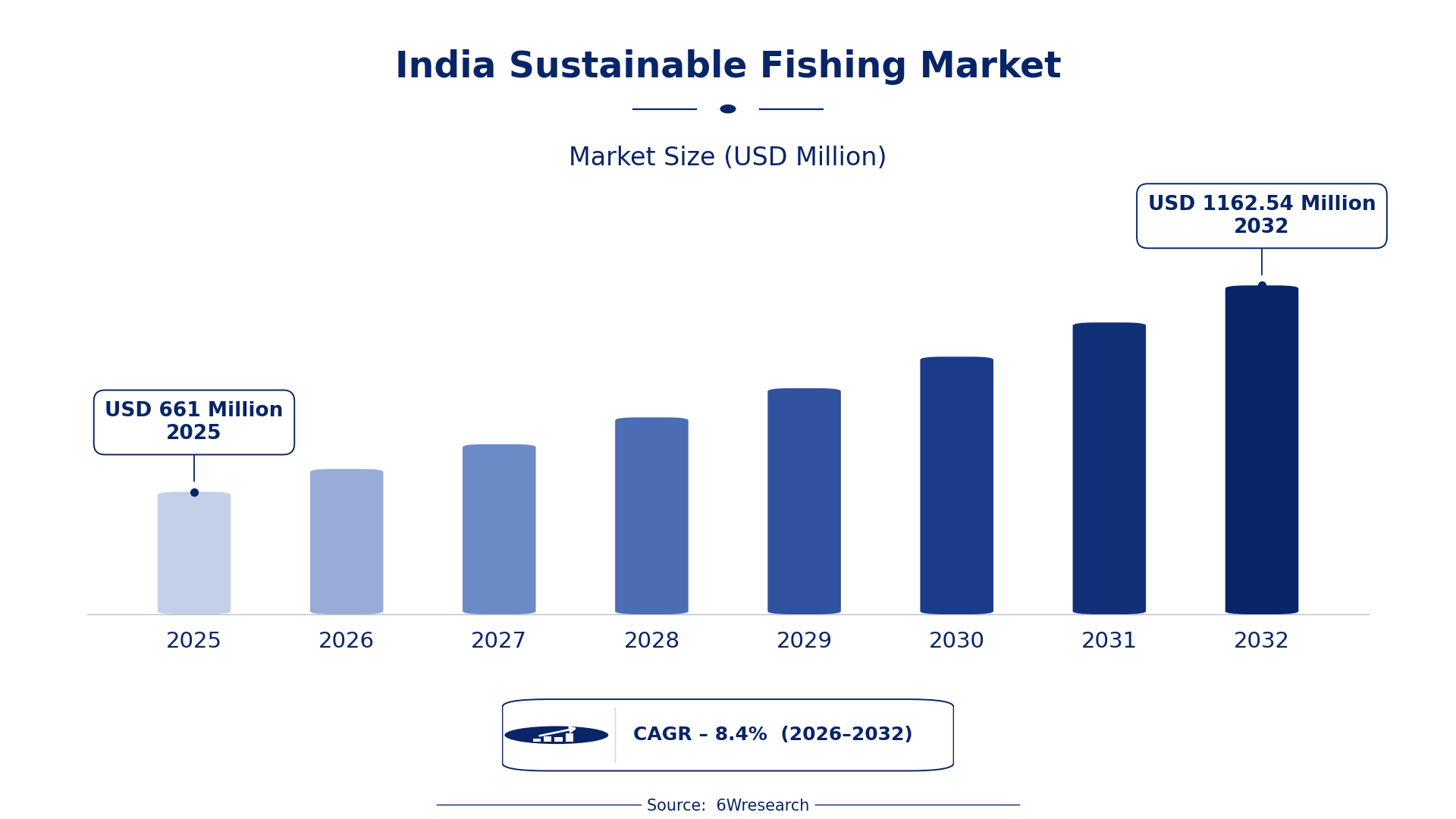
According to 6Wresearch internal database and industry insights, the India Sustainable Fishing Market was valued at USD 661.0 million in 2025 and is projected to reach USD 1,162.54 million by 2032, growing at a CAGR of approximately 8.4% during 2026–2032.
India Sustainable Fishing Market Highlights
| Report Metric | Details |
| Report Name | India Sustainable Fishing Market |
| Market Size 2025 | USD 661.0 million |
| Market Size 2032 | USD 1,162.54 million |
| Absolute Growth 2025–2032 | USD 501.54 million |
| CAGR 2026–2032 | 8.4% |
| Peak Annual Growth | 10.9% in 2026 |
| Forecast Period | 2026–2032 |
| Historical Data | 2022–2025 |
| Base Year | 2025 |
| Leading Sustainable Fishing, 2025 | Aquaculture Fish (43% share) |
| Leading Product Type, 2025 | Shrimp (38% share) |
| Leading Fishing Method, 2025 | Sustainable Farming (36% share) |
| Leading Distribution Channel, 2025 | Direct Sales (50% share) |
| Leading End User Industry, 2025 | Food & Beverage Sector (45% share) |
| Fastest-Growing Product Type | Tuna (11.2% CAGR) |
| Fastest-Growing Fishing Method | Pole and Line (10.3% CAGR) |
| Fastest-Growing Distribution Channel | Online Platforms (10.0% CAGR) |
| Fastest-Growing End User Industry | Restaurants & Hotels (9.5% CAGR) |
| Growing Sector | Aquaculture |
| Key End Users | Food & Beverage Sector, Restaurants & Hotels, Household Consumption |
India Sustainable Fishing Market Year-wise Growth Rate and Key Drivers (2022–2032)
This graph illustrates the annual growth rates of the market from 2022 to 2032, highlighting a steady upward trajectory and projected market expansion over the forecast period.
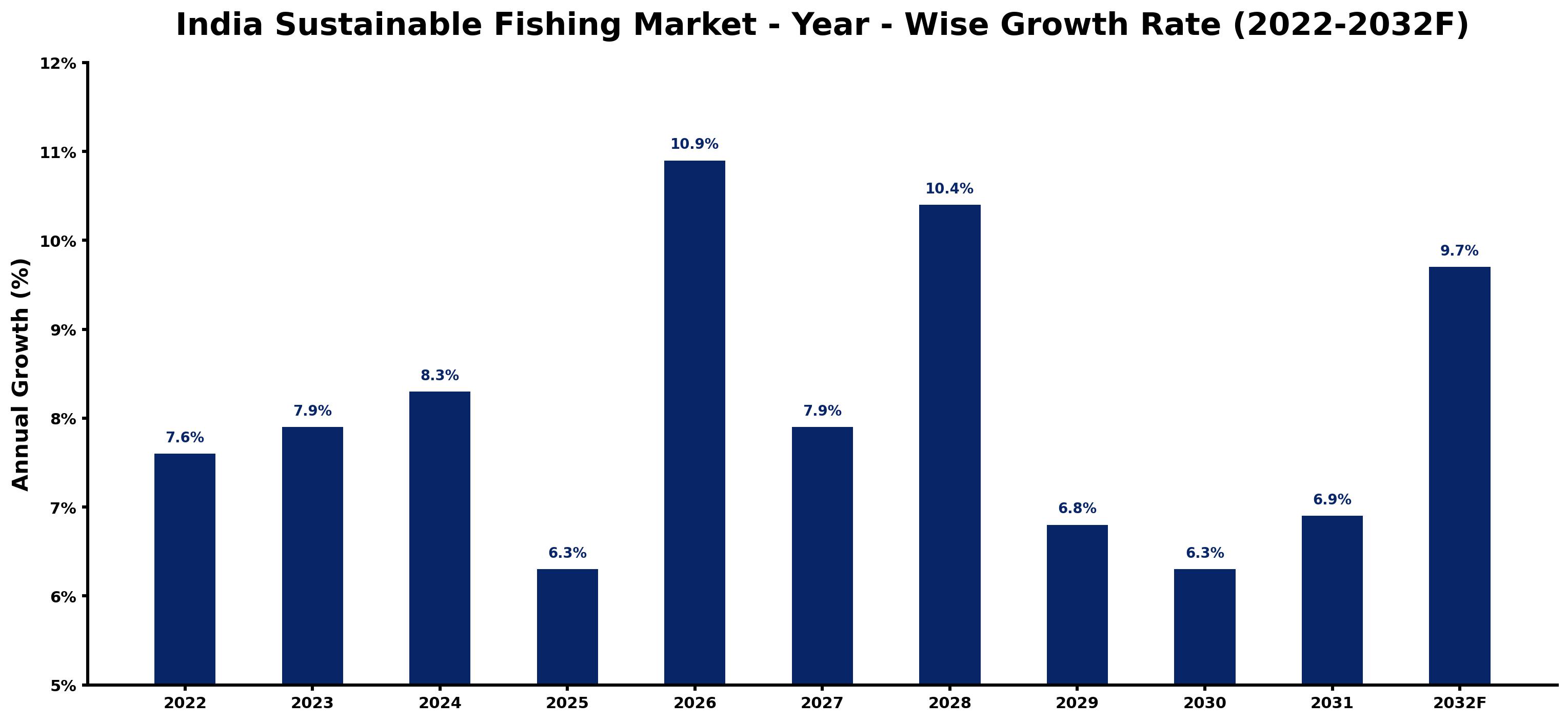
The following table presents the estimated annual growth rate for each year together with the principal factor influencing market performance.
| Year | Estimated Annual Growth (%) | Market Rationale |
| 2022 | 7.6 | The market experienced steady growth due to the Pradhan Mantri Matsya Sampada Yojana promoting sustainable practices. |
| 2023 | 7.9 | Demand for sustainable seafood rose as consumers preferred eco-friendly options, particularly in coastal regions. |
| 2024 | 8.3 | Growth accelerated as the National Fisheries Policy began to take effect, enhancing local production capabilities. |
| 2025 | 6.3 | Market growth slowed slightly as production faced seasonal challenges affecting supply availability. |
| 2026 | 10.9 | A surge in sustainable aquaculture practices is expected to drive growth as investments increase. |
| 2027 | 7.9 | Growth will moderate as the market adjusts to new supply chain dynamics and regulatory requirements. |
| 2028 | 10.4 | Increased exports and domestic consumption will spur renewed growth in sustainable seafood. |
| 2029 | 6.8 | Market growth will slow as competition intensifies among suppliers in the seafood sector. |
| 2030 | 6.3 | Growth will continue to moderate as sustainability standards evolve and adapt to market needs. |
| 2031 | 6.9 | A rebound in demand from the food service sector will boost growth as restaurants seek sustainable options. |
| 2032 | 9.7 | Sustained investments in sustainable practices are projected to enhance growth in the seafood market. |
Note: Market size estimations and growth projections presented in this report are based on 6Wresearch's proprietary forecasting methodology, utilizing the latest available industry data, government publications, and primary research inputs.
India Sustainable Fishing Market Synopsis
Sustainable Fishing in India includes practices that maintain fish populations and ecosystems while providing food. It features methods such as aquaculture and line-caught fishing, primarily catering to the food and beverage industry. The India Sustainable Fishing Market is growing due to rising domestic consumption, increased exports, and government initiatives like the Pradhan Mantri Matsya Sampada Yojana. With seafood exports valued at $6.7 billion in 2022, the emphasis on sustainability is attracting further investments in the sector, especially in regions like Kerala and Tamil Nadu.
Market Dynamics Impact Analysis (2026–2032)
| Factor | Type | Impact | Primary Segment Affected |
| Increasing demand for eco-friendly seafood options | Driver | High | Aquaculture Fish |
| Growing popularity of sustainable practices among consumers | Driver | High | Line-Caught Fish |
| Emerging markets for sustainable seafood exports | Opportunity | High | Shrimp |
| Expansion of online platforms for seafood distribution | Opportunity | Medium | Direct Sales |
| Challenges in meeting sustainability certifications | Restraint | High | Aquaculture Fish |
| Limited awareness of sustainable practices among fishermen | Restraint | Medium | Line-Caught Fish |
| Regulatory compliance costs for producers | Challenge | High | Aquaculture Fish |
| Seasonal fluctuations impacting supply availability | Challenge | Medium | Shrimp |
Evaluation of Drivers in India Sustainable Fishing Market (2026–2032)
The table below links each growth driver to the segment it affects and the evidence for it.
| Drivers | Primary Segment Affected | Why It Matters (Evidence) |
| Rising domestic consumption of sustainable seafood | Aquaculture Fish | India's seafood exports reached $6.7 billion in 2022, driving local demand for sustainable practices and products. |
| Government initiatives promoting sustainable practices | Line-Caught Fish | The National Fisheries Policy, 2020, aims to promote sustainable fishing practices across India, improving local production capabilities. |
| Increased investment in aquaculture infrastructure | Aquaculture Fish | The Fisheries and Aquaculture Infrastructure Development Fund allocated ₹7,522 crores for improvements, supporting sustainable fishing initiatives. |
| Growing consumer preference for eco-friendly seafood | Shrimp | The rise in sustainable shrimp farming in Andhra Pradesh is meeting increasing consumer demand for environmentally friendly options. |
| Expansion of distribution channels for seafood | Direct Sales | Direct sales accounted for 50% of the distribution channel, facilitating access to fresh seafood and increasing market reach. |
India's seafood exports were valued at $6.7 billion in 2022, creating strong demand for sustainable practices. Funding from the Fisheries and Aquaculture Infrastructure Development Fund supports advancements in fishing infrastructure. Consumer preference for eco-friendly seafood is clear, particularly in regions like Andhra Pradesh, where sustainable practices are increasingly embraced.
Evaluation of Restraints in India Sustainable Fishing Market
The table below lists the restraints and the evidence behind each.
| Market Restraint | Primary Segment Affected | Why It Matters (Evidence) |
| High costs associated with sustainability certifications | Aquaculture Fish | Producers face expenses to meet ISO 14001 certification requirements for environmental management, impacting profitability. |
| Limited awareness of sustainable fishing practices | Line-Caught Fish | Many fishermen remain unaware of sustainable practices, hindering market growth and adoption of eco-friendly methods. |
| Seasonal fluctuations affecting supply availability | Shrimp | Seasonal variations can disrupt shrimp supply, impacting market stability and resulting in inconsistent quality. |
| Regulatory compliance complexities | Line-Caught Fish | Complex regulations can deter local producers, limiting their competitiveness against imported seafood. |
| Market competition from cheaper imports | Aquaculture Fish | Imported seafood often competes on price, challenging local sustainable products and limiting market share. |
India Sustainable Fishing Market Challenges
The India Sustainable Fishing Market faces a few practical problems, and the first is cost. Rising expenses for sustainable fishing practices, particularly in aquaculture, can increase production costs by 15%, which directly impacts profitability for producers. Logistical challenges in coastal states like Kerala and Tamil Nadu can lead to a 20% reduction in timely seafood deliveries to buyers, disrupting supply chains. Buyers in the food and beverage industry often encounter inconsistent quality, resulting in a 10% loss of sales due to customer dissatisfaction. Competition from cheaper imported seafood pressures local suppliers, forcing them to lower prices and potentially compromise on quality standards.
Trends in the India Sustainable Fishing Market
The trends below show where the India Sustainable Fishing Market is heading.
- Shift towards Online Seafood Sales: Consumers are increasingly purchasing seafood through online platforms, with this channel growing at a rate of 10% annually. This trend reflects changing consumer behaviour as convenience becomes a priority, particularly in urban areas.
- Emergence of Sustainable Shrimp Farming: Sustainable shrimp farming is gaining traction in Andhra Pradesh, contributing to local aquaculture production. This method is projected to grow by 10.6% in the coming years, aligning with global sustainability trends and consumer preferences.
- Increased Focus on Certification Standards: There is a growing emphasis on obtaining certifications like ISO 14001 among Indian fisheries. This shift is driven by consumer demand for verified sustainable practices, improving market positioning for compliant producers.
- Expansion of Sustainable Fishing Practices: The National Fisheries Policy, 2020, has catalysed the adoption of sustainable fishing methods across India. This policy aims to improve practices, contributing to a projected growth rate of 8.4% by 2032.
Investment Opportunities in the India Sustainable Fishing Market
The following opportunities in the India Sustainable Fishing Market pair current demand with a clear way in.
- Aquaculture Facilities in Coastal Regions: Coastal regions like Kerala and Tamil Nadu present opportunities for investment in aquaculture facilities. With fish production reaching 14.7 million tons in 2021, there is potential for expansion and increased output, particularly in sustainable practices.
- Supply of Sustainable Fishing Equipment: There is an increasing demand for sustainable fishing gear among local fishermen. This demand arises from the need to comply with sustainability standards, particularly in coastal states like Tamil Nadu, where awareness is growing.
- Investment in Certification Services: The market gap for certification services is clear, with many producers seeking ISO 14001 certification. This presents an opportunity for service providers to enter the market and support local fisheries in achieving compliance.
- Support for Local Fishermen: Fishermen in coastal states require assistance to transition to sustainable practices. Initiatives from the National Fisheries Development Board can facilitate this shift, enhancing local production capabilities and market access.
Government Initiatives in the India Sustainable Fishing Market
The Pradhan Mantri Matsya Sampada Yojana, launched in 2020, aims to enhance fish production and promote sustainable practices with a budget of ₹20,050 crores. This initiative directly supports the sustainable fishing sector by providing financial assistance to producers and improving infrastructure for sustainable practices. The National Fisheries Policy, 2020, established by the Ministry of Fisheries, aims to promote sustainable fishing and aquaculture practices across India, ensuring better resource management for producers.
The Fisheries and Aquaculture Infrastructure Development Fund allocates ₹7,522 crores to improve infrastructure for sustainable fishing. This funding enables producers to develop facilities that meet sustainability standards and expand their market access. The Coastal Aquaculture Authority regulates aquaculture practices to ensure sustainability and environmental protection, providing oversight to enhance compliance among producers.
Future Insight of the India Sustainable Fishing Market
The India Sustainable Fishing Market is set for notable changes by 2032, driven by several key factors. The National Fisheries Policy aims to improve sustainable practices, potentially increasing fish production to 18 million tons. The Pradhan Mantri Matsya Sampada Yojana will support aquaculture growth, encouraging innovation among suppliers. The Marine Stewardship Council's initiatives will promote responsible fishing standards, ensuring higher quality seafood products for buyers and enhancing market stability.
Market Segmentation Analysis
Each segment group is reviewed below, with the leader by share and the fastest grower by CAGR.
By Sustainable Fishing – Aquaculture Fish Dominated and Is Expected to Record the Fastest Growth
According to Sumit Sagar, AM at 6Wresearch, in 2025, Aquaculture Fish led the sustainable fishing split with a 43% share. Aquaculture fish commands the largest share as it serves as the main source of fish production in India, effectively meeting the high demand for seafood. This segment thrives particularly in coastal states like Kerala and Tamil Nadu, which are key players in sustainable fishing practices. Its lead should widen, with a projected CAGR of 10.6% during 2026–2032, the highest in this split. The aquaculture fish segment is also the fastest-growing, as sustainable practices are increasingly embraced to satisfy the rising demand for fish. With India's total fish production reaching 14.7 million tons in 2021, aquaculture's contribution of 7.5 million tons underscores its expanding importance in the market. Suppliers should enhance aquaculture practices to capture the growing demand for sustainable fish.
By Product Type – Shrimp Dominated, Tuna Expected to Grow Fastest
Shrimp held a 38% share of the India Sustainable Fishing Market by product type in 2025. Shrimp leads the market share as a major product in both domestic and export markets, reflecting its strong consumer popularity. The seafood exports valued at $6.7 billion in 2022 highlight shrimp's critical role in India's sustainable fishing sector. Tuna is projected to grow fastest, at a CAGR of 11.2% during 2026–2032. Tuna is the fastest-growing product type, fuelled by high demand in food service and retail sectors. As consumer preferences shift towards sustainable seafood options, tuna's growth trajectory is set to accelerate further. Buyers should diversify their offerings to include high-demand products like tuna to maintain competitiveness.
By Fishing Method – Sustainable Farming Dominated, Pole and Line Expected to Grow Fastest
With a 36% revenue share in 2025, Sustainable Farming was the largest fishing method category. Sustainable farming holds the largest share as a growing practice in aquaculture, aligning with the increasing consumer demand for environmentally friendly fishing methods. This method is essential for maintaining fish populations and ecosystems while providing food. The quickest growth will come from Pole and Line, forecast to expand at a CAGR of 10.3% between 2026 and 2032. Pole and line fishing is the fastest-growing method, as it promotes sustainability and is increasingly favoured by environmentally conscious consumers. Its traditional roots resonate with buyers seeking responsible sourcing practices. Suppliers should invest in sustainable fishing methods to meet the rising consumer demand for eco-friendly seafood.
By Distribution Channel – Direct Sales Dominated, Online Platforms Expected to Grow Fastest
Direct Sales accounted for a 50% market share by distribution channel in 2025. Direct sales capture the largest share, being a common channel for fresh fish distribution that ensures quality and freshness for consumers. This method is particularly effective in regions with a high concentration of seafood consumers. Online Platforms are set to record the highest CAGR in this split, 10.0% over 2026–2032. Online platforms are the fastest-growing distribution channel, driven by changing consumer behaviours towards digital shopping. The convenience of online access is reshaping how consumers purchase sustainable seafood, indicating a shift in buying habits. Suppliers must enhance their online presence to capitalise on the growing trend of digital seafood sales.
By End User Industry – Food & Beverage Sector Dominated, Restaurants & Hotels Expected to Grow Fastest
Food & Beverage Sector took a 45% share of end user industry in 2025, more than any other category. The food and beverage sector holds the largest share as the primary consumer of sustainable fish products, reflecting the industry's commitment to quality and sustainability. This sector's demand is vital for the growth of sustainable fishing practices in India. Over 2026–2032, Restaurants & Hotels are expected to post the fastest growth, at a CAGR of 9.5%. Restaurants and hotels represent the fastest-growing end user industry, as they increasingly seek high-quality, sustainable seafood options to meet customer preferences. This trend indicates a shift towards more responsible sourcing in the food service industry. Suppliers should target the restaurant and hotel sectors to align with the growing demand for sustainable seafood.
Key Attractiveness of the Report
- 10 Years of Market Numbers
- Historical Data Starting from 2022 to 2025
- Base Year 2025
- Forecast Data until 2032
- Key Performance Indicators Impacting the Market
- Major Upcoming Developments and Projects
Key Highlights of the Report:
- India Sustainable Fishing Market Outlook
- Market Size of India Sustainable Fishing Market, 2025
- Forecast of India Sustainable Fishing Market, 2032
- Historical Data and Forecast of India Sustainable Fishing Revenues & Volume for the Period 2022 - 2032F
- India Sustainable Fishing Market Trend Evolution
- India Sustainable Fishing Market Drivers and Challenges
- India Sustainable Fishing Price Trends
- India Sustainable Fishing Porter's Five Forces
- India Sustainable Fishing Industry Life Cycle
- Historical Data and Forecast of India Sustainable Fishing Market Revenues & Volume By Sustainable Fishing for the Period 2022 - 2032F
- Historical Data and Forecast of India Sustainable Fishing Market Revenues & Volume By Line-Caught Fish for the Period 2022 - 2032F
- Historical Data and Forecast of India Sustainable Fishing Market Revenues & Volume By Aquaculture Fish for the Period 2022 - 2032F
- Historical Data and Forecast of India Sustainable Fishing Market Revenues & Volume By Trap-Caught Fish for the Period 2022 - 2032F
- Historical Data and Forecast of India Sustainable Fishing Market Revenues & Volume By Net-Free Fishing for the Period 2022 - 2032F
- Historical Data and Forecast of India Sustainable Fishing Market Revenues & Volume By Product Type for the Period 2022 - 2032F
- Historical Data and Forecast of India Sustainable Fishing Market Revenues & Volume By Tuna for the Period 2022 - 2032F
- Historical Data and Forecast of India Sustainable Fishing Market Revenues & Volume By Salmon for the Period 2022 - 2032F
- Historical Data and Forecast of India Sustainable Fishing Market Revenues & Volume By Lobster for the Period 2022 - 2032F
- Historical Data and Forecast of India Sustainable Fishing Market Revenues & Volume By Shrimp for the Period 2022 - 2032F
- Historical Data and Forecast of India Sustainable Fishing Market Revenues & Volume By Fishing Method for the Period 2022 - 2032F
- Historical Data and Forecast of India Sustainable Fishing Market Revenues & Volume By Pole and Line for the Period 2022 - 2032F
- Historical Data and Forecast of India Sustainable Fishing Market Revenues & Volume By Sustainable Farming for the Period 2022 - 2032F
- Historical Data and Forecast of India Sustainable Fishing Market Revenues & Volume By Pot & Trap Fishing for the Period 2022 - 2032F
- Historical Data and Forecast of India Sustainable Fishing Market Revenues & Volume By Bycatch Reduction Tech for the Period 2022 - 2032F
- Historical Data and Forecast of India Sustainable Fishing Market Revenues & Volume By Distribution Channel for the Period 2022 - 2032F
- Historical Data and Forecast of India Sustainable Fishing Market Revenues & Volume By Direct Sales for the Period 2022 - 2032F
- Historical Data and Forecast of India Sustainable Fishing Market Revenues & Volume By Online Platforms for the Period 2022 - 2032F
- Historical Data and Forecast of India Sustainable Fishing Market Revenues & Volume By Fish Markets for the Period 2022 - 2032F
- Historical Data and Forecast of India Sustainable Fishing Market Revenues & Volume By Retail Chains for the Period 2022 - 2032F
- Historical Data and Forecast of India Sustainable Fishing Market Revenues & Volume By End User Industry for the Period 2022 - 2032F
- Historical Data and Forecast of India Sustainable Fishing Market Revenues & Volume By Food & Beverage Sector for the Period 2022 - 2032F
- Historical Data and Forecast of India Sustainable Fishing Market Revenues & Volume By Restaurants & Hotels for the Period 2022 - 2032F
- Historical Data and Forecast of India Sustainable Fishing Market Revenues & Volume By Household Consumption for the Period 2022 - 2032F
- Historical Data and Forecast of India Sustainable Fishing Market Revenues & Volume By Frozen Food Suppliers for the Period 2022 - 2032F
- India Sustainable Fishing Import Export Trade Statistics
- Market Opportunity Assessment By Sustainable Fishing
- Market Opportunity Assessment By Product Type
- Market Opportunity Assessment By Fishing Method
- Market Opportunity Assessment By Distribution Channel
- Market Opportunity Assessment By End User Industry
- India Sustainable Fishing Top Companies Market Share
- India Sustainable Fishing Competitive Benchmarking By Technical and Operational Parameters
- India Sustainable Fishing Company Profiles
- India Sustainable Fishing Key Strategic Recommendations
Market Covered
The report offers an extensive study of the following market segments.
By Sustainable Fishing
- Line-Caught Fish
- Aquaculture Fish
- Trap-Caught Fish
- Net-Free Fishing
By Product Type
- Tuna
- Salmon
- Lobster
- Shrimp
By Fishing Method
- Pole and Line
- Sustainable Farming
- Pot & Trap Fishing
- Bycatch Reduction Tech
By Distribution Channel
- Direct Sales
- Online Platforms
- Fish Markets
- Retail Chains
By End User Industry
- Food & Beverage Sector
- Restaurants & Hotels
- Household Consumption
- Frozen Food Suppliers































