China Sustainable Fishing Market Size & Growth Rate
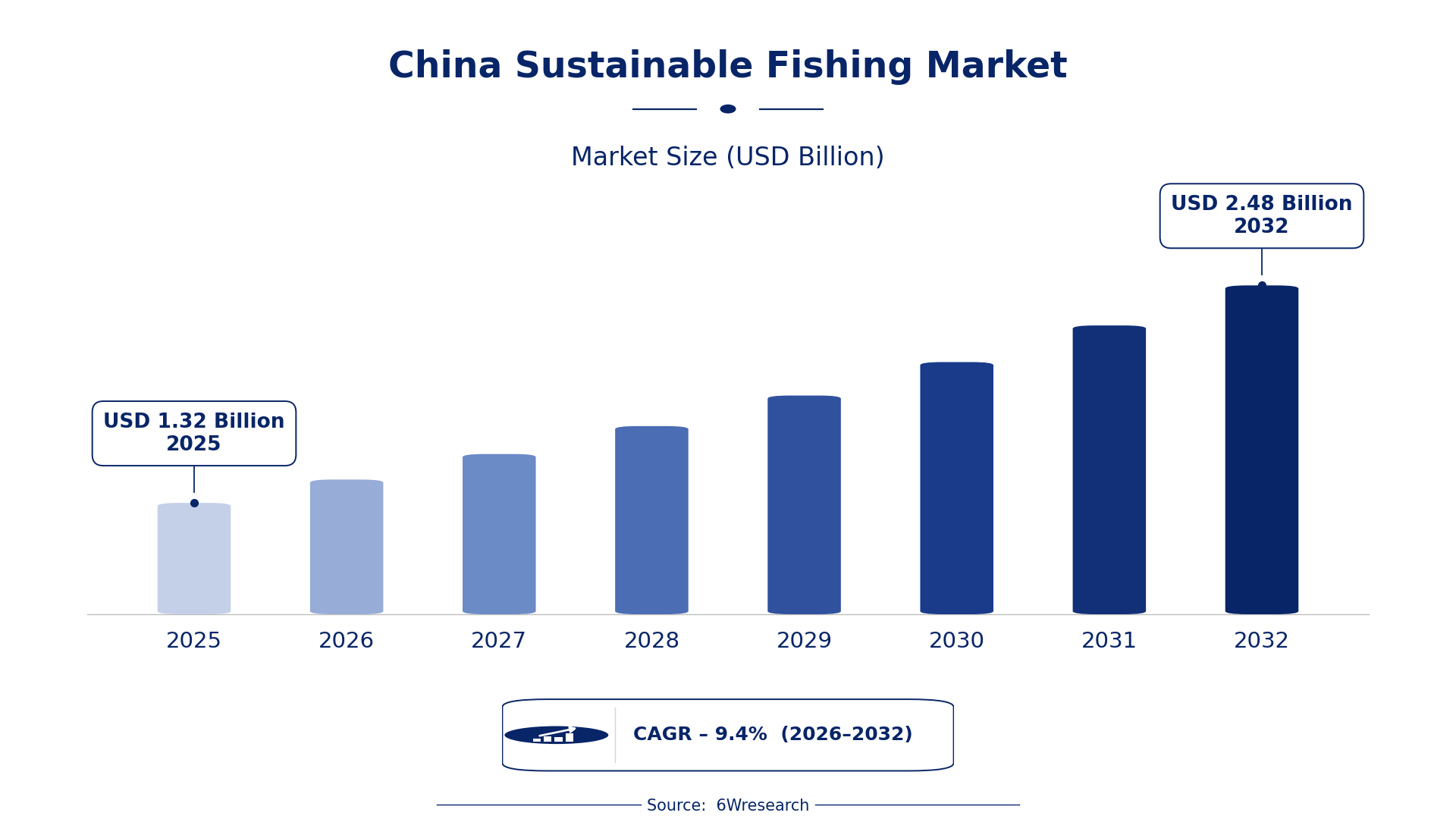
According to 6Wresearch internal database and industry insights, the China Sustainable Fishing Market was valued at USD 1.32 billion in 2025 and is projected to reach USD 2.48 billion by 2032, growing at a CAGR of approximately 9.4% during 2026–2032.
China Sustainable Fishing Market Highlights
| Report Metric | Details |
| Report Name | China Sustainable Fishing Market |
| Market Size 2025 | USD 1.32 billion |
| Market Size 2032 | USD 2.48 billion |
| Absolute Growth 2025–2032 | USD 1.16 billion |
| CAGR 2026–2032 | 9.4% |
| Peak Annual Growth | 11.6% in 2027 |
| Forecast Period | 2026–2032 |
| Historical Data | 2022–2025 |
| Base Year | 2025 |
| Leading Sustainable Fishing, 2025 | Aquaculture Fish (37% share) |
| Leading Product Type, 2025 | Shrimp (45% share) |
| Leading Fishing Method, 2025 | Sustainable Farming (44% share) |
| Leading Distribution Channel, 2025 | Direct Sales (43% share) |
| Leading End User Industry, 2025 | Food & Beverage Sector (49% share) |
| Fastest-Growing Sustainable Fishing | Line-Caught Fish (10.9% CAGR) |
| Fastest-Growing Product Type | Salmon (10.6% CAGR) |
| Fastest-Growing Fishing Method | Pole and Line (10.8% CAGR) |
| Fastest-Growing Distribution Channel | Online Platforms (11.1% CAGR) |
| Fastest-Growing End User Industry | Restaurants & Hotels (11.4% CAGR) |
| Growing Sector | Food & Beverage Sector |
| Key End Users | Restaurants & Hotels, Food Service Sector, Households |
China Sustainable Fishing Market Year-wise Growth Rate and Key Drivers (2022–2032)
This graph illustrates the annual growth rates of the market from 2022 to 2032, highlighting a steady upward trajectory and projected market expansion over the forecast period.
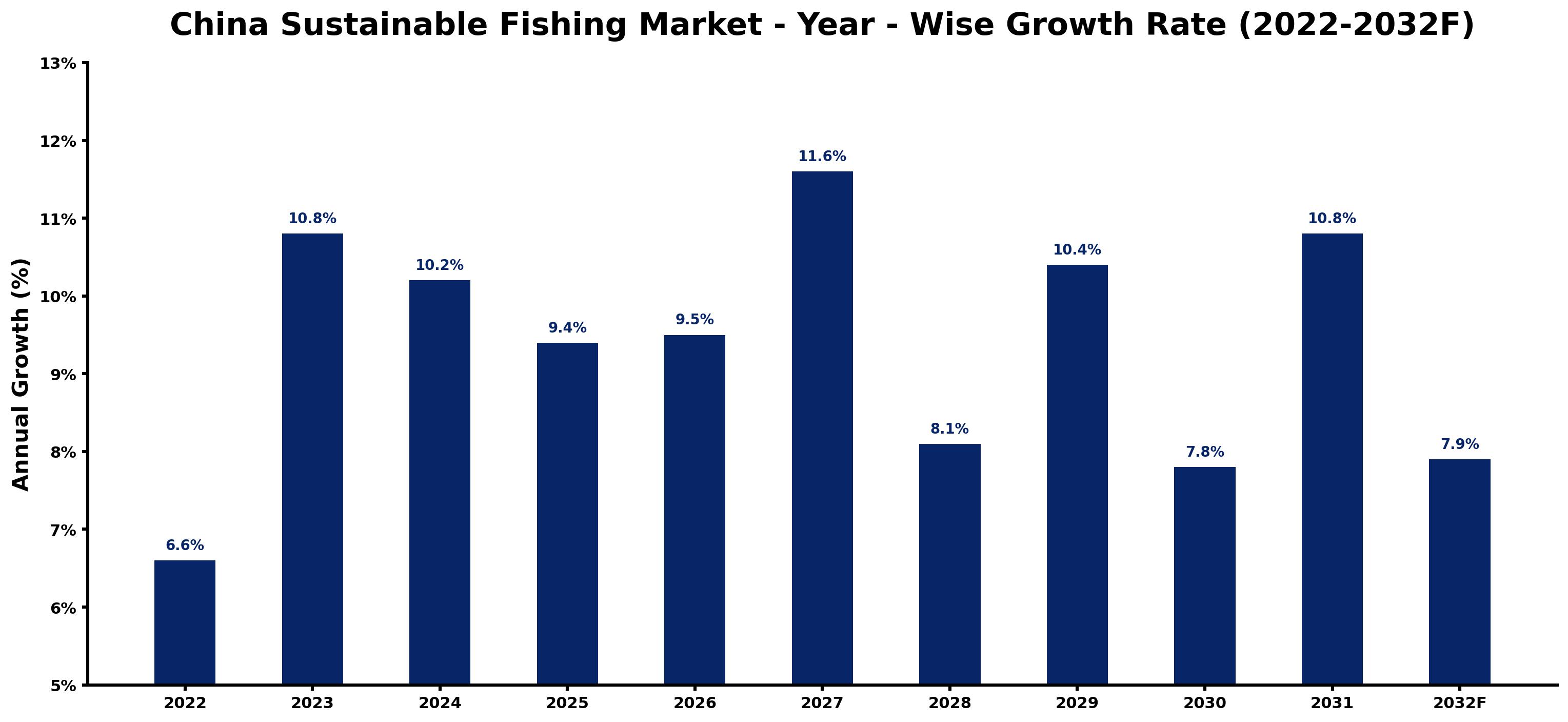
Each row of the following table gives one year's estimated growth and the event or demand shift that explains it.
| Year | Estimated Annual Growth (%) | Market Rationale |
| 2022 | 6.6 | The market maintained steady demand as consumers increasingly sought sustainable seafood options. |
| 2023 | 10.8 | Growth accelerated due to rising awareness of sustainable practices among consumers and restaurants. |
| 2024 | 10.2 | Demand continued but at a slower pace as market adjustments took place following rapid growth. |
| 2025 | 9.4 | A slight slowdown occurred as the market stabilised after a period of high growth in previous years. |
| 2026 | 9.5 | Growth resumed as investments in sustainable aquaculture practices began to yield results. |
| 2027 | 11.6 | The market peaked due to heightened consumer interest in sustainably sourced seafood. |
| 2028 | 8.1 | A slowdown was observed as market dynamics normalised following peak growth rates. |
| 2029 | 10.4 | Demand surged again as restaurants expanded their sustainable seafood offerings. |
| 2030 | 7.8 | Growth slowed as market conditions stabilised after a period of rapid expansion. |
| 2031 | 10.8 | An increase in growth was driven by ongoing consumer preference for sustainable seafood. |
| 2032 | 7.9 | The market continued to grow, supported by initiatives to enhance sustainable fishing practices. |
Note: Market size estimations and growth projections presented in this report are based on 6Wresearch's proprietary forecasting methodology, utilizing the latest available industry data, government publications, and primary research inputs.
China Sustainable Fishing Market Synopsis
Sustainable Fishing in China involves practices that preserve fish populations while supplying seafood. It encompasses methods such as aquaculture and selective fishing, primarily catering to the food service sector and households. The China Sustainable Fishing Market is growing due to increasing consumer awareness and supportive government initiatives. The aquaculture sector accounts for over 60% of the total fish supply, with a strong emphasis on sustainable practices. With a population exceeding 1.4 billion, the demand for seafood continues to rise, propelling market growth.
Market Dynamics Impact Analysis (2026–2032)
| Factor | Type | Impact | Primary Segment Affected |
| Increasing consumer awareness of sustainable seafood practices drives demand. | Driver | High | Aquaculture Fish |
| The rise of online seafood sales is creating new purchasing channels. | Driver | High | Direct Sales |
| Growing investments in eco-friendly aquaculture facilities present new opportunities. | Opportunity | High | Sustainable Farming |
| The push for sustainable seafood in restaurants creates demand for certified products. | Opportunity | High | Food & Beverage Sector |
| High costs of sustainable fishing equipment can limit market growth. | Restraint | Medium | Line-Caught Fish |
| Strict regulations on bycatch reduction may hinder some fishing methods. | Restraint | Medium | Trap-Caught Fish |
| Supply chain disruptions can delay the availability of sustainable seafood. | Challenge | High | Aquaculture Fish |
| Approval processes for sustainable certifications can slow market entry. | Challenge | Medium | Sustainable Farming |
Evaluation of Drivers in China Sustainable Fishing Market (2026–2032)
The factors lifting demand, and the evidence behind each, are summarised below.
| Drivers | Primary Segment Affected | Why It Matters (Evidence) |
| Rising consumer demand for sustainably sourced seafood. | Aquaculture Fish | In 2022, China's seafood consumption reached 65 million tons, pushing aquaculture to meet this demand. |
| Growth of online seafood sales channels. | Direct Sales | Online seafood sales grew by 30% in 2023, reflecting consumer preference for convenience. |
| Government initiatives promoting sustainable practices. | Sustainable Farming | The 'Sustainable Aquaculture Development Plan' targets a 15% increase in sustainable farming by 2025. |
| Increasing focus on eco-friendly practices in restaurants. | Food & Beverage Sector | The Food & Beverage sector accounts for 40% of total seafood consumption in China. |
| Expansion of sustainable fishing technologies. | Line-Caught Fish | The updated 'National Marine Economy Development Plan' includes measures for promoting sustainable fishing technologies. |
In 2022, China's seafood consumption reached 65 million tons, pushing aquaculture to meet this demand. Online seafood sales grew by 30% in 2023, reflecting consumer preference for convenience. The 'Sustainable Aquaculture Development Plan' aims for a 15% increase in sustainable farming by 2025, while the Food & Beverage sector accounts for 40% of total seafood consumption. The updated 'National Marine Economy Development Plan' includes measures for promoting sustainable fishing technologies, further supporting market growth.
Evaluation of Restraints in China Sustainable Fishing Market
The key brakes on demand, and where they bite hardest, are shown below.
| Market Restraint | Primary Segment Affected | Why It Matters (Evidence) |
| High costs of sustainable fishing equipment can limit market growth. | Line-Caught Fish | Producers face increased expenses in adopting sustainable fishing technologies, impacting profitability. |
| Strict regulations on bycatch reduction may hinder some fishing methods. | Trap-Caught Fish | Compliance with new guidelines can slow down production rates, affecting supply availability. |
| Supply chain disruptions can delay the availability of sustainable seafood. | Aquaculture Fish | Logistical challenges can result in increased lead times for seafood deliveries. |
| Approval processes for sustainable certifications can slow market entry. | Sustainable Farming | Obtaining necessary certifications can be time-consuming and costly for producers. |
| Limited consumer knowledge about sustainable practices may restrict market growth. | Aquaculture Fish | Consumers may hesitate to pay premium prices for sustainable products without understanding their benefits. |
China Sustainable Fishing Market Challenges
Producers in the China Sustainable Fishing Market face a skills shortage that hampers the implementation of efficient aquaculture techniques. This lack of expertise leads to suboptimal practices, costing producers an estimated 15% in potential seafood quality and availability each year. Additionally, intense competition from international seafood suppliers pressures local producers, resulting in a 10% decline in market share for domestic offerings. Compliance with the National Standard GB/T 18602-2020 adds further complexity, as non-compliance can incur fines, ultimately increasing costs for producers and leading to higher prices for consumers seeking sustainable seafood.
Trends in the China Sustainable Fishing Market
The trends below show where the China Sustainable Fishing Market is heading.
- Restaurants Prioritising Sustainable Seafood: Restaurants across urban areas are increasingly prioritising sustainable seafood options to meet consumer demand. In 2023, 40% of restaurants reported offering sustainable seafood, reflecting a growing trend.
- Shift to Online Seafood Purchases: More consumers are shifting to online platforms for seafood purchases, driven by convenience and variety. Online seafood sales grew by 30% in 2023, indicating a change in buying behaviour.
- Emergence of Eco-Friendly Aquaculture: Eco-friendly aquaculture practices are gaining traction, with the Yangtze River Delta leading the way. In 2023, sustainable aquaculture practices increased by 20%, showcasing a shift towards greener methods.
- Focus on Bycatch Reduction Technologies: The fishing industry is increasingly adopting bycatch reduction technologies to comply with regulations. In 2022, the updated National Standard for Sustainable Fishing included stricter guidelines for bycatch reduction.
Investment Opportunities in the China Sustainable Fishing Market
Several openings in the China Sustainable Fishing Market merit attention from investors.
- Growing Demand for Online Seafood Sales: Now is an opportune time to invest in online seafood platforms, as online seafood sales grew by 30% in 2023. This trend is evident in urban areas where convenience is key, particularly among households seeking sustainable options.
- Investment in Sustainable Aquaculture: The 2023 government plan aims for a 20% increase in sustainable aquaculture by 2025, presenting a significant opportunity for investment in eco-friendly aquaculture facilities. The Yangtze River Delta is a prime region for such initiatives.
- Expansion of Sustainable Fishing Practices: With the National Standard GB/T 18602-2020 in place, there is a growing need for suppliers of eco-friendly fishing equipment. Fisheries looking to comply with these standards will require new technology and practices to meet regulations.
- Focus on Food & Beverage Sector: The Food & Beverage sector, accounting for 40% of total seafood consumption, is increasingly prioritising sustainable sourcing. Suppliers should target this sector by offering certified sustainable seafood options to meet consumer demand.
Government Initiatives in the China Sustainable Fishing Market
The Ministry of Agriculture oversees the implementation of various initiatives, including the 'Aquatic Product Quality and Safety Improvement Program' approved in 2023, which allocates $500 million to ensure sustainable practices across all fisheries. This program aims to improve the quality and safety of aquatic products while promoting eco-friendly fishing methods. The 'Green Fishing Practices Initiative' launched in 2020 provides subsidies for fisheries adopting sustainable methods, further supporting the transition towards sustainable fishing. These initiatives are vital for ensuring compliance with national standards and improving the overall sustainability of the fishing industry.
The Ministry of Agriculture and Rural Affairs funds various schemes to support sustainable fishing practices. For instance, the 'Sustainable Aquaculture Development Plan' aims to enhance eco-friendly practices in aquaculture, targeting a 15% increase in sustainable farming by 2025. Additionally, the 'National Marine Economy Development Plan' promotes sustainable fishing technologies, focusing on reducing bycatch. These measures ensure that fisheries adopt best practices and improve their operational efficiency.
Future Insight of the China Sustainable Fishing Market
Several forward-looking factors are expected to support the China Sustainable Fishing Market in the coming years. A government initiative aims to increase sustainable aquaculture by 20%, enhancing local production capabilities. Online seafood sales are anticipated to grow, driven by consumer demand for convenience and access to fresh products. The Ministry of Agriculture and Rural Affairs will likely continue promoting best practices, ensuring sustainability in fishing methods. These developments will facilitate a more efficient supply chain, catering to the rising seafood consumption among China's urban population.
Market Segmentation Analysis
The analysis below covers each segmentation, its leading category in 2025 and its fastest-growing category through 2032.
By Sustainable Fishing – Aquaculture Fish Dominated, Line-Caught Fish Expected to Grow Fastest
According to Sumit Sagar, AM at 6Wresearch, in 2025, Aquaculture Fish led the sustainable fishing split with a 37% share. Aquaculture fish dominate the market share in China's sustainable fishing sector, contributing over 60% to the total fish supply. This method ensures a consistent seafood source for a large domestic consumer base, especially in regions like the Yangtze River Delta. Line-Caught Fish is set to record the highest CAGR in this split, 10.9% over 2026–2032. Line-caught fish are growing rapidly as consumers increasingly seek sustainable and high-quality seafood options. Government initiatives promoting sustainable fishing practices are enhancing this segment's growth among fisheries. Suppliers should focus on expanding aquaculture capabilities to meet the rising demand for sustainable seafood.
By Product Type – Shrimp Dominated, Salmon Expected to Grow Fastest
The largest product type category in 2025 was Shrimp, with a 45% share of total revenue. Shrimp holds the largest market share as one of the most consumed seafood types in China, appealing to a wide range of consumer preferences. Its versatility in culinary applications across various regions solidifies its popularity. Over 2026–2032, Salmon is expected to post the fastest growth, at a CAGR of 10.6%. Salmon is experiencing the fastest growth, particularly among urban consumers who prefer premium seafood options. This trend is supported by a rising awareness of the health benefits linked to salmon consumption. Buyers should consider diversifying their seafood offerings to include more salmon to capture the growing consumer interest.
By Fishing Method – Sustainable Farming Dominated, Pole and Line Expected to Grow Fastest
Sustainable Farming took a 44% share of fishing method in 2025, more than any other category. Sustainable farming leads the market share as it is widely adopted for aquaculture practices, ensuring a steady supply of seafood. This method aligns with the national standards promoting sustainable fishing, making it a preferred choice among producers. The quickest growth will come from Pole and Line, forecast to expand at a CAGR of 10.8% between 2026 and 2032. Pole and line fishing is rapidly gaining popularity as a sustainable method, appealing to environmentally conscious consumers. Its growth is further accelerated by initiatives from the Ministry of Agriculture and Rural Affairs to promote sustainable practices. Suppliers should invest in sustainable fishing methods to align with consumer preferences and regulatory standards.
By Distribution Channel – Direct Sales Dominated, Online Platforms Expected to Grow Fastest
With a 43% revenue share in 2025, Direct Sales was the largest distribution channel category. Direct sales lead the market share as they are commonly used by local fisheries to sell directly to consumers. This method builds a strong connection between producers and buyers, enhancing trust in seafood quality. Online Platforms are projected to grow fastest, at a CAGR of 11.1% during 2026–2032. Online platforms are witnessing the fastest growth, with a 30% increase in sales driven by consumer preference for convenience in seafood purchases. This trend reflects a broader shift towards digital commerce in the food sector. Suppliers must strengthen their online presence to capture the growing segment of consumers who prefer digital purchasing options.
By End User Industry – Food & Beverage Sector Dominated, Restaurants & Hotels Expected to Grow Fastest
Food & Beverage Sector held a 49% share of the China Sustainable Fishing Market by end user industry in 2025. The food and beverage sector commands the largest share in the sustainable fishing market, being a major consumer of seafood. Its demand is driven by the need for high-quality ingredients in diverse culinary offerings. Restaurants & Hotels are set to record the highest CAGR in this split, 11.4% over 2026–2032. Restaurants and hotels are the fastest-growing end-users as they increasingly seek premium sustainable seafood to meet customer expectations. This trend aligns with a rising consumer focus on sustainability in dining experiences. Suppliers should target the food and beverage sector with tailored offerings to address the increasing demand for sustainable seafood.
Key Attractiveness of the Report
- 10 Years of Market Numbers
- Historical Data Starting from 2022 to 2025
- Base Year 2025
- Forecast Data until 2032
- Key Performance Indicators Impacting the Market
- Major Upcoming Developments and Projects
Key Highlights of the Report:
- China Sustainable Fishing Market Outlook
- Market Size of China Sustainable Fishing Market, 2025
- Forecast of China Sustainable Fishing Market, 2032
- Historical Data and Forecast of China Sustainable Fishing Revenues & Volume for the Period 2022 - 2032F
- China Sustainable Fishing Market Trend Evolution
- China Sustainable Fishing Market Drivers and Challenges
- China Sustainable Fishing Price Trends
- China Sustainable Fishing Porter's Five Forces
- China Sustainable Fishing Industry Life Cycle
- Historical Data and Forecast of China Sustainable Fishing Market Revenues & Volume By Sustainable Fishing for the Period 2022 - 2032F
- Historical Data and Forecast of China Sustainable Fishing Market Revenues & Volume By Line-Caught Fish for the Period 2022 - 2032F
- Historical Data and Forecast of China Sustainable Fishing Market Revenues & Volume By Aquaculture Fish for the Period 2022 - 2032F
- Historical Data and Forecast of China Sustainable Fishing Market Revenues & Volume By Trap-Caught Fish for the Period 2022 - 2032F
- Historical Data and Forecast of China Sustainable Fishing Market Revenues & Volume By Net-Free Fishing for the Period 2022 - 2032F
- Historical Data and Forecast of China Sustainable Fishing Market Revenues & Volume By Product Type for the Period 2022 - 2032F
- Historical Data and Forecast of China Sustainable Fishing Market Revenues & Volume By Tuna for the Period 2022 - 2032F
- Historical Data and Forecast of China Sustainable Fishing Market Revenues & Volume By Salmon for the Period 2022 - 2032F
- Historical Data and Forecast of China Sustainable Fishing Market Revenues & Volume By Lobster for the Period 2022 - 2032F
- Historical Data and Forecast of China Sustainable Fishing Market Revenues & Volume By Shrimp for the Period 2022 - 2032F
- Historical Data and Forecast of China Sustainable Fishing Market Revenues & Volume By Fishing Method for the Period 2022 - 2032F
- Historical Data and Forecast of China Sustainable Fishing Market Revenues & Volume By Pole and Line for the Period 2022 - 2032F
- Historical Data and Forecast of China Sustainable Fishing Market Revenues & Volume By Sustainable Farming for the Period 2022 - 2032F
- Historical Data and Forecast of China Sustainable Fishing Market Revenues & Volume By Pot & Trap Fishing for the Period 2022 - 2032F
- Historical Data and Forecast of China Sustainable Fishing Market Revenues & Volume By Bycatch Reduction Tech for the Period 2022 - 2032F
- Historical Data and Forecast of China Sustainable Fishing Market Revenues & Volume By Distribution Channel for the Period 2022 - 2032F
- Historical Data and Forecast of China Sustainable Fishing Market Revenues & Volume By Direct Sales for the Period 2022 - 2032F
- Historical Data and Forecast of China Sustainable Fishing Market Revenues & Volume By Online Platforms for the Period 2022 - 2032F
- Historical Data and Forecast of China Sustainable Fishing Market Revenues & Volume By Fish Markets for the Period 2022 - 2032F
- Historical Data and Forecast of China Sustainable Fishing Market Revenues & Volume By Retail Chains for the Period 2022 - 2032F
- Historical Data and Forecast of China Sustainable Fishing Market Revenues & Volume By End User Industry for the Period 2022 - 2032F
- Historical Data and Forecast of China Sustainable Fishing Market Revenues & Volume By Food & Beverage Sector for the Period 2022 - 2032F
- Historical Data and Forecast of China Sustainable Fishing Market Revenues & Volume By Restaurants & Hotels for the Period 2022 - 2032F
- Historical Data and Forecast of China Sustainable Fishing Market Revenues & Volume By Household Consumption for the Period 2022 - 2032F
- Historical Data and Forecast of China Sustainable Fishing Market Revenues & Volume By Frozen Food Suppliers for the Period 2022 - 2032F
- China Sustainable Fishing Import Export Trade Statistics
- Market Opportunity Assessment By Sustainable Fishing
- Market Opportunity Assessment By Product Type
- Market Opportunity Assessment By Fishing Method
- Market Opportunity Assessment By Distribution Channel
- Market Opportunity Assessment By End User Industry
- China Sustainable Fishing Top Companies Market Share
- China Sustainable Fishing Competitive Benchmarking By Technical and Operational Parameters
- China Sustainable Fishing Company Profiles
- China Sustainable Fishing Key Strategic Recommendations
Market Covered
Segments analysed in this report are listed below.
By Sustainable Fishing
- Line-Caught Fish
- Aquaculture Fish
- Trap-Caught Fish
- Net-Free Fishing
By Product Type
- Tuna
- Salmon
- Lobster
- Shrimp
By Fishing Method
- Pole and Line
- Sustainable Farming
- Pot & Trap Fishing
- Bycatch Reduction Tech
By Distribution Channel
- Direct Sales
- Online Platforms
- Fish Markets
- Retail Chains
By End User Industry
- Food & Beverage Sector
- Restaurants & Hotels
- Household Consumption
- Frozen Food Suppliers































