India Sustainable Hygiene Materials Market Size & Growth Rate
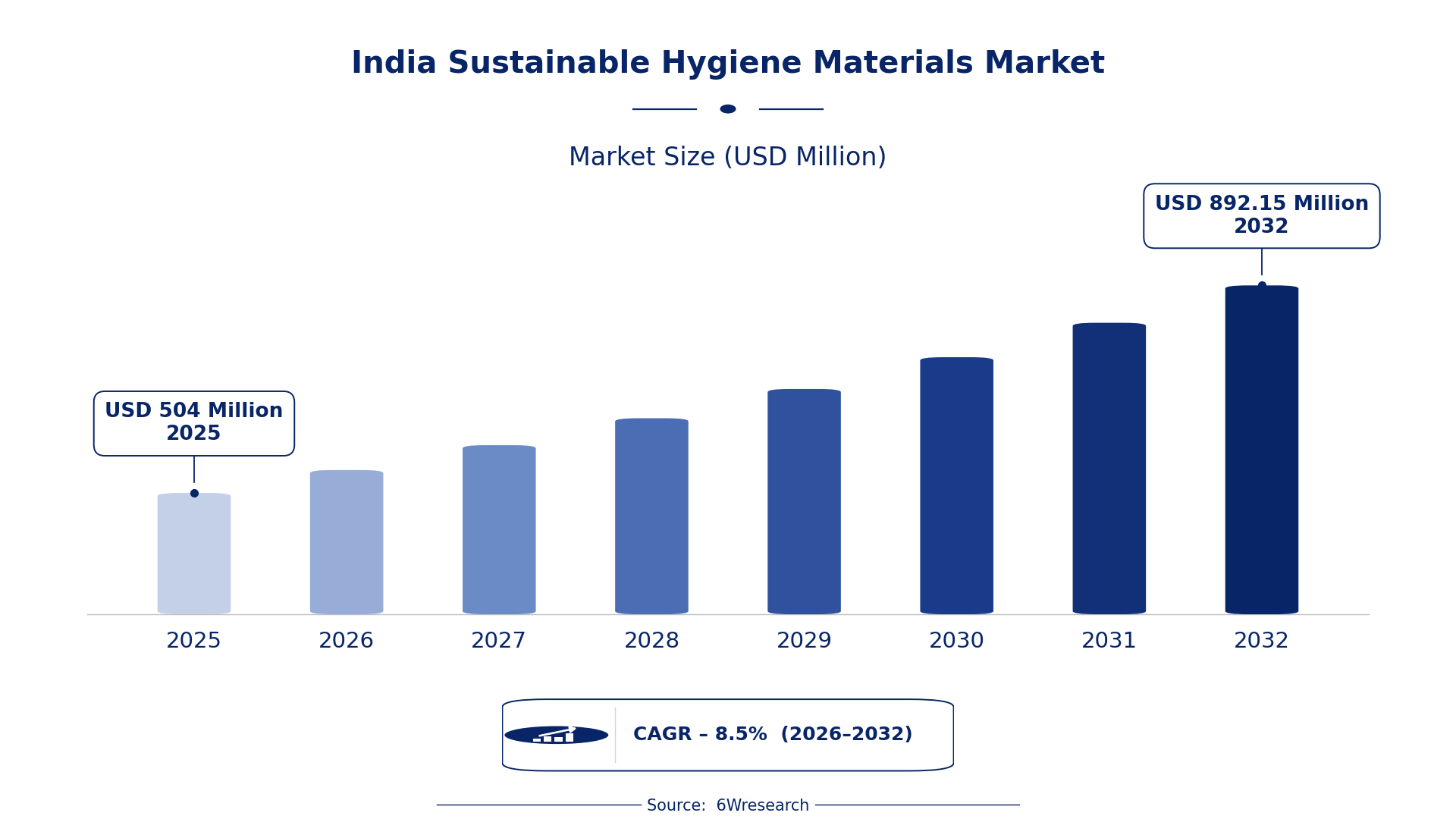
According to 6Wresearch internal database and industry insights, the India Sustainable Hygiene Materials Market was valued at USD 504.0 million in 2025 and is projected to reach USD 892.15 million by 2032, growing at a CAGR of approximately 8.5% during 2026–2032.
India Sustainable Hygiene Materials Market Highlights
| Report Metric | Details |
| Report Name | India Sustainable Hygiene Materials Market |
| Market Size 2025 | USD 504.0 million |
| Market Size 2032 | USD 892.15 million |
| Absolute Growth 2025–2032 | USD 388.15 million |
| CAGR 2026–2032 | 8.5% |
| Peak Annual Growth | 10.1% in 2032 |
| Forecast Period | 2026–2032 |
| Historical Data | 2022–2025 |
| Base Year | 2025 |
| Leading Sustainable Hygiene Materials, 2025 | Compostable Diapers (43% share) |
| Leading Product Type, 2025 | Infant Diapers (48% share) |
| Leading Material Type, 2025 | Organic Cotton (48% share) |
| Leading Distribution Channel, 2025 | Online Platforms (34% share) |
| Leading End User Industry, 2025 | Baby Care Sector (41% share) |
| Fastest-Growing Sustainable Hygiene Materials | Reusable Sanitary Pads (9.8% CAGR) |
| Fastest-Growing Product Type | Incontinence Products (11.0% CAGR) |
| Fastest-Growing Material Type | Bamboo + PLA (9.9% CAGR) |
| Fastest-Growing End User Industry | Women's Health Clinics (10.6% CAGR) |
| Growing Sector | Women's Health Clinics |
| Key End Users | Baby Care Sector, Elder Care Facilities, Women's Health Clinics, Hospitals & Homes |
India Sustainable Hygiene Materials Market Year-wise Growth Rate and Key Drivers (2022–2032)
This graph illustrates the annual growth rates of the market from 2022 to 2032, highlighting a steady upward trajectory and projected market expansion over the forecast period.
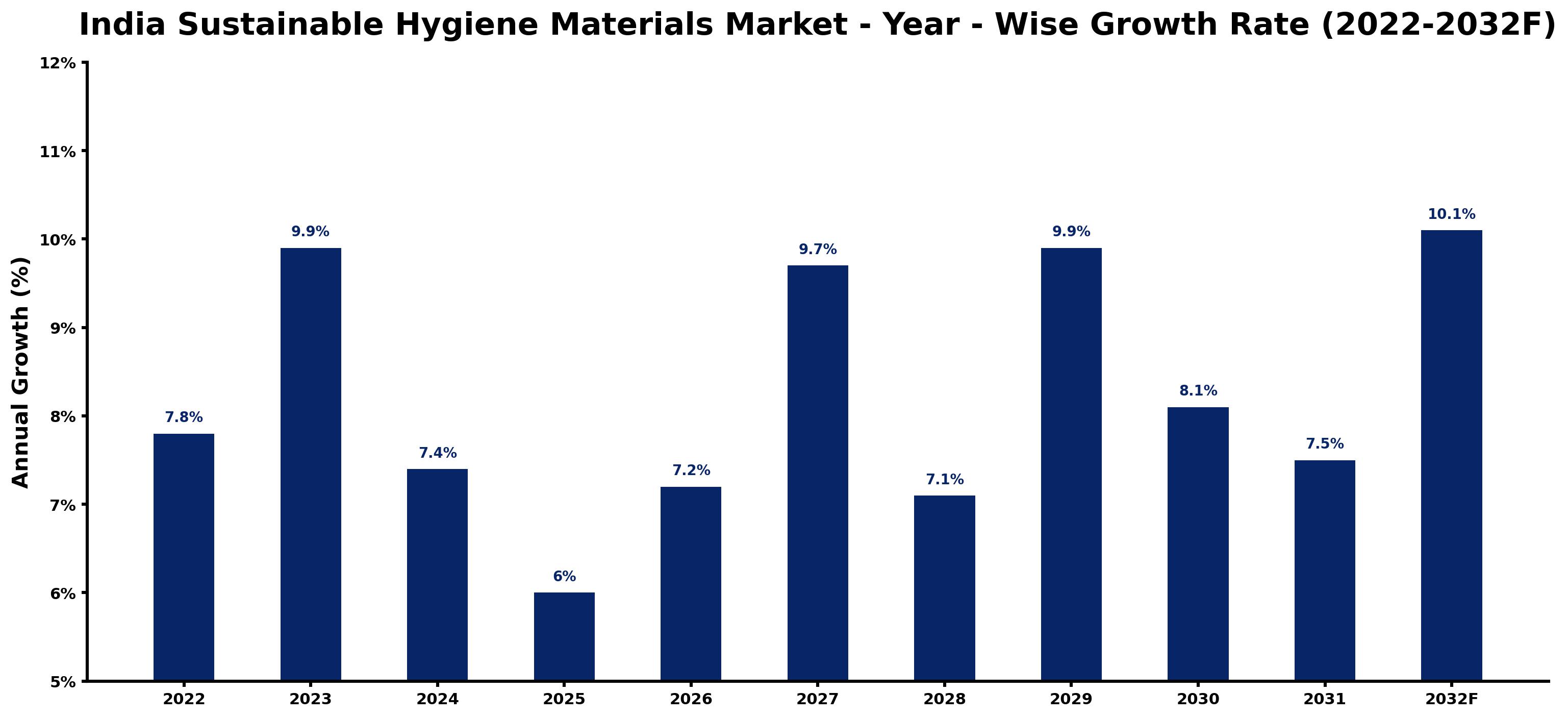
The table below sets out the estimated growth rate for each year and the main factor behind it.
| Year | Estimated Annual Growth (%) | Market Rationale |
| 2022 | 7.8 | The market experienced steady growth due to the Swachh Bharat Mission promoting hygiene practices. |
| 2023 | 9.9 | Demand surged as compostable diapers gained traction among eco-conscious parents in urban areas. |
| 2024 | 7.4 | Growth slowed as competition among brands began to affect the adoption of new products. |
| 2025 | 6.0 | The market continued to grow, driven by the expanding baby care sector and its hygiene needs. |
| 2026 | 7.2 | Demand increased as online platforms became a major distribution channel for hygiene products. |
| 2027 | 9.7 | The market saw a rise in demand for reusable sanitary pads supported by women's health NGOs. |
| 2028 | 7.1 | Growth decelerated slightly as competition among brands intensified in the market. |
| 2029 | 9.9 | Demand accelerated again, driven by the increasing use of biodegradable wipes among consumers. |
| 2030 | 8.1 | Growth slowed as the market adjusted to the rising costs of sustainable materials. |
| 2031 | 7.5 | The market continued to grow, supported by the Menstrual Hygiene Management Scheme encouraging reusable products. |
| 2032 | 10.1 | The market peaked as the demand for eco-friendly hygiene products reached new heights. |
Note: Market size estimations and growth projections presented in this report are based on 6Wresearch's proprietary forecasting methodology, utilizing the latest available industry data, government publications, and primary research inputs.
India Sustainable Hygiene Materials Market Synopsis
The India Sustainable Hygiene Materials Market includes eco-friendly products designed for personal hygiene, such as compostable diapers and reusable sanitary pads. These items utilise biodegradable or recyclable materials, primarily serving the baby care and women's health sectors. The market is growing due to India's vast population and heightened awareness of sustainable practices. Initiatives like the Swachh Bharat Mission and support from NGOs are driving demand, underscoring a shift towards environmentally conscious consumer choices.
Market Dynamics Impact Analysis (2026–2032)
| Factor | Type | Impact | Primary Segment Affected |
| Increasing awareness of sustainable hygiene practices drives demand for eco-friendly products. | Driver | High | Compostable Diapers |
| The growing baby care sector boosts the need for infant hygiene products. | Driver | High | Infant Diapers |
| The rise in online shopping creates opportunities for expanding market reach. | Opportunity | High | Online Platforms |
| The increasing preference for reusable sanitary products opens new market segments. | Opportunity | High | Reusable Sanitary Pads |
| The high cost of sustainable materials may limit product affordability. | Restraint | Medium | Compostable Diapers |
| Competition among brands can lead to price wars, affecting profitability. | Restraint | Medium | Biodegradable Wipes |
| Supply chain disruptions can delay product availability in the market. | Challenge | High | Compostable Diapers |
| Limited consumer knowledge about the benefits of sustainable products can hinder growth. | Challenge | Medium | Reusable Sanitary Pads |
Evaluation of Drivers in India Sustainable Hygiene Materials Market (2026–2032)
The table below links each growth driver to the segment it affects and the evidence for it.
| Drivers | Primary Segment Affected | Why It Matters (Evidence) |
| Growing awareness of eco-friendly hygiene products among consumers. | Compostable Diapers | This trend is clear as compostable diapers gain traction in urban areas, resulting in increased purchases by eco-conscious parents. |
| Expansion of the baby care sector boosts demand for hygiene materials. | Infant Diapers | With a projected growth in the baby care sector, demand for infant hygiene products is set to rise significantly. |
| Online platforms facilitate easier access to sustainable hygiene products. | Online Platforms | As online sales channels grow, consumers are purchasing more hygiene products through these platforms. |
| Support from NGOs promotes the use of reusable sanitary products. | Reusable Sanitary Pads | Various women's health NGOs are advocating for reusable sanitary pads, increasing their adoption among women. |
| Rising awareness of plastic waste drives demand for biodegradable wipes. | Biodegradable Wipes | The expanding market for biodegradable wipes reflects a growing consumer preference for sustainable alternatives. |
Growth in the Sustainable Hygiene Materials market in India comes from increasing consumer awareness of eco-friendly products, expanding online shopping, and a growing baby care sector. The Indian population exceeding 1.4 billion creates substantial demand for hygiene products. In urban areas, compostable diapers are gaining traction, resulting in higher purchases among eco-conscious parents. The baby care sector is projected to grow, boosting the demand for infant hygiene products. Support from NGOs for reusable sanitary pads is driving their adoption among women, further enhancing market growth.
Evaluation of Restraints in India Sustainable Hygiene Materials Market
Below mentioned are some major restraints and their influence on market dynamics.
| Market Restraint | Primary Segment Affected | Why It Matters (Evidence) |
| High costs of sustainable materials limit affordability for consumers. | Compostable Diapers | As sustainable materials remain costly, many consumers may opt for cheaper alternatives, affecting sales. |
| Intense competition among brands can lead to price wars. | Biodegradable Wipes | This competition impacts profitability, forcing brands to lower prices and affecting overall market stability. |
| Supply chain disruptions can hinder product availability. | Compostable Diapers | Disruptions in supply chains can delay the delivery of products, resulting in lost sales opportunities. |
| Limited consumer knowledge about sustainable products can slow adoption. | Reusable Sanitary Pads | Many consumers are unaware of the benefits of reusable products, which hampers market growth. |
| Regulatory challenges may affect product compliance and market entry. | Compostable Diapers | Producers face stringent regulations that can complicate the introduction of new products. |
India Sustainable Hygiene Materials Market Challenges
The India Sustainable Hygiene Materials Market encounters regulatory challenges, as compliance with the Bureau of Indian Standards can delay product launches for suppliers by up to six months. Competition from traditional hygiene products, often offered at lower prices, poses a challenge for eco-friendly producers, making it harder to attract buyers. Rising costs of sustainable materials, like organic cotton, can inflate production expenses by 20%, affecting pricing strategies for consumers. A shortage of skilled workers in sustainable product design limits innovation, restricting manufacturers' ability to meet the specific needs of health-conscious consumers.
Trends in the India Sustainable Hygiene Materials Market
Below mentioned are some of the trends shaping the India Sustainable Hygiene Materials Market growth.
- Shift Towards Eco-Friendly Hygiene Products: The Indian market is increasingly favouring eco-friendly hygiene products, with compostable diapers gaining traction among urban parents. In 2022, the market for sustainable hygiene materials was projected to grow, reflecting evolving consumer preferences.
- Rise of Online Sales Channels: With online platforms accounting for 34% of hygiene product sales in 2025, consumers are increasingly turning to e-commerce for purchasing sustainable hygiene materials. This shift is reshaping distribution in India.
- Growing Adoption of Reusable Sanitary Products: Since 2022, there has been a notable increase in the adoption of reusable sanitary pads, supported by various women's health NGOs. This trend is expected to continue, enhancing sustainability in menstrual hygiene management.
- Expansion of Biodegradable Wipes Market: The biodegradable wipes market is expanding rapidly, driven by rising awareness of plastic waste among consumers. This trend is clear as more households opt for biodegradable options in their hygiene routines.
Investment Opportunities in the India Sustainable Hygiene Materials Market
Several openings in the India Sustainable Hygiene Materials Market merit attention from investors.
- Growing Demand for Compostable Diapers: With a projected market size of USD 504.0 million by 2025, there is an opportunity to invest in compostable diaper production. Manufacturers can partner with urban retailers to meet the rising demand.
- Investment in Reusable Sanitary Pads: The increasing awareness of menstrual hygiene presents an opportunity to supply reusable sanitary pads. Collaborating with women's health clinics can facilitate market entry and promote sustainable practices.
- Expansion of Online Distribution Channels: As online platforms are projected to grow significantly, there is an opportunity to enhance e-commerce strategies for sustainable hygiene materials. Partnering with logistics providers can streamline distribution.
- Focus on Biodegradable Wipes: The expanding market for biodegradable wipes offers a chance to invest in production. Targeting urban consumers through specialty stores can enhance visibility and sales.
Government Initiatives in the India Sustainable Hygiene Materials Market
The Swachh Bharat Mission, launched by the Ministry of Housing and Urban Affairs in 2019, aims to improve sanitation and hygiene across India. This initiative has impacted the hygiene materials market by promoting the use of sustainable products. The National Health Mission, initiated by the Ministry of Health and Family Welfare in 2020, supports maternal and child health, influencing the demand for sustainable hygiene products. These measures encourage the adoption of eco-friendly materials in various hygiene applications. The Pradhan Mantri Fasal Bima Yojana, updated in 2021, supports farmers producing organic cotton for hygiene products, enhancing sustainability in the market.
In 2022, the Menstrual Hygiene Management Scheme by the Ministry of Women and Child Development encouraged the use of reusable sanitary products among women. Additionally, the Bureau of Indian Standards introduced new guidelines in 2023 for the manufacturing of biodegradable hygiene products, ensuring quality and safety standards for consumers. These regulations help producers comply with market requirements and enhance consumer confidence in sustainable hygiene materials.
Future Insight of the India Sustainable Hygiene Materials Market
The India Sustainable Hygiene Materials Market will undergo significant changes by 2032, driven by increased government support for eco-friendly initiatives and growing consumer awareness. The Swachh Bharat Mission will promote better hygiene practices, leading to a surge in demand for biodegradable products. Online sales channels will expand, making sustainable hygiene materials more accessible to consumers. By 2025, the market for reusable sanitary pads is projected to reach new heights, reflecting a broader shift towards environmentally responsible purchasing decisions.
Market Segmentation Analysis
The analysis below covers each segmentation, its leading category in 2025 and its fastest-growing category through 2032.
By Sustainable Hygiene Materials – Compostable Diapers Dominated, Reusable Sanitary Pads Expected to Grow Fastest
According to Sumit Sagar, AM at 6Wresearch, in 2025, Compostable Diapers led the sustainable hygiene materials split with a 43% share. Compostable diapers hold the largest market share due to their widespread use among eco-conscious parents, particularly in urban areas. This segment benefits from initiatives like the National Health Mission, which promotes maternal and child health, increasing their adoption. Reusable Sanitary Pads are projected to grow fastest, at a CAGR of 9.8% during 2026–2032. The reusable sanitary pads segment is experiencing rapid growth as awareness of sustainable menstrual products rises among women, supported by various women's health NGOs. This trend is expected to continue as more consumers seek eco-friendly alternatives. Suppliers should focus on expanding their offerings in compostable diapers and reusable sanitary pads to meet the growing demand.
By Product Type – Infant Diapers Dominated, Incontinence Products Expected to Grow Fastest
The largest product type category in 2025 was Infant Diapers, with a 48% share of total revenue. Infant diapers hold the largest market share as they are essential for baby care, catering to the hygiene needs of families in India. The high birth rate in the country ensures a consistent demand for these products, particularly among urban parents. The quickest growth will come from Incontinence Products, forecast to expand at a CAGR of 11.0% between 2026 and 2032. Incontinence products are experiencing rapid growth due to the increasing elderly population and the rising need for hygiene solutions in healthcare settings. This trend underscores a broader recognition of the importance of hygiene for older adults, driving further market expansion. Manufacturers should focus on developing incontinence products to effectively tap into this growing market segment.
By Material Type – Organic Cotton Dominated, Bamboo + PLA Expected to Grow Fastest
With a 48% revenue share in 2025, Organic Cotton was the largest material type category. Organic cotton holds the largest market share due to its eco-friendly properties, which resonate with consumers focused on sustainability. Its sourcing from local farmers not only supports the economy but also appeals to environmentally conscious buyers seeking responsible options. Over 2026–2032, Bamboo + PLA is expected to post the fastest growth, at a CAGR of 9.9%. Bamboo combined with PLA is the fastest growing material type, driven by its effectiveness in sustainable product manufacturing. The rising consumer demand for biodegradable alternatives in hygiene products is encouraging manufacturers to increasingly adopt this material. Suppliers must consider expanding their product lines to include bamboo and PLA to stay competitive in the growing market.
By Distribution Channel – Online Platforms Dominated and Is Expected to Record the Fastest Growth
Online Platforms took a 34% share of distribution channel in 2025, more than any other category. Online platforms command a substantial market share as they serve as a primary sales channel for consumers interested in sustainable hygiene materials. The ease of access and convenience provided by online shopping has led to a notable increase in sales, particularly among younger, tech-savvy demographics. Online Platforms are also forecast to expand faster than any other category, at a CAGR of 11.1% over 2026–2032. Online platforms are also the fastest growing distribution channel, indicating a clear shift in consumer purchasing habits towards digital avenues. This trend underscores the importance for suppliers to strengthen their online presence to meet the rising demand. Companies should focus on enhancing their online sales strategies to leverage the growing preference for digital purchasing.
By End User Industry – Baby Care Sector Dominated, Women's Health Clinics Expected to Grow Fastest
Baby Care Sector accounted for a 41% market share by end user industry in 2025. The baby care sector holds the largest market share as it is the primary user of hygiene materials, driven by the need for infant hygiene products. The projected growth in this sector further solidifies its leading position. Women's Health Clinics are projected to grow fastest, at a CAGR of 10.6% during 2026–2032. Women's health clinics are the fastest growing end user industry, as they increasingly adopt sustainable products to improve patient care. This growth is indicative of a broader trend towards eco-friendly solutions in healthcare. Suppliers should target women's health clinics to expand their market reach and align with the growing demand for sustainable hygiene solutions.
Key Attractiveness of the Report
- 10 Years of Market Numbers
- Historical Data Starting from 2022 to 2025
- Base Year 2025
- Forecast Data until 2032
- Key Performance Indicators Impacting the Market
- Major Upcoming Developments and Projects
Key Highlights of the Report:
- India Sustainable Hygiene Materials Market Outlook
- Market Size of India Sustainable Hygiene Materials Market, 2025
- Forecast of India Sustainable Hygiene Materials Market, 2032
- Historical Data and Forecast of India Sustainable Hygiene Materials Revenues & Volume for the Period 2022 - 2032F
- India Sustainable Hygiene Materials Market Trend Evolution
- India Sustainable Hygiene Materials Market Drivers and Challenges
- India Sustainable Hygiene Materials Price Trends
- India Sustainable Hygiene Materials Porter's Five Forces
- India Sustainable Hygiene Materials Industry Life Cycle
- Historical Data and Forecast of India Sustainable Hygiene Materials Market Revenues & Volume By Sustainable Hygiene Materials for the Period 2022 - 2032F
- Historical Data and Forecast of India Sustainable Hygiene Materials Market Revenues & Volume By Compostable Diapers for the Period 2022 - 2032F
- Historical Data and Forecast of India Sustainable Hygiene Materials Market Revenues & Volume By Reusable Sanitary Pads for the Period 2022 - 2032F
- Historical Data and Forecast of India Sustainable Hygiene Materials Market Revenues & Volume By Biodegradable Wipes for the Period 2022 - 2032F
- Historical Data and Forecast of India Sustainable Hygiene Materials Market Revenues & Volume By Recyclable Adult Diapers for the Period 2022 - 2032F
- Historical Data and Forecast of India Sustainable Hygiene Materials Market Revenues & Volume By Product Type for the Period 2022 - 2032F
- Historical Data and Forecast of India Sustainable Hygiene Materials Market Revenues & Volume By Infant Diapers for the Period 2022 - 2032F
- Historical Data and Forecast of India Sustainable Hygiene Materials Market Revenues & Volume By Cloth Pads for the Period 2022 - 2032F
- Historical Data and Forecast of India Sustainable Hygiene Materials Market Revenues & Volume By Wet Wipes for the Period 2022 - 2032F
- Historical Data and Forecast of India Sustainable Hygiene Materials Market Revenues & Volume By Incontinence Products for the Period 2022 - 2032F
- Historical Data and Forecast of India Sustainable Hygiene Materials Market Revenues & Volume By Material Type for the Period 2022 - 2032F
- Historical Data and Forecast of India Sustainable Hygiene Materials Market Revenues & Volume By Bamboo + PLA for the Period 2022 - 2032F
- Historical Data and Forecast of India Sustainable Hygiene Materials Market Revenues & Volume By Organic Cotton for the Period 2022 - 2032F
- Historical Data and Forecast of India Sustainable Hygiene Materials Market Revenues & Volume By Wood Pulp for the Period 2022 - 2032F
- Historical Data and Forecast of India Sustainable Hygiene Materials Market Revenues & Volume By Recycled Material for the Period 2022 - 2032F
- Historical Data and Forecast of India Sustainable Hygiene Materials Market Revenues & Volume By Distribution Channel for the Period 2022 - 2032F
- Historical Data and Forecast of India Sustainable Hygiene Materials Market Revenues & Volume By Online Platforms for the Period 2022 - 2032F
- Historical Data and Forecast of India Sustainable Hygiene Materials Market Revenues & Volume By Direct Sales for the Period 2022 - 2032F
- Historical Data and Forecast of India Sustainable Hygiene Materials Market Revenues & Volume By Pharmacies for the Period 2022 - 2032F
- Historical Data and Forecast of India Sustainable Hygiene Materials Market Revenues & Volume By Specialty Stores for the Period 2022 - 2032F
- Historical Data and Forecast of India Sustainable Hygiene Materials Market Revenues & Volume By End User Industry for the Period 2022 - 2032F
- Historical Data and Forecast of India Sustainable Hygiene Materials Market Revenues & Volume By Baby Care Sector for the Period 2022 - 2032F
- Historical Data and Forecast of India Sustainable Hygiene Materials Market Revenues & Volume By Women's Health Clinics for the Period 2022 - 2032F
- Historical Data and Forecast of India Sustainable Hygiene Materials Market Revenues & Volume By Hospitals & Homes for the Period 2022 - 2032F
- Historical Data and Forecast of India Sustainable Hygiene Materials Market Revenues & Volume By Elder Care Facilities for the Period 2022 - 2032F
- India Sustainable Hygiene Materials Import Export Trade Statistics
- Market Opportunity Assessment By Sustainable Hygiene Materials
- Market Opportunity Assessment By Product Type
- Market Opportunity Assessment By Material Type
- Market Opportunity Assessment By Distribution Channel
- Market Opportunity Assessment By End User Industry
- India Sustainable Hygiene Materials Top Companies Market Share
- India Sustainable Hygiene Materials Competitive Benchmarking By Technical and Operational Parameters
- India Sustainable Hygiene Materials Company Profiles
- India Sustainable Hygiene Materials Key Strategic Recommendations
Market Covered
Segments analysed in this report are listed below.
By Sustainable Hygiene Materials
- Compostable Diapers
- Reusable Sanitary Pads
- Biodegradable Wipes
- Recyclable Adult Diapers
By Product Type
- Infant Diapers
- Cloth Pads
- Wet Wipes
- Incontinence Products
By Material Type
- Bamboo + PLA
- Organic Cotton
- Wood Pulp
- Recycled Material
By Distribution Channel
- Online Platforms
- Direct Sales
- Pharmacies
- Specialty Stores
By End User Industry
- Baby Care Sector
- Women's Health Clinics
- Hospitals & Homes
- Elder Care Facilities































