China Sustainable Hygiene Materials Market Size & Growth Rate
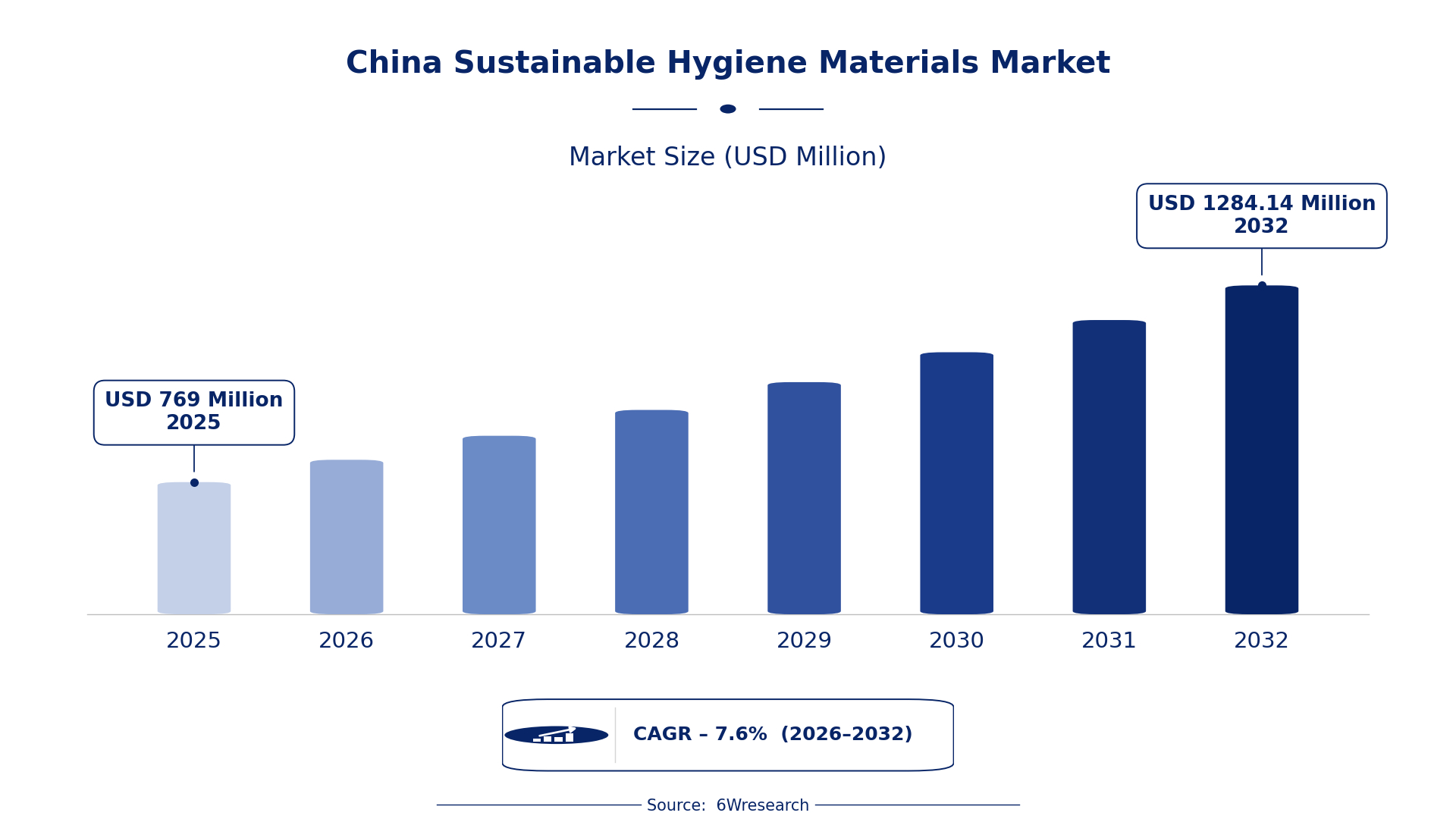
According to 6Wresearch internal database and industry insights, the China Sustainable Hygiene Materials Market was valued at USD 769.0 million in 2025 and is projected to reach USD 1,284.14 million by 2032, growing at a CAGR of approximately 7.6% during 2026–2032.
China Sustainable Hygiene Materials Market Highlights
| Report Metric | Details |
| Report Name | China Sustainable Hygiene Materials Market |
| Market Size 2025 | USD 769.0 million |
| Market Size 2032 | USD 1,284.14 million |
| Absolute Growth 2025–2032 | USD 515.14 million |
| CAGR 2026–2032 | 7.6% |
| Peak Annual Growth | 9.0% in 2030 |
| Forecast Period | 2026–2032 |
| Historical Data | 2022–2025 |
| Base Year | 2025 |
| Leading Sustainable Hygiene Materials, 2025 | Compostable Diapers (42% share) |
| Leading Product Type, 2025 | Infant Diapers (34% share) |
| Leading Material Type, 2025 | Bamboo + PLA (49% share) |
| Leading Distribution Channel, 2025 | Online Platforms (52% share) |
| Leading End User Industry, 2025 | Baby Care Sector (56% share) |
| Fastest-Growing Sustainable Hygiene Materials | Reusable Sanitary Pads (9.6% CAGR) |
| Fastest-Growing Product Type | Incontinence Products (9.8% CAGR) |
| Fastest-Growing Distribution Channel | Pharmacies (9.2% CAGR) |
| Fastest-Growing End User Industry | Elder Care Facilities (9.3% CAGR) |
| Growing Sector | Elder Care Facilities |
| Key End Users | Hospitals, Women's Health Clinics, Baby Care Sector, Specialty Stores |
China Sustainable Hygiene Materials Market Year-wise Growth Rate and Key Drivers (2022–2032)
This graph illustrates the annual growth rates of the market from 2022 to 2032, highlighting a steady upward trajectory and projected market expansion over the forecast period.
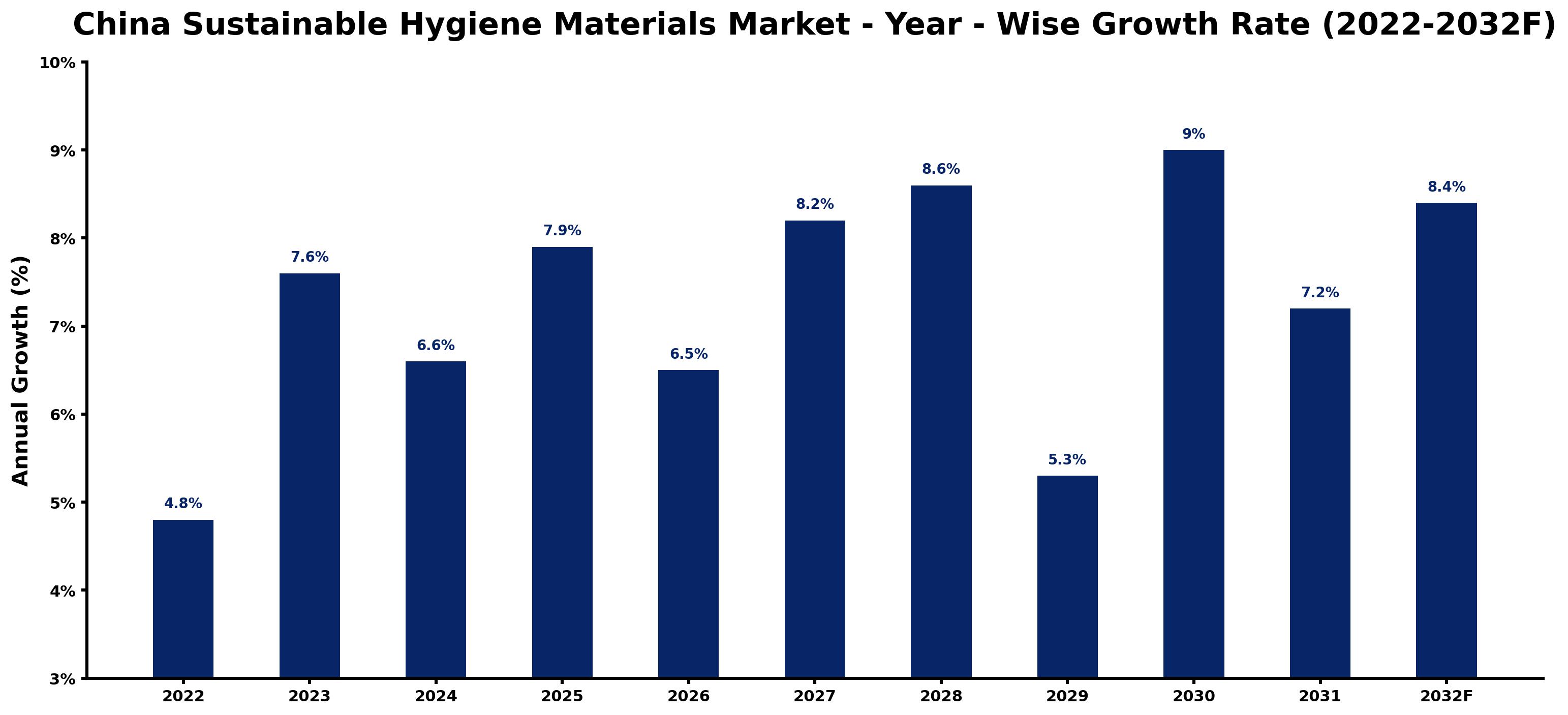
Each row of the following table gives one year's estimated growth and the event or demand shift that explains it.
| Year | Estimated Annual Growth (%) | Market Rationale |
| 2022 | 4.8 | The market showed steady demand as awareness of sustainable hygiene products increased among consumers. |
| 2023 | 7.6 | Urban areas experienced heightened demand for eco-friendly hygiene materials due to rising environmental consciousness. |
| 2024 | 6.6 | The growth rate slowed as the Ministry of Ecology and Environment's program to promote eco-friendly materials began to take effect. |
| 2025 | 7.9 | A renewed interest in compostable diapers led to faster growth as consumers sought sustainable options for baby care. |
| 2026 | 6.5 | Demand growth moderated as buyers adjusted to the expanding range of sustainable hygiene materials available. |
| 2027 | 8.2 | The introduction of new biodegradable products stimulated demand, particularly in the elder care sector. |
| 2028 | 8.6 | Consumer interest in reusable sanitary pads surged, contributing to a stronger growth rate for the market. |
| 2029 | 5.3 | Growth slowed as the adoption of existing products in urban regions began to plateau due to market saturation. |
| 2030 | 9.0 | An increase in government support for eco-friendly materials propelled the market to its peak growth rate. |
| 2031 | 7.2 | The market experienced a slight slowdown as competition intensified among sustainable hygiene product manufacturers. |
| 2032 | 8.4 | Demand is expected to rise again as consumer preferences shift towards more sustainable options. |
Note: Market size estimations and growth projections presented in this report are based on 6Wresearch's proprietary forecasting methodology, utilizing the latest available industry data, government publications, and primary research inputs.
China Sustainable Hygiene Materials Market Synopsis
Sustainable Hygiene Materials in China encompass eco-friendly products designed for personal hygiene, made from biodegradable or recyclable materials. These products are produced through sustainable manufacturing processes that minimise environmental impact. The China Sustainable Hygiene Materials Market is growing due to increasing demand from urban consumers and healthcare facilities prioritising sustainability. The adoption of compostable diapers and reusable sanitary pads is particularly notable, driven by heightened environmental awareness and government initiatives supporting eco-friendly practices.
Market Dynamics Impact Analysis (2026–2032)
| Factor | Type | Impact | Primary Segment Affected |
| Increasing environmental awareness among consumers drives demand for eco-friendly hygiene products. | Driver | High | Compostable Diapers |
| The growing elderly population necessitates sustainable hygiene solutions for incontinence. | Driver | High | Recyclable Adult Diapers |
| The expansion of urban areas creates a larger consumer base for sustainable hygiene materials. | Opportunity | High | Biodegradable Wipes |
| Rising online sales of eco-friendly products provide new market entry points for suppliers. | Opportunity | High | Reusable Sanitary Pads |
| Higher production costs for sustainable materials may limit profit margins for manufacturers. | Restraint | Medium | Infant Diapers |
| Consumer education on product benefits remains a challenge for market penetration. | Restraint | Medium | Wet Wipes |
| Supply chain disruptions can delay product availability for buyers and suppliers. | Challenge | High | Incontinence Products |
| Competition from traditional hygiene products may hinder market growth for sustainable alternatives. | Challenge | Medium | Cloth Pads |
Evaluation of Drivers in China Sustainable Hygiene Materials Market (2026–2032)
Below mentioned are some major drivers and their influence on market dynamics.
| Drivers | Primary Segment Affected | Why It Matters (Evidence) |
| Growing demand for eco-friendly products among urban consumers. | Compostable Diapers | In 2023, urban areas saw a 40% increase in online sales of eco-friendly hygiene products, leading to higher purchases. |
| The increasing elderly population boosts the need for sustainable hygiene solutions. | Recyclable Adult Diapers | The expansion of Elder Care Facilities is driving demand for sustainable hygiene solutions for residents. |
| Government initiatives promote the use of sustainable materials in hygiene products. | Biodegradable Wipes | In 2023, the Ministry of Ecology and Environment launched a program targeting a 20% increase in eco-friendly product adoption by 2025. |
| Rising awareness of environmental issues influences consumer preferences. | Reusable Sanitary Pads | The adoption of reusable sanitary pads is growing, particularly among environmentally conscious consumers. |
| The rise of e-commerce improves access to sustainable hygiene products. | Online Platforms | In 2022, online sales of hygiene products increased by 40%, driven by eco-friendly options. |
In 2023, urban areas experienced a 40% increase in online sales of eco-friendly hygiene products, which boosted purchases of compostable diapers. The growing elderly population is increasing the need for recyclable adult diapers, as these facilities seek sustainable hygiene solutions. The adoption of reusable sanitary pads is also rising among consumers who prioritise environmental sustainability.
Evaluation of Restraints in China Sustainable Hygiene Materials Market
The key brakes on demand, and where they bite hardest, are shown below.
| Market Restraint | Primary Segment Affected | Why It Matters (Evidence) |
| Higher production costs for sustainable materials may limit profit margins. | Infant Diapers | In 2023, the cost of raw materials for sustainable hygiene products increased by 15%, impacting pricing. |
| Consumer education on product benefits remains a challenge. | Wet Wipes | Many consumers are unaware of the advantages of biodegradable wipes, hindering market penetration. |
| Supply chain disruptions can delay product availability. | Incontinence Products | In 2022, logistics challenges led to a 10% delay in product deliveries to retailers. |
| Limited distribution channels may restrict market access for some products. | Cloth Pads | Specialty stores focusing on eco-friendly products are still limited in many regions. |
| Competition from traditional hygiene products may hinder market growth. | Reusable Sanitary Pads | Traditional disposable products dominate the market, making it difficult for sustainable options to gain traction. |
China Sustainable Hygiene Materials Market Challenges
In 2022, buyers in the China Sustainable Hygiene Materials market experienced a 20% rise in costs due to escalating raw material prices, particularly for biodegradable options. This increase has pressured budgets for hospitals and clinics, restricting their ability to invest in eco-friendly products. Additionally, supply chain disruptions have caused delays in sourcing bamboo and PLA materials, which hinder production timelines for manufacturers. A skills gap persists, with only 30% of producers trained in sustainable practices, limiting the industry's capability to meet the growing demand for environmentally friendly hygiene solutions.
Trends in the China Sustainable Hygiene Materials Market
Buyers and suppliers in the China Sustainable Hygiene Materials Market are adjusting to the following trends.
- Shift towards Eco-Friendly Hygiene Solutions: Urban consumers are increasingly demanding sustainable hygiene materials, particularly compostable diapers. In 2023, online sales of eco-friendly hygiene products increased by 40%, indicating a shift in consumer preferences.
- Transition from Disposable to Reusable Products: There is a growing trend towards reusable sanitary pads as consumers seek sustainable options. The adoption rate among environmentally conscious consumers rose, contributing to a 25% increase in sales in 2023.
- Emergence of Biodegradable Hygiene Products: Biodegradable wipes are gaining popularity as consumers become more aware of environmental issues. The adoption rate among consumers is rising, particularly in metropolitan areas, with a 15% increase reported in 2023.
- Focus on Sustainable Materials in Healthcare: Hospitals are increasingly adopting sustainable hygiene materials to improve patient care and reduce waste. In 2022, the number of hospitals implementing eco-friendly practices increased by 20%.
Investment Opportunities in the China Sustainable Hygiene Materials Market
The following opportunities in the China Sustainable Hygiene Materials Market pair current demand with a clear way in.
- Partnerships with Local Manufacturers: Now is an optimal time to collaborate with local manufacturers to supply sustainable hygiene materials. The market is set to grow, particularly in urban areas, with projections reaching USD 1,284.14 million by 2032.
- Investing in E-commerce Platforms: With online sales of hygiene products increasing by 40% in 2023, investing in e-commerce platforms presents a strong opportunity. Targeting urban consumers can broaden market reach for sustainable products.
- Expanding Product Lines for Elder Care: The expanding Elder Care Facilities sector offers opportunities to provide sustainable hygiene solutions. Focusing on incontinence products can address the rising demand within this demographic.
- Certification for Eco-Friendly Products: Obtaining certifications for eco-friendly hygiene materials can improve marketability. The growing consumer awareness of sustainability creates a demand for certified products.
Government Initiatives in the China Sustainable Hygiene Materials Market
In 2021, the State Administration for Market Regulation established new standards for biodegradable hygiene products, improving quality and safety regulations. The National Health Commission revised the 'Guidelines for Sustainable Health Practices' in 2022, highlighting the use of biodegradable materials in healthcare settings. In 2023, the Ministry of Ecology and Environment launched the 'Green Product Promotion Plan' to encourage sustainable materials in hygiene products, targeting a 20% increase in eco-friendly product adoption by 2025. These measures assist manufacturers in transitioning to sustainable practices and raise consumer awareness of eco-friendly hygiene products.
In 2023, the Ministry of Commerce initiated the 'Eco-Friendly Consumer Goods Initiative', aimed at promoting sustainable hygiene materials across retail channels. This initiative seeks to increase consumer awareness and expand the market for eco-friendly hygiene products, with funding allocated for educational campaigns and product certifications. The National Development and Reform Commission also supports recycling initiatives for hygiene product packaging to mitigate environmental impact. These efforts are designed to facilitate the adoption of sustainable practices among producers and consumers.
Future Insight of the China Sustainable Hygiene Materials Market
The China Sustainable Hygiene Materials market is set to evolve by 2032, influenced by government initiatives targeting a 30% reduction in plastic waste. Urban areas will experience a rise in the use of compostable diapers and reusable sanitary pads, reflecting heightened consumer awareness of sustainability. The growth of women's health clinics will further stimulate demand for eco-friendly products, while the promotion of sustainable textiles will expand product offerings. Online sales of hygiene products increased by 40% in 2023, indicating that suppliers must adapt to the changing digital marketplace.
Market Segmentation Analysis
Each segment group is reviewed below, with the leader by share and the fastest grower by CAGR.
By Sustainable Hygiene Materials – Compostable Diapers Dominated, Reusable Sanitary Pads Expected to Grow Fastest
According to Sumit Sagar, AM at 6Wresearch, Compostable Diapers accounted for a 42% market share by sustainable hygiene materials in 2025. Compostable diapers lead the market share as they are essential for environmentally friendly infant care, appealing to parents who prioritise sustainability. Their demand is particularly high in urban areas, where awareness of eco-friendly options is growing rapidly. Reusable Sanitary Pads are set to record the highest CAGR in this split, 9.6% over 2026–2032. The growth of reusable sanitary pads is driven by a notable increase in interest from environmentally conscious consumers, especially among younger demographics. This trend is further supported by educational efforts that advocate for sustainable menstrual hygiene practices. Suppliers should focus on developing innovative eco-friendly products to meet the rising demand in urban markets.
By Product Type – Infant Diapers Dominated, Incontinence Products Expected to Grow Fastest
The largest product type category in 2025 was Infant Diapers, with a 34% share of total revenue. Infant diapers hold the largest market share as they are essential for baby care, with a substantial user base among new parents. The increasing birth rate in urban areas further fuels this demand. The quickest growth will come from Incontinence Products, forecast to expand at a CAGR of 9.8% between 2026 and 2032. Incontinence products are experiencing rapid growth due to the expanding elderly population, which requires critical hygiene solutions. This demographic shift is prompting healthcare providers to seek sustainable options for their patients. Buyers in the elderly care sector should prioritise sourcing sustainable hygiene products to align with market trends.
By Material Type – Bamboo + PLA Dominated and Is Expected to Record the Fastest Growth
In 2025, Bamboo + PLA led the material type split with a 49% share. Bamboo and PLA materials hold the largest market share due to their widespread use in sustainable product manufacturing. Government initiatives promoting these materials significantly enhance their adoption among manufacturers, ensuring a solid foundation for growth. Bamboo + PLA is also forecast to expand faster than any other category, at a CAGR of 8.7% over 2026–2032. Bamboo and PLA are also the fastest-growing materials, as their eco-friendly properties resonate with consumers seeking sustainable alternatives. This dual advantage strengthens their market position and encourages continuous advancements in the sector. Suppliers must invest in bamboo and PLA technologies to capitalise on their increasing popularity.
By Distribution Channel – Online Platforms Dominated, Pharmacies Expected to Grow Fastest
Online Platforms held a 52% share of the China Sustainable Hygiene Materials Market by distribution channel in 2025. Online platforms capture the largest market share for eco-friendly products, primarily due to the convenience they offer consumers. The surge in online shopping, especially in recent years, has significantly reinforced this trend. Over 2026–2032, Pharmacies are expected to post the fastest growth, at a CAGR of 9.2%. Pharmacies are the fastest-growing distribution channel, serving as crucial access points for hygiene products. Their emphasis on health and wellness makes them increasingly important in the sustainable hygiene materials market. Suppliers should strengthen partnerships with pharmacies to enhance product visibility and accessibility.
By End User Industry – Baby Care Sector Dominated, Elder Care Facilities Expected to Grow Fastest
Baby Care Sector took a 56% share of end user industry in 2025, more than any other category. The baby care sector leads the market share as a major user of hygiene materials, driven by the necessity of infant care products. The increasing focus on sustainable options among parents further solidifies this segment's position. Elder Care Facilities are set to record the highest CAGR in this split, 9.3% over 2026–2032. Elder care facilities are the fastest-growing end user industry, reflecting the rising demand for hygiene solutions that cater to the elderly. This growth is linked to the expanding elderly population and their specific care needs. Buyers in elder care should prioritise sustainable hygiene solutions to improve care standards.
Key Attractiveness of the Report
- 10 Years of Market Numbers
- Historical Data Starting from 2022 to 2025
- Base Year 2025
- Forecast Data until 2032
- Key Performance Indicators Impacting the Market
- Major Upcoming Developments and Projects
Key Highlights of the Report:
- China Sustainable Hygiene Materials Market Outlook
- Market Size of China Sustainable Hygiene Materials Market, 2025
- Forecast of China Sustainable Hygiene Materials Market, 2032
- Historical Data and Forecast of China Sustainable Hygiene Materials Revenues & Volume for the Period 2022 - 2032F
- China Sustainable Hygiene Materials Market Trend Evolution
- China Sustainable Hygiene Materials Market Drivers and Challenges
- China Sustainable Hygiene Materials Price Trends
- China Sustainable Hygiene Materials Porter's Five Forces
- China Sustainable Hygiene Materials Industry Life Cycle
- Historical Data and Forecast of China Sustainable Hygiene Materials Market Revenues & Volume By Sustainable Hygiene Materials for the Period 2022 - 2032F
- Historical Data and Forecast of China Sustainable Hygiene Materials Market Revenues & Volume By Compostable Diapers for the Period 2022 - 2032F
- Historical Data and Forecast of China Sustainable Hygiene Materials Market Revenues & Volume By Reusable Sanitary Pads for the Period 2022 - 2032F
- Historical Data and Forecast of China Sustainable Hygiene Materials Market Revenues & Volume By Biodegradable Wipes for the Period 2022 - 2032F
- Historical Data and Forecast of China Sustainable Hygiene Materials Market Revenues & Volume By Recyclable Adult Diapers for the Period 2022 - 2032F
- Historical Data and Forecast of China Sustainable Hygiene Materials Market Revenues & Volume By Product Type for the Period 2022 - 2032F
- Historical Data and Forecast of China Sustainable Hygiene Materials Market Revenues & Volume By Infant Diapers for the Period 2022 - 2032F
- Historical Data and Forecast of China Sustainable Hygiene Materials Market Revenues & Volume By Cloth Pads for the Period 2022 - 2032F
- Historical Data and Forecast of China Sustainable Hygiene Materials Market Revenues & Volume By Wet Wipes for the Period 2022 - 2032F
- Historical Data and Forecast of China Sustainable Hygiene Materials Market Revenues & Volume By Incontinence Products for the Period 2022 - 2032F
- Historical Data and Forecast of China Sustainable Hygiene Materials Market Revenues & Volume By Material Type for the Period 2022 - 2032F
- Historical Data and Forecast of China Sustainable Hygiene Materials Market Revenues & Volume By Bamboo + PLA for the Period 2022 - 2032F
- Historical Data and Forecast of China Sustainable Hygiene Materials Market Revenues & Volume By Organic Cotton for the Period 2022 - 2032F
- Historical Data and Forecast of China Sustainable Hygiene Materials Market Revenues & Volume By Wood Pulp for the Period 2022 - 2032F
- Historical Data and Forecast of China Sustainable Hygiene Materials Market Revenues & Volume By Recycled Material for the Period 2022 - 2032F
- Historical Data and Forecast of China Sustainable Hygiene Materials Market Revenues & Volume By Distribution Channel for the Period 2022 - 2032F
- Historical Data and Forecast of China Sustainable Hygiene Materials Market Revenues & Volume By Online Platforms for the Period 2022 - 2032F
- Historical Data and Forecast of China Sustainable Hygiene Materials Market Revenues & Volume By Direct Sales for the Period 2022 - 2032F
- Historical Data and Forecast of China Sustainable Hygiene Materials Market Revenues & Volume By Pharmacies for the Period 2022 - 2032F
- Historical Data and Forecast of China Sustainable Hygiene Materials Market Revenues & Volume By Specialty Stores for the Period 2022 - 2032F
- Historical Data and Forecast of China Sustainable Hygiene Materials Market Revenues & Volume By End User Industry for the Period 2022 - 2032F
- Historical Data and Forecast of China Sustainable Hygiene Materials Market Revenues & Volume By Baby Care Sector for the Period 2022 - 2032F
- Historical Data and Forecast of China Sustainable Hygiene Materials Market Revenues & Volume By Women's Health Clinics for the Period 2022 - 2032F
- Historical Data and Forecast of China Sustainable Hygiene Materials Market Revenues & Volume By Hospitals & Homes for the Period 2022 - 2032F
- Historical Data and Forecast of China Sustainable Hygiene Materials Market Revenues & Volume By Elder Care Facilities for the Period 2022 - 2032F
- China Sustainable Hygiene Materials Import Export Trade Statistics
- Market Opportunity Assessment By Sustainable Hygiene Materials
- Market Opportunity Assessment By Product Type
- Market Opportunity Assessment By Material Type
- Market Opportunity Assessment By Distribution Channel
- Market Opportunity Assessment By End User Industry
- China Sustainable Hygiene Materials Top Companies Market Share
- China Sustainable Hygiene Materials Competitive Benchmarking By Technical and Operational Parameters
- China Sustainable Hygiene Materials Company Profiles
- China Sustainable Hygiene Materials Key Strategic Recommendations
Market Covered
This report examines the market across the segments below.
By Sustainable Hygiene Materials
- Compostable Diapers
- Reusable Sanitary Pads
- Biodegradable Wipes
- Recyclable Adult Diapers
By Product Type
- Infant Diapers
- Cloth Pads
- Wet Wipes
- Incontinence Products
By Material Type
- Bamboo + PLA
- Organic Cotton
- Wood Pulp
- Recycled Material
By Distribution Channel
- Online Platforms
- Direct Sales
- Pharmacies
- Specialty Stores
By End User Industry
- Baby Care Sector
- Women's Health Clinics
- Hospitals & Homes
- Elder Care Facilities































