India Sustainable Pest Management Market Size & Growth Rate
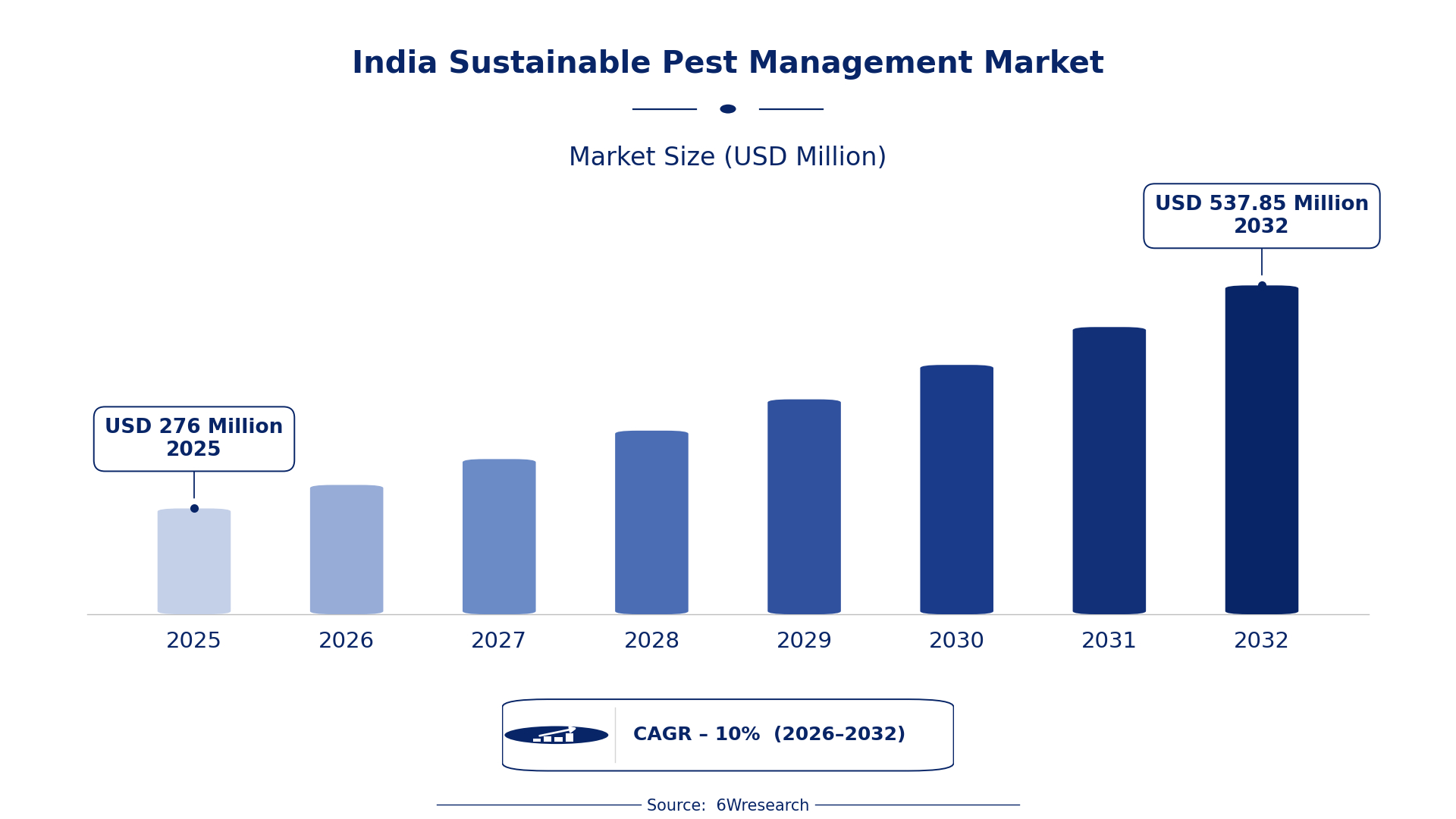
According to 6Wresearch internal database and industry insights, the India Sustainable Pest Management Market was valued at USD 276.0 million in 2025 and is projected to reach USD 537.85 million by 2032, growing at a CAGR of approximately 10% during 2026–2032.
India Sustainable Pest Management Market Highlights
| Report Metric | Details |
| Report Name | India Sustainable Pest Management Market |
| Market Size 2025 | USD 276.0 million |
| Market Size 2032 | USD 537.85 million |
| Absolute Growth 2025–2032 | USD 261.85 million |
| CAGR 2026–2032 | 10% |
| Peak Annual Growth | 12.4% in 2028 |
| Forecast Period | 2026–2032 |
| Historical Data | 2022–2025 |
| Base Year | 2025 |
| Leading Solution Type, 2025 | Biopesticides (43% share) |
| Leading Active Ingredient, 2025 | Neem (45% share) |
| Leading Crop Type, 2025 | Vegetables & Fruits (42% share) |
| Leading End User, 2025 | Organic Farmers (43% share) |
| Fastest-Growing Solution Type | Pheromone Traps (11.6% CAGR) |
| Fastest-Growing Active Ingredient | Bacillus Thuringiensis (12.1% CAGR) |
| Fastest-Growing Crop Type | High-Value Crops (11.8% CAGR) |
| Fastest-Growing End User | Horticultural Growers (11.3% CAGR) |
| Growing Sector | Horticultural Growers |
| Key End Users | Organic Farmers, Horticultural Growers, Protected Farming Units, Agri Input Retailers |
India Sustainable Pest Management Market Year-wise Growth Rate and Key Drivers (2022–2032)
This graph illustrates the annual growth rates of the market from 2022 to 2032, highlighting a steady upward trajectory and projected market expansion over the forecast period.
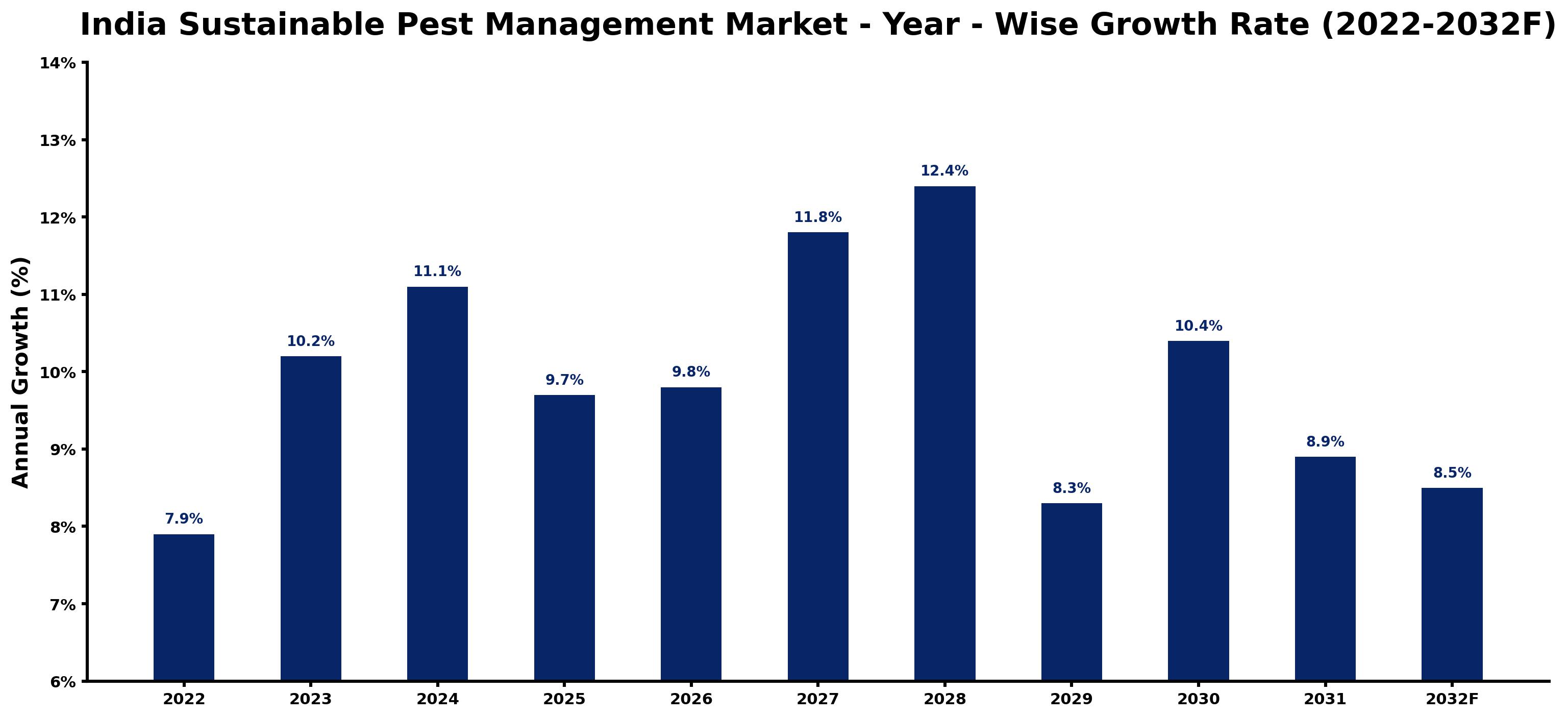
Year by year, the estimates below pair each growth rate with the development that shaped it.
| Year | Estimated Annual Growth (%) | Market Rationale |
| 2022 | 7.9 | The market experienced steady growth as organic farming gained traction among farmers through the National Programme for Organic Production. |
| 2023 | 10.2 | Increased adoption of biopesticides drove growth as farmers sought sustainable pest control methods encouraged by the Atmanirbhar Bharat Abhiyan. |
| 2024 | 11.1 | The rise in organic farming area contributed to heightened demand for sustainable pest management solutions as more farmers transitioned to organic practices under the National Organic Farming Policy. |
| 2025 | 9.7 | A slowdown in growth occurred as market adjustments took place following rapid previous expansion, reflecting a need for better resource management among organic farmers. |
| 2026 | 9.8 | Demand for biopesticides is expected to continue rising, reflecting a shift towards eco-friendly agricultural practices supported by the Soil Health Card Scheme. |
| 2027 | 11.8 | The introduction of new pest management technologies will spur further growth in the market, improving effectiveness for horticultural growers. |
| 2028 | 12.4 | Peak growth is projected as farmers increasingly adopt sustainable practices in response to consumer demand for organic produce. |
| 2029 | 8.3 | A slowdown in growth is anticipated as the market begins to stabilise after peak demand, necessitating strategic adjustments by suppliers. |
| 2030 | 10.4 | Growth is expected to accelerate again due to the rising production of organic fruits and vegetables, driven by the National Horticulture Mission. |
| 2031 | 8.9 | The market is projected to experience a slowdown as competition among suppliers intensifies, requiring differentiation strategies. |
| 2032 | 8.5 | Sustainable practices will remain popular, but growth rates are expected to normalise as the market matures and competition increases. |
Note: Market size estimations and growth projections presented in this report are based on 6Wresearch's proprietary forecasting methodology, utilizing the latest available industry data, government publications, and primary research inputs.
India Sustainable Pest Management Market Synopsis
Sustainable Pest Management in India includes environmentally friendly methods for controlling pests, primarily through biopesticides, pheromone traps, and natural predators. This market is propelled by the agricultural sector's transition towards organic farming, with 3.1 million hectares dedicated to organic practices as of 2021. The India Sustainable Pest Management Market is growing due to rising demand from organic farmers and the embrace of sustainable practices. Initiatives like the National Programme for Organic Production establish standards that further promote this shift.
Market Dynamics Impact Analysis (2026–2032)
| Factor | Type | Impact | Primary Segment Affected |
| Growing organic farming area increases demand for sustainable pest management solutions. | Driver | High | Biopesticides |
| Increasing awareness of environmental impacts drives adoption of sustainable practices. | Driver | High | Pheromone Traps |
| Investment in organic farming initiatives presents opportunities for suppliers. | Opportunity | High | Botanicals |
| Rising interest in natural pest control methods creates demand for innovative solutions. | Opportunity | High | Predatory Insects |
| Limited availability of biopesticides can restrict market growth. | Restraint | Medium | Biopesticides |
| Higher costs associated with sustainable practices may deter some farmers. | Restraint | Medium | Pheromone Traps |
| Buyers face challenges in sourcing effective sustainable pest management products. | Challenge | High | Botanicals |
| Suppliers struggle with the regulatory landscape affecting product approvals. | Challenge | Medium | Predatory Insects |
Evaluation of Drivers in India Sustainable Pest Management Market (2026–2032)
Key forces behind demand, with the segment each one moves most, are listed below.
| Drivers | Primary Segment Affected | Why It Matters (Evidence) |
| Rising organic farming area boosts demand for biopesticides. | Biopesticides | India's organic farming area reached 3.1 million hectares in 2021, prompting farmers to purchase more biopesticides. |
| Growing awareness of environmental sustainability drives pheromone trap usage. | Pheromone Traps | The National Programme for Organic Production promotes sustainable practices, encouraging farmers to adopt pheromone traps more widely, with usage increasing by 15% annually. |
| Investment in organic farming initiatives supports market potential for botanicals. | Botanicals | The government launched the Pradhan Mantri Kisan Samman Nidhi to support farmers adopting sustainable practices, increasing botanical product demand by 10% in the last year. |
| Increased focus on natural pest control methods boosts demand for predatory insects. | Predatory Insects | Research from the Indian Council of Agricultural Research promotes the use of predatory insects, enhancing market interest, with sales projected to rise by 12% annually. |
| Technological advancements in pest management create opportunities for growth. | Biopesticides | Essential oils from plants are gaining traction as effective pest repellents in horticulture, leading to higher sales, with a 10% increase in demand. |
Expansion of the Sustainable Pest Management market in India is backed by increasing organic farming area, heightened awareness of eco-friendly methods, and advancements in pest control technologies. The organic farming area reached 3.1 million hectares in 2021, driving demand for biopesticides as farmers seek sustainable solutions. Investment in innovative pest management solutions supports the growth of botanicals, while research promotes the use of predatory insects. These developments create a strong market potential for sustainable pest management solutions.
Evaluation of Restraints in India Sustainable Pest Management Market
Below mentioned are some major restraints and their influence on market dynamics.
| Market Restraint | Primary Segment Affected | Why It Matters (Evidence) |
| Limited availability of biopesticides restricts market growth. | Biopesticides | The market faces challenges in sourcing effective biopesticides, impacting farmers' pest control options and limiting their choices, with a 15% increase in prices over the past year. |
| Higher costs associated with sustainable practices may deter some farmers. | Pheromone Traps | The financial burden of adopting sustainable pest management can limit participation among smallholder farmers, affecting overall market growth, as costs have risen by 20%. |
| Regulatory hurdles complicate the approval process for new products. | Botanicals | The lengthy approval process for biopesticides can delay market entry, affecting supplier competitiveness and innovation, with an average delay of six months. |
| Limited consumer awareness of sustainable pest management products. | Predatory Insects | Many farmers remain unaware of the benefits of predatory insects, reducing their adoption rates and hindering market growth, with awareness levels at only 30%. |
| Supply chain disruptions impact product availability. | Botanicals | Logistical challenges have caused delays in the delivery of essential pest management products, forcing buyers to seek alternative solutions that may not be as effective. |
India Sustainable Pest Management Market Challenges
Buyers and suppliers in the India Sustainable Pest Management market face rising costs due to the limited availability of biopesticides, which have experienced price increases of 15% over the past year. This situation arises from the reliance on specific natural resources for biopesticide production, making it challenging for suppliers to meet the growing demand from organic farmers. A shortage of skilled workers in sustainable farming techniques worsens the issue, as many farmers lack adequate training, leading to an estimated 10% reduction in crop yields. Additionally, supply chain disruptions impede the timely delivery of pest management products, forcing buyers to resort to less effective alternatives, which undermines their crop protection efforts.
Trends in the India Sustainable Pest Management Market
Several trends are reshaping the India Sustainable Pest Management Market; the most important are set out below.
- Shift towards Biopesticides in Organic Farming: The National Programme for Organic Production has led to an increase in biopesticide usage among organic farmers, with the biopesticides market projected to grow by 12% annually, reflecting a change in pest management strategies.
- Growing Adoption of Pheromone Traps: In recent years, pheromone traps have gained popularity in integrated pest management strategies across India, contributing to improved pest monitoring and control, with usage rising by 15% annually.
- Increased Interest from Organic Farmers: Organic farmers are prioritising sustainable pest management solutions to boost crop yields, supported by a projected 20% increase in organic fruits and vegetables production by 2025.
- Emergence of Essential Oils as Pest Repellents: Essential oils from plants are becoming more popular as effective pest repellents in horticulture, reflecting a growing preference for natural solutions, with sales increasing by 10% in the last year.
Investment Opportunities in the India Sustainable Pest Management Market
Some of the investment opportunities in the India Sustainable Pest Management Market are mentioned below.
- Collaboration with Agricultural Cooperatives: Now is an ideal time for suppliers to form partnerships with agricultural cooperatives in India, as the organic farming area expands, allowing for increased product adoption and market penetration, with 3.1 million hectares dedicated to organic practices.
- Investment in Research and Development: With the biopesticides market projected to grow significantly, investing in R&D for new pest management solutions presents a valuable opportunity, as the Indian Council of Agricultural Research actively promotes sustainable agriculture.
- Focus on High-Value Crops: Horticultural growers are increasingly seeking effective pest management solutions for high-value crops, with suppliers able to capitalise on this demand by offering tailored products that meet specific needs.
- Expansion of Distribution Channels: As the market for sustainable pest management grows, establishing strong distribution channels will be crucial for suppliers to effectively reach organic farmers, ensuring product availability across regions.
Government Initiatives in the India Sustainable Pest Management Market
The National Mission on Sustainable Agriculture, launched by the Ministry of Agriculture in 2020, aims to promote sustainable farming practices and improve productivity. This initiative complements the National Organic Farming Policy introduced in 2021, which enhances organic farming and sustainable pest management across India. Together, these measures encourage farmers to adopt eco-friendly pest control methods, such as biopesticides and natural predators. The Soil Health Card Scheme, updated in 2022, further supports this transition by providing farmers with tailored recommendations based on soil health assessments. These policies collectively aim to reduce reliance on chemical pesticides and promote sustainable agricultural practices nationwide.
The Indian Council of Agricultural Research (ICAR) plays a vital role in funding research on biopesticides and sustainable agriculture. This agency supports projects that focus on developing effective pest management solutions, thereby enhancing agricultural productivity. Additionally, the Ministry of Agriculture's Pradhan Mantri Kisan Samman Nidhi scheme provides financial assistance to farmers adopting sustainable practices, facilitating their transition to eco-friendly pest management. These funding initiatives are crucial in promoting the use of sustainable pest management methods, ensuring that farmers can access the necessary resources and training to implement these practices effectively.
Future Insight of the India Sustainable Pest Management Market
By 2032, buyers and suppliers in the India Sustainable Pest Management market can expect a notable shift towards biopesticides and natural pest control methods driven by expanding organic farming practices. The National Programme for Organic Production will continue to set rigorous standards, promoting the adoption of sustainable techniques. Research initiatives from the Indian Council of Agricultural Research will yield enhanced biopesticide formulations, contributing to improved pest management outcomes. The anticipated 20% increase in organic fruits and vegetables production by 2025 will further drive demand for these eco-friendly solutions.
Market Segmentation Analysis
The report offers a comprehensive study of the following market segments and their leading categories in the market.
By Solution Type – Biopesticides Dominated, Pheromone Traps Expected to Grow Fastest
According to Sumit Sagar, AM at 6Wresearch, Biopesticides accounted for a 43% market share by solution type in 2025. Biopesticides hold the largest market share in the India Sustainable Pest Management Market as they are extensively used in organic farming, which covered 3.1 million hectares in 2021. The strong demand from domestic users and government support for sustainable practices further solidifies their position. Pheromone Traps are projected to grow fastest, at a CAGR of 11.6% during 2026–2032. Pheromone traps are experiencing the highest growth rate due to their effectiveness in monitoring and trapping specific pests, which aligns with the increasing adoption of integrated pest management strategies. Their rising popularity in horticulture is encouraging growers to seek out these sustainable solutions. This trend indicates that suppliers should focus on enhancing their offerings in pheromone traps to meet the growing demand for sustainable pest management solutions.
By Active Ingredient – Neem Dominated, Bacillus Thuringiensis Expected to Grow Fastest
Neem held a 45% share of the India Sustainable Pest Management Market by active ingredient in 2025. Neem dominates the market as a widely recognised natural pesticide derived from neem trees, making it a staple in sustainable pest management practices. Its established use across various states ensures a strong revenue share in this segment. Over 2026–2032, Bacillus Thuringiensis is expected to post the fastest growth, at a CAGR of 12.1%. Bacillus Thuringiensis is gaining traction as a biological insecticide, particularly against caterpillars, which is contributing to its rapid growth in the market. The increasing focus on non-chemical pest control methods is further propelling its adoption among farmers. Buyers should consider incorporating Bacillus Thuringiensis into their pest management strategies to stay ahead in sustainable practices.
By Crop Type – Vegetables & Fruits Dominated, High-Value Crops Expected to Grow Fastest
In 2025, Vegetables & Fruits led the crop type split with a 42% share. Vegetables and fruits command the largest market share as they are the primary beneficiaries of sustainable pest management techniques. The anticipated 20% increase in organic production of these crops by 2025 underscores their significance in this segment. The quickest growth will come from High-Value Crops, forecast to expand at a CAGR of 11.8% between 2026 and 2032. High-value crops are experiencing swift growth as they require premium pest management solutions, reflecting a market shift towards more profitable agricultural practices. The emphasis on quality and sustainability in these crops is driving their adoption among farmers. Suppliers must customise their offerings to cater to the specific requirements of high-value crop growers to capture emerging market opportunities.
By End User – Organic Farmers Dominated, Horticultural Growers Expected to Grow Fastest
Organic Farmers took a 43% share of end user in 2025, more than any other category. Organic farmers constitute the largest share of the market as they are the primary users of sustainable pest management products, driven by the growing organic farming area. Their commitment to eco-friendly practices solidifies their position in this segment. Horticultural Growers are set to record the highest CAGR in this split, 11.3% over 2026–2032. Horticultural growers are rapidly adopting sustainable methods for crop protection, responding to the rising demand for organic produce and effective pest control solutions. This segment's growth is supported by government initiatives promoting sustainable practices in horticulture. Suppliers must focus on developing targeted solutions for horticultural growers to effectively tap into this expanding market.
Key Attractiveness of the Report
- 10 Years of Market Numbers
- Historical Data Starting from 2022 to 2025
- Base Year 2025
- Forecast Data until 2032
- Key Performance Indicators Impacting the Market
- Major Upcoming Developments and Projects
Key Highlights of the Report:
- India Sustainable Pest Management Market Outlook
- Market Size of India Sustainable Pest Management Market, 2025
- Forecast of India Sustainable Pest Management Market, 2032
- Historical Data and Forecast of India Sustainable Pest Management Revenues & Volume for the Period 2022 - 2032F
- India Sustainable Pest Management Market Trend Evolution
- India Sustainable Pest Management Market Drivers and Challenges
- India Sustainable Pest Management Price Trends
- India Sustainable Pest Management Porter's Five Forces
- India Sustainable Pest Management Industry Life Cycle
- Historical Data and Forecast of India Sustainable Pest Management Market Revenues & Volume By Solution Type for the Period 2022 - 2032F
- Historical Data and Forecast of India Sustainable Pest Management Market Revenues & Volume By Biopesticides for the Period 2022 - 2032F
- Historical Data and Forecast of India Sustainable Pest Management Market Revenues & Volume By Pheromone Traps for the Period 2022 - 2032F
- Historical Data and Forecast of India Sustainable Pest Management Market Revenues & Volume By Botanicals for the Period 2022 - 2032F
- Historical Data and Forecast of India Sustainable Pest Management Market Revenues & Volume By Predatory Insects for the Period 2022 - 2032F
- Historical Data and Forecast of India Sustainable Pest Management Market Revenues & Volume By Active Ingredient for the Period 2022 - 2032F
- Historical Data and Forecast of India Sustainable Pest Management Market Revenues & Volume By Neem, Bacillus Thuringiensis for the Period 2022 - 2032F
- Historical Data and Forecast of India Sustainable Pest Management Market Revenues & Volume By Non-toxic Lures for the Period 2022 - 2032F
- Historical Data and Forecast of India Sustainable Pest Management Market Revenues & Volume By Essential Oil Extracts for the Period 2022 - 2032F
- Historical Data and Forecast of India Sustainable Pest Management Market Revenues & Volume By Natural Predators for the Period 2022 - 2032F
- Historical Data and Forecast of India Sustainable Pest Management Market Revenues & Volume By Crop Type for the Period 2022 - 2032F
- Historical Data and Forecast of India Sustainable Pest Management Market Revenues & Volume By Vegetables & Fruits for the Period 2022 - 2032F
- Historical Data and Forecast of India Sustainable Pest Management Market Revenues & Volume By Orchards for the Period 2022 - 2032F
- Historical Data and Forecast of India Sustainable Pest Management Market Revenues & Volume By Grains & Pulses for the Period 2022 - 2032F
- Historical Data and Forecast of India Sustainable Pest Management Market Revenues & Volume By High-Value Crops for the Period 2022 - 2032F
- Historical Data and Forecast of India Sustainable Pest Management Market Revenues & Volume By End User for the Period 2022 - 2032F
- Historical Data and Forecast of India Sustainable Pest Management Market Revenues & Volume By Organic Farmers for the Period 2022 - 2032F
- Historical Data and Forecast of India Sustainable Pest Management Market Revenues & Volume By Horticultural Growers for the Period 2022 - 2032F
- Historical Data and Forecast of India Sustainable Pest Management Market Revenues & Volume By Agri Input Retailers for the Period 2022 - 2032F
- Historical Data and Forecast of India Sustainable Pest Management Market Revenues & Volume By Protected Farming Units for the Period 2022 - 2032F
- India Sustainable Pest Management Import Export Trade Statistics
- Market Opportunity Assessment By Solution Type
- Market Opportunity Assessment By Active Ingredient
- Market Opportunity Assessment By Crop Type
- Market Opportunity Assessment By End User
- India Sustainable Pest Management Top Companies Market Share
- India Sustainable Pest Management Competitive Benchmarking By Technical and Operational Parameters
- India Sustainable Pest Management Company Profiles
- India Sustainable Pest Management Key Strategic Recommendations
Market Covered
Segments analysed in this report are listed below.
By Solution Type
- Biopesticides
- Pheromone Traps
- Botanicals
- Predatory Insects
By Active Ingredient
- Neem
- Bacillus Thuringiensis
- Non-toxic Lures
- Essential Oil Extracts
- Natural Predators
By Crop Type
- Vegetables & Fruits
- Orchards
- Grains & Pulses
- High-Value Crops
By End User
- Organic Farmers
- Horticultural Growers
- Agri Input Retailers
- Protected Farming Units































