China Sustainable Pest Management Market Size & Growth Rate
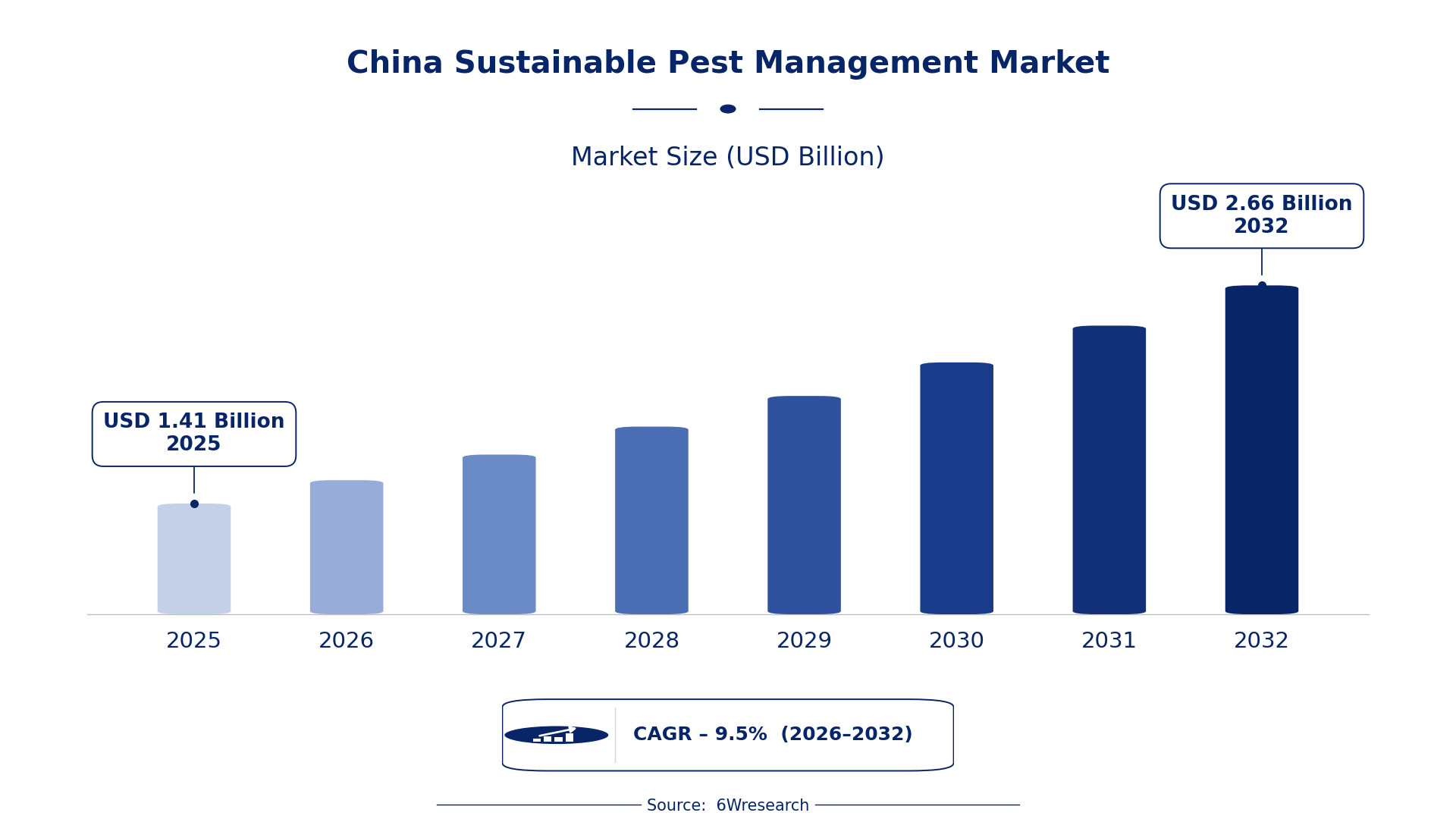
According to 6Wresearch internal database and industry insights, the China Sustainable Pest Management Market was valued at USD 1.41 billion in 2025 and is projected to reach USD 2.66 billion by 2032, growing at a CAGR of approximately 9.5% during 2026–2032.
China Sustainable Pest Management Market Highlights
| Report Metric | Details |
| Report Name | China Sustainable Pest Management Market |
| Market Size 2025 | USD 1.41 billion |
| Market Size 2032 | USD 2.66 billion |
| Absolute Growth 2025–2032 | USD 1.25 billion |
| CAGR 2026–2032 | 9.5% |
| Peak Annual Growth | 12.0% in 2029 |
| Forecast Period | 2026–2032 |
| Historical Data | 2022–2025 |
| Base Year | 2025 |
| Leading Solution Type, 2025 | Biopesticides (38% share) |
| Leading Active Ingredient, 2025 | Neem (46% share) |
| Leading Crop Type, 2025 | Vegetables & Fruits (45% share) |
| Leading End User, 2025 | Organic Farmers (46% share) |
| Fastest-Growing Solution Type | Pheromone Traps (12.3% CAGR) |
| Fastest-Growing Active Ingredient | Bacillus Thuringiensis (11.2% CAGR) |
| Fastest-Growing Crop Type | High-Value Crops (10.5% CAGR) |
| Fastest-Growing End User | Horticultural Growers (11.7% CAGR) |
| Growing Sector | Organic Farming |
| Key End Users | Organic Farmers, Horticultural Growers, Protected Farming Units |
China Sustainable Pest Management Market Year-wise Growth Rate and Key Drivers (2022–2032)
This graph illustrates the annual growth rates of the market from 2022 to 2032, highlighting a steady upward trajectory and projected market expansion over the forecast period.
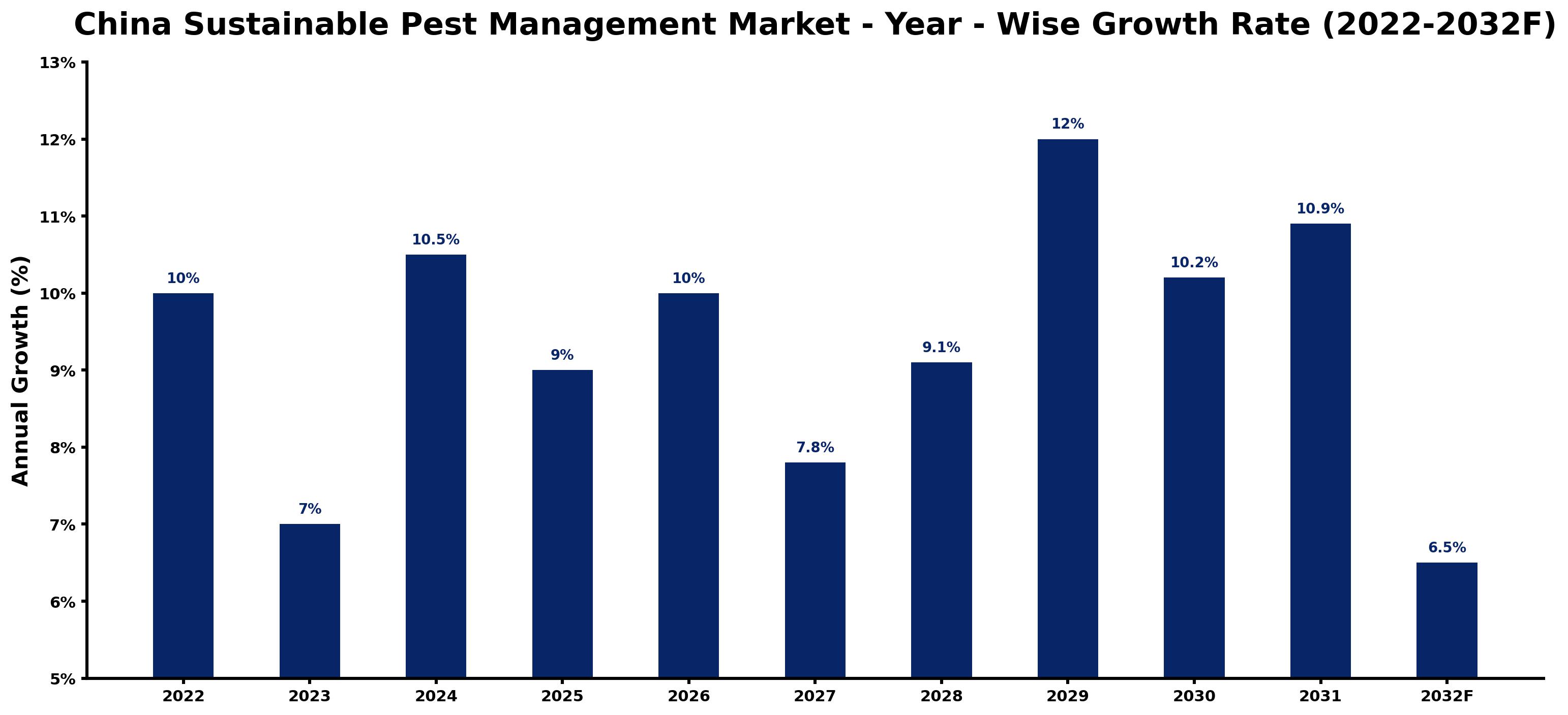
Annual growth estimates for each year appear below with the principal reason behind them, explaining the shifts that set the pace of the market.
| Year | Estimated Annual Growth (%) | Market Rationale |
| 2022 | 10.0 | The market experienced solid growth, driven by the 'Green Agriculture Development Plan' promoting sustainable practices among farmers. |
| 2023 | 7.0 | Growth slowed as farmers adjusted to new sustainable pest management techniques and products, particularly biopesticides. |
| 2024 | 10.5 | A resurgence in growth occurred due to heightened demand for organic produce and sustainable farming methods, supported by government initiatives. |
| 2025 | 9.0 | The market continued to grow, albeit at a slower pace, as farmers sought effective pest control solutions through pheromone traps. |
| 2026 | 10.0 | Growth is expected to accelerate again as biopesticide adoption increases among organic farmers across the country. |
| 2027 | 7.8 | A slowdown in growth is projected as market saturation begins to affect new product introductions. |
| 2028 | 9.1 | The market is expected to rebound with renewed interest in sustainable practices and effective pest management solutions. |
| 2029 | 12.0 | The peak growth year is expected, driven by strong demand for biopesticides and pheromone traps among organic farmers. |
| 2030 | 10.2 | Growth is projected to slow as the market begins to stabilise, reflecting a mature adoption of sustainable practices. |
| 2031 | 10.9 | A rise in growth is anticipated as new technologies and products enter the market, enhancing pest management solutions. |
| 2032 | 6.5 | Growth is projected to slow as the market approaches saturation and established practices dominate. |
Note: Market size estimations and growth projections presented in this report are based on 6Wresearch's proprietary forecasting methodology, utilizing the latest available industry data, government publications, and primary research inputs.
China Sustainable Pest Management Market Synopsis
The China Sustainable Pest Management Market focuses on eco-friendly methods for pest control, employing biopesticides, pheromone traps, and natural predators. This market is expanding due to the growing demand for organic farming and food safety. In 2023, the organic farming sector reached 3.1 million hectares, illustrating a shift towards sustainable agricultural practices. Government initiatives such as the 'Green Agriculture Development Plan' are promoting the use of biopesticides.
Market Dynamics Impact Analysis (2026–2032)
| Factor | Type | Impact | Primary Segment Affected |
| Increasing adoption of biopesticides among organic farmers | Driver | High | Biopesticides |
| Rising demand for pheromone traps due to pest resistance | Driver | High | Pheromone Traps |
| Growing organic farming sector needing sustainable solutions | Opportunity | High | Organic Farmers |
| Expansion of high-value crop production requiring effective pest management | Opportunity | Medium | High-Value Crops |
| Regulatory challenges in biopesticide approvals | Restraint | High | Biopesticides |
| Limited awareness of sustainable practices among traditional farmers | Restraint | Medium | Organic Farmers |
| Sustainable Pest Management in China faces high regulatory barriers | Challenge | High | Biopesticides |
| Market saturation may limit new product introductions | Challenge | Medium | Pheromone Traps |
Evaluation of Drivers in China Sustainable Pest Management Market (2026–2032)
Below mentioned are some major drivers and their influence on market dynamics.
| Drivers | Primary Segment Affected | Why It Matters (Evidence) |
| Increased focus on food safety | Biopesticides | This focus drives organic farmers to seek safer pest control solutions, with biopesticide production reaching 1.2 million tons in 2022. |
| Growing pest resistance to chemical pesticides | Pheromone Traps | The market for pheromone traps is projected to expand as farmers increasingly seek effective monitoring solutions. |
| Rising organic farming acreage | Organic Farmers | With 3.1 million hectares dedicated to organic farming in 2023, demand for sustainable pest management solutions has surged. |
| Government support for sustainable practices | Natural Predators | The 'Integrated Pest Management (IPM) Program' promotes the use of natural predators, encouraging biodiversity in agriculture. |
| Increased yield from sustainable practices | High-Value Crops | The average yield increase of 15% for high-value crops motivates farmers to invest in sustainable pest management solutions. |
Market growth in China for Sustainable Pest Management rests on rising end-use demand from organic farmers, alongside a strong supply response. The organic farming sector is expanding, with over 3.1 million hectares dedicated to organic practices. Biopesticide production has surged, reflecting a strong shift towards environmentally friendly alternatives. The average yield increase of 15% for high-value crops motivates farmers to invest in these solutions, leading to greater market activity.
Evaluation of Restraints in China Sustainable Pest Management Market
The table below lists the restraints and the evidence behind each.
| Market Restraint | Primary Segment Affected | Why It Matters (Evidence) |
| Regulatory hurdles in biopesticide registration | Biopesticides | The 'Pesticide Registration Regulation' complicates the approval process, delaying product availability and limiting market growth by up to six months. |
| Limited knowledge among traditional farmers | Organic Farmers | Many traditional farmers lack awareness of sustainable practices, hindering broader adoption of pest management solutions and limiting market potential. |
| Inconsistent quality of biopesticides | Natural Predators | Variability in product quality can lead to ineffective pest control, discouraging farmers from making the switch to sustainable solutions. |
| High initial costs of sustainable solutions | Horticultural Growers | The upfront investment required for sustainable pest management may deter some growers from adopting these methods, impacting market growth. |
| Market saturation affecting new product launches | Pheromone Traps | As the market matures, new product introductions may face challenges due to established competitors, limiting innovation. |
China Sustainable Pest Management Market Challenges
Buyers in the China Sustainable Pest Management market encounter regulatory hurdles, as compliance with national biopesticide standards can delay product availability by up to six months. Farmers face inconsistent adoption of sustainable practices, limiting their access to eco-friendly solutions and impacting crop yields. Supply chain challenges arise from the annual demand for 200 million natural predators, causing sourcing delays that impede effective pest management. The average price of biopesticides, around 300 RMB per litre, presents a financial challenge for smaller organic farmers transitioning from conventional methods.
Trends in the China Sustainable Pest Management Market
Four trends stand out in the China Sustainable Pest Management Market.
- Shift towards Biopesticides: In 2023, biopesticides comprised a substantial portion of pest management solutions, with production reaching 1.2 million tons. This trend reflects a growing preference for eco-friendly options among farmers.
- Increase in Organic Farmers: The number of organic farmers in China has increased to approximately 1.5 million, signalling a strong demand for sustainable pest management solutions. This growth underscores the shift towards organic practices in agriculture.
- Expansion of Pheromone Trap Usage: The market for pheromone traps is growing as farmers seek effective monitoring tools. This trend is driven by increasing pest resistance to chemical pesticides, making traps more popular.
- Adoption of Integrated Pest Management: The 'Integrated Pest Management (IPM) Program' encourages sustainable practices across key agricultural regions, promoting diverse pest management strategies to enhance crop protection.
Investment Opportunities in the China Sustainable Pest Management Market
Some of the investment opportunities in the China Sustainable Pest Management Market are mentioned below.
- Gap in Sustainable Pest Management Solutions: With the organic farming sector covering 3.1 million hectares, there is a gap in sustainable pest management solutions. Investing in biopesticides can meet this demand effectively.
- Partnerships with Organic Farmers: Collaborating with organic farmers can provide access to a growing market. This sector's demand for sustainable solutions is increasing, presenting opportunities for local partnerships.
- Investment in High-Value Crop Management: High-value crops are expanding, creating a need for effective pest management solutions. Focusing on this segment can yield substantial returns for suppliers.
- Development of New Biopesticide Products: The market for biopesticides is set to grow significantly. Engaging in product development aligned with the 'Green Agriculture Development Plan' can facilitate market entry.
Government Initiatives in the China Sustainable Pest Management Market
The 'Green Agriculture Development Plan' by the Ministry of Agriculture and Rural Affairs aims to increase biopesticide usage by 25% by 2025. This measure promotes sustainable practices among farmers, encouraging the adoption of eco-friendly pest management solutions. The plan supports investment in biopesticide production, ensuring compliance with national standards. Furthermore, the 'Organic Food Certification Program' has been updated to include stricter guidelines for sustainable pest management practices, ensuring that products meet environmental safety standards.
The 'Sustainable Pest Management Initiative' by the National Agro-Technical Extension and Service Center supports farmers in adopting eco-friendly practices. This agency provides funding for training programs and resources to improve sustainable pest management. The 'Integrated Pest Management (IPM) Program' promotes sustainable practices across key agricultural regions, facilitating the adoption of diverse pest control strategies. These initiatives aim to improve pest management effectiveness while ensuring environmental protection.
Future Insight of the China Sustainable Pest Management Market
Several factors are expected to support the China Sustainable Pest Management market in the coming years. The organic farming sector, currently covering 3.1 million hectares, is projected to expand, creating more opportunities for eco-friendly practices. The 'National Plan for Sustainable Agriculture Development' aims to significantly boost biopesticide usage, improving product availability. Additionally, the rising adoption of pheromone traps will enhance pest control efficiency, while the average yield increase of 15% for high-value crops will encourage broader acceptance among farmers.
Market Segmentation Analysis
The analysis below covers each segmentation, its leading category in 2025 and its fastest-growing category through 2032.
By Solution Type – Biopesticides Dominated, Pheromone Traps Expected to Grow Fastest
According to Sumit Sagar, AM at 6Wresearch, with a 38% revenue share in 2025, Biopesticides was the largest solution type category. Biopesticides lead the market share in China due to their effectiveness in controlling pests without harmful chemicals, appealing to environmentally conscious farmers. The Ministry of Agriculture's 'Green Agriculture Development Plan' promotes their use, highlighting their importance in sustainable pest management. The quickest growth will come from Pheromone Traps, forecast to expand at a CAGR of 12.3% between 2026 and 2032. Pheromone traps are experiencing rapid growth as they specifically target pest species, essential in combating rising resistance to chemical pesticides. Their anticipated expansion correlates with the increasing adoption of integrated pest management strategies among farmers. Suppliers must ensure the availability and education of pheromone traps to meet the growing market demand.
By Active Ingredient – Neem Dominated, Bacillus Thuringiensis Expected to Grow Fastest
Neem took a 46% share of active ingredient in 2025, more than any other category. Neem stands as the leading active ingredient in sustainable pest management, widely recognised for its insecticidal properties that resonate with farmers seeking effective solutions. Its ability to control pests while preserving beneficial organisms solidifies its prominent market share. Bacillus Thuringiensis is set to record the highest CAGR in this split, 11.2% over 2026–2032. Bacillus Thuringiensis is experiencing the fastest growth as it provides an effective biological control method for caterpillars, appealing to organic farmers who prefer non-chemical alternatives. The rising trend towards biological control methods is propelling this segment's rapid expansion. Buyers should consider incorporating Bacillus Thuringiensis into their pest management practices to improve effectiveness.
By Crop Type – Vegetables & Fruits Dominated, High-Value Crops Expected to Grow Fastest
In 2025, Vegetables & Fruits led the crop type split with a 45% share. Vegetables and fruits dominate the sustainable pest management market in China as they are major crops benefiting from sustainable practices, ensuring high demand for effective pest control. The focus on these crops aligns with the growing consumer preference for organic produce. High-Value Crops are projected to grow fastest, at a CAGR of 10.5% during 2026–2032. High-value crops are the fastest-growing segment as they are targeted for premium market pest management, reflecting the increasing profitability of sustainable practices. The average yield increase of 15% from sustainable methods further incentivises this growth. Suppliers should tailor their offerings to meet the specific needs of high-value crop producers.
By End User – Organic Farmers Dominated, Horticultural Growers Expected to Grow Fastest
Organic Farmers accounted for a 46% market share by end user in 2025. Organic farmers represent the largest market share as they are the primary users of sustainable pest management solutions, driven by adherence to organic farming standards. With approximately 1.5 million organic farmers in China, their collective demand significantly shapes market trends. Over 2026–2032, Horticultural Growers are expected to post the fastest growth, at a CAGR of 11.7%. Horticultural growers are the fastest-growing end user segment, actively employing sustainable pest management in the flower and ornamental plant sectors. Their increasing adoption of these practices signals a broader commitment to sustainability in horticulture. Suppliers should tailor their marketing strategies to effectively engage horticultural growers and address their specific requirements.
Key Attractiveness of the Report
- 10 Years of Market Numbers
- Historical Data Starting from 2022 to 2025
- Base Year 2025
- Forecast Data until 2032
- Key Performance Indicators Impacting the Market
- Major Upcoming Developments and Projects
Key Highlights of the Report:
- China Sustainable Pest Management Market Outlook
- Market Size of China Sustainable Pest Management Market, 2025
- Forecast of China Sustainable Pest Management Market, 2032
- Historical Data and Forecast of China Sustainable Pest Management Revenues & Volume for the Period 2022 - 2032F
- China Sustainable Pest Management Market Trend Evolution
- China Sustainable Pest Management Market Drivers and Challenges
- China Sustainable Pest Management Price Trends
- China Sustainable Pest Management Porter's Five Forces
- China Sustainable Pest Management Industry Life Cycle
- Historical Data and Forecast of China Sustainable Pest Management Market Revenues & Volume By Solution Type for the Period 2022 - 2032F
- Historical Data and Forecast of China Sustainable Pest Management Market Revenues & Volume By Biopesticides for the Period 2022 - 2032F
- Historical Data and Forecast of China Sustainable Pest Management Market Revenues & Volume By Pheromone Traps for the Period 2022 - 2032F
- Historical Data and Forecast of China Sustainable Pest Management Market Revenues & Volume By Botanicals for the Period 2022 - 2032F
- Historical Data and Forecast of China Sustainable Pest Management Market Revenues & Volume By Predatory Insects for the Period 2022 - 2032F
- Historical Data and Forecast of China Sustainable Pest Management Market Revenues & Volume By Active Ingredient for the Period 2022 - 2032F
- Historical Data and Forecast of China Sustainable Pest Management Market Revenues & Volume By Neem, Bacillus Thuringiensis for the Period 2022 - 2032F
- Historical Data and Forecast of China Sustainable Pest Management Market Revenues & Volume By Non-toxic Lures for the Period 2022 - 2032F
- Historical Data and Forecast of China Sustainable Pest Management Market Revenues & Volume By Essential Oil Extracts for the Period 2022 - 2032F
- Historical Data and Forecast of China Sustainable Pest Management Market Revenues & Volume By Natural Predators for the Period 2022 - 2032F
- Historical Data and Forecast of China Sustainable Pest Management Market Revenues & Volume By Crop Type for the Period 2022 - 2032F
- Historical Data and Forecast of China Sustainable Pest Management Market Revenues & Volume By Vegetables & Fruits for the Period 2022 - 2032F
- Historical Data and Forecast of China Sustainable Pest Management Market Revenues & Volume By Orchards for the Period 2022 - 2032F
- Historical Data and Forecast of China Sustainable Pest Management Market Revenues & Volume By Grains & Pulses for the Period 2022 - 2032F
- Historical Data and Forecast of China Sustainable Pest Management Market Revenues & Volume By High-Value Crops for the Period 2022 - 2032F
- Historical Data and Forecast of China Sustainable Pest Management Market Revenues & Volume By End User for the Period 2022 - 2032F
- Historical Data and Forecast of China Sustainable Pest Management Market Revenues & Volume By Organic Farmers for the Period 2022 - 2032F
- Historical Data and Forecast of China Sustainable Pest Management Market Revenues & Volume By Horticultural Growers for the Period 2022 - 2032F
- Historical Data and Forecast of China Sustainable Pest Management Market Revenues & Volume By Agri Input Retailers for the Period 2022 - 2032F
- Historical Data and Forecast of China Sustainable Pest Management Market Revenues & Volume By Protected Farming Units for the Period 2022 - 2032F
- China Sustainable Pest Management Import Export Trade Statistics
- Market Opportunity Assessment By Solution Type
- Market Opportunity Assessment By Active Ingredient
- Market Opportunity Assessment By Crop Type
- Market Opportunity Assessment By End User
- China Sustainable Pest Management Top Companies Market Share
- China Sustainable Pest Management Competitive Benchmarking By Technical and Operational Parameters
- China Sustainable Pest Management Company Profiles
- China Sustainable Pest Management Key Strategic Recommendations
Market Covered
Segments analysed in this report are listed below.
By Solution Type
- Biopesticides
- Pheromone Traps
- Botanicals
- Predatory Insects
By Active Ingredient
- Neem
- Bacillus Thuringiensis
- Non-toxic Lures
- Essential Oil Extracts
- Natural Predators
By Crop Type
- Vegetables & Fruits
- Orchards
- Grains & Pulses
- High-Value Crops
By End User
- Organic Farmers
- Horticultural Growers
- Agri Input Retailers
- Protected Farming Units































