India Sustainable Products Market Size & Growth Rate
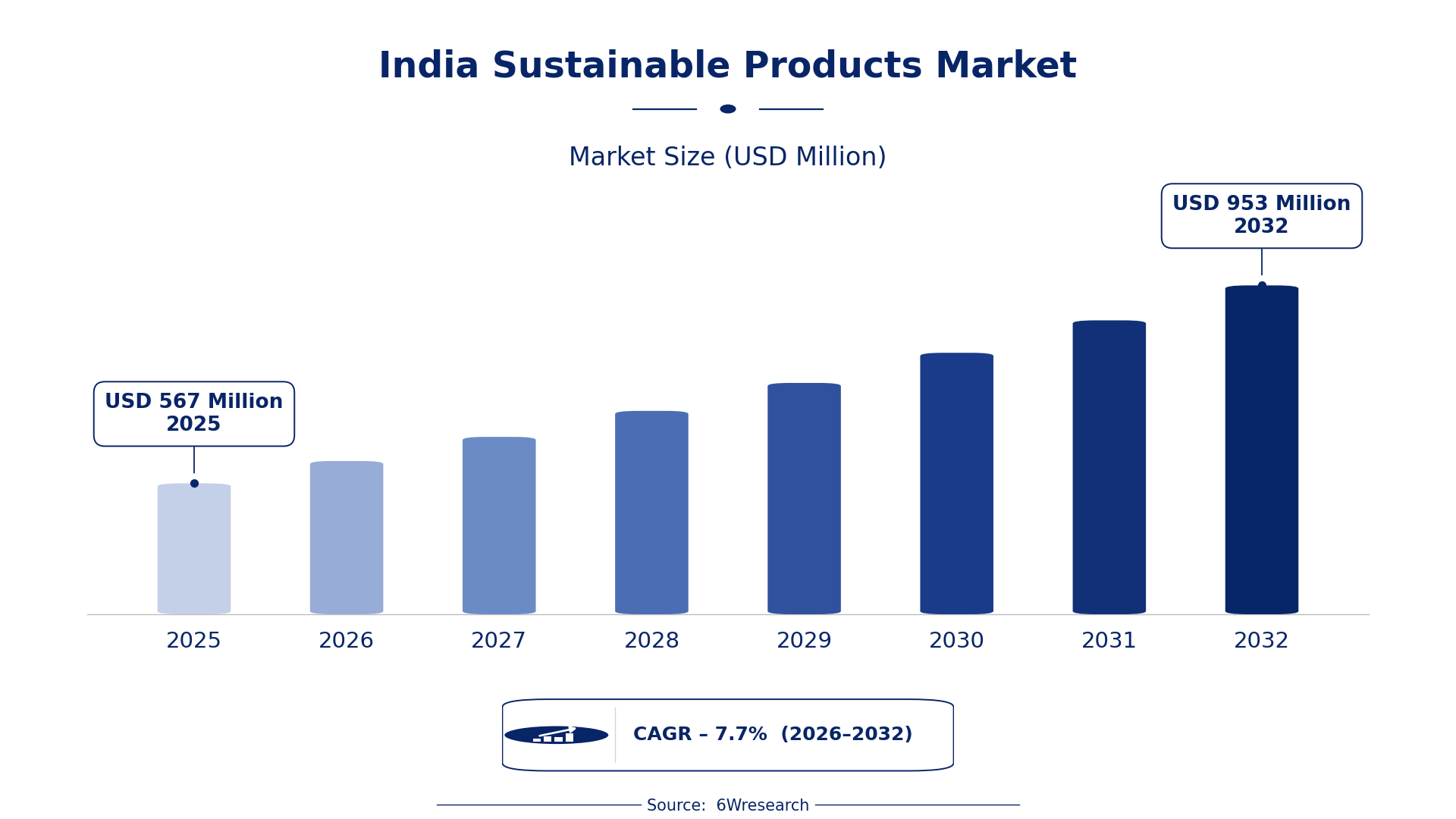
According to 6Wresearch internal database and industry insights, the India Sustainable Products Market was valued at USD 567.0 million in 2025 and is projected to reach USD 953 million by 2032, growing at a CAGR of approximately 7.7% during 2026–2032.
India Sustainable Products Market Highlights
| Report Metric | Details |
| Report Name | India Sustainable Products Market |
| Market Size 2025 | USD 567.0 million |
| Market Size 2032 | USD 953 million |
| Absolute Growth 2025–2032 | USD 386 million |
| CAGR 2026–2032 | 7.7% |
| Peak Annual Growth | 9.9% in 2029 |
| Forecast Period | 2026–2032 |
| Historical Data | 2022–2025 |
| Base Year | 2025 |
| Leading Product Category, 2025 | Reusable Home Goods (50% share) |
| Leading Core Attribute, 2025 | Recycled/Reclaimed Material (49% share) |
| Leading Packaging Type, 2025 | Paper or Bioplastic Wraps (35% share) |
| Leading End User, 2025 | Zero-Waste Retailers (48% share) |
| Fastest-Growing Product Category | Eco-Friendly Apparel (9.1% CAGR) |
| Fastest-Growing Core Attribute | Natural/Organic Fibers (9.2% CAGR) |
| Fastest-Growing Packaging Type | Minimalist Tags (9.3% CAGR) |
| Fastest-Growing End User | Sustainable Fashion (9.1% CAGR) |
| Growing Sector | Eco-Friendly Apparel |
| Key End Users | Zero-Waste Retailers, Sustainable Fashion, Beauty Retailers |
India Sustainable Products Market Year-wise Growth Rate and Key Drivers (2022–2032)
This graph illustrates the annual growth rates of the market from 2022 to 2032, highlighting a steady upward trajectory and projected market expansion over the forecast period.
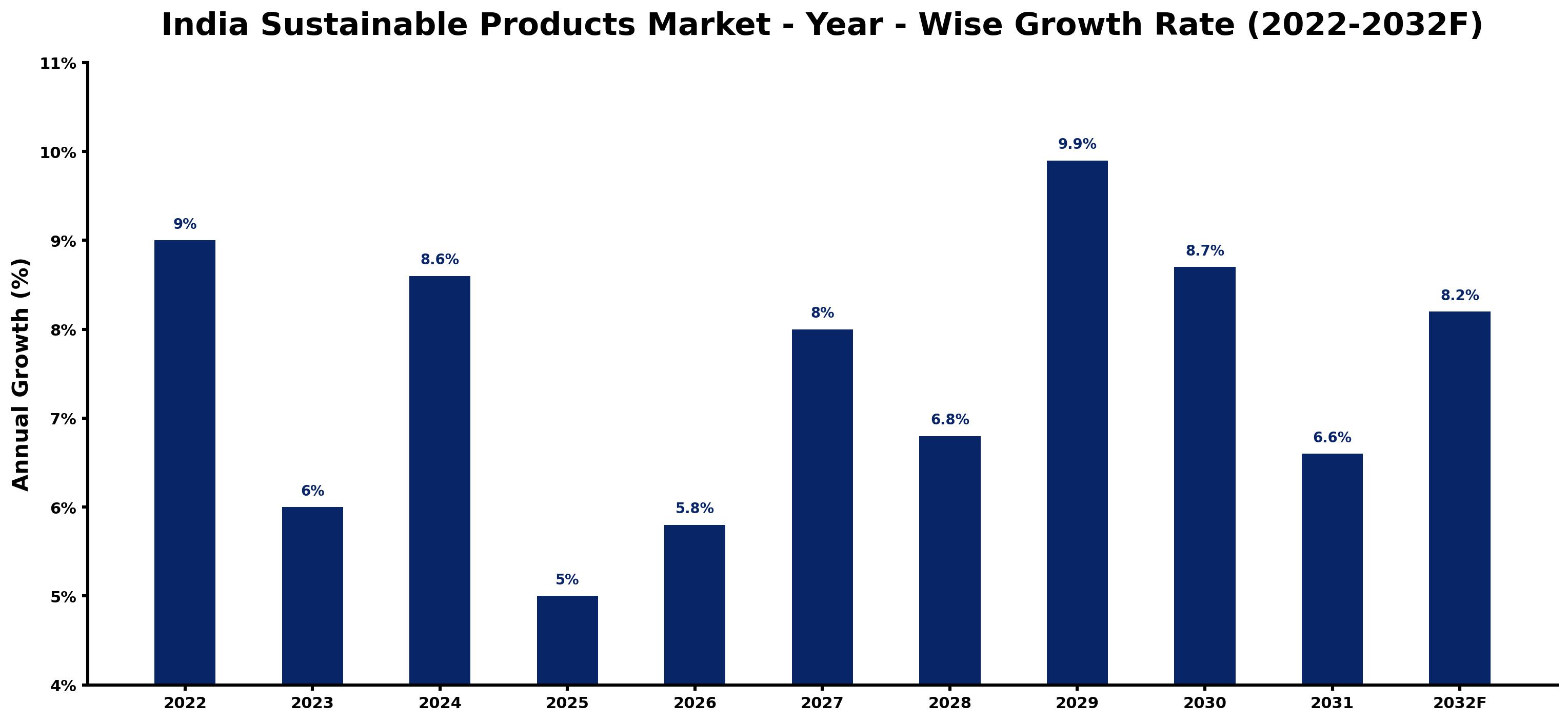
Each row of the following table gives one year's estimated growth and the event or demand shift that explains it.
| Year | Estimated Annual Growth (%) | Market Rationale |
| 2022 | 9.0 | The market experienced strong demand from eco-conscious consumers and sustainable initiatives. |
| 2023 | 6.0 | Growth slowed due to the 'Swachh Bharat Mission' promoting waste management and sustainability. |
| 2024 | 8.6 | A resurgence in consumer interest in eco-friendly goods boosted market performance. |
| 2025 | 5.0 | Demand growth slowed as consumer spending stabilised amid economic uncertainties. |
| 2026 | 5.8 | An increase in local production of sustainable goods is expected to drive demand. |
| 2027 | 8.0 | Growing interest in eco-friendly apparel is projected to support market growth. |
| 2028 | 6.8 | A slight slowdown occurred as the market began to stabilise after rapid growth. |
| 2029 | 9.9 | The peak growth rate is anticipated as sustainability becomes a priority for consumers. |
| 2030 | 8.7 | A slowdown is expected as the market adjusts to higher consumer expectations. |
| 2031 | 6.6 | Growth continues to slow as market saturation begins to take effect. |
| 2032 | 8.2 | An uptick in demand is projected as new eco-friendly initiatives gain traction. |
Note: Market size estimations and growth projections presented in this report are based on 6Wresearch's proprietary forecasting methodology, utilizing the latest available industry data, government publications, and primary research inputs.
India Sustainable Products Market Synopsis
Sustainable Products in India include eco-friendly goods crafted to minimise environmental impact, often utilising recycled materials and organic fibres. These products aim to reduce waste while encouraging sustainable practices among consumers. The India Sustainable Products Market is expanding due to heightened awareness of environmental issues and robust demand from local users. Initiatives such as the 'Swachh Bharat Mission' and the emergence of zero-waste retailers are propelling this growth, reflecting a shift towards more sustainable consumer behaviours.
Market Dynamics Impact Analysis (2026–2032)
| Factor | Type | Impact | Primary Segment Affected |
| Growing consumer preference for eco-friendly goods | Driver | High | Eco-Friendly Apparel |
| Increase in zero-waste retailers promoting sustainable products | Driver | High | Zero-Waste Retailers |
| Investment in sustainable packaging solutions | Opportunity | High | Paper or Bioplastic Wraps |
| Rising demand for organic food products | Opportunity | Medium | Natural/Organic Fibers |
| High production costs for sustainable materials | Restraint | High | Recycled/Reclaimed Material |
| Limited consumer awareness about sustainable alternatives | Restraint | Medium | Low-Waste Toiletries |
| Buyers face challenges in sourcing affordable sustainable products | Challenge | High | Green Electronics |
| Suppliers encounter difficulties in meeting eco-certification standards | Challenge | Medium | Eco-Friendly Apparel |
Evaluation of Drivers in India Sustainable Products Market (2026–2032)
The factors lifting demand, and the evidence behind each, are summarised below.
| Drivers | Primary Segment Affected | Why It Matters (Evidence) |
| Increased consumer awareness of environmental issues | Eco-Friendly Apparel | This awareness drives demand for sustainable clothing options, with the textile sector projected to reach $223 billion. |
| Government initiatives promoting sustainability | Recycled/Reclaimed Material | Policies like the 'Swachh Bharat Mission' support the use of recycled materials, enhancing market growth. |
| Growth of zero-waste retailing | Zero-Waste Retailers | The rise of these retailers encourages sustainable purchasing habits among consumers, increasing demand. |
| New guidelines for eco-friendly packaging materials | Paper or Bioplastic Wraps | These guidelines enhance consumer trust and drive demand for sustainable packaging solutions. |
| Rising population and urbanisation | Reusable Home Goods | With a population of 1.4 billion, the demand for sustainable home goods continues to grow. |
With a population of around 1.4 billion, the appetite for eco-friendly goods continues to grow. The textile sector's anticipated growth to $223 billion will drive demand for sustainable apparel, encouraging producers to innovate. Furthermore, new guidelines for eco-friendly packaging materials are building consumer trust and boosting demand for sustainable products. This mix of elements creates a thriving market environment.
Evaluation of Restraints in India Sustainable Products Market
The key brakes on demand, and where they bite hardest, are shown below.
| Market Restraint | Primary Segment Affected | Why It Matters (Evidence) |
| High production costs for sustainable materials | Recycled/Reclaimed Material | Producers face increased costs, which may limit their ability to compete with conventional products. |
| Limited consumer awareness about sustainable alternatives | Low-Waste Toiletries | Many consumers remain unaware of eco-friendly options, hindering market growth. |
| Supply chain challenges in sourcing sustainable materials | Green Electronics | These challenges can delay product availability and increase costs for suppliers. |
| Regulatory hurdles in meeting eco-certification standards | Eco-Friendly Apparel | Compliance with standards can be complex and costly, affecting market entry for new products. |
| Market saturation in certain sustainable product categories | Reusable Home Goods | An oversupply of similar products may lead to price competition and reduced margins. |
India Sustainable Products Market Challenges
Buyers and suppliers in the India Sustainable Products Market encounter immediate supply chain disruptions due to raw material shortages, which can delay production schedules by up to three months. Skills deficits in eco-friendly manufacturing restrict the workforce's capacity to meet rising demand, leading to increased labour costs for producers. Regulatory compliance with changing eco-friendly packaging guidelines complicates operations, potentially resulting in fines that can reach 5% of annual revenue for businesses. Technological limitations hinder the adoption of advanced sustainable practices, stalling innovation and affecting competitiveness for suppliers.
Trends in the India Sustainable Products Market
Four trends stand out in the India Sustainable Products Market.
- Shift Towards Eco-Friendly Packaging: In 2021, the Bureau of Indian Standards introduced guidelines for eco-friendly packaging materials, raising market standards. This shift is expected to enhance consumer trust and demand for sustainable products.
- Rise of Zero-Waste Retailing: The number of zero-waste retailers in India has exceeded 1,000, encouraging sustainable consumer habits. This growth reflects a notable change in shopping behaviour towards more environmentally friendly options.
- Increased Focus on Sustainable Fashion: The sustainable fashion sector is gaining momentum, with a projected CAGR of 9.1% from 2026 to 2032. This trend underscores a growing consumer preference for eco-friendly apparel.
- Expansion of Organic Food Standards: The FSSAI has established standards for organic food products, bolstering the market for eco-friendly goods. This initiative supports a broader shift towards sustainability in food consumption.
Investment Opportunities in the India Sustainable Products Market
Some of the investment opportunities in the India Sustainable Products Market are mentioned below.
- Investment in Sustainable Packaging Solutions: With the e-commerce sector increasingly prioritising sustainable packaging, there is an opportunity to invest in eco-friendly materials. The market for sustainable packaging is expected to grow considerably in the coming years.
- Supply of Organic Fibers for Apparel Production: As the textile industry is projected to reach USD 223 billion, demand for organic fibres is on the rise. Investing in this area can cater to the growing interest in sustainable fashion.
- Partnerships with Zero-Waste Retailers: Collaborating with zero-waste retailers can help suppliers effectively reach eco-conscious consumers. This partnership approach is timely, given the increasing number of such retailers in India.
- Development of Green Electronics: The National Policy on Electronics aims to promote green electronics manufacturing. This initiative presents an opportunity for investment in sustainable technology solutions.
Government Initiatives in the India Sustainable Products Market
The 'Plastic Waste Management Rules' were updated in 2021 to reduce single-use plastics and encourage sustainable alternatives. This regulation requires producers to adopt eco-friendly practices, positively impacting the sustainable products market. Additionally, the 'Swachh Bharat Mission 2.0' initiated in 2020 improves waste management practices, further supporting the sustainable products industry by promoting cleanliness and sustainability across India. The 'National Biodiversity Action Plan' revised in 2021 advocates for the use of sustainable materials in various sectors, overseen by the Ministry of Environment.
The Ministry of Environment, Forest and Climate Change supervises sustainable product regulations, endorsing initiatives that promote eco-friendly practices. The 'National Clean Air Programme' launched in 2019 aims to enhance air quality, indirectly promoting sustainable products. Furthermore, the 'National Policy on Electronics' encourages green electronics manufacturing, ensuring that producers align with sustainability goals. These measures collectively support the growth of sustainable products in India.
Future Insight of the India Sustainable Products Market
The India Sustainable Products Market is set to undergo notable changes by 2032, driven by initiatives like the 'Swachh Bharat Mission' that improve waste management efforts. The textile sector is projected to grow to $223 billion, stimulating demand for eco-friendly apparel and prompting innovation among producers. The 'Atmanirbhar Bharat' initiative will strengthen local manufacturing capabilities, allowing suppliers to better serve environmentally conscious buyers. Increased focus on organic food standards by the FSSAI will create more opportunities for eco-friendly goods, further expanding the market.
Market Segmentation Analysis
The report offers a comprehensive study of the following market segments and their leading categories in the market.
By Product Category – Reusable Home Goods Dominated, Eco-Friendly Apparel Expected to Grow Fastest
According to Sumit Sagar, AM at 6Wresearch, the largest product category category in 2025 was Reusable Home Goods, with a 50% share of total revenue. Reusable home goods dominate the market share as they play a vital role in reducing household waste, attracting a growing number of eco-conscious consumers. The presence of over 1,000 zero-waste retailers in India highlights the strong demand for these sustainable products. Over 2026–2032, Eco-Friendly Apparel is expected to post the fastest growth, at a CAGR of 9.1%. Eco-friendly apparel is experiencing rapid growth as consumer preferences increasingly favour sustainable fashion, supported by initiatives like 'Atmanirbhar Bharat' that encourage local production. This segment's expansion is further reinforced by the textile industry's projected growth to $223 billion by 2021. Suppliers should focus on enhancing their reusable home goods offerings to effectively capture the expanding market share.
By Core Attribute – Recycled/Reclaimed Material Dominated, Natural/Organic Fibers Expected to Grow Fastest
Recycled/Reclaimed Material held a 49% share of the India Sustainable Products Market by core attribute in 2025. Recycled and reclaimed materials hold the largest market share due to their essential role in creating sustainable products and significantly reducing landfill waste. The introduction of guidelines for eco-friendly packaging materials underscores the importance of these materials in the industry. Natural/Organic Fibers are set to record the highest CAGR in this split, 9.2% over 2026–2032. Natural and organic fibers are witnessing the fastest growth as they are crucial for producing eco-friendly apparel, which is increasingly in demand among consumers. This trend aligns with the rising standards established by the FSSAI for organic products, boosting the overall market for sustainable goods. Buyers should prioritise products made from recycled materials to align with sustainability goals and regulatory standards.
By Packaging Type – Paper or Bioplastic Wraps Dominated, Minimalist Tags Expected to Grow Fastest
Paper or Bioplastic Wraps accounted for a 35% market share by packaging type in 2025. Paper or bioplastic wraps command the largest market share as they are essential for the eco-friendly presentation of sustainable products, appealing to environmentally conscious consumers. The growing emphasis on sustainable packaging solutions within India's e-commerce sector further solidifies this dominance. Minimalist Tags are projected to grow fastest, at a CAGR of 9.3% during 2026–2032. Minimalist tags are quickly gaining popularity as they enhance the appeal of sustainable products without being primary items, catering to consumer preferences for simplicity. This trend reflects the broader movement towards minimalism in packaging across various sectors. Suppliers should consider adopting minimalist packaging strategies to attract eco-conscious buyers and improve market share.
By End User – Zero-Waste Retailers Dominated, Sustainable Fashion Expected to Grow Fastest
With a 48% revenue share in 2025, Zero-Waste Retailers was the largest end user category. Zero-waste retailers are the leading end users, significantly promoting sustainable products and educating consumers about eco-friendly choices. Their influence greatly impacts consumer habits, driving demand for sustainable goods throughout India. The quickest growth will come from Sustainable Fashion, forecast to expand at a CAGR of 9.1% between 2026 and 2032. Sustainable fashion is the fastest-growing end user segment, reflecting a shift in consumer demand for eco-friendly apparel that aligns with sustainability initiatives. This growth is supported by the overall expansion of the textile industry, projected to reach $223 billion by 2021. Suppliers should target zero-waste retailers to effectively reach environmentally conscious consumers and increase their market share.
Key Attractiveness of the Report
- 10 Years of Market Numbers
- Historical Data Starting from 2022 to 2025
- Base Year 2025
- Forecast Data until 2032
- Key Performance Indicators Impacting the Market
- Major Upcoming Developments and Projects
Key Highlights of the Report:
- India Sustainable Products Market Outlook
- Market Size of India Sustainable Products Market, 2025
- Forecast of India Sustainable Products Market, 2032
- Historical Data and Forecast of India Sustainable Products Revenues & Volume for the Period 2022 - 2032F
- India Sustainable Products Market Trend Evolution
- India Sustainable Products Market Drivers and Challenges
- India Sustainable Products Price Trends
- India Sustainable Products Porter's Five Forces
- India Sustainable Products Industry Life Cycle
- Historical Data and Forecast of India Sustainable Products Market Revenues & Volume By Product Category for the Period 2022 - 2032F
- Historical Data and Forecast of India Sustainable Products Market Revenues & Volume By Reusable Home Goods for the Period 2022 - 2032F
- Historical Data and Forecast of India Sustainable Products Market Revenues & Volume By Eco-Friendly Apparel for the Period 2022 - 2032F
- Historical Data and Forecast of India Sustainable Products Market Revenues & Volume By Low-Waste Toiletries for the Period 2022 - 2032F
- Historical Data and Forecast of India Sustainable Products Market Revenues & Volume By Green Electronics for the Period 2022 - 2032F
- Historical Data and Forecast of India Sustainable Products Market Revenues & Volume By Core Attribute for the Period 2022 - 2032F
- Historical Data and Forecast of India Sustainable Products Market Revenues & Volume By Recycled/Reclaimed Material for the Period 2022 - 2032F
- Historical Data and Forecast of India Sustainable Products Market Revenues & Volume By Natural/Organic Fibers for the Period 2022 - 2032F
- Historical Data and Forecast of India Sustainable Products Market Revenues & Volume By Solid Bar/Refill Formats for the Period 2022 - 2032F
- Historical Data and Forecast of India Sustainable Products Market Revenues & Volume By Low-Carbon Materials for the Period 2022 - 2032F
- Historical Data and Forecast of India Sustainable Products Market Revenues & Volume By Packaging Type for the Period 2022 - 2032F
- Historical Data and Forecast of India Sustainable Products Market Revenues & Volume By Paper or Bioplastic Wraps for the Period 2022 - 2032F
- Historical Data and Forecast of India Sustainable Products Market Revenues & Volume By Minimalist Tags for the Period 2022 - 2032F
- Historical Data and Forecast of India Sustainable Products Market Revenues & Volume By Tin/Glass Containers for the Period 2022 - 2032F
- Historical Data and Forecast of India Sustainable Products Market Revenues & Volume By FSC Box + Eco-Inks for the Period 2022 - 2032F
- Historical Data and Forecast of India Sustainable Products Market Revenues & Volume By End User for the Period 2022 - 2032F
- Historical Data and Forecast of India Sustainable Products Market Revenues & Volume By Zero-Waste Retailers for the Period 2022 - 2032F
- Historical Data and Forecast of India Sustainable Products Market Revenues & Volume By Sustainable Fashion for the Period 2022 - 2032F
- Historical Data and Forecast of India Sustainable Products Market Revenues & Volume By Beauty Retailers for the Period 2022 - 2032F
- Historical Data and Forecast of India Sustainable Products Market Revenues & Volume By Consumer Tech Startups for the Period 2022 - 2032F
- India Sustainable Products Import Export Trade Statistics
- Market Opportunity Assessment By Product Category
- Market Opportunity Assessment By Core Attribute
- Market Opportunity Assessment By Packaging Type
- Market Opportunity Assessment By End User
- India Sustainable Products Top Companies Market Share
- India Sustainable Products Competitive Benchmarking By Technical and Operational Parameters
- India Sustainable Products Company Profiles
- India Sustainable Products Key Strategic Recommendations
Market Covered
Segments analysed in this report are listed below.
By Product Category
- Reusable Home Goods
- Eco-Friendly Apparel
- Low-Waste Toiletries
- Green Electronics
By Core Attribute
- Recycled/Reclaimed Material
- Natural/Organic Fibers
- Solid Bar/Refill Formats
- Low-Carbon Materials
By Packaging Type
- Paper or Bioplastic Wraps
- Minimalist Tags
- Tin/Glass Containers
- FSC Box + Eco-Inks
By End User
- Zero-Waste Retailers
- Sustainable Fashion
- Beauty Retailers
- Consumer Tech Startups































