India Synthetic Esters Market Size & Growth Rate
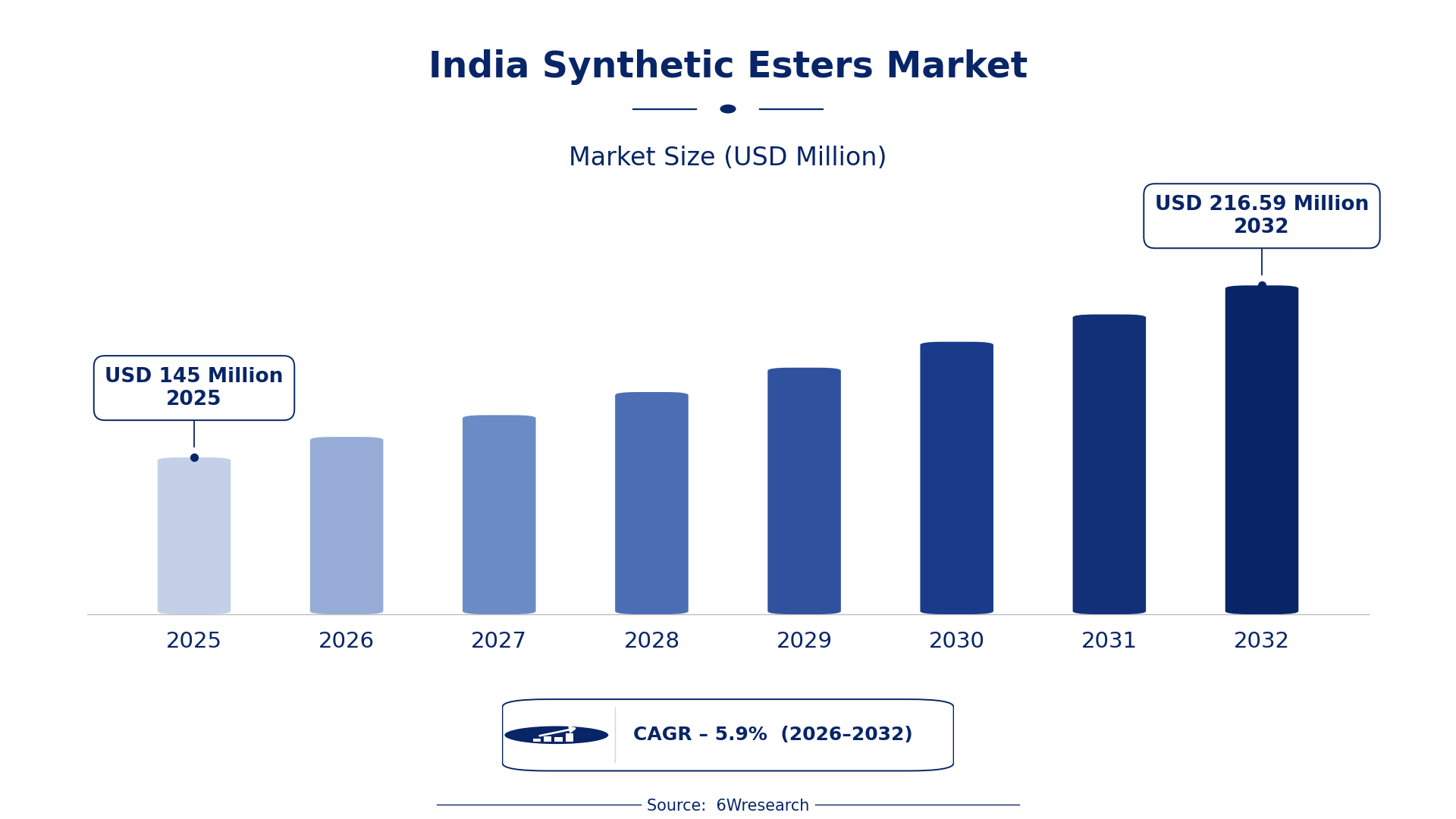
According to 6Wresearch internal database and industry insights, the India Synthetic Esters Market was valued at USD 145.0 million in 2025 and is projected to reach USD 216.59 million by 2032, growing at a CAGR of approximately 5.9% during 2026–2032.
India Synthetic Esters Market Highlights
| Report Metric | Details |
| Report Name | India Synthetic Esters Market |
| Market Size 2025 | USD 145.0 million |
| Market Size 2032 | USD 216.59 million |
| Absolute Growth 2025–2032 | USD 71.59 million |
| CAGR 2026–2032 | 5.9% |
| Peak Annual Growth | 7.7% in 2030 |
| Forecast Period | 2026–2032 |
| Historical Data | 2022–2025 |
| Base Year | 2025 |
| Leading Ester Type, 2025 | Mono Esters (36% share) |
| Leading Chemical Structure, 2025 | Linear Alkyl Esters (49% share) |
| Leading Application Use, 2025 | Metalworking Fluids (38% share) |
| Leading End User, 2025 | Lubricant Manufacturers (45% share) |
| Fastest-Growing Ester Type | Complex Esters (7.3% CAGR) |
| Fastest-Growing Chemical Structure | Polyol-Based (7.1% CAGR) |
| Fastest-Growing Application Use | Automotive Lubricants (8.1% CAGR) |
| Fastest-Growing End User | Oil & Additive OEMs (8.5% CAGR) |
| Growing Sector | Automotive Lubricants |
| Key End Users | Lubricant Manufacturers, Oil & Additive OEMs, Industrial Cleaners, PVC Manufacturers |
India Synthetic Esters Market Year-wise Growth Rate and Key Drivers (2022–2032)
This graph illustrates the annual growth rates of the market from 2022 to 2032, highlighting a steady upward trajectory and projected market expansion over the forecast period.
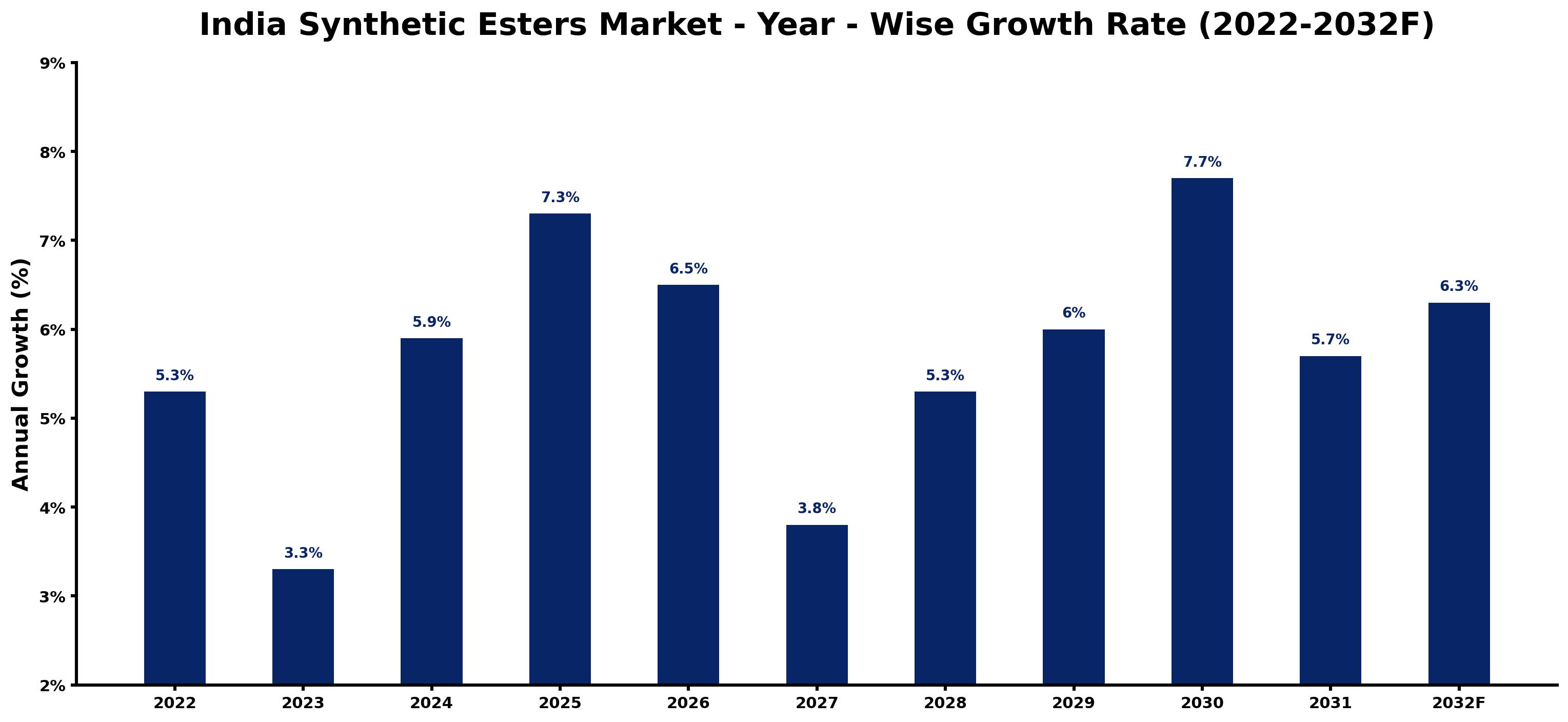
The following table presents the estimated annual growth rate for each year together with the principal factor influencing market performance.
| Year | Estimated Annual Growth (%) | Market Rationale |
| 2022 | 5.3 | The market experienced steady growth due to strong domestic demand from lubricant manufacturers. |
| 2023 | 3.3 | Growth slowed as manufacturers adjusted to fluctuating raw material prices and supply chain issues. |
| 2024 | 5.9 | Increased demand for automotive lubricants boosted growth as vehicle production ramped up. |
| 2025 | 7.3 | The automotive sector's expansion drove substantial demand for synthetic esters, reaching historical peak growth. |
| 2026 | 6.5 | Demand growth slowed as the National Automotive Testing and R&D Infrastructure Project (NATRIP) began influencing new investments. |
| 2027 | 3.8 | A decrease in growth was noted due to rising competition among local manufacturers in the lubricant sector. |
| 2028 | 5.3 | Growth accelerated as the push for biodegradable lubricants gained traction in the market. |
| 2029 | 6.0 | The automotive industry's continued expansion contributed to a faster growth rate in synthetic esters. |
| 2030 | 7.7 | Peak growth is expected as the demand for high-performance lubricants surges in the automotive sector. |
| 2031 | 5.7 | Growth slowed slightly as manufacturers faced challenges in meeting evolving environmental standards. |
| 2032 | 6.3 | The market is projected to grow as the demand for non-toxic alternatives increases in consumer products. |
Note: Market size estimations and growth projections presented in this report are based on 6Wresearch's proprietary forecasting methodology, utilizing the latest available industry data, government publications, and primary research inputs.
India Synthetic Esters Market Synopsis
The India Synthetic Esters Market includes synthetic compounds formed through the esterification of alcohols and acids, primarily utilised in lubricants, metalworking fluids, and plasticizers. The market is expected to reach 150,000 tons by 2025, driven by the automotive sector, which represents 40% of demand. Key influences include government initiatives that promote bio-based esters and the growing emphasis on sustainable practices among lubricant manufacturers. The Indian market for plasticizers is also set to experience considerable growth, further increasing the demand for synthetic esters.
Market Dynamics Impact Analysis (2026–2032)
| Factor | Type | Impact | Primary Segment Affected |
| Rising demand for automotive lubricants due to increased vehicle production | Driver | High | Automotive Lubricants |
| Growing preference for biodegradable lubricants among consumers | Driver | High | Phthalate-Free Esters |
| Increasing investments in green chemistry initiatives | Opportunity | High | Complex Esters |
| Emerging demand for high-performance lubricants in the automotive sector | Opportunity | High | Automotive Lubricants |
| Fluctuating raw material prices affecting production costs | Restraint | High | Mono Esters |
| Regulatory compliance challenges for manufacturers | Restraint | Medium | Complex Esters |
| Competition from alternative lubricant technologies | Challenge | High | Lubricant Manufacturers |
| Supply chain disruptions impacting raw material availability | Challenge | Medium | Oil & Additive OEMs |
Evaluation of Drivers in India Synthetic Esters Market (2026–2032)
The main growth drivers and the segments they affect most are set out below.
| Drivers | Primary Segment Affected | Why It Matters (Evidence) |
| Increased vehicle production driving demand for lubricants | Automotive Lubricants | The automotive sector in India accounts for 40% of synthetic ester demand, leading to higher purchases from lubricant manufacturers. |
| Rising consumer preference for environmentally friendly products | Phthalate-Free Esters | Growing regulations on toxic substances push manufacturers to source non-toxic alternatives, increasing demand. |
| Government initiatives supporting bio-based products | Complex Esters | The National Policy on Biofuels aims to increase the use of bio-based esters, encouraging manufacturers to invest. |
| Expansion of the metalworking industry increasing fluid requirements | Metalworking Fluids | The $5 billion Indian metalworking industry relies heavily on synthetic esters for effective machining processes. |
| Growing automotive sector boosting lubricant formulations | Mono Esters | The expected growth in the automotive industry translates to higher demand for synthetic esters. |
Market growth in India for Synthetic Esters relies on the rising demand from automotive lubricant manufacturers, spurred by the expected expansion of the automotive sector. This sector, responsible for 40% of synthetic ester demand, continues to grow, supporting overall market development. The $5 billion Indian metalworking industry depends on synthetic esters for critical metalworking fluids, resulting in heightened demand. Increasing consumer preference for non-toxic alternatives boosts the market for phthalate-free esters.
Evaluation of Restraints in India Synthetic Esters Market
The main factors holding the market back are set out below.
| Market Restraint | Primary Segment Affected | Why It Matters (Evidence) |
| Fluctuating raw material prices affecting profit margins | Mono Esters | The volatility in raw material costs has led to increased production costs for manufacturers, impacting pricing strategies. |
| Regulatory compliance challenges for synthetic esters | Complex Esters | Manufacturers face stringent regulations from the Bureau of Indian Standards, complicating production processes. |
| Limited awareness of synthetic esters among end-users | Automotive Lubricants | Many consumers remain unaware of the benefits of synthetic esters, hindering market penetration. |
| Competition from cheaper alternatives in the lubricant market | Phthalate-Free Esters | The presence of lower-cost options limits the market share of premium synthetic esters. |
| Supply chain disruptions affecting material availability | Oil & Additive OEMs | Global supply chain issues have led to delays in raw material procurement, affecting production timelines. |
India Synthetic Esters Market Challenges
Producers in the India synthetic esters market face rising production costs due to fluctuating raw material prices, potentially increasing operational expenses by up to 15% annually. Regulatory compliance with BIS standards presents another hurdle, as manufacturers may experience delays in product launches, hindering their ability to satisfy market demand. Importers encounter supply chain disruptions when sourcing specific synthetic compounds, which can extend lead times by several weeks and complicate inventory management. Buyers confront competition from cheaper alternatives in the lubricant sector, which can erode the market share of domestically produced synthetic esters and force them to seek cost-effective solutions.
Trends in the India Synthetic Esters Market
Below mentioned are some of the trends shaping the India Synthetic Esters Market growth.
- Maharashtra Leading in Bio-Based Synthetic Esters: Maharashtra is leading the charge in promoting bio-based synthetic esters, bolstered by government initiatives that encourage sustainable practices. The National Policy on Biofuels aims to boost bio-based ester usage, targeting a 20% increase by 2025.
- Surge in Phthalate-Free Esters Demand: The demand for phthalate-free esters is increasing due to stringent environmental regulations. The market for these alternatives is anticipated to grow significantly, focusing on non-toxic solutions in consumer products.
- Adoption of High-Performance Lubricants: Complex esters are increasingly utilised in high-performance automotive applications, driven by the automotive sector's growth. The market for these lubricants is projected to expand by 8.1% annually through 2032.
- Focus on Sustainable Practices: The Make in India initiative is encouraging local production of synthetic esters, promoting sustainability. This initiative aims to increase production by 30% by 2025.
Investment Opportunities in the India Synthetic Esters Market
Several openings in the India Synthetic Esters Market merit attention from investors.
- Supply of Bio-Based Synthetic Esters: Manufacturers can invest in bio-based synthetic esters to address rising demand. The National Policy on Biofuels supports this shift, aiming to increase bio-based ester usage by 20% by 2025.
- Investment in High-Performance Lubricants: The automotive lubricant sector presents a prime opportunity for investment. With a projected growth rate of 10% by 2026, manufacturers can focus on developing high-performance formulations.
- Expansion in Maharashtra's Manufacturing Sector: Maharashtra's industrial hub offers an ideal location for synthetic ester production. Local partnerships can facilitate market entry and enhance distribution channels.
- Development of Non-Toxic Alternatives: Investing in phthalate-free esters aligns with consumer preferences for safety. The rising demand for non-toxic products presents a valuable opportunity for manufacturers.
Government Initiatives in the India Synthetic Esters Market
The Bureau of Indian Standards (BIS) has established quality standards for lubricants, ensuring compliance with ISO 9001:2015. Additionally, the National Policy on Biofuels, introduced in 2021, aims to increase the use of bio-based esters, promoting sustainable practices in the industry. The Make in India initiative has also encouraged local production, supporting the growth of the synthetic esters market. These measures ensure that manufacturers can access resources and support for transitioning to greener alternatives.
The Ministry of Chemicals and Fertilizers launched a programme in 2021 to promote green chemistry, providing funding for manufacturers adopting sustainable practices. The Indian Chemical Council (ICC) advocates for sustainable chemical practices and supports projects that align with environmental goals. These initiatives ensure that manufacturers can access resources and support for transitioning to greener alternatives. The government has allocated significant funding to support these initiatives, enhancing the industry's sustainability efforts.
Future Insight of the India Synthetic Esters Market
By 2032, buyers and suppliers in the India synthetic esters market can expect substantial changes driven by government initiatives that promote bio-based alternatives and sustainable practices. The growth of the automotive sector will drive demand for high-performance lubricants, supported by advanced testing facilities established under the National Automotive Testing and R&D Infrastructure Project. The emphasis on biodegradable lubricants will reshape product offerings, aligning with evolving environmental regulations. Additionally, the expansion of the Indian plasticizers market will create new opportunities for suppliers, enhancing the overall development of synthetic esters.
Market Segmentation Analysis
The report offers a comprehensive study of the following market segments and their leading categories in the market.
By Ester Type – Mono Esters Dominated, Complex Esters Expected to Grow Fastest
According to Sumit Sagar, AM at 6Wresearch, with a 36% revenue share in 2025, Mono Esters was the largest ester type category. Mono esters lead the market due to their widespread use as lubricants and plasticizers across various applications, particularly in automotive and industrial sectors. Their established presence and reliability in these critical areas ensure they maintain the largest market share. The quickest growth will come from Complex Esters, forecast to expand at a CAGR of 7.3% between 2026 and 2032. Complex esters are rapidly gaining traction, particularly in high-performance automotive applications, as the automotive industry is projected to grow at a CAGR of 10% by 2026. This trend highlights a shift towards more advanced lubricant solutions that cater to evolving performance standards. Suppliers should focus on developing complex esters to meet the increasing demand from the automotive sector.
By Chemical Structure – Linear Alkyl Esters Dominated, Polyol-Based Expected to Grow Fastest
The largest chemical structure category in 2025 was Linear Alkyl Esters, with a 49% share of total revenue. Linear alkyl esters command the largest market share due to their extensive use in automotive and industrial lubricants, ensuring reliable performance in demanding applications. Their established role in these sectors guarantees consistent demand and a strong market position, particularly in Maharashtra and Gujarat. Over 2026–2032, Polyol-Based is expected to post the fastest growth, at a CAGR of 7.1%. Polyol-based esters are experiencing rapid growth, driven by their application in high-performance lubricants and greases, which are increasingly sought after in the automotive industry. This reflects a broader trend towards advanced formulations that enhance vehicle efficiency, supported by government initiatives promoting bio-based solutions. Suppliers should focus on developing polyol-based esters to meet the rising demand for high-performance lubricants.
By Application Use – Metalworking Fluids Dominated, Automotive Lubricants Expected to Grow Fastest
Metalworking Fluids held a 38% share of the India Synthetic Esters Market by application use in 2025. Metalworking fluids lead the market as they are essential for machining and metal processing, playing a vital role in the $5 billion Indian metalworking industry. Their critical function ensures steady demand from manufacturers reliant on effective fluid solutions, particularly in industrial settings. Automotive Lubricants are projected to grow fastest, at a CAGR of 8.1% during 2026–2032. Automotive lubricants are witnessing the fastest growth, driven by the expansion of the automotive industry and the increasing need for effective vehicle maintenance solutions. This segment's growth indicates the overall health of the automotive sector, with a projected CAGR of 10% by 2026. Suppliers must prioritise automotive lubricants to align with the industry's growth trajectory and changing consumer needs.
By End User – Lubricant Manufacturers Dominated, Oil & Additive OEMs Expected to Grow Fastest
Lubricant Manufacturers took a 45% share of end user in 2025, more than any other category. Lubricant manufacturers represent the largest share of the market as they are the primary users of synthetic esters for formulation in various products. Their established relationships with suppliers ensure a stable and consistent demand for these materials, particularly in the automotive sector. Oil & Additive OEMs are set to record the highest CAGR in this split, 8.5% over 2026–2032. Oil and additive OEMs are experiencing rapid growth, as they play a crucial role in the production of automotive fluids essential for vehicle performance. This growth aligns with the overall expansion of the automotive sector, indicating strong future demand for these products. Manufacturers should strengthen partnerships with oil and additive OEMs to capture growth opportunities in the automotive lubricants market.
Key Attractiveness of the Report
- 10 Years of Market Numbers
- Historical Data Starting from 2022 to 2025
- Base Year 2025
- Forecast Data until 2032
- Key Performance Indicators Impacting the Market
- Major Upcoming Developments and Projects
Key Highlights of the Report:
- India Synthetic Esters Market Outlook
- Market Size of India Synthetic Esters Market, 2025
- Forecast of India Synthetic Esters Market, 2032
- Historical Data and Forecast of India Synthetic Esters Revenues & Volume for the Period 2022 - 2032F
- India Synthetic Esters Market Trend Evolution
- India Synthetic Esters Market Drivers and Challenges
- India Synthetic Esters Price Trends
- India Synthetic Esters Porter's Five Forces
- India Synthetic Esters Industry Life Cycle
- Historical Data and Forecast of India Synthetic Esters Market Revenues & Volume By Ester Type for the Period 2022 - 2032F
- Historical Data and Forecast of India Synthetic Esters Market Revenues & Volume By Mono Esters for the Period 2022 - 2032F
- Historical Data and Forecast of India Synthetic Esters Market Revenues & Volume By Complex Esters for the Period 2022 - 2032F
- Historical Data and Forecast of India Synthetic Esters Market Revenues & Volume By Dibasic Esters for the Period 2022 - 2032F
- Historical Data and Forecast of India Synthetic Esters Market Revenues & Volume By Phthalate-Free Esters for the Period 2022 - 2032F
- Historical Data and Forecast of India Synthetic Esters Market Revenues & Volume By Chemical Structure for the Period 2022 - 2032F
- Historical Data and Forecast of India Synthetic Esters Market Revenues & Volume By Linear Alkyl Esters for the Period 2022 - 2032F
- Historical Data and Forecast of India Synthetic Esters Market Revenues & Volume By Polyol-Based for the Period 2022 - 2032F
- Historical Data and Forecast of India Synthetic Esters Market Revenues & Volume By Succinate/Glutarate Based for the Period 2022 - 2032F
- Historical Data and Forecast of India Synthetic Esters Market Revenues & Volume By Non-Toxic Alternatives for the Period 2022 - 2032F
- Historical Data and Forecast of India Synthetic Esters Market Revenues & Volume By Application Use for the Period 2022 - 2032F
- Historical Data and Forecast of India Synthetic Esters Market Revenues & Volume By Metalworking Fluids for the Period 2022 - 2032F
- Historical Data and Forecast of India Synthetic Esters Market Revenues & Volume By Automotive Lubricants for the Period 2022 - 2032F
- Historical Data and Forecast of India Synthetic Esters Market Revenues & Volume By Cleaning Agents for the Period 2022 - 2032F
- Historical Data and Forecast of India Synthetic Esters Market Revenues & Volume By Plasticizers for the Period 2022 - 2032F
- Historical Data and Forecast of India Synthetic Esters Market Revenues & Volume By End User for the Period 2022 - 2032F
- Historical Data and Forecast of India Synthetic Esters Market Revenues & Volume By Lubricant Manufacturers for the Period 2022 - 2032F
- Historical Data and Forecast of India Synthetic Esters Market Revenues & Volume By Oil & Additive OEMs for the Period 2022 - 2032F
- Historical Data and Forecast of India Synthetic Esters Market Revenues & Volume By Industrial Cleaners for the Period 2022 - 2032F
- Historical Data and Forecast of India Synthetic Esters Market Revenues & Volume By PVC Manufacturers for the Period 2022 - 2032F
- India Synthetic Esters Import Export Trade Statistics
- Market Opportunity Assessment By Ester Type
- Market Opportunity Assessment By Chemical Structure
- Market Opportunity Assessment By Application Use
- Market Opportunity Assessment By End User
- India Synthetic Esters Top Companies Market Share
- India Synthetic Esters Competitive Benchmarking By Technical and Operational Parameters
- India Synthetic Esters Company Profiles
- India Synthetic Esters Key Strategic Recommendations
Market Covered
This report examines the market across the segments below.
By Ester Type
- Mono Esters
- Complex Esters
- Dibasic Esters
- Phthalate-Free Esters
By Chemical Structure
- Linear Alkyl Esters
- Polyol-Based
- Succinate/Glutarate Based
- Non-Toxic Alternatives
By Application Use
- Metalworking Fluids
- Automotive Lubricants
- Cleaning Agents
- Plasticizers
By End User
- Lubricant Manufacturers
- Oil & Additive OEMs
- Industrial Cleaners
- PVC Manufacturers































