China Synthetic Esters Market Size & Growth Rate
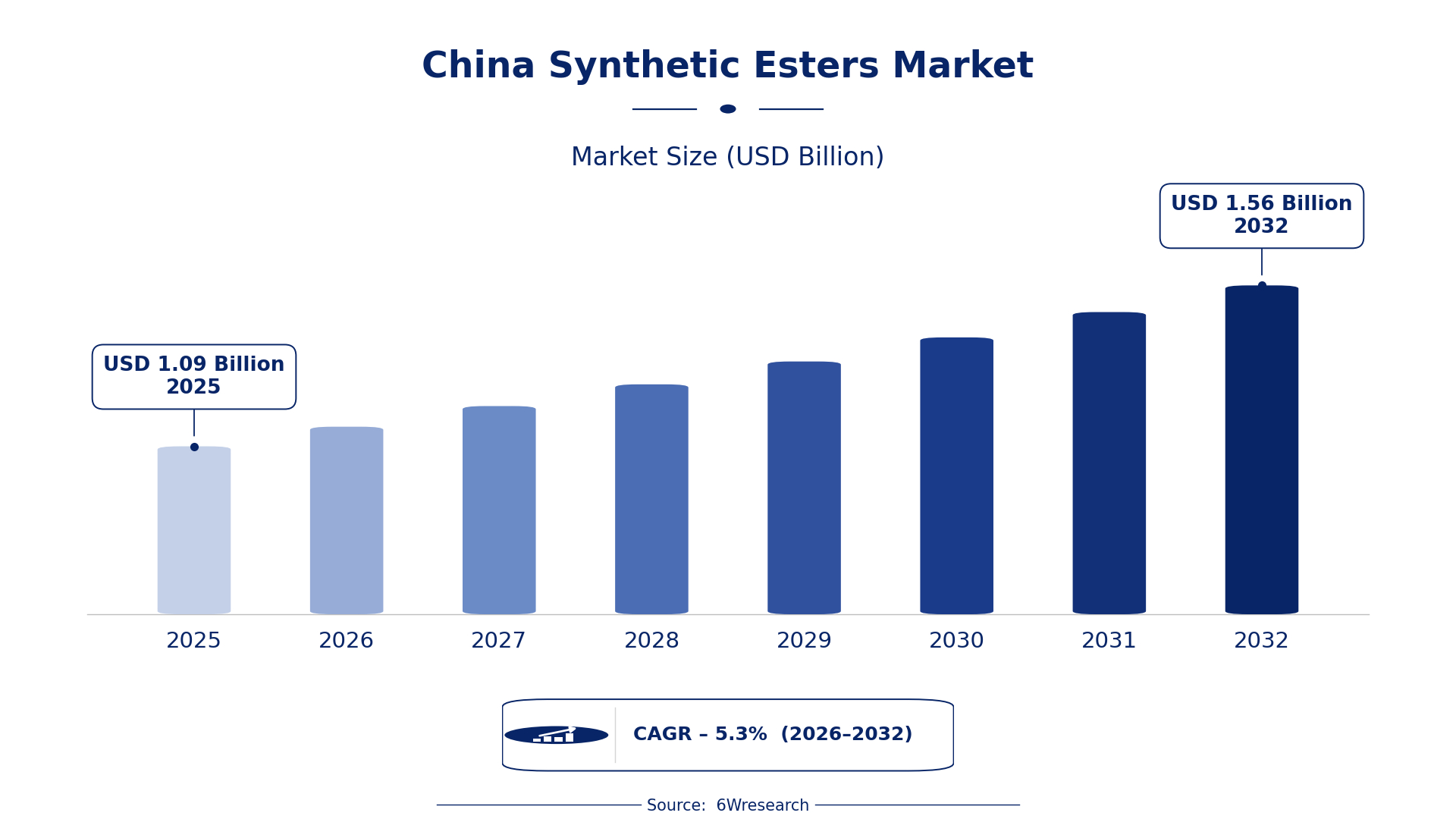
According to 6Wresearch internal database and industry insights, the China Synthetic Esters Market was valued at USD 1.09 billion in 2025 and is projected to reach USD 1.56 billion by 2032, growing at a CAGR of approximately 5.3% during 2026–2032.
China Synthetic Esters Market Highlights
| Report Metric | Details |
| Report Name | China Synthetic Esters Market |
| Market Size 2025 | USD 1.09 billion |
| Market Size 2032 | USD 1.56 billion |
| Absolute Growth 2025–2032 | USD 0.47 billion |
| CAGR 2026–2032 | 5.3% |
| Peak Annual Growth | 7.3% in 2028 |
| Forecast Period | 2026–2032 |
| Historical Data | 2022–2025 |
| Base Year | 2025 |
| Leading Ester Type, 2025 | Complex Esters (50% share) |
| Leading Chemical Structure, 2025 | Linear Alkyl Esters (43% share) |
| Leading Application Use, 2025 | Automotive Lubricants (36% share) |
| Leading End User, 2025 | Lubricant Manufacturers (45% share) |
| Fastest-Growing Ester Type | Phthalate-Free Esters (8.1% CAGR) |
| Fastest-Growing Chemical Structure | Non-Toxic Alternatives (7.5% CAGR) |
| Fastest-Growing Application Use | Plasticizers (7.6% CAGR) |
| Fastest-Growing End User | PVC Manufacturers (6.8% CAGR) |
| Growing Sector | Plasticizers |
| Key End Users | Automotive Lubricants, Metalworking Fluids, Plasticizers, Cleaning Agents |
China Synthetic Esters Market Year-wise Growth Rate and Key Drivers (2022–2032)
This graph illustrates the annual growth rates of the market from 2022 to 2032, highlighting a steady upward trajectory and projected market expansion over the forecast period.
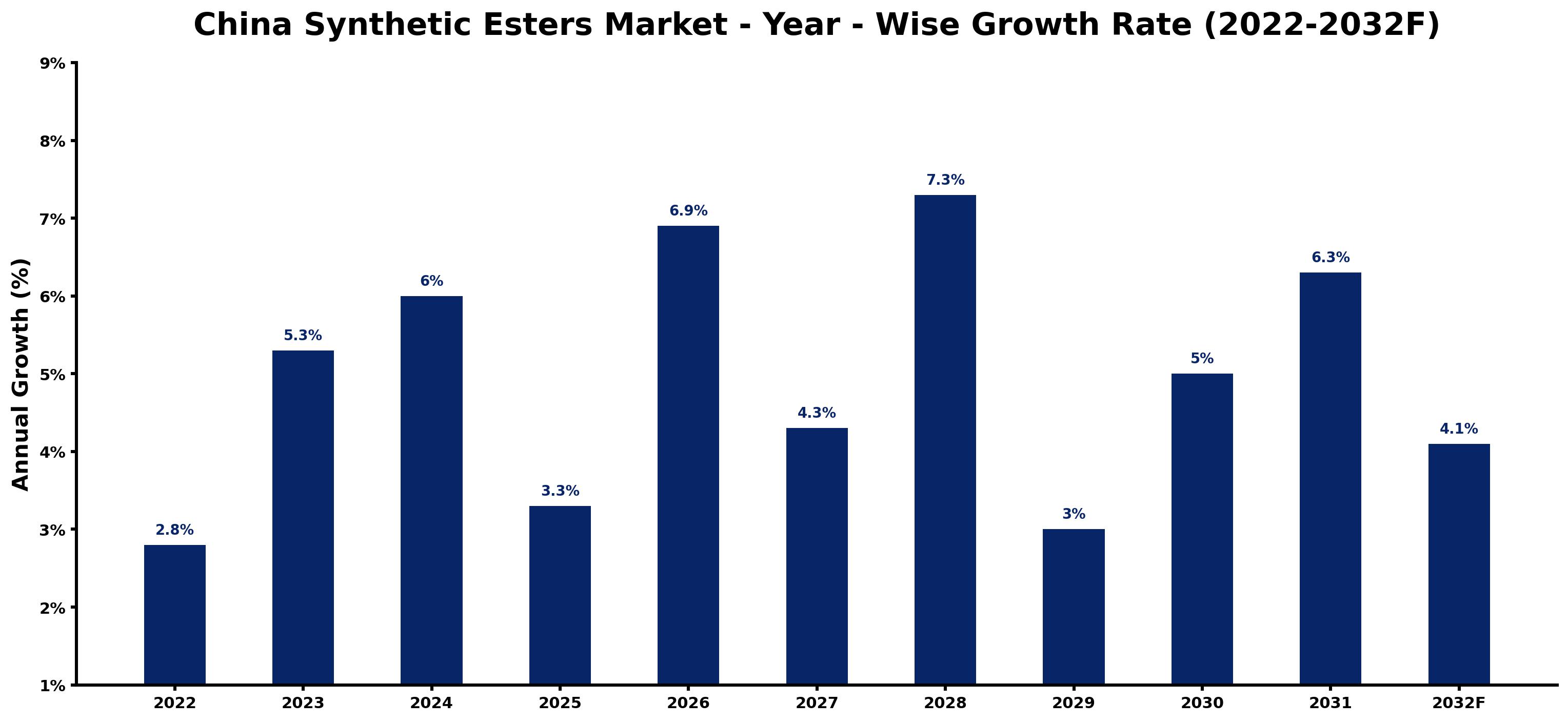
Annual growth estimates for each year appear below with the principal reason behind them, explaining the shifts that set the pace of the market.
| Year | Estimated Annual Growth (%) | Market Rationale |
| 2022 | 2.8 | The market experienced steady demand from lubricant manufacturers and industrial applications. |
| 2023 | 5.3 | Growth was supported by increased activity in the automotive sector and rising production of synthetic esters. |
| 2024 | 6.0 | Demand surged due to the implementation of new quality standards for lubricants. |
| 2025 | 3.3 | Growth slowed as manufacturers adjusted to production capacities and market changes. |
| 2026 | 6.9 | The market rebounded with heightened investment in biodegradable ester production. |
| 2027 | 4.3 | Demand growth decelerated as manufacturers faced challenges in supply chains. |
| 2028 | 7.3 | A peak in growth occurred due to rising demand for automotive lubricants and innovation. |
| 2029 | 3.0 | Growth slowed as saturation began to affect new investments in the sector. |
| 2030 | 5.0 | Increased focus on non-toxic alternatives drove demand for safer synthetic esters. |
| 2031 | 6.3 | Growth accelerated as PVC production expanded, increasing demand for plasticizers. |
| 2032 | 4.1 | A slowdown is expected as market maturity sets in, affecting growth rates. |
Note: Market size estimations and growth projections presented in this report are based on 6Wresearch's proprietary forecasting methodology, utilizing the latest available industry data, government publications, and primary research inputs.
China Synthetic Esters Market Synopsis
The China Synthetic Esters Market includes a variety of synthetic compounds derived from alcohols and acids, primarily utilised in lubricants and plasticisers. In 2022, the automotive sector represented around 30% of total demand, contributing to robust growth. The East China region stands out as a key centre for both production and consumption. The increasing demand for non-toxic alternatives and the enforcement of new quality standards are driving market expansion. With over 200 lubricant manufacturers employing synthetic esters, the market is poised for sustained growth.
Market Dynamics Impact Analysis (2026–2032)
| Factor | Type | Impact | Primary Segment Affected |
| Rising automotive production and demand for high-performance lubricants. | Driver | High | Automotive Lubricants |
| Increased regulatory pressure for safer alternatives drives demand for non-toxic esters. | Driver | High | Phthalate-Free Esters |
| Growing demand for biodegradable esters presents new market opportunities. | Opportunity | High | Complex Esters |
| Investment in PVC production creates a need for plasticizers. | Opportunity | Medium | Plasticizers |
| High production costs limit the competitiveness of synthetic esters. | Restraint | High | Mono Esters |
| Supply chain disruptions impact the availability of raw materials. | Restraint | Medium | Complex Esters |
| Regulatory compliance costs can be burdensome for manufacturers. | Challenge | High | Lubricant Manufacturers |
| Technological advancements require continuous investment, straining budgets. | Challenge | Medium | Oil & Additive OEMs |
Evaluation of Drivers in China Synthetic Esters Market (2026–2032)
Below mentioned are some major drivers and their influence on market dynamics.
| Drivers | Primary Segment Affected | Why It Matters (Evidence) |
| Increased automotive production drives demand for high-performance lubricants. | Automotive Lubricants | In 2022, the automotive sector accounted for approximately 30% of synthetic esters demand. |
| Regulatory pressure for safer alternatives boosts demand for non-toxic esters. | Phthalate-Free Esters | The Ministry of Ecology and Environment promotes non-toxic alternatives in industrial applications. |
| Investment in biodegradable esters supports market growth. | Complex Esters | The China Petroleum and Chemical Industry Federation reported a steady increase in biodegradable ester adoption. |
| Rising PVC production increases the need for plasticizers. | Plasticizers | China's PVC production reached 16 million tons in 2022, with synthetic esters as key plasticizers. |
| Growing demand for metalworking fluids drives synthetic ester usage. | Metalworking Fluids | The annual demand for metalworking fluids in China is estimated at 1.5 million tons. |
Growth across the Synthetic Esters market in China is anchored in rising automotive production, increased investments in biodegradable esters, and the demand for high-performance lubricants. The automotive sector accounted for approximately 30% of synthetic esters demand in 2022, prompting lubricant manufacturers to seek advanced solutions. The ongoing shift towards non-toxic alternatives is creating opportunities for manufacturers to innovate. As PVC production reached 16 million tons in 2022, the need for effective plasticizers continues to grow. The annual demand for metalworking fluids is projected at 1.5 million tons, indicating a strong market for synthetic esters.
Evaluation of Restraints in China Synthetic Esters Market
Below mentioned are some major restraints and their influence on market dynamics.
| Market Restraint | Primary Segment Affected | Why It Matters (Evidence) |
| High production costs limit competitiveness in the synthetic esters market. | Mono Esters | Manufacturers face challenges in maintaining profit margins due to rising raw material prices. |
| Supply chain disruptions impact the availability of essential raw materials. | Complex Esters | Recent global supply chain issues have delayed production schedules for synthetic esters. |
| Regulatory compliance costs can be burdensome for manufacturers. | Lubricant Manufacturers | Compliance with the updated National Standards for Lubricants increases operational expenses. |
| Technological advancements require continuous investment, straining budgets. | Oil & Additive OEMs | The need for innovation in formulations demands significant capital allocation. |
| Market saturation limits growth opportunities for new entrants. | Plasticizers | Established players dominate the market, making it difficult for newcomers to gain traction. |
China Synthetic Esters Market Challenges
In 2022, about 30% of synthetic esters demand in China originated from the automotive sector, which is under increasing regulatory scrutiny. These regulations compel manufacturers to invest up to 20% more on compliance, impacting their profit margins. Buyers face fluctuating raw material prices, resulting in cost increases of approximately 15% for end-users across various applications. Supply chain disruptions are common, particularly in the East China region, leading to delays that can extend lead times by as much as two months for lubricant manufacturers. The slow adoption of new technologies further limits innovation, restricting the product options available to buyers.
Trends in the China Synthetic Esters Market
The trends below show where the China Synthetic Esters Market is heading.
- Green Manufacturing Initiative Promoting Non-Toxic Alternatives: The 'Green Manufacturing' initiative promotes the use of environmentally friendly materials, including synthetic esters. In 2023, this programme is anticipated to stimulate the market for non-toxic alternatives, appealing to manufacturers seeking sustainable solutions.
- Shift Towards Biodegradable Esters: A heightened focus on sustainability is propelling the shift towards biodegradable esters in industrial applications. The China Petroleum and Chemical Industry Federation noted a steady increase in adoption, with a portion of new investments directed towards this segment.
- Increased Demand for Plasticizers in PVC Production: As PVC production grows, the demand for effective plasticisers is on the rise. In 2022, China's PVC output reached 16 million tons, underscoring the necessity for synthetic esters in enhancing product flexibility.
- Adoption of ISO 9001 Quality Standards: ISO 9001 is increasingly embraced by manufacturers of synthetic esters in China. This standard ensures consistent quality in production processes, improving competitiveness and meeting buyer expectations.
Investment Opportunities in the China Synthetic Esters Market
Investors looking at the China Synthetic Esters Market should consider the following areas.
- Investment in Biodegradable Esters: The rising demand for biodegradable esters presents a chance for manufacturers. With a steady increase in adoption reported, lubricant manufacturers are exploring sustainable alternatives to traditional esters.
- Supply of Non-Toxic Alternatives: The demand for non-toxic alternatives creates a market opportunity. As regulatory pressures mount, lubricant manufacturers are actively seeking compliant solutions to satisfy consumer demand.
- Expansion in PVC Production: The growth of PVC production in China generates a need for effective plasticisers. With PVC production reaching 16 million tons in 2022, suppliers can enter the market by collaborating with PVC manufacturers.
- Focus on Metalworking Fluids: The anticipated growth in demand for metalworking fluids creates opportunities for synthetic esters. With an estimated annual demand of 1.5 million tons, suppliers can target manufacturers in this sector.
Government Initiatives in the China Synthetic Esters Market
In 2023, the Ministry of Ecology and Environment introduced the 'Green Product Certification' program to encourage the use of non-toxic synthetic esters in manufacturing. This measure builds on previous standards, such as the updated 'National Standards for Lubricants' in 2022, which included specifications for synthetic esters. These regulations aim to improve product safety and environmental sustainability, benefiting both producers and consumers in the synthetic esters market.
The Ministry of Industry and Information Technology oversees the 'Synthetic Lubricants Development Plan', which aims to boost domestic production capabilities and reduce reliance on imports. This initiative supports manufacturers by providing funding for research and development projects focused on synthetic esters. Additionally, the State Administration for Market Regulation ensures compliance with quality standards, facilitating smoother market entry for compliant products.
Future Insight of the China Synthetic Esters Market
Several forward-looking factors are expected to support the synthetic esters market in China in the coming years. The government's 'Green Manufacturing' initiative is likely to increase demand for environmentally friendly synthetic esters across various sectors. The rise in PVC production, which reached 16 million tons in 2022, will boost the consumption of synthetic esters as plasticisers. Enhanced quality standards, such as the National Standard GB/T 18602, will encourage manufacturers to produce higher quality products. The growing trend towards biodegradable esters will reshape product offerings, aligning with market preferences for sustainable solutions.
Market Segmentation Analysis
The analysis below covers each segmentation, its leading category in 2025 and its fastest-growing category through 2032.
By Ester Type – Complex Esters Dominated, Phthalate-Free Esters Expected to Grow Fastest
According to Sumit Sagar, AM at 6Wresearch, the largest ester type category in 2025 was Complex Esters, with a 50% share of total revenue. Complex esters lead the market share in China's synthetic esters sector, primarily due to their multifunctional capabilities that make them essential in lubricants and coatings. Their importance is highlighted by the extensive usage among over 200 lubricant manufacturers across the country, showcasing their critical role in various applications. Over 2026–2032, Phthalate-Free Esters are expected to post the fastest growth, at a CAGR of 8.1%. Phthalate-free esters are rapidly gaining market traction as regulatory pressures for safer alternatives intensify. The government's initiatives promoting non-toxic materials further accelerate this trend, positioning phthalate-free esters as a preferred choice for manufacturers. Suppliers must adapt their product lines to include phthalate-free options to meet regulatory standards and consumer preferences.
By Chemical Structure – Linear Alkyl Esters Dominated, Non-Toxic Alternatives Expected to Grow Fastest
Linear Alkyl Esters accounted for a 43% market share by chemical structure in 2025. Linear alkyl esters hold the largest market share in China, largely due to their extensive use in automotive and industrial lubricants, which are crucial for optimal engine performance. Their established presence is reinforced by a strong installed base among lubricant manufacturers in the region. Non-Toxic Alternatives are projected to grow fastest, at a CAGR of 7.5% during 2026–2032. Non-toxic alternatives are experiencing rapid growth as health and environmental concerns drive industries to seek safer options. The government's 'Green Manufacturing' initiative significantly encourages the adoption of these environmentally friendly materials, further propelling their market presence. To remain competitive, suppliers should focus on developing non-toxic alternatives that align with market trends and regulatory demands.
By Application Use – Automotive Lubricants Dominated, Plasticizers Expected to Grow Fastest
In 2025, Automotive Lubricants led the application use split with a 36% share. Automotive lubricants represent the largest share of synthetic esters demand in China, primarily due to their essential role in enhancing engine performance and longevity. This sector's importance is underscored by its contribution of approximately 30% to the overall market, reflecting its critical nature. Plasticizers are set to record the highest CAGR in this split, 7.6% over 2026–2032. Plasticizers are witnessing the fastest growth as they are vital for enhancing flexibility in PVC products, which are increasingly in demand. The surge in PVC production, reaching 16 million tons in 2022, significantly fuels this growth trajectory. This trend indicates that suppliers should prioritise the development of plasticizers to capitalise on the expanding PVC market.
By End User – Lubricant Manufacturers Dominated, PVC Manufacturers Expected to Grow Fastest
With a 45% revenue share in 2025, Lubricant Manufacturers was the largest end user category. Lubricant manufacturers represent the largest share of the synthetic esters market in China, as they are the primary consumers of these compounds for their formulations. Their extensive use of synthetic esters is critical for maintaining product quality and performance. The quickest growth will come from PVC Manufacturers, forecast to expand at a CAGR of 6.8% between 2026 and 2032. PVC manufacturers are the fastest-growing end users of synthetic esters, as they rely on these compounds for producing flexible PVC products. The increasing demand for PVC, particularly in construction and packaging, drives this rapid adoption. This trend indicates that suppliers should strengthen their relationships with PVC manufacturers to tap into the expanding market for flexible PVC applications.
Key Attractiveness of the Report
- 10 Years of Market Numbers
- Historical Data Starting from 2022 to 2025
- Base Year 2025
- Forecast Data until 2032
- Key Performance Indicators Impacting the Market
- Major Upcoming Developments and Projects
Key Highlights of the Report:
- China Synthetic Esters Market Outlook
- Market Size of China Synthetic Esters Market, 2025
- Forecast of China Synthetic Esters Market, 2032
- Historical Data and Forecast of China Synthetic Esters Revenues & Volume for the Period 2022 - 2032F
- China Synthetic Esters Market Trend Evolution
- China Synthetic Esters Market Drivers and Challenges
- China Synthetic Esters Price Trends
- China Synthetic Esters Porter's Five Forces
- China Synthetic Esters Industry Life Cycle
- Historical Data and Forecast of China Synthetic Esters Market Revenues & Volume By Ester Type for the Period 2022 - 2032F
- Historical Data and Forecast of China Synthetic Esters Market Revenues & Volume By Mono Esters for the Period 2022 - 2032F
- Historical Data and Forecast of China Synthetic Esters Market Revenues & Volume By Complex Esters for the Period 2022 - 2032F
- Historical Data and Forecast of China Synthetic Esters Market Revenues & Volume By Dibasic Esters for the Period 2022 - 2032F
- Historical Data and Forecast of China Synthetic Esters Market Revenues & Volume By Phthalate-Free Esters for the Period 2022 - 2032F
- Historical Data and Forecast of China Synthetic Esters Market Revenues & Volume By Chemical Structure for the Period 2022 - 2032F
- Historical Data and Forecast of China Synthetic Esters Market Revenues & Volume By Linear Alkyl Esters for the Period 2022 - 2032F
- Historical Data and Forecast of China Synthetic Esters Market Revenues & Volume By Polyol-Based for the Period 2022 - 2032F
- Historical Data and Forecast of China Synthetic Esters Market Revenues & Volume By Succinate/Glutarate Based for the Period 2022 - 2032F
- Historical Data and Forecast of China Synthetic Esters Market Revenues & Volume By Non-Toxic Alternatives for the Period 2022 - 2032F
- Historical Data and Forecast of China Synthetic Esters Market Revenues & Volume By Application Use for the Period 2022 - 2032F
- Historical Data and Forecast of China Synthetic Esters Market Revenues & Volume By Metalworking Fluids for the Period 2022 - 2032F
- Historical Data and Forecast of China Synthetic Esters Market Revenues & Volume By Automotive Lubricants for the Period 2022 - 2032F
- Historical Data and Forecast of China Synthetic Esters Market Revenues & Volume By Cleaning Agents for the Period 2022 - 2032F
- Historical Data and Forecast of China Synthetic Esters Market Revenues & Volume By Plasticizers for the Period 2022 - 2032F
- Historical Data and Forecast of China Synthetic Esters Market Revenues & Volume By End User for the Period 2022 - 2032F
- Historical Data and Forecast of China Synthetic Esters Market Revenues & Volume By Lubricant Manufacturers for the Period 2022 - 2032F
- Historical Data and Forecast of China Synthetic Esters Market Revenues & Volume By Oil & Additive OEMs for the Period 2022 - 2032F
- Historical Data and Forecast of China Synthetic Esters Market Revenues & Volume By Industrial Cleaners for the Period 2022 - 2032F
- Historical Data and Forecast of China Synthetic Esters Market Revenues & Volume By PVC Manufacturers for the Period 2022 - 2032F
- China Synthetic Esters Import Export Trade Statistics
- Market Opportunity Assessment By Ester Type
- Market Opportunity Assessment By Chemical Structure
- Market Opportunity Assessment By Application Use
- Market Opportunity Assessment By End User
- China Synthetic Esters Top Companies Market Share
- China Synthetic Esters Competitive Benchmarking By Technical and Operational Parameters
- China Synthetic Esters Company Profiles
- China Synthetic Esters Key Strategic Recommendations
Market Covered
Segments analysed in this report are listed below.
By Ester Type
- Mono Esters
- Complex Esters
- Dibasic Esters
- Phthalate-Free Esters
By Chemical Structure
- Linear Alkyl Esters
- Polyol-Based
- Succinate/Glutarate Based
- Non-Toxic Alternatives
By Application Use
- Metalworking Fluids
- Automotive Lubricants
- Cleaning Agents
- Plasticizers
By End User
- Lubricant Manufacturers
- Oil & Additive OEMs
- Industrial Cleaners
- PVC Manufacturers































