India Synthetic Flavoring Market Size & Growth Rate
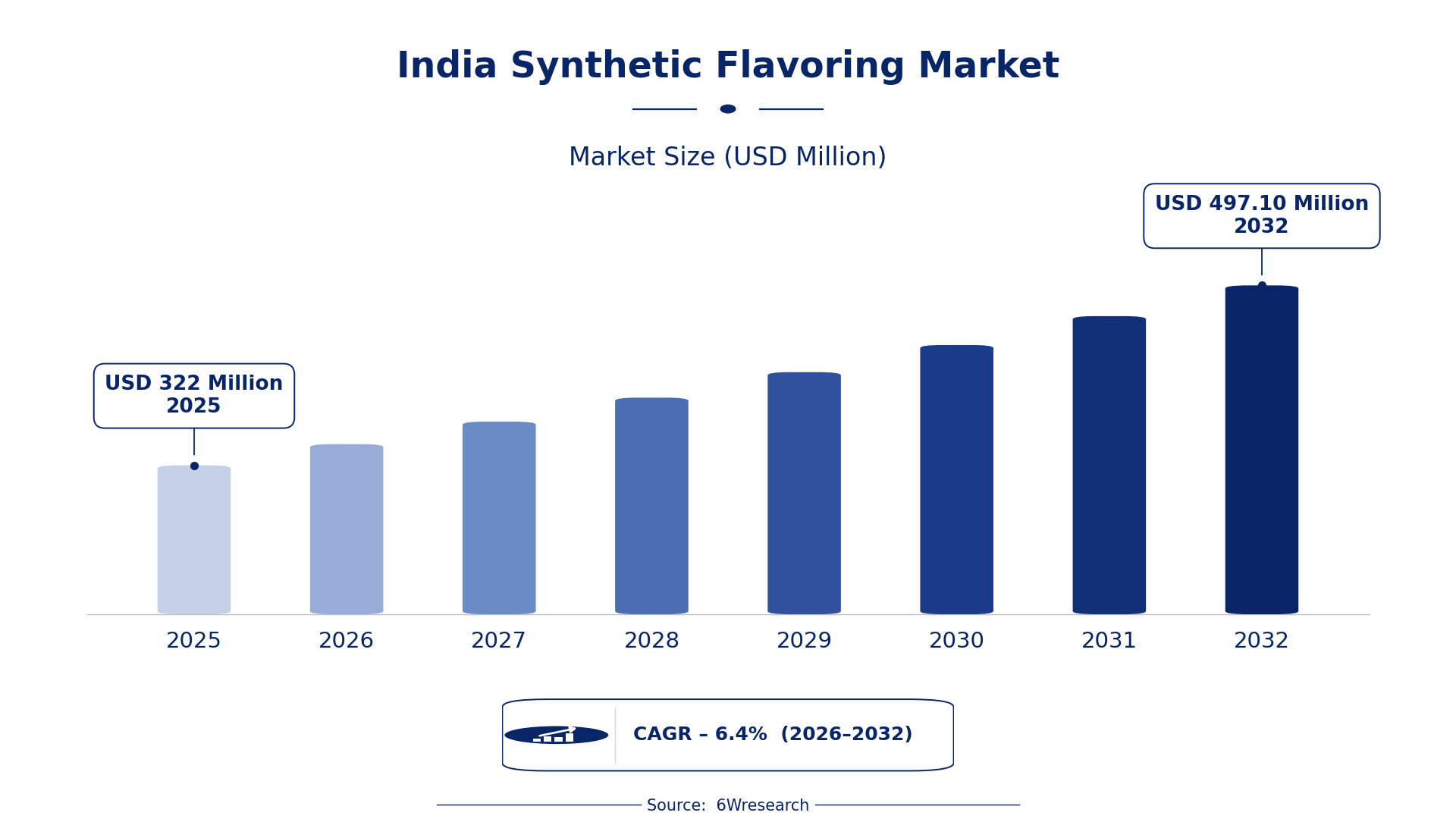
According to 6Wresearch internal database and industry insights, the India Synthetic Flavoring Market was valued at USD 322.0 million in 2025 and is projected to reach USD 497.10 million by 2032, growing at a CAGR of approximately 6.4% during 2026–2032.
India Synthetic Flavoring Market Highlights
| Report Metric | Details |
| Report Name | India Synthetic Flavoring Market |
| Market Size 2025 | USD 322.0 million |
| Market Size 2032 | USD 497.10 million |
| Absolute Growth 2025–2032 | USD 175.10 million |
| CAGR 2026–2032 | 6.4% |
| Peak Annual Growth | 8.7% in 2026 |
| Forecast Period | 2026–2032 |
| Historical Data | 2022–2025 |
| Base Year | 2025 |
| Leading Flavor Type, 2025 | Fruit Flavors (50% share) |
| Leading Base Compound, 2025 | Esters/Aldehydes (55% share) |
| Leading Application Segment, 2025 | Beverages (51% share) |
| Leading End User, 2025 | F&B Manufacturers (39% share) |
| Fastest-Growing Flavor Type | Savory Flavors (8.3% CAGR) |
| Fastest-Growing Application Segment | Ready-to-Eat Foods (7.9% CAGR) |
| Fastest-Growing End User | Snack Brands (7.8% CAGR) |
| Growing Sector | Snack Food Sector |
| Key End Users | F&B Manufacturers, Snack Brands, Beverage Producers, Food Additive Suppliers |
India Synthetic Flavoring Market Year-wise Growth Rate and Key Drivers (2022–2032)
This graph illustrates the annual growth rates of the market from 2022 to 2032, highlighting a steady upward trajectory and projected market expansion over the forecast period.
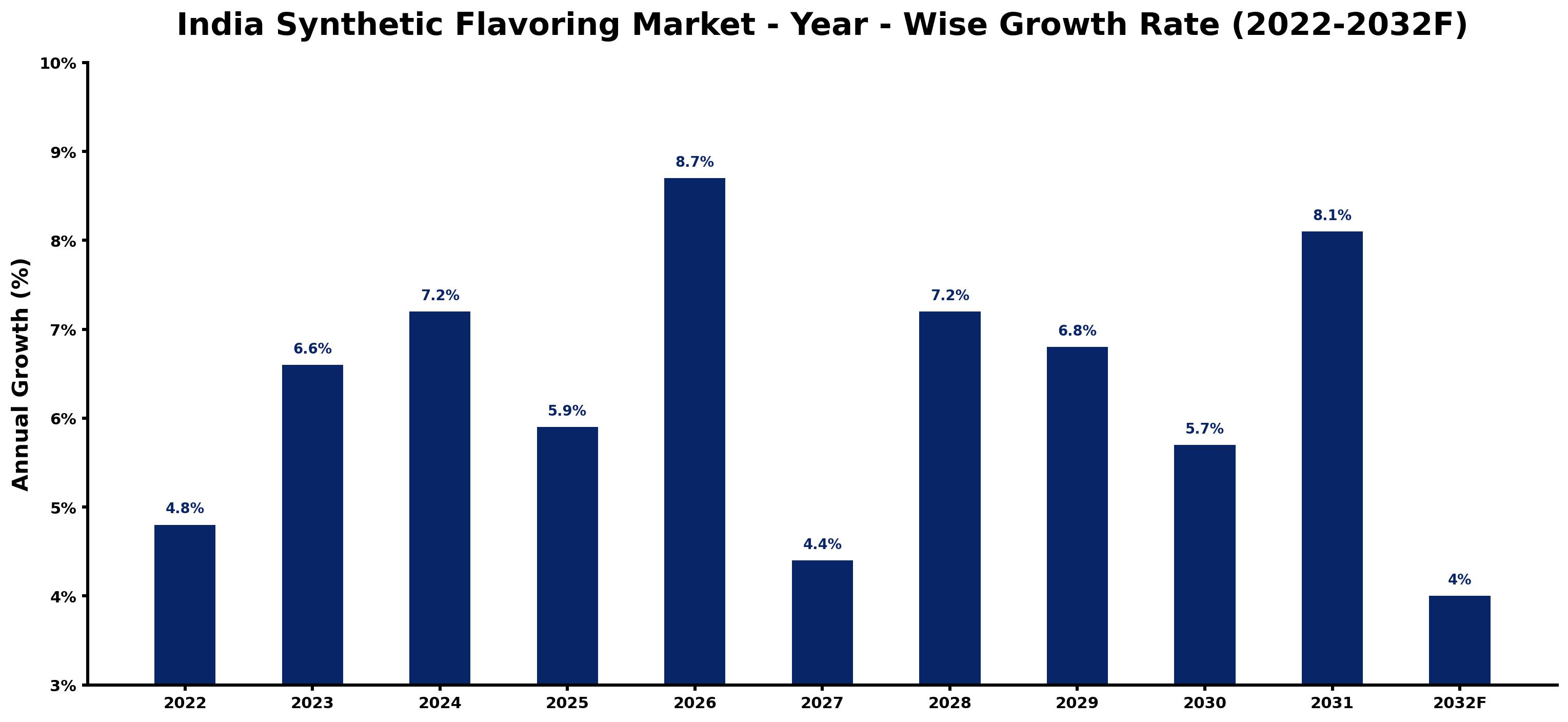
Annual growth estimates for each year appear below with the principal reason behind them, explaining the shifts that set the pace of the market.
| Year | Estimated Annual Growth (%) | Market Rationale |
| 2022 | 4.8 | The market experienced steady demand from the food processing industry, reflecting its established presence. |
| 2023 | 6.6 | Consumer preferences shifted towards diverse flavors in food products, accelerating market growth. |
| 2024 | 7.2 | Demand continued to rise due to increasing consumption of processed foods and beverages, particularly in Maharashtra. |
| 2025 | 5.9 | Growth slowed slightly, influenced by changing consumer trends and preferences for natural flavors. |
| 2026 | 8.7 | A surge in demand is expected, driven by innovations in flavor technology and the National Mission on Food Processing. |
| 2027 | 4.4 | Market growth is projected to decelerate as consumer preferences stabilise after previous peaks. |
| 2028 | 7.2 | An uptick in growth is anticipated, supported by expanding beverage and snack sectors. |
| 2029 | 6.8 | The market will see a slowdown as competition intensifies among flavor producers. |
| 2030 | 5.7 | Growth is expected to continue slowing, influenced by rising interest in natural flavor alternatives. |
| 2031 | 8.1 | Demand is projected to rebound, driven by a resurgence in the snack food market and product innovations. |
| 2032 | 4.0 | The market is expected to stabilise with modest growth as consumer preferences evolve towards healthier options. |
Note: Market size estimations and growth projections presented in this report are based on 6Wresearch's proprietary forecasting methodology, utilizing the latest available industry data, government publications, and primary research inputs.
India Synthetic Flavoring Market Synopsis
Synthetic Flavoring in India encompasses chemical products that improve the taste and aroma of food and beverages. These flavors are produced through various chemical processes and are widely used in processed foods, beverages, and confectionery. The India Synthetic Flavoring Market is experiencing growth due to rising domestic demand driven by a population of approximately 1.4 billion and urbanisation. The food processing industry significantly contributes to this demand, particularly in beverages and snacks. The ongoing National Mission on Food Processing further supports this trend by strengthening the sector's capacity.
Market Dynamics Impact Analysis (2026–2032)
| Factor | Type | Impact | Primary Segment Affected |
| Growing population and urbanisation drive demand for synthetic flavors in processed foods. | Driver | High | Beverages |
| Expansion of the food processing industry increases the need for flavoring agents. | Driver | High | F&B Manufacturers |
| Rising demand for instant meals creates opportunities for flavor suppliers. | Opportunity | High | Instant Meals |
| The growth of the Indian snack market presents a significant investment opportunity. | Opportunity | High | Snack Brands |
| Increasing preference for natural flavors may restrain synthetic flavor demand. | Restraint | Medium | Fruit Flavors |
| Regulatory changes may impose additional compliance costs on flavor producers. | Restraint | Medium | Esters/Aldehydes |
| The synthetic flavoring market in India faces challenges from rising competition and innovation. | Challenge | High | Savory Flavors |
| Consumer shift towards healthier options complicates market positioning for synthetic flavors. | Challenge | Medium | Sweet & Dessert Notes |
Evaluation of Drivers in India Synthetic Flavoring Market (2026–2032)
The factors lifting demand, and the evidence behind each, are summarised below.
| Drivers | Primary Segment Affected | Why It Matters (Evidence) |
| Increasing consumption of processed foods drives demand for synthetic flavors. | Beverages | The beverage sector accounts for 51% of flavor usage, boosting sales significantly. |
| Urbanisation leads to higher demand for convenient food options. | Instant Meals | The instant meals segment is expanding rapidly, requiring diverse flavor profiles to attract consumers. |
| The thriving snack market boosts the need for flavour solutions. | Snack Brands | The Indian snack market is projected to grow at a CAGR of 7.8%, necessitating flavour enhancements for product differentiation. |
| Investment in food processing infrastructure expands flavor production capabilities. | F&B Manufacturers | The food processing industry creates a strong demand for flavoring agents, enhancing production capacity. |
| Regulatory support encourages the development of new flavor products. | Esters/Aldehydes | The Food Safety and Standards Authority of India ensures compliance, facilitating market entry for new flavors. |
Growth in the Synthetic Flavoring market in India is fuelled by rising consumption of processed foods, especially in the beverage sector, which accounts for 51% of flavour usage. Urbanisation is driving demand for convenient food options, particularly in the instant meals segment. The booming snack market is increasing the need for flavour solutions, with projections indicating a growth rate of 7.8%. Investment in food processing infrastructure is expanding production capabilities, as the industry generates strong demand for flavouring agents. Support from the Food Safety and Standards Authority of India promotes the development of new flavour products, ensuring compliance and facilitating market entry for unique flavours.
Evaluation of Restraints in India Synthetic Flavoring Market
The main factors holding the market back are set out below.
| Market Restraint | Primary Segment Affected | Why It Matters (Evidence) |
| Rising preference for natural flavors may limit synthetic flavor demand. | Esters/Aldehydes | New regulations may require substantial investment in testing and certification, affecting profitability for small producers. |
| Intense competition among flavor producers may drive down prices. | Savory Flavors | With numerous players in the market, price wars can erode margins for producers. |
| Consumer health trends are shifting towards cleaner labels, affecting synthetic flavor sales. | Sweet & Dessert Notes | As consumers demand transparency, synthetic flavors may be viewed unfavourably compared to natural options. |
| Economic fluctuations can impact discretionary spending on processed foods. | Beverages | Economic downturns may lead consumers to reduce spending on non-essential food products. |
| Regulatory changes may impose additional compliance costs on producers. | Savory Flavors | New standards could require significant investment in quality assurance processes, impacting smaller manufacturers. |
India Synthetic Flavoring Market Challenges
The India Synthetic Flavoring Market faces outdated production technology, which hampers efficiency and increases waste for manufacturers. A lack of skilled workers limits producers' ability to implement modern techniques, resulting in extended product development timelines for suppliers. Intense competition from natural flavor alternatives pressures prices, forcing producers to reduce margins and negatively impacting profitability across the supply chain. Volatile raw material costs for synthetic flavoring agents lead to unpredictable pricing for buyers, complicating budgeting and procurement strategies, with some experiencing cost increases of up to 15% annually.
Trends in the India Synthetic Flavoring Market
Buyers and suppliers in the India Synthetic Flavoring Market are adjusting to the following trends.
- Shift towards Healthier Flavor Profiles: Maharashtra is experiencing a shift towards healthier flavour profiles in processed foods, driven by consumer demand for transparency. The Indian snack market is projected to grow at a CAGR of 7.8%, with a focus on natural ingredients.
- Increase in Snack Product Innovations: F&B Manufacturers are increasingly innovating snack products to meet evolving consumer tastes, with the Indian snack market projected to reach ₹70 billion by 2025. This trend is leading to more diverse flavour offerings in the market.
- Growth of Instant Meal Segment: The instant meal segment is expanding rapidly, supported by changing lifestyles and consumer preferences for convenience. This segment is expected to require a diverse range of flavours to attract buyers, with a market value exceeding ₹20 billion.
- Adoption of New Food Safety Standards: The introduction of ISO 22000 standards is encouraging manufacturers to adopt better food safety practices. This shift is expected to enhance consumer trust and boost demand for compliant flavour products.
Investment Opportunities in the India Synthetic Flavoring Market
Investors looking at the India Synthetic Flavoring Market should consider the following areas.
- Investment in Flavor Development: Synthetic flavour suppliers can invest in developing healthier flavour options to meet rising consumer demand. The Indian snack market is projected to reach ₹70 billion, providing a strong opportunity for suppliers.
- Expansion into Ready-to-Eat Foods: F&B Manufacturers are increasingly looking for innovative flavours to enhance their ready-to-eat product offerings. With the market valued at over ₹200 billion, this presents a strong opportunity for suppliers.
- Collaboration with Food Processing Firms: There is a growing need for synthetic flavours among food processing firms aiming to innovate their products. The National Mission on Food Processing supports this trend, creating avenues for collaboration with a budget of ₹6,000 crores.
- Focus on Beverage Flavor Innovations: With the Indian beverage market expected to grow at a rate of 10% from 2023 to 2028, suppliers should focus on innovative flavour solutions. This growth presents a timely opportunity for investment.
Government Initiatives in the India Synthetic Flavoring Market
In 2021, the Ministry of Food Processing Industries launched the Pradhan Mantri Kisan SAMPADA Yojana, allocating ₹6,000 crores to enhance food processing, which directly benefits synthetic flavour producers by improving infrastructure and production capabilities. This initiative complements the Food Safety and Standards (Food Products Standards and Food Additives) Regulations updated in 2020, which introduced new standards for synthetic flavouring, ensuring compliance and safety in the market. These measures support the growth of synthetic flavouring by promoting innovation and adherence to quality standards, thereby enhancing consumer confidence in these products.
F&B manufacturers leverage the Production-Linked Incentive Scheme introduced by the Ministry of Commerce and Industry in 2022, which incentivises domestic manufacturing of food additives, including synthetic flavours. This scheme encourages local producers to invest in advanced technologies and expand their production capacities, resulting in a more competitive market. The National Food Processing Policy, established in 2020, aims to increase the food processing sector's contribution to GDP, providing funding and support to enhance flavour production. These initiatives enable manufacturers to meet rising consumer demand effectively.
Future Insight of the India Synthetic Flavoring Market
The India Synthetic Flavoring Market will undergo significant changes by 2032, driven by advancements in production technology and stringent food safety standards like ISO 22000. The National Mission on Food Processing will enhance the sector, allowing suppliers to scale operations efficiently. With the Indian beverage market expected to grow at a CAGR of 10% from 2023 to 2028, demand for synthetic flavours will increase, particularly in soft drinks and snacks. Buyers can expect more innovative flavour profiles as producers respond to evolving consumer preferences.
Market Segmentation Analysis
The analysis below covers each segmentation, its leading category in 2025 and its fastest-growing category through 2032.
By Flavor Type – Fruit Flavors Dominated, Savory Flavors Expected to Grow Fastest
According to Sumit Sagar, AM at 6Wresearch, Fruit Flavors accounted for a 50% market share by flavor type in 2025. Fruit flavors hold the largest share in the India synthetic flavoring market due to their extensive use in beverages and desserts, appealing to a diverse consumer base. For instance, the beverage sector heavily relies on fruit flavors to attract younger consumers, making them a staple in many products. The quickest growth will come from Savory Flavors, forecast to expand at a CAGR of 8.3% between 2026 and 2032. Savory flavors are experiencing rapid growth, primarily driven by the increasing popularity of snack foods across India. With the snack market projected to expand significantly, the demand for savory flavoring agents is expected to rise accordingly. Suppliers should consider developing unique savory flavor solutions to effectively tap into the expanding snack food market.
By Base Compound – Esters/Aldehydes Dominated and Is Expected to Record the Fastest Growth
Esters/Aldehydes took a 55% share of base compound in 2025, more than any other category. Esters and aldehydes dominate the market share as they are essential components in formulating fruit flavors, widely used in various food products. Their versatility and effectiveness in enhancing taste make them a preferred choice among food manufacturers. Its lead should widen, with a projected CAGR of 7.9% during 2026–2032, the highest in this split. The growth of esters and aldehydes is set to accelerate, as they play a crucial role in both fruit and savory flavor profiles, ensuring their ongoing relevance across multiple applications. This dual functionality will further solidify their leading position in the market. Suppliers should focus on advancing the development of esters and aldehydes to meet the rising demand for diverse flavor profiles in the food sector.
By Application Segment – Beverages Dominated, Ready-to-Eat Foods Expected to Grow Fastest
In 2025, Beverages led the application segment split with a 51% share. Beverages represent the largest application segment for synthetic flavors, driven by their essential role in enhancing the taste of a wide array of drinks. The robust growth of the beverage market reflects a high demand for flavoring agents that cater to evolving consumer preferences. Ready-to-Eat Foods are set to record the highest CAGR in this split, 7.9% over 2026–2032. Ready-to-eat foods are quickly gaining traction, propelled by the rising trend of convenience in meal options among consumers. As lifestyles become increasingly hectic, the demand for flavour-enhanced ready-to-eat meals is anticipated to surge. This trend suggests that suppliers should invest in flavour solutions specifically designed for ready-to-eat foods to capitalise on changing consumer habits.
By End User – F&B Manufacturers Dominated, Snack Brands Expected to Grow Fastest
The largest end user category in 2025 was F&B Manufacturers, with a 39% share of total revenue. F&B manufacturers command the largest market share as they are the primary users of synthetic flavors, incorporating them into a diverse range of food products. Their established presence within the food processing industry highlights their critical role in driving flavor demand. Over 2026–2032, Snack Brands are expected to post the fastest growth, at a CAGR of 7.8%. Snack brands are experiencing the fastest growth as they increasingly prioritise flavour enhancement to attract consumers in a competitive landscape. The rise of health-conscious snacking options is further propelling this trend. This indicates that suppliers should align their product offerings with the evolving preferences of snack brands to seize new market opportunities.
Key Attractiveness of the Report
- 10 Years of Market Numbers
- Historical Data Starting from 2022 to 2025
- Base Year 2025
- Forecast Data until 2032
- Key Performance Indicators Impacting the Market
- Major Upcoming Developments and Projects
Key Highlights of the Report:
- India Synthetic Flavoring Market Outlook
- Market Size of India Synthetic Flavoring Market, 2025
- Forecast of India Synthetic Flavoring Market, 2032
- Historical Data and Forecast of India Synthetic Flavoring Revenues & Volume for the Period 2022 - 2032F
- India Synthetic Flavoring Market Trend Evolution
- India Synthetic Flavoring Market Drivers and Challenges
- India Synthetic Flavoring Price Trends
- India Synthetic Flavoring Porter's Five Forces
- India Synthetic Flavoring Industry Life Cycle
- Historical Data and Forecast of India Synthetic Flavoring Market Revenues & Volume By Flavor Type for the Period 2022 - 2032F
- Historical Data and Forecast of India Synthetic Flavoring Market Revenues & Volume By Fruit Flavors for the Period 2022 - 2032F
- Historical Data and Forecast of India Synthetic Flavoring Market Revenues & Volume By Meat Flavors for the Period 2022 - 2032F
- Historical Data and Forecast of India Synthetic Flavoring Market Revenues & Volume By Sweet & Dessert Notes for the Period 2022 - 2032F
- Historical Data and Forecast of India Synthetic Flavoring Market Revenues & Volume By Savory Flavors for the Period 2022 - 2032F
- Historical Data and Forecast of India Synthetic Flavoring Market Revenues & Volume By Base Compound for the Period 2022 - 2032F
- Historical Data and Forecast of India Synthetic Flavoring Market Revenues & Volume By Esters/Aldehydes for the Period 2022 - 2032F
- Historical Data and Forecast of India Synthetic Flavoring Market Revenues & Volume By Maillard Reaction Agents for the Period 2022 - 2032F
- Historical Data and Forecast of India Synthetic Flavoring Market Revenues & Volume By Vanillin/Ethyl Maltol for the Period 2022 - 2032F
- Historical Data and Forecast of India Synthetic Flavoring Market Revenues & Volume By MSG Replacements for the Period 2022 - 2032F
- Historical Data and Forecast of India Synthetic Flavoring Market Revenues & Volume By Application Segment for the Period 2022 - 2032F
- Historical Data and Forecast of India Synthetic Flavoring Market Revenues & Volume By Beverages for the Period 2022 - 2032F
- Historical Data and Forecast of India Synthetic Flavoring Market Revenues & Volume By Instant Meals for the Period 2022 - 2032F
- Historical Data and Forecast of India Synthetic Flavoring Market Revenues & Volume By Baked Goods for the Period 2022 - 2032F
- Historical Data and Forecast of India Synthetic Flavoring Market Revenues & Volume By Ready-to-Eat Foods for the Period 2022 - 2032F
- Historical Data and Forecast of India Synthetic Flavoring Market Revenues & Volume By End User for the Period 2022 - 2032F
- Historical Data and Forecast of India Synthetic Flavoring Market Revenues & Volume By F&B Manufacturers for the Period 2022 - 2032F
- Historical Data and Forecast of India Synthetic Flavoring Market Revenues & Volume By Snack Brands for the Period 2022 - 2032F
- Historical Data and Forecast of India Synthetic Flavoring Market Revenues & Volume By Bakery Chains for the Period 2022 - 2032F
- Historical Data and Forecast of India Synthetic Flavoring Market Revenues & Volume By Food Additive Suppliers for the Period 2022 - 2032F
- India Synthetic Flavoring Import Export Trade Statistics
- Market Opportunity Assessment By Flavor Type
- Market Opportunity Assessment By Base Compound
- Market Opportunity Assessment By Application Segment
- Market Opportunity Assessment By End User
- India Synthetic Flavoring Top Companies Market Share
- India Synthetic Flavoring Competitive Benchmarking By Technical and Operational Parameters
- India Synthetic Flavoring Company Profiles
- India Synthetic Flavoring Key Strategic Recommendations
Market Covered
Segments analysed in this report are listed below.
By Flavor Type
- Fruit Flavors
- Meat Flavors
- Sweet & Dessert Notes
- Savory Flavors
By Base Compound
- Esters/Aldehydes
- Maillard Reaction Agents
- Vanillin/Ethyl Maltol
- MSG Replacements
By Application Segment
- Beverages
- Instant Meals
- Baked Goods
- Ready-to-Eat Foods
By End User
- F&B Manufacturers
- Snack Brands
- Bakery Chains
- Food Additive Suppliers































