China Synthetic Flavoring Market Size & Growth Rate
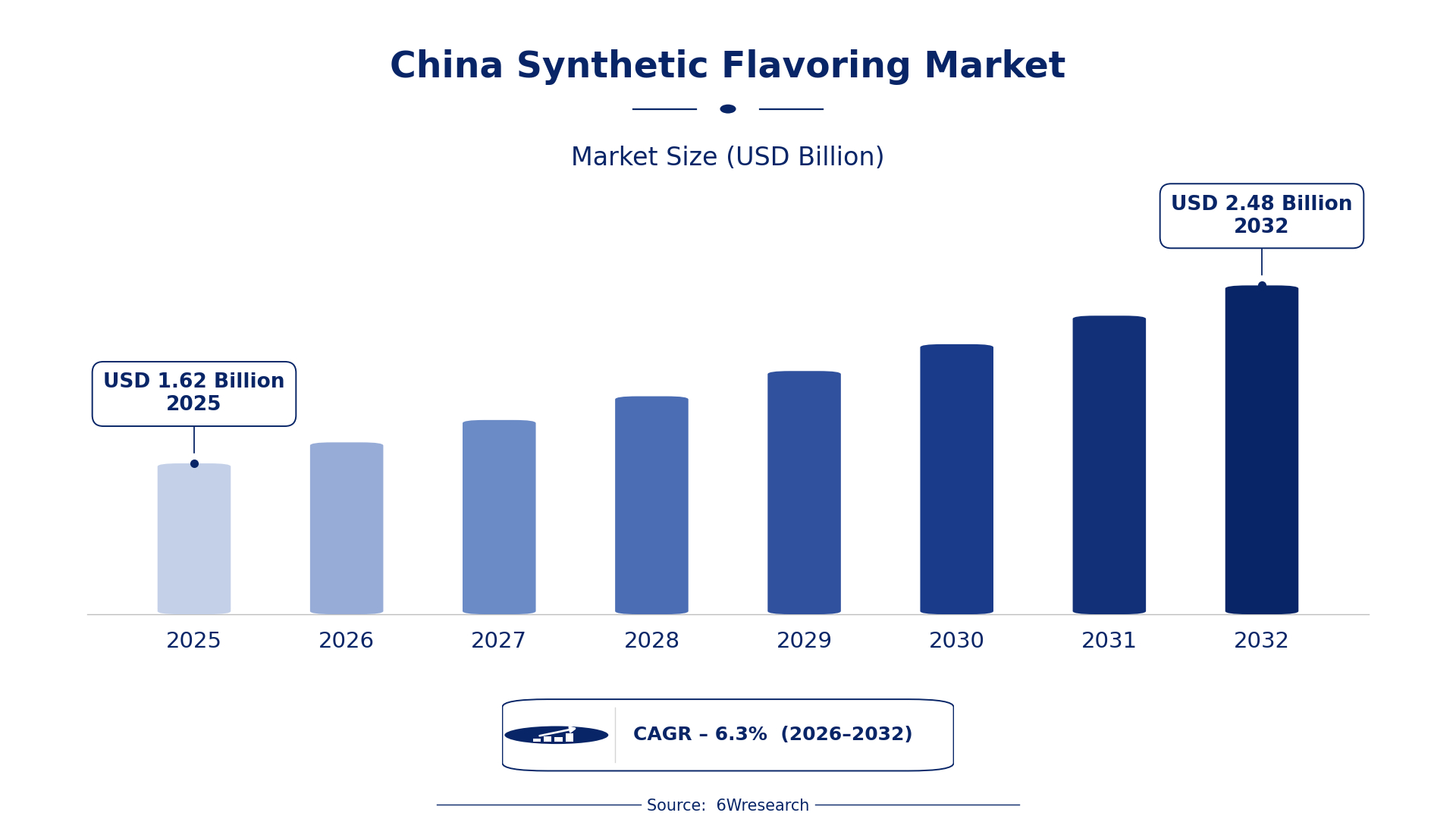
According to 6Wresearch internal database and industry insights, the China Synthetic Flavoring Market was valued at USD 1.62 billion in 2025 and is projected to reach USD 2.48 billion by 2032, growing at a CAGR of approximately 6.3% during 2026–2032.
China Synthetic Flavoring Market Highlights
| Report Metric | Details |
| Report Name | China Synthetic Flavoring Market |
| Market Size 2025 | USD 1.62 billion |
| Market Size 2032 | USD 2.48 billion |
| Absolute Growth 2025–2032 | USD 0.86 billion |
| CAGR 2026–2032 | 6.3% |
| Peak Annual Growth | 8.5% in 2029 |
| Forecast Period | 2026–2032 |
| Historical Data | 2022–2025 |
| Base Year | 2025 |
| Leading Flavor Type, 2025 | Fruit Flavors (52% share) |
| Leading Base Compound, 2025 | Esters/Aldehydes (36% share) |
| Leading Application Segment, 2025 | Beverages (40% share) |
| Leading End User, 2025 | F&B Manufacturers (38% share) |
| Fastest-Growing Flavor Type | Savory Flavors (8.1% CAGR) |
| Fastest-Growing Base Compound | Vanillin/Ethyl Maltol (8.9% CAGR) |
| Fastest-Growing Application Segment | Ready-to-Eat Foods (9.1% CAGR) |
| Fastest-Growing End User | Snack Brands (8.5% CAGR) |
| Growing Sector | Food and Beverage |
| Key End Users | F&B Manufacturers, Snack Brands, Bakery Chains |
China Synthetic Flavoring Market Year-wise Growth Rate and Key Drivers (2022–2032)
This graph illustrates the annual growth rates of the market from 2022 to 2032, highlighting a steady upward trajectory and projected market expansion over the forecast period.
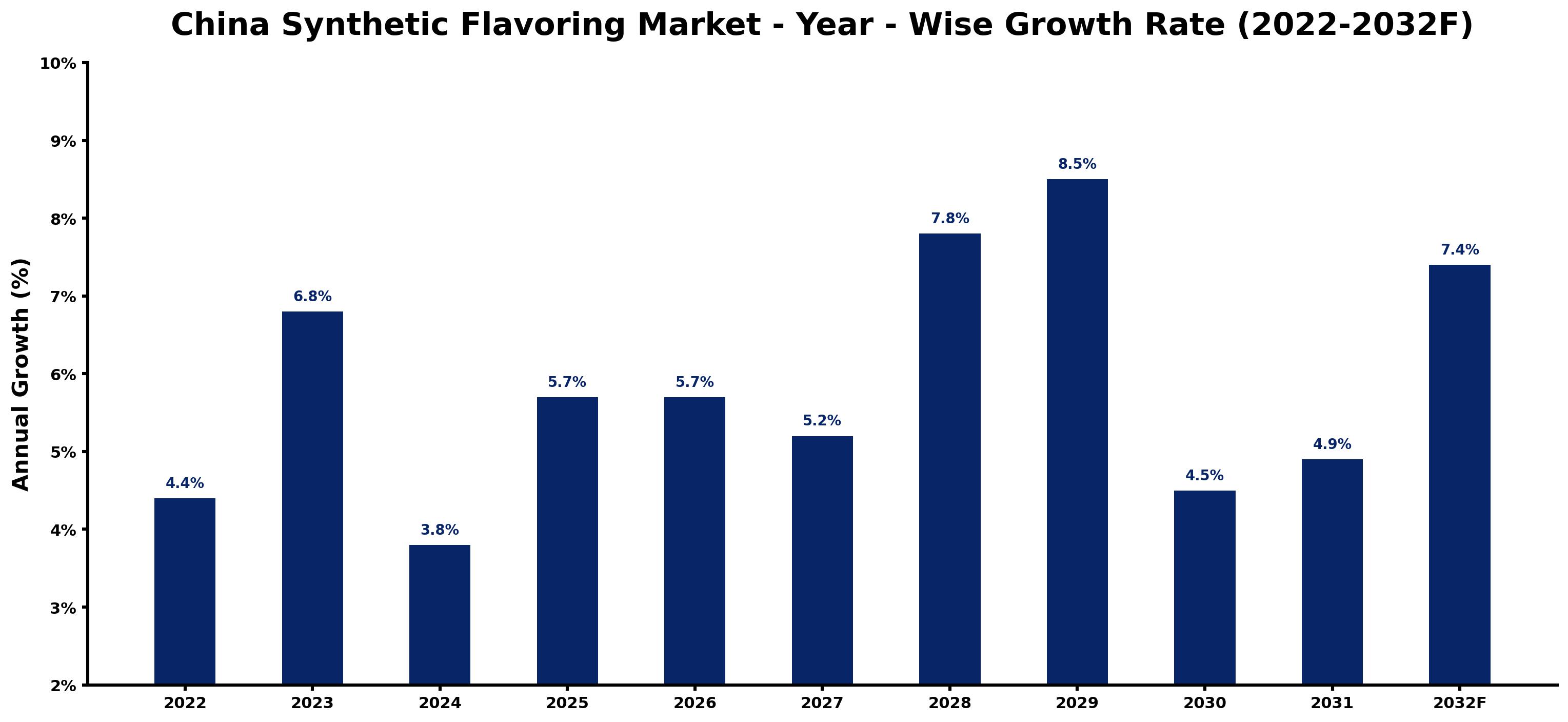
Year by year, the estimates below pair each growth rate with the development that shaped it.
| Year | Estimated Annual Growth (%) | Market Rationale |
| 2022 | 4.4 | The market experienced steady demand from food and beverage manufacturers, reflecting its established presence. |
| 2023 | 6.8 | Growth accelerated due to increased consumer interest in diverse flavour profiles in food products. |
| 2024 | 3.8 | A slowdown occurred as manufacturers adjusted to rising costs of raw materials and production. |
| 2025 | 5.7 | Demand surged as the food processing industry continued to expand, particularly in beverage applications. |
| 2026 | 5.7 | A slight slowdown is anticipated as the Food Safety Improvement Plan impacts production practices. |
| 2027 | 5.2 | Interest in flavour innovation is projected to contribute to a further slowdown in growth rates. |
| 2028 | 7.8 | Demand for ready-to-eat foods is expected to drive a faster growth rate compared to previous years. |
| 2029 | 8.5 | The market is anticipated to peak with heightened consumer preference for synthetic flavours in various applications. |
| 2030 | 4.5 | A growth slowdown is likely as manufacturers face challenges in sourcing sustainable ingredients. |
| 2031 | 4.9 | Demand is projected to rebound as food and beverage manufacturers adapt to changing consumer preferences. |
| 2032 | 7.4 | Growth will accelerate again, driven by advancements in flavour technology and expanding market applications. |
Note: Market size estimations and growth projections presented in this report are based on 6Wresearch's proprietary forecasting methodology, utilizing the latest available industry data, government publications, and primary research inputs.
China Synthetic Flavoring Market Synopsis
Synthetic Flavoring in China includes chemical compounds designed to replicate natural flavours in food products. These compounds are produced through processes like esterification and fermentation, and they find applications in beverages, snacks, and ready-to-eat meals. The China Synthetic Flavoring Market is projected to reach 1.5 billion USD by 2025, driven by the thriving food and beverage sector, which employs over 30 million people. Rising consumer demand for varied flavour profiles and advancements in food safety standards are propelling market growth. Shanghai stands out as a major hub for flavour manufacturing and innovation, further supporting this expansion.
Market Dynamics Impact Analysis (2026–2032)
| Factor | Type | Impact | Primary Segment Affected |
| Increased consumer demand for diverse flavour profiles | Driver | High | Beverages |
| Growth of the food processing industry | Driver | High | Instant Meals |
| Rising demand for ready-to-eat foods | Opportunity | High | Ready-to-Eat Foods |
| Expansion of the bakery industry | Opportunity | Medium | Baked Goods |
| Regulatory challenges in flavour safety standards | Restraint | High | Savory Flavors |
| Competition from natural flavouring agents | Restraint | Medium | Fruit Flavors |
| Sourcing sustainable ingredients remains a challenge | Challenge | High | Sweet & Dessert Notes |
| Market saturation affecting new product introductions | Challenge | Medium | Meat Flavors |
Evaluation of Drivers in China Synthetic Flavoring Market (2026–2032)
The table below links each growth driver to the segment it affects and the evidence for it.
| Drivers | Primary Segment Affected | Why It Matters (Evidence) |
| Increased consumer interest in unique flavours | Beverages | This trend has led to a 40% share of the beverage segment in the synthetic flavouring market. |
| Expansion of the food processing industry | Instant Meals | Valued at over 1 trillion USD in 2022, this sector drives demand for synthetic flavouring agents. |
| Growing popularity of ready-to-eat meals | Ready-to-Eat Foods | This segment is projected to grow at a CAGR of 9.1% through 2032, increasing flavour demand. |
| Rising bakery industry growth | Baked Goods | The bakery industry is expanding at an annual rate of 5%, boosting the need for flavour enhancement. |
| Innovation in flavour technology | Savory Flavors | Advancements in flavour technology improve product offerings, supported by the China Food Industry Association. |
Growth in the Synthetic Flavoring market in China stems from heightened consumer interest in unique flavours, the expansion of the food processing industry, and the increasing popularity of ready-to-eat meals. The beverage segment represents over 40% of the market, showcasing diverse consumer preferences. The food processing industry, valued at over 1 trillion USD in 2022, drives demand for synthetic flavouring agents. The bakery industry is growing at an annual rate of 5%, further increasing flavour requirements. Advances in flavour technology are improving product offerings, stimulating demand in the market.
Evaluation of Restraints in China Synthetic Flavoring Market
Below mentioned are some major restraints and their influence on market dynamics.
| Market Restraint | Primary Segment Affected | Why It Matters (Evidence) |
| Regulatory challenges in flavour safety standards | Savory Flavors | The National Food Safety Standard for Food Additives (GB 2760-2014) imposes strict regulations on synthetic flavours. |
| Competition from natural flavouring agents | Fruit Flavors | The rising demand for natural flavours is influencing the production of synthetic flavouring agents. |
| Sourcing sustainable ingredients remains a challenge | Sweet & Dessert Notes | Manufacturers face difficulties in obtaining sustainable raw materials, affecting production timelines. |
| Market saturation affecting new product introductions | Meat Flavors | Increased competition has led to fewer new products entering the market. |
| High production costs due to raw material prices | Baked Goods | Fluctuating raw material prices are impacting the profitability of flavour manufacturers. |
China Synthetic Flavoring Market Challenges
The China Synthetic Flavoring Market still has to solve a few problems, starting with skills shortages. Many producers cannot find qualified personnel, which hampers production efficiency and delays product launches for food manufacturers. Technology limitations also pose a challenge, as outdated production methods lead to inconsistent flavor quality, affecting buyer trust in the market. Increased competition from natural flavoring alternatives is another hurdle, as consumers shift preferences, forcing synthetic flavor suppliers to innovate quickly. Rising raw material costs are straining profit margins for producers, leading to higher prices for food and beverage companies reliant on synthetic flavoring.
Trends in the China Synthetic Flavoring Market
The trends below show where the China Synthetic Flavoring Market is heading.
- Shift in Consumer Preferences Towards Unique Flavors: In China, there is a noticeable shift towards unique and diverse flavour profiles in food products. This trend is reflected in the beverage segment, which accounts for over 40% of the synthetic flavouring market.
- Transition from Natural to Synthetic Flavors: The demand for synthetic flavours is increasing as consumers seek consistent taste experiences. The National Standard for Flavors (GB 2760) reflects this trend, accommodating new flavouring substances.
- Emergence of New Flavor Technologies: The Food Flavor Innovation Program initiated by the Ministry of Industry and Information Technology is driving advancements in flavour technology, improving product offerings in the market.
- Growing Demand for Ready-to-Eat Meals: The ready-to-eat food segment is expanding rapidly, with a projected CAGR of 9.1% through 2032, indicating a strong market shift towards convenience foods.
Investment Opportunities in the China Synthetic Flavoring Market
The following opportunities in the China Synthetic Flavoring Market pair current demand with a clear way in.
- Investment in Synthetic Flavor Production: With the synthetic flavouring market expected to reach 1.5 billion USD by 2025, there is a strong opportunity for investment in production facilities, particularly in Shanghai.
- Expansion of Flavor Offerings in Bakeries: The bakery industry, growing at 5% annually, presents an opportunity to supply flavours to bakery chains looking to differentiate their products.
- Collaborations for Flavor Innovation: Establishing joint ventures with local food additive suppliers can facilitate entry into the growing synthetic flavour market, particularly in Guangdong province.
- Increasing Demand for Food Safety Compliance: The implementation of the Food Safety Improvement Plan in 2023 highlights the need for compliant flavouring agents, creating opportunities for suppliers to meet these standards.
Government Initiatives in the China Synthetic Flavoring Market
The National Food Safety Standard for Food Additives (GB 2760-2014) implemented by the Ministry of Health in 2021 has a significant impact on producers of synthetic flavors. This regulation enhances the safety and quality of flavouring agents, requiring producers to adhere to strict testing and reporting standards. Compliance with these standards ensures that synthetic flavors meet safety benchmarks, which is crucial for maintaining consumer trust. Additionally, the Sustainable Food Production Strategy initiated by the National Development and Reform Commission in 2022 promotes the use of safe synthetic flavors, encouraging investments in quality control measures. These policies aim to elevate the standards of synthetic flavor production in China.
In 2023, the Ministry of Agriculture launched the Food Safety Improvement Plan, focusing on safe flavouring practices in food production. This initiative supports funding for research and development in flavour technology, enhancing safety protocols. The State Administration for Market Regulation's program initiated in 2022 aims to improve quality control of food additives, including synthetic flavors. This program ensures compliance with safety regulations, benefiting producers by streamlining approval processes and enhancing market access for compliant products. The collaboration between these agencies fosters a safer food environment, ultimately benefiting consumers.
Future Insight of the China Synthetic Flavoring Market
By 2032, the China Synthetic Flavoring Market will experience advancements driven by regulatory updates and technological improvements. The Ministry of Agriculture's 2023 program to enhance food safety standards is likely to boost consumer confidence in flavouring agents. The bakery industry is projected to grow at 5% annually, increasing demand for flavouring agents. As the beverage segment continues to dominate, accounting for over 40% of the market, suppliers will need to adapt their products to align with evolving consumer preferences for both synthetic and natural flavours.
Market Segmentation Analysis
The report offers a comprehensive study of the following market segments and their leading categories in the market.
By Flavor Type – Fruit Flavors Dominated, Savory Flavors Expected to Grow Fastest
According to Sumit Sagar, AM at 6Wresearch, in 2025, Fruit Flavors led the flavor type split with a 52% share. Fruit flavors command a substantial share of the market due to their prevalent use in beverages and desserts, which are staples in many households. The beverage industry, representing over 40% of the synthetic flavoring market, heavily utilises fruit flavors to attract consumers. Savory Flavors are set to record the highest CAGR in this split, 8.1% over 2026–2032. Savory flavors are rapidly gaining traction, particularly in snacks and ready meals, as consumer preferences shift towards more diverse taste experiences. The bakery industry's growth at an annual rate of 5% is also contributing to the rising demand for savory profiles. Suppliers should prioritise the development of savory flavor options to align with evolving consumer tastes.
By Base Compound – Esters/Aldehydes Dominated, Vanillin/Ethyl Maltol Expected to Grow Fastest
With a 36% revenue share in 2025, Esters/Aldehydes was the largest base compound category. Esters and aldehydes dominate the market due to their crucial role in creating fruit flavors, which are widely used in beverages and desserts. Their consistent demand from food and beverage manufacturers ensures they maintain a leading position in the synthetic flavoring market. The quickest growth will come from Vanillin/Ethyl Maltol, forecast to expand at a CAGR of 8.9% between 2026 and 2032. Vanillin and ethyl maltol are experiencing rapid growth as they are essential for developing appealing sweet flavor profiles, particularly in snacks. The rising popularity of sweet snacks is significantly contributing to the expansion of this segment. Suppliers should focus on developing esters, aldehydes, vanillin, and ethyl maltol to meet the increasing demand in the synthetic flavoring market.
By Application Segment – Beverages Dominated, Ready-to-Eat Foods Expected to Grow Fastest
Beverages took a 40% share of application segment in 2025, more than any other category. The beverages segment leads the market as it is a primary application area for synthetic flavoring, catering to a diverse range of drink products. This segment benefits from the steady growth of the beverage industry, ensuring ongoing opportunities for suppliers. Over 2026–2032, Ready-to-Eat Foods are expected to post the fastest growth, at a CAGR of 9.1%. Ready-to-eat foods are the fastest-growing application segment, driven by the rising demand for consistent flavor profiles in convenient meal options. As consumer preferences shift towards convenience, this segment is set for significant growth. Suppliers should consider expanding their product lines to cater to the growing ready-to-eat foods segment to capitalise on emerging opportunities.
By End User – F&B Manufacturers Dominated, Snack Brands Expected to Grow Fastest
The largest end user category in 2025 was F&B Manufacturers, with a 38% share of total revenue. Food and beverage manufacturers represent the largest market share as they are the primary consumers of synthetic flavors, integrating them into a wide array of products. This extensive application across various food categories ensures a stable demand for flavoring agents from this sector. Snack Brands are projected to grow fastest, at a CAGR of 8.5% during 2026–2032. Snack brands are becoming the fastest-growing end users, increasingly utilising synthetic flavors to enhance the appeal of their products. The rising trend in snack consumption is driving this segment's growth, creating new opportunities for suppliers. Suppliers should tailor their offerings to meet the specific needs of snack brands to leverage the growth potential in this segment.
Key Attractiveness of the Report
- 10 Years of Market Numbers
- Historical Data Starting from 2022 to 2025
- Base Year 2025
- Forecast Data until 2032
- Key Performance Indicators Impacting the Market
- Major Upcoming Developments and Projects
Key Highlights of the Report:
- China Synthetic Flavoring Market Outlook
- Market Size of China Synthetic Flavoring Market, 2025
- Forecast of China Synthetic Flavoring Market, 2032
- Historical Data and Forecast of China Synthetic Flavoring Revenues & Volume for the Period 2022 - 2032F
- China Synthetic Flavoring Market Trend Evolution
- China Synthetic Flavoring Market Drivers and Challenges
- China Synthetic Flavoring Price Trends
- China Synthetic Flavoring Porter's Five Forces
- China Synthetic Flavoring Industry Life Cycle
- Historical Data and Forecast of China Synthetic Flavoring Market Revenues & Volume By Flavor Type for the Period 2022 - 2032F
- Historical Data and Forecast of China Synthetic Flavoring Market Revenues & Volume By Fruit Flavors for the Period 2022 - 2032F
- Historical Data and Forecast of China Synthetic Flavoring Market Revenues & Volume By Meat Flavors for the Period 2022 - 2032F
- Historical Data and Forecast of China Synthetic Flavoring Market Revenues & Volume By Sweet & Dessert Notes for the Period 2022 - 2032F
- Historical Data and Forecast of China Synthetic Flavoring Market Revenues & Volume By Savory Flavors for the Period 2022 - 2032F
- Historical Data and Forecast of China Synthetic Flavoring Market Revenues & Volume By Base Compound for the Period 2022 - 2032F
- Historical Data and Forecast of China Synthetic Flavoring Market Revenues & Volume By Esters/Aldehydes for the Period 2022 - 2032F
- Historical Data and Forecast of China Synthetic Flavoring Market Revenues & Volume By Maillard Reaction Agents for the Period 2022 - 2032F
- Historical Data and Forecast of China Synthetic Flavoring Market Revenues & Volume By Vanillin/Ethyl Maltol for the Period 2022 - 2032F
- Historical Data and Forecast of China Synthetic Flavoring Market Revenues & Volume By MSG Replacements for the Period 2022 - 2032F
- Historical Data and Forecast of China Synthetic Flavoring Market Revenues & Volume By Application Segment for the Period 2022 - 2032F
- Historical Data and Forecast of China Synthetic Flavoring Market Revenues & Volume By Beverages for the Period 2022 - 2032F
- Historical Data and Forecast of China Synthetic Flavoring Market Revenues & Volume By Instant Meals for the Period 2022 - 2032F
- Historical Data and Forecast of China Synthetic Flavoring Market Revenues & Volume By Baked Goods for the Period 2022 - 2032F
- Historical Data and Forecast of China Synthetic Flavoring Market Revenues & Volume By Ready-to-Eat Foods for the Period 2022 - 2032F
- Historical Data and Forecast of China Synthetic Flavoring Market Revenues & Volume By End User for the Period 2022 - 2032F
- Historical Data and Forecast of China Synthetic Flavoring Market Revenues & Volume By F&B Manufacturers for the Period 2022 - 2032F
- Historical Data and Forecast of China Synthetic Flavoring Market Revenues & Volume By Snack Brands for the Period 2022 - 2032F
- Historical Data and Forecast of China Synthetic Flavoring Market Revenues & Volume By Bakery Chains for the Period 2022 - 2032F
- Historical Data and Forecast of China Synthetic Flavoring Market Revenues & Volume By Food Additive Suppliers for the Period 2022 - 2032F
- China Synthetic Flavoring Import Export Trade Statistics
- Market Opportunity Assessment By Flavor Type
- Market Opportunity Assessment By Base Compound
- Market Opportunity Assessment By Application Segment
- Market Opportunity Assessment By End User
- China Synthetic Flavoring Top Companies Market Share
- China Synthetic Flavoring Competitive Benchmarking By Technical and Operational Parameters
- China Synthetic Flavoring Company Profiles
- China Synthetic Flavoring Key Strategic Recommendations
Market Covered
This report examines the market across the segments below.
By Flavor Type
- Fruit Flavors
- Meat Flavors
- Sweet & Dessert Notes
- Savory Flavors
By Base Compound
- Esters/Aldehydes
- Maillard Reaction Agents
- Vanillin/Ethyl Maltol
- MSG Replacements
By Application Segment
- Beverages
- Instant Meals
- Baked Goods
- Ready-to-Eat Foods
By End User
- F&B Manufacturers
- Snack Brands
- Bakery Chains
- Food Additive Suppliers































