India Synthetic Food Color Market Size & Growth Rate
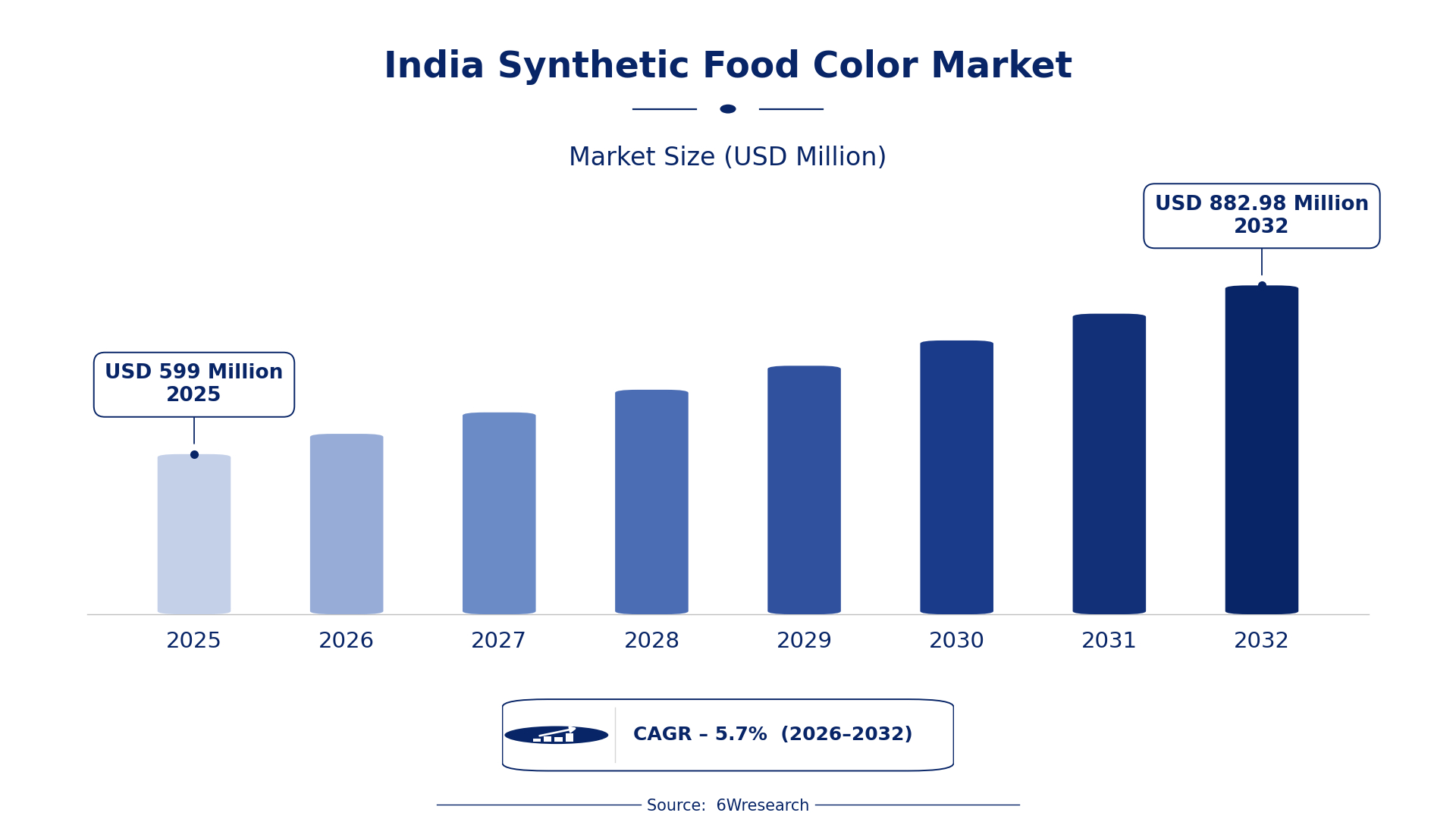
According to 6Wresearch internal database and industry insights, the India Synthetic Food Color Market was valued at USD 599.0 million in 2025 and is projected to reach USD 882.98 million by 2032, growing at a CAGR of approximately 5.7% during 2026–2032.
India Synthetic Food Color Market Highlights
| Report Metric | Details |
| Report Name | India Synthetic Food Color Market |
| Market Size 2025 | USD 599.0 million |
| Market Size 2032 | USD 882.98 million |
| Absolute Growth 2025–2032 | USD 283.98 million |
| CAGR 2026–2032 | 5.7% |
| Peak Annual Growth | 8.0% in 2030 |
| Forecast Period | 2026–2032 |
| Historical Data | 2022–2025 |
| Base Year | 2025 |
| Leading Color Type, 2025 | Red (Allura Red) (39% share) |
| Leading Chemical Source, 2025 | Azo Dye (45% share) |
| Leading Food Category, 2025 | Confectionery (39% share) |
| Leading End User, 2025 | Candy Manufacturers (43% share) |
| Fastest-Growing Color Type | Yellow (Tartrazine) (7.3% CAGR) |
| Fastest-Growing Chemical Source | Sulfonated Azo (6.7% CAGR) |
| Fastest-Growing Food Category | Beverages (7.6% CAGR) |
| Fastest-Growing End User | Juice Makers (7.7% CAGR) |
| Growing Sector | Juice Makers |
| Key End Users | Candy Manufacturers, Juice Makers, Baking Brands, Ice Cream Brands |
India Synthetic Food Color Market Year-wise Growth Rate and Key Drivers (2022–2032)
This graph illustrates the annual growth rates of the market from 2022 to 2032, highlighting a steady upward trajectory and projected market expansion over the forecast period.
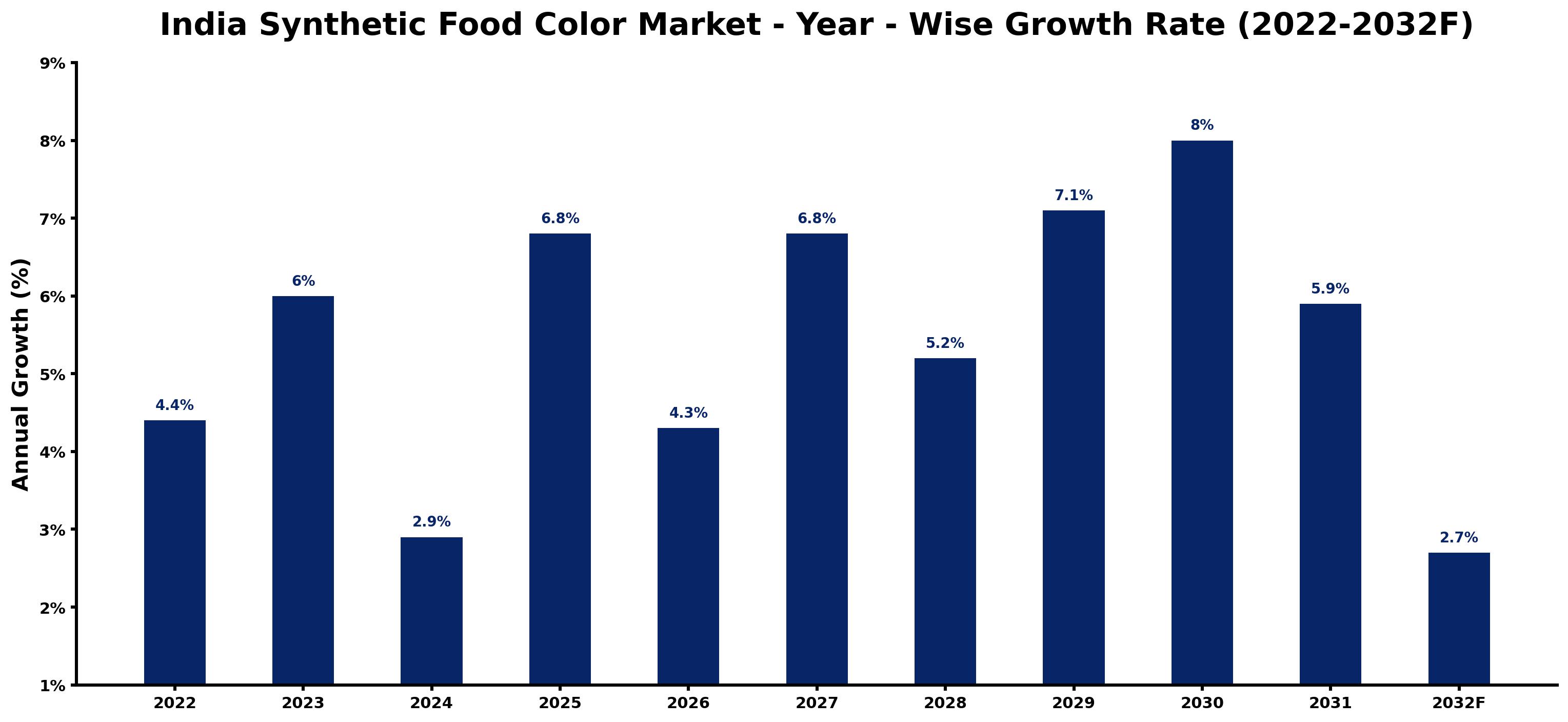
Year by year, the estimates below pair each growth rate with the development that shaped it.
| Year | Estimated Annual Growth (%) | Market Rationale |
| 2022 | 4.4 | The market experienced stable growth, driven by demand from domestic manufacturers in the confectionery sector. |
| 2023 | 6.0 | Increased consumption in the confectionery sector accelerated growth compared to the previous year, particularly in snacks and beverages. |
| 2024 | 2.9 | Growth slowed due to fluctuating raw material prices and increased production costs faced by manufacturers. |
| 2025 | 6.8 | A surge in the confectionery industry's expansion boosted growth as manufacturers increased their output. |
| 2026 | 4.3 | Growth is expected to slow as manufacturers adjust to new regulatory standards under the Food Safety and Standards Act. |
| 2027 | 6.8 | A rebound in demand from candy manufacturers will lead to increased growth rates in synthetic food colors. |
| 2028 | 5.2 | Growth is projected to slow again as market saturation begins to affect purchasing decisions in the confectionery segment. |
| 2029 | 7.1 | Renewed interest in vibrant food colors among beverage producers is expected to spur growth in synthetic color usage. |
| 2030 | 8.0 | The market will peak as new applications in food products drive demand for synthetic colors across various sectors. |
| 2031 | 5.9 | Growth is anticipated to slow as the market stabilises and competition intensifies among manufacturers in the sector. |
| 2032 | 2.7 | A gradual slowdown is expected as market maturity sets in, impacting future growth rates. |
Note: Market size estimations and growth projections presented in this report are based on 6Wresearch's proprietary forecasting methodology, utilizing the latest available industry data, government publications, and primary research inputs.
India Synthetic Food Color Market Synopsis
Synthetic Food Color in India encompasses artificial dyes used to enhance the appearance of food and beverages. These colors are produced through chemical synthesis, primarily involving azo compounds. Valued at approximately 200 million USD as of 2023, the market is expanding due to rising demand from the confectionery and beverage sectors. The Indian confectionery industry is projected to reach 1.5 billion USD by 2025, significantly driving demand for synthetic food colors. Over 60% of these colors are derived from azo dyes, reflecting their stability and popularity among manufacturers.
Market Dynamics Impact Analysis (2026–2032)
| Factor | Type | Impact | Primary Segment Affected |
| Rising demand from the confectionery sector | Driver | High | Confectionery |
| Growth in the beverage industry | Driver | High | Beverages |
| Increasing demand for vibrant food products | Opportunity | High | Red (Allura Red) |
| Expansion of the dairy sector | Opportunity | Medium | Dairy Products |
| Regulatory compliance costs | Restraint | High | Red (Allura Red) |
| Market saturation in key segments | Restraint | Medium | Confectionery |
| Supply chain disruptions affecting raw materials | Challenge | High | Red (Allura Red) |
| Intense competition among manufacturers | Challenge | Medium | Red (Allura Red) |
Evaluation of Drivers in India Synthetic Food Color Market (2026–2032)
Key forces behind demand, with the segment each one moves most, are listed below.
| Drivers | Primary Segment Affected | Why It Matters (Evidence) |
| Increased production capacity in the confectionery sector | Confectionery | The Indian confectionery industry is projected to reach 1.5 billion USD by 2025, driving demand for synthetic colors. |
| Rising popularity of vibrant beverages | Beverages | Synthetic colors are used in over 70% of packaged food products, indicating high adoption levels among manufacturers. |
| Growing consumer preference for visually appealing food | Azo Dye | Stable azo dyes account for over 60% of synthetic food colors, driving demand for vibrant food products. |
| Expansion of the dairy sector | Dairy Products | The Indian dairy sector is projected to grow to 200 billion USD by 2026, influencing color usage in dairy products. |
| Regulatory support for food safety standards | Red (Allura Red) | The Food Safety and Standards Authority of India regulates food colors under the Food Safety and Standards Act, ensuring compliance. |
The Synthetic Food Color market in India is growing on the back of increased production capacity in the confectionery sector, projected to reach 1.5 billion USD by 2025. The rising popularity of vibrant beverages is clear as synthetic colors are used in over 70% of packaged food products, reflecting high adoption levels. Consumer preference for visually appealing food drives demand for synthetic colors, with over 60% derived from stable azo dyes. The expansion of the dairy sector, expected to reach 200 billion USD by 2026, further influences color usage. Support from the Food Safety and Standards Authority of India ensures compliance and safety in food color applications.
Evaluation of Restraints in India Synthetic Food Color Market
The main factors holding the market back are set out below.
| Market Restraint | Primary Segment Affected | Why It Matters (Evidence) |
| High compliance costs for food safety regulations | Red (Allura Red) | Producers face increased costs due to compliance with the Food Safety and Standards Act, impacting pricing and profit margins. |
| Market saturation in the confectionery segment | Confectionery | Intense competition and limited growth opportunities in the confectionery sector lead to price pressures and reduced profitability. |
| Supply chain disruptions affecting raw materials | Red (Allura Red) | Fluctuations in raw material availability can delay production schedules and increase costs for manufacturers. |
| Limited awareness of synthetic color benefits among small manufacturers | Red (Allura Red) | Small manufacturers may hesitate to invest in synthetic colors due to lack of information on benefits and applications. |
| Stringent quality standards imposed by regulatory bodies | Red (Allura Red) | Producers must invest in quality assurance processes to meet standards set by the Bureau of Indian Standards, increasing operational costs. |
India Synthetic Food Color Market Challenges
The India Synthetic Food Color Market faces a critical challenge with skills shortages among producers, which raises operational costs and delays product availability for manufacturers. Many producers struggle to find trained personnel in chemical synthesis, leading to a potential 20% increase in production costs. Suppliers contend with outdated technology, as many production facilities lack modern equipment, resulting in inefficiencies that can inflate costs by 15%. Competition from natural food color alternatives is intensifying, forcing buyers to reconsider sourcing strategies and risking a 10% increase in procurement expenses. Supply chain disruptions in Maharashtra can delay shipments of synthetic colors, impacting production timelines for beverage and confectionery producers.
Trends in the India Synthetic Food Color Market
Four trends stand out in the India Synthetic Food Color Market.
- Shift towards Natural Color Alternatives: The National Food Security Mission promotes the use of natural color alternatives, impacting synthetic color demand. Approximately 30% of manufacturers are exploring natural options as consumer preferences shift towards healthier products.
- Increased Regulation on Food Safety: In 2021, the Food Safety and Standards Authority of India updated regulations affecting synthetic food color usage. Compliance with these regulations is essential for over 60% of manufacturers to ensure product safety.
- Emergence of New Food Products: The Indian market is seeing a rise in new food products that require vibrant colors. The confectionery sector has experienced a notable increase in demand for synthetic colors in innovative product lines, reflecting changing consumer tastes.
- Growing Demand for Vegan Products: The rise in veganism is influencing color choices, with many manufacturers seeking plant-based alternatives. Approximately 25% of new products launched in 2023 are vegan-friendly, driving demand for suitable synthetic colors.
Investment Opportunities in the India Synthetic Food Color Market
The following opportunities in the India Synthetic Food Color Market pair current demand with a clear way in.
- Supply of Azo Dyes for Confectionery: With the confectionery sector projected to reach 1.5 billion USD by 2025, suppliers can focus on providing azo dyes to meet demand. Collaborating with candy manufacturers in Maharashtra can facilitate market entry.
- Expansion of Dairy Product Colorants: As the Indian dairy sector is expected to grow to 200 billion USD by 2026, there is an opportunity to supply synthetic colors tailored for dairy products. Partnering with dairy brands can enhance market presence.
- Investment in Natural Color Alternatives: Developing natural color alternatives can meet the rising consumer demand for healthier products. Collaborating with food safety organizations can provide necessary certifications for market entry.
- Certification for Food Safety Compliance: With stringent regulations in place, offering certification services for synthetic food colors can be a lucrative opportunity. Targeting manufacturers seeking compliance with the Food Safety and Standards Act can drive business growth.
Government Initiatives in the India Synthetic Food Color Market
The Food Safety and Standards Authority of India (FSSAI) updated the Food Safety and Standards (Food Products Standards and Food Additives) Regulations in 2021, introducing new guidelines for synthetic food colors. This measure requires manufacturers to comply with stricter safety and quality standards, ensuring that synthetic colors used in food products are safe for consumption. Additionally, the Food Safety and Standards (Amendment) Bill was introduced in 2023 to strengthen regulations around food additives, including synthetic colors. This legislation aims to enhance consumer protection and improve the overall quality of food products in the market, impacting how producers formulate their offerings. Compliance with these regulations is essential for maintaining market access and consumer trust.
The National Food Security Mission, launched in 2020, aims to enhance food quality and safety, which includes the regulation of food additives like synthetic colors. This initiative encourages food manufacturers to adopt better practices, ensuring that synthetic colors meet safety standards. The Bureau of Indian Standards (BIS) revised standards for food additives in 2023, impacting the synthetic food color industry by setting new quality benchmarks. These standards guide manufacturers in producing compliant products, ensuring safety and quality in the market. The collaboration between FSSAI and BIS helps streamline the approval process for synthetic food colors, facilitating smoother market entry for compliant products.
Future Insight of the India Synthetic Food Color Market
The India Synthetic Food Color Market is set for transformative changes by 2032, driven by advancements in food safety standards and technology. The implementation of ISO 22000 will elevate safety management systems, ensuring higher quality synthetic food colors. By 2026, the Indian dairy sector is expected to grow to 200 billion USD, which will increase the demand for synthetic colors in dairy products. The National Food Security Mission will further improve food quality, expanding the application of synthetic colors in packaged products. These trends will create new opportunities for suppliers and buyers, fostering a more competitive market.
Market Segmentation Analysis
The analysis below covers each segmentation, its leading category in 2025 and its fastest-growing category through 2032.
By Color Type – Red (Allura Red) Dominated, Yellow (Tartrazine) Expected to Grow Fastest
According to Sumit Sagar, AM at 6Wresearch, Red (Allura Red) took a 39% share of color type in 2025, more than any other category. Red, specifically Allura Red, commands the largest share as it is widely used in candies and beverages, appealing to consumers with its bright hue. Its extensive application in popular products ensures a robust installed base among manufacturers in the Indian synthetic food color market. The quickest growth will come from Yellow (Tartrazine), forecast to expand at a CAGR of 7.3% between 2026 and 2032. Yellow, particularly Tartrazine, is rapidly gaining popularity as it is increasingly favoured in snacks and drinks, reflecting a trend towards visually appealing food products. The anticipated growth in the snack sector, projected to reach substantial market values, further propels this trend. Suppliers should focus on expanding their Tartrazine offerings to leverage its growing demand in the snack and beverage markets.
By Chemical Source – Azo Dye Dominated, Sulfonated Azo Expected to Grow Fastest
With a 45% revenue share in 2025, Azo Dye was the largest chemical source category. Azo dyes are the primary source for many synthetic food colors, owing to their stability and vividness, which are essential for maintaining product appeal. This chemical source's dominance is evidenced by its substantial share in the overall synthetic food color market. Sulfonated Azo is projected to grow fastest, at a CAGR of 6.7% during 2026–2032. Sulfonated Azo is gaining traction rapidly as it is used in various food color applications, particularly in products requiring high solubility and stability. The increasing focus on food safety and quality standards is driving this segment's growth. Manufacturers should invest in developing Sulfonated Azo formulations to meet the rising demand for versatile and safe food color solutions.
By Food Category – Confectionery Dominated, Beverages Expected to Grow Fastest
The largest food category category in 2025 was Confectionery, with a 39% share of total revenue. Confectionery leads the market for synthetic food colors, as it heavily relies on vibrant hues to attract consumers, especially in candies and sweets. This sector's substantial market share highlights the critical role of visual appeal in driving consumer purchases. Over 2026–2032, Beverages are expected to post the fastest growth, at a CAGR of 7.6%. Beverages are experiencing the fastest growth in synthetic food color usage, primarily due to the expanding soft drink market and consumer demand for visually appealing drinks. This trend will likely persist as beverage innovations continue to emerge. Suppliers should prioritise product development for the beverage sector to align with the increasing demand for eye-catching drink formulations.
By End User – Candy Manufacturers Dominated, Juice Makers Expected to Grow Fastest
In 2025, Candy Manufacturers led the end user split with a 43% share. Candy manufacturers are the main users of synthetic colors, employing these dyes to enhance the visual appeal of their products, which significantly impacts consumer buying choices. This group's substantial market share highlights the critical role of aesthetics in the confectionery sector. Juice Makers are set to record the highest CAGR in this split, 7.7% over 2026–2032. Juice makers are increasingly incorporating synthetic colors to elevate the visual quality of their beverages, aligning with consumer preferences for vibrant and appealing drinks. This growth is propelled by the expanding market for health-oriented beverages. Suppliers should customise their products to cater to the specific requirements of juice makers, emphasising natural-looking and attractive color solutions.
Key Attractiveness of the Report
- 10 Years of Market Numbers
- Historical Data Starting from 2022 to 2025
- Base Year 2025
- Forecast Data until 2032
- Key Performance Indicators Impacting the Market
- Major Upcoming Developments and Projects
Key Highlights of the Report:
- India Synthetic Food Color Market Outlook
- Market Size of India Synthetic Food Color Market, 2025
- Forecast of India Synthetic Food Color Market, 2032
- Historical Data and Forecast of India Synthetic Food Color Revenues & Volume for the Period 2022 - 2032F
- India Synthetic Food Color Market Trend Evolution
- India Synthetic Food Color Market Drivers and Challenges
- India Synthetic Food Color Price Trends
- India Synthetic Food Color Porter's Five Forces
- India Synthetic Food Color Industry Life Cycle
- Historical Data and Forecast of India Synthetic Food Color Market Revenues & Volume By Color Type for the Period 2022 - 2032F
- Historical Data and Forecast of India Synthetic Food Color Market Revenues & Volume By Red (Allura Red) for the Period 2022 - 2032F
- Historical Data and Forecast of India Synthetic Food Color Market Revenues & Volume By Yellow (Tartrazine) for the Period 2022 - 2032F
- Historical Data and Forecast of India Synthetic Food Color Market Revenues & Volume By Blue (Brilliant Blue) for the Period 2022 - 2032F
- Historical Data and Forecast of India Synthetic Food Color Market Revenues & Volume By Green (Fast Green) for the Period 2022 - 2032F
- Historical Data and Forecast of India Synthetic Food Color Market Revenues & Volume By Chemical Source for the Period 2022 - 2032F
- Historical Data and Forecast of India Synthetic Food Color Market Revenues & Volume By Azo Dye for the Period 2022 - 2032F
- Historical Data and Forecast of India Synthetic Food Color Market Revenues & Volume By Sulfonated Azo for the Period 2022 - 2032F
- Historical Data and Forecast of India Synthetic Food Color Market Revenues & Volume By Triarylmethane Dye for the Period 2022 - 2032F
- Historical Data and Forecast of India Synthetic Food Color Market Revenues & Volume By Combined Dyes for the Period 2022 - 2032F
- Historical Data and Forecast of India Synthetic Food Color Market Revenues & Volume By Food Category for the Period 2022 - 2032F
- Historical Data and Forecast of India Synthetic Food Color Market Revenues & Volume By Confectionery for the Period 2022 - 2032F
- Historical Data and Forecast of India Synthetic Food Color Market Revenues & Volume By Beverages for the Period 2022 - 2032F
- Historical Data and Forecast of India Synthetic Food Color Market Revenues & Volume By Dairy Products for the Period 2022 - 2032F
- Historical Data and Forecast of India Synthetic Food Color Market Revenues & Volume By Bakery & Snacks for the Period 2022 - 2032F
- Historical Data and Forecast of India Synthetic Food Color Market Revenues & Volume By End User for the Period 2022 - 2032F
- Historical Data and Forecast of India Synthetic Food Color Market Revenues & Volume By Candy Manufacturers for the Period 2022 - 2032F
- Historical Data and Forecast of India Synthetic Food Color Market Revenues & Volume By Juice Makers for the Period 2022 - 2032F
- Historical Data and Forecast of India Synthetic Food Color Market Revenues & Volume By Ice Cream Brands for the Period 2022 - 2032F
- Historical Data and Forecast of India Synthetic Food Color Market Revenues & Volume By Baking Brands for the Period 2022 - 2032F
- India Synthetic Food Color Import Export Trade Statistics
- Market Opportunity Assessment By Color Type
- Market Opportunity Assessment By Chemical Source
- Market Opportunity Assessment By Food Category
- Market Opportunity Assessment By End User
- India Synthetic Food Color Top Companies Market Share
- India Synthetic Food Color Competitive Benchmarking By Technical and Operational Parameters
- India Synthetic Food Color Company Profiles
- India Synthetic Food Color Key Strategic Recommendations
Market Covered
Segments analysed in this report are listed below.
By Color Type
- Red (Allura Red)
- Yellow (Tartrazine)
- Blue (Brilliant Blue)
- Green (Fast Green)
By Chemical Source
- Azo Dye
- Sulfonated Azo
- Triarylmethane Dye
- Combined Dyes
By Food Category
- Confectionery
- Beverages
- Dairy Products
- Bakery & Snacks
By End User
- Candy Manufacturers
- Juice Makers
- Ice Cream Brands
- Baking Brands































