China Synthetic Food Color Market Size & Growth Rate
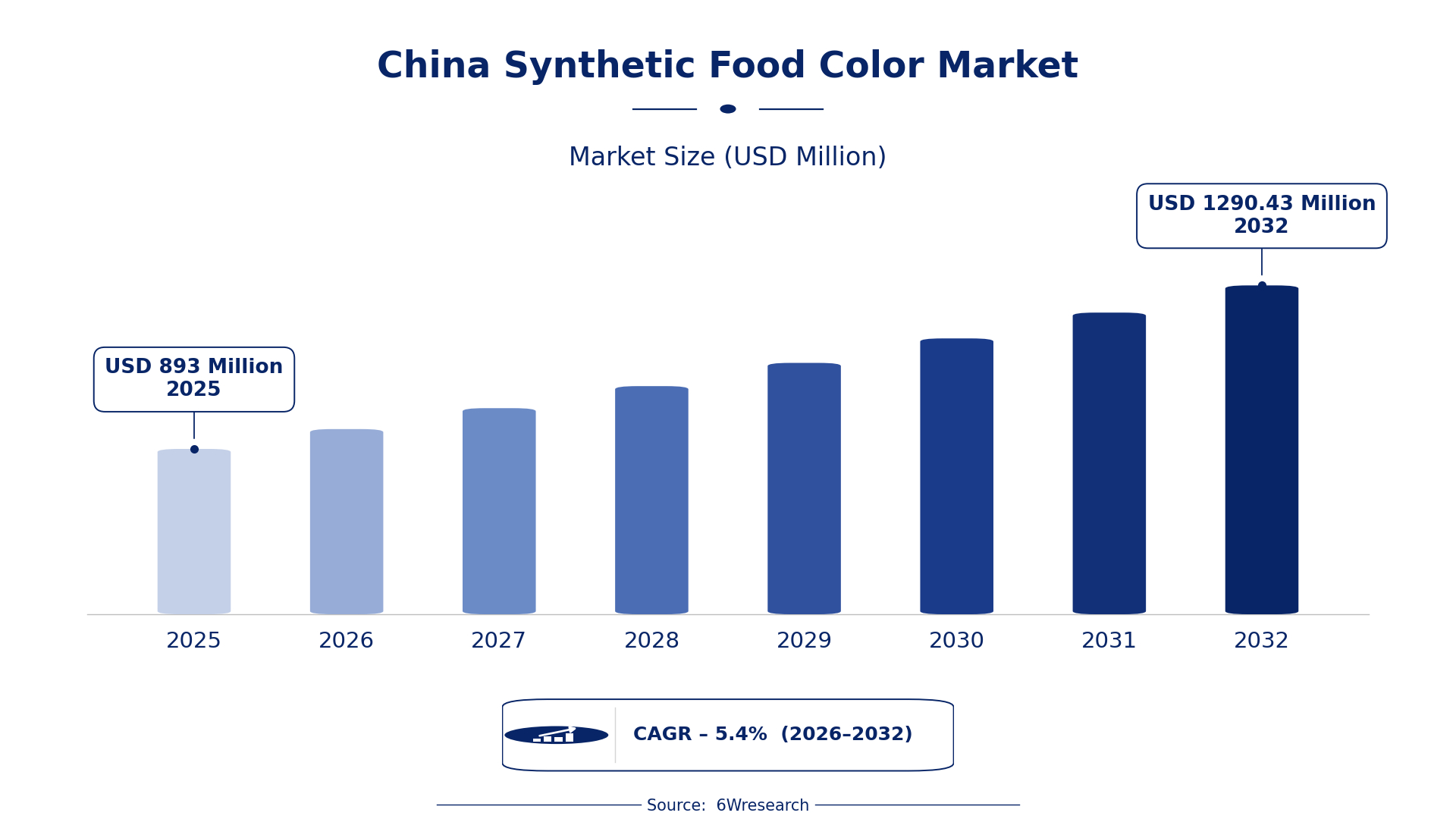
According to 6Wresearch internal database and industry insights, the China Synthetic Food Color Market was valued at USD 893.0 million in 2025 and is projected to reach USD 1,290.43 million by 2032, growing at a CAGR of approximately 5.4% during 2026–2032.
China Synthetic Food Color Market Highlights
| Report Metric | Details |
| Report Name | China Synthetic Food Color Market |
| Market Size 2025 | USD 893.0 million |
| Market Size 2032 | USD 1,290.43 million |
| Absolute Growth 2025–2032 | USD 397.43 million |
| CAGR 2026–2032 | 5.4% |
| Peak Annual Growth | 7.5% in 2032 |
| Forecast Period | 2026–2032 |
| Historical Data | 2022–2025 |
| Base Year | 2025 |
| Leading Color Type, 2025 | Yellow (Tartrazine) (39% share) |
| Leading Chemical Source, 2025 | Azo Dye (41% share) |
| Leading Food Category, 2025 | Confectionery (37% share) |
| Leading End User, 2025 | Candy Manufacturers (39% share) |
| Fastest-Growing Color Type | Red (Allura Red) (7.6% CAGR) |
| Fastest-Growing Food Category | Beverages (6.6% CAGR) |
| Fastest-Growing End User | Juice Makers (7.0% CAGR) |
| Growing Sector | Confectionery |
| Key End Users | Candy Manufacturers, Beverage Producers, Juice Makers, Ice Cream Brands |
China Synthetic Food Color Market Year-wise Growth Rate and Key Drivers (2022–2032)
This graph illustrates the annual growth rates of the market from 2022 to 2032, highlighting a steady upward trajectory and projected market expansion over the forecast period.
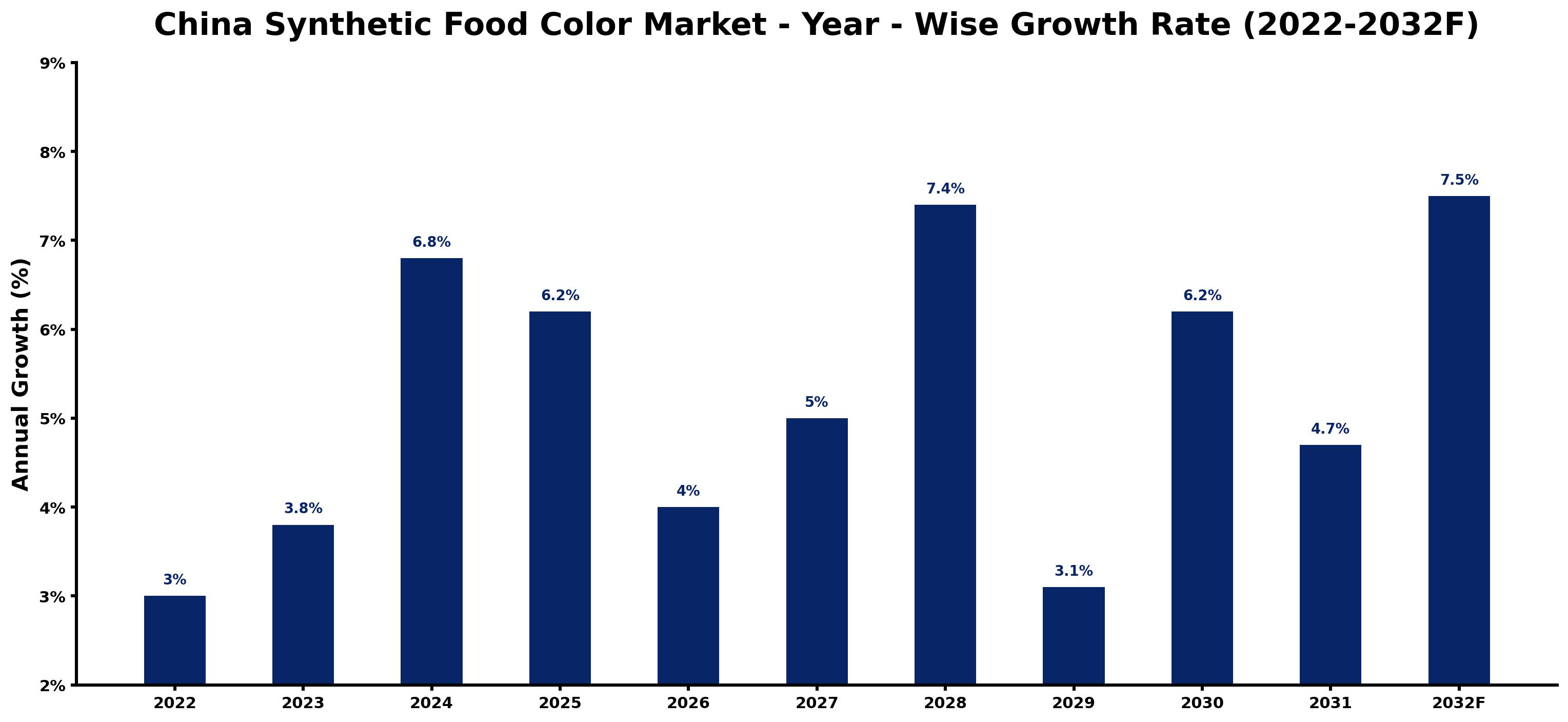
Each row of the following table gives one year's estimated growth and the event or demand shift that explains it.
| Year | Estimated Annual Growth (%) | Market Rationale |
| 2022 | 3.0 | The market showed steady demand for synthetic food colors among domestic manufacturers and processors. |
| 2023 | 3.8 | Growth accelerated due to increased usage in confectionery products, particularly among candy manufacturers. |
| 2024 | 6.8 | The introduction of new regulations boosted confidence among producers and buyers, enhancing market stability. |
| 2025 | 6.2 | A slight slowdown occurred as producers adjusted to regulatory changes and market conditions, impacting growth rates. |
| 2026 | 4.0 | Further adjustments in production methods are expected to contribute to a continued but slower growth rate, affecting overall demand. |
| 2027 | 5.0 | Demand from candy manufacturers is projected to surge, driving a rebound in growth rates as new products are launched. |
| 2028 | 7.4 | The beverage sector's expansion will lead to a notable increase in synthetic color usage, particularly in drinks. |
| 2029 | 3.1 | A slowdown is anticipated as market saturation begins affecting growth rates, especially in confectionery. |
| 2030 | 6.2 | Growth is expected to rebound as new product launches revitalise interest in synthetic colors across various segments. |
| 2031 | 4.7 | A moderation in growth is projected as the market stabilises after previous fluctuations, particularly in the beverage sector. |
| 2032 | 7.5 | The market is expected to peak with strong demand from diverse food sectors, particularly beverages and confectionery. |
Note: Market size estimations and growth projections presented in this report are based on 6Wresearch's proprietary forecasting methodology, utilizing the latest available industry data, government publications, and primary research inputs.
China Synthetic Food Color Market Synopsis
Synthetic Food Color in China includes artificial dyes that improve the visual appeal of food. These colours are created through chemical processes and find primary applications in confectionery, beverages, and dairy products. The China Synthetic Food Color Market is expanding due to increasing demand from local manufacturers and processors, with production exceeding 10,000 tons in 2022. The food and beverage industry, valued at over $1 trillion, plays a crucial role in this growth. In addition, the Ministry of Agriculture's 2023 program promotes safe food colouring practices, further facilitating market expansion.
Market Dynamics Impact Analysis (2026–2032)
| Factor | Type | Impact | Primary Segment Affected |
| Increased demand for vibrant colors in confectionery products | Driver | High | Confectionery |
| Growing beverage sector requiring appealing product aesthetics | Driver | High | Beverages |
| Investment in safe food coloring technologies | Opportunity | High | Yellow (Tartrazine) |
| Expansion of the candy manufacturing sector | Opportunity | High | Candy Manufacturers |
| Regulatory compliance costs impacting small producers | Restraint | Medium | Azo Dye |
| Limited consumer awareness about synthetic food colors | Restraint | Medium | Yellow (Tartrazine) |
| Supply chain disruptions affecting raw material availability | Challenge | High | Yellow (Tartrazine) |
| Fluctuating prices of synthetic color raw materials | Challenge | High | Yellow (Tartrazine) |
Evaluation of Drivers in China Synthetic Food Color Market (2026–2032)
The table below links each growth driver to the segment it affects and the evidence for it.
| Drivers | Primary Segment Affected | Why It Matters (Evidence) |
| Rising use of synthetic colors in over 70% of confectionery products | Confectionery | This high usage drives demand for vibrant colors, leading to increased purchases by manufacturers in the sector. |
| Beverage sector growth, with approximately 80% of colors used in drinks | Beverages | The expanding beverage market necessitates appealing colors, prompting manufacturers to source more synthetic colors for new products. |
| ISO 9001 certification among manufacturers ensuring quality | Azo Dye | Certified producers attract more buyers seeking reliable products, boosting overall demand for synthetic colors in the market. |
| Government initiatives promoting safe food coloring practices | Yellow (Tartrazine) | These initiatives encourage manufacturers to adopt safer practices, increasing demand for compliant synthetic colors in the industry. |
| Expansion of candy manufacturers in Guangdong province | Candy Manufacturers | The concentration of production facilities in this region increases local demand for synthetic food colors, enhancing supply opportunities. |
Growth in the Synthetic Food Color market in China comes from the increasing use of synthetic colors in confectionery products, which are prevalent in over 70% of items. The beverage sector also fuels demand, with approximately 80% of synthetic colors used in drinks, prompting manufacturers to source more vibrant options. The presence of ISO 9001 certification among producers ensures quality and reliability, attracting buyers. Furthermore, the expansion of candy manufacturers in Guangdong province boosts local demand for these products, contributing significantly to market growth.
Evaluation of Restraints in China Synthetic Food Color Market
The main factors holding the market back are set out below.
| Market Restraint | Primary Segment Affected | Why It Matters (Evidence) |
| Compliance costs associated with the Food Safety Law | Azo Dye | Producers face increased expenses to meet regulatory standards, impacting profitability and pricing strategies. |
| Consumer skepticism regarding synthetic food colors | Yellow (Tartrazine) | Limited awareness leads to hesitance in purchasing products containing synthetic colors, affecting sales volumes. |
| Supply chain disruptions affecting raw material availability | Yellow (Tartrazine) | Manufacturers struggle to maintain production levels due to inconsistent raw material supplies, impacting delivery timelines. |
| Fluctuating prices of raw materials for synthetic colors | Yellow (Tartrazine) | Price volatility affects budgeting and planning for producers, complicating procurement and production strategies. |
| Limited market penetration in niche food segments | Beverages | Some beverage manufacturers remain hesitant to adopt synthetic colors, restricting market expansion opportunities. |
China Synthetic Food Color Market Challenges
The China synthetic food color market encounters strict regulations from the National Food Safety Standard GB 2760-2014, complicating compliance for producers and delaying product launches. Importers face supply chain disruptions, as reliance on the Guangdong province for production may lead to shortages, affecting availability for distributors. Buyers experience limited variety in synthetic colours, as over 70% of confectionery products rely on a few common shades, restricting options and hindering creativity. Increasing compliance and production costs place pressure on profit margins for manufacturers, making it difficult to maintain competitive pricing in a $1 trillion food and beverage industry.
Trends in the China Synthetic Food Color Market
Several trends are reshaping the China Synthetic Food Color Market; the most important are set out below.
- Launch of New Food Safety Standards: The 2023 National Standard for Food Safety GB 2760 introduced updated regulations affecting synthetic colours. This change encourages producers to implement improved safety protocols, ensuring compliance and boosting consumer confidence in food products.
- Increase in Beverage Sector Utilisation: In 2022, around 80% of synthetic food colours were used in beverages. This trend reflects the growing demand for visually appealing drinks, prompting manufacturers to invest in vibrant colour solutions to attract consumers.
- Growth in Candy Manufacturing: Candy manufacturers are increasingly adopting synthetic colours, with a market share of 39% anticipated in 2025. This growth is driven by consumer preferences for visually attractive confectionery products, leading to higher sales.
- Expansion of ISO Certification Among Producers: The prevalence of ISO 9001 certification among manufacturers is on the rise, ensuring quality and safety in synthetic food colours. This trend supports market growth as buyers seek reliable suppliers for their products.
Investment Opportunities in the China Synthetic Food Color Market
Several openings in the China Synthetic Food Color Market merit attention from investors.
- Investment in Safe Food Coloring Technologies: With a budget of 50 million yuan allocated for food safety improvements, there is an opportunity to supply safe synthetic colours. Collaborating with local manufacturers can facilitate market entry and enhance product offerings.
- Expansion into Beverage Sector: The growth of the beverage sector presents an opportunity to supply vibrant synthetic colours. Targeting beverage manufacturers in Guangdong province can strengthen market presence and drive sales.
- Supply of Azo Dyes to Confectionery Producers: As Azo Dye holds a 41% market share, investing in its production can meet rising demand from confectionery manufacturers. Establishing partnerships with local producers can streamline entry into this profitable segment.
- Development of Eco-Friendly Synthetic Colors: With increasing consumer awareness, there is a gap for eco-friendly synthetic colours. Targeting health-conscious buyers in urban areas can drive market growth and attract new customers.
Government Initiatives in the China Synthetic Food Color Market
The 2023 National Standard for Food Safety GB 2760 updated regulations on synthetic food colours, improving safety measures for producers. This law builds on the Food Safety Law implemented in 2021, which established stricter compliance requirements for food additives, including synthetic colours. Producers must now adhere to these updated standards, ensuring their products meet safety regulations, which helps improve consumer trust and market stability. Additionally, the National Health Commission oversees the implementation of these standards, ensuring that manufacturers comply with safety protocols and promote public health.
In 2022, the Ministry of Agriculture launched a program with a budget of 50 million yuan to improve food safety standards for synthetic food colours. This initiative aims to support producers in adopting safer practices and ensuring compliance with regulations. The National Health Commission plays a key role in overseeing these standards, ensuring that manufacturers adhere to safety protocols and promoting public health. Furthermore, this program enables producers to access resources for improving their production processes, enhancing overall product quality.
Future Insight of the China Synthetic Food Color Market
The China synthetic food color market will evolve by 2032, driven by advancements in food safety practices and regulatory support. The Ministry of Agriculture's initiative to promote safe colouring practices will enhance consumer confidence and expand market opportunities. New safety guidelines will improve industry standards, ensuring higher quality products for buyers. With over 10,000 tons of synthetic food colours produced in 2022, innovations in applications are expected to increase demand across various sectors, particularly in beverages and confectionery.
Market Segmentation Analysis
The report offers a comprehensive study of the following market segments and their leading categories in the market.
By Color Type – Yellow (Tartrazine) Dominated, Red (Allura Red) Expected to Grow Fastest
According to Sumit Sagar, AM at 6Wresearch, in 2025, Yellow (Tartrazine) led the color type split with a 39% share. Yellow, particularly Tartrazine, holds the largest share due to its extensive use in various food products, especially in confectionery. Its significance is underscored by its presence in over 70% of confectionery items in China, making it a staple in the market. Red (Allura Red) is projected to grow fastest, at a CAGR of 7.6% during 2026–2032. Red, specifically Allura Red, is experiencing rapid growth as it gains popularity in candies and beverages, responding to consumer preferences for vibrant colours. This trend is expected to continue, further widening the lead of Tartrazine due to its established market presence. Suppliers should focus on enhancing their offerings of Tartrazine and Allura Red to effectively meet the increasing demand in the Chinese synthetic food color market.
By Chemical Source – Azo Dye Dominated and Is Expected to Record the Fastest Growth
Azo Dye held a 41% share of the China Synthetic Food Color Market by chemical source in 2025. Azo Dye dominates the market share as it is predominantly used in food coloring applications, ensuring a reliable supply for manufacturers. The widespread adoption of Azo Dye across various food categories solidifies its leading position. Its lead should widen, with a projected CAGR of 7.1% during 2026–2032, the highest in this split. Azo Dye is also the fastest-growing segment, as its versatility and cost-effectiveness make it the preferred choice among manufacturers. As demand for synthetic food colors rises, Azo Dye's lead will continue to widen due to its established presence. Manufacturers should prioritise Azo Dye production to capitalise on its market leadership and growth potential.
By Food Category – Confectionery Dominated, Beverages Expected to Grow Fastest
Confectionery took a 37% share of food category in 2025, more than any other category. Confectionery leads the market share as it is the primary application area for synthetic food colors, with a significant number of products relying on these dyes for visual enhancement. The substantial volume of synthetic colors produced for this category highlights its critical role in the industry. The quickest growth will come from Beverages, forecast to expand at a CAGR of 6.6% between 2026 and 2032. Beverages are the fastest-growing segment, driven by a noticeable consumer shift towards visually appealing drinks that utilise vibrant synthetic colours. As beverage consumption continues to rise in China, this segment's growth is expected to accelerate. Suppliers should consider expanding their product lines to cater to the increasing demands of the growing beverage sector, which offers promising opportunities.
By End User – Candy Manufacturers Dominated, Juice Makers Expected to Grow Fastest
With a 39% revenue share in 2025, Candy Manufacturers was the largest end user category. Candy Manufacturers represent the largest share of end users, as they are major consumers of synthetic colors to enhance the visual appeal of their products. The consistent demand for colourful candies ensures a stable market for these dyes, solidifying their importance in the industry. Over 2026–2032, Juice Makers are expected to post the fastest growth, at a CAGR of 7.0%. Juice Makers are the fastest-growing end user segment, increasingly adopting synthetic colors to create visually appealing beverages that attract consumers. This trend is likely to persist as the beverage market continues to expand, further driving demand for synthetic colors. Suppliers should tailor their products to meet the specific needs of Juice Makers, capitalising on this rapidly growing segment.
Key Attractiveness of the Report
- 10 Years of Market Numbers
- Historical Data Starting from 2022 to 2025
- Base Year 2025
- Forecast Data until 2032
- Key Performance Indicators Impacting the Market
- Major Upcoming Developments and Projects
Key Highlights of the Report:
- China Synthetic Food Color Market Outlook
- Market Size of China Synthetic Food Color Market, 2025
- Forecast of China Synthetic Food Color Market, 2032
- Historical Data and Forecast of China Synthetic Food Color Revenues & Volume for the Period 2022 - 2032F
- China Synthetic Food Color Market Trend Evolution
- China Synthetic Food Color Market Drivers and Challenges
- China Synthetic Food Color Price Trends
- China Synthetic Food Color Porter's Five Forces
- China Synthetic Food Color Industry Life Cycle
- Historical Data and Forecast of China Synthetic Food Color Market Revenues & Volume By Color Type for the Period 2022 - 2032F
- Historical Data and Forecast of China Synthetic Food Color Market Revenues & Volume By Red (Allura Red) for the Period 2022 - 2032F
- Historical Data and Forecast of China Synthetic Food Color Market Revenues & Volume By Yellow (Tartrazine) for the Period 2022 - 2032F
- Historical Data and Forecast of China Synthetic Food Color Market Revenues & Volume By Blue (Brilliant Blue) for the Period 2022 - 2032F
- Historical Data and Forecast of China Synthetic Food Color Market Revenues & Volume By Green (Fast Green) for the Period 2022 - 2032F
- Historical Data and Forecast of China Synthetic Food Color Market Revenues & Volume By Chemical Source for the Period 2022 - 2032F
- Historical Data and Forecast of China Synthetic Food Color Market Revenues & Volume By Azo Dye for the Period 2022 - 2032F
- Historical Data and Forecast of China Synthetic Food Color Market Revenues & Volume By Sulfonated Azo for the Period 2022 - 2032F
- Historical Data and Forecast of China Synthetic Food Color Market Revenues & Volume By Triarylmethane Dye for the Period 2022 - 2032F
- Historical Data and Forecast of China Synthetic Food Color Market Revenues & Volume By Combined Dyes for the Period 2022 - 2032F
- Historical Data and Forecast of China Synthetic Food Color Market Revenues & Volume By Food Category for the Period 2022 - 2032F
- Historical Data and Forecast of China Synthetic Food Color Market Revenues & Volume By Confectionery for the Period 2022 - 2032F
- Historical Data and Forecast of China Synthetic Food Color Market Revenues & Volume By Beverages for the Period 2022 - 2032F
- Historical Data and Forecast of China Synthetic Food Color Market Revenues & Volume By Dairy Products for the Period 2022 - 2032F
- Historical Data and Forecast of China Synthetic Food Color Market Revenues & Volume By Bakery & Snacks for the Period 2022 - 2032F
- Historical Data and Forecast of China Synthetic Food Color Market Revenues & Volume By End User for the Period 2022 - 2032F
- Historical Data and Forecast of China Synthetic Food Color Market Revenues & Volume By Candy Manufacturers for the Period 2022 - 2032F
- Historical Data and Forecast of China Synthetic Food Color Market Revenues & Volume By Juice Makers for the Period 2022 - 2032F
- Historical Data and Forecast of China Synthetic Food Color Market Revenues & Volume By Ice Cream Brands for the Period 2022 - 2032F
- Historical Data and Forecast of China Synthetic Food Color Market Revenues & Volume By Baking Brands for the Period 2022 - 2032F
- China Synthetic Food Color Import Export Trade Statistics
- Market Opportunity Assessment By Color Type
- Market Opportunity Assessment By Chemical Source
- Market Opportunity Assessment By Food Category
- Market Opportunity Assessment By End User
- China Synthetic Food Color Top Companies Market Share
- China Synthetic Food Color Competitive Benchmarking By Technical and Operational Parameters
- China Synthetic Food Color Company Profiles
- China Synthetic Food Color Key Strategic Recommendations
Market Covered
Segments analysed in this report are listed below.
By Color Type
- Red (Allura Red)
- Yellow (Tartrazine)
- Blue (Brilliant Blue)
- Green (Fast Green)
By Chemical Source
- Azo Dye
- Sulfonated Azo
- Triarylmethane Dye
- Combined Dyes
By Food Category
- Confectionery
- Beverages
- Dairy Products
- Bakery & Snacks
By End User
- Candy Manufacturers
- Juice Makers
- Ice Cream Brands
- Baking Brands































