India Synthetic Vision Technology Market Size & Growth Rate
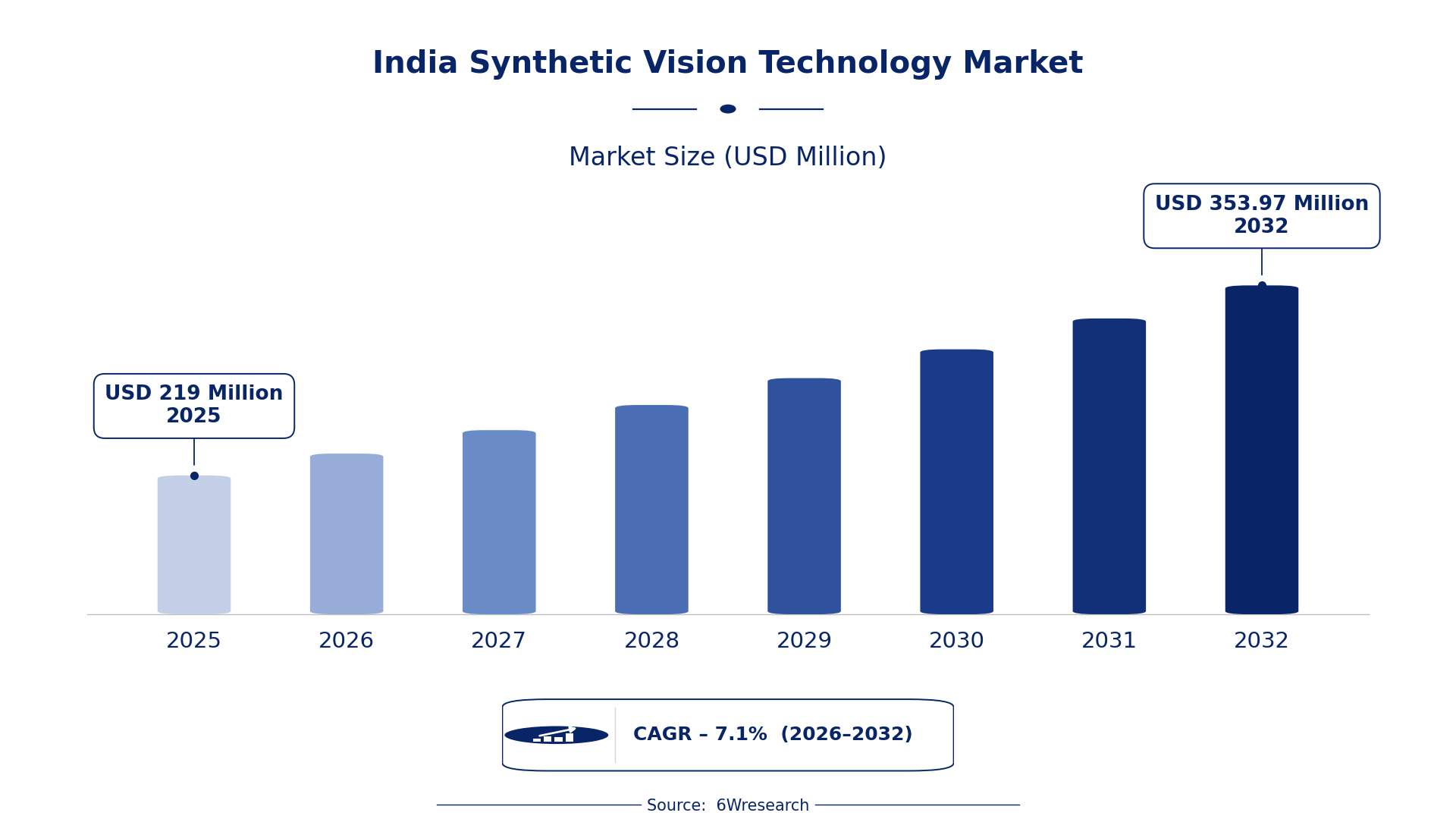
According to 6Wresearch internal database and industry insights, the India Synthetic Vision Technology Market was valued at USD 219.0 million in 2025 and is projected to reach USD 353.97 million by 2032, growing at a CAGR of approximately 7.1% during 2026–2032.
India Synthetic Vision Technology Market Highlights
| Report Metric | Details |
| Report Name | India Synthetic Vision Technology Market |
| Market Size 2025 | USD 219.0 million |
| Market Size 2032 | USD 353.97 million |
| Absolute Growth 2025–2032 | USD 134.97 million |
| CAGR 2026–2032 | 7.1% |
| Peak Annual Growth | 8.4% in 2029 |
| Forecast Period | 2026–2032 |
| Historical Data | 2022–2025 |
| Base Year | 2025 |
| Leading Synthetic Vision Tech, 2025 | Cockpit Display Systems (42% share) |
| Leading Product Type, 2025 | HUD Devices (38% share) |
| Leading Technology Type, 2025 | SVS (Synthetic Vision) (40% share) |
| Leading Distribution Channel, 2025 | OEM Suppliers (42% share) |
| Leading End User Industry, 2025 | Commercial Airlines (38% share) |
| Fastest-Growing Synthetic Vision Tech | Training Simulators (9.3% CAGR) |
| Fastest-Growing Product Type | Pilot Simulators (9.7% CAGR) |
| Fastest-Growing Technology Type | Sensor Fusion (8.6% CAGR) |
| Fastest-Growing End User Industry | Aviation Industry (9.5% CAGR) |
| Growing Sector | Aviation Industry |
| Key End Users | Commercial Airlines, Defense Aircraft, Aerospace Institutions |
India Synthetic Vision Technology Market Year-wise Growth Rate and Key Drivers (2022–2032)
This graph illustrates the annual growth rates of the market from 2022 to 2032, highlighting a steady upward trajectory and projected market expansion over the forecast period.
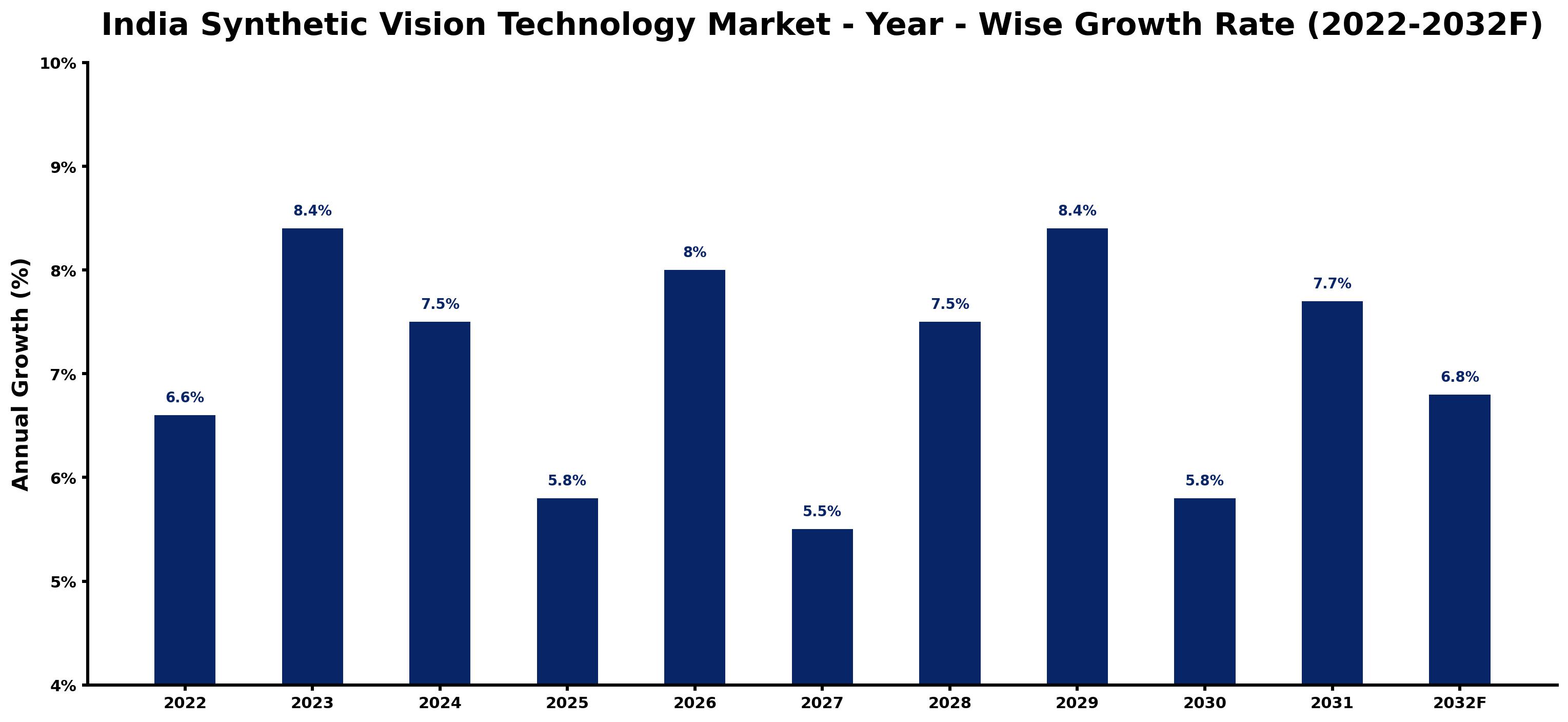
The table below sets out the estimated growth rate for each year and the main factor behind it.
| Year | Estimated Annual Growth (%) | Market Rationale |
| 2022 | 6.6 | The market experienced steady demand from both commercial airlines and military applications. |
| 2023 | 8.4 | Investment in modernizing aviation technologies accelerated growth, leading to increased procurement. |
| 2024 | 7.5 | Demand for training simulators slowed growth as the market adjusted to new technologies. |
| 2025 | 5.8 | The market continued to grow, albeit at a slower rate due to the National Civil Aviation Policy's focus on infrastructure improvements. |
| 2026 | 8.0 | A renewed focus on indigenous manufacturing is expected to spur faster growth in aviation technologies. |
| 2027 | 5.5 | Demand for cockpit display systems is projected to slow as buyers adjust to new technologies. |
| 2028 | 7.5 | Increased investment in airport infrastructure will boost demand for navigation systems. |
| 2029 | 8.4 | The market is expected to rebound with strong growth driven by rising safety standards in aviation. |
| 2030 | 5.8 | Growth is projected to slow again as the market adjusts to new regulatory requirements. |
| 2031 | 7.7 | Demand for advanced SVT technologies is expected to increase as safety concerns continue to rise. |
| 2032 | 6.8 | The market will experience a slowdown as buyers consolidate their technology investments. |
Note: Market size estimations and growth projections presented in this report are based on 6Wresearch's proprietary forecasting methodology, utilizing the latest available industry data, government publications, and primary research inputs.
India Synthetic Vision Technology Market Synopsis
Synthetic Vision Technology in India covers advanced systems that provide pilots with a 3D view of terrain and obstacles, improving situational awareness. The market is expanding due to significant investments in aviation modernization and a growing domestic market. The defense budget allocates 1.5 billion USD for aviation technology upgrades, while the National Civil Aviation Policy aims to improve infrastructure. These factors contribute to strong demand for SVT solutions across commercial and military sectors, particularly among commercial airlines and defense aircraft operators.
Market Dynamics Impact Analysis (2026–2032)
| Factor | Type | Impact | Primary Segment Affected |
| Increased defense budget allocations for aviation technology modernization. | Driver | High | Cockpit Display Systems |
| Growing demand for pilot training simulators to enhance skills. | Driver | High | Training Simulators |
| Rising safety standards in aviation create demand for advanced navigation systems. | Opportunity | High | Navigation Systems |
| Investment in airport infrastructure boosts the need for cockpit display systems. | Opportunity | High | Cockpit Display Systems |
| Market saturation in certain segments limits rapid growth potential. | Restraint | Medium | HUD Devices |
| Regulatory compliance costs can deter smaller players from entering the market. | Restraint | Medium | Training Simulators |
| Limited skilled workforce in aviation technology hampers growth. | Challenge | High | Commercial Airlines |
| Dependence on imported components can delay technology deployment. | Challenge | Medium | Aviation Industry |
Evaluation of Drivers in India Synthetic Vision Technology Market (2026–2032)
The factors lifting demand, and the evidence behind each, are summarised below.
| Drivers | Primary Segment Affected | Why It Matters (Evidence) |
| Increased defense budget allocations for aviation technology modernization. | Cockpit Display Systems | The Indian defense budget for 2023-24 allocates 1.5 billion USD for modernizing aviation technologies, driving demand for advanced systems. |
| Growing demand for pilot training simulators to improve skills. | Training Simulators | The aviation industry's expansion necessitates improved training solutions, leading to a projected CAGR of 9.3% for training simulators. |
| Rising safety standards in aviation create demand for advanced navigation systems. | Navigation Systems | The Directorate General of Civil Aviation oversees standards, increasing the need for sophisticated navigation technologies. |
| Investment in airport infrastructure boosts the need for cockpit display systems. | Cockpit Display Systems | India's plan to invest 5 billion USD in airport infrastructure by 2025 drives demand for advanced cockpit technologies. |
| Growing commercial airline sector demands improved situational awareness. | HUD Devices | Commercial Airlines, holding a 38% market share, require HUD devices for enhanced safety and efficiency. |
The Synthetic Vision Technology market in India is expanding as increased defense budget allocations, rising demand for pilot training solutions, and elevated safety standards drive growth. The Indian defense budget for 2023-24 allocates 1.5 billion USD for modernizing aviation technologies, which boosts demand for advanced systems. The aviation industry's expansion necessitates improved training solutions, leading to a projected CAGR of 9.3% for training simulators. The Directorate General of Civil Aviation oversees standards, increasing the need for sophisticated navigation technologies. India's plan to invest 5 billion USD in airport infrastructure by 2025 fuels demand for advanced cockpit technologies.
Evaluation of Restraints in India Synthetic Vision Technology Market
Below mentioned are some major restraints and their influence on market dynamics.
| Market Restraint | Primary Segment Affected | Why It Matters (Evidence) |
| Market saturation in certain segments limits rapid growth potential. | HUD Devices | As the market matures, demand for HUD devices faces saturation, slowing growth rates. |
| Regulatory compliance costs can deter smaller players from entering the market. | Training Simulators | High compliance costs associated with aviation standards can restrict market entry for smaller firms. |
| Limited skilled workforce in aviation technology hampers growth. | Commercial Airlines | The aviation sector struggles with a shortage of skilled professionals, impacting operational efficiency. |
| Dependence on imported components can delay technology deployment. | Aviation Industry | A leading supplier on foreign suppliers for critical components can lead to supply chain delays. |
| Economic fluctuations may impact aviation spending. | Navigation Systems | Economic downturns can lead to reduced budgets for aviation technology investments. |
India Synthetic Vision Technology Market Challenges
The India Synthetic Vision Technology market faces several challenges, starting with regulatory compliance, which consumes time and resources for producers. The Directorate General of Civil Aviation enforces strict standards that can delay product approvals by up to six months, affecting manufacturers' ability to introduce new technologies. Supply chain disruptions pose another challenge, as reliance on imported components can lead to production delays, costing buyers an increased operational downtime of approximately 20%. Skills shortages in advanced aviation technology mean that training for personnel can take over a year, resulting in slower adoption of new systems for end users. Technology integration issues may also arise, as outdated systems might not support advanced SVT features, compelling suppliers to invest heavily in upgrades, potentially exceeding 1 million USD.
Trends in the India Synthetic Vision Technology Market
Several trends are reshaping the India Synthetic Vision Technology Market; the most important are set out below.
- Shift towards Advanced Training Simulators: Since 2023, the demand for advanced training simulators has surged as commercial airlines seek to improve pilot skills. This shift is reflected in a projected CAGR of 9.3% for training simulators, showcasing the industry's commitment to safety.
- Growth of HUD Devices in Commercial Aviation: The introduction of new HUD devices in 2023 has transformed pilot interfaces, enhancing situational awareness. This trend is supported by commercial airlines, which account for 38% of the market share, driving demand for these technologies.
- Advancements in Navigation Systems: In 2023, the Indian government highlighted the need for advanced navigation systems, aligning with the National Civil Aviation Policy. This initiative aims to bolster aviation safety, leading to increased investments in navigation technologies.
- Increased Investment in Airport Infrastructure: In 2023, India announced a 5 billion USD investment in airport infrastructure, significantly impacting the aviation sector. This funding is expected to drive demand for cockpit display systems and related technologies.
Investment Opportunities in the India Synthetic Vision Technology Market
Below are the investment opportunities with the strongest case in the India Synthetic Vision Technology Market.
- Investment Gap in Pilot Training Solutions: With a projected CAGR of 9.3% for training simulators, there is a strong opportunity to invest in advanced pilot training solutions. Commercial airlines are actively seeking partnerships to improve training capabilities.
- Growing Demand for Advanced Navigation Technologies: The aviation industry's expansion creates a pressing need for sophisticated navigation systems. Investing in these technologies can cater to the increasing demand from commercial airlines and defense sectors.
- Partnerships for Indigenous Manufacturing: The 'Make in India' initiative presents opportunities for local partnerships in manufacturing aviation technologies. Engaging with local suppliers can streamline production and reduce costs for OEMs.
- Focus on Airport Infrastructure Development: The Indian government's commitment to invest 5 billion USD in airport infrastructure creates opportunities for suppliers of cockpit display systems. Collaborating with local partners can facilitate market entry.
Government Initiatives in the India Synthetic Vision Technology Market
The Defence Acquisition Procedure 2020 promotes indigenous manufacturing of defense aviation technologies, reducing reliance on imports. This measure boosts the production capabilities of local manufacturers, ensuring they meet the growing need for Synthetic Vision Technology. The initiative supports the development of advanced systems that align with national security objectives. Furthermore, the National Policy on Electronics 2019 encourages the development of electronic components for aviation technology, enhancing local production capabilities.
The Directorate General of Civil Aviation oversees the 'Ude Desh ka Aam Naagrik' scheme, which aims to improve regional connectivity and aviation infrastructure. This initiative funds the development of airports and enhances the overall aviation ecosystem, benefiting both producers and buyers of Synthetic Vision Technology. The scheme's focus on infrastructure development is vital for increasing the adoption of advanced aviation technologies across the country. Additionally, the Aerospace and Defence Sector Skill Council established in 2021 aims to enhance skill development in the aviation workforce.
Future Insight of the India Synthetic Vision Technology Market
By 2032, buyers and suppliers in the India Synthetic Vision Technology market can expect significant changes driven by key factors. The Indian government's investment of 5 billion USD in airport infrastructure will create a robust demand for advanced aviation technologies. The 'Make in India' initiative will improve local production capabilities, reducing reliance on imports. The National Civil Aviation Policy aims to enhance aviation infrastructure and technology, paving the way for new SVT applications that will improve flight safety and pilot training.
Market Segmentation Analysis
The analysis below covers each segmentation, its leading category in 2025 and its fastest-growing category through 2032.
By Synthetic Vision Tech – Cockpit Display Systems Dominated, Training Simulators Expected to Grow Fastest
According to Sumit Sagar, AM at 6Wresearch, with a 42% revenue share in 2025, Cockpit Display Systems was the largest synthetic vision tech category. Cockpit Display Systems hold the largest share due to their essential role in pilot interface and navigation, particularly within the Indian Air Force's fleet of over 1,500 aircraft. Their importance in enhancing flight safety and operational efficiency solidifies their leading position within the Synthetic Vision Technology market. Training Simulators are set to record the highest CAGR in this split, 9.3% over 2026–2032. Training Simulators are experiencing rapid growth driven by the aviation sector's increasing focus on realistic training scenarios, with a notable rise in demand for skilled pilots. This growth is further supported by the Indian government's substantial investment in aviation infrastructure, enhancing training capabilities. Suppliers should focus on advancing Training Simulators to meet the rising demand for effective pilot training solutions.
By Product Type – HUD Devices Dominated, Pilot Simulators Expected to Grow Fastest
In 2025, HUD Devices led the product type split with a 38% share. HUD Devices dominate the market as they are crucial for displaying real-time data to pilots, ensuring safety and situational awareness during flights. Their integration across various aircraft types, including commercial and military, reinforces their leading market share in the Synthetic Vision Technology sector. Pilot Simulators are projected to grow fastest, at a CAGR of 9.7% during 2026–2032. Pilot Simulators are experiencing the fastest growth due to the aviation industry's heightened need for realistic training environments. This surge is driven by the increasing number of airports and the push for improved pilot training methodologies, aligning with industry demands. Buyers should invest in advanced Pilot Simulators to enhance training effectiveness and operational readiness.
By Technology Type – SVS (Synthetic Vision) Dominated, Sensor Fusion Expected to Grow Fastest
SVS (Synthetic Vision) took a 40% share of technology type in 2025, more than any other category. SVS (Synthetic Vision) is the leading technology type as it is fundamental for terrain awareness and avoidance, critical for flight safety in India's diverse geography. Its integration into various aircraft types makes it indispensable for both commercial and military applications, ensuring a strong market position. Over 2026–2032, Sensor Fusion is expected to post the fastest growth, at a CAGR of 8.6%. Sensor Fusion is growing rapidly as it enhances the capabilities of existing systems by supporting data integration from multiple sources. The increasing need for sophisticated navigation solutions in the aviation sector drives this technology's relevance and market growth. Suppliers must develop advanced Sensor Fusion technologies to maintain competitiveness in the market.
By Distribution Channel – OEM Suppliers Dominated and Is Expected to Record the Fastest Growth
OEM Suppliers held a 42% share of the India Synthetic Vision Technology Market by distribution channel in 2025. OEM Suppliers are the primary source for technology integration, holding the largest share in distributing Synthetic Vision Technology. Their established relationships with aircraft manufacturers ensure a consistent demand for integrated solutions in the aviation market, reinforcing their market position. Its lead should widen, with a projected CAGR of 8.3% during 2026–2032, the highest in this split. OEM Suppliers are also the fastest-growing channel, benefiting from the rising demand for integrated technologies in new aircraft models. Their capacity to provide comprehensive solutions positions them well for future growth in the Synthetic Vision Technology market. Suppliers should strengthen partnerships with OEM Suppliers to leverage their market position and expand distribution capabilities.
By End User Industry – Commercial Airlines Dominated, Aviation Industry Expected to Grow Fastest
Commercial Airlines accounted for a 38% market share by end user industry in 2025. Commercial Airlines represent the largest user of Synthetic Vision Technology, driven by significant demand for safety and efficiency in operations. The expansion of India's aviation market, with over 450 airports, further amplifies this segment's market share and importance. Aviation Industry is set to record the highest CAGR in this split, 9.5% over 2026–2032. The Aviation Industry overall is experiencing rapid growth, supported by increasing investments in modernising aviation technologies and infrastructure. This trend aligns with the government's focus on enhancing aviation safety and operational capabilities, driving further demand. Buyers in the Aviation Industry should prioritise adopting advanced technologies to improve safety and operational efficiency.
Key Attractiveness of the Report
- 10 Years of Market Numbers
- Historical Data Starting from 2022 to 2025
- Base Year 2025
- Forecast Data until 2032
- Key Performance Indicators Impacting the Market
- Major Upcoming Developments and Projects
Key Highlights of the Report:
- India Synthetic Vision Technology Market Outlook
- Market Size of India Synthetic Vision Technology Market, 2025
- Forecast of India Synthetic Vision Technology Market, 2032
- Historical Data and Forecast of India Synthetic Vision Technology Revenues & Volume for the Period 2022 - 2032F
- India Synthetic Vision Technology Market Trend Evolution
- India Synthetic Vision Technology Market Drivers and Challenges
- India Synthetic Vision Technology Price Trends
- India Synthetic Vision Technology Porter's Five Forces
- India Synthetic Vision Technology Industry Life Cycle
- Historical Data and Forecast of India Synthetic Vision Technology Market Revenues & Volume By Synthetic Vision Tech for the Period 2022 - 2032F
- Historical Data and Forecast of India Synthetic Vision Technology Market Revenues & Volume By Cockpit Display Systems for the Period 2022 - 2032F
- Historical Data and Forecast of India Synthetic Vision Technology Market Revenues & Volume By Head-Up Displays for the Period 2022 - 2032F
- Historical Data and Forecast of India Synthetic Vision Technology Market Revenues & Volume By Navigation Systems for the Period 2022 - 2032F
- Historical Data and Forecast of India Synthetic Vision Technology Market Revenues & Volume By Training Simulators for the Period 2022 - 2032F
- Historical Data and Forecast of India Synthetic Vision Technology Market Revenues & Volume By Product Type for the Period 2022 - 2032F
- Historical Data and Forecast of India Synthetic Vision Technology Market Revenues & Volume By 3D Flight Display for the Period 2022 - 2032F
- Historical Data and Forecast of India Synthetic Vision Technology Market Revenues & Volume By HUD Devices for the Period 2022 - 2032F
- Historical Data and Forecast of India Synthetic Vision Technology Market Revenues & Volume By Advanced SVT for the Period 2022 - 2032F
- Historical Data and Forecast of India Synthetic Vision Technology Market Revenues & Volume By Pilot Simulators for the Period 2022 - 2032F
- Historical Data and Forecast of India Synthetic Vision Technology Market Revenues & Volume By Technology Type for the Period 2022 - 2032F
- Historical Data and Forecast of India Synthetic Vision Technology Market Revenues & Volume By SVS (Synthetic Vision) for the Period 2022 - 2032F
- Historical Data and Forecast of India Synthetic Vision Technology Market Revenues & Volume By Augmented Vision for the Period 2022 - 2032F
- Historical Data and Forecast of India Synthetic Vision Technology Market Revenues & Volume By Sensor Fusion for the Period 2022 - 2032F
- Historical Data and Forecast of India Synthetic Vision Technology Market Revenues & Volume By VR + SVT for the Period 2022 - 2032F
- Historical Data and Forecast of India Synthetic Vision Technology Market Revenues & Volume By Distribution Channel for the Period 2022 - 2032F
- Historical Data and Forecast of India Synthetic Vision Technology Market Revenues & Volume By OEM Suppliers for the Period 2022 - 2032F
- Historical Data and Forecast of India Synthetic Vision Technology Market Revenues & Volume By Direct Sales for the Period 2022 - 2032F
- Historical Data and Forecast of India Synthetic Vision Technology Market Revenues & Volume By Industrial Distributors for the Period 2022 - 2032F
- Historical Data and Forecast of India Synthetic Vision Technology Market Revenues & Volume By Specialty Contractors for the Period 2022 - 2032F
- Historical Data and Forecast of India Synthetic Vision Technology Market Revenues & Volume By End User Industry for the Period 2022 - 2032F
- Historical Data and Forecast of India Synthetic Vision Technology Market Revenues & Volume By Aviation Industry for the Period 2022 - 2032F
- Historical Data and Forecast of India Synthetic Vision Technology Market Revenues & Volume By Defense Aircraft for the Period 2022 - 2032F
- Historical Data and Forecast of India Synthetic Vision Technology Market Revenues & Volume By Commercial Airlines for the Period 2022 - 2032F
- Historical Data and Forecast of India Synthetic Vision Technology Market Revenues & Volume By Aerospace Institutions for the Period 2022 - 2032F
- India Synthetic Vision Technology Import Export Trade Statistics
- Market Opportunity Assessment By Synthetic Vision Tech
- Market Opportunity Assessment By Product Type
- Market Opportunity Assessment By Technology Type
- Market Opportunity Assessment By Distribution Channel
- Market Opportunity Assessment By End User Industry
- India Synthetic Vision Technology Top Companies Market Share
- India Synthetic Vision Technology Competitive Benchmarking By Technical and Operational Parameters
- India Synthetic Vision Technology Company Profiles
- India Synthetic Vision Technology Key Strategic Recommendations
Market Covered
This report examines the market across the segments below.
By Synthetic Vision Tech
- Cockpit Display Systems
- Head-Up Displays
- Navigation Systems
- Training Simulators
By Product Type
- 3D Flight Display
- HUD Devices
- Advanced SVT
- Pilot Simulators
By Technology Type
- SVS (Synthetic Vision)
- Augmented Vision
- Sensor Fusion
- VR + SVT
By Distribution Channel
- OEM Suppliers
- Direct Sales
- Industrial Distributors
- Specialty Contractors
By End User Industry
- Aviation Industry
- Defense Aircraft
- Commercial Airlines
- Aerospace Institutions































