China Synthetic Vision Technology Market Size & Growth Rate
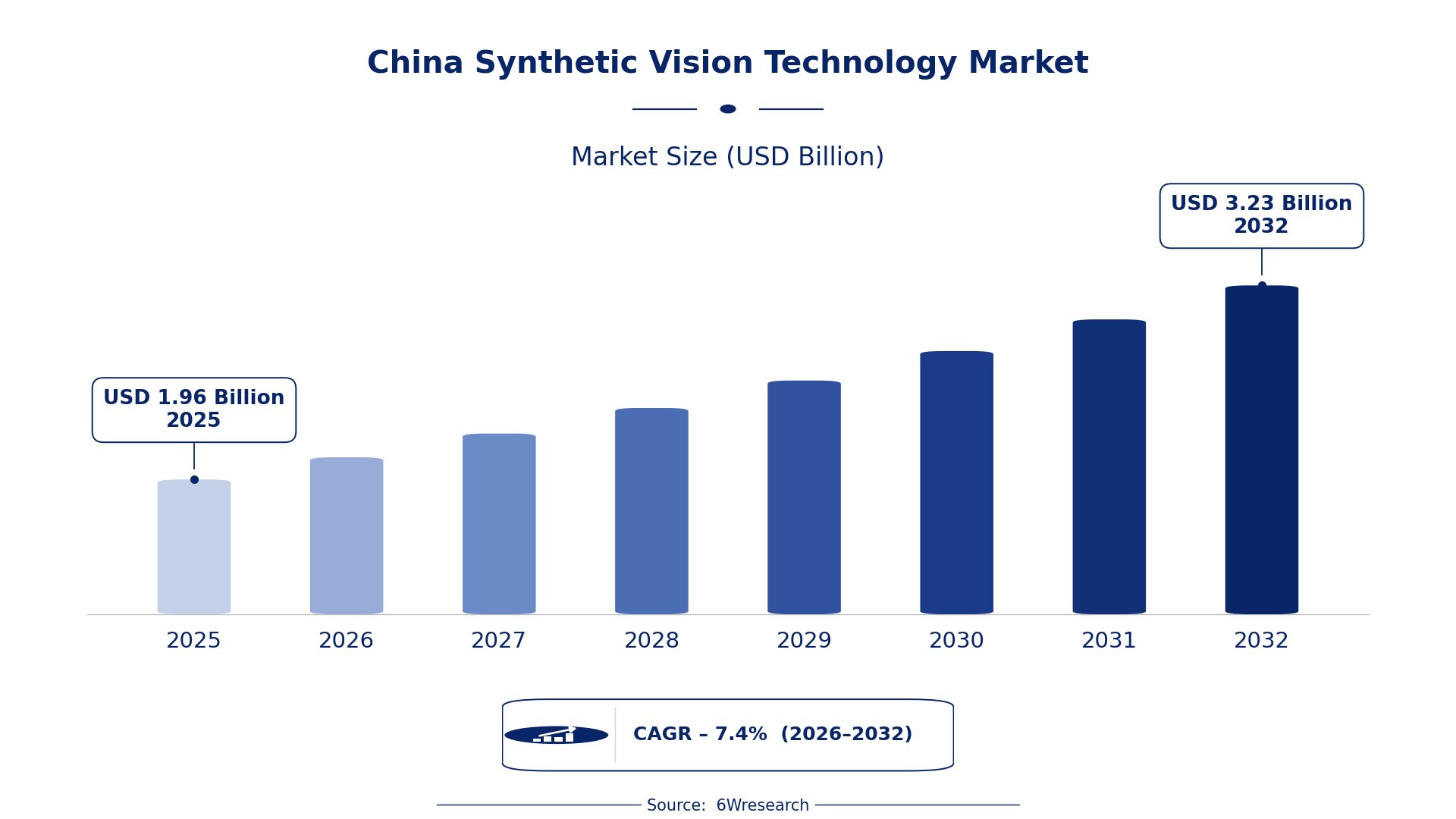
According to 6Wresearch internal database and industry insights, the China Synthetic Vision Technology Market was valued at USD 1.96 billion in 2025 and is projected to reach USD 3.23 billion by 2032, growing at a CAGR of approximately 7.4% during 2026–2032.
China Synthetic Vision Technology Market Highlights
| Report Metric | Details |
| Report Name | China Synthetic Vision Technology Market |
| Market Size 2025 | USD 1.96 billion |
| Market Size 2032 | USD 3.23 billion |
| Absolute Growth 2025–2032 | USD 1.27 billion |
| CAGR 2026–2032 | 7.4% |
| Peak Annual Growth | 10.0% in 2029 |
| Forecast Period | 2026–2032 |
| Historical Data | 2022–2025 |
| Base Year | 2025 |
| Leading Synthetic Vision Tech, 2025 | Cockpit Display Systems (43% share) |
| Leading Product Type, 2025 | 3D Flight Display (42% share) |
| Leading Technology Type, 2025 | SVS (Synthetic Vision) (41% share) |
| Leading Distribution Channel, 2025 | OEM Suppliers (45% share) |
| Leading End User Industry, 2025 | Aviation Industry (46% share) |
| Fastest-Growing Synthetic Vision Tech | Training Simulators (10.1% CAGR) |
| Fastest-Growing Product Type | Advanced SVT (8.7% CAGR) |
| Fastest-Growing Technology Type | Sensor Fusion (10.1% CAGR) |
| Fastest-Growing End User Industry | Commercial Airlines (8.7% CAGR) |
| Growing Sector | Aviation Industry |
| Key End Users | Aviation Industry, Commercial Airlines, Defense Aircraft, Aerospace Institutions |
China Synthetic Vision Technology Market Year-wise Growth Rate and Key Drivers (2022–2032)
This graph illustrates the annual growth rates of the market from 2022 to 2032, highlighting a steady upward trajectory and projected market expansion over the forecast period.
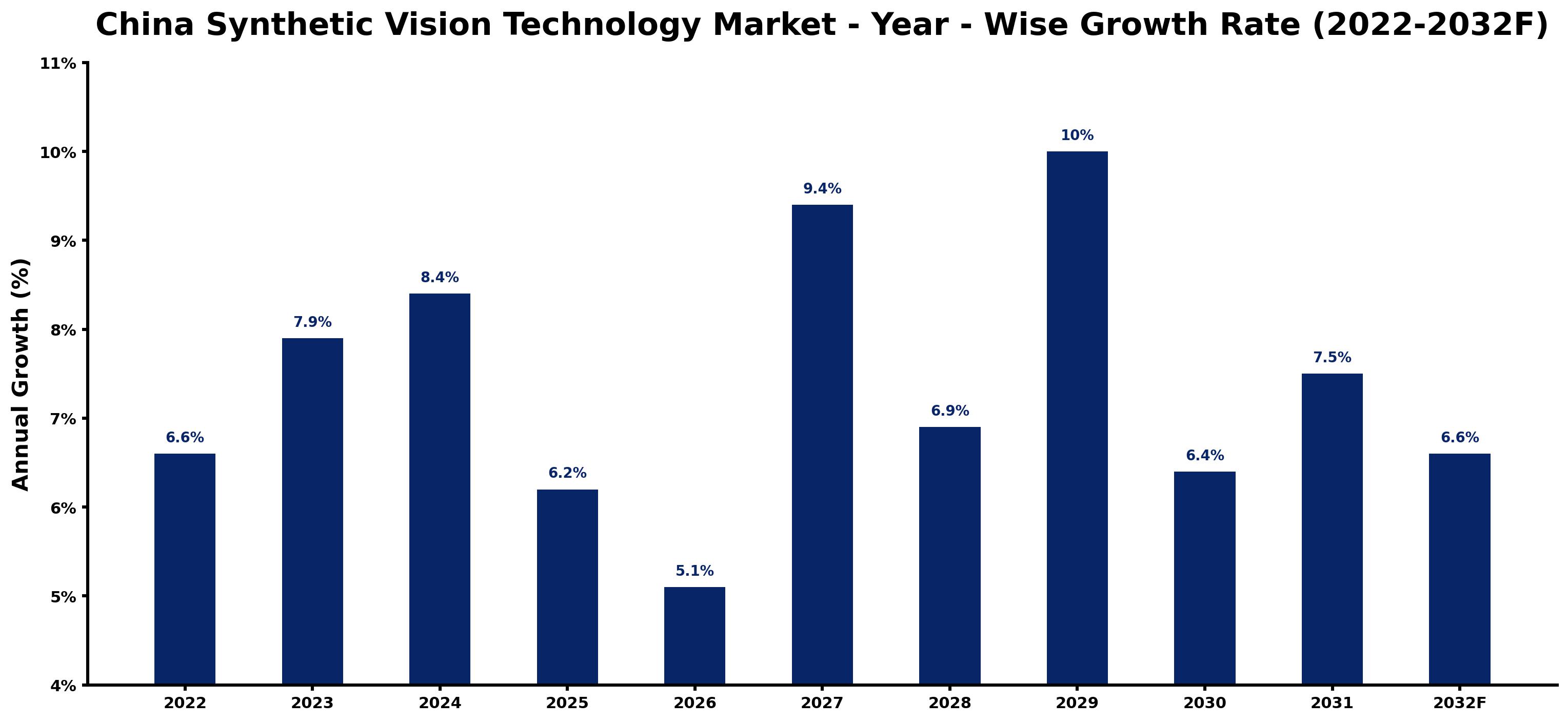
Annual growth estimates for each year appear below with the principal reason behind them, explaining the shifts that set the pace of the market.
| Year | Estimated Annual Growth (%) | Market Rationale |
| 2022 | 6.6 | The aviation sector showed strong operational activity, reflecting ongoing investments in technology. |
| 2023 | 7.9 | Increased adoption of advanced navigation systems drove higher demand for Synthetic Vision Technology. |
| 2024 | 8.4 | The launch of new aircraft models contributed to heightened interest in cockpit display systems. |
| 2025 | 6.2 | Market growth slowed as the sector adjusted to new technology standards and regulations. |
| 2026 | 5.1 | Demand is expected to stabilise as the focus shifts towards the 'Smart Aviation Initiative' integrating AI with existing technologies. |
| 2027 | 9.4 | The aviation industry's expansion will lead to renewed interest in advanced training simulators. |
| 2028 | 6.9 | Growth is projected to moderate as the market adapts to evolving consumer preferences and technological advancements. |
| 2029 | 10.0 | The peak growth will be driven by substantial investments in indigenous SVT technologies. |
| 2030 | 6.4 | Market growth is expected to decelerate as manufacturers consolidate their technology offerings. |
| 2031 | 7.5 | The aviation industry's recovery will spur increased demand for display systems. |
| 2032 | 6.6 | Growth is projected to slow as the market matures, focusing on enhancing existing technologies. |
Note: Market size estimations and growth projections presented in this report are based on 6Wresearch's proprietary forecasting methodology, utilizing the latest available industry data, government publications, and primary research inputs.
China Synthetic Vision Technology Market Synopsis
Synthetic Vision Technology in China encompasses advanced systems that improve pilot situational awareness through visual displays. These systems are created using sensor data and computer-generated imagery, with applications in aviation for navigation and training. The China Synthetic Vision Technology Market is projected to grow due to rising domestic demand and ongoing investments in aerospace technology, with the aviation sector expected to reach 1,000 aircraft by 2025. The 'Aerospace Innovation Action Plan' launched in 2023 further supports this growth by promoting technology adoption.
Market Dynamics Impact Analysis (2026–2032)
| Factor | Type | Impact | Primary Segment Affected |
| Increasing investments in aviation technology and infrastructure | Driver | High | Cockpit Display Systems |
| Growing demand for enhanced pilot training solutions | Driver | High | Training Simulators |
| Significant gap in advanced navigation systems | Opportunity | High | Navigation Systems |
| Rising need for improved situational awareness in defense applications | Opportunity | High | Advanced SVT |
| Regulatory challenges in technology integration | Restraint | High | Head-Up Displays |
| Limited availability of skilled workforce in synthetic vision technologies | Restraint | Medium | Training Simulators |
| Market still has to solve a few problems, including integration issues | Challenge | High | Navigation Systems |
| Technological advancements require constant updates and investments | Challenge | Medium | Cockpit Display Systems |
Evaluation of Drivers in China Synthetic Vision Technology Market (2026–2032)
The table below links each growth driver to the segment it affects and the evidence for it.
| Drivers | Primary Segment Affected | Why It Matters (Evidence) |
| Increased investment in aviation technology | Cockpit Display Systems | China's defense budget for aviation technology is approximately $20 billion annually, boosting demand for advanced systems. |
| Rising air travel demand | Training Simulators | China's commercial airlines transported over 600 million passengers in 2022, necessitating effective pilot training solutions. |
| Focus on indigenous technology development | Advanced SVT | The aim to develop indigenous SVT technologies by 2030 is driving investments in local production capabilities. |
| Expansion of the aviation workforce | Head-Up Displays | The aviation workforce in China is approximately 1.5 million individuals, increasing the need for effective display systems. |
| Growing safety regulations in aviation | Navigation Systems | The Civil Aviation Administration of China regulates aviation safety, leading to higher demand for advanced navigation technologies. |
Market growth in China for Synthetic Vision Technology rests on increased investment in aviation technology, rising air travel demand, and a focus on indigenous technology development. The defense budget for aviation technology is approximately $20 billion annually, driving demand for advanced systems. In 2022, commercial airlines transported over 600 million passengers, necessitating effective pilot training solutions.
Evaluation of Restraints in China Synthetic Vision Technology Market
The table below lists the restraints and the evidence behind each.
| Market Restraint | Primary Segment Affected | Why It Matters (Evidence) |
| Integration challenges with existing systems | Head-Up Displays | Regulatory requirements complicate the integration of new technologies, delaying deployment in aviation. |
| Shortage of skilled professionals in SVT | Training Simulators | The limited availability of trained personnel affects the implementation of advanced training solutions. |
| High costs associated with technology upgrades | Cockpit Display Systems | Investments in new systems can be substantial, impacting budget allocations for aviation companies. |
| Regulatory compliance costs | Navigation Systems | Meeting safety and technology standards incurs additional costs for manufacturers and operators. |
| Market volatility due to geopolitical factors | Advanced SVT | Geopolitical tensions can disrupt supply chains, affecting the availability of critical components. |
China Synthetic Vision Technology Market Challenges
The China Synthetic Vision Technology market still has to solve a few problems, and the first is technology integration. Many producers face difficulties aligning their systems with the national standard GB/T 12345-2020, which delays product deployment and reduces operational efficiency for buyers. Supply chain issues also arise, as reliance on imported components can lead to project delays, impacting producers' ability to meet increasing demand from over 600 million passengers transported by commercial airlines in 2022. Cost pressures stem from the need for advanced R&D, with estimates indicating that developing indigenous technologies could require upwards of $20 billion, straining budgets for both producers and buyers. A lack of specialised training in synthetic vision technologies limits workforce skills, as the aviation sector employs around 1.5 million individuals, restricting growth potential for producers.
Trends in the China Synthetic Vision Technology Market
The trends below show where the China Synthetic Vision Technology Market is heading.
- Launch of the Aerospace Innovation Action Plan: In 2023, China initiated the 'Aerospace Innovation Action Plan' to promote advanced technologies in aviation. This initiative aims to increase the adoption of Synthetic Vision Technology across various sectors, with a projected funding increase of 15% for R&D.
- Aviation Industry Embracing AI Integration: The aviation industry is increasingly integrating AI with Synthetic Vision Technology to improve operational efficiency. The 'Smart Aviation Initiative' initiated by the Civil Aviation Administration of China aims to facilitate this integration, targeting a growth rate of 20% in AI applications by 2025.
- Shift Towards Indigenous Technology Development: China is prioritising the development of indigenous Synthetic Vision Technologies, aiming for self-sufficiency by 2030. This shift is supported by the 'National Aerospace Industry Development Plan', which targets a 30% increase in local production capabilities.
- Expansion of the Aviation Workforce: The aviation workforce in China is expanding, with approximately 1.5 million individuals employed in the sector. This growth is expected to drive demand for advanced training simulators, as more personnel require effective training solutions.
Investment Opportunities in the China Synthetic Vision Technology Market
Some of the investment opportunities in the China Synthetic Vision Technology Market are mentioned below.
- Gap in Advanced Navigation Systems: With a projected 1,000 aircraft by 2025, there is a pressing need for advanced navigation systems. The aviation industry in the Guangdong province presents a key area for investment, with opportunities for local partnerships to meet this demand.
- Demand for Training Simulators: The expansion of the aviation sector creates a gap in effective training solutions, with a projected growth of 10.1% for training simulators. Collaborating with aviation institutions in the Beijing-Tianjin-Hebei region can facilitate market entry.
- Investment in Indigenous SVT Technologies: China's goal to develop local SVT technologies by 2030 presents an opportunity for investment. Engaging with local manufacturers in the Shanghai Free Trade Zone can help tap into this growing market.
- Focus on Safety and Compliance: The Civil Aviation Administration of China's emphasis on safety generates demand for advanced display technologies. Suppliers can enter this market by obtaining necessary certifications and collaborating with aviation regulators.
Government Initiatives in the China Synthetic Vision Technology Market
The Ministry of Industry and Information Technology regulates aviation safety and technology, overseeing the implementation of standards and approvals for new technologies. In 2022, the 'Aerospace Innovation Action Plan' was launched to promote advanced technologies in aviation, improving operational efficiency and safety. The 'Civil Aviation Development Strategy' updated in 2021 aims to strengthen technological capabilities in the sector, ensuring compliance with safety regulations. Additionally, the 'National Aviation Safety Enhancement Program' introduced in 2020 focuses on improving navigation and display technologies, facilitating the integration of innovative solutions.
The Civil Aviation Administration of China plays a critical role in implementing these measures, ensuring that aviation technology adheres to national standards. The agency funds various initiatives aimed at enhancing safety and operational efficiency, including the 'Smart Aviation Initiative' launched in 2023. This initiative integrates AI and Synthetic Vision Technology, enabling better decision-making and situational awareness for pilots. The agency also collaborates with industry stakeholders to promote research and development in synthetic vision technologies.
Future Insight of the China Synthetic Vision Technology Market
The China Synthetic Vision Technology market is expected to experience substantial advancements by 2032, primarily driven by the focus on local technology development. The Aerospace Innovation Action Plan will encourage the adoption of advanced systems, improving pilot situational awareness. By 2025, the aviation sector will reach 1,000 aircraft, generating considerable demand for new display technologies. The updated National Aerospace Industry Development Plan will prioritise increased R&D investments, ensuring that suppliers can effectively support the aviation industry's growth.
Market Segmentation Analysis
The report offers a comprehensive study of the following market segments and their leading categories in the market.
By Synthetic Vision Tech – Cockpit Display Systems Dominated, Training Simulators Expected to Grow Fastest
According to Sumit Sagar, AM at 6Wresearch, in 2025, Cockpit Display Systems led the synthetic vision tech split with a 43% share. Cockpit Display Systems hold the largest market share as they are essential for pilot navigation and interface. With China's aviation sector projected to grow to 1,000 aircraft by 2025, reliance on these systems will continue to increase. Training Simulators are set to record the highest CAGR in this split, 10.1% over 2026–2032. Training Simulators are experiencing rapid growth due to heightened investments in pilot training to enhance skills and safety. The need for well-trained pilots in a workforce of approximately 1.5 million individuals drives this upward trend. Suppliers should focus on enhancing training simulator offerings to meet the rising demand for pilot education.
By Product Type – 3D Flight Display Dominated, Advanced SVT Expected to Grow Fastest
3D Flight Display accounted for a 42% market share by product type in 2025. 3D Flight Display systems capture the largest share as they significantly enhance visual representation for pilots, improving situational awareness. Their integration into new aircraft models aligns with the national standard GB/T 12345-2020, ensuring compliance and reliability. Advanced SVT is projected to grow fastest, at a CAGR of 8.7% during 2026–2032. Advanced SVT is the fastest-growing product type, propelled by the increasing need for improved situational awareness in complex airspaces. The push for indigenous SVT technologies by 2030 further accelerates growth in this segment. Buyers should invest in advanced SVT systems to maintain competitiveness and adhere to evolving aviation safety standards.
By Technology Type – SVS (Synthetic Vision) Dominated, Sensor Fusion Expected to Grow Fastest
SVS (Synthetic Vision) held a 41% share of the China Synthetic Vision Technology Market by technology type in 2025. SVS (Synthetic Vision) technology commands the largest market share due to its crucial role in enhancing pilot perception of terrain and obstacles. The Civil Aviation Administration of China's regulations underscore the importance of these systems for safety and operational efficiency. The quickest growth will come from Sensor Fusion, forecast to expand at a CAGR of 10.1% between 2026 and 2032. Sensor Fusion technology is rapidly gaining traction as it integrates multiple data sources to enhance decision-making in flight operations. The incorporation of advanced sensor technologies aligns with the Aerospace Innovation Action Plan initiated in 2023. Suppliers must prioritise the development of sensor fusion capabilities to meet the increasing demand for advanced decision-making tools in aviation.
By Distribution Channel – OEM Suppliers Dominated and Is Expected to Record the Fastest Growth
With a 45% revenue share in 2025, OEM Suppliers was the largest distribution channel category. OEM Suppliers dominate the market share as they are the primary providers of essential components for SVT systems, ensuring quality and reliability. Their established relationships with aircraft manufacturers reinforce their strong market position. Its lead should widen, with a projected CAGR of 9.4% during 2026–2032, the highest in this split. OEM Suppliers are also the fastest-growing distribution channel, benefiting from the rise in aircraft production and technological advancements in the aviation sector. Their adaptability to new standards and demands keeps them at the forefront. Suppliers should strengthen partnerships with OEMs to leverage growth opportunities in the expanding aviation market.
By End User Industry – Aviation Industry Dominated, Commercial Airlines Expected to Grow Fastest
The largest end user industry category in 2025 was Aviation Industry, with a 46% share of total revenue. The Aviation Industry commands the largest market share as the principal user of SVT technologies, vital for operational safety and efficiency. With the aviation sector contributing approximately 4% to China's GDP, the demand for these technologies remains robust. Commercial Airlines are set to record the highest CAGR in this split, 8.7% over 2026–2032. Commercial Airlines are the fastest-growing end user, increasingly adopting SVT solutions to enhance operational efficiency and passenger safety. The transportation of over 600 million passengers in 2022 highlights the urgency for advanced technologies. Buyers in commercial airlines should prioritise the integration of SVT technologies to improve their operational capabilities and meet passenger expectations.
Key Attractiveness of the Report
- 10 Years of Market Numbers
- Historical Data Starting from 2022 to 2025
- Base Year 2025
- Forecast Data until 2032
- Key Performance Indicators Impacting the Market
- Major Upcoming Developments and Projects
Key Highlights of the Report:
- China Synthetic Vision Technology Market Outlook
- Market Size of China Synthetic Vision Technology Market, 2025
- Forecast of China Synthetic Vision Technology Market, 2032
- Historical Data and Forecast of China Synthetic Vision Technology Revenues & Volume for the Period 2022 - 2032F
- China Synthetic Vision Technology Market Trend Evolution
- China Synthetic Vision Technology Market Drivers and Challenges
- China Synthetic Vision Technology Price Trends
- China Synthetic Vision Technology Porter's Five Forces
- China Synthetic Vision Technology Industry Life Cycle
- Historical Data and Forecast of China Synthetic Vision Technology Market Revenues & Volume By Synthetic Vision Tech for the Period 2022 - 2032F
- Historical Data and Forecast of China Synthetic Vision Technology Market Revenues & Volume By Cockpit Display Systems for the Period 2022 - 2032F
- Historical Data and Forecast of China Synthetic Vision Technology Market Revenues & Volume By Head-Up Displays for the Period 2022 - 2032F
- Historical Data and Forecast of China Synthetic Vision Technology Market Revenues & Volume By Navigation Systems for the Period 2022 - 2032F
- Historical Data and Forecast of China Synthetic Vision Technology Market Revenues & Volume By Training Simulators for the Period 2022 - 2032F
- Historical Data and Forecast of China Synthetic Vision Technology Market Revenues & Volume By Product Type for the Period 2022 - 2032F
- Historical Data and Forecast of China Synthetic Vision Technology Market Revenues & Volume By 3D Flight Display for the Period 2022 - 2032F
- Historical Data and Forecast of China Synthetic Vision Technology Market Revenues & Volume By HUD Devices for the Period 2022 - 2032F
- Historical Data and Forecast of China Synthetic Vision Technology Market Revenues & Volume By Advanced SVT for the Period 2022 - 2032F
- Historical Data and Forecast of China Synthetic Vision Technology Market Revenues & Volume By Pilot Simulators for the Period 2022 - 2032F
- Historical Data and Forecast of China Synthetic Vision Technology Market Revenues & Volume By Technology Type for the Period 2022 - 2032F
- Historical Data and Forecast of China Synthetic Vision Technology Market Revenues & Volume By SVS (Synthetic Vision) for the Period 2022 - 2032F
- Historical Data and Forecast of China Synthetic Vision Technology Market Revenues & Volume By Augmented Vision for the Period 2022 - 2032F
- Historical Data and Forecast of China Synthetic Vision Technology Market Revenues & Volume By Sensor Fusion for the Period 2022 - 2032F
- Historical Data and Forecast of China Synthetic Vision Technology Market Revenues & Volume By VR + SVT for the Period 2022 - 2032F
- Historical Data and Forecast of China Synthetic Vision Technology Market Revenues & Volume By Distribution Channel for the Period 2022 - 2032F
- Historical Data and Forecast of China Synthetic Vision Technology Market Revenues & Volume By OEM Suppliers for the Period 2022 - 2032F
- Historical Data and Forecast of China Synthetic Vision Technology Market Revenues & Volume By Direct Sales for the Period 2022 - 2032F
- Historical Data and Forecast of China Synthetic Vision Technology Market Revenues & Volume By Industrial Distributors for the Period 2022 - 2032F
- Historical Data and Forecast of China Synthetic Vision Technology Market Revenues & Volume By Specialty Contractors for the Period 2022 - 2032F
- Historical Data and Forecast of China Synthetic Vision Technology Market Revenues & Volume By End User Industry for the Period 2022 - 2032F
- Historical Data and Forecast of China Synthetic Vision Technology Market Revenues & Volume By Aviation Industry for the Period 2022 - 2032F
- Historical Data and Forecast of China Synthetic Vision Technology Market Revenues & Volume By Defense Aircraft for the Period 2022 - 2032F
- Historical Data and Forecast of China Synthetic Vision Technology Market Revenues & Volume By Commercial Airlines for the Period 2022 - 2032F
- Historical Data and Forecast of China Synthetic Vision Technology Market Revenues & Volume By Aerospace Institutions for the Period 2022 - 2032F
- China Synthetic Vision Technology Import Export Trade Statistics
- Market Opportunity Assessment By Synthetic Vision Tech
- Market Opportunity Assessment By Product Type
- Market Opportunity Assessment By Technology Type
- Market Opportunity Assessment By Distribution Channel
- Market Opportunity Assessment By End User Industry
- China Synthetic Vision Technology Top Companies Market Share
- China Synthetic Vision Technology Competitive Benchmarking By Technical and Operational Parameters
- China Synthetic Vision Technology Company Profiles
- China Synthetic Vision Technology Key Strategic Recommendations
Market Covered
Segments analysed in this report are listed below.
By Synthetic Vision Tech
- Cockpit Display Systems
- Head-Up Displays
- Navigation Systems
- Training Simulators
By Product Type
- 3D Flight Display
- HUD Devices
- Advanced SVT
- Pilot Simulators
By Technology Type
- SVS (Synthetic Vision)
- Augmented Vision
- Sensor Fusion
- VR + SVT
By Distribution Channel
- OEM Suppliers
- Direct Sales
- Industrial Distributors
- Specialty Contractors
By End User Industry
- Aviation Industry
- Defense Aircraft
- Commercial Airlines
- Aerospace Institutions































