India Systemic Autoimmune Treatment Market Size & Growth Rate
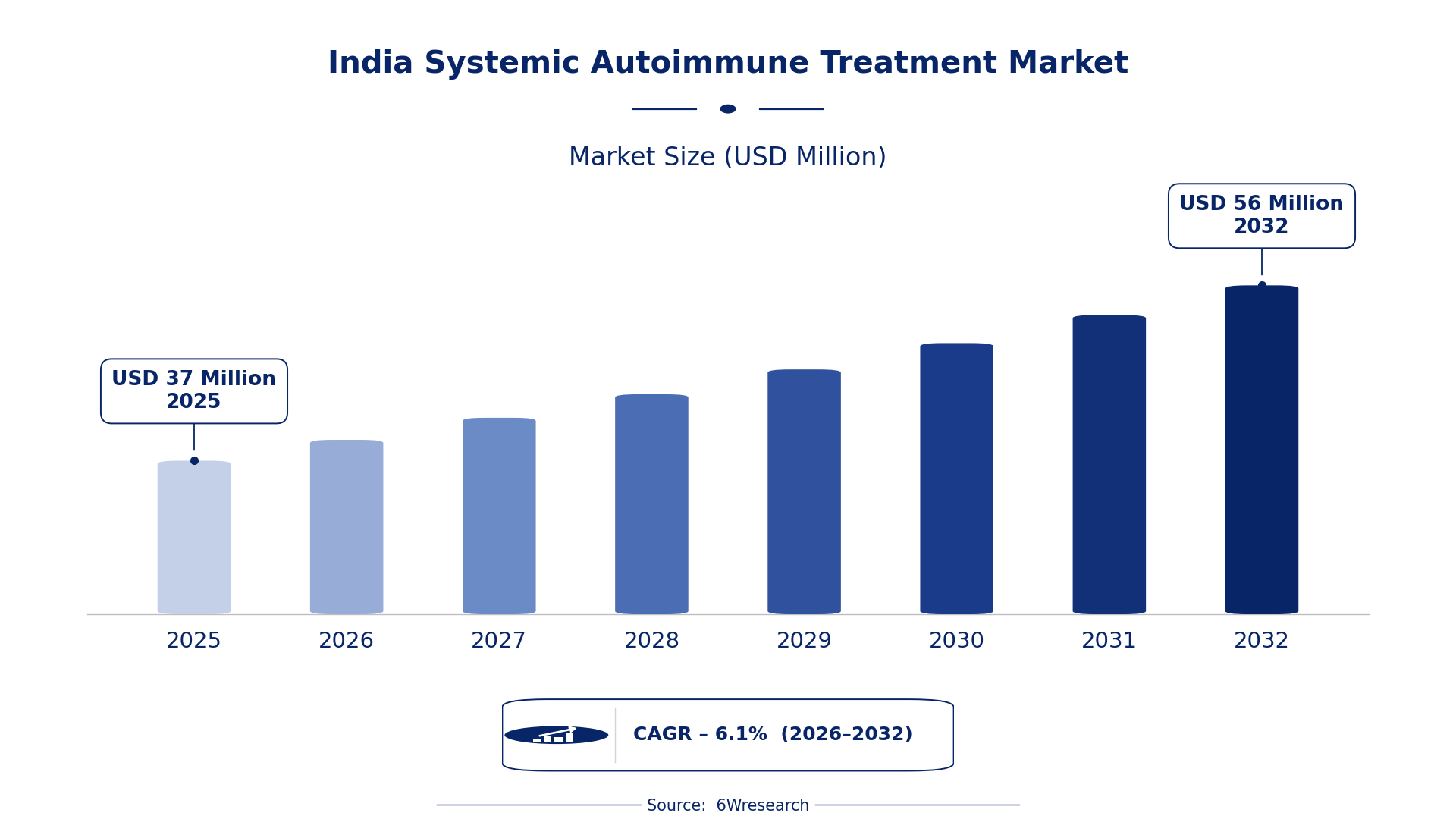
According to 6Wresearch internal database and industry insights, the India Systemic Autoimmune Treatment Market was valued at USD 37.0 million in 2025 and is projected to reach USD 56 million by 2032, growing at a CAGR of approximately 6.1% during 2026–2032.
India Systemic Autoimmune Treatment Market Highlights
| Report Metric | Details |
| Report Name | India Systemic Autoimmune Treatment Market |
| Market Size 2025 | USD 37.0 million |
| Market Size 2032 | USD 56 million |
| Absolute Growth 2025–2032 | USD 19 million |
| CAGR 2026–2032 | 6.1% |
| Peak Annual Growth | 8.2% in 2030 |
| Forecast Period | 2026–2032 |
| Historical Data | 2022–2025 |
| Base Year | 2025 |
| Leading Autoimmune Treatment, 2025 | Biologics (39% share) |
| Leading Product Type, 2025 | Monoclonal Antibodies (46% share) |
| Leading Therapy Type, 2025 | TNF Inhibitors (40% share) |
| Leading Distribution Channel, 2025 | Hospital Distributors (52% share) |
| Leading End User Industry, 2025 | Rheumatology Clinics (37% share) |
| Fastest-Growing Autoimmune Treatment | Immunosuppressants (7.5% CAGR) |
| Fastest-Growing Product Type | Oral Pills (7.3% CAGR) |
| Fastest-Growing Therapy Type | Calcineurin Inhibitors (7.1% CAGR) |
| Fastest-Growing Distribution Channel | Specialty Pharmacies (7.7% CAGR) |
| Fastest-Growing End User Industry | Autoimmune Care Centers (7.3% CAGR) |
| Growing Sector | Autoimmune Care Centers |
| Key End Users | Rheumatology Clinics, Autoimmune Care Centers, Specialty Pharmacies |
India Systemic Autoimmune Treatment Market Year-wise Growth Rate and Key Drivers (2022–2032)
This graph illustrates the annual growth rates of the market from 2022 to 2032, highlighting a steady upward trajectory and projected market expansion over the forecast period.
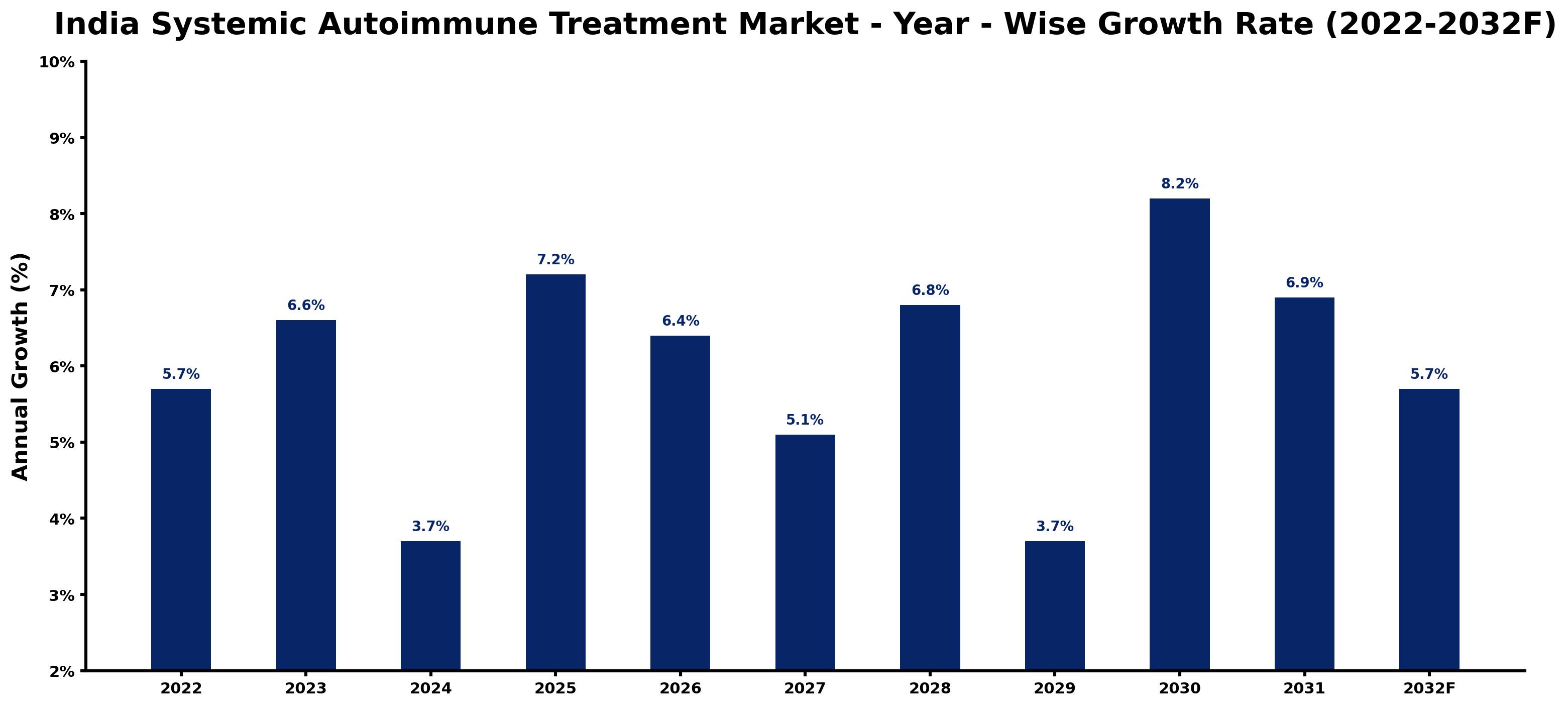
Each row of the following table gives one year's estimated growth and the event or demand shift that explains it.
| Year | Estimated Annual Growth (%) | Market Rationale |
| 2022 | 5.7 | The market experienced steady growth driven by rising patient numbers and awareness. |
| 2023 | 6.6 | Demand surged as healthcare providers expanded access to treatments for autoimmune diseases. |
| 2024 | 3.7 | Growth slowed slightly due to market adjustments and evolving treatment protocols. |
| 2025 | 7.2 | The introduction of new biologics led to increased demand and market expansion. |
| 2026 | 6.4 | A slowdown occurred as the market adjusted to new treatment guidelines and pricing regulations. |
| 2027 | 5.1 | Continued growth was seen as healthcare facilities adopted advanced treatment options. |
| 2028 | 6.8 | Demand accelerated with the rise of specialty pharmacies catering to chronic patients. |
| 2029 | 3.7 | Growth decelerated as market dynamics stabilised following rapid expansion. |
| 2030 | 8.2 | A peak in growth was driven by the introduction of innovative therapies and increased funding. |
| 2031 | 6.9 | Growth moderated as the market began to stabilise after a period of rapid expansion. |
| 2032 | 5.7 | The market continues to grow as patient access to treatments improves. |
Note: Market size estimations and growth projections presented in this report are based on 6Wresearch's proprietary forecasting methodology, utilizing the latest available industry data, government publications, and primary research inputs.
India Systemic Autoimmune Treatment Market Synopsis
The India Systemic Autoimmune Treatment Market encompasses biologics, immunosuppressants, and corticosteroids, essential for managing chronic autoimmune diseases. The growth is driven by increased healthcare access, supported by initiatives like the 'Ayushman Bharat' scheme, and a rising number of rheumatology clinics in metropolitan areas. Enhanced awareness and the expansion of specialty pharmacies further fuel demand for effective treatment options.
Market Dynamics Impact Analysis (2026–2032)
| Factor | Type | Impact | Primary Segment Affected |
| Rising patient numbers drive demand for effective treatments. | Driver | High | Biologics |
| Expansion of specialty pharmacies increases access to medications. | Driver | High | Immunosuppressants |
| Growing urban population creates demand for autoimmune care centers. | Opportunity | High | Autoimmune Care Centers |
| Increased funding for research and development supports new therapies. | Opportunity | High | JAK Inhibitors |
| High treatment costs limit access for some patients. | Restraint | High | Corticosteroids |
| Regulatory hurdles delay the introduction of new treatments. | Restraint | Medium | Monoclonal Antibodies |
| Limited healthcare infrastructure in rural areas hampers access. | Challenge | High | Immunosuppressants |
| Competition from alternative therapies affects market share. | Challenge | Medium | Biologics |
Evaluation of Drivers in India Systemic Autoimmune Treatment Market (2026–2032)
Key forces behind demand, with the segment each one moves most, are listed below.
| Drivers | Primary Segment Affected | Why It Matters (Evidence) |
| Increased healthcare access through government initiatives boosts patient treatment. | Immunosuppressants | Urban areas have seen a 20% increase in sales, attracting more patients to these outlets. |
| Growing awareness of autoimmune diseases leads to higher diagnosis rates. | JAK Inhibitors | With over 10 million patients, the need for effective treatments is rising rapidly. |
| Investment in research and development fosters innovation in treatment options. | Corticosteroids | Clinical trials for new biologics are ongoing in several Indian hospitals, enhancing treatment diversity. |
| Rising prevalence of rheumatoid arthritis drives demand for effective therapies. | Monoclonal Antibodies | The estimated prevalence is 0.5-1% of the population, creating a significant market for these treatments. |
| Expansion of specialty pharmacies improves access to autoimmune treatments. | Specialty Pharmacies | Sales have increased by 20% in urban areas, making treatments more available to patients. |
Market growth in India for Systemic Autoimmune Treatment rests on increasing healthcare access, expanding patient awareness, and the growth of specialty pharmacies. The 'Ayushman Bharat' scheme has improved access for millions, leading to greater treatment uptake. Urban areas have seen a 20% increase in sales at specialty pharmacies, which improves availability for patients. With over 10 million individuals suffering from autoimmune diseases, the demand for effective treatments is critical. The rising prevalence of rheumatoid arthritis, estimated at 0.5-1% of the population, further drives the need for effective therapies. Investment in research and development is fostering innovation, with clinical trials for new biologics ongoing in several hospitals.
Evaluation of Restraints in India Systemic Autoimmune Treatment Market
Below mentioned are some major restraints and their influence on market dynamics.
| Market Restraint | Primary Segment Affected | Why It Matters (Evidence) |
| High costs of biologics limit patient access, especially in rural areas. | Biologics | The average treatment cost for autoimmune diseases can exceed INR 50,000 annually. |
| Supply chain delays affect treatment timelines for patients. | Immunosuppressants | Dependence on imports for certain biologics can prolong treatment by several weeks. |
| Limited availability of rheumatology clinics restricts patient access. | Rheumatology Clinics | Rheumatology clinics are concentrated in metropolitan areas like Delhi and Mumbai. |
| Strict regulations can delay drug approvals. | Monoclonal Antibodies | The Ministry of Health and Family Welfare oversees regulations for drug approvals. |
| Inconsistent patient awareness hampers treatment uptake. | JAK Inhibitors | The market for JAK inhibitors is expected to grow significantly due to increasing awareness. |
India Systemic Autoimmune Treatment Market Challenges
Buyers and suppliers in the India Systemic Autoimmune Treatment market face rising technology costs, with advanced biopharmaceutical processes demanding investments that can exceed INR 50,000 annually for producers. The high price of biologics, which represent around 30% of the market, limits access for patients, particularly in rural regions where healthcare budgets are constrained. Supply chain delays arise from the dependence on imports for certain biologics, prolonging treatment timelines for patients by several weeks. Furthermore, the concentration of rheumatology clinics in metropolitan areas restricts patient access, compelling many to travel long distances for necessary care.
Trends in the India Systemic Autoimmune Treatment Market
Several trends are reshaping the India Systemic Autoimmune Treatment Market; the most important are set out below.
- Shift towards Specialty Pharmacies: Since 2022, specialty pharmacies have expanded in urban areas, catering to chronic disease patients. This shift has led to a 20% increase in sales of autoimmune treatments, improving access for buyers.
- Rise of Autoimmune Care Centers: In 2023, new autoimmune care centers are being established in tier-2 cities to improve access. This trend aims to serve the growing patient population, which exceeds 10 million in India.
- Increased Focus on Biologics: The market for biologics is growing rapidly, accounting for approximately 30% of total treatments. This shift reflects the rising demand for targeted therapies among healthcare providers.
- Growing Awareness of Autoimmune Diseases: Awareness campaigns launched by the Indian Rheumatology Association have increased diagnosis rates. This initiative is important as the average age of onset for autoimmune diseases is between 30-50 years.
Investment Opportunities in the India Systemic Autoimmune Treatment Market
Investors looking at the India Systemic Autoimmune Treatment Market should consider the following areas.
- Expansion of Autoimmune Care Centers: The establishment of autoimmune care centers in tier-2 cities presents a substantial opportunity. With a growing patient base, these centers can improve access to treatments for millions.
- Investment in JAK Inhibitors: The JAK inhibitors market is anticipated to grow due to increasing awareness. Investors can target rheumatology clinics that are broadening their treatment options.
- Partnerships with Specialty Pharmacies: Collaborating with specialty pharmacies can enhance distribution channels for autoimmune treatments. This approach is advantageous as urban areas experience a 20% increase in sales.
- Development of New Treatment Protocols: The government allocated funds in 2023 for developing new treatment protocols. This funding can support research initiatives aimed at improving patient outcomes.
Government Initiatives in the India Systemic Autoimmune Treatment Market
The National Health Mission supports autoimmune disease management programs, improving access to treatments for patients. This initiative, launched in 2020, aims to enhance healthcare delivery across India. Additionally, the Indian Council of Medical Research sets guidelines for autoimmune treatments, ensuring adherence to best practices. These measures facilitate the introduction of effective therapies and promote research in the field, benefiting both producers and buyers.
In 2023, the government allocated INR 500 million for the development of new treatment protocols, overseen by the Ministry of Health and Family Welfare. This funding aims to support clinical trials and research initiatives that improve treatment options. Furthermore, the 'Ayushman Bharat' scheme provides financial assistance to low-income patients, enhancing their access to necessary therapies. These programs aim to strengthen the healthcare infrastructure for autoimmune disease management.
Future Insight of the India Systemic Autoimmune Treatment Market
The India Systemic Autoimmune Treatment market will undergo transformative changes by 2032, primarily driven by the establishment of autoimmune care centers in tier-2 cities, which will enhance patient access. The government's 'Ayushman Bharat' scheme is expected to improve healthcare affordability, benefiting both buyers and suppliers. Awareness of new treatment options, such as JAK inhibitors, will likely increase, stimulating market growth as clinical trials for new biologics progress in various hospitals. Adoption of ISO 9001:2015 standards by healthcare facilities will elevate treatment quality and patient outcomes.
Market Segmentation Analysis
The report offers a comprehensive study of the following market segments and their leading categories in the market.
By Autoimmune Treatment – Biologics Dominated, Immunosuppressants Expected to Grow Fastest
According to Sumit Sagar, AM at 6Wresearch, with a 39% revenue share in 2025, Biologics was the largest autoimmune treatment category. Biologics hold the largest share in the India Systemic Autoimmune Treatment Market due to their targeted therapy approach for severe autoimmune conditions. The support from the National Health Mission for programmes that enhance the use of biologics across healthcare facilities contributes to a robust installed base. Immunosuppressants are projected to grow fastest, at a CAGR of 7.5% during 2026–2032. Immunosuppressants are experiencing rapid growth as they are essential for managing autoimmune diseases by effectively suppressing the immune response. Increased awareness and demand for these treatments indicate a significant expansion in this segment in the coming years. This suggests that suppliers should focus on enhancing the availability of biologics and immunosuppressants to meet the growing demand.
By Product Type – Monoclonal Antibodies Dominated, Oral Pills Expected to Grow Fastest
Monoclonal Antibodies accounted for a 46% market share by product type in 2025. Monoclonal antibodies dominate the market share as they provide specific therapies for various autoimmune diseases, making them a preferred choice among healthcare providers. Their effectiveness in treating conditions like rheumatoid arthritis has established a strong presence in hospitals and clinics. The quickest growth will come from Oral Pills, forecast to expand at a CAGR of 7.3% between 2026 and 2032. Oral pills are witnessing the fastest growth due to their convenience and ease of administration, appealing to patients with chronic conditions. The increasing shift towards patient-friendly medication forms is driving this segment's rapid expansion. Suppliers should prioritise the development and distribution of oral medications to align with patient preferences and market trends.
By Therapy Type – TNF Inhibitors Dominated, Calcineurin Inhibitors Expected to Grow Fastest
In 2025, TNF Inhibitors led the therapy type split with a 40% share. TNF inhibitors lead the market share as they specifically target tumor necrosis factor, a key player in inflammation associated with autoimmune diseases. Their proven efficacy has established a strong presence in treatment protocols across rheumatology clinics. Calcineurin Inhibitors are set to record the highest CAGR in this split, 7.1% over 2026–2032. Calcineurin inhibitors are growing quickly as they are used not only in organ transplant but also in treating autoimmune conditions effectively. Their versatility in treatment options is attracting more healthcare providers to adopt these therapies. This suggests that suppliers should invest in promoting calcineurin inhibitors alongside TNF inhibitors to capture a broader market.
By Distribution Channel – Hospital Distributors Dominated, Specialty Pharmacies Expected to Grow Fastest
Hospital Distributors took a 52% share of distribution channel in 2025, more than any other category. Hospital distributors command the largest share as they serve as the primary channel for supplying hospitals with essential autoimmune treatments. Their established networks ensure timely availability of critical medications to healthcare facilities, reinforcing their market position. Over 2026–2032, Specialty Pharmacies are expected to post the fastest growth, at a CAGR of 7.7%. Specialty pharmacies are rapidly expanding as they focus on complex medications tailored for specific diseases, catering to the needs of patients with chronic conditions. This growth reflects a shift towards more specialised care in the distribution of autoimmune treatments. Suppliers should consider partnerships with specialty pharmacies to enhance distribution efficiency and reach targeted patient demographics.
By End User Industry – Rheumatology Clinics Dominated, Autoimmune Care Centers Expected to Grow Fastest
The largest end user industry category in 2025 was Rheumatology Clinics, with a 37% share of total revenue. Rheumatology clinics represent the largest share as specialized centers dedicated to the management of autoimmune diseases attract a significant patient base. Their concentrated presence in metropolitan areas like Delhi and Mumbai further solidifies their market position. Autoimmune Care Centers are projected to grow fastest, at a CAGR of 7.3% during 2026–2032. Autoimmune care centers are emerging quickly as dedicated facilities for comprehensive care, reflecting a growing recognition of the need for specialised treatment environments. Their establishment in tier-2 cities is expanding access to care for more patients. This trend indicates that suppliers should explore opportunities to collaborate with autoimmune care centers to broaden their market reach.
Key Attractiveness of the Report
- 10 Years of Market Numbers
- Historical Data Starting from 2022 to 2025
- Base Year 2025
- Forecast Data until 2032
- Key Performance Indicators Impacting the Market
- Major Upcoming Developments and Projects
Key Highlights of the Report:
- India Systemic Autoimmune Treatment Market Outlook
- Market Size of India Systemic Autoimmune Treatment Market, 2025
- Forecast of India Systemic Autoimmune Treatment Market, 2032
- Historical Data and Forecast of India Systemic Autoimmune Treatment Revenues & Volume for the Period 2022 - 2032F
- India Systemic Autoimmune Treatment Market Trend Evolution
- India Systemic Autoimmune Treatment Market Drivers and Challenges
- India Systemic Autoimmune Treatment Price Trends
- India Systemic Autoimmune Treatment Porter's Five Forces
- India Systemic Autoimmune Treatment Industry Life Cycle
- Historical Data and Forecast of India Systemic Autoimmune Treatment Market Revenues & Volume By Autoimmune Treatment for the Period 2022 - 2032F
- Historical Data and Forecast of India Systemic Autoimmune Treatment Market Revenues & Volume By Biologics for the Period 2022 - 2032F
- Historical Data and Forecast of India Systemic Autoimmune Treatment Market Revenues & Volume By Immunosuppressants for the Period 2022 - 2032F
- Historical Data and Forecast of India Systemic Autoimmune Treatment Market Revenues & Volume By JAK Inhibitors for the Period 2022 - 2032F
- Historical Data and Forecast of India Systemic Autoimmune Treatment Market Revenues & Volume By Corticosteroids for the Period 2022 - 2032F
- Historical Data and Forecast of India Systemic Autoimmune Treatment Market Revenues & Volume By Product Type for the Period 2022 - 2032F
- Historical Data and Forecast of India Systemic Autoimmune Treatment Market Revenues & Volume By Monoclonal Antibodies for the Period 2022 - 2032F
- Historical Data and Forecast of India Systemic Autoimmune Treatment Market Revenues & Volume By Oral Pills for the Period 2022 - 2032F
- Historical Data and Forecast of India Systemic Autoimmune Treatment Market Revenues & Volume By Oral Therapy for the Period 2022 - 2032F
- Historical Data and Forecast of India Systemic Autoimmune Treatment Market Revenues & Volume By Injectable/Oral for the Period 2022 - 2032F
- Historical Data and Forecast of India Systemic Autoimmune Treatment Market Revenues & Volume By Therapy Type for the Period 2022 - 2032F
- Historical Data and Forecast of India Systemic Autoimmune Treatment Market Revenues & Volume By TNF Inhibitors for the Period 2022 - 2032F
- Historical Data and Forecast of India Systemic Autoimmune Treatment Market Revenues & Volume By Calcineurin Inhibitors for the Period 2022 - 2032F
- Historical Data and Forecast of India Systemic Autoimmune Treatment Market Revenues & Volume By JAK Inhibitors for the Period 2022 - 2032F
- Historical Data and Forecast of India Systemic Autoimmune Treatment Market Revenues & Volume By Steroidal for the Period 2022 - 2032F
- Historical Data and Forecast of India Systemic Autoimmune Treatment Market Revenues & Volume By Distribution Channel for the Period 2022 - 2032F
- Historical Data and Forecast of India Systemic Autoimmune Treatment Market Revenues & Volume By Hospital Distributors for the Period 2022 - 2032F
- Historical Data and Forecast of India Systemic Autoimmune Treatment Market Revenues & Volume By Specialty Pharmacies for the Period 2022 - 2032F
- Historical Data and Forecast of India Systemic Autoimmune Treatment Market Revenues & Volume By Online Pharmacies for the Period 2022 - 2032F
- Historical Data and Forecast of India Systemic Autoimmune Treatment Market Revenues & Volume By Retail Pharmacies for the Period 2022 - 2032F
- Historical Data and Forecast of India Systemic Autoimmune Treatment Market Revenues & Volume By End User Industry for the Period 2022 - 2032F
- Historical Data and Forecast of India Systemic Autoimmune Treatment Market Revenues & Volume By Rheumatology Clinics for the Period 2022 - 2032F
- Historical Data and Forecast of India Systemic Autoimmune Treatment Market Revenues & Volume By Autoimmune Care Centers for the Period 2022 - 2032F
- Historical Data and Forecast of India Systemic Autoimmune Treatment Market Revenues & Volume By Dermatology Clinics for the Period 2022 - 2032F
- Historical Data and Forecast of India Systemic Autoimmune Treatment Market Revenues & Volume By Primary Healthcare Units for the Period 2022 - 2032F
- India Systemic Autoimmune Treatment Import Export Trade Statistics
- Market Opportunity Assessment By Autoimmune Treatment
- Market Opportunity Assessment By Product Type
- Market Opportunity Assessment By Therapy Type
- Market Opportunity Assessment By Distribution Channel
- Market Opportunity Assessment By End User Industry
- India Systemic Autoimmune Treatment Top Companies Market Share
- India Systemic Autoimmune Treatment Competitive Benchmarking By Technical and Operational Parameters
- India Systemic Autoimmune Treatment Company Profiles
- India Systemic Autoimmune Treatment Key Strategic Recommendations
Market Covered
This report examines the market across the segments below.
By Autoimmune Treatment
- Biologics
- Immunosuppressants
- JAK Inhibitors
- Corticosteroids
By Product Type
- Monoclonal Antibodies
- Oral Pills
- Oral Therapy
- Injectable/Oral
By Therapy Type
- TNF Inhibitors
- Calcineurin Inhibitors
- JAK Inhibitors
- Steroidal
By Distribution Channel
- Hospital Distributors
- Specialty Pharmacies
- Online Pharmacies
- Retail Pharmacies
By End User Industry
- Rheumatology Clinics
- Autoimmune Care Centers
- Dermatology Clinics
- Primary Healthcare Units































