China Systemic Autoimmune Treatment Market Size & Growth Rate
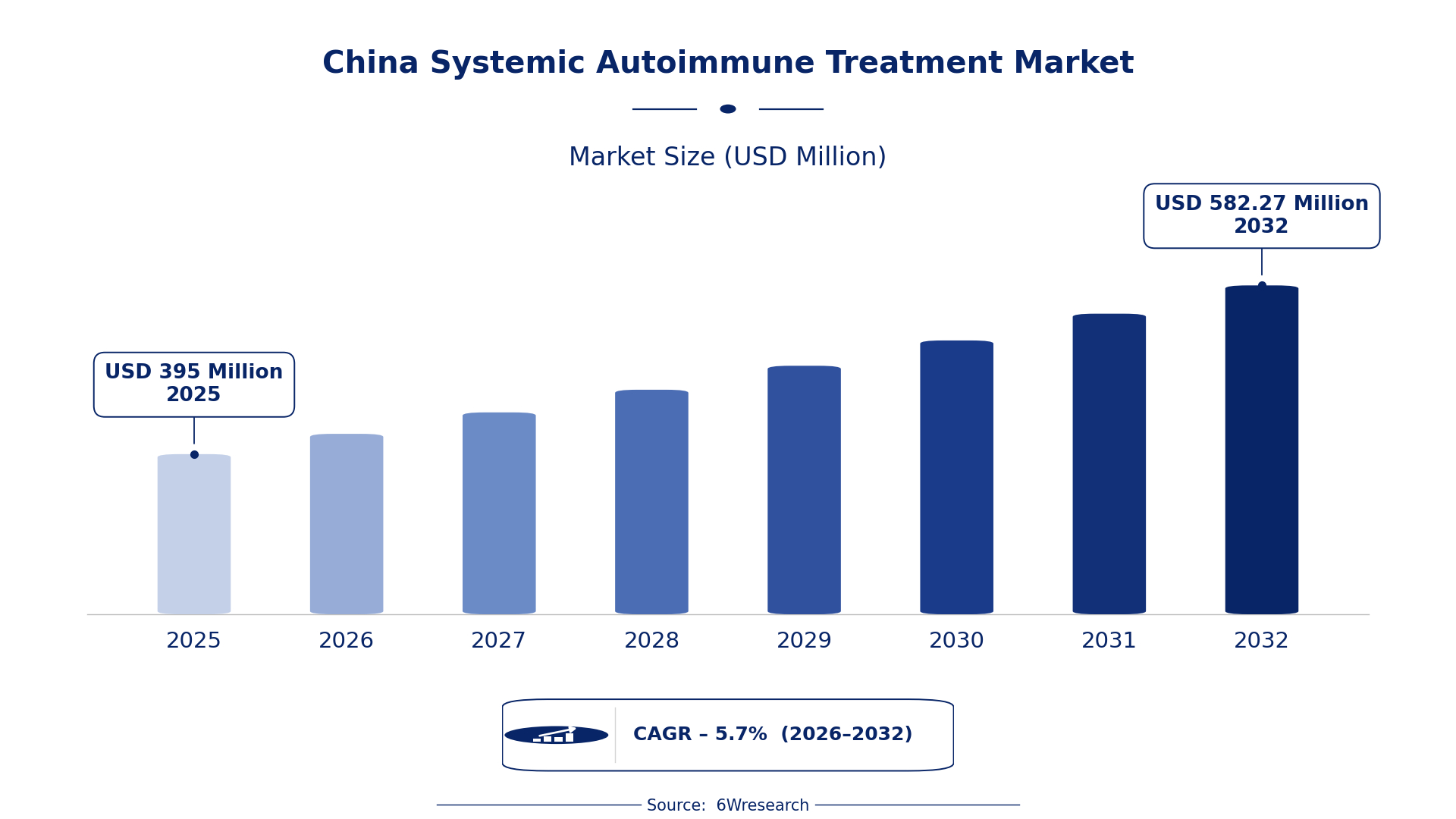
According to 6Wresearch internal database and industry insights, the China Systemic Autoimmune Treatment Market was valued at USD 395.0 million in 2025 and is projected to reach USD 582.27 million by 2032, growing at a CAGR of approximately 5.7% during 2026–2032.
China Systemic Autoimmune Treatment Market Highlights
| Report Metric | Details |
| Report Name | China Systemic Autoimmune Treatment Market |
| Market Size 2025 | USD 395.0 million |
| Market Size 2032 | USD 582.27 million |
| Absolute Growth 2025–2032 | USD 187.27 million |
| CAGR 2026–2032 | 5.7% |
| Peak Annual Growth | 7.3% in 2030 |
| Forecast Period | 2026–2032 |
| Historical Data | 2022–2025 |
| Base Year | 2025 |
| Leading Autoimmune Treatment, 2025 | Biologics (48% share) |
| Leading Product Type, 2025 | Monoclonal Antibodies (54% share) |
| Leading Therapy Type, 2025 | TNF Inhibitors (48% share) |
| Leading Distribution Channel, 2025 | Hospital Distributors (44% share) |
| Leading End User Industry, 2025 | Rheumatology Clinics (49% share) |
| Fastest-Growing Autoimmune Treatment | JAK Inhibitors (8.4% CAGR) |
| Fastest-Growing Therapy Type | JAK Inhibitors (7.5% CAGR) |
| Fastest-Growing Distribution Channel | Online Pharmacies (8.5% CAGR) |
| Fastest-Growing End User Industry | Autoimmune Care Centers (7.8% CAGR) |
| Growing Sector | Rheumatology Clinics |
| Key End Users | Rheumatology Clinics, Autoimmune Care Centers, Specialty Pharmacies |
China Systemic Autoimmune Treatment Market Year-wise Growth Rate and Key Drivers (2022–2032)
This graph illustrates the annual growth rates of the market from 2022 to 2032, highlighting a steady upward trajectory and projected market expansion over the forecast period.
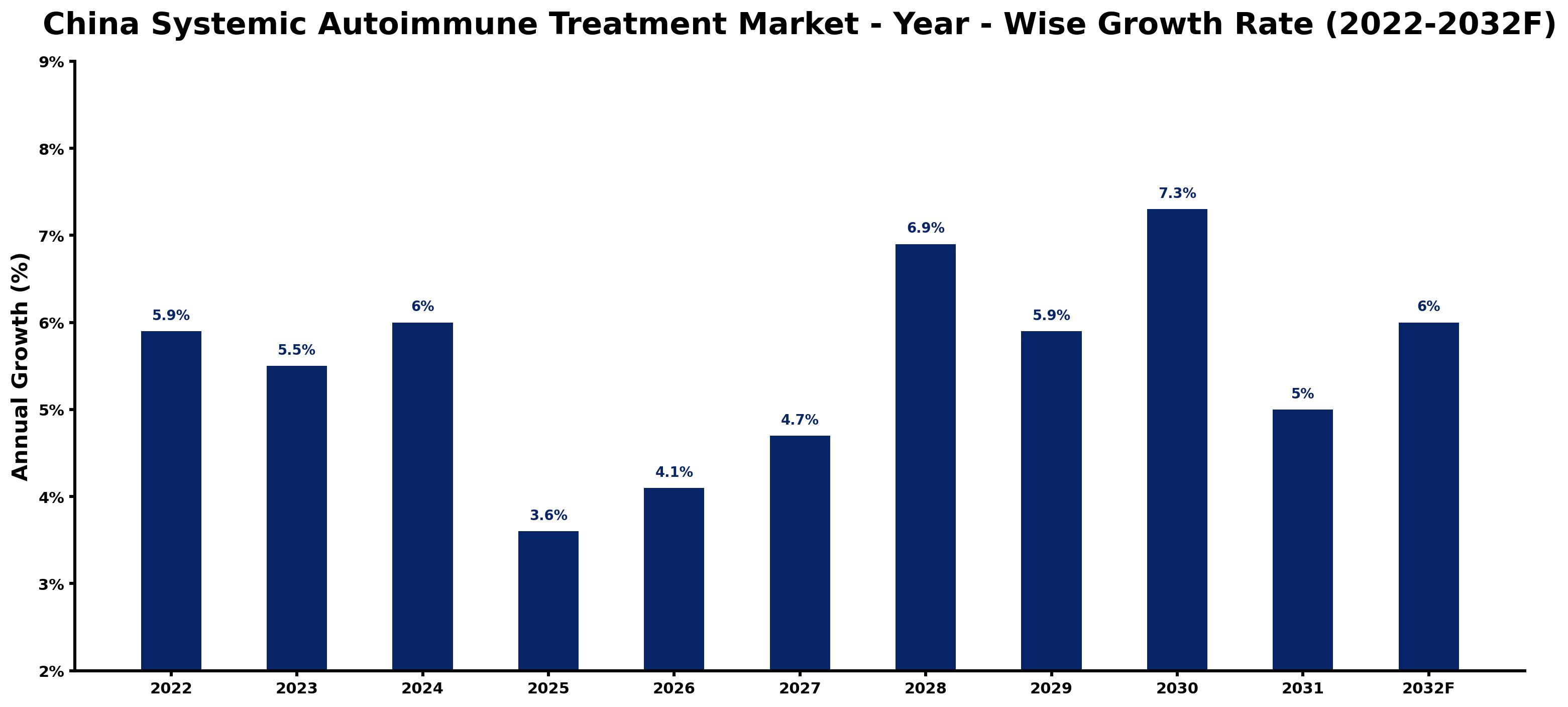
The following table presents the estimated annual growth rate for each year together with the principal factor influencing market performance.
| Year | Estimated Annual Growth (%) | Market Rationale |
| 2022 | 5.9 | The market showed steady growth with approximately 10 million patients diagnosed with autoimmune diseases. |
| 2023 | 5.5 | Growth slowed slightly as the National Health Commission promoted biologics under the 2021 Health Plan. |
| 2024 | 6.0 | The market experienced a surge as rheumatology clinics expanded their services in urban areas. |
| 2025 | 3.6 | Growth slowed again due to increased competition among treatment options. |
| 2026 | 4.1 | Demand rose as JAK inhibitors gained traction, supported by government research initiatives. |
| 2027 | 4.7 | The market continued to grow with rising adoption of oral therapies in primary healthcare units. |
| 2028 | 6.9 | Demand accelerated as autoimmune care centers expanded across major urban areas. |
| 2029 | 5.9 | Growth slowed as online pharmacies captured a significant share of total drug sales. |
| 2030 | 7.3 | The market peaked with a surge in demand for TNF inhibitors among rheumatology clinics. |
| 2031 | 5.0 | Growth decelerated as the market adjusted to new treatment standards. |
| 2032 | 6.0 | Demand increased again as the adoption of immunosuppressants rose in specialized clinics. |
Note: Market size estimations and growth projections presented in this report are based on 6Wresearch's proprietary forecasting methodology, utilizing the latest available industry data, government publications, and primary research inputs.
China Systemic Autoimmune Treatment Market Synopsis
Systemic Autoimmune Treatment in China includes biological and chemical therapies designed to modulate the immune system. These therapies are primarily aimed at managing chronic autoimmune conditions and are produced through advanced biotechnological processes. The China Systemic Autoimmune Treatment Market is expanding due to a large patient base, with around 10 million diagnosed cases. Urban healthcare settings, especially in Shanghai and Beijing, are driving this demand. Government initiatives supporting biologics and JAK inhibitors are further propelling market growth.
Market Dynamics Impact Analysis (2026–2032)
| Factor | Type | Impact | Primary Segment Affected |
| Increasing patient population diagnosed with autoimmune diseases drives demand for treatments. | Driver | High | Biologics |
| Government support for innovative therapies enhances treatment availability. | Driver | High | JAK Inhibitors |
| Rising demand for oral therapies creates opportunities for new entrants. | Opportunity | High | Oral Therapy |
| Expansion of autoimmune care centers opens new markets for suppliers. | Opportunity | Medium | Autoimmune Care Centers |
| High competition among treatment options may limit market share for new products. | Restraint | Medium | Immunosuppressants |
| Regulatory hurdles can delay the introduction of new therapies. | Restraint | High | Monoclonal Antibodies |
| Buyers face challenges in accessing innovative treatments due to high costs. | Challenge | High | Corticosteroids |
| Suppliers encounter difficulties in meeting stringent regulatory standards. | Challenge | Medium | Injectable/Oral |
Evaluation of Drivers in China Systemic Autoimmune Treatment Market (2026–2032)
Below mentioned are some major drivers and their influence on market dynamics.
| Drivers | Primary Segment Affected | Why It Matters (Evidence) |
| Growing patient population drives demand for systemic autoimmune treatments. | Biologics | In 2022, approximately 10 million patients were diagnosed with autoimmune diseases, increasing the need for effective treatments. |
| Government initiatives support new therapies, improving treatment access. | JAK Inhibitors | The National Natural Science Foundation funds research in JAK inhibitors, promoting their use in clinical settings. |
| Expansion of rheumatology clinics increases treatment availability. | Monoclonal Antibodies | Key regions like Shanghai and Beijing are seeing a rise in specialized clinics for autoimmune treatments. |
| Rising adoption of oral therapies improves patient compliance. | Oral Therapy | The adoption rate of oral therapies in primary healthcare units has increased by 15% since 2020. |
| Online pharmacies are becoming a significant distribution channel. | Online Pharmacies | In 2023, online pharmacies accounted for 20% of total drug sales in the autoimmune segment. |
Approximately 10 million patients diagnosed with autoimmune diseases create a strong demand for effective treatments. Urban areas are experiencing a rise in rheumatology clinics, increasing treatment availability. The adoption of oral therapies in primary healthcare units has risen by 15% since 2020, improving patient compliance. Online pharmacies accounted for 20% of total drug sales in the autoimmune segment, reflecting changing consumer preferences for convenient access to medications.
Evaluation of Restraints in China Systemic Autoimmune Treatment Market
The following restraints limit how fast demand can grow.
| Market Restraint | Primary Segment Affected | Why It Matters (Evidence) |
| High competition among treatment options may limit market share. | Immunosuppressants | The presence of multiple treatment options can dilute individual product demand, affecting overall sales. |
| Regulatory hurdles can delay new therapies' market entry. | Monoclonal Antibodies | Stringent regulatory requirements can prolong the approval process for new treatments, impacting availability. |
| High costs of treatments pose access challenges for patients. | Corticosteroids | Patients may struggle to afford advanced therapies, limiting their treatment options. |
| Limited awareness of autoimmune diseases can hinder patient access to treatments. | Biologics | Insufficient public knowledge may result in delayed diagnoses and treatment initiation. |
| Supply chain disruptions can affect product availability. | Injectable/Oral | Logistical challenges can delay the distribution of essential treatments to healthcare facilities. |
China Systemic Autoimmune Treatment Market Challenges
Approximately 10 million patients diagnosed with autoimmune diseases in China face treatment costs that can exceed 30% of their annual income, restricting access for many. Producers encounter supply chain disruptions due to stringent regulations from the China Food and Drug Administration, which delay product availability and raise costs for distributors. Compliance with new production standards for immunosuppressants adds further expenses for manufacturers, potentially increasing prices for clinics. A shortage of skilled professionals in advanced biotechnological processes limits producers' capacity to innovate, resulting in fewer treatment options for patients.
Trends in the China Systemic Autoimmune Treatment Market
Four trends stand out in the China Systemic Autoimmune Treatment Market.
- Shift towards Oral Therapies: Since 2020, there has been a marked shift towards oral therapies in autoimmune treatment, particularly within primary healthcare units. The adoption rate of these therapies has risen by 15%, making them more accessible for chronic patients.
- Expansion of Autoimmune Care Centers: In 2023, over 300 autoimmune care centres were established across major urban areas in China, improving treatment access. This expansion supports comprehensive care for patients with chronic autoimmune conditions.
- Increased Focus on JAK Inhibitors: The introduction of the Fast Track Approval pathway for JAK inhibitors in 2022 has accelerated their market entry. This initiative aims to improve patient access to these new therapies.
- Growth of Online Pharmacies: Online pharmacies have gained traction, accounting for 20% of total drug sales in the autoimmune segment by 2023. This trend reflects changing consumer preferences for convenient access to medications.
Investment Opportunities in the China Systemic Autoimmune Treatment Market
Several openings in the China Systemic Autoimmune Treatment Market merit attention from investors.
- Rheumatology Clinics Seeking Advanced Treatments: Rheumatology clinics are increasingly in search of advanced systemic autoimmune treatments, supported by a patient base of around 10 million. Collaborating with local distributors can facilitate market entry.
- Joint Ventures for New Therapies: With a budget of 1 billion yuan, the Biological Drug Development Strategy encourages partnerships for new therapies. Engaging in joint ventures can help navigate regulatory landscapes effectively.
- Expansion in Urban Healthcare Settings: The growing number of autoimmune care centres in urban areas presents an investment opportunity. Focusing on specialised treatments can attract more patients and improve outcomes.
- Increasing Demand for Oral Medications: The 15% increase in oral therapy adoption highlights a gap in the market. Suppliers can capitalise on this trend by offering new oral formulations to healthcare providers.
Government Initiatives in the China Systemic Autoimmune Treatment Market
The 'Chronic Disease Management Program' launched by the National Health Commission in 2021 aims to improve treatment access for autoimmune patients, targeting 5 million patients by 2025. This initiative strengthens the framework for systemic autoimmune treatments, ensuring that more patients receive timely care and support. Additionally, the 'Biological Drug Development Strategy' initiated by the Ministry of Science and Technology in 2022, with a budget of 1 billion yuan, supports innovative therapies, boosting the production capabilities of manufacturers.
The updated 'Regulations on the Administration of Drug Registration' introduced in 2023 by the State Administration for Market Regulation streamlines approval processes for new autoimmune treatments. This regulation simplifies access to new therapies for healthcare providers, improving treatment options for patients. Furthermore, the Fast Track Approval pathway for JAK inhibitors allows quicker access to these essential therapies, benefiting both producers and patients.
Future Insight of the China Systemic Autoimmune Treatment Market
The China Systemic Autoimmune Treatment Market will undergo substantial transformations by 2032, primarily driven by increased government support for research in JAK inhibitors and a rise in the adoption of biologics. Enhanced access to corticosteroids through government programs will improve patient outcomes and treatment adherence. The establishment of over 300 autoimmune care centres across major urban areas will facilitate better patient management and access to therapies. Online pharmacies will continue to expand, representing a larger share of drug sales and improving treatment accessibility for buyers.
Market Segmentation Analysis
The analysis below covers each segmentation, its leading category in 2025 and its fastest-growing category through 2032.
By Autoimmune Treatment – Biologics Dominated, JAK Inhibitors Expected to Grow Fastest
According to Sumit Sagar, AM at 6Wresearch, with a 48% revenue share in 2025, Biologics was the largest autoimmune treatment category. Biologics hold the largest share in the China Systemic Autoimmune Treatment Market due to their targeted action in managing chronic autoimmune diseases. Their extensive use in treating conditions like rheumatoid arthritis is supported by the National Health Commission's promotion of biologics under the 2021 Health Plan. Over 2026–2032, JAK Inhibitors are expected to post the fastest growth, at a CAGR of 8.4%. JAK Inhibitors are seeing rapid growth due to the Chinese government's backing for research through the National Natural Science Foundation, which has spurred interest in these therapies. Their specific applications in autoimmune disorders are attracting a growing patient base, ensuring a widening lead for biologics. This trend suggests that suppliers should prioritise expanding their biologics offerings to meet rising demand.
By Product Type – Monoclonal Antibodies Dominated and Is Expected to Record the Fastest Growth
The largest product type category in 2025 was Monoclonal Antibodies, with a 54% share of total revenue. Monoclonal Antibodies dominate the market share as they are widely utilized for their specificity in targeting disease mechanisms, particularly in treating rheumatoid arthritis. Their established presence in rheumatology clinics further reinforces their leading position, ensuring consistent demand. Its lead should widen, with a projected CAGR of 6.9% during 2026–2032, the highest in this split. Monoclonal Antibodies also represent the fastest-growing segment, driven by increasing patient awareness and the effectiveness of these therapies. Their continued success in addressing complex autoimmune conditions will likely strengthen their market share even further. Suppliers should prioritise the development and distribution of Monoclonal Antibodies to capitalise on this growth.
By Therapy Type – TNF Inhibitors Dominated, JAK Inhibitors Expected to Grow Fastest
TNF Inhibitors held a 48% share of the China Systemic Autoimmune Treatment Market by therapy type in 2025. TNF Inhibitors maintain the largest share as they are a key treatment for rheumatoid arthritis and other autoimmune conditions, making them essential in clinical practice. Their established efficacy has made them a preferred choice among healthcare providers. JAK Inhibitors are projected to grow fastest, at a CAGR of 7.5% during 2026–2032. JAK Inhibitors are the fastest-growing therapy type, attributed to their emerging role in treating autoimmune disorders and the increasing clinical trials supporting their use. This growth suggests that TNF Inhibitors may continue to face competition from these newer therapies. Suppliers need to consider diversifying their portfolios to include JAK Inhibitors alongside traditional therapies.
By Distribution Channel – Hospital Distributors Dominated, Online Pharmacies Expected to Grow Fastest
Hospital Distributors took a 44% share of distribution channel in 2025, more than any other category. Hospital Distributors command the largest share in the market as they are crucial for ensuring the availability of systemic autoimmune treatments within healthcare facilities. Their established networks facilitate timely access to critical medications for patients, solidifying their market position. Online Pharmacies are set to record the highest CAGR in this split, 8.5% over 2026–2032. Online Pharmacies are the fastest-growing distribution channel, accounting for 20% of total drug sales in the autoimmune segment in 2023. This growth reflects a shift towards more accessible patient care options in urban areas, indicating a potential for increased revenue share. Suppliers should enhance their online presence to capture the growing demand for medications through digital channels.
By End User Industry – Rheumatology Clinics Dominated, Autoimmune Care Centers Expected to Grow Fastest
In 2025, Rheumatology Clinics led the end user industry split with a 49% share. Rheumatology Clinics lead the market share as primary care centers for autoimmune patients, providing specialised treatment and management. Their focus on chronic conditions ensures a steady patient base that drives demand for systemic treatments, reinforcing their dominant position. Over 2026–2032, Autoimmune Care Centers are expected to post the fastest growth, at a CAGR of 7.8%. Autoimmune Care Centers are the fastest-growing end user segment, reflecting an increase in dedicated facilities for comprehensive treatment of autoimmune diseases. This growth indicates a shift towards more specialised care for patients, which will likely expand their market share. Suppliers should target Autoimmune Care Centers to align with the trend towards specialised treatment facilities.
Key Attractiveness of the Report
- 10 Years of Market Numbers
- Historical Data Starting from 2022 to 2025
- Base Year 2025
- Forecast Data until 2032
- Key Performance Indicators Impacting the Market
- Major Upcoming Developments and Projects
Key Highlights of the Report:
- China Systemic Autoimmune Treatment Market Outlook
- Market Size of China Systemic Autoimmune Treatment Market, 2025
- Forecast of China Systemic Autoimmune Treatment Market, 2032
- Historical Data and Forecast of China Systemic Autoimmune Treatment Revenues & Volume for the Period 2022 - 2032F
- China Systemic Autoimmune Treatment Market Trend Evolution
- China Systemic Autoimmune Treatment Market Drivers and Challenges
- China Systemic Autoimmune Treatment Price Trends
- China Systemic Autoimmune Treatment Porter's Five Forces
- China Systemic Autoimmune Treatment Industry Life Cycle
- Historical Data and Forecast of China Systemic Autoimmune Treatment Market Revenues & Volume By Autoimmune Treatment for the Period 2022 - 2032F
- Historical Data and Forecast of China Systemic Autoimmune Treatment Market Revenues & Volume By Biologics for the Period 2022 - 2032F
- Historical Data and Forecast of China Systemic Autoimmune Treatment Market Revenues & Volume By Immunosuppressants for the Period 2022 - 2032F
- Historical Data and Forecast of China Systemic Autoimmune Treatment Market Revenues & Volume By JAK Inhibitors for the Period 2022 - 2032F
- Historical Data and Forecast of China Systemic Autoimmune Treatment Market Revenues & Volume By Corticosteroids for the Period 2022 - 2032F
- Historical Data and Forecast of China Systemic Autoimmune Treatment Market Revenues & Volume By Product Type for the Period 2022 - 2032F
- Historical Data and Forecast of China Systemic Autoimmune Treatment Market Revenues & Volume By Monoclonal Antibodies for the Period 2022 - 2032F
- Historical Data and Forecast of China Systemic Autoimmune Treatment Market Revenues & Volume By Oral Pills for the Period 2022 - 2032F
- Historical Data and Forecast of China Systemic Autoimmune Treatment Market Revenues & Volume By Oral Therapy for the Period 2022 - 2032F
- Historical Data and Forecast of China Systemic Autoimmune Treatment Market Revenues & Volume By Injectable/Oral for the Period 2022 - 2032F
- Historical Data and Forecast of China Systemic Autoimmune Treatment Market Revenues & Volume By Therapy Type for the Period 2022 - 2032F
- Historical Data and Forecast of China Systemic Autoimmune Treatment Market Revenues & Volume By TNF Inhibitors for the Period 2022 - 2032F
- Historical Data and Forecast of China Systemic Autoimmune Treatment Market Revenues & Volume By Calcineurin Inhibitors for the Period 2022 - 2032F
- Historical Data and Forecast of China Systemic Autoimmune Treatment Market Revenues & Volume By JAK Inhibitors for the Period 2022 - 2032F
- Historical Data and Forecast of China Systemic Autoimmune Treatment Market Revenues & Volume By Steroidal for the Period 2022 - 2032F
- Historical Data and Forecast of China Systemic Autoimmune Treatment Market Revenues & Volume By Distribution Channel for the Period 2022 - 2032F
- Historical Data and Forecast of China Systemic Autoimmune Treatment Market Revenues & Volume By Hospital Distributors for the Period 2022 - 2032F
- Historical Data and Forecast of China Systemic Autoimmune Treatment Market Revenues & Volume By Specialty Pharmacies for the Period 2022 - 2032F
- Historical Data and Forecast of China Systemic Autoimmune Treatment Market Revenues & Volume By Online Pharmacies for the Period 2022 - 2032F
- Historical Data and Forecast of China Systemic Autoimmune Treatment Market Revenues & Volume By Retail Pharmacies for the Period 2022 - 2032F
- Historical Data and Forecast of China Systemic Autoimmune Treatment Market Revenues & Volume By End User Industry for the Period 2022 - 2032F
- Historical Data and Forecast of China Systemic Autoimmune Treatment Market Revenues & Volume By Rheumatology Clinics for the Period 2022 - 2032F
- Historical Data and Forecast of China Systemic Autoimmune Treatment Market Revenues & Volume By Autoimmune Care Centers for the Period 2022 - 2032F
- Historical Data and Forecast of China Systemic Autoimmune Treatment Market Revenues & Volume By Dermatology Clinics for the Period 2022 - 2032F
- Historical Data and Forecast of China Systemic Autoimmune Treatment Market Revenues & Volume By Primary Healthcare Units for the Period 2022 - 2032F
- China Systemic Autoimmune Treatment Import Export Trade Statistics
- Market Opportunity Assessment By Autoimmune Treatment
- Market Opportunity Assessment By Product Type
- Market Opportunity Assessment By Therapy Type
- Market Opportunity Assessment By Distribution Channel
- Market Opportunity Assessment By End User Industry
- China Systemic Autoimmune Treatment Top Companies Market Share
- China Systemic Autoimmune Treatment Competitive Benchmarking By Technical and Operational Parameters
- China Systemic Autoimmune Treatment Company Profiles
- China Systemic Autoimmune Treatment Key Strategic Recommendations
Market Covered
This report examines the market across the segments below.
By Autoimmune Treatment
- Biologics
- Immunosuppressants
- JAK Inhibitors
- Corticosteroids
By Product Type
- Monoclonal Antibodies
- Oral Pills
- Oral Therapy
- Injectable/Oral
By Therapy Type
- TNF Inhibitors
- Calcineurin Inhibitors
- JAK Inhibitors
- Steroidal
By Distribution Channel
- Hospital Distributors
- Specialty Pharmacies
- Online Pharmacies
- Retail Pharmacies
By End User Industry
- Rheumatology Clinics
- Autoimmune Care Centers
- Dermatology Clinics
- Primary Healthcare Units































