India Systemic Mycoses Market Size & Growth Rate
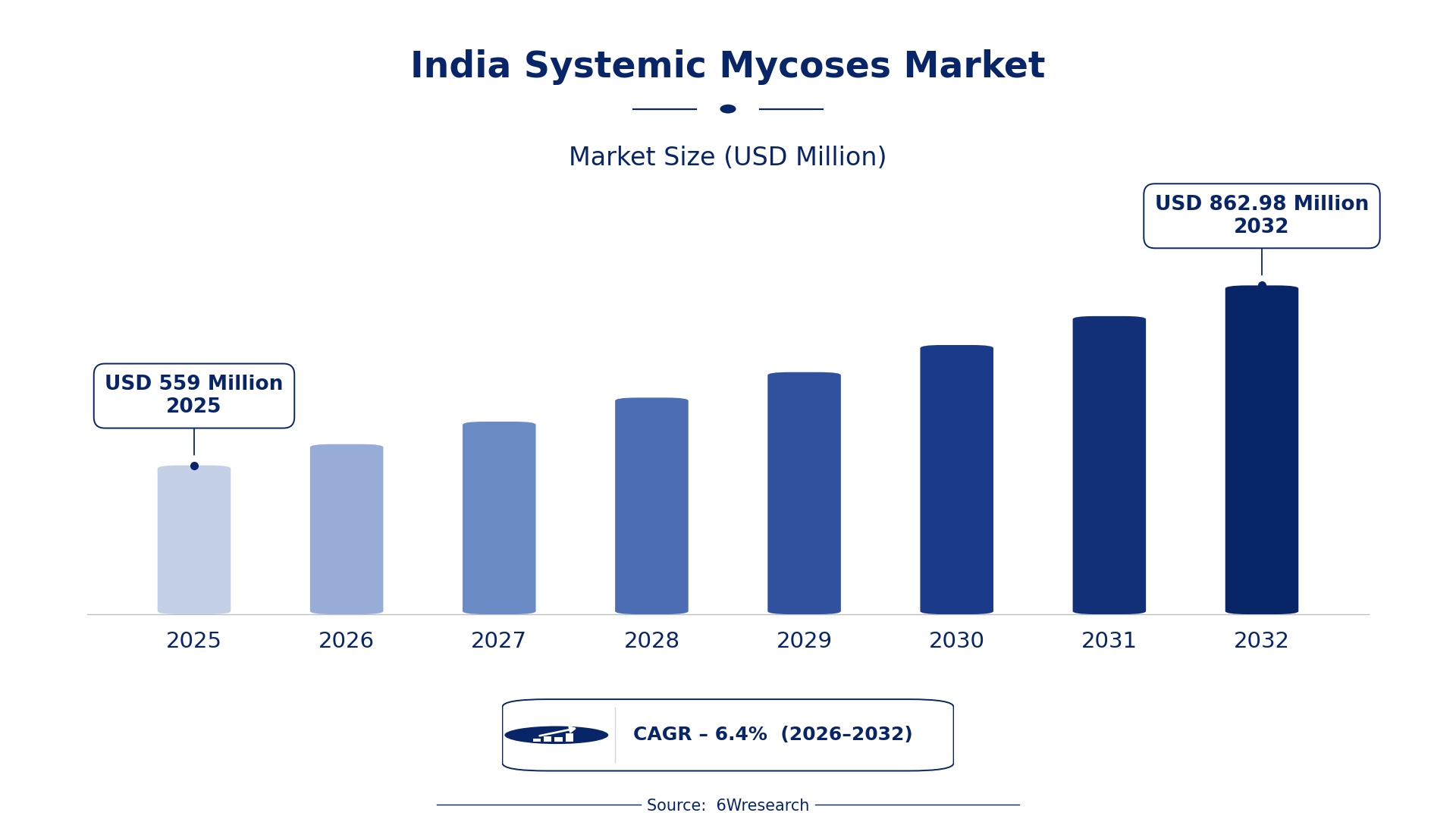
According to 6Wresearch internal database and industry insights, the India Systemic Mycoses Market was valued at USD 559.0 million in 2025 and is projected to reach USD 862.98 million by 2032, growing at a CAGR of approximately 6.4% during 2026–2032.
India Systemic Mycoses Market Highlights
| Report Metric | Details |
| Report Name | India Systemic Mycoses Market |
| Market Size 2025 | USD 559.0 million |
| Market Size 2032 | USD 862.98 million |
| Absolute Growth 2025–2032 | USD 303.98 million |
| CAGR 2026–2032 | 6.4% |
| Peak Annual Growth | 8.3% in 2026 |
| Forecast Period | 2026–2032 |
| Historical Data | 2022–2025 |
| Base Year | 2025 |
| Leading Systemic Mycoses, 2025 | Antifungal Injections (52% share) |
| Leading Product Type, 2025 | Amphotericin B (49% share) |
| Leading Antifungal Type, 2025 | Polyenes (39% share) |
| Leading Distribution Channel, 2025 | Hospital Pharmacies (47% share) |
| Leading End User Industry, 2025 | Infectious Disease Units (35% share) |
| Fastest-Growing Systemic Mycoses | Oral Antifungals (7.5% CAGR) |
| Fastest-Growing Product Type | Itraconazole (9.0% CAGR) |
| Fastest-Growing Antifungal Type | Azoles (7.7% CAGR) |
| Fastest-Growing Distribution Channel | Online Pharmacies (8.2% CAGR) |
| Fastest-Growing End User Industry | Outpatient Clinics (8.5% CAGR) |
| Growing Sector | Infectious Disease Units |
| Key End Users | Hospitals, Clinics, Pharmacies |
India Systemic Mycoses Market Year-wise Growth Rate and Key Drivers (2022–2032)
This graph illustrates the annual growth rates of the market from 2022 to 2032, highlighting a steady upward trajectory and projected market expansion over the forecast period.
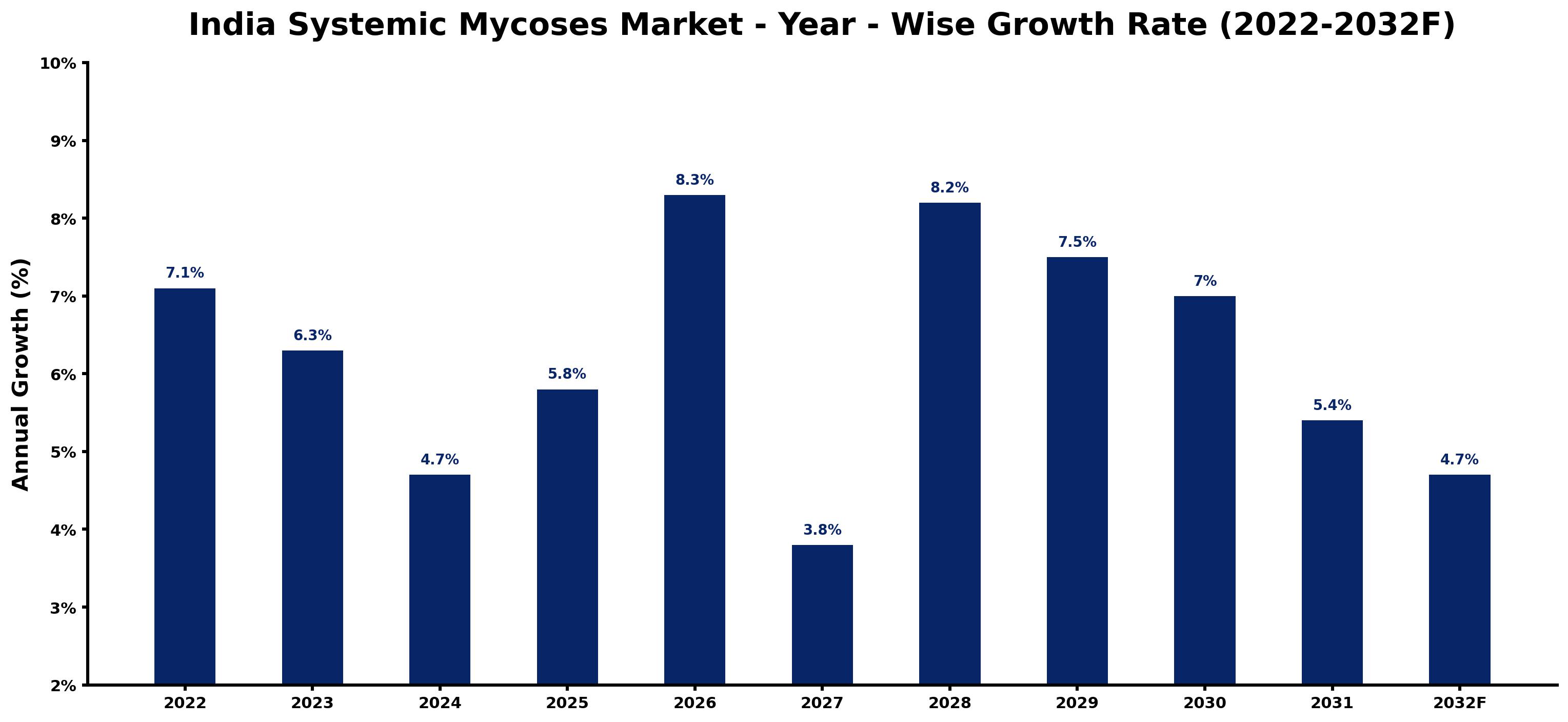
Each row of the following table gives one year's estimated growth and the event or demand shift that explains it.
| Year | Estimated Annual Growth (%) | Market Rationale |
| 2022 | 7.1 | The market experienced strong demand due to rising systemic fungal infections reported by the Indian Council of Medical Research. |
| 2023 | 6.3 | Growth slowed as hospitals adjusted to treatment protocols amid rising infection rates and resource allocation challenges. |
| 2024 | 4.7 | The market continued to slow as healthcare facilities faced capacity constraints in managing infectious diseases. |
| 2025 | 5.8 | Demand increased as healthcare providers expanded antifungal treatment options in response to patient needs. |
| 2026 | 8.3 | A surge in growth is expected due to heightened awareness and the introduction of new antifungal therapies. |
| 2027 | 3.8 | Growth is projected to slow again as the market adjusts to the previous year's rapid expansion and treatment standardisation. |
| 2028 | 8.2 | A resurgence in demand is anticipated driven by the increasing prevalence of systemic mycoses and improved treatment access. |
| 2029 | 7.5 | The market is expected to slow as healthcare providers focus on managing costs while maintaining treatment efficacy. |
| 2030 | 7.0 | Growth will continue to slow as the market stabilises following the rapid changes in treatment protocols and patient management. |
| 2031 | 5.4 | Demand growth is projected to decelerate as healthcare systems adapt to ongoing challenges in infectious disease management. |
| 2032 | 4.7 | The market is expected to slow further as healthcare providers focus on long-term treatment strategies and patient care. |
Note: Market size estimations and growth projections presented in this report are based on 6Wresearch's proprietary forecasting methodology, utilizing the latest available industry data, government publications, and primary research inputs.
India Systemic Mycoses Market Synopsis
Systemic Mycoses in India covers serious fungal infections affecting internal organs, treated with antifungal medications. These infections, primarily caused by fungi like Candida and Aspergillus, require immediate medical attention. The India Systemic Mycoses Market is growing due to a rising patient population and increased healthcare access. The National Health Mission aims to improve treatment availability in rural areas, driving demand for effective antifungal therapies.
Market Dynamics Impact Analysis (2026–2032)
| Factor | Type | Impact | Primary Segment Affected |
| Rising patient population and increased prevalence of systemic fungal infections drive demand for effective treatments. | Driver | High | Antifungal Injections |
| Expansion of healthcare infrastructure improves access to antifungal therapies, encouraging more purchases. | Driver | High | Oral Antifungals |
| Growing demand for specialized antifungal treatments presents opportunities for investment in healthcare facilities. | Opportunity | High | Infectious Disease Units |
| The rise of online pharmacies creates new avenues for distributing antifungal medications to patients. | Opportunity | Medium | Online Pharmacies |
| Limited access to antifungal treatments in rural areas constrains market growth and patient care. | Restraint | High | Combination Therapy |
| Challenges in antifungal drug approval processes may delay the introduction of new treatments. | Restraint | Medium | Pediatric Antifungals |
| High costs associated with antifungal treatments can limit accessibility for patients in need. | Challenge | High | Amphotericin B |
| Resistance to antifungal medications complicates treatment options and affects patient outcomes. | Challenge | Medium | Itraconazole |
Evaluation of Drivers in India Systemic Mycoses Market (2026–2032)
The table below links each growth driver to the segment it affects and the evidence for it.
| Drivers | Primary Segment Affected | Why It Matters (Evidence) |
| Increasing prevalence of systemic fungal infections drives demand for antifungal injections. | Antifungal Injections | India has a population exceeding 1.4 billion, increasing the need for effective treatments. |
| Healthcare providers are expanding access to oral antifungals to treat less severe cases. | Oral Antifungals | The National Health Mission aims to improve healthcare access, including antifungal treatments. |
| Rising awareness of antifungal resistance encourages investment in combination therapies. | Combination Therapy | The Indian Society for Clinical Microbiology promotes awareness and research on antifungal resistance. |
| Growing online pharmacy sales provide patients with easier access to antifungal medications. | Online Pharmacies | Online pharmacies are witnessing a 30% annual growth in antifungal medication sales. |
| Infectious Disease Units are enhancing their services to manage systemic mycoses more effectively. | Infectious Disease Units | Infectious Disease Units in major cities like Mumbai and Delhi are equipped to handle systemic mycoses. |
Expansion of the Systemic Mycoses market in India is backed by rising patient demand, increased healthcare access, and greater awareness of fungal infections. The population exceeding 1.4 billion amplifies the need for antifungal treatments. The Indian Society for Clinical Microbiology actively promotes awareness of antifungal resistance, encouraging investment in combination therapies. Additionally, urban centres are expanding their capabilities to manage systemic mycoses effectively, driving further investment in antifungal therapies.
Evaluation of Restraints in India Systemic Mycoses Market
The main factors holding the market back are set out below.
| Market Restraint | Primary Segment Affected | Why It Matters (Evidence) |
| Limited access to antifungal treatments in rural areas restricts patient care. | Combination Therapy | The National Health Mission's focus on rural healthcare has not yet fully addressed antifungal treatment availability. |
| Delays in antifungal drug approvals hinder timely access to new treatments. | Pediatric Antifungals | The Central Drugs Standard Control Organization oversees the approval process, which can be lengthy. |
| High costs of antifungal treatments can limit patient access and adherence to therapy. | Amphotericin B | Patients in lower-income brackets may struggle to afford necessary treatments. |
| Resistance to antifungal medications complicates treatment protocols and patient outcomes. | Itraconazole | The Indian Society for Clinical Microbiology highlights the growing concern over antifungal resistance. |
| Inadequate training for healthcare professionals on antifungal treatments may lead to suboptimal patient care. | Antifungal Injections | Specialized training programs are still being developed to address this gap. |
India Systemic Mycoses Market Challenges
The India Systemic Mycoses Market still has to solve a few problems, starting with skills shortages among healthcare professionals. Many clinics lack trained staff to effectively diagnose and treat systemic mycoses, which delays patient care and increases mortality rates by up to 20%. Supply chain disruptions hinder the availability of critical antifungal medications, particularly in rural areas, making it difficult for hospitals to provide timely treatment for over 1.4 billion people. Rising costs of antifungal therapies further strain budgets for healthcare providers, forcing them to limit treatment options for patients and impacting recovery rates for those suffering from serious infections.
Trends in the India Systemic Mycoses Market
Buyers and suppliers in the India Systemic Mycoses Market are adjusting to the following trends.
- Shift Towards Online Pharmacies: Online pharmacies have experienced a 30% annual growth in antifungal medication sales, reflecting changing consumer behaviour. This shift enables patients to access treatments more conveniently, particularly in urban areas.
- Emergence of Combination Therapies: The trend towards combination therapies began in 2021, as guidelines recommended improved treatment effectiveness for systemic mycoses. This approach is gaining traction among healthcare providers, leading to better patient outcomes.
- Increased Focus on Pediatric Antifungal Treatments: Pediatric hospitals are increasingly adopting specialised antifungal therapies for children, addressing a critical need in the healthcare system. This shift is expected to enhance treatment efficacy for younger patients.
- Expansion of Infectious Disease Units: Infectious Disease Units are broadening their services to include comprehensive antifungal treatment protocols. This trend is driven by the rising incidence of systemic fungal infections across India.
Investment Opportunities in the India Systemic Mycoses Market
Several openings in the India Systemic Mycoses Market merit attention from investors.
- Investment in Rural Healthcare Facilities: With a population exceeding 1.4 billion, India presents a significant gap in antifungal treatment access. Investing in rural healthcare facilities, particularly in states like Uttar Pradesh, can improve patient outcomes.
- Partnerships with Online Pharmacies: Online pharmacies are growing rapidly, with a 30% annual increase in antifungal medication sales. Collaborating with these platforms can improve distribution and accessibility for patients in urban areas.
- Development of Pediatric Antifungal Therapies: Pediatric hospitals increasingly require specialised antifungal therapies for children. Investing in this area can address a critical market gap and improve treatment outcomes.
- Enhancing Infectious Disease Units: Infectious Disease Units in cities like Mumbai and Delhi are expanding their services. Investing in these facilities can strengthen treatment capabilities for systemic mycoses.
Government Initiatives in the India Systemic Mycoses Market
In 2021, the Ministry of Health and Family Welfare launched the 'National Antimicrobial Resistance Action Plan' to address rising fungal infections. This plan focuses on improving treatment protocols and raising awareness about antifungal resistance. The 'National Health Mission' continues to allocate funds for enhancing healthcare infrastructure, including antifungal treatments, particularly in rural areas. In 2022, the Central Drugs Standard Control Organization updated guidelines for antifungal drug approvals to streamline the process for new treatments, ensuring quicker access to essential medications.
The 'National Health Mission' funds initiatives to improve treatment access for systemic mycoses. The Central Drugs Standard Control Organization oversees the approval of antifungal drugs, ensuring they meet safety and efficacy standards. The 'National Programme for Prevention and Control of Cancer, Diabetes, Cardiovascular Diseases & Stroke' includes provisions for managing fungal infections among high-risk patients, improving treatment protocols. The National Institute of Pharmaceutical Education and Research is conducting research on antifungal resistance patterns, aiming to develop new treatment strategies.
Future Insight of the India Systemic Mycoses Market
The India Systemic Mycoses Market will undergo notable changes by 2032, driven by several key factors. Improved healthcare access initiatives, such as the National Health Mission, will enhance the availability of treatments in rural areas. The updated National Antifungal Guidelines will standardise treatment protocols, ensuring better patient outcomes. Research from the National Institute of Virology will lead to advancements in understanding fungal pathogens, promoting innovation in treatment options. With online pharmacies experiencing a 30% annual growth in antifungal medication sales, patients will benefit from improved access to necessary treatments.
Market Segmentation Analysis
Each segment group is reviewed below, with the leader by share and the fastest grower by CAGR.
By Systemic Mycoses – Antifungal Injections Dominated, Oral Antifungals Expected to Grow Fastest
According to Sumit Sagar, AM at 6Wresearch, in 2025, Antifungal Injections led the systemic mycoses split with a 52% share. Antifungal injections hold the largest share in India due to their critical role in treating severe infections, particularly in tertiary care hospitals. For instance, Amphotericin B is a first-line treatment for cryptococcal meningitis, which is prevalent among HIV patients. Over 2026–2032, Oral Antifungals are expected to post the fastest growth, at a CAGR of 7.5%. The oral antifungals segment is experiencing rapid growth as they are commonly prescribed for less severe cases, making treatment more accessible. The convenience of oral administration is driving demand, particularly in outpatient settings. Suppliers should focus on expanding their oral antifungal offerings to capture the growing demand in outpatient clinics.
By Product Type – Amphotericin B Dominated, Itraconazole Expected to Grow Fastest
Amphotericin B held a 49% share of the India Systemic Mycoses Market by product type in 2025. Amphotericin B holds the largest market share as it is the first-line treatment for severe fungal infections, making it indispensable in hospitals. Its critical role in managing cases of cryptococcal meningitis, especially among HIV patients, reinforces its strong presence in the healthcare system. Itraconazole is set to record the highest CAGR in this split, 9.0% over 2026–2032. Itraconazole is experiencing rapid growth due to its broad application in treating various fungal infections, appealing to a diverse patient demographic. The increasing prevalence of aspergillosis in India is driving more healthcare providers to prescribe this medication, further boosting its market position. Suppliers should focus on ensuring a reliable supply of Itraconazole to meet the growing demand from healthcare professionals.
By Antifungal Type – Polyenes Dominated, Azoles Expected to Grow Fastest
The largest antifungal type category in 2025 was Polyenes, with a 39% share of total revenue. Polyenes hold the largest market share due to their effectiveness against a wide variety of fungi, particularly in critical care settings. Their established role in treating severe infections, such as cryptococcal meningitis, ensures they remain a staple in antifungal therapies. Azoles are projected to grow fastest, at a CAGR of 7.7% during 2026–2032. Azoles are experiencing rapid growth as they are frequently prescribed for systemic infections, appealing to healthcare providers across various settings. Their effectiveness in treating conditions like aspergillosis and lower side effects compared to Polyenes contribute to their rising adoption. Suppliers should focus on promoting Azole-based products to capitalise on their increasing acceptance among healthcare professionals.
By Distribution Channel – Hospital Pharmacies Dominated, Online Pharmacies Expected to Grow Fastest
Hospital Pharmacies took a 47% share of distribution channel in 2025, more than any other category. Hospital pharmacies dominate the market share as they are the primary distribution point for antifungal medications, ensuring patients receive timely treatment. Their essential role within healthcare facilities, particularly in urban areas, reinforces their significance in the antifungal supply chain. The quickest growth will come from Online Pharmacies, forecast to expand at a CAGR of 8.2% between 2026 and 2032. Online pharmacies are growing swiftly, providing convenient access to antifungal medications, especially for patients managing less severe infections. The 30% annual growth in online sales indicates a notable shift towards digital healthcare solutions in the antifungal market. Suppliers should strengthen their online presence to cater to the rising demand for antifungal medications through digital channels.
By End User Industry – Infectious Disease Units Dominated, Outpatient Clinics Expected to Grow Fastest
With a 35% revenue share in 2025, Infectious Disease Units was the largest end user industry category. Infectious disease units lead the market as they provide specialized care for fungal infections, ensuring that patients receive targeted treatment. Their focus on managing complex cases contributes to their dominant market share. Over 2026–2032, Outpatient Clinics are expected to post the fastest growth, at a CAGR of 8.5%. Outpatient clinics are growing quickly as they treat patients with less severe infections, expanding access to antifungal therapies. The increasing patient population seeking treatment in these settings is driving their rapid growth. Suppliers should consider strategies to engage outpatient clinics to tap into the expanding market for antifungal treatments.
Key Attractiveness of the Report
- 10 Years of Market Numbers
- Historical Data Starting from 2022 to 2025
- Base Year 2025
- Forecast Data until 2032
- Key Performance Indicators Impacting the Market
- Major Upcoming Developments and Projects
Key Highlights of the Report:
- India Systemic Mycoses Market Outlook
- Market Size of India Systemic Mycoses Market, 2025
- Forecast of India Systemic Mycoses Market, 2032
- Historical Data and Forecast of India Systemic Mycoses Revenues & Volume for the Period 2022 - 2032F
- India Systemic Mycoses Market Trend Evolution
- India Systemic Mycoses Market Drivers and Challenges
- India Systemic Mycoses Price Trends
- India Systemic Mycoses Porter's Five Forces
- India Systemic Mycoses Industry Life Cycle
- Historical Data and Forecast of India Systemic Mycoses Market Revenues & Volume By Systemic Mycoses for the Period 2022 - 2032F
- Historical Data and Forecast of India Systemic Mycoses Market Revenues & Volume By Antifungal Injections for the Period 2022 - 2032F
- Historical Data and Forecast of India Systemic Mycoses Market Revenues & Volume By Oral Antifungals for the Period 2022 - 2032F
- Historical Data and Forecast of India Systemic Mycoses Market Revenues & Volume By Combination Therapy for the Period 2022 - 2032F
- Historical Data and Forecast of India Systemic Mycoses Market Revenues & Volume By Pediatric Antifungals for the Period 2022 - 2032F
- Historical Data and Forecast of India Systemic Mycoses Market Revenues & Volume By Product Type for the Period 2022 - 2032F
- Historical Data and Forecast of India Systemic Mycoses Market Revenues & Volume By Amphotericin B for the Period 2022 - 2032F
- Historical Data and Forecast of India Systemic Mycoses Market Revenues & Volume By Itraconazole for the Period 2022 - 2032F
- Historical Data and Forecast of India Systemic Mycoses Market Revenues & Volume By Dual Drug Regimen for the Period 2022 - 2032F
- Historical Data and Forecast of India Systemic Mycoses Market Revenues & Volume By Suspension Drugs for the Period 2022 - 2032F
- Historical Data and Forecast of India Systemic Mycoses Market Revenues & Volume By Antifungal Type for the Period 2022 - 2032F
- Historical Data and Forecast of India Systemic Mycoses Market Revenues & Volume By Polyenes for the Period 2022 - 2032F
- Historical Data and Forecast of India Systemic Mycoses Market Revenues & Volume By Azoles for the Period 2022 - 2032F
- Historical Data and Forecast of India Systemic Mycoses Market Revenues & Volume By Echinocandins + Azoles for the Period 2022 - 2032F
- Historical Data and Forecast of India Systemic Mycoses Market Revenues & Volume By Triazoles for the Period 2022 - 2032F
- Historical Data and Forecast of India Systemic Mycoses Market Revenues & Volume By Distribution Channel for the Period 2022 - 2032F
- Historical Data and Forecast of India Systemic Mycoses Market Revenues & Volume By Hospital Pharmacies for the Period 2022 - 2032F
- Historical Data and Forecast of India Systemic Mycoses Market Revenues & Volume By Online Pharmacies for the Period 2022 - 2032F
- Historical Data and Forecast of India Systemic Mycoses Market Revenues & Volume By Specialty Clinics for the Period 2022 - 2032F
- Historical Data and Forecast of India Systemic Mycoses Market Revenues & Volume By Retail Pharmacies for the Period 2022 - 2032F
- Historical Data and Forecast of India Systemic Mycoses Market Revenues & Volume By End User Industry for the Period 2022 - 2032F
- Historical Data and Forecast of India Systemic Mycoses Market Revenues & Volume By Infectious Disease Units for the Period 2022 - 2032F
- Historical Data and Forecast of India Systemic Mycoses Market Revenues & Volume By Outpatient Clinics for the Period 2022 - 2032F
- Historical Data and Forecast of India Systemic Mycoses Market Revenues & Volume By Oncology Hospitals for the Period 2022 - 2032F
- Historical Data and Forecast of India Systemic Mycoses Market Revenues & Volume By Pediatric Hospitals for the Period 2022 - 2032F
- India Systemic Mycoses Import Export Trade Statistics
- Market Opportunity Assessment By Systemic Mycoses
- Market Opportunity Assessment By Product Type
- Market Opportunity Assessment By Antifungal Type
- Market Opportunity Assessment By Distribution Channel
- Market Opportunity Assessment By End User Industry
- India Systemic Mycoses Top Companies Market Share
- India Systemic Mycoses Competitive Benchmarking By Technical and Operational Parameters
- India Systemic Mycoses Company Profiles
- India Systemic Mycoses Key Strategic Recommendations
Market Covered
This report examines the market across the segments below.
By Systemic Mycoses
- Antifungal Injections
- Oral Antifungals
- Combination Therapy
- Pediatric Antifungals
By Product Type
- Amphotericin B
- Itraconazole
- Dual Drug Regimen
- Suspension Drugs
By Antifungal Type
- Polyenes
- Azoles
- Echinocandins + Azoles
- Triazoles
By Distribution Channel
- Hospital Pharmacies
- Online Pharmacies
- Specialty Clinics
- Retail Pharmacies
By End User Industry
- Infectious Disease Units
- Outpatient Clinics
- Oncology Hospitals
- Pediatric Hospitals































