India Tail Stabilizer Market Size & Growth Rate
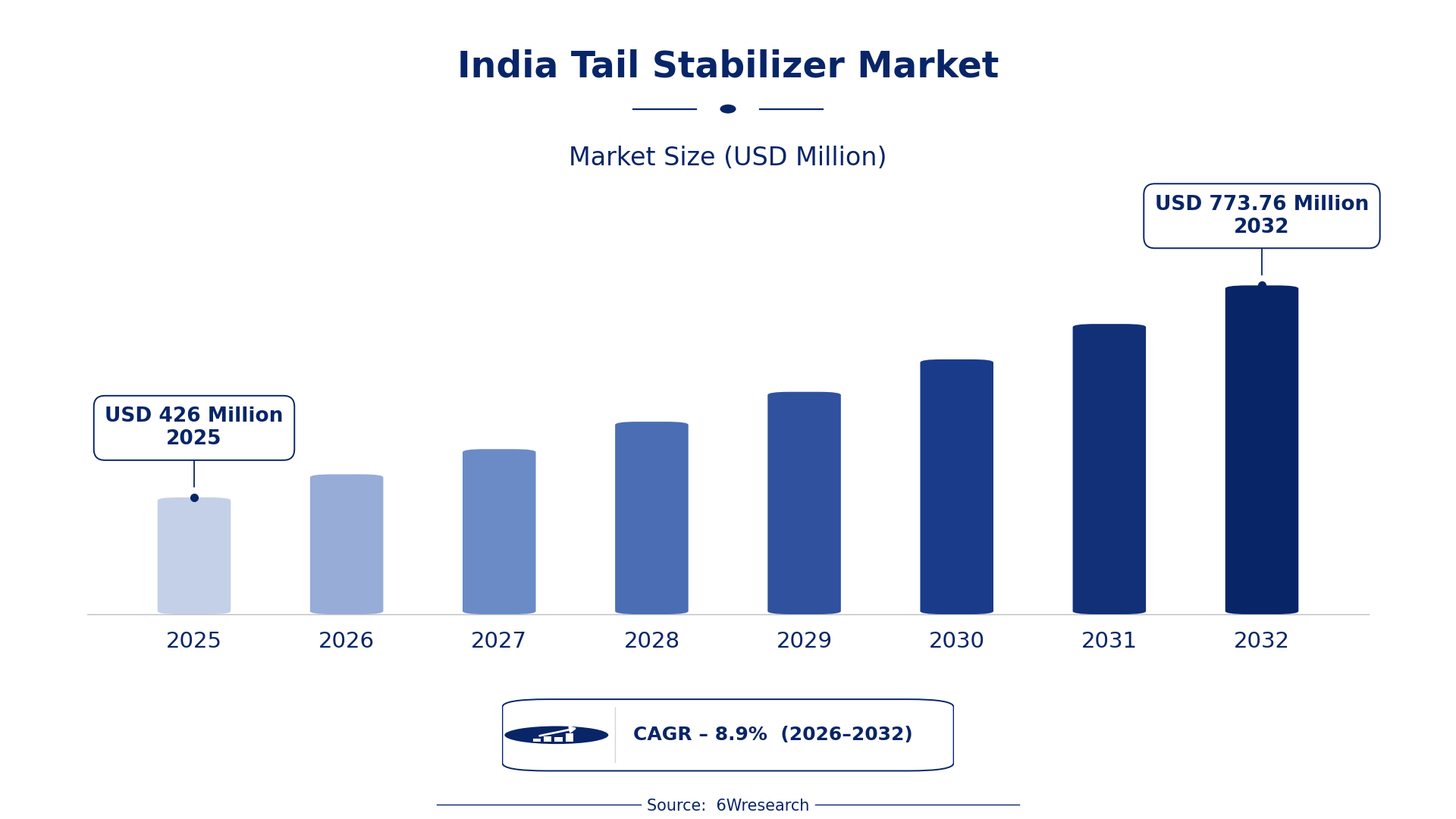
According to 6Wresearch internal database and industry insights, the India Tail Stabilizer Market was valued at USD 426.0 million in 2025 and is projected to reach USD 773.76 million by 2032, growing at a CAGR of approximately 8.9% during 2026–2032.
India Tail Stabilizer Market Highlights
| Report Metric | Details |
| Report Name | India Tail Stabilizer Market |
| Market Size 2025 | USD 426.0 million |
| Market Size 2032 | USD 773.76 million |
| Absolute Growth 2025–2032 | USD 347.76 million |
| CAGR 2026–2032 | 8.9% |
| Peak Annual Growth | 10.4% in 2027 |
| Forecast Period | 2026–2032 |
| Historical Data | 2022–2025 |
| Base Year | 2025 |
| Leading Tail Stabilizer, 2025 | UAV Stabilizers (39% share) |
| Leading Product Type, 2025 | Fixed Fin (41% share) |
| Leading Configuration, 2025 | Composite (40% share) |
| Leading Distribution Channel, 2025 | OEM Sales (53% share) |
| Leading End User Industry, 2025 | Drone Manufacturers (41% share) |
| Fastest-Growing Product Type | Movable Units (10.9% CAGR) |
| Fastest-Growing Configuration | Aluminum (11.5% CAGR) |
| Fastest-Growing Distribution Channel | Defense Suppliers (11.0% CAGR) |
| Fastest-Growing End User Industry | Aircraft OEMs (11.7% CAGR) |
| Growing Sector | UAV Manufacturing |
| Key End Users | Drone Manufacturers, Aircraft OEMs, Aerospace Integrators, Defense Suppliers |
India Tail Stabilizer Market Year-wise Growth Rate and Key Drivers (2022–2032)
This graph illustrates the annual growth rates of the market from 2022 to 2032, highlighting a steady upward trajectory and projected market expansion over the forecast period.
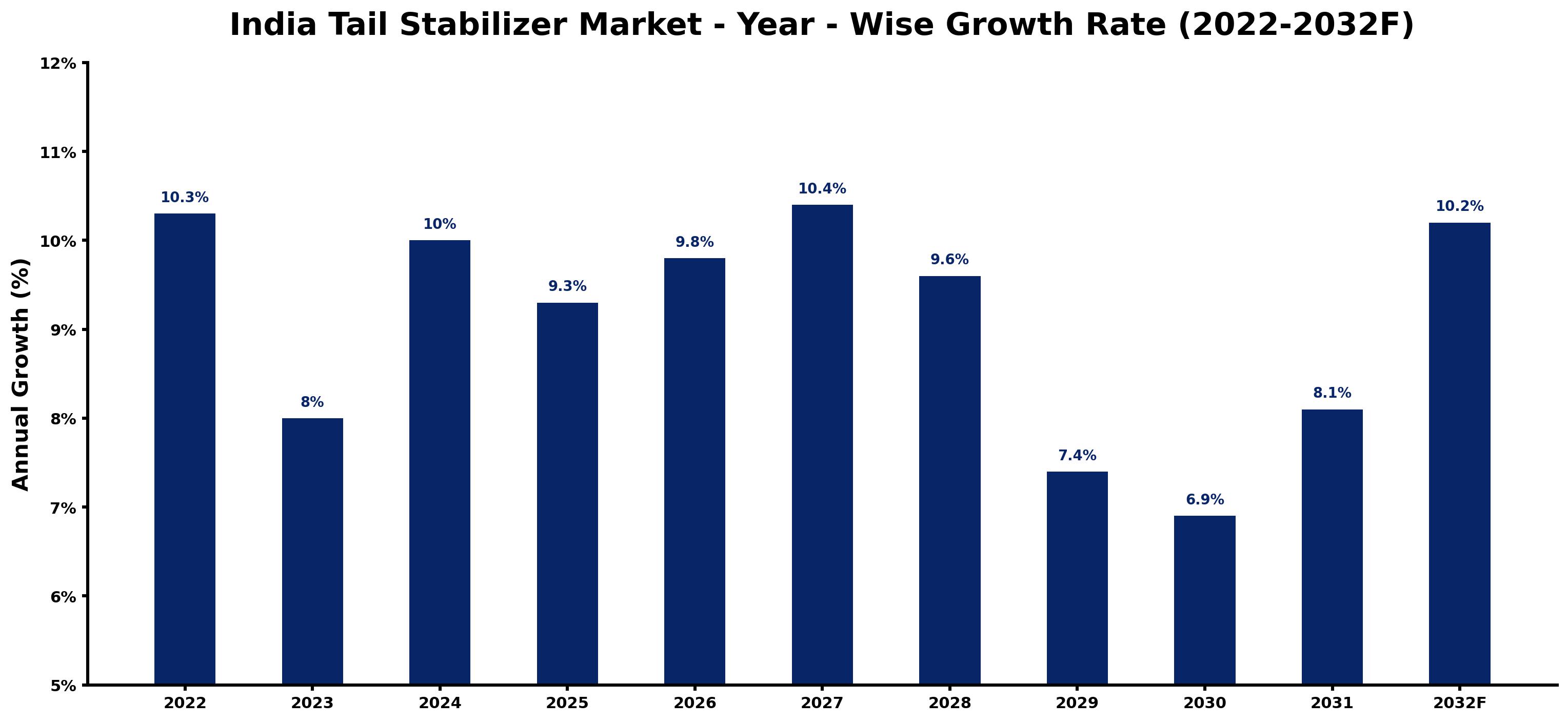
Each row of the following table gives one year's estimated growth and the event or demand shift that explains it.
| Year | Estimated Annual Growth (%) | Market Rationale |
| 2022 | 10.3 | The market experienced strong demand from domestic aircraft manufacturers and defense projects. |
| 2023 | 8.0 | Demand growth slowed as the market adjusted to previous high levels of production. |
| 2024 | 10.0 | Increased demand arose from the rise in drone manufacturing and defense procurement projects. |
| 2025 | 9.3 | Growth continued, supported by ongoing defense initiatives and aerospace projects. |
| 2026 | 9.8 | Investment in domestic manufacturing is expected to accelerate growth in stabilizer demand. |
| 2027 | 10.4 | The market is projected to peak with substantial orders from military and civilian sectors. |
| 2028 | 9.6 | Growth is anticipated to slow as the market stabilizes after peak demand. |
| 2029 | 7.4 | Demand is expected to decrease as competition intensifies in the aerospace sector. |
| 2030 | 6.9 | Growth is projected to slow further as the market adjusts to new production capacities. |
| 2031 | 8.1 | Demand is expected to rebound as new aerospace projects are initiated. |
| 2032 | 10.2 | The market is projected to grow due to increased investments in UAV technology. |
Note: Market size estimations and growth projections presented in this report are based on 6Wresearch's proprietary forecasting methodology, utilizing the latest available industry data, government publications, and primary research inputs.
India Tail Stabilizer Market Synopsis
The Tail Stabilizer in India is a crucial component in aircraft design, ensuring stability and control during flight. These stabilizers, primarily crafted from composite materials or aluminium, play a key role across various aircraft types. The market is expanding due to increasing demand from domestic aircraft manufacturers and major defence projects, with a target of producing 500 drones by 2025. The aerospace sector in India is thriving, propelled by initiatives like the National Aerospace Policy 2022, which aims to elevate domestic manufacturing.
Market Dynamics Impact Analysis (2026–2032)
| Factor | Type | Impact | Primary Segment Affected |
| Rising investments in domestic aerospace manufacturing | Driver | High | UAV Stabilizers |
| Increased demand from drone manufacturers | Driver | High | UAV Stabilizers |
| Growing need for stabilizers in UAV production | Opportunity | High | UAV Stabilizers |
| Expansion of the Bengaluru aerospace cluster | Opportunity | Medium | UAV Stabilizers |
| Challenges in meeting stringent quality standards | Restraint | High | Fixed Fin |
| Limited availability of skilled workforce in aerospace | Restraint | Medium | Horizontal Stabilizer |
| Supply chain disruptions affecting timely deliveries | Challenge | High | UAV Stabilizers |
| Fluctuating raw material prices impacting production costs | Challenge | Medium | UAV Stabilizers |
Evaluation of Drivers in India Tail Stabilizer Market (2026–2032)
Below mentioned are some major drivers and their influence on market dynamics.
| Drivers | Primary Segment Affected | Why It Matters (Evidence) |
| Increased government funding for defense procurement | UAV Stabilizers | The Ministry of Defence allocated ₹1.5 lakh crore for defense procurement in 2023, boosting demand for stabilizers. |
| Growing domestic drone manufacturing | UAV Stabilizers | With over 100 registered drone manufacturers in 2023, demand for stabilizers is surging. |
| Rising investments in the Bengaluru aerospace cluster | UAV Stabilizers | This cluster is attracting substantial investments, enhancing production capabilities for stabilizers. |
| Expansion of the aerospace sector due to policy initiatives | Fixed Fin | The National Aerospace Policy 2022 encourages local production, increasing demand for stabilizers. |
| Technological advancements in aircraft design | Horizontal Stabilizer | The adoption of new materials and designs is leading to higher demand for stabilizers. |
This funding supports the rising domestic drone manufacturing sector, with over 100 registered manufacturers as of 2023. Investments in the Bengaluru aerospace cluster are further boosting production capabilities, driving demand for tail stabilizers. The shift towards advanced materials in aircraft design is creating new opportunities for stabilizer adoption.
Evaluation of Restraints in India Tail Stabilizer Market
The table below lists the restraints and the evidence behind each.
| Market Restraint | Primary Segment Affected | Why It Matters (Evidence) |
| Stringent quality standards for aerospace components | Fixed Fin | Compliance with IS 15664:2006 standard requires substantial investment in testing and certification. |
| Shortage of skilled workforce in the aerospace sector | Horizontal Stabilizer | Limited availability of trained professionals delays production and increases costs. |
| Supply chain disruptions affecting component availability | UAV Stabilizers | Global supply chain issues have led to delays in sourcing essential materials. |
| Fluctuating raw material prices impacting budgets | Composite | Volatility in prices for aluminum and composites affects production costs and margins. |
| Competition from international manufacturers | UAV Stabilizers | Foreign companies often offer lower prices, challenging local producers. |
India Tail Stabilizer Market Challenges
Buyers and suppliers in the India Tail Stabilizer market encounter a skills shortage that hampers production efficiency. This issue arises from a lack of qualified aerospace engineers, leading to project delays that can extend timelines by up to six months for manufacturers. Rising material costs, especially for composites and aluminium, have pushed production expenses up by around 15%, impacting profit margins for suppliers. Compliance with the IS 15664:2006 standard adds complexity, as extensive testing and documentation can delay deliveries by four weeks for buyers. Rapid technological advancements in drone manufacturing necessitate continuous investment, straining smaller producers financially.
Trends in the India Tail Stabilizer Market
The trends below show where the India Tail Stabilizer Market is heading.
- Shift towards UAV Stabilizers: The Indian aerospace sector is increasingly focusing on UAV stabilizers, as indicated by the National Civil Aviation Policy 2016, which encourages advancements in drone technology. As of 2023, there are over 100 registered drone manufacturers, reflecting a growing market.
- Transition from Aluminum to Composite Materials: The use of composite materials in tail stabilizers is on the rise, supported by the Make in India initiative. This shift is expected to improve performance and reduce weight, with composite materials projected to hold a 40% share by 2025.
- Emergence of Defense Suppliers as Key Players: Defense suppliers are becoming significant players in the tail stabilizer market, with an anticipated growth rate of 11.0% from 2026 to 2032. This trend is driven by increased defence procurement and local manufacturing initiatives.
- Focus on Lightweight Designs: There is a growing emphasis on lightweight designs in tail stabilizers, especially for UAV applications. The Bengaluru aerospace cluster is at the forefront of this change, aiming for improved fuel efficiency and performance.
Investment Opportunities in the India Tail Stabilizer Market
The following opportunities in the India Tail Stabilizer Market pair current demand with a clear way in.
- Drone Manufacturers seeking stabilizers: Drone manufacturers are increasingly looking for high-quality stabilizers, with a target of 500 drones to be manufactured by 2025. Suppliers can enter this market by partnering with local manufacturers.
- Bengaluru Aerospace Cluster Expansion: The Bengaluru aerospace cluster is expanding rapidly, with substantial investments in production facilities. This growth creates opportunities for suppliers of tail stabilizers to establish local partnerships.
- Growing demand for lightweight stabilizers: The shift towards lightweight stabilizers presents a valuable opportunity, with a projected growth of 10.0% in UAV stabilizers. Suppliers can focus on composite materials to meet this demand.
- Investment in Defense Procurement: With the Ministry of Defence allocating ₹1.5 lakh crore for procurement, there is a strong demand for stabilizers. Suppliers should consider engaging with defense contractors to secure contracts.
Government Initiatives in the India Tail Stabilizer Market
The Drone Rules 2021, established by the Ministry of Civil Aviation, regulate the manufacturing and use of drones, directly impacting the demand for UAV stabilizers. This regulation ensures that manufacturers adhere to safety and operational standards, creating a reliable market environment. Additionally, the National Aerospace Policy 2022 aims to strengthen domestic manufacturing capabilities, promoting self-reliance in the aerospace sector. This policy targets a substantial increase in local production, which is crucial for tail stabilizer manufacturers. The Atmanirbhar Bharat initiative, launched in 2020, further supports local production efforts, aiming to reduce dependency on imports and boost indigenous capabilities in defence manufacturing.
The Ministry of Defence's Defence Acquisition Procedure 2020 streamlines procurement processes for defence equipment, including aircraft components like tail stabilizers. This procedure simplifies the approval process for manufacturers, facilitating quicker access to government contracts. The Defence Research and Development Organisation is actively involved in funding projects that focus on indigenous aerospace technologies, essential for advancing tail stabilizer production. Furthermore, the Make in India initiative encourages local manufacturers to innovate and produce aerospace components, targeting a substantial increase in domestic output by 2025. This initiative is crucial for creating a competitive environment for tail stabilizer suppliers.
Future Insight of the India Tail Stabilizer Market
By 2032, buyers and suppliers in the India Tail Stabilizer market can anticipate notable advancements driven by government initiatives and industry standards. The National Aerospace Policy 2022 aims to elevate domestic aircraft manufacturing, targeting the production of 500 drones by 2025. The Ministry of Defence's allocation of ₹1.5 lakh crore for defence procurement will enhance funding for cutting-edge aerospace technologies. The Bengaluru aerospace cluster is set to evolve into a key production hub, fostering collaboration between manufacturers and research institutions.
Market Segmentation Analysis
The analysis below covers each segmentation, its leading category in 2025 and its fastest-growing category through 2032.
By Tail Stabilizer – UAV Stabilizers Dominated and Is Expected to Record the Fastest Growth
According to Sumit Sagar, AM at 6Wresearch, UAV Stabilizers held a 39% share of the India Tail Stabilizer Market by tail stabilizer in 2025. UAV stabilizers dominate the Indian tail stabilizer market due to their critical role in ensuring stability for drones manufactured by over 100 registered companies. The government's target of producing 500 drones by 2025 significantly boosts the demand for these essential components. The same category are also set to grow fastest, at a CAGR of 10.0% during 2026–2032. UAV stabilizers are also the fastest-growing segment, propelled by rapid advancements in drone technology and the supportive framework established by the National Civil Aviation Policy 2016. As production increases, UAV stabilizers will continue to widen their market lead. Suppliers should prioritise the development of advanced UAV stabilizers to fully exploit the expanding drone market.
By Product Type – Fixed Fin Dominated, Movable Units Expected to Grow Fastest
Fixed Fin accounted for a 41% market share by product type in 2025. Fixed fins capture the largest market share as they are fundamental to traditional aircraft designs, which are prevalent in India's aerospace sector. Their established presence ensures steady demand from aircraft manufacturers throughout the country. Over 2026–2032, Movable Units are expected to post the fastest growth, at a CAGR of 10.9%. Movable units are the fastest-growing segment, primarily due to their use in specialised aircraft that require enhanced control capabilities. As the industry progresses, the demand for movable units is expected to rise significantly. Buyers should consider integrating movable units to stay aligned with the latest advancements in aircraft technology.
By Configuration – Composite Dominated, Aluminum Expected to Grow Fastest
With a 40% revenue share in 2025, Composite was the largest configuration category. Composite materials lead the market share because of their superior strength-to-weight ratio, making them ideal for aerospace applications. Their widespread utilisation in the Bengaluru aerospace cluster solidifies their dominant position in the market. Aluminum is projected to grow fastest, at a CAGR of 11.5% during 2026–2032. Aluminum is the fastest-growing configuration due to its lightweight properties, appealing to manufacturers focused on improving fuel efficiency. This trend towards lighter materials is likely to enhance aluminum's presence in the market. Suppliers need to focus on developing lightweight solutions in both composite and aluminum materials to meet industry demands.
By Distribution Channel – OEM Sales Dominated, Defense Suppliers Expected to Grow Fastest
OEM Sales took a 53% share of distribution channel in 2025, more than any other category. OEM sales hold the largest market share as the primary channel for aircraft manufacturers, ensuring consistent demand for tail stabilizers. This established distribution method is vital for maintaining strong relationships with leading aircraft producers. Defense Suppliers are set to record the highest CAGR in this split, 11.0% over 2026–2032. Defense suppliers represent the fastest-growing distribution channel, driven by increased military procurement and the Ministry of Defence's substantial budget allocation for defence projects. This trend underscores the rising need for reliable suppliers in the military sector. Suppliers should strengthen partnerships with defense suppliers to capitalise on the increasing military demand for aircraft components.
By End User Industry – Drone Manufacturers Dominated, Aircraft OEMs Expected to Grow Fastest
The largest end user industry category in 2025 was Drone Manufacturers, with a 41% share of total revenue. Drone manufacturers hold the largest share in the tail stabilizer market, reflecting the rapid growth of the UAV sector in India. Their increasing reliance on stabilizers for UAV design underscores the segment's significance in the market. The quickest growth will come from Aircraft OEMs, forecast to expand at a CAGR of 11.7% between 2026 and 2032. Aircraft OEMs represent the fastest-growing end user industry, as they are major users of tail stabilizers in production, driven by the need for advanced aircraft designs. This growth indicates a shift towards more sophisticated aircraft manufacturing. Suppliers should align their strategies to cater to the evolving needs of both drone manufacturers and aircraft OEMs.
Key Attractiveness of the Report
- 10 Years of Market Numbers
- Historical Data Starting from 2022 to 2025
- Base Year 2025
- Forecast Data until 2032
- Key Performance Indicators Impacting the Market
- Major Upcoming Developments and Projects
Key Highlights of the Report:
- India Tail Stabilizer Market Outlook
- Market Size of India Tail Stabilizer Market, 2025
- Forecast of India Tail Stabilizer Market, 2032
- Historical Data and Forecast of India Tail Stabilizer Revenues & Volume for the Period 2022 - 2032F
- India Tail Stabilizer Market Trend Evolution
- India Tail Stabilizer Market Drivers and Challenges
- India Tail Stabilizer Price Trends
- India Tail Stabilizer Porter's Five Forces
- India Tail Stabilizer Industry Life Cycle
- Historical Data and Forecast of India Tail Stabilizer Market Revenues & Volume By Tail Stabilizer for the Period 2022 - 2032F
- Historical Data and Forecast of India Tail Stabilizer Market Revenues & Volume By Vertical Stabilizer for the Period 2022 - 2032F
- Historical Data and Forecast of India Tail Stabilizer Market Revenues & Volume By Horizontal Stabilizer for the Period 2022 - 2032F
- Historical Data and Forecast of India Tail Stabilizer Market Revenues & Volume By Adjustable Stabilizers for the Period 2022 - 2032F
- Historical Data and Forecast of India Tail Stabilizer Market Revenues & Volume By UAV Stabilizers for the Period 2022 - 2032F
- Historical Data and Forecast of India Tail Stabilizer Market Revenues & Volume By Product Type for the Period 2022 - 2032F
- Historical Data and Forecast of India Tail Stabilizer Market Revenues & Volume By Fixed Fin for the Period 2022 - 2032F
- Historical Data and Forecast of India Tail Stabilizer Market Revenues & Volume By Elevator Section for the Period 2022 - 2032F
- Historical Data and Forecast of India Tail Stabilizer Market Revenues & Volume By Movable Units for the Period 2022 - 2032F
- Historical Data and Forecast of India Tail Stabilizer Market Revenues & Volume By Lightweight Fins for the Period 2022 - 2032F
- Historical Data and Forecast of India Tail Stabilizer Market Revenues & Volume By Configuration for the Period 2022 - 2032F
- Historical Data and Forecast of India Tail Stabilizer Market Revenues & Volume By Composite for the Period 2022 - 2032F
- Historical Data and Forecast of India Tail Stabilizer Market Revenues & Volume By Aluminum for the Period 2022 - 2032F
- Historical Data and Forecast of India Tail Stabilizer Market Revenues & Volume By Alloy + CFRP for the Period 2022 - 2032F
- Historical Data and Forecast of India Tail Stabilizer Market Revenues & Volume By Thermoplastics for the Period 2022 - 2032F
- Historical Data and Forecast of India Tail Stabilizer Market Revenues & Volume By Distribution Channel for the Period 2022 - 2032F
- Historical Data and Forecast of India Tail Stabilizer Market Revenues & Volume By OEM Sales for the Period 2022 - 2032F
- Historical Data and Forecast of India Tail Stabilizer Market Revenues & Volume By Direct Sales for the Period 2022 - 2032F
- Historical Data and Forecast of India Tail Stabilizer Market Revenues & Volume By Defense Suppliers for the Period 2022 - 2032F
- Historical Data and Forecast of India Tail Stabilizer Market Revenues & Volume By Online Distributors for the Period 2022 - 2032F
- Historical Data and Forecast of India Tail Stabilizer Market Revenues & Volume By End User Industry for the Period 2022 - 2032F
- Historical Data and Forecast of India Tail Stabilizer Market Revenues & Volume By Aircraft OEMs for the Period 2022 - 2032F
- Historical Data and Forecast of India Tail Stabilizer Market Revenues & Volume By Aerospace Integrators for the Period 2022 - 2032F
- Historical Data and Forecast of India Tail Stabilizer Market Revenues & Volume By Fighter Jets for the Period 2022 - 2032F
- Historical Data and Forecast of India Tail Stabilizer Market Revenues & Volume By Drone Manufacturers for the Period 2022 - 2032F
- India Tail Stabilizer Import Export Trade Statistics
- Market Opportunity Assessment By Tail Stabilizer
- Market Opportunity Assessment By Product Type
- Market Opportunity Assessment By Configuration
- Market Opportunity Assessment By Distribution Channel
- Market Opportunity Assessment By End User Industry
- India Tail Stabilizer Top Companies Market Share
- India Tail Stabilizer Competitive Benchmarking By Technical and Operational Parameters
- India Tail Stabilizer Company Profiles
- India Tail Stabilizer Key Strategic Recommendations
Market Covered
Segments analysed in this report are listed below.
By Tail Stabilizer
- Vertical Stabilizer
- Horizontal Stabilizer
- Adjustable Stabilizers
- UAV Stabilizers
By Product Type
- Fixed Fin
- Elevator Section
- Movable Units
- Lightweight Fins
By Configuration
- Composite
- Aluminum
- Alloy + CFRP
- Thermoplastics
By Distribution Channel
- OEM Sales
- Direct Sales
- Defense Suppliers
- Online Distributors
By End User Industry
- Aircraft OEMs
- Aerospace Integrators
- Fighter Jets
- Drone Manufacturers































