China Tail Stabilizer Market Size & Growth Rate
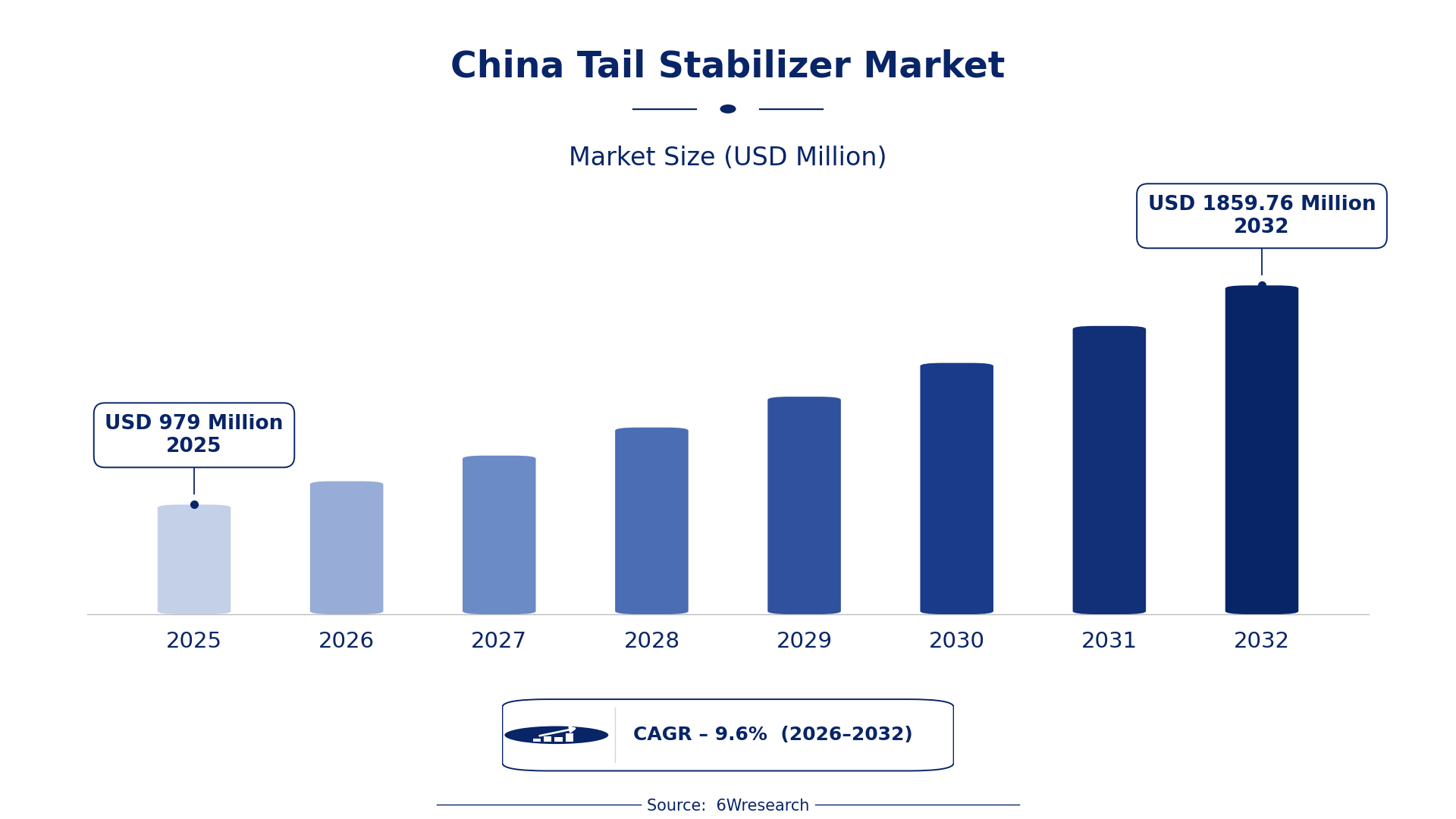
According to 6Wresearch internal database and industry insights, the China Tail Stabilizer Market was valued at USD 979.0 million in 2025 and is projected to reach USD 1,859.76 million by 2032, growing at a CAGR of approximately 9.6% during 2026–2032.
China Tail Stabilizer Market Highlights
| Report Metric | Details |
| Report Name | China Tail Stabilizer Market |
| Market Size 2025 | USD 979.0 million |
| Market Size 2032 | USD 1,859.76 million |
| Absolute Growth 2025–2032 | USD 880.76 million |
| CAGR 2026–2032 | 9.6% |
| Peak Annual Growth | 12.0% in 2032 |
| Forecast Period | 2026–2032 |
| Historical Data | 2022–2025 |
| Base Year | 2025 |
| Leading Tail Stabilizer, 2025 | UAV Stabilizers (34% share) |
| Leading Product Type, 2025 | Fixed Fin (45% share) |
| Leading Configuration, 2025 | Composite (46% share) |
| Leading Distribution Channel, 2025 | OEM Sales (45% share) |
| Leading End User Industry, 2025 | Drone Manufacturers (34% share) |
| Fastest-Growing Product Type | Movable Units (11.5% CAGR) |
| Fastest-Growing Configuration | Alloy + CFRP (10.6% CAGR) |
| Fastest-Growing Distribution Channel | Online Distributors (12.1% CAGR) |
| Fastest-Growing End User Industry | Aircraft OEMs (11.8% CAGR) |
| Growing Sector | UAV Manufacturing |
| Key End Users | Aircraft OEMs, Drone Manufacturers, Aerospace Integrators |
China Tail Stabilizer Market Year-wise Growth Rate and Key Drivers (2022–2032)
This graph illustrates the annual growth rates of the market from 2022 to 2032, highlighting a steady upward trajectory and projected market expansion over the forecast period.
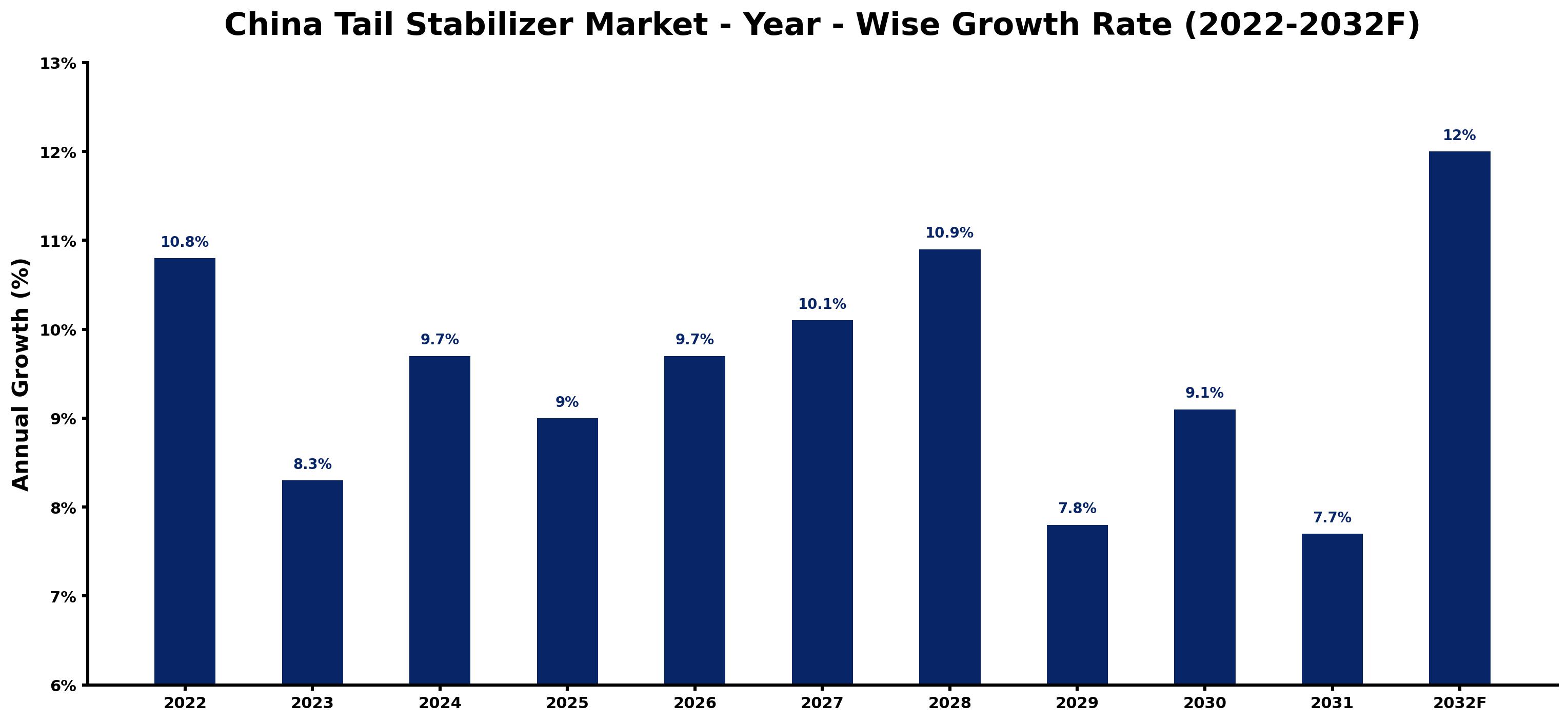
Each row of the following table gives one year's estimated growth and the event or demand shift that explains it.
| Year | Estimated Annual Growth (%) | Market Rationale |
| 2022 | 10.8 | The market experienced strong demand from domestic manufacturers and exports. |
| 2023 | 8.3 | Growth slowed due to a temporary reduction in military aircraft production. |
| 2024 | 9.7 | Increased investment in UAV technology spurred faster growth this year. |
| 2025 | 9.0 | Demand from commercial aircraft manufacturers moderated growth compared to last year. |
| 2026 | 9.7 | A surge in military applications is expected to drive demand higher. |
| 2027 | 10.1 | Continued growth in UAV production supports a rising demand for stabilizers. |
| 2028 | 10.9 | Technological advancements in aerospace manufacturing enhance market performance. |
| 2029 | 7.8 | Growth slowed as the market adjusts to increased production capacities. |
| 2030 | 9.1 | Rising air traffic is projected to boost demand for new aircraft. |
| 2031 | 7.7 | A slowdown in growth is anticipated as production stabilizes. |
| 2032 | 12.0 | The market is expected to peak due to significant investments in aerospace. |
Note: Market size estimations and growth projections presented in this report are based on 6Wresearch's proprietary forecasting methodology, utilizing the latest available industry data, government publications, and primary research inputs.
China Tail Stabilizer Market Synopsis
The Tail Stabilizer Market in China encompasses aerodynamic surfaces vital for aircraft stability and control. These stabilizers are primarily made from aluminum, composites, or thermoplastics. The market is expanding as China's aerospace industry is projected to reach $1 trillion by 2035, driven by domestic manufacturers and military applications. The 'Made in China 2025' initiative is fostering innovation and investment in high-tech industries, further propelling demand for tail stabilizers. As the UAV market grows, demand for stabilizers tailored for drones is also increasing.
Market Dynamics Impact Analysis (2026–2032)
| Factor | Type | Impact | Primary Segment Affected |
| Rising demand for UAV applications is driving the need for stabilizers. | Driver | High | UAV Stabilizers |
| Increased production of commercial aircraft enhances the demand for stabilizers. | Driver | High | Fixed Fin |
| The growing UAV market presents opportunities for suppliers of stabilizers. | Opportunity | High | UAV Stabilizers |
| Investment in military aircraft modernization creates a demand for advanced stabilizers. | Opportunity | High | Vertical Stabilizer |
| Regulatory compliance can slow down the approval process for new stabilizer designs. | Restraint | Medium | Horizontal Stabilizer |
| High production costs for advanced materials limit market growth potential. | Restraint | Medium | Composite |
| Supply chain disruptions can delay stabilizer production timelines. | Challenge | High | Movable Units |
| Technological advancements require continuous investment, impacting smaller manufacturers. | Challenge | Medium | Elevator Section |
Evaluation of Drivers in China Tail Stabilizer Market (2026–2032)
The main growth drivers and the segments they affect most are set out below.
| Drivers | Primary Segment Affected | Why It Matters (Evidence) |
| Increased UAV production drives demand for stabilizers. | UAV Stabilizers | China's UAV market is expected to grow at a rate of 10.9%, leading to higher stabilizer purchases from manufacturers. |
| Rising air traffic fuels the need for new aircraft. | Fixed Fin | China's air traffic is projected to double by 2035, increasing demand for stabilizers significantly. |
| Military modernization initiatives boost stabilizer demand. | Vertical Stabilizer | The National Development and Reform Commission supports military aircraft upgrades, raising stabilizer purchases by increasing production. |
| Investment in aerospace innovation improves stabilizer production capabilities. | Composite | The 'Aerospace Industry Development Plan' aims to bolster domestic production capabilities by 2030, enhancing overall market capacity. |
| Growing commercial aircraft production increases stabilizer requirements. | Horizontal Stabilizer | China produced over 300 commercial aircraft in 2022, driving stabilizer demand from aircraft manufacturers. |
The Tail Stabilizer market in China is expanding as end-use demand from UAV manufacturers, military modernization, and rising air traffic drive growth. The UAV market is expected to grow significantly, leading to increased stabilizer purchases from manufacturers. China’s air traffic is projected to double by 2035, pushing demand for new aircraft and their components. Investment in aerospace innovation is improving production capabilities, allowing manufacturers to meet rising requirements effectively.
Evaluation of Restraints in China Tail Stabilizer Market
The key brakes on demand, and where they bite hardest, are shown below.
| Market Restraint | Primary Segment Affected | Why It Matters (Evidence) |
| Regulatory compliance delays new stabilizer designs. | Horizontal Stabilizer | The Civil Aviation Administration of China sets stringent standards that can slow approval processes, impacting time-to-market by several months. |
| High production costs limit market growth potential. | Composite | Advanced materials like CFRP are expensive, affecting profit margins for manufacturers and increasing prices for buyers by around 15%. |
| Supply chain disruptions impact stabilizer production timelines. | Movable Units | Global supply chain issues have caused delays in sourcing essential materials, complicating production schedules by increasing lead times by 20%. |
| Limited access to advanced manufacturing technologies hinders competitiveness. | Elevator Section | Smaller manufacturers struggle to invest in the latest technologies, affecting their market position and growth potential significantly. |
| Market saturation in traditional stabilizer types restricts growth. | Fixed Fin | The established market for fixed fins limits opportunities for new entrants and innovation, constraining overall market expansion. |
China Tail Stabilizer Market Challenges
Producers in the China tail stabilizer market are navigating stringent regulations from the Civil Aviation Administration, which can delay product approvals by up to six months, hindering timely market entry. Rising material costs, particularly for aluminium and composites, have raised production expenses by about 15%, prompting buyers to reconsider their sourcing strategies. Supply chain disruptions in key aerospace manufacturing regions like Shandong and Sichuan have resulted in a 20% increase in lead times, complicating logistics for manufacturers. Additionally, rapid technological advancements necessitate that firms allocate at least 10% of their budgets to R&D, straining financial resources for many producers.
Trends in the China Tail Stabilizer Market
The trends below show where the China Tail Stabilizer Market is heading.
- Shift Towards Advanced UAV Stabilizers: The 'Aerospace Technology Promotion Program' initiated in 2023 is driving innovation in UAV stabilizers, with a projected growth rate of 10.9% for this segment. This trend is significant for manufacturers looking to capture the expanding UAV market.
- Increased Focus on Composite Materials: Drone manufacturers are increasingly adopting composite materials for stabilizers, improving performance and reducing weight. This shift is reflected in the 46% market share of composite stabilizers, indicating a strong preference for advanced materials.
- Growth in Military UAV Applications: The Chinese military's focus on UAV technology has led to a surge in demand for stabilizers designed for drones. This market segment is anticipated to grow rapidly, reflecting the military's strategic investments in aerial capabilities.
- Regulatory Updates Driving Innovation: The Civil Aviation Administration of China's updated standards in 2021 are pushing manufacturers to innovate stabilizer designs. Compliance with these standards is essential for maintaining market relevance and ensuring safety.
Investment Opportunities in the China Tail Stabilizer Market
The following opportunities in the China Tail Stabilizer Market pair current demand with a clear way in.
- Market Gap for Lightweight Stabilizers: With China's aerospace industry projected to reach $1 trillion by 2035, there is a gap for lightweight stabilizers. Manufacturers can target aircraft OEMs needing efficient designs to improve fuel economy and performance.
- Investment in Aerospace Hubs: China's 40+ aerospace manufacturing hubs, particularly in Shandong and Sichuan, present opportunities for local partnerships. Collaborating with these hubs can facilitate market entry and improve production capabilities for stabilizers.
- Supply of Advanced Composite Materials: The demand for advanced composite materials in stabilizer production is growing. Suppliers can enter the market by partnering with aerospace integrators to provide high-quality materials that meet industry standards and specifications.
- Expansion of Online Distribution Channels: The rise of online distributors, projected to grow at 12.1%, offers a lucrative opportunity for manufacturers. Establishing a strong online presence can help reach a broader customer base effectively.
Government Initiatives in the China Tail Stabilizer Market
The updated 'Aerospace Manufacturing Standards' by the Civil Aviation Administration of China in 2021 align with international regulations and enhance safety. This measure mandates that manufacturers comply with stricter guidelines, ensuring higher quality and reliability in stabilizer production. Additionally, the 'National Aerospace Technology Innovation Action Plan' approved by the National Development and Reform Commission in 2021 aims to increase R&D investment by 15% annually until 2025. This plan promotes innovation in stabilizer design and production processes, boosting competitiveness in the market. The 'Aerospace Industry Development Plan' launched by the Ministry of Industry and Information Technology in 2022 focuses on enhancing domestic production capabilities and innovation by 2030, providing a framework for growth in the sector.
In 2023, the Ministry of Science and Technology initiated the 'Aerospace Technology Promotion Program' with a budget of $500 million to support startups in the sector. This program aims to enhance technological capabilities and encourage new entrants in the aerospace industry. Furthermore, the 'Defense Industry Modernization Strategy' introduced by the State Administration for Science, Technology and Industry for National Defense in 2020 aims to improve technological capabilities in military aviation, providing funding and resources for manufacturers to advance their stabilizer offerings. These initiatives are designed to support the growth of the aerospace sector.
Future Insight of the China Tail Stabilizer Market
The China tail stabilizer market is set for substantial growth by 2032, driven by the government's 'Made in China 2025' initiative, which prioritises high-tech manufacturing. The aerospace industry is projected to reach $1 trillion by 2035, creating considerable opportunities for suppliers and buyers. A doubling of air traffic will necessitate the production of new aircraft, directly increasing demand for tail stabilizers. Furthermore, advancements in manufacturing technologies, promoted by the Ministry of Industry and Information Technology, will streamline production processes and enhance product quality.
Market Segmentation Analysis
The report offers a comprehensive study of the following market segments and their leading categories in the market.
By Tail Stabilizer – UAV Stabilizers Dominated and Is Expected to Record the Fastest Growth
According to Sumit Sagar, AM at 6Wresearch, UAV Stabilizers held a 34% share of the China Tail Stabilizer Market by tail stabilizer in 2025. UAV stabilizers dominate the market share as they are essential for unmanned aerial vehicles, which are increasingly utilised in both military and commercial applications. The growing production of UAVs for surveillance and reconnaissance missions highlights their critical role in the aerospace sector. The same category are also set to grow fastest, at a CAGR of 10.9% during 2026–2032. UAV stabilizers are poised for rapid growth, particularly in military applications where performance is crucial. As the UAV sector in China is expected to expand significantly, the demand for these stabilizers will likely increase, further solidifying their market position. Suppliers should focus on UAV stabilizers to effectively address the surging demand in the aerospace industry.
By Product Type – Fixed Fin Dominated, Movable Units Expected to Grow Fastest
With a 45% revenue share in 2025, Fixed Fin was the largest product type category. Fixed fins lead the market share due to their fundamental role in traditional aircraft designs, providing the stability and control that manufacturers rely on. Their established presence in the aerospace industry ensures consistent demand from aircraft producers. Movable Units are set to record the highest CAGR in this split, 11.5% over 2026–2032. Movable units are experiencing the fastest growth as they offer enhanced control across various flight conditions, making them increasingly desirable for manufacturers. As aircraft designs evolve, the demand for movable units is expected to rise, driving their market expansion. Buyers should explore the integration of movable units to optimise aircraft performance and align with industry advancements.
By Configuration – Composite Dominated, Alloy + CFRP Expected to Grow Fastest
Composite took a 46% share of configuration in 2025, more than any other category. Composite materials hold the largest share in the configuration segment, prized for their exceptional strength-to-weight ratio, making them ideal for modern aircraft designs. Their widespread application in the aerospace sector underscores the preference for lightweight yet durable components. Alloy + CFRP is projected to grow fastest, at a CAGR of 10.6% during 2026–2032. The combination of alloy and CFRP is rapidly gaining traction as it merges the advantages of both metals and composites, appealing to manufacturers seeking optimal performance. This trend indicates a shift towards advanced materials that enhance aircraft efficiency and durability. Suppliers must adapt to the increasing demand for alloy and CFRP configurations to remain competitive in the aerospace market.
By Distribution Channel – OEM Sales Dominated, Online Distributors Expected to Grow Fastest
In 2025, OEM Sales led the distribution channel split with a 45% share. OEM sales represent the leading distribution channel, crucial for aircraft manufacturers requiring stabilizers for new aircraft production. This well-established channel guarantees a steady flow of orders from key players in the aerospace sector. The quickest growth will come from Online Distributors, forecast to expand at a CAGR of 12.1% between 2026 and 2032. Online distributors are emerging as the fastest-growing channel, catering to aftermarket sales as more buyers seek convenience and accessibility. This trend highlights the need for suppliers to bolster their online presence to capture this expanding market segment. Suppliers should invest in online distribution strategies to widen their reach and adapt to shifting purchasing behaviours.
By End User Industry – Drone Manufacturers Dominated, Aircraft OEMs Expected to Grow Fastest
The largest end user industry category in 2025 was Drone Manufacturers, with a 34% share of total revenue. Drone manufacturers account for the largest share of the end user segment, driven by the rapid growth of UAV applications across various industries. Their increasing reliance on stabilizers for performance and safety reinforces their dominant position in the market. Over 2026–2032, Aircraft OEMs are expected to post the fastest growth, at a CAGR of 11.8%. Aircraft OEMs are experiencing the fastest growth as they ramp up production to meet the rising demand for new aircraft, particularly in response to increasing air traffic. This trend suggests a strong future for stabilizer suppliers targeting the OEM market. Suppliers should strengthen partnerships with aircraft OEMs to capitalise on the growing demand for stabilizers in new aircraft production.
Key Attractiveness of the Report
- 10 Years of Market Numbers
- Historical Data Starting from 2022 to 2025
- Base Year 2025
- Forecast Data until 2032
- Key Performance Indicators Impacting the Market
- Major Upcoming Developments and Projects
Key Highlights of the Report:
- China Tail Stabilizer Market Outlook
- Market Size of China Tail Stabilizer Market, 2025
- Forecast of China Tail Stabilizer Market, 2032
- Historical Data and Forecast of China Tail Stabilizer Revenues & Volume for the Period 2022 - 2032F
- China Tail Stabilizer Market Trend Evolution
- China Tail Stabilizer Market Drivers and Challenges
- China Tail Stabilizer Price Trends
- China Tail Stabilizer Porter's Five Forces
- China Tail Stabilizer Industry Life Cycle
- Historical Data and Forecast of China Tail Stabilizer Market Revenues & Volume By Tail Stabilizer for the Period 2022 - 2032F
- Historical Data and Forecast of China Tail Stabilizer Market Revenues & Volume By Vertical Stabilizer for the Period 2022 - 2032F
- Historical Data and Forecast of China Tail Stabilizer Market Revenues & Volume By Horizontal Stabilizer for the Period 2022 - 2032F
- Historical Data and Forecast of China Tail Stabilizer Market Revenues & Volume By Adjustable Stabilizers for the Period 2022 - 2032F
- Historical Data and Forecast of China Tail Stabilizer Market Revenues & Volume By UAV Stabilizers for the Period 2022 - 2032F
- Historical Data and Forecast of China Tail Stabilizer Market Revenues & Volume By Product Type for the Period 2022 - 2032F
- Historical Data and Forecast of China Tail Stabilizer Market Revenues & Volume By Fixed Fin for the Period 2022 - 2032F
- Historical Data and Forecast of China Tail Stabilizer Market Revenues & Volume By Elevator Section for the Period 2022 - 2032F
- Historical Data and Forecast of China Tail Stabilizer Market Revenues & Volume By Movable Units for the Period 2022 - 2032F
- Historical Data and Forecast of China Tail Stabilizer Market Revenues & Volume By Lightweight Fins for the Period 2022 - 2032F
- Historical Data and Forecast of China Tail Stabilizer Market Revenues & Volume By Configuration for the Period 2022 - 2032F
- Historical Data and Forecast of China Tail Stabilizer Market Revenues & Volume By Composite for the Period 2022 - 2032F
- Historical Data and Forecast of China Tail Stabilizer Market Revenues & Volume By Aluminum for the Period 2022 - 2032F
- Historical Data and Forecast of China Tail Stabilizer Market Revenues & Volume By Alloy + CFRP for the Period 2022 - 2032F
- Historical Data and Forecast of China Tail Stabilizer Market Revenues & Volume By Thermoplastics for the Period 2022 - 2032F
- Historical Data and Forecast of China Tail Stabilizer Market Revenues & Volume By Distribution Channel for the Period 2022 - 2032F
- Historical Data and Forecast of China Tail Stabilizer Market Revenues & Volume By OEM Sales for the Period 2022 - 2032F
- Historical Data and Forecast of China Tail Stabilizer Market Revenues & Volume By Direct Sales for the Period 2022 - 2032F
- Historical Data and Forecast of China Tail Stabilizer Market Revenues & Volume By Defense Suppliers for the Period 2022 - 2032F
- Historical Data and Forecast of China Tail Stabilizer Market Revenues & Volume By Online Distributors for the Period 2022 - 2032F
- Historical Data and Forecast of China Tail Stabilizer Market Revenues & Volume By End User Industry for the Period 2022 - 2032F
- Historical Data and Forecast of China Tail Stabilizer Market Revenues & Volume By Aircraft OEMs for the Period 2022 - 2032F
- Historical Data and Forecast of China Tail Stabilizer Market Revenues & Volume By Aerospace Integrators for the Period 2022 - 2032F
- Historical Data and Forecast of China Tail Stabilizer Market Revenues & Volume By Fighter Jets for the Period 2022 - 2032F
- Historical Data and Forecast of China Tail Stabilizer Market Revenues & Volume By Drone Manufacturers for the Period 2022 - 2032F
- China Tail Stabilizer Import Export Trade Statistics
- Market Opportunity Assessment By Tail Stabilizer
- Market Opportunity Assessment By Product Type
- Market Opportunity Assessment By Configuration
- Market Opportunity Assessment By Distribution Channel
- Market Opportunity Assessment By End User Industry
- China Tail Stabilizer Top Companies Market Share
- China Tail Stabilizer Competitive Benchmarking By Technical and Operational Parameters
- China Tail Stabilizer Company Profiles
- China Tail Stabilizer Key Strategic Recommendations
Market Covered
The report offers an extensive study of the following market segments.
By Tail Stabilizer
- Vertical Stabilizer
- Horizontal Stabilizer
- Adjustable Stabilizers
- UAV Stabilizers
By Product Type
- Fixed Fin
- Elevator Section
- Movable Units
- Lightweight Fins
By Configuration
- Composite
- Aluminum
- Alloy + CFRP
- Thermoplastics
By Distribution Channel
- OEM Sales
- Direct Sales
- Defense Suppliers
- Online Distributors
By End User Industry
- Aircraft OEMs
- Aerospace Integrators
- Fighter Jets
- Drone Manufacturers































