India Target Acquisition Radar Market Size & Growth Rate
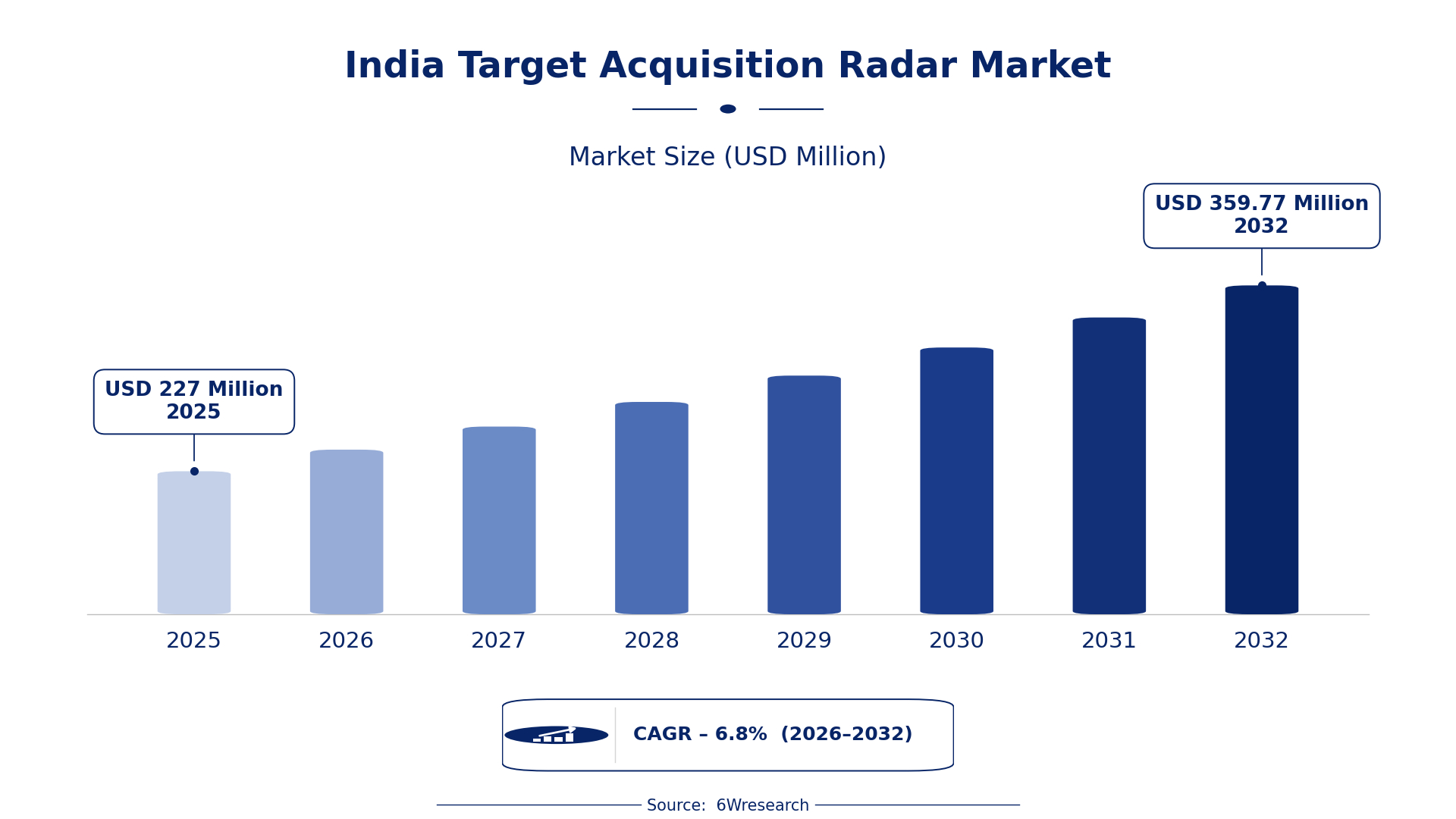
According to 6Wresearch internal database and industry insights, the India Target Acquisition Radar Market was valued at USD 227.0 million in 2025 and is projected to reach USD 359.77 million by 2032, growing at a CAGR of approximately 6.8% during 2026–2032.
India Target Acquisition Radar Market Highlights
| Report Metric | Details |
| Report Name | India Target Acquisition Radar Market |
| Market Size 2025 | USD 227.0 million |
| Market Size 2032 | USD 359.77 million |
| Absolute Growth 2025–2032 | USD 132.77 million |
| CAGR 2026–2032 | 6.8% |
| Peak Annual Growth | 9.3% in 2028 |
| Forecast Period | 2026–2032 |
| Historical Data | 2022–2025 |
| Base Year | 2025 |
| Leading Target Acquisition Radar, 2025 | Fire-Control Radar (44% share) |
| Leading Product Type, 2025 | Tracking Systems (46% share) |
| Leading Radar Band, 2025 | X-Band (45% share) |
| Leading Distribution Channel, 2025 | Government Contracts (52% share) |
| Leading End User Industry, 2025 | Missile Systems (47% share) |
| Fastest-Growing Target Acquisition Radar | Mobile Radar Units (9.3% CAGR) |
| Fastest-Growing Radar Band | L-Band (9.2% CAGR) |
| Fastest-Growing Distribution Channel | OEMs (8.2% CAGR) |
| Fastest-Growing End User Industry | Tactical Drones (8.1% CAGR) |
| Growing Sector | Military Applications |
| Key End Users | Indian Armed Forces, Indian Navy, Indian Air Force, Defense Contractors |
India Target Acquisition Radar Market Year-wise Growth Rate and Key Drivers (2022–2032)
This graph illustrates the annual growth rates of the market from 2022 to 2032, highlighting a steady upward trajectory and projected market expansion over the forecast period.
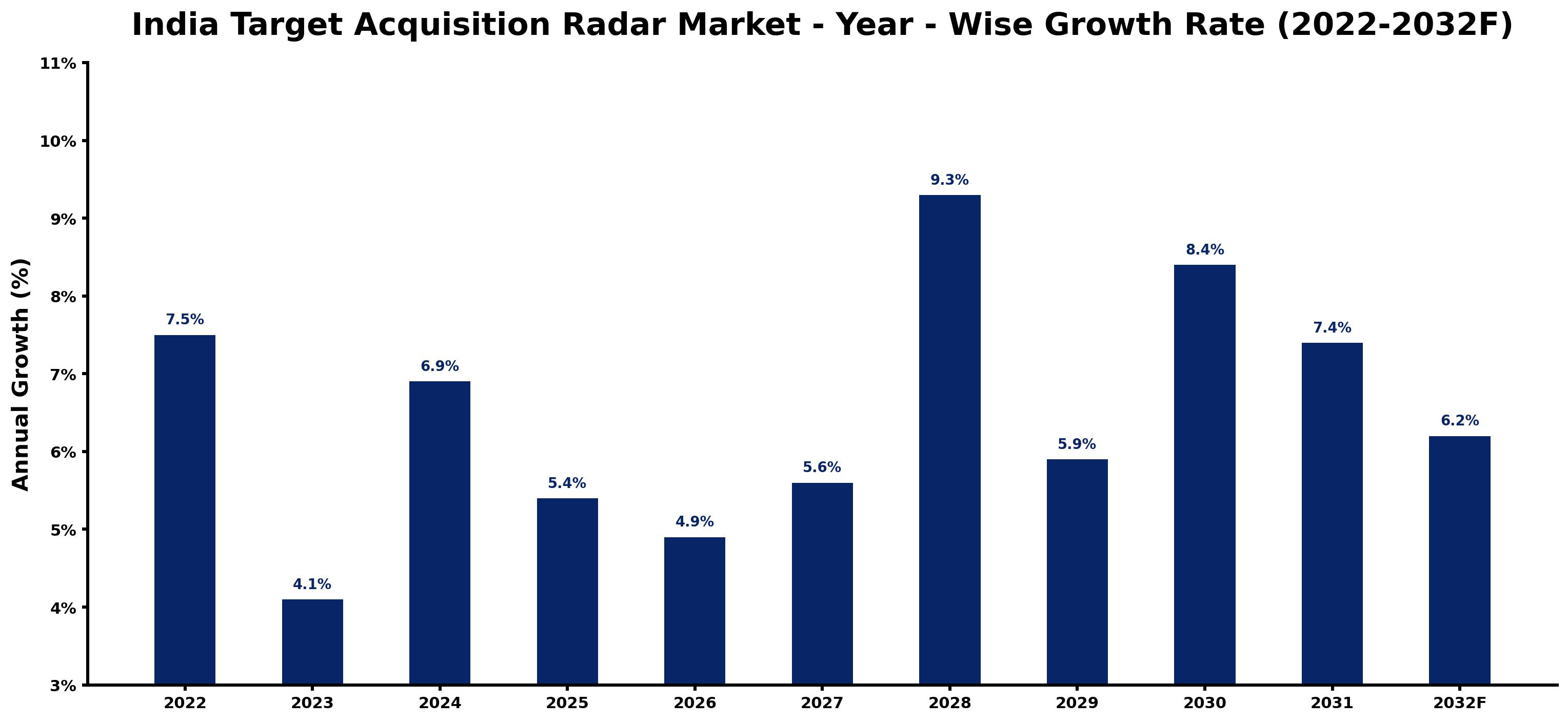
Each row of the following table gives one year's estimated growth and the event or demand shift that explains it.
| Year | Estimated Annual Growth (%) | Market Rationale |
| 2022 | 7.5 | The Indian defense sector showed strong demand for radar systems due to increased military spending. |
| 2023 | 4.1 | Growth slowed as the defense budget was reallocated towards various military modernization initiatives. |
| 2024 | 6.9 | Demand rose with the Indian Armed Forces focusing on enhancing radar capabilities by 2025. |
| 2025 | 5.4 | The market experienced slower growth as procurement processes for new systems were extended. |
| 2026 | 4.9 | Growth is expected to continue slowing as the focus shifts towards indigenous production of radar technologies. |
| 2027 | 5.6 | Demand is projected to increase as the Indian Navy expands its procurement of Ship-Based Target Radars. |
| 2028 | 9.3 | The market is expected to peak due to heightened investments in missile defense applications and radar systems. |
| 2029 | 5.9 | Growth is projected to slow as the market adjusts to increased competition among suppliers. |
| 2030 | 8.4 | Demand is expected to rise again as the Indian Air Force adopts more UAV-Borne Target Radars for surveillance. |
| 2031 | 7.4 | Growth is projected to slow as the market stabilizes following the peak in procurement activities. |
| 2032 | 6.2 | The market will continue to grow as the government pushes for 70% indigenization in defense production. |
Note: Market size estimations and growth projections presented in this report are based on 6Wresearch's proprietary forecasting methodology, utilizing the latest available industry data, government publications, and primary research inputs.
India Target Acquisition Radar Market Synopsis
The India Target Acquisition Radar Market encompasses advanced electronic systems for detecting and tracking aerial and ground targets. These radars are essential for military applications, particularly in missile systems and tactical operations. The market is growing due to substantial investments in radar technologies, driven by the Indian defense budget of approximately ₹5.25 lakh crore for 2023-24. The focus on indigenous production under the 'Make in India' initiative is further stimulating demand, particularly in missile defense applications and the naval sector.
Market Dynamics Impact Analysis (2026–2032)
| Factor | Type | Impact | Primary Segment Affected |
| Increased defense spending by the Indian government | Driver | High | Fire-Control Radar |
| Growing demand for indigenous radar systems | Driver | High | Mobile Radar Units |
| Expansion of the naval defense sector | Opportunity | High | Ship-Based Target Radar |
| Rising need for surveillance capabilities in tactical operations | Opportunity | High | UAV-Borne Target Radars |
| Delays in procurement processes | Restraint | Medium | Tracking Systems |
| Challenges in achieving indigenization targets | Restraint | High | Ground Deployment |
| Supply chain disruptions affecting radar component availability | Challenge | Medium | Naval Defense |
| Competition from international radar manufacturers | Challenge | High | Missile Systems |
Evaluation of Drivers in India Target Acquisition Radar Market (2026–2032)
The factors lifting demand, and the evidence behind each, are summarised below.
| Drivers | Primary Segment Affected | Why It Matters (Evidence) |
| Increased defense budget allocation for radar technologies | Fire-Control Radar | India's defense budget for 2023-24 is approximately ₹5.25 lakh crore, leading to more procurement. |
| Focus on indigenous production of radar systems | Mobile Radar Units | The 'Make in India' initiative encourages local manufacturing, increasing demand for domestic radar systems. |
| Growing naval procurement activities | Ship-Based Target Radar | Since 2021, the Indian Navy has increased procurement of Ship-Based Target Radars to enhance maritime security. |
| Rising surveillance requirements from the Indian Air Force | UAV-Borne Target Radars | The Indian Air Force is expected to adopt more UAV-Borne Target Radars by 2025, boosting operational capabilities. |
| Rising demand for real-time tracking capabilities | Tracking Systems | Over 100 Mobile Radar Units are currently operated by the Indian Army across various regions. |
Growth across the Target Acquisition Radar market in India is anchored in increased defense spending, expanding naval procurement, and a focus on indigenous production. The Indian defense budget for 2023-24 is approximately ₹5.25 lakh crore, facilitating more investments in radar technologies. The Indian Navy has been increasing its procurement of Ship-Based Target Radars since 2021, which strengthens maritime defense capabilities. The Indian Air Force is projected to adopt more UAV-Borne Target Radars by 2025, improving surveillance operations.
Evaluation of Restraints in India Target Acquisition Radar Market
The following restraints limit how fast demand can grow.
| Market Restraint | Primary Segment Affected | Why It Matters (Evidence) |
| Delays in procurement processes for radar systems | Tracking Systems | Lengthy approval processes can postpone the acquisition of essential radar technologies. |
| Challenges in achieving indigenization targets | Ground Deployment | The goal of 70% indigenization by 2025 may be difficult to meet, affecting local production. |
| Supply chain disruptions impacting radar components | Naval Defense | Global supply chain issues hinder the availability of critical radar components, delaying projects. |
| Intense competition from international manufacturers | Missile Systems | Local suppliers face challenges from established international radar manufacturers in the market. |
| Budget reallocations affecting radar investments | Fire-Control Radar | Changes in defense budget priorities can limit funding for radar system upgrades. |
India Target Acquisition Radar Market Challenges
Buyers and suppliers in the India Target Acquisition Radar market are contending with rising costs, as the defense budget for 2023-24 is approximately ₹5.25 lakh crore, leading to higher prices for radar technologies. A shortage of skilled professionals is apparent; the push for advanced expertise under the 'Make in India' initiative is causing delays in project timelines for manufacturers. Complex regulatory frameworks can hinder operations; compliance with the National Aerospace and Defence Policy may prolong approval processes, impacting procurement schedules for the armed forces. Increased competition from local manufacturers is pressuring established suppliers, squeezing profit margins and complicating efforts to maintain market share.
Trends in the India Target Acquisition Radar Market
Several trends are reshaping the India Target Acquisition Radar Market; the most important are set out below.
- Shift Towards Indigenous Manufacturing: India's defense sector is placing greater emphasis on local production, with the 'Make in India' initiative introduced in 2020. This programme aims to elevate domestic radar manufacturing, targeting a turnover of ₹1.75 lakh crore by 2025.
- Increase in Naval Radar Procurement: The Indian Navy has markedly increased its procurement of Ship-Based Target Radars since 2021 to bolster maritime security. This trend underscores a commitment to modernising naval capabilities, with investments rising annually.
- Adoption of UAV-Borne Target Radars: By 2025, the Indian Air Force is anticipated to adopt more UAV-Borne Target Radars to enhance surveillance operations. This shift reflects a growing dependence on drone technology for defence applications.
- Enhanced Focus on Missile Defense Systems: The Indian Armed Forces are prioritising missile defense capabilities, particularly with X-Band radar systems. This focus aligns with the increasing defense budget, which underscores advanced radar technologies.
Investment Opportunities in the India Target Acquisition Radar Market
Several openings in the India Target Acquisition Radar Market merit attention from investors.
- Growing Demand for Indigenous Radar Systems: With a defense budget of ₹5.25 lakh crore, there is a considerable opportunity to invest in local radar manufacturing. The 'Make in India' initiative encourages domestic suppliers to fulfil military requirements.
- Expansion of Naval Defense Capabilities: The Indian Navy's rising procurement of Ship-Based Target Radars offers an opportunity for suppliers. Collaborating with naval contractors can lead to substantial contracts in this expanding sector.
- Rising Need for Tactical Surveillance: The Indian Air Force's anticipated adoption of more UAV-Borne Target Radars by 2025 generates demand for advanced surveillance technologies. Suppliers can penetrate this market by partnering with defense agencies.
- Investment in Mobile Radar Units: The expected growth of Mobile Radar Units indicates a need for innovative radar solutions. Partnering with OEMs can facilitate entry into this burgeoning segment.
Government Initiatives in the India Target Acquisition Radar Market
The Defence Procurement Procedure 2020 promotes indigenous development of military technologies, including target acquisition radars. This policy encourages local manufacturers to invest in research and development, ensuring radar systems align with national security needs. Additionally, the 'Atmanirbhar Bharat' initiative launched in 2021 advocates for self-reliance in defense manufacturing, aiming to reduce reliance on imports and enhance local production capabilities. The Ministry of Defence aims for a turnover of ₹1.75 lakh crore in defense manufacturing by 2025, which will positively influence radar production.
The 'Make in India' programme, initiated in 2020, supports domestic manufacturing of defense equipment, including radars. This initiative provides funding and resources to local manufacturers, aiding the development of advanced radar technologies. The Ministry of Defence oversees radar projects, ensuring adherence to national standards. Furthermore, the National Aerospace and Defence Policy seeks to advance radar technology, targeting a 70% indigenization in defense production by 2025.
Future Insight of the India Target Acquisition Radar Market
The India Target Acquisition Radar market is set to undergo substantial transformations by 2032, with the Indian Armed Forces prioritising local production to enhance radar capabilities. The Ministry of Defence aims for growth in local manufacturing, targeting a 70% indigenization rate in defense production. The Indian Navy's increased procurement of advanced radar systems will support this shift, while the Indian Air Force's adoption of UAV-Borne Target Radars will improve surveillance operations. These developments will create new opportunities for suppliers and refine the market environment.
Market Segmentation Analysis
The analysis below covers each segmentation, its leading category in 2025 and its fastest-growing category through 2032.
By Target Acquisition Radar – Fire-Control Radar Dominated, Mobile Radar Units Expected to Grow Fastest
According to Sumit Sagar, AM at 6Wresearch, the largest target acquisition radar category in 2025 was Fire-Control Radar, with a 44% share of total revenue. Fire-Control Radars hold the largest market share due to their critical role in missile systems, which are a priority for India's defense strategy. The Indian Armed Forces' commitment to modernising their capabilities ensures sustained demand for these essential systems. Mobile Radar Units are set to record the highest CAGR in this split, 9.3% over 2026–2032. Mobile Radar Units are experiencing rapid growth as they offer flexible deployment across various terrains, essential for modern military operations. With over 100 Mobile Radar Units currently in operation, their importance in tactical deployments is set to increase. Suppliers should focus on developing advanced Mobile Radar Units to meet the increasing demand from the Indian Armed Forces.
By Product Type – Tracking Systems Dominated and Is Expected to Record the Fastest Growth
Tracking Systems accounted for a 46% market share by product type in 2025. Tracking Systems hold the largest market share due to their critical role in real-time target tracking for military applications. The Indian Armed Forces' focus on upgrading radar capabilities further highlights the necessity of these systems in defence operations. Tracking Systems are also forecast to expand faster than any other category, at a CAGR of 8.8% over 2026–2032. Tracking Systems are also the fastest-growing segment, propelled by the increasing demand for precise and timely target information in military engagements. As the Indian Armed Forces continue to modernise, the need for these systems will expand significantly. Suppliers should prioritise the development of advanced Tracking Systems to meet the escalating requirements of the military.
By Radar Band – X-Band Dominated, L-Band Expected to Grow Fastest
X-Band took a 45% share of radar band in 2025, more than any other category. X-Band radars lead the market share due to their widespread use in high-resolution tracking for missile defense applications. Their effectiveness in military operations makes them a preferred choice among defence forces in India. L-Band is projected to grow fastest, at a CAGR of 9.2% during 2026–2032. L-Band radars are growing rapidly, particularly for long-range detection, which is increasingly important for strategic military planning. The diversification of applications in radar technology is likely to stimulate further growth in this segment. Suppliers must consider expanding their offerings in L-Band radars to capitalise on the growing demand for long-range detection capabilities.
By Distribution Channel – Government Contracts Dominated, OEMs Expected to Grow Fastest
With a 52% revenue share in 2025, Government Contracts was the largest distribution channel category. Government Contracts dominate the market share as they serve as the primary revenue source for radar suppliers in India. The Indian government's commitment to bolstering indigenous radar production ensures a consistent stream of contracts for suppliers. Over 2026–2032, OEMs are expected to post the fastest growth, at a CAGR of 8.2%. OEMs represent the fastest-growing distribution channel, driven by their role as the main manufacturers of radar systems. The emphasis on local production through the 'Make in India' initiative is expected to heighten reliance on OEMs in the near future. Suppliers must cultivate strong relationships with OEMs to capitalise on the increasing trend towards local manufacturing and government contracts.
By End User Industry – Missile Systems Dominated, Tactical Drones Expected to Grow Fastest
In 2025, Missile Systems led the end user industry split with a 47% share. Missile Systems account for the largest market share, being essential for guidance and targeting in defence operations. The Indian military's ongoing efforts to improve missile capabilities ensure a sustained demand for these systems. Tactical Drones are set to record the highest CAGR in this split, 8.1% over 2026–2032. Tactical Drones are experiencing the fastest growth, as they are increasingly incorporated into military operations to enhance operational effectiveness. The growing focus on unmanned systems in modern warfare is anticipated to further accelerate this segment's expansion. Buyers should consider investing in Tactical Drones to harness their advantages in contemporary military strategies.
Key Attractiveness of the Report
- 10 Years of Market Numbers
- Historical Data Starting from 2022 to 2025
- Base Year 2025
- Forecast Data until 2032
- Key Performance Indicators Impacting the Market
- Major Upcoming Developments and Projects
Key Highlights of the Report:
- India Target Acquisition Radar Market Outlook
- Market Size of India Target Acquisition Radar Market, 2025
- Forecast of India Target Acquisition Radar Market, 2032
- Historical Data and Forecast of India Target Acquisition Radar Revenues & Volume for the Period 2022 - 2032F
- India Target Acquisition Radar Market Trend Evolution
- India Target Acquisition Radar Market Drivers and Challenges
- India Target Acquisition Radar Price Trends
- India Target Acquisition Radar Porter's Five Forces
- India Target Acquisition Radar Industry Life Cycle
- Historical Data and Forecast of India Target Acquisition Radar Market Revenues & Volume By Target Acquisition Radar for the Period 2022 - 2032F
- Historical Data and Forecast of India Target Acquisition Radar Market Revenues & Volume By Fire-Control Radar for the Period 2022 - 2032F
- Historical Data and Forecast of India Target Acquisition Radar Market Revenues & Volume By Mobile Radar Units for the Period 2022 - 2032F
- Historical Data and Forecast of India Target Acquisition Radar Market Revenues & Volume By Ship-Based Target Radar for the Period 2022 - 2032F
- Historical Data and Forecast of India Target Acquisition Radar Market Revenues & Volume By UAV-Borne Target Radars for the Period 2022 - 2032F
- Historical Data and Forecast of India Target Acquisition Radar Market Revenues & Volume By Product Type for the Period 2022 - 2032F
- Historical Data and Forecast of India Target Acquisition Radar Market Revenues & Volume By Tracking Systems for the Period 2022 - 2032F
- Historical Data and Forecast of India Target Acquisition Radar Market Revenues & Volume By Ground Deployment for the Period 2022 - 2032F
- Historical Data and Forecast of India Target Acquisition Radar Market Revenues & Volume By Naval Defense for the Period 2022 - 2032F
- Historical Data and Forecast of India Target Acquisition Radar Market Revenues & Volume By Compact AESA for the Period 2022 - 2032F
- Historical Data and Forecast of India Target Acquisition Radar Market Revenues & Volume By Radar Band for the Period 2022 - 2032F
- Historical Data and Forecast of India Target Acquisition Radar Market Revenues & Volume By X-Band for the Period 2022 - 2032F
- Historical Data and Forecast of India Target Acquisition Radar Market Revenues & Volume By L-Band for the Period 2022 - 2032F
- Historical Data and Forecast of India Target Acquisition Radar Market Revenues & Volume By S-Band for the Period 2022 - 2032F
- Historical Data and Forecast of India Target Acquisition Radar Market Revenues & Volume By Ku-Band for the Period 2022 - 2032F
- Historical Data and Forecast of India Target Acquisition Radar Market Revenues & Volume By Distribution Channel for the Period 2022 - 2032F
- Historical Data and Forecast of India Target Acquisition Radar Market Revenues & Volume By OEMs for the Period 2022 - 2032F
- Historical Data and Forecast of India Target Acquisition Radar Market Revenues & Volume By Government Contracts for the Period 2022 - 2032F
- Historical Data and Forecast of India Target Acquisition Radar Market Revenues & Volume By Naval Contractors for the Period 2022 - 2032F
- Historical Data and Forecast of India Target Acquisition Radar Market Revenues & Volume By Drone Manufacturers for the Period 2022 - 2032F
- Historical Data and Forecast of India Target Acquisition Radar Market Revenues & Volume By End User Industry for the Period 2022 - 2032F
- Historical Data and Forecast of India Target Acquisition Radar Market Revenues & Volume By Missile Systems for the Period 2022 - 2032F
- Historical Data and Forecast of India Target Acquisition Radar Market Revenues & Volume By Armored Forces for the Period 2022 - 2032F
- Historical Data and Forecast of India Target Acquisition Radar Market Revenues & Volume By Maritime Operations for the Period 2022 - 2032F
- Historical Data and Forecast of India Target Acquisition Radar Market Revenues & Volume By Tactical Drones for the Period 2022 - 2032F
- India Target Acquisition Radar Import Export Trade Statistics
- Market Opportunity Assessment By Target Acquisition Radar
- Market Opportunity Assessment By Product Type
- Market Opportunity Assessment By Radar Band
- Market Opportunity Assessment By Distribution Channel
- Market Opportunity Assessment By End User Industry
- India Target Acquisition Radar Top Companies Market Share
- India Target Acquisition Radar Competitive Benchmarking By Technical and Operational Parameters
- India Target Acquisition Radar Company Profiles
- India Target Acquisition Radar Key Strategic Recommendations
Market Covered
Segments analysed in this report are listed below.
By Target Acquisition Radar
- Fire-Control Radar
- Mobile Radar Units
- Ship-Based Target Radar
- UAV-Borne Target Radars
By Product Type
- Tracking Systems
- Ground Deployment
- Naval Defense
- Compact AESA
By Radar Band
- X-Band
- L-Band
- S-Band
- Ku-Band
By Distribution Channel
- OEMs
- Government Contracts
- Naval Contractors
- Drone Manufacturers
By End User Industry
- Missile Systems
- Armored Forces
- Maritime Operations
- Tactical Drones































