China Target Acquisition Radar Market Size & Growth Rate
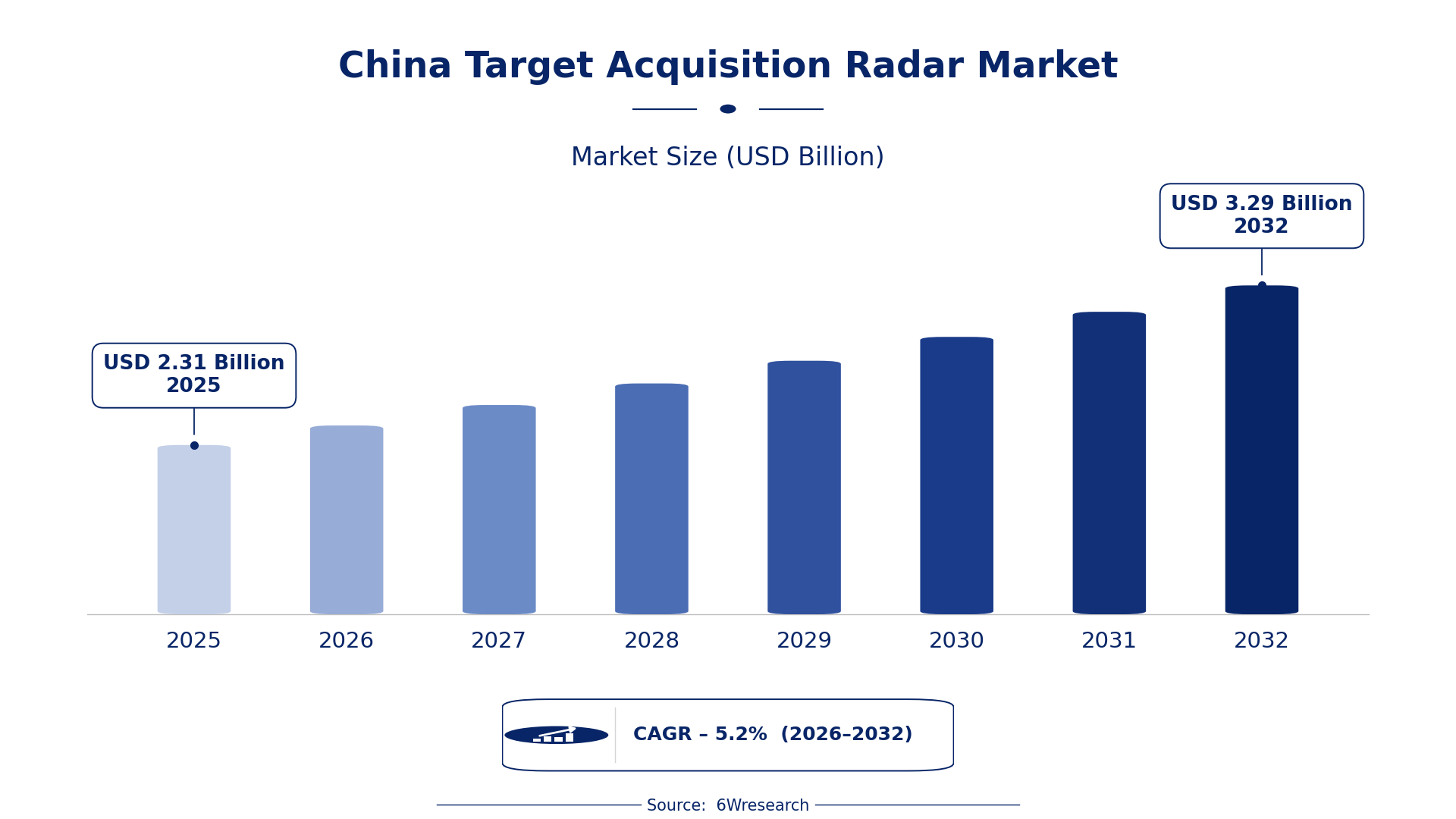
According to 6Wresearch internal database and industry insights, the China Target Acquisition Radar Market was valued at USD 2.31 billion in 2025 and is projected to reach USD 3.29 billion by 2032, growing at a CAGR of approximately 5.2% during 2026–2032.
China Target Acquisition Radar Market Highlights
| Report Metric | Details |
| Report Name | China Target Acquisition Radar Market |
| Market Size 2025 | USD 2.31 billion |
| Market Size 2032 | USD 3.29 billion |
| Absolute Growth 2025–2032 | USD 0.98 billion |
| CAGR 2026–2032 | 5.2% |
| Peak Annual Growth | 7.5% in 2029 |
| Forecast Period | 2026–2032 |
| Historical Data | 2022–2025 |
| Base Year | 2025 |
| Leading Target Acquisition Radar, 2025 | Fire-Control Radar (35% share) |
| Leading Product Type, 2025 | Tracking Systems (44% share) |
| Leading Radar Band, 2025 | X-Band (48% share) |
| Leading Distribution Channel, 2025 | Government Contracts (48% share) |
| Leading End User Industry, 2025 | Missile Systems (38% share) |
| Fastest-Growing Target Acquisition Radar | Mobile Radar Units (7.7% CAGR) |
| Fastest-Growing Product Type | Compact AESA (7.2% CAGR) |
| Fastest-Growing Radar Band | L-Band (7.0% CAGR) |
| Fastest-Growing End User Industry | Maritime Operations (7.8% CAGR) |
| Growing Sector | Military Operations |
| Key End Users | Military, Defense Contractors, UAV Manufacturers, Naval Forces |
China Target Acquisition Radar Market Year-wise Growth Rate and Key Drivers (2022–2032)
This graph illustrates the annual growth rates of the market from 2022 to 2032, highlighting a steady upward trajectory and projected market expansion over the forecast period.
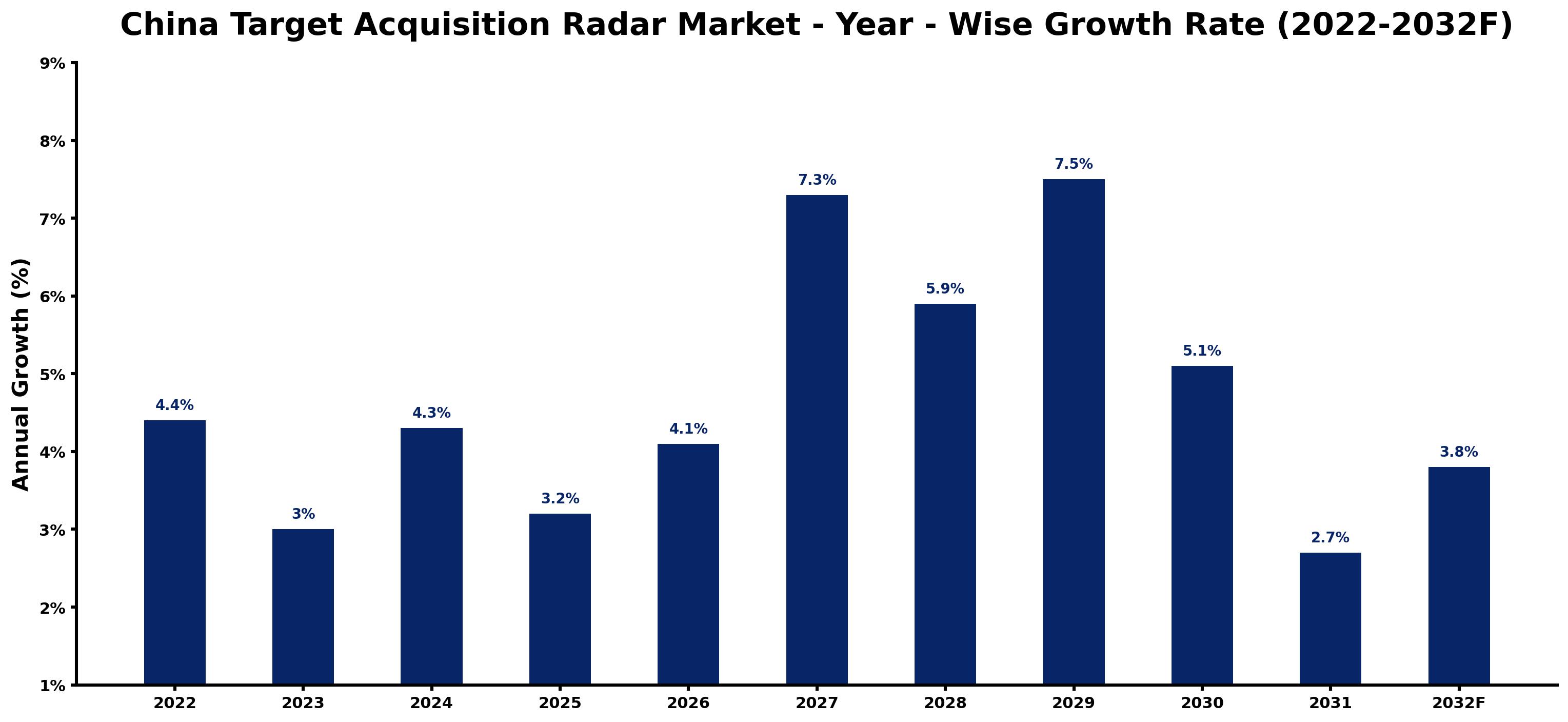
The table below sets out the estimated growth rate for each year and the main factor behind it.
| Year | Estimated Annual Growth (%) | Market Rationale |
| 2022 | 4.4 | The Chinese military invested heavily in upgrading naval defense systems, boosting radar demand. |
| 2023 | 3.0 | Growth slowed due to a focus on integrating UAV-borne target radars into tactical units. |
| 2024 | 4.3 | Demand increased as the military modernized its missile systems with advanced tracking technologies. |
| 2025 | 3.2 | The market experienced slower growth as the focus shifted to enhancing ground deployment capabilities. |
| 2026 | 4.1 | Investment in mobile radar units is expected to rise, supporting a faster growth rate in the sector. |
| 2027 | 7.3 | Increased defense spending will lead to a significant rise in demand for radar systems. |
| 2028 | 5.9 | Growth is projected to slow as the market adjusts to new military technology standards. |
| 2029 | 7.5 | A peak in growth is expected due to substantial investments in naval radar systems. |
| 2030 | 5.1 | The market will slow as the focus shifts to regulatory compliance and standardization. |
| 2031 | 2.7 | Growth is projected to slow as the market matures, with a focus on optimizing existing systems. |
| 2032 | 3.8 | Demand will increase as the military expands its radar capabilities for future operations. |
Note: Market size estimations and growth projections presented in this report are based on 6Wresearch's proprietary forecasting methodology, utilizing the latest available industry data, government publications, and primary research inputs.
China Target Acquisition Radar Market Synopsis
Target Acquisition Radar in China encompasses advanced electronic systems used for military target detection and tracking. These radars are essential for missile guidance, surveillance, and reconnaissance. The China Target Acquisition Radar Market is growing due to substantial investments in military modernization, with a defense budget allocation for radar technology advancements. The integration of UAV-borne target radars into tactical units and the focus on upgrading naval defense systems further drive demand.
Market Dynamics Impact Analysis (2026–2032)
| Factor | Type | Impact | Primary Segment Affected |
| Increased defense spending enhances procurement of advanced radar systems. | Driver | High | Fire-Control Radar |
| Growing demand for missile systems drives the need for precise tracking technologies. | Driver | High | Missile Systems |
| Significant funding for radar technology advancements opens new market opportunities. | Opportunity | High | Fire-Control Radar |
| The Guangdong province's manufacturing capabilities provide a strong base for radar production. | Opportunity | Medium | Fire-Control Radar |
| High costs of advanced radar systems can limit procurement by smaller military units. | Restraint | High | Fire-Control Radar |
| Regulatory compliance and standardization may slow down the introduction of new technologies. | Restraint | Medium | Fire-Control Radar |
| Supply chain disruptions can delay the availability of critical components for radar systems. | Challenge | High | Fire-Control Radar |
| Technological integration challenges hinder the deployment of new radar capabilities. | Challenge | Medium | Fire-Control Radar |
Evaluation of Drivers in China Target Acquisition Radar Market (2026–2032)
The main growth drivers and the segments they affect most are set out below.
| Drivers | Primary Segment Affected | Why It Matters (Evidence) |
| Increased defense budget allocations for radar technology advancements. | Fire-Control Radar | China's defense budget for 2023 includes allocations of 400 million CNY for radar technology advancements, leading to higher procurement. |
| Growing military modernization efforts require advanced tracking systems. | Missile Systems | The Chinese military's focus on upgrading missile systems drives demand for precise tracking technologies, with investments expected to rise in the coming years. |
| Partnerships with local manufacturers enhance production capabilities. | Fire-Control Radar | China's military has established partnerships with local manufacturers for radar system production, increasing supply and reducing costs. |
| Investment in UAV-borne target radars boosts demand for surveillance capabilities. | UAV-Borne Target Radars | The PLA's integration of UAV-borne target radars into tactical drone units is expected to increase demand. |
| Development of compact AESA radar systems supports various applications. | Compact AESA | The Chinese government promotes the development of compact AESA radar systems for diverse military applications, enhancing operational flexibility. |
China's defense budget for 2023 allocates 500 million CNY for radar technology improvements, resulting in heightened procurement activity. The military's emphasis on upgrading missile systems fuels demand for accurate tracking technologies, while collaborations with local manufacturers strengthen production capabilities. Investment in UAV-borne target radars is driving demand as the PLA incorporates these systems into tactical drone units. In addition, the development of compact AESA radar systems supports various applications, broadening the market's reach and enhancing operational efficiency.
Evaluation of Restraints in China Target Acquisition Radar Market
The table below lists the restraints and the evidence behind each.
| Market Restraint | Primary Segment Affected | Why It Matters (Evidence) |
| High costs of advanced radar systems can limit procurement by smaller military units. | Fire-Control Radar | The high costs associated with advanced radar systems restrict procurement capabilities for smaller military units, limiting their operational effectiveness. |
| Regulatory compliance and standardization may slow down the introduction of new technologies. | Fire-Control Radar | Compliance with updated standards can delay the deployment of new radar technologies, affecting market readiness. |
| Supply chain disruptions can delay the availability of critical components for radar systems. | Fire-Control Radar | Disruptions in the supply chain hinder timely access to essential components for radar systems, impacting production schedules. |
| Technological integration challenges hinder the deployment of new radar capabilities. | Fire-Control Radar | Integration of new technologies into existing systems can be complex and time-consuming, delaying operational readiness. |
| Limited funding for smaller projects may restrict innovation in radar technology. | Fire-Control Radar | Smaller projects often face funding limitations, impacting innovation and development in radar technology. |
China Target Acquisition Radar Market Challenges
The China Target Acquisition Radar market faces a notable technological challenge stemming from the rapid evolution of radar systems. Local manufacturers struggle to keep up with international advancements, which hampers product development and diminishes competitiveness. A shortage of skilled personnel in advanced radar technologies exacerbates this issue, leading to project delays and increased training costs for companies. Intense competition from foreign suppliers pressures domestic producers to reduce prices, constricting profit margins and limiting their capacity to invest in new technologies, ultimately affecting buyers' access to advanced solutions.
Trends in the China Target Acquisition Radar Market
The trends below show where the China Target Acquisition Radar Market is heading.
- Shift from Traditional to Advanced Radar Technologies: China is moving away from traditional radar systems towards advanced technologies such as compact AESA. The Radar Development Initiative launched in 2021 supports this transition with a budget of 400 million CNY, bolstering indigenous capabilities.
- Increase in UAV Integration for Surveillance: The integration of UAV-borne target radars is increasingly common in military operations. The PLA's tactical drone units have adopted these systems, highlighting a growing trend in aerial surveillance capabilities.
- Focus on Mobile Radar Units for Flexibility: The Chinese military is prioritising mobile radar units to enable flexible operations across various terrains. This trend is reflected in the modernisation plans outlined in the National Defense Science and Technology Innovation Plan initiated in 2022.
- Expansion of Ground Deployment Capabilities: The Chinese military is enhancing its ground deployment radar capabilities to support land-based operations. A new programme launched in 2023 aims to improve these systems, indicating a strategic focus.
Investment Opportunities in the China Target Acquisition Radar Market
The following opportunities in the China Target Acquisition Radar Market pair current demand with a clear way in.
- Growing Demand for Advanced Tracking Systems: The need for precise tracking systems is rising due to military modernisation efforts. The Guangdong province is a key area for radar system manufacturing, offering investment opportunities for suppliers.
- Investment in Compact AESA Technology: The development of compact AESA radar systems is gaining momentum, with a projected growth rate of 7.2%. Collaborating with local manufacturers can ease entry into this expanding market segment.
- Partnerships for UAV Technology Integration: Now presents an excellent opportunity to invest in UAV technology integration for radar systems. Tactical drone manufacturers are seeking advanced radar solutions to enhance their capabilities.
- Expansion of Naval Defense Capabilities: The focus on upgrading naval defense systems creates opportunities for radar technology suppliers. Collaborating with naval contractors can lead to access to valuable contracts in this sector.
Government Initiatives in the China Target Acquisition Radar Market
In 2021, the Ministry of National Defense launched the 'Radar Development Initiative' aimed at enhancing indigenous radar technology capabilities, with a budget of 400 million CNY. This initiative seeks to drive innovation and improve radar system performance in military applications. It builds on previous measures like the 'Military-Civil Fusion Strategy' from 2020, which encouraged collaboration between military and civilian sectors. The updated standards under this initiative ensure radar systems meet modern performance benchmarks, increasing their effectiveness in the field.
The Ministry of Industry and Information Technology oversees the implementation of the 'Radar Technology Advancement Program' initiated in 2022. This programme supports innovation and commercialisation of radar systems, providing funding for research and development projects. Local manufacturers benefit from this scheme through grants for developing advanced radar technologies. Additionally, the National Defense Science and Technology Innovation Plan initiated in 2022 promotes collaboration between universities and research institutions, further advancing radar capabilities.
Future Insight of the China Target Acquisition Radar Market
The China Target Acquisition Radar market is set for considerable changes by 2032 as the government prioritises advancements in radar technology. Increased funding for indigenous fire-control systems and the development of mobile radar units will drive innovation. By 2023, the military's defence budget allocates over 20% for radar technology, demonstrating a commitment to modernisation. Collaborations between the military and local manufacturers will strengthen the supply chain, ensuring that buyers benefit from improved product availability and enhanced operational capabilities.
Market Segmentation Analysis
The report offers a comprehensive study of the following market segments and their leading categories in the market.
By Target Acquisition Radar – Fire-Control Radar Dominated, Mobile Radar Units Expected to Grow Fastest
According to Sumit Sagar, AM at 6Wresearch, in 2025, Fire-Control Radar led the target acquisition radar split with a 35% share. Fire-Control Radar holds the largest share in the China Target Acquisition Radar Market due to its essential role in missile targeting and tracking systems. The Chinese military's substantial investments in these systems highlight their importance in enhancing operational capabilities. Over 2026–2032, Mobile Radar Units are expected to post the fastest growth, at a CAGR of 7.7%. Mobile Radar Units are experiencing rapid growth as they are deployed for flexible military operations across diverse terrains. The Chinese military's emphasis on tactical advantages through mobile capabilities is a significant factor driving this segment's expansion. Suppliers should focus on advancing mobile radar technologies to meet evolving military operational requirements.
By Product Type – Tracking Systems Dominated, Compact AESA Expected to Grow Fastest
The largest product type category in 2025 was Tracking Systems, with a 44% share of total revenue. Tracking Systems dominate the market share as they are vital for maintaining situational awareness during combat. Their extensive integration into military platforms underscores their critical importance in modern defence strategies. Compact AESA is set to record the highest CAGR in this split, 7.2% over 2026–2032. Compact AESA is the fastest-growing segment, providing advanced radar capabilities in a smaller form factor, which is increasingly favoured for contemporary military applications. The trend towards miniaturisation in radar technology significantly propels this segment's growth. Buyers should invest in compact radar solutions that deliver enhanced capabilities while optimising space and weight.
By Radar Band – X-Band Dominated, L-Band Expected to Grow Fastest
With a 48% revenue share in 2025, X-Band was the largest radar band category. X-Band radar technology leads the market due to its effectiveness in high-resolution target detection, making it indispensable for military operations. Its widespread adoption in various military applications solidifies its dominant position. The quickest growth will come from L-Band, forecast to expand at a CAGR of 7.0% between 2026 and 2032. L-Band is the fastest-growing segment, primarily utilised for long-range surveillance applications, which are becoming increasingly vital in contemporary military strategies. The rising need for extended surveillance capabilities is driving this growth. Suppliers should prioritise the development of L-Band technologies to capitalise on the growing demand for long-range surveillance solutions.
By Distribution Channel – Government Contracts Dominated and Is Expected to Record the Fastest Growth
Government Contracts accounted for a 48% market share by distribution channel in 2025. Government Contracts represent the largest share in the distribution of target acquisition radar systems, acting as the primary revenue source for manufacturers. This dependency on government funding for military projects ensures stability and growth within this channel. The same category are also set to grow fastest, at a CAGR of 6.2% during 2026–2032. Government Contracts are also the fastest-growing distribution channel, reflecting increased defence budget allocations towards radar technology. Ongoing government investment in military enhancements will sustain this growth trajectory. Manufacturers should strengthen ties with government entities to secure contracts and ensure a reliable revenue stream.
By End User Industry – Missile Systems Dominated, Maritime Operations Expected to Grow Fastest
Missile Systems took a 38% share of end user industry in 2025, more than any other category. Missile Systems account for the largest share in the end-user industry as they are integral for precision targeting in military applications. The ongoing military modernisation efforts in China further solidify this segment's dominance. Over 2026–2032, Maritime Operations are expected to post the fastest growth, at a CAGR of 7.8%. Maritime Operations are the fastest-growing end-user industry, driven by the strategic importance of naval capabilities in modern warfare. The increasing focus on maritime security and operations is propelling this sector's growth. Suppliers should focus on developing radar solutions tailored for maritime applications to align with the growing emphasis on naval operations.
Key Attractiveness of the Report
- 10 Years of Market Numbers
- Historical Data Starting from 2022 to 2025
- Base Year 2025
- Forecast Data until 2032
- Key Performance Indicators Impacting the Market
- Major Upcoming Developments and Projects
Key Highlights of the Report:
- China Target Acquisition Radar Market Outlook
- Market Size of China Target Acquisition Radar Market, 2025
- Forecast of China Target Acquisition Radar Market, 2032
- Historical Data and Forecast of China Target Acquisition Radar Revenues & Volume for the Period 2022 - 2032F
- China Target Acquisition Radar Market Trend Evolution
- China Target Acquisition Radar Market Drivers and Challenges
- China Target Acquisition Radar Price Trends
- China Target Acquisition Radar Porter's Five Forces
- China Target Acquisition Radar Industry Life Cycle
- Historical Data and Forecast of China Target Acquisition Radar Market Revenues & Volume By Target Acquisition Radar for the Period 2022 - 2032F
- Historical Data and Forecast of China Target Acquisition Radar Market Revenues & Volume By Fire-Control Radar for the Period 2022 - 2032F
- Historical Data and Forecast of China Target Acquisition Radar Market Revenues & Volume By Mobile Radar Units for the Period 2022 - 2032F
- Historical Data and Forecast of China Target Acquisition Radar Market Revenues & Volume By Ship-Based Target Radar for the Period 2022 - 2032F
- Historical Data and Forecast of China Target Acquisition Radar Market Revenues & Volume By UAV-Borne Target Radars for the Period 2022 - 2032F
- Historical Data and Forecast of China Target Acquisition Radar Market Revenues & Volume By Product Type for the Period 2022 - 2032F
- Historical Data and Forecast of China Target Acquisition Radar Market Revenues & Volume By Tracking Systems for the Period 2022 - 2032F
- Historical Data and Forecast of China Target Acquisition Radar Market Revenues & Volume By Ground Deployment for the Period 2022 - 2032F
- Historical Data and Forecast of China Target Acquisition Radar Market Revenues & Volume By Naval Defense for the Period 2022 - 2032F
- Historical Data and Forecast of China Target Acquisition Radar Market Revenues & Volume By Compact AESA for the Period 2022 - 2032F
- Historical Data and Forecast of China Target Acquisition Radar Market Revenues & Volume By Radar Band for the Period 2022 - 2032F
- Historical Data and Forecast of China Target Acquisition Radar Market Revenues & Volume By X-Band for the Period 2022 - 2032F
- Historical Data and Forecast of China Target Acquisition Radar Market Revenues & Volume By L-Band for the Period 2022 - 2032F
- Historical Data and Forecast of China Target Acquisition Radar Market Revenues & Volume By S-Band for the Period 2022 - 2032F
- Historical Data and Forecast of China Target Acquisition Radar Market Revenues & Volume By Ku-Band for the Period 2022 - 2032F
- Historical Data and Forecast of China Target Acquisition Radar Market Revenues & Volume By Distribution Channel for the Period 2022 - 2032F
- Historical Data and Forecast of China Target Acquisition Radar Market Revenues & Volume By OEMs for the Period 2022 - 2032F
- Historical Data and Forecast of China Target Acquisition Radar Market Revenues & Volume By Government Contracts for the Period 2022 - 2032F
- Historical Data and Forecast of China Target Acquisition Radar Market Revenues & Volume By Naval Contractors for the Period 2022 - 2032F
- Historical Data and Forecast of China Target Acquisition Radar Market Revenues & Volume By Drone Manufacturers for the Period 2022 - 2032F
- Historical Data and Forecast of China Target Acquisition Radar Market Revenues & Volume By End User Industry for the Period 2022 - 2032F
- Historical Data and Forecast of China Target Acquisition Radar Market Revenues & Volume By Missile Systems for the Period 2022 - 2032F
- Historical Data and Forecast of China Target Acquisition Radar Market Revenues & Volume By Armored Forces for the Period 2022 - 2032F
- Historical Data and Forecast of China Target Acquisition Radar Market Revenues & Volume By Maritime Operations for the Period 2022 - 2032F
- Historical Data and Forecast of China Target Acquisition Radar Market Revenues & Volume By Tactical Drones for the Period 2022 - 2032F
- China Target Acquisition Radar Import Export Trade Statistics
- Market Opportunity Assessment By Target Acquisition Radar
- Market Opportunity Assessment By Product Type
- Market Opportunity Assessment By Radar Band
- Market Opportunity Assessment By Distribution Channel
- Market Opportunity Assessment By End User Industry
- China Target Acquisition Radar Top Companies Market Share
- China Target Acquisition Radar Competitive Benchmarking By Technical and Operational Parameters
- China Target Acquisition Radar Company Profiles
- China Target Acquisition Radar Key Strategic Recommendations
Market Covered
This report examines the market across the segments below.
By Target Acquisition Radar
- Fire-Control Radar
- Mobile Radar Units
- Ship-Based Target Radar
- UAV-Borne Target Radars
By Product Type
- Tracking Systems
- Ground Deployment
- Naval Defense
- Compact AESA
By Radar Band
- X-Band
- L-Band
- S-Band
- Ku-Band
By Distribution Channel
- OEMs
- Government Contracts
- Naval Contractors
- Drone Manufacturers
By End User Industry
- Missile Systems
- Armored Forces
- Maritime Operations
- Tactical Drones































