India Targeted Oncology Drugs Market Size & Growth Rate
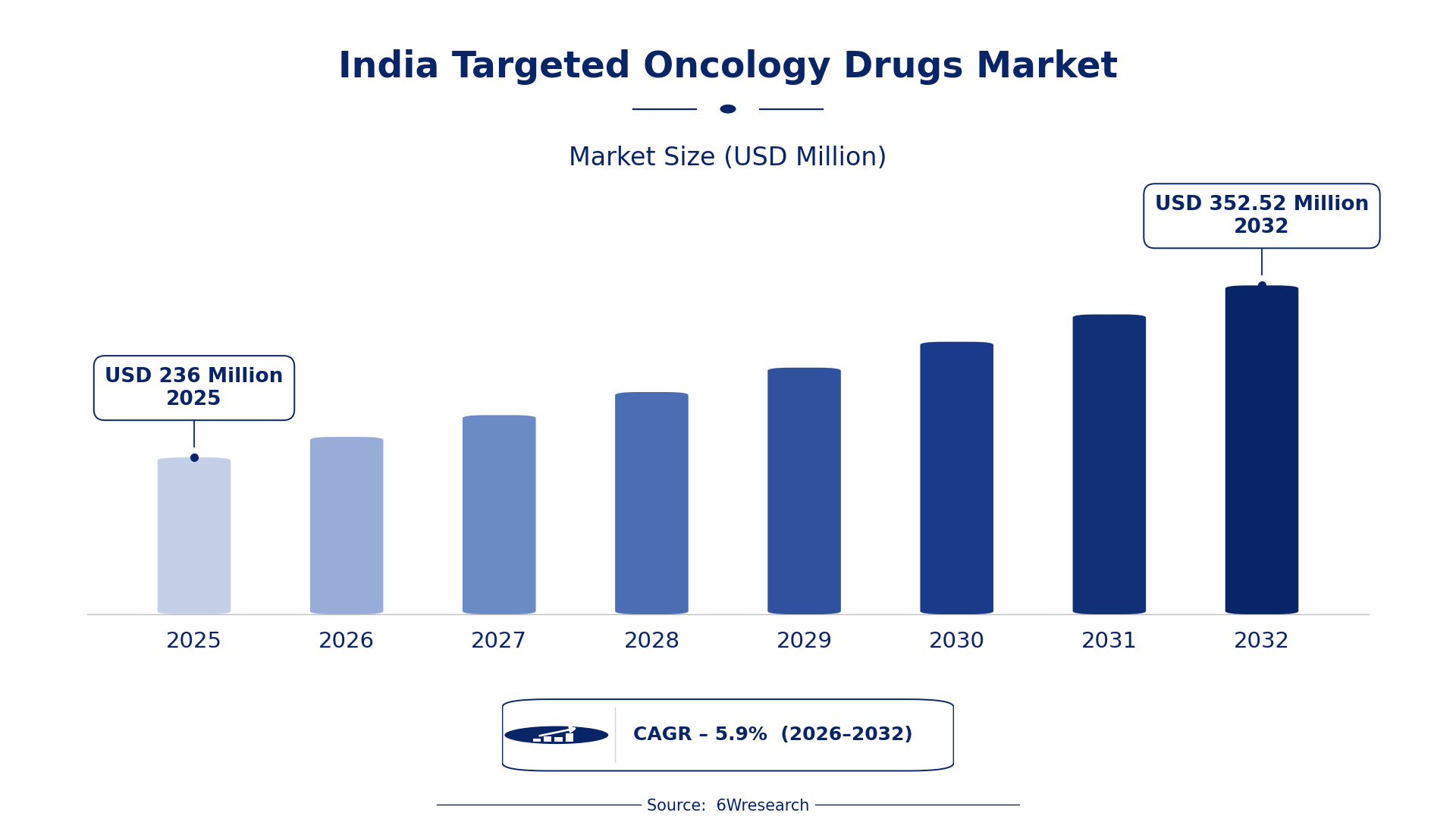
According to 6Wresearch internal database and industry insights, the India Targeted Oncology Drugs Market was valued at USD 236.0 million in 2025 and is projected to reach USD 352.52 million by 2032, growing at a CAGR of approximately 5.9% during 2026–2032.
India Targeted Oncology Drugs Market Highlights
| Report Metric | Details |
| Report Name | India Targeted Oncology Drugs Market |
| Market Size 2025 | USD 236.0 million |
| Market Size 2032 | USD 352.52 million |
| Absolute Growth 2025–2032 | USD 116.52 million |
| CAGR 2026–2032 | 5.9% |
| Peak Annual Growth | 8.2% in 2032 |
| Forecast Period | 2026–2032 |
| Historical Data | 2022–2025 |
| Base Year | 2025 |
| Leading Drug Type, 2025 | ALK Inhibitors (49% share) |
| Leading Cancer Indication, 2025 | Breast Cancer (54% share) |
| Leading Mechanism of Action, 2025 | Kinase Blocker (38% share) |
| Leading End User, 2025 | Cancer Hospitals (43% share) |
| Fastest-Growing Drug Type | BRAF Inhibitors (8.1% CAGR) |
| Fastest-Growing Cancer Indication | Melanoma (8.1% CAGR) |
| Fastest-Growing Mechanism of Action | Gene Mutation Inhibitor (8.5% CAGR) |
| Fastest-Growing End User | Oncology Centers (7.6% CAGR) |
| Growing Sector | Oncology |
| Key End Users | Oncology Centers, Cancer Hospitals, Specialty Clinics |
India Targeted Oncology Drugs Market Year-wise Growth Rate and Key Drivers (2022–2032)
This graph illustrates the annual growth rates of the market from 2022 to 2032, highlighting a steady upward trajectory and projected market expansion over the forecast period.
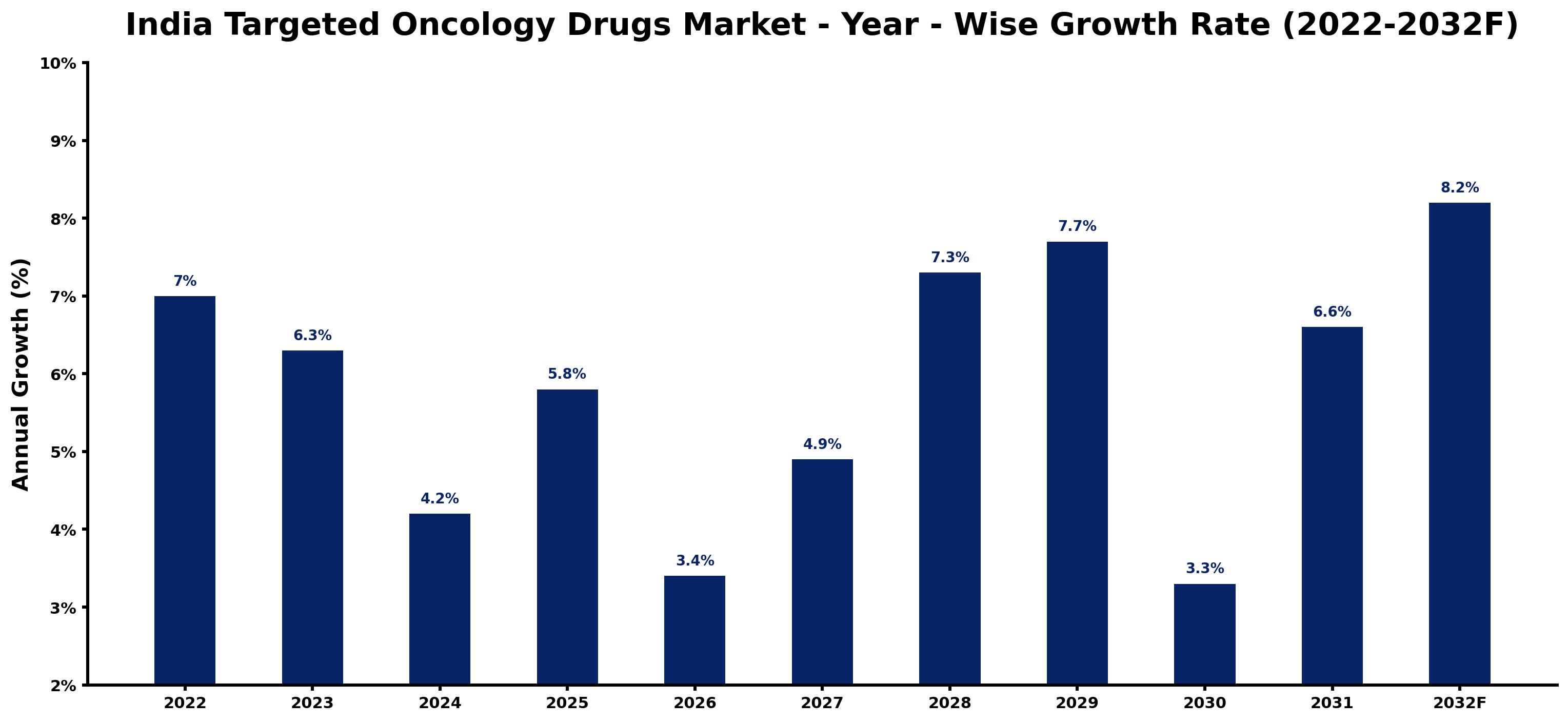
The table below sets out the estimated growth rate for each year and the main factor behind it.
| Year | Estimated Annual Growth (%) | Market Rationale |
| 2022 | 7.0 | The market experienced strong demand from oncology centers and hospitals. |
| 2023 | 6.3 | Growth slowed due to a temporary reduction in clinical trial activities. |
| 2024 | 4.2 | The market continued to slow as competition increased among drug manufacturers. |
| 2025 | 5.8 | Demand rebounded as new therapies gained regulatory approval and market entry. |
| 2026 | 3.4 | Growth is expected to slow again as the market adjusts to new pricing regulations. |
| 2027 | 4.9 | Increased investment in research will lead to a rise in drug development activities. |
| 2028 | 7.3 | The market is projected to expand as patient awareness campaigns increase treatment uptake. |
| 2029 | 7.7 | Demand will continue to rise as more patients seek advanced therapies. |
| 2030 | 3.3 | Growth is expected to slow due to market saturation in certain drug categories. |
| 2031 | 6.6 | The market will see renewed interest driven by new treatment guidelines. |
| 2032 | 8.2 | The market is projected to peak as new therapies gain traction. |
Note: Market size estimations and growth projections presented in this report are based on 6Wresearch's proprietary forecasting methodology, utilizing the latest available industry data, government publications, and primary research inputs.
India Targeted Oncology Drugs Market Synopsis
The India Targeted Oncology Drugs Market includes specialized medications that target specific mechanisms in cancer cells, primarily used in the treatment of various cancers. Developed through advanced biotechnological processes, these drugs play a crucial part in oncology treatments. The market is expanding due to the rising incidence of cancer, with over 1.5 million new cases reported each year. Demand is driven by oncology centres and cancer hospitals that cater to a growing patient population and increasingly adopt advanced therapies. The National Cancer Control Programme also supports improved treatment accessibility.
Market Dynamics Impact Analysis (2026–2032)
| Factor | Type | Impact | Primary Segment Affected |
| Rising cancer incidence drives demand for targeted therapies. | Driver | High | Breast Cancer |
| Increased clinical trials for new drug approvals create market opportunities. | Driver | High | Melanoma |
| Growing patient population seeking advanced therapies creates a supply gap. | Opportunity | High | Lung Cancer |
| Investment in research and development of new oncology drugs is rising. | Opportunity | High | Ovarian/Prostate Cancer |
| High costs of targeted therapies limit access for low-income patients. | Restraint | High | Breast Cancer |
| Regulatory hurdles delay the approval of new oncology drugs. | Restraint | Medium | Melanoma |
| Limited availability of specialized healthcare professionals affects treatment. | Challenge | High | Lung Cancer |
| Market saturation in certain drug categories leads to increased competition. | Challenge | Medium | Ovarian/Prostate Cancer |
Evaluation of Drivers in India Targeted Oncology Drugs Market (2026–2032)
The factors lifting demand, and the evidence behind each, are summarised below.
| Drivers | Primary Segment Affected | Why It Matters (Evidence) |
| Rising cancer incidence increases demand for targeted therapies. | Breast Cancer | With over 1.5 million new cases annually, oncology centers are purchasing more targeted drugs. |
| Increased clinical trials for new drug approvals boost market activity. | Melanoma | Clinical trials for targeted therapies have risen by 25%, leading to more available options. |
| Growing patient population seeking advanced therapies creates a supply gap. | Lung Cancer | Approximately 70% of lung cancer cases are diagnosed at advanced stages, increasing demand. |
| Investment in research and development of new oncology drugs is rising. | Ovarian/Prostate Cancer | The Department of Biotechnology's scheme promotes research with a budget of ₹500 crore. |
| Increased funding for cancer treatment accessibility encourages market growth. | Breast Cancer | The National Health Policy 2021 aims to improve cancer care infrastructure by 2025. |
Market growth for Targeted Oncology Drugs in India is underpinned by rising cancer incidence, increased clinical trials for new drug approvals, and growing patient demand for advanced therapies. With over 1.5 million new cancer cases reported annually, oncology centers are purchasing more targeted drugs. Clinical trials for targeted therapies have increased by 25% in the last two years, providing more options for patients. The Department of Biotechnology's scheme promotes research with a budget of ₹500 crore, encouraging the development of new therapies. As a result, more effective treatments are becoming available to meet the needs of patients diagnosed at advanced stages.
Evaluation of Restraints in India Targeted Oncology Drugs Market
The main factors holding the market back are set out below.
| Market Restraint | Primary Segment Affected | Why It Matters (Evidence) |
| High costs of targeted therapies limit access for low-income patients. | Breast Cancer | The rising prices of targeted drugs restrict access for over 60% of cancer patients in urban areas. |
| Regulatory hurdles delay the approval of new oncology drugs. | Melanoma | The Drugs and Cosmetics Act regulates approvals, causing delays in bringing new therapies to market. |
| Limited availability of specialized healthcare professionals affects treatment. | Lung Cancer | The National Medical Commission's guidelines emphasize the need for specialized training in oncology, leading to workforce shortages. |
| Market saturation in certain drug categories leads to increased competition. | Ovarian/Prostate Cancer | As more drugs enter the market, competition increases, affecting pricing strategies. |
| Inconsistent patient awareness leads to underutilization of available therapies. | Breast Cancer | Many patients remain unaware of the benefits of targeted therapies, limiting treatment uptake. |
India Targeted Oncology Drugs Market Challenges
The India Targeted Oncology Drugs Market still has to solve a few problems, starting with skills shortages that hinder producers from developing advanced therapies. This gap exists due to limited training opportunities in biotechnological processes, resulting in delays in drug development for buyers, particularly oncology centers. High production costs arise from compliance with the Drugs and Cosmetics Act, forcing buyers to pay up to 30% more for treatments. Outdated technology in manufacturing processes leads to inefficiencies, causing delays in drug availability for hospitals. Intense competition from imported therapies pressures local producers to lower prices, impacting their profit margins and sustainability.
Trends in the India Targeted Oncology Drugs Market
Below mentioned are some of the trends shaping the India Targeted Oncology Drugs Market growth.
- Shift from Traditional to Targeted Therapies: Since 2020, oncology centers have increasingly adopted targeted therapies over traditional treatments. This shift is reflected in the rise of clinical trials for targeted therapies, which have increased by 25%, providing more effective options for patients.
- Emergence of Gene Mutation Inhibitors: In recent years, Gene Mutation Inhibitors have gained traction in India, particularly among oncology centers. With a projected CAGR of 8.5%, these inhibitors are becoming essential in personalized cancer treatment.
- Focus on Early Detection and Treatment: The National Cancer Control Programme, launched in 2020, emphasizes early detection and treatment. This initiative aims to reduce advanced-stage diagnoses, positively impacting the demand for targeted therapies.
- Increased Investment in Cancer Research: The Department of Biotechnology's scheme, initiated in 2021, promotes research in targeted therapies with a budget of ₹500 crore. This investment is expected to support the development of new oncology drugs.
Investment Opportunities in the India Targeted Oncology Drugs Market
Several openings in the India Targeted Oncology Drugs Market merit attention from investors.
- Timing for Investment in Targeted Therapies: With the increasing cancer incidence, now is the ideal time to invest in targeted therapies. The National Health Policy 2021 aims to improve cancer care infrastructure by 2025, creating a supportive environment.
- Supply of New Oncology Drugs: Investing in the development of new oncology drugs is essential. The growing patient population in urban areas, where over 60% of cancer patients seek treatment, presents a significant market opportunity.
- Entry through Partnerships with Research Institutions: Collaborating with local research institutions can facilitate entry into the targeted oncology drugs market. The Department of Biotechnology's scheme supports partnerships focused on cancer research.
- Focus on Urban Cancer Hospitals: Targeting urban cancer hospitals for distribution of targeted therapies is strategic. With a 43% share in 2025, these facilities are key players in administering advanced treatments.
Government Initiatives in the India Targeted Oncology Drugs Market
The National Health Policy 2021 aims to increase cancer treatment accessibility through funding and infrastructure improvements by 2025. This policy encourages investment in oncology facilities and ensures that more patients receive timely treatments. The National Cancer Control Programme, launched by the Ministry of Health and Family Welfare in 2020, focuses on early detection and treatment of cancer across India. This initiative is crucial for improving patient outcomes and reducing the burden of advanced-stage cancer diagnoses.
The Department of Biotechnology's scheme, initiated in 2021, promotes research in targeted therapies with a budget of ₹500 crore. This funding allows producers to develop new treatments. The National Medical Commission's 2022 guidelines emphasise the need for specialised training in oncology for healthcare professionals. This training ensures that medical staff are equipped to administer advanced therapies effectively. The Ayushman Bharat scheme, updated in 2021, provides health insurance coverage for cancer treatments to low-income families, allowing beneficiaries to access targeted therapies without financial strain.
Future Insight of the India Targeted Oncology Drugs Market
The India Targeted Oncology Drugs Market is expected to undergo notable changes by 2032, with clinical trials for targeted therapies projected to increase, thus improving treatment options for buyers in urban oncology centres. The National Health Mission's initiatives will enhance cancer care access, stimulating demand for these therapies. Compliance with ISO 9001 standards will elevate product quality, benefiting suppliers and patients. Furthermore, advancements in biotechnological processes will streamline drug development, ensuring timely availability of new treatments.
Market Segmentation Analysis
The analysis below covers each segmentation, its leading category in 2025 and its fastest-growing category through 2032.
By Drug Type – ALK Inhibitors Dominated, BRAF Inhibitors Expected to Grow Fastest
According to Sumit Sagar, AM at 6Wresearch, ALK Inhibitors accounted for a 49% market share by drug type in 2025. ALK inhibitors hold the largest share of the India targeted oncology drugs market because they are essential in treating specific types of lung cancer, particularly in urban cancer hospitals. Their established use in clinical practice ensures a consistent demand, reflecting their importance in oncology treatment protocols. BRAF Inhibitors are projected to grow fastest, at a CAGR of 8.1% during 2026–2032. BRAF inhibitors are witnessing rapid growth as they become more commonly prescribed for melanoma, a cancer type that has seen a notable increase in cases. This heightened focus on targeted therapies for melanoma will likely expand their market share further. Suppliers need to enhance the distribution of BRAF inhibitors to effectively cater to the rising demand in melanoma treatment.
By Cancer Indication – Breast Cancer Dominated, Melanoma Expected to Grow Fastest
In 2025, Breast Cancer led the cancer indication split with a 54% share. Breast cancer holds the largest share of the targeted oncology drugs market in India, primarily due to the extensive application of these therapies for patients with specific tumour types. The high incidence of breast cancer cases ensures a consistent demand for effective treatment options. Melanoma is set to record the highest CAGR in this split, 8.1% over 2026–2032. Melanoma is emerging as the fastest-growing indication for targeted oncology drugs, driven by its rising prevalence and the urgent need for effective therapies. As awareness and diagnosis improve, the demand for targeted treatments in melanoma will likely accelerate. Buyers should anticipate an expanding array of targeted therapies specifically designed for melanoma as market conditions evolve.
By Mechanism of Action – Kinase Blocker Dominated, Gene Mutation Inhibitor Expected to Grow Fastest
The largest mechanism of action category in 2025 was Kinase Blocker, with a 38% share of total revenue. Kinase blockers dominate the market share in the India targeted oncology drugs sector as they are widely utilised to inhibit cancer cell growth across various types of cancers. Their established efficacy in treatment protocols makes them a preferred choice among healthcare providers. Over 2026–2032, Gene Mutation Inhibitor is expected to post the fastest growth, at a CAGR of 8.5%. Gene mutation inhibitors are rapidly gaining traction due to their ability to specifically target genetic mutations in tumours, reflecting a shift towards personalised medicine. As more genetic testing becomes available, the demand for these inhibitors is expected to rise. Suppliers must invest in research and development for gene mutation inhibitors to capitalise on the growing trend towards personalised oncology treatments.
By End User – Cancer Hospitals Dominated, Oncology Centers Expected to Grow Fastest
Cancer Hospitals held a 43% share of the India Targeted Oncology Drugs Market by end user in 2025. Cancer hospitals represent the largest share of the targeted oncology drugs market in India, serving as critical facilities where these therapies are administered to a vast patient population. Their pivotal role in providing comprehensive cancer care underlines their dominant market position. The quickest growth will come from Oncology Centers, forecast to expand at a CAGR of 7.6% between 2026 and 2032. Oncology centers are the fastest-growing segment as they are the primary users of targeted oncology drugs, driven by a rise in cancer diagnoses and evolving treatment protocols. This trend highlights a growing preference for specialised cancer care. Suppliers should focus on building partnerships with oncology centers to ensure timely access to targeted therapies for patients.
Key Attractiveness of the Report
- 10 Years of Market Numbers
- Historical Data Starting from 2022 to 2025
- Base Year 2025
- Forecast Data until 2032
- Key Performance Indicators Impacting the Market
- Major Upcoming Developments and Projects
Key Highlights of the Report:
- India Targeted Oncology Drugs Market Outlook
- Market Size of India Targeted Oncology Drugs Market, 2025
- Forecast of India Targeted Oncology Drugs Market, 2032
- Historical Data and Forecast of India Targeted Oncology Drugs Revenues & Volume for the Period 2022 - 2032F
- India Targeted Oncology Drugs Market Trend Evolution
- India Targeted Oncology Drugs Market Drivers and Challenges
- India Targeted Oncology Drugs Price Trends
- India Targeted Oncology Drugs Porter's Five Forces
- India Targeted Oncology Drugs Industry Life Cycle
- Historical Data and Forecast of India Targeted Oncology Drugs Market Revenues & Volume By Drug Type for the Period 2022 - 2032F
- Historical Data and Forecast of India Targeted Oncology Drugs Market Revenues & Volume By ALK Inhibitors for the Period 2022 - 2032F
- Historical Data and Forecast of India Targeted Oncology Drugs Market Revenues & Volume By BRAF Inhibitors for the Period 2022 - 2032F
- Historical Data and Forecast of India Targeted Oncology Drugs Market Revenues & Volume By HER2 Inhibitors for the Period 2022 - 2032F
- Historical Data and Forecast of India Targeted Oncology Drugs Market Revenues & Volume By PARP Inhibitors for the Period 2022 - 2032F
- Historical Data and Forecast of India Targeted Oncology Drugs Market Revenues & Volume By Cancer Indication for the Period 2022 - 2032F
- Historical Data and Forecast of India Targeted Oncology Drugs Market Revenues & Volume By Lung Cancer for the Period 2022 - 2032F
- Historical Data and Forecast of India Targeted Oncology Drugs Market Revenues & Volume By Melanoma for the Period 2022 - 2032F
- Historical Data and Forecast of India Targeted Oncology Drugs Market Revenues & Volume By Breast Cancer for the Period 2022 - 2032F
- Historical Data and Forecast of India Targeted Oncology Drugs Market Revenues & Volume By Ovarian/Prostate Cancer for the Period 2022 - 2032F
- Historical Data and Forecast of India Targeted Oncology Drugs Market Revenues & Volume By Mechanism of Action for the Period 2022 - 2032F
- Historical Data and Forecast of India Targeted Oncology Drugs Market Revenues & Volume By Kinase Blocker for the Period 2022 - 2032F
- Historical Data and Forecast of India Targeted Oncology Drugs Market Revenues & Volume By Gene Mutation Inhibitor for the Period 2022 - 2032F
- Historical Data and Forecast of India Targeted Oncology Drugs Market Revenues & Volume By Receptor Blocker for the Period 2022 - 2032F
- Historical Data and Forecast of India Targeted Oncology Drugs Market Revenues & Volume By DNA Repair Inhibition for the Period 2022 - 2032F
- Historical Data and Forecast of India Targeted Oncology Drugs Market Revenues & Volume By End User for the Period 2022 - 2032F
- Historical Data and Forecast of India Targeted Oncology Drugs Market Revenues & Volume By Oncology Centers for the Period 2022 - 2032F
- Historical Data and Forecast of India Targeted Oncology Drugs Market Revenues & Volume By Cancer Hospitals for the Period 2022 - 2032F
- Historical Data and Forecast of India Targeted Oncology Drugs Market Revenues & Volume By Specialty Clinics for the Period 2022 - 2032F
- Historical Data and Forecast of India Targeted Oncology Drugs Market Revenues & Volume By Clinical Oncology Labs for the Period 2022 - 2032F
- India Targeted Oncology Drugs Import Export Trade Statistics
- Market Opportunity Assessment By Drug Type
- Market Opportunity Assessment By Cancer Indication
- Market Opportunity Assessment By Mechanism of Action
- Market Opportunity Assessment By End User
- India Targeted Oncology Drugs Top Companies Market Share
- India Targeted Oncology Drugs Competitive Benchmarking By Technical and Operational Parameters
- India Targeted Oncology Drugs Company Profiles
- India Targeted Oncology Drugs Key Strategic Recommendations
Market Covered
Segments analysed in this report are listed below.
By Drug Type
- ALK Inhibitors
- BRAF Inhibitors
- HER2 Inhibitors
- PARP Inhibitors
By Cancer Indication
- Lung Cancer
- Melanoma
- Breast Cancer
- Ovarian/Prostate Cancer
By Mechanism of Action
- Kinase Blocker
- Gene Mutation Inhibitor
- Receptor Blocker
- DNA Repair Inhibition
By End User
- Oncology Centers
- Cancer Hospitals
- Specialty Clinics
- Clinical Oncology Labs































