China Targeted Oncology Drugs Market Size & Growth Rate
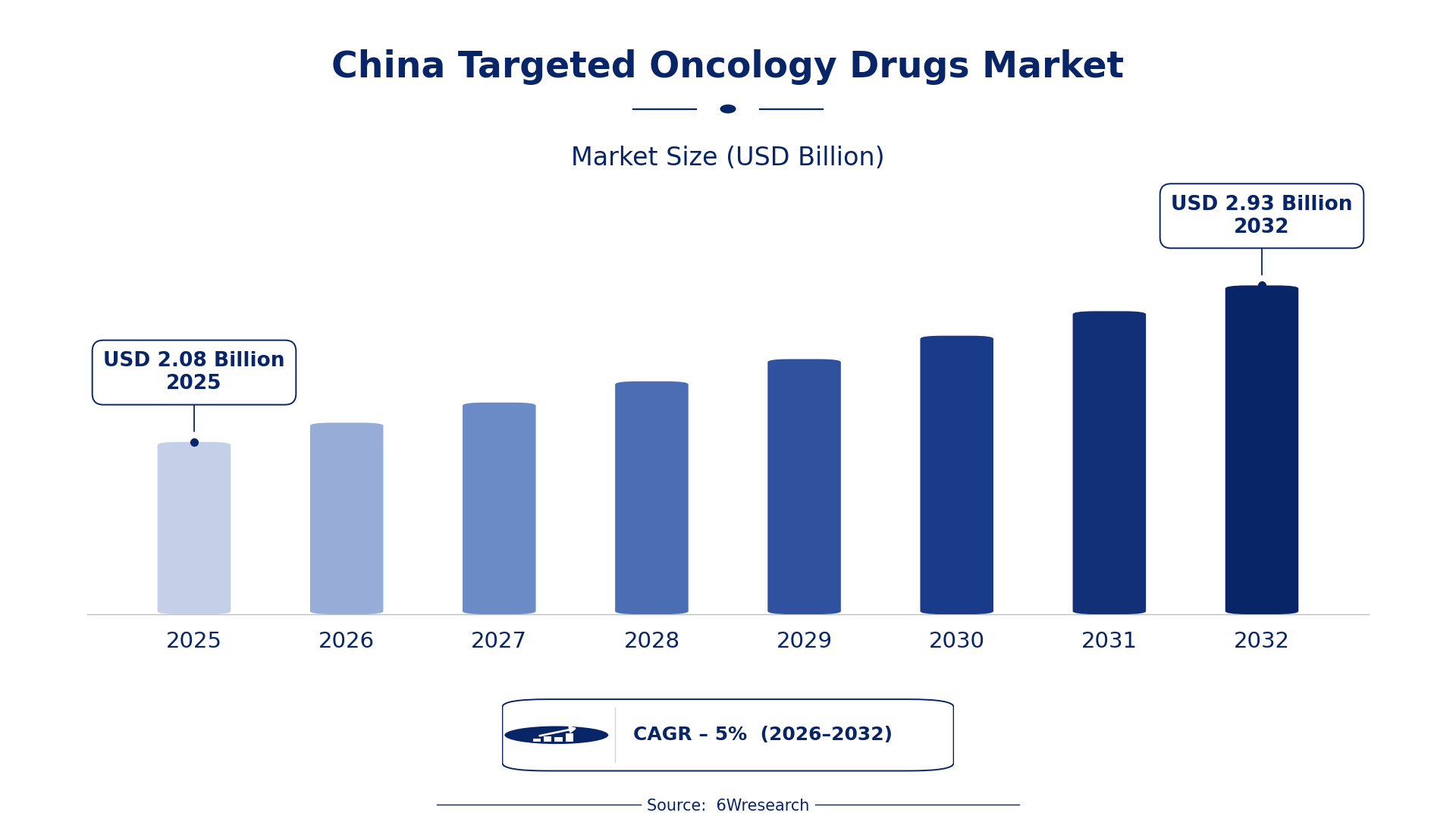
According to 6Wresearch internal database and industry insights, the China Targeted Oncology Drugs Market was valued at USD 2.08 billion in 2025 and is projected to reach USD 2.93 billion by 2032, growing at a CAGR of approximately 5% during 2026–2032.
China Targeted Oncology Drugs Market Highlights
| Report Metric | Details |
| Report Name | China Targeted Oncology Drugs Market |
| Market Size 2025 | USD 2.08 billion |
| Market Size 2032 | USD 2.93 billion |
| Absolute Growth 2025–2032 | USD 0.85 billion |
| CAGR 2026–2032 | 5% |
| Peak Annual Growth | 8.1% in 2032 |
| Forecast Period | 2026–2032 |
| Historical Data | 2022–2025 |
| Base Year | 2025 |
| Leading Drug Type, 2025 | ALK Inhibitors (36% share) |
| Leading Cancer Indication, 2025 | Lung Cancer (40% share) |
| Leading Mechanism of Action, 2025 | Kinase Blocker (49% share) |
| Leading End User, 2025 | Oncology Centers (40% share) |
| Fastest-Growing Drug Type | BRAF Inhibitors (7.7% CAGR) |
| Fastest-Growing Cancer Indication | Ovarian/Prostate Cancer (6.8% CAGR) |
| Fastest-Growing Mechanism of Action | Gene Mutation Inhibitor (7.7% CAGR) |
| Fastest-Growing End User | Specialty Clinics (6.8% CAGR) |
| Growing Sector | Oncology Centers |
| Key End Users | Oncology Centers, Cancer Hospitals, Specialty Clinics, Clinical Oncology Labs |
China Targeted Oncology Drugs Market Year-wise Growth Rate and Key Drivers (2022–2032)
This graph illustrates the annual growth rates of the market from 2022 to 2032, highlighting a steady upward trajectory and projected market expansion over the forecast period.
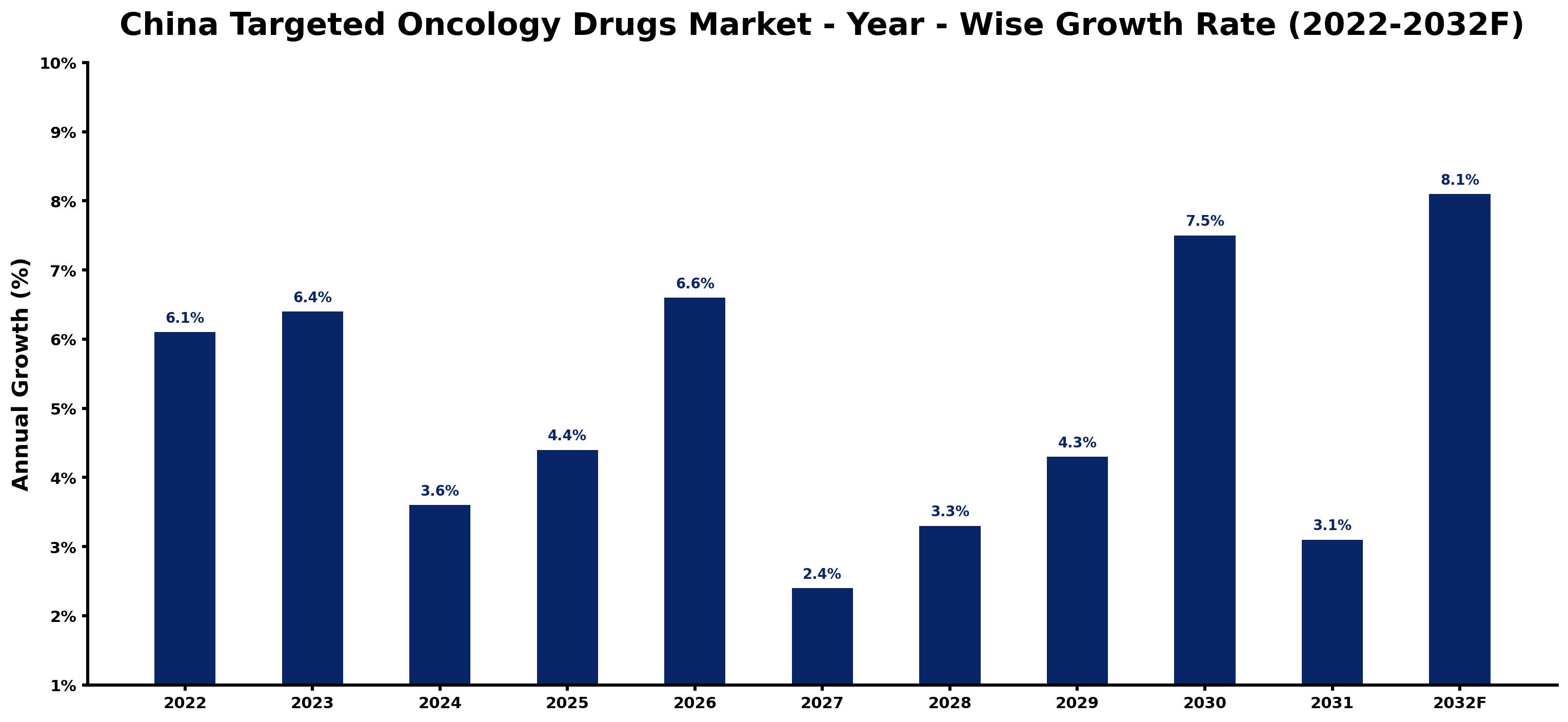
The following table presents the estimated annual growth rate for each year together with the principal factor influencing market performance.
| Year | Estimated Annual Growth (%) | Market Rationale |
| 2022 | 6.1 | The market experienced solid growth due to rising cancer incidences across the country. |
| 2023 | 6.4 | Demand increased as targeted therapies gained wider acceptance among healthcare providers. |
| 2024 | 3.6 | Growth slowed as the National Health Commission's Cancer Prevention and Control Action Plan was implemented. |
| 2025 | 4.4 | The introduction of new therapies accelerated growth, attracting more oncology centers. |
| 2026 | 6.6 | Increased investments in cancer research are expected to contribute to a faster growth rate. |
| 2027 | 2.4 | Growth is projected to slow as market saturation begins to impact new product introductions. |
| 2028 | 3.3 | A resurgence in cancer treatment initiatives is expected to stimulate demand for targeted therapies. |
| 2029 | 4.3 | The expansion of oncology centers will further boost the market's growth potential. |
| 2030 | 7.5 | Heightened awareness of targeted therapies is expected to lead to increased patient demand. |
| 2031 | 3.1 | Growth is projected to slow as competition intensifies among existing therapies in the market. |
| 2032 | 8.1 | The market is expected to peak as new therapies enter, driving substantial demand. |
Note: Market size estimations and growth projections presented in this report are based on 6Wresearch's proprietary forecasting methodology, utilizing the latest available industry data, government publications, and primary research inputs.
China Targeted Oncology Drugs Market Synopsis
Targeted oncology drugs in China are advanced treatments that specifically target molecular pathways involved in tumour growth. These drugs are developed through biotechnology methods and are primarily used for treating lung cancer, melanoma, and breast cancer. The China Targeted Oncology Drugs Market is expanding due to the rising incidence of cancer, with over 4.5 million new cases reported in 2022. The inclusion of targeted therapies in the National Reimbursement Drug List has improved accessibility, driving demand among healthcare providers and patients alike.
Market Dynamics Impact Analysis (2026–2032)
| Factor | Type | Impact | Primary Segment Affected |
| Rising cancer incidences drive demand for targeted therapies, particularly in oncology centers. | Driver | High | Lung Cancer |
| Increased investment in cancer research enhances the development of innovative therapies. | Driver | High | Oncology Centers |
| Expansion of oncology centers creates opportunities for increased therapy offerings. | Opportunity | High | Oncology Centers |
| The growing focus on cancer prevention and treatment opens avenues for new drug development. | Opportunity | High | Clinical Oncology Labs |
| Limited access to targeted therapies in rural areas restricts market growth. | Restraint | High | Cancer Hospitals |
| Stringent regulatory requirements can delay the approval of new therapies. | Restraint | High | Oncology Centers |
| The China Targeted Oncology Drugs Market faces challenges from high competition among existing therapies. | Challenge | Medium | Oncology Centers |
| The need for continuous innovation in treatment options poses a challenge for manufacturers. | Challenge | Medium | Clinical Oncology Labs |
Evaluation of Drivers in China Targeted Oncology Drugs Market (2026–2032)
The table below links each growth driver to the segment it affects and the evidence for it.
| Drivers | Primary Segment Affected | Why It Matters (Evidence) |
| Rising cancer incidences drive demand for targeted therapies. | Lung Cancer | The National Health Commission reported over 4.5 million new cancer cases in 2022, increasing the need for effective treatments. |
| Increased investment in cancer research supports the development of new therapies. | Oncology Centers | The Chinese government allocated a budget of 5 billion CNY for cancer research and drug development in 2023. |
| The inclusion of targeted therapies in the National Reimbursement Drug List boosts accessibility. | Cancer Hospitals | This policy change increases patient access to advanced treatments, encouraging more purchases. |
| Expansion of oncology centers increases the availability of targeted therapies. | Specialty Clinics | In 2023, over 300 oncology centers were reported to be offering targeted oncology treatments. |
| Growing awareness of targeted therapies among healthcare professionals drives demand. | Clinical Oncology Labs | The China Society of Clinical Oncology promotes best practices, leading to increased adoption of treatments. |
Growth in the Targeted Oncology Drugs market in China stems from increasing cancer incidences, heightened investment in cancer research and the inclusion of targeted therapies in reimbursement lists. The rising number of cancer cases has intensified the need for effective treatments. The expansion of oncology centres, with over 300 offering targeted treatments, supports demand. Awareness among healthcare professionals about targeted therapies encourages adoption and purchasing across various healthcare settings.
Evaluation of Restraints in China Targeted Oncology Drugs Market
The table below lists the restraints and the evidence behind each.
| Market Restraint | Primary Segment Affected | Why It Matters (Evidence) |
| Limited access to targeted therapies in rural areas restricts market growth. | Cancer Hospitals | Many rural regions lack sufficient healthcare infrastructure, limiting patient access to advanced treatments. |
| Stringent regulatory requirements can delay the approval of new therapies. | Oncology Centers | Manufacturers face lengthy approval processes from the China National Medical Products Administration, impacting time to market. |
| High competition among existing therapies leads to price pressures. | Oncology Centers | As more therapies enter the market, providers may face challenges in maintaining profit margins. |
| Lack of awareness about targeted therapies in underserved populations limits demand. | Specialty Clinics | Patients in these areas may not seek out advanced treatments due to insufficient information. |
| Economic fluctuations can impact healthcare budgets and spending on new therapies. | Clinical Oncology Labs | Budget constraints may lead to reduced investment in cancer treatments. |
China Targeted Oncology Drugs Market Challenges
The China Targeted Oncology Drugs Market faces a major technological challenge due to lengthy drug approval processes, which can delay new treatments from reaching patients. This issue exists because the China National Medical Products Administration requires extensive clinical data, resulting in treatment delays for hospitals that need timely access to therapies. Supply chain disruptions limit the availability of essential raw materials, causing production delays that can extend lead times for clinics. Rising costs associated with advanced biotechnology methods increase the financial burden on producers, compelling them to raise prices for buyers, which can restrict patient access to these essential therapies.
Trends in the China Targeted Oncology Drugs Market
Buyers and suppliers in the China Targeted Oncology Drugs Market are adjusting to the following trends.
- Shift from Traditional Chemotherapy to Targeted Therapies: In recent years, oncology centres have increasingly adopted targeted therapies over traditional chemotherapy, reflecting a shift in treatment paradigms. In 2023, over 300 oncology centres reported offering targeted oncology treatments, highlighting this trend.
- Emergence of Gene Mutation Inhibitors: Since 2021, Gene Mutation Inhibitors have gained prominence in treating specific cancers. The growing focus on genetic profiling has led to a 7.7% CAGR for this sub-segment, as more patients seek personalised treatment options.
- Increased Focus on Cancer Prevention Initiatives: The 'Healthy China 2030' initiative launched in 2023 emphasises cancer prevention and treatment. This program aims to reduce the cancer burden, with a budget allocation of 5 billion CNY for related efforts.
- Expansion of Clinical Oncology Labs: Clinical Oncology Labs in major cities like Beijing and Shanghai are enhancing their capabilities for targeted therapy diagnostics. This expansion is critical as it supports the growing demand for personalised cancer treatments.
Investment Opportunities in the China Targeted Oncology Drugs Market
Investors looking at the China Targeted Oncology Drugs Market should consider the following areas.
- Investment in Oncology Centers: With over 300 oncology centres now offering targeted treatments, there is an opportunity for investment in these facilities. This expansion is important as it supports the market's growth potential.
- Development of Gene Mutation Inhibitors: The rising demand for Gene Mutation Inhibitors presents a valuable investment opportunity. Manufacturers can focus on this segment to meet growing patient needs.
- Partnerships with Clinical Oncology Labs: Collaborating with Clinical Oncology Labs can improve access to targeted therapies. As these labs expand, they require innovative solutions to support their diagnostics and treatment planning.
- Focus on Rural Healthcare Initiatives: Addressing limited access to targeted therapies in rural areas presents a timely opportunity. By investing in outreach programs, suppliers can tap into underserved markets and improve patient outcomes.
Government Initiatives in the China Targeted Oncology Drugs Market
The National Health Commission has implemented various measures to improve cancer treatment accessibility. The 'Cancer Prevention and Control Action Plan (2019-2022)' launched in 2020 aimed to reduce the cancer burden and enhance treatment access. In 2021, the '13th Five-Year Plan for Health' was approved, focusing on the development of targeted therapies in oncology. Furthermore, the National Medical Products Administration introduced a fast-track approval pathway for innovative oncology drugs in 2022, significantly reducing time to market for new treatments. These initiatives collectively aim to improve patient outcomes and increase the availability of targeted oncology drugs in China.
Oncology centers benefit from the National Reimbursement Drug List, updated in 2023 to include more targeted oncology drugs, which enhances patient access to essential therapies. The Ministry of Science and Technology oversees the 'National Key Research and Development Program,' which allocates 10 billion CNY for cancer drug innovations, supporting research and development in this field. Additionally, the China Society of Clinical Oncology promotes best practices in cancer treatment, ensuring that healthcare providers are equipped with the latest knowledge and resources to deliver effective therapies. These efforts are crucial for improving treatment outcomes for cancer patients.
Future Insight of the China Targeted Oncology Drugs Market
The China Targeted Oncology Drugs Market will experience notable transformations by 2032, driven by key initiatives. The 'Healthy China 2030' initiative will enhance cancer prevention and treatment efforts nationwide. With the Chinese government allocating 5 billion CNY for cancer research in 2023, innovation in targeted therapies will accelerate, leading to improved treatment options. Over 300 oncology centres are expanding their capabilities, ensuring that more effective therapies become accessible to patients. Compliance with ISO 9001 standards will ensure a higher quality of oncology drugs produced.
Market Segmentation Analysis
The analysis below covers each segmentation, its leading category in 2025 and its fastest-growing category through 2032.
By Drug Type – ALK Inhibitors Dominated, BRAF Inhibitors Expected to Grow Fastest
According to Sumit Sagar, AM at 6Wresearch, ALK Inhibitors accounted for a 36% market share by drug type in 2025. ALK Inhibitors hold a significant share in the China Targeted Oncology Drugs Market due to their critical application in lung cancer treatment, which is a pressing health concern. The high number of lung cancer cases, exceeding 4.5 million in 2022, fuels the demand for these targeted therapies. BRAF Inhibitors are projected to grow fastest, at a CAGR of 7.7% during 2026–2032. BRAF Inhibitors are experiencing rapid growth as they specifically target melanoma, a cancer type that has gained attention in recent years. The increasing number of oncology centers offering targeted therapies is accelerating the adoption of BRAF Inhibitors, positioning them for further expansion. Suppliers should focus on enhancing the availability of BRAF Inhibitors to meet the rising market demand.
By Cancer Indication – Lung Cancer Dominated, Ovarian/Prostate Cancer Expected to Grow Fastest
Lung Cancer took a 40% share of cancer indication in 2025, more than any other category. Lung Cancer is the leading indication for targeted oncology drugs in China, primarily due to its high incidence and the emphasis on lung cancer treatment within national healthcare strategies. The prioritisation of lung cancer in funding and research reflects its significance in public health initiatives. Ovarian/Prostate Cancer is set to record the highest CAGR in this split, 6.8% over 2026–2032. Ovarian and Prostate Cancer are witnessing the fastest growth as awareness increases and treatment options become more advanced. Government efforts to improve access to targeted therapies for these cancers are expected to significantly enhance their market presence. Buyers should actively pursue targeted therapies for Ovarian and Prostate Cancer to ensure access to the latest treatment options as the market evolves.
By Mechanism of Action – Kinase Blocker Dominated, Gene Mutation Inhibitor Expected to Grow Fastest
The largest mechanism of action category in 2025 was Kinase Blocker, with a 49% share of total revenue. Kinase Blockers dominate the market as they are a key mechanism in targeted therapies, effectively addressing various cancers including lung cancer. Their established efficacy and integration into treatment protocols have solidified their leading position among oncology drugs. The quickest growth will come from Gene Mutation Inhibitor, forecast to expand at a CAGR of 7.7% between 2026 and 2032. Gene Mutation Inhibitors are growing rapidly as they specifically target genetic mutations in tumours, which is becoming increasingly relevant in precision medicine. The rise in genetic testing and personalised treatment plans is driving their adoption in clinical settings. Suppliers should invest in developing Gene Mutation Inhibitors to meet the rising demand for personalised cancer treatments.
By End User – Oncology Centers Dominated, Specialty Clinics Expected to Grow Fastest
Oncology Centers held a 40% share of the China Targeted Oncology Drugs Market by end user in 2025. Oncology Centers are the main users of targeted oncology drugs, equipped with the necessary resources to deliver specialised cancer treatments effectively. The high concentration of cancer cases within these centres ensures a steady demand for targeted therapies. Over 2026–2032, Specialty Clinics are expected to post the fastest growth, at a CAGR of 6.8%. Specialty Clinics are rapidly increasing their engagement with targeted oncology drugs, adapting their services to provide more tailored cancer treatments. This trend reflects a shift towards more accessible cancer care options for patients, enhancing their role in the market. Suppliers should consider forming partnerships with Specialty Clinics to broaden distribution and reach a larger patient base.
Key Attractiveness of the Report
- 10 Years of Market Numbers
- Historical Data Starting from 2022 to 2025
- Base Year 2025
- Forecast Data until 2032
- Key Performance Indicators Impacting the Market
- Major Upcoming Developments and Projects
Key Highlights of the Report:
- China Targeted Oncology Drugs Market Outlook
- Market Size of China Targeted Oncology Drugs Market, 2025
- Forecast of China Targeted Oncology Drugs Market, 2032
- Historical Data and Forecast of China Targeted Oncology Drugs Revenues & Volume for the Period 2022 - 2032F
- China Targeted Oncology Drugs Market Trend Evolution
- China Targeted Oncology Drugs Market Drivers and Challenges
- China Targeted Oncology Drugs Price Trends
- China Targeted Oncology Drugs Porter's Five Forces
- China Targeted Oncology Drugs Industry Life Cycle
- Historical Data and Forecast of China Targeted Oncology Drugs Market Revenues & Volume By Drug Type for the Period 2022 - 2032F
- Historical Data and Forecast of China Targeted Oncology Drugs Market Revenues & Volume By ALK Inhibitors for the Period 2022 - 2032F
- Historical Data and Forecast of China Targeted Oncology Drugs Market Revenues & Volume By BRAF Inhibitors for the Period 2022 - 2032F
- Historical Data and Forecast of China Targeted Oncology Drugs Market Revenues & Volume By HER2 Inhibitors for the Period 2022 - 2032F
- Historical Data and Forecast of China Targeted Oncology Drugs Market Revenues & Volume By PARP Inhibitors for the Period 2022 - 2032F
- Historical Data and Forecast of China Targeted Oncology Drugs Market Revenues & Volume By Cancer Indication for the Period 2022 - 2032F
- Historical Data and Forecast of China Targeted Oncology Drugs Market Revenues & Volume By Lung Cancer for the Period 2022 - 2032F
- Historical Data and Forecast of China Targeted Oncology Drugs Market Revenues & Volume By Melanoma for the Period 2022 - 2032F
- Historical Data and Forecast of China Targeted Oncology Drugs Market Revenues & Volume By Breast Cancer for the Period 2022 - 2032F
- Historical Data and Forecast of China Targeted Oncology Drugs Market Revenues & Volume By Ovarian/Prostate Cancer for the Period 2022 - 2032F
- Historical Data and Forecast of China Targeted Oncology Drugs Market Revenues & Volume By Mechanism of Action for the Period 2022 - 2032F
- Historical Data and Forecast of China Targeted Oncology Drugs Market Revenues & Volume By Kinase Blocker for the Period 2022 - 2032F
- Historical Data and Forecast of China Targeted Oncology Drugs Market Revenues & Volume By Gene Mutation Inhibitor for the Period 2022 - 2032F
- Historical Data and Forecast of China Targeted Oncology Drugs Market Revenues & Volume By Receptor Blocker for the Period 2022 - 2032F
- Historical Data and Forecast of China Targeted Oncology Drugs Market Revenues & Volume By DNA Repair Inhibition for the Period 2022 - 2032F
- Historical Data and Forecast of China Targeted Oncology Drugs Market Revenues & Volume By End User for the Period 2022 - 2032F
- Historical Data and Forecast of China Targeted Oncology Drugs Market Revenues & Volume By Oncology Centers for the Period 2022 - 2032F
- Historical Data and Forecast of China Targeted Oncology Drugs Market Revenues & Volume By Cancer Hospitals for the Period 2022 - 2032F
- Historical Data and Forecast of China Targeted Oncology Drugs Market Revenues & Volume By Specialty Clinics for the Period 2022 - 2032F
- Historical Data and Forecast of China Targeted Oncology Drugs Market Revenues & Volume By Clinical Oncology Labs for the Period 2022 - 2032F
- China Targeted Oncology Drugs Import Export Trade Statistics
- Market Opportunity Assessment By Drug Type
- Market Opportunity Assessment By Cancer Indication
- Market Opportunity Assessment By Mechanism of Action
- Market Opportunity Assessment By End User
- China Targeted Oncology Drugs Top Companies Market Share
- China Targeted Oncology Drugs Competitive Benchmarking By Technical and Operational Parameters
- China Targeted Oncology Drugs Company Profiles
- China Targeted Oncology Drugs Key Strategic Recommendations
Market Covered
This report examines the market across the segments below.
By Drug Type
- ALK Inhibitors
- BRAF Inhibitors
- HER2 Inhibitors
- PARP Inhibitors
By Cancer Indication
- Lung Cancer
- Melanoma
- Breast Cancer
- Ovarian/Prostate Cancer
By Mechanism of Action
- Kinase Blocker
- Gene Mutation Inhibitor
- Receptor Blocker
- DNA Repair Inhibition
By End User
- Oncology Centers
- Cancer Hospitals
- Specialty Clinics
- Clinical Oncology Labs































