India Telecom Computing Architecture Market Size & Growth Rate
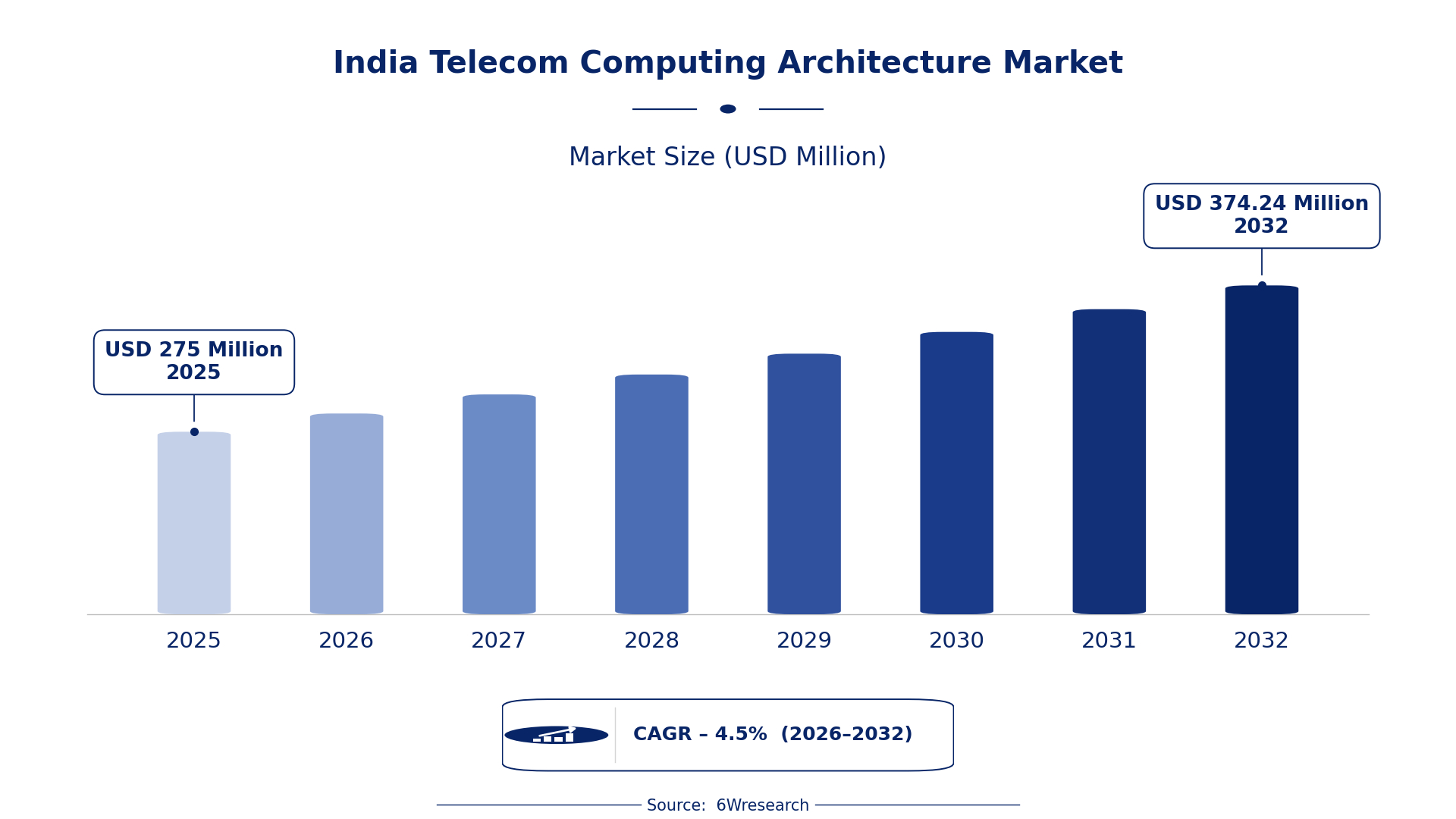
According to 6Wresearch internal database and industry insights, the India Telecom Computing Architecture Market was valued at USD 275.0 million in 2025 and is projected to reach USD 374.24 million by 2032, growing at a CAGR of approximately 4.5% during 2026–2032.
India Telecom Computing Architecture Market Highlights
| Report Metric | Details |
| Report Name | India Telecom Computing Architecture Market |
| Market Size 2025 | USD 275.0 million |
| Market Size 2032 | USD 374.24 million |
| Absolute Growth 2025–2032 | USD 99.24 million |
| CAGR 2026–2032 | 4.5% |
| Peak Annual Growth | 6.9% in 2032 |
| Forecast Period | 2026–2032 |
| Historical Data | 2022–2025 |
| Base Year | 2025 |
| Leading Telecom Computing Architecture, 2025 | NFV Infrastructure (43% share) |
| Leading Product Type, 2025 | Virtualized Servers (46% share) |
| Leading Architecture Type, 2025 | AdvancedTCA (32% share) |
| Leading Distribution Channel, 2025 | OEMs (44% share) |
| Leading End User Industry, 2025 | 5G Deployment Firms (46% share) |
| Fastest-Growing Telecom Computing Architecture | Edge Computing Platforms (6.8% CAGR) |
| Fastest-Growing Architecture Type | x86/ARM (6.3% CAGR) |
| Fastest-Growing Distribution Channel | Cloud Providers (6.2% CAGR) |
| Fastest-Growing End User Industry | Core Network Providers (7.1% CAGR) |
| Growing Sector | Telecom Cloud Operators |
| Key End Users | 5G Deployment Firms, Telecom Cloud Operators, Core Network Providers |
India Telecom Computing Architecture Market Year-wise Growth Rate and Key Drivers (2022–2032)
This graph illustrates the annual growth rates of the market from 2022 to 2032, highlighting a steady upward trajectory and projected market expansion over the forecast period.
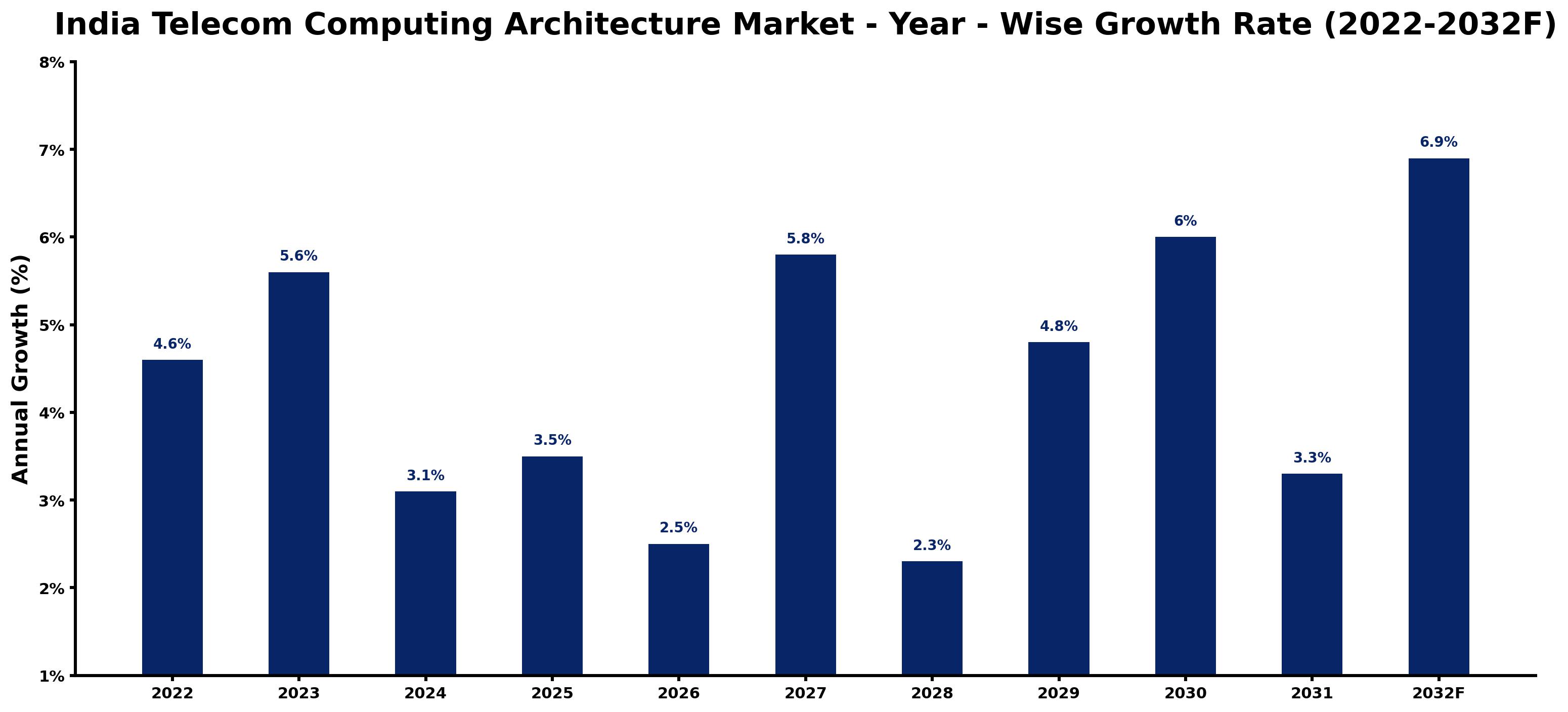
The following table presents the estimated annual growth rate for each year together with the principal factor influencing market performance.
| Year | Estimated Annual Growth (%) | Market Rationale |
| 2022 | 4.6 | The market experienced steady growth due to increasing telecom infrastructure investments. |
| 2023 | 5.6 | Demand surged as 5G rollout preparations accelerated across major cities. |
| 2024 | 3.1 | Growth slowed as the market adjusted to the initial impacts of 5G deployment. |
| 2025 | 3.5 | Investment in telecom infrastructure continued to rise, driven by the National Digital Communications Policy 2020. |
| 2026 | 2.5 | A slowdown occurred as growth stabilised following prior rapid expansions. |
| 2027 | 5.8 | Demand increased with heightened focus on advanced telecom solutions and services from telecom cloud operators. |
| 2028 | 2.3 | Growth slowed again as the market faced challenges in sustaining momentum amid evolving technologies. |
| 2029 | 4.8 | A resurgence in demand was noted as telecom firms invested in new technologies and infrastructure. |
| 2030 | 6.0 | Growth picked up again with a renewed focus on cloud services and edge computing initiatives. |
| 2031 | 3.3 | The market slowed as firms adjusted to changing technology landscapes and regulatory requirements. |
| 2032 | 6.9 | Demand is expected to peak as 5G networks become fully operational and accessible. |
Note: Market size estimations and growth projections presented in this report are based on 6Wresearch's proprietary forecasting methodology, utilizing the latest available industry data, government publications, and primary research inputs.
India Telecom Computing Architecture Market Synopsis
The Telecom Computing Architecture Market in India integrates hardware and software components to deliver telecommunications services. It supports 5G networks, enhances data processing capabilities, and enables cloud services. The market is expanding due to substantial investments in telecom infrastructure, with forecasts suggesting it will reach USD 275.0 million by 2025. The ongoing deployment of 5G networks and the drive for broadband access are increasing demand from various buyer groups, including telecom cloud operators and firms focused on 5G implementation.
Market Dynamics Impact Analysis (2026–2032)
| Factor | Type | Impact | Primary Segment Affected |
| Increasing telecom infrastructure investment is driving demand for advanced computing solutions. | Driver | High | NFV Infrastructure |
| The rollout of 5G networks is creating a need for more sophisticated telecom architectures. | Driver | High | NFV Infrastructure |
| Growing demand for edge computing solutions presents opportunities for suppliers. | Opportunity | High | Edge Computing Platforms |
| The expansion of cloud services creates a significant market for telecom computing solutions. | Opportunity | High | Telecom Cloud Operators |
| High costs associated with infrastructure development can limit market growth. | Restraint | High | NFV Infrastructure |
| Regulatory hurdles may slow down the deployment of new technologies. | Restraint | Medium | NFV Infrastructure |
| The Telecom Computing Architecture Market in India faces challenges in keeping pace with rapid technological changes. | Challenge | High | NFV Infrastructure |
| Competition from alternative technologies can hinder market expansion. | Challenge | Medium | NFV Infrastructure |
Evaluation of Drivers in India Telecom Computing Architecture Market (2026–2032)
The main growth drivers and the segments they affect most are set out below.
| Drivers | Primary Segment Affected | Why It Matters (Evidence) |
| Increased investment in telecom infrastructure is driving demand for modular designs. | NFV Infrastructure | Telecom infrastructure investment in India is projected to exceed $100 billion by 2025. |
| The 5G rollout is creating demand for advanced telecom computing solutions. | NFV Infrastructure | 5G rollout is targeted for completion in major cities by 2024. |
| The rise of cloud services is boosting demand for virtualized servers. | Virtualized Servers | Telecom Cloud Operators are anticipated to grow by 30% annually through 2025. |
| Growing internet penetration is increasing demand for telecom computing architectures. | NFV Infrastructure | India has over 700 million internet users as of 2023. |
| The push for edge computing is driving demand for localized processing solutions. | Edge Computing Platforms | The Ministry of Electronics and Information Technology supports edge computing initiatives. |
The Telecom Computing Architecture market in India is growing on the back of rising end-use demand, increased infrastructure investment, and the push for advanced technologies. Telecom infrastructure investment is projected to exceed $100 billion by 2025, prompting firms to seek modular designs. The anticipated completion of 5G rollout in major cities by 2024 is further driving demand for advanced telecom computing solutions.
Evaluation of Restraints in India Telecom Computing Architecture Market
Below mentioned are some major restraints and their influence on market dynamics.
| Market Restraint | Primary Segment Affected | Why It Matters (Evidence) |
| High costs associated with telecom infrastructure development can limit growth. | NFV Infrastructure | Investment in infrastructure is expected to exceed $100 billion by 2025. |
| Regulatory hurdles may slow down the deployment of new technologies. | NFV Infrastructure | The Department of Telecommunications oversees telecom regulations in India. |
| Challenges in maintaining service quality can deter user adoption. | NFV Infrastructure | The Telecom Regulatory Authority of India updated QoS standards in 2021. |
| Market volatility can affect investment decisions in telecom infrastructure. | NFV Infrastructure | The National Telecom Policy 2022 focuses on enhancing connectivity. |
| Competition from alternative technologies may limit market growth. | NFV Infrastructure | Emerging technologies continuously reshape telecom offerings. |
India Telecom Computing Architecture Market Challenges
The India Telecom Computing Architecture market encounters several practical challenges, beginning with outdated technology that increases operational costs for producers. Legacy systems obstruct the integration of new solutions, delaying the crucial 5G rollout for buyers and hindering their ability to achieve the target of 1.2 billion subscribers by 2025. Intense competition among telecom providers drives prices down, compelling buyers to accept lower service quality, which can lead to customer dissatisfaction. Supply chain disruptions also impact the availability of essential components, causing delays in infrastructure investments expected to exceed $100 billion by 2025 for producers.
Trends in the India Telecom Computing Architecture Market
Four trends stand out in the India Telecom Computing Architecture Market.
- Shift towards Edge Computing Solutions: The Indian telecom sector is increasingly embracing edge computing solutions to enhance service delivery. The Ministry of Electronics and Information Technology supports initiatives that facilitate this transition, with telecom cloud operators anticipated to grow by 30% annually through 2025.
- Adoption of 5G Technologies: The 5G Test Bed initiative, launched in 2021, is enabling the development and testing of 5G technologies in India. This initiative is poised to increase demand for telecom computing architecture as the rollout progresses, with completion aimed for major cities by 2024.
- Growing Focus on Virtualized Servers: Virtualized servers are becoming crucial in the telecom sector, driven by the rising demand for cloud services. With telecom cloud operators expected to grow significantly, this trend is reshaping architecture requirements.
- Expansion of Broadband Access: The National Digital Communications Policy 2020 aims to provide broadband access to all citizens by 2022. This initiative is set to enhance telecom infrastructure, driving demand for telecom computing architectures.
Investment Opportunities in the India Telecom Computing Architecture Market
Below are the investment opportunities with the strongest case in the India Telecom Computing Architecture Market.
- Investment in Edge Computing: With the rise of edge computing, suppliers have an opportunity to invest in localized processing solutions. The Ministry of Electronics and Information Technology is advocating for edge computing initiatives, with telecom cloud operators projected to grow by 30% annually through 2025.
- Supply for 5G Deployment: As 5G networks are rolled out, there is a growing need for advanced telecom computing architecture. 5G deployment firms are key buyers, and suppliers can enter the market through partnerships or local collaborations.
- Cloud Services Expansion: The increasing demand for cloud services presents an opportunity for investment in virtualized servers. Telecom cloud operators are expected to grow significantly, providing a pathway for suppliers to engage with this buyer group.
- Broadband Infrastructure Development: The ongoing push for broadband access creates opportunities for investment in telecom computing solutions. The National Digital Communications Policy 2020 aims for universal broadband access by 2022, improving market prospects.
Government Initiatives in the India Telecom Computing Architecture Market
The National Digital Communications Policy 2020, introduced by the Ministry of Communications, aims to provide broadband access to all citizens by 2022, improving telecom infrastructure across India. This policy is important for telecom computing architecture producers, as it mandates enhancements in service delivery and infrastructure investment. Additionally, the Telecom Regulatory Authority of India (TRAI) updated the Quality of Service (QoS) standards in 2021 to ensure better service delivery for telecom users, which directly affects performance expectations for telecom computing solutions. The Department of Telecommunications (DoT) initiated the 5G Test Bed program in 2021 to support research and development in 5G technologies, encouraging innovation and collaboration in the sector. These measures aim to strengthen the telecom environment and support the growth of computing architectures.
The Telecom Equipment and Services Export Promotion Council actively supports export initiatives for telecom computing solutions, assisting manufacturers in reaching international markets. The National Broadband Mission, launched in 2020, focuses on providing affordable broadband access across rural and urban areas, enhancing connectivity for telecom service providers. This mission encourages investment in telecom infrastructure, ensuring that buyers can access advanced computing architectures. The Digital India initiative, launched in 2015, continues to promote the growth of telecom services and infrastructure, benefiting both producers and buyers in the telecom computing architecture market. These government schemes provide necessary funding and approvals that facilitate the expansion of telecom computing capabilities in India.
Future Insight of the India Telecom Computing Architecture Market
The India Telecom Computing Architecture market is set to evolve significantly by 2032, driven by advancements in cloud services and edge computing initiatives. The completion of the 5G rollout in major cities by 2024 will improve connectivity for buyers and broaden service offerings. Regulatory frameworks like the National Digital Communications Policy 2020 will ensure wider broadband access, promoting market growth. The telecom sector is projected to see a 30% annual increase in telecom cloud operators through 2025, creating new opportunities for suppliers.
Market Segmentation Analysis
The report offers a comprehensive study of the following market segments and their leading categories in the market.
By Telecom Computing Architecture – NFV Infrastructure Dominated, Edge Computing Platforms Expected to Grow Fastest
According to Sumit Sagar, AM at 6Wresearch, NFV Infrastructure took a 43% share of telecom computing architecture in 2025, more than any other category. NFV Infrastructure leads the market in India because it supports network functions virtualization, which is essential for the flexibility required by telecom operators. With a projected telecom subscriber base of 1.2 billion by 2025, this infrastructure is increasingly vital. Edge Computing Platforms are set to record the highest CAGR in this split, 6.8% over 2026–2032. Edge Computing Platforms are growing quickly as they enable data processing at the network edge, which significantly reduces latency for users. The 5G Test Bed initiative launched by the Indian government in 2021 is expected to further boost the adoption of these platforms. Suppliers should focus on enhancing NFV and edge computing offerings to meet the rising demand in the telecom sector.
By Product Type – Virtualized Servers Dominated and Is Expected to Record the Fastest Growth
Virtualized Servers held a 46% share of the India Telecom Computing Architecture Market by product type in 2025. Virtualized Servers command the largest market share as they are essential for enabling cloud-based telecom services, which are in high demand. With over 700 million internet users in India, the need for scalable and efficient server solutions continues to grow. Virtualized Servers are also forecast to expand faster than any other category, at a CAGR of 6.0% over 2026–2032. The growth of Virtualized Servers is propelled by the increasing reliance on cloud services within the telecom sector, especially with the rollout of 5G networks. This trend ensures that Virtualized Servers will remain at the forefront of telecom computing architecture. Buyers should prioritise investments in virtualized server technologies to maximise the benefits of cloud computing in their operations.
By Architecture Type – AdvancedTCA Dominated, x86/ARM Expected to Grow Fastest
With a 32% revenue share in 2025, AdvancedTCA was the largest architecture type category. AdvancedTCA holds the largest market share due to its widespread adoption in telecom for high reliability, making it a preferred choice among service providers. Its effectiveness in supporting critical telecom applications reinforces its dominant position. The quickest growth will come from x86/ARM, forecast to expand at a CAGR of 6.3% between 2026 and 2032. x86/ARM architectures are rapidly gaining traction as they provide versatile solutions that cater to various telecom computing needs. Their adaptability and efficiency are appealing to firms looking to modernise their infrastructure. Suppliers should broaden their offerings to include x86/ARM solutions to capture the growing interest in flexible architecture types.
By Distribution Channel – OEMs Dominated, Cloud Providers Expected to Grow Fastest
OEMs accounted for a 44% market share by distribution channel in 2025. OEMs command the largest share of the market as they are the primary manufacturers of telecom computing solutions, supplying essential hardware to operators. Their established relationships with telecom providers ensure a steady demand for their products. Cloud Providers are projected to grow fastest, at a CAGR of 6.2% during 2026–2032. Cloud Providers are experiencing the fastest growth as they distribute telecom computing resources, aligning with the industry's shift towards cloud solutions. The increasing emphasis on digital infrastructure further supports their expansion. Buyers should consider partnerships with cloud providers to optimise their telecom computing resources and improve service delivery.
By End User Industry – 5G Deployment Firms Dominated, Core Network Providers Expected to Grow Fastest
In 2025, 5G Deployment Firms led the end user industry split with a 46% share. 5G Deployment Firms represent the largest share in the market as they are crucial for implementing next-generation networks, which are pivotal for India's telecom future. Continuous investments in 5G infrastructure underscore their importance in the market. Core Network Providers are set to record the highest CAGR in this split, 7.1% over 2026–2032. Core Network Providers are witnessing the fastest growth as they are essential users of telecom architectures, vital for maintaining robust network operations. Their role in supporting the expanding telecom ecosystem drives their rapid adoption. Suppliers must align their strategies with the needs of core network providers to ensure their solutions meet the demands of a rapidly evolving telecom landscape.
Key Attractiveness of the Report
- 10 Years of Market Numbers
- Historical Data Starting from 2022 to 2025
- Base Year 2025
- Forecast Data until 2032
- Key Performance Indicators Impacting the Market
- Major Upcoming Developments and Projects
Key Highlights of the Report:
- India Telecom Computing Architecture Market Outlook
- Market Size of India Telecom Computing Architecture Market, 2025
- Forecast of India Telecom Computing Architecture Market, 2032
- Historical Data and Forecast of India Telecom Computing Architecture Revenues & Volume for the Period 2022 - 2032F
- India Telecom Computing Architecture Market Trend Evolution
- India Telecom Computing Architecture Market Drivers and Challenges
- India Telecom Computing Architecture Price Trends
- India Telecom Computing Architecture Porter's Five Forces
- India Telecom Computing Architecture Industry Life Cycle
- Historical Data and Forecast of India Telecom Computing Architecture Market Revenues & Volume By Telecom Computing Architecture for the Period 2022 - 2032F
- Historical Data and Forecast of India Telecom Computing Architecture Market Revenues & Volume By ATCA Systems for the Period 2022 - 2032F
- Historical Data and Forecast of India Telecom Computing Architecture Market Revenues & Volume By MicroTCA Platforms for the Period 2022 - 2032F
- Historical Data and Forecast of India Telecom Computing Architecture Market Revenues & Volume By NFV Infrastructure for the Period 2022 - 2032F
- Historical Data and Forecast of India Telecom Computing Architecture Market Revenues & Volume By Edge Computing Platforms for the Period 2022 - 2032F
- Historical Data and Forecast of India Telecom Computing Architecture Market Revenues & Volume By Product Type for the Period 2022 - 2032F
- Historical Data and Forecast of India Telecom Computing Architecture Market Revenues & Volume By Modular Chassis for the Period 2022 - 2032F
- Historical Data and Forecast of India Telecom Computing Architecture Market Revenues & Volume By Compact Systems for the Period 2022 - 2032F
- Historical Data and Forecast of India Telecom Computing Architecture Market Revenues & Volume By Virtualized Servers for the Period 2022 - 2032F
- Historical Data and Forecast of India Telecom Computing Architecture Market Revenues & Volume By Edge Servers for the Period 2022 - 2032F
- Historical Data and Forecast of India Telecom Computing Architecture Market Revenues & Volume By Architecture Type for the Period 2022 - 2032F
- Historical Data and Forecast of India Telecom Computing Architecture Market Revenues & Volume By AdvancedTCA for the Period 2022 - 2032F
- Historical Data and Forecast of India Telecom Computing Architecture Market Revenues & Volume By MicroTCA for the Period 2022 - 2032F
- Historical Data and Forecast of India Telecom Computing Architecture Market Revenues & Volume By x86/ARM for the Period 2022 - 2032F
- Historical Data and Forecast of India Telecom Computing Architecture Market Revenues & Volume By SD-WAN Based for the Period 2022 - 2032F
- Historical Data and Forecast of India Telecom Computing Architecture Market Revenues & Volume By Distribution Channel for the Period 2022 - 2032F
- Historical Data and Forecast of India Telecom Computing Architecture Market Revenues & Volume By OEMs for the Period 2022 - 2032F
- Historical Data and Forecast of India Telecom Computing Architecture Market Revenues & Volume By System Integrators for the Period 2022 - 2032F
- Historical Data and Forecast of India Telecom Computing Architecture Market Revenues & Volume By Cloud Providers for the Period 2022 - 2032F
- Historical Data and Forecast of India Telecom Computing Architecture Market Revenues & Volume By Direct Sales for the Period 2022 - 2032F
- Historical Data and Forecast of India Telecom Computing Architecture Market Revenues & Volume By End User Industry for the Period 2022 - 2032F
- Historical Data and Forecast of India Telecom Computing Architecture Market Revenues & Volume By Core Network Providers for the Period 2022 - 2032F
- Historical Data and Forecast of India Telecom Computing Architecture Market Revenues & Volume By 5G Deployment Firms for the Period 2022 - 2032F
- Historical Data and Forecast of India Telecom Computing Architecture Market Revenues & Volume By Telecom Cloud Operators for the Period 2022 - 2032F
- Historical Data and Forecast of India Telecom Computing Architecture Market Revenues & Volume By Edge Service Providers for the Period 2022 - 2032F
- India Telecom Computing Architecture Import Export Trade Statistics
- Market Opportunity Assessment By Telecom Computing Architecture
- Market Opportunity Assessment By Product Type
- Market Opportunity Assessment By Architecture Type
- Market Opportunity Assessment By Distribution Channel
- Market Opportunity Assessment By End User Industry
- India Telecom Computing Architecture Top Companies Market Share
- India Telecom Computing Architecture Competitive Benchmarking By Technical and Operational Parameters
- India Telecom Computing Architecture Company Profiles
- India Telecom Computing Architecture Key Strategic Recommendations
Market Covered
The report offers an extensive study of the following market segments.
By Telecom Computing Architecture
- ATCA Systems
- MicroTCA Platforms
- NFV Infrastructure
- Edge Computing Platforms
By Product Type
- Modular Chassis
- Compact Systems
- Virtualized Servers
- Edge Servers
By Architecture Type
- AdvancedTCA
- MicroTCA
- x86/ARM
- SD-WAN Based
By Distribution Channel
- OEMs
- System Integrators
- Cloud Providers
- Direct Sales
By End User Industry
- Core Network Providers
- 5G Deployment Firms
- Telecom Cloud Operators
- Edge Service Providers































