China Telecom Computing Architecture Market Size & Growth Rate
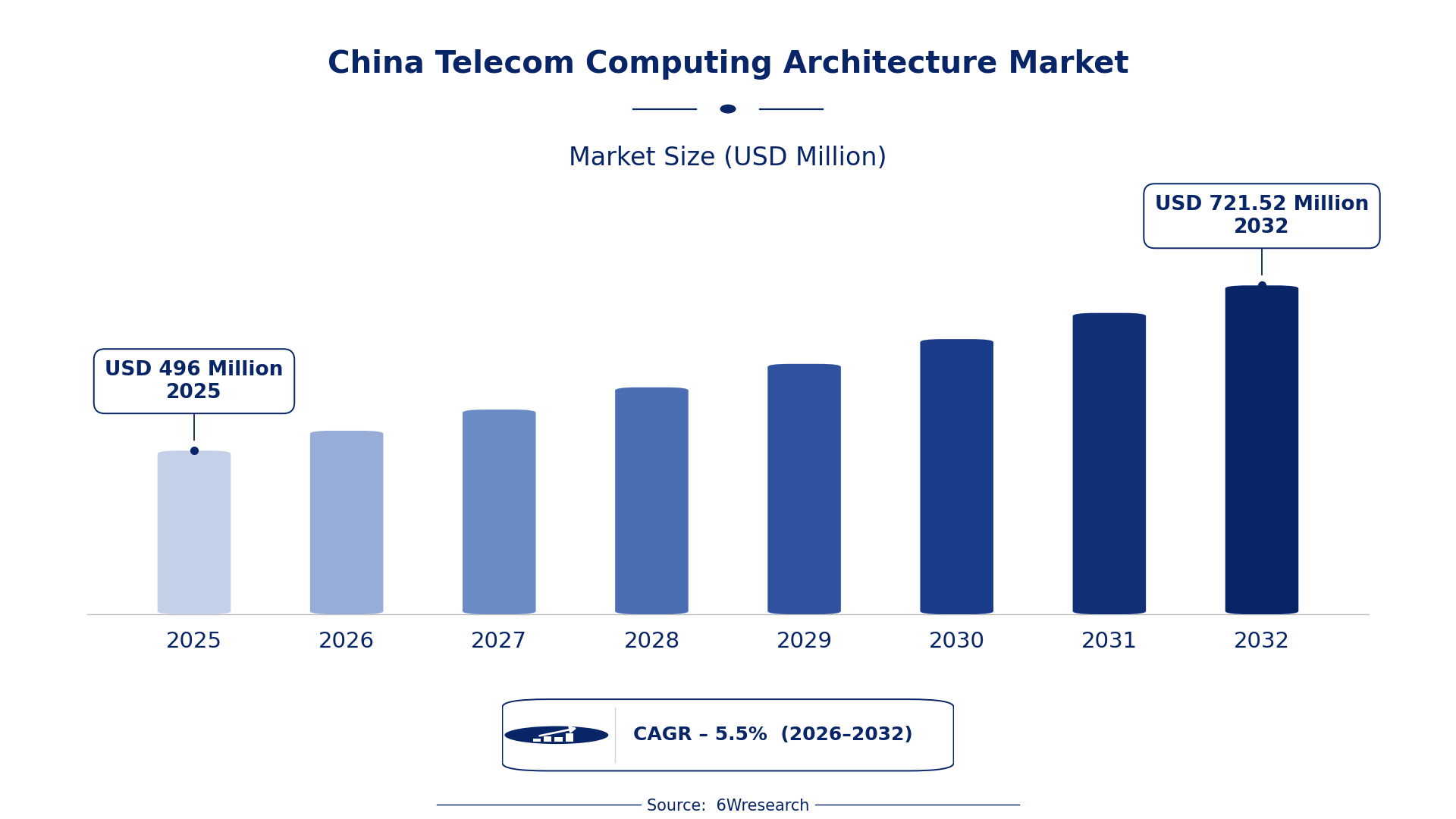
According to 6Wresearch internal database and industry insights, the China Telecom Computing Architecture Market was valued at USD 496.0 million in 2025 and is projected to reach USD 721.52 million by 2032, growing at a CAGR of approximately 5.5% during 2026–2032.
China Telecom Computing Architecture Market Highlights
| Report Metric | Details |
| Report Name | China Telecom Computing Architecture Market |
| Market Size 2025 | USD 496.0 million |
| Market Size 2032 | USD 721.52 million |
| Absolute Growth 2025–2032 | USD 225.52 million |
| CAGR 2026–2032 | 5.5% |
| Peak Annual Growth | 7.6% in 2028 |
| Forecast Period | 2026–2032 |
| Historical Data | 2022–2025 |
| Base Year | 2025 |
| Leading Telecom Computing Architecture, 2025 | NFV Infrastructure (43% share) |
| Leading Product Type, 2025 | Virtualized Servers (37% share) |
| Leading Architecture Type, 2025 | AdvancedTCA (45% share) |
| Leading Distribution Channel, 2025 | OEMs (46% share) |
| Leading End User Industry, 2025 | 5G Deployment Firms (34% share) |
| Fastest-Growing Telecom Computing Architecture | Edge Computing Platforms (7.5% CAGR) |
| Fastest-Growing Architecture Type | SD-WAN Based (6.7% CAGR) |
| Fastest-Growing Distribution Channel | Cloud Providers (8.1% CAGR) |
| Fastest-Growing End User Industry | Core Network Providers (8.2% CAGR) |
| Growing Sector | Telecom Cloud Operators |
| Key End Users | Telecom Cloud Operators, 5G Deployment Firms, Edge Service Providers |
China Telecom Computing Architecture Market Year-wise Growth Rate and Key Drivers (2022–2032)
This graph illustrates the annual growth rates of the market from 2022 to 2032, highlighting a steady upward trajectory and projected market expansion over the forecast period.
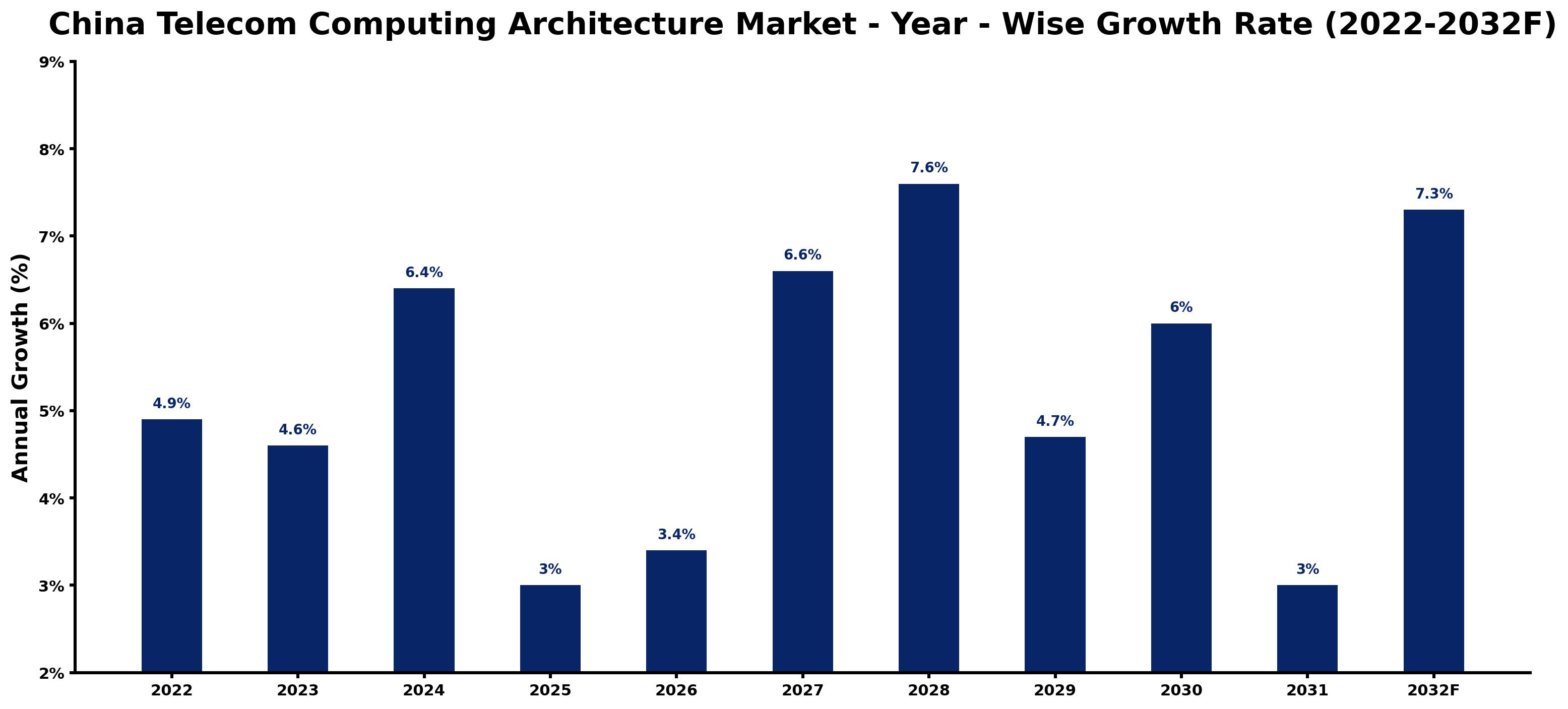
The table below sets out the estimated growth rate for each year and the main factor behind it.
| Year | Estimated Annual Growth (%) | Market Rationale |
| 2022 | 4.9 | The market experienced steady demand from telecom infrastructure investments. |
| 2023 | 4.6 | Growth slowed due to a temporary reduction in infrastructure spending. |
| 2024 | 6.4 | Increased investments in 5G deployment boosted market growth. |
| 2025 | 3.0 | Demand slowed as firms adjusted to prior investments in infrastructure. |
| 2026 | 3.4 | Demand is expected to rise as firms adopt advanced telecom technologies. |
| 2027 | 6.6 | Investment in edge computing solutions will drive market expansion. |
| 2028 | 7.6 | Peak growth is projected as 5G networks achieve wider urban coverage. |
| 2029 | 4.7 | Growth will slow as market conditions normalise after rapid expansion. |
| 2030 | 6.0 | Adoption of cloud services is expected to drive demand higher again. |
| 2031 | 3.0 | Growth is projected to slow as the market adjusts to new technology standards. |
| 2032 | 7.3 | A resurgence in demand for telecom architecture is expected due to the 5G Action Plan. |
Note: Market size estimations and growth projections presented in this report are based on 6Wresearch's proprietary forecasting methodology, utilizing the latest available industry data, government publications, and primary research inputs.
China Telecom Computing Architecture Market Synopsis
Telecom Computing Architecture in China refers to the structural design and framework used in telecommunications systems, enabling efficient data processing and management. It integrates hardware and software components to support 5G networks and optimize data traffic management. The China Telecom Computing Architecture Market is growing due to substantial investments in 5G infrastructure, with $30 billion allocated for network expansion in 2023. The National Development and Reform Commission's support for telecom innovation further fuels this demand, ensuring a thriving market environment.
Market Dynamics Impact Analysis (2026–2032)
| Factor | Type | Impact | Primary Segment Affected |
| Rising mobile subscriber base drives demand for advanced telecom solutions. | Driver | High | NFV Infrastructure |
| Increased investment in 5G infrastructure enhances network capabilities. | Driver | High | NFV Infrastructure |
| Growing need for cloud services presents opportunities for investment. | Opportunity | High | Telecom Cloud Operators |
| Expansion of edge computing solutions creates new market avenues. | Opportunity | Medium | Edge Computing Platforms |
| High competition among telecom providers may limit profit margins. | Restraint | High | NFV Infrastructure |
| Regulatory challenges can delay project approvals and implementations. | Restraint | Medium | NFV Infrastructure |
| Telecom Computing Architecture in China faces challenges from rapid technological changes. | Challenge | High | NFV Infrastructure |
| Supply chain disruptions can impact the availability of telecom components. | Challenge | Medium | NFV Infrastructure |
Evaluation of Drivers in China Telecom Computing Architecture Market (2026–2032)
The table below links each growth driver to the segment it affects and the evidence for it.
| Drivers | Primary Segment Affected | Why It Matters (Evidence) |
| Increased mobile subscriptions drive demand for telecom architecture. | NFV Infrastructure | China has over 1.4 billion mobile subscribers as of 2023, leading to higher demand for infrastructure. |
| Investments in 5G infrastructure boost market growth. | NFV Infrastructure | In 2023, China allocated $30 billion for 5G network expansion, increasing architecture needs. |
| Cloud service adoption increases demand for virtualized servers. | Virtualized Servers | Telecom Cloud Operators are projected to grow by 15% annually through 2025, reflecting rising demand. |
| Edge computing solutions support data processing needs. | Edge Computing Platforms | The Edge Computing Development Plan supports urban deployment, enhancing demand for these solutions. |
| The push for network function virtualization drives architecture innovation. | NFV Infrastructure | Telecommunication standards defined by the Telecommunication Technology Association promote NFV adoption. |
Market growth for Telecom Computing Architecture in China is underpinned by increased mobile subscriptions, investments in 5G infrastructure, and cloud service adoption. The demand for advanced telecom solutions is substantial, driven by over 1.4 billion mobile subscribers in 2023. The allocation of $30 billion for 5G expansion further boosts the need for new architecture. The expected growth of Telecom Cloud Operators highlights the increasing need for virtualized servers. The Edge Computing Development Plan supports the deployment of edge computing solutions, driving demand for telecom architecture.
Evaluation of Restraints in China Telecom Computing Architecture Market
The main factors holding the market back are set out below.
| Market Restraint | Primary Segment Affected | Why It Matters (Evidence) |
| Intense competition among telecom providers can compress profit margins. | NFV Infrastructure | With numerous players in the market, price wars can limit profitability for providers. |
| Regulatory hurdles can delay project approvals and implementations. | NFV Infrastructure | Strict telecom regulations overseen by the Ministry of Industry and Information Technology can slow down deployment. |
| Rapid technological changes require constant adaptation from suppliers. | NFV Infrastructure | The fast pace of innovation in telecom technology necessitates ongoing investment in R&D. |
| Supply chain disruptions can hinder component availability. | NFV Infrastructure | Global supply chain issues have affected the timely delivery of essential telecom components. |
| High initial investment costs can deter new entrants. | NFV Infrastructure | The substantial capital required for infrastructure can limit market participation. |
China Telecom Computing Architecture Market Challenges
The China Telecom Computing Architecture Market encounters several practical issues, with high costs for buyers being a primary concern. In 2023, telecom infrastructure investment reached $50 billion, escalating expenses for companies requiring advanced systems. Supply chain delays also impede progress, as Shenzhen, a key manufacturing hub, faces component shortages, extending lead times for equipment delivery by up to six weeks. Rapidly changing standards from the Telecommunication Technology Association present technological challenges, complicating compliance for suppliers and potentially delaying project timelines by several months. Regulatory hurdles are present as well, with the Ministry of Industry and Information Technology enforcing strict guidelines that can prolong project approvals for new initiatives by an average of three months.
Trends in the China Telecom Computing Architecture Market
Below mentioned are some of the trends shaping the China Telecom Computing Architecture Market growth.
- Shift towards Edge Computing Solutions: China is increasingly adopting edge computing solutions to improve data processing efficiency. The Edge Computing Development Plan, launched in 2021, allocates $20 billion over five years to support this shift.
- Growth of Cloud-Based Telecom Services: The demand for cloud-based telecom services is rising, driven by the Telecom Cloud Services Promotion Program. This initiative aims for a 30% increase in cloud solutions by 2025.
- Expansion of 5G Infrastructure: The 5G Infrastructure Development Plan aims for nationwide coverage by 2025, enhancing connectivity across urban areas. This plan is supported by a $50 billion allocation for infrastructure upgrades.
- Increased Focus on Cybersecurity Standards: The National Cybersecurity Strategy emphasises secure telecom infrastructure, impacting architecture standards. This focus is important for ensuring data protection in a growing digital economy.
Investment Opportunities in the China Telecom Computing Architecture Market
Several openings in the China Telecom Computing Architecture Market merit attention from investors.
- Partnerships with Telecom Cloud Operators: Now is an ideal time to invest in partnerships with Telecom Cloud Operators, expected to grow by 15% annually. Collaborating with these firms can improve service offerings and market reach.
- Investment in Edge Computing Facilities: Shenzhen is a key hub for telecom innovation, making it a prime location for investing in edge computing facilities. This investment can cater to the growing demand for localized data processing.
- Collaboration with 5G Deployment Firms: 5G Deployment Firms are significant buyers of telecom architecture, with a 34% market share in 2025. Establishing joint ventures can facilitate entry into this lucrative segment.
- Regulatory Support for Cloud Services: The Telecom Cloud Services Promotion Program encourages investment in cloud solutions. Companies can benefit from this support to improve their product offerings in the telecom sector.
Government Initiatives in the China Telecom Computing Architecture Market
The 5G Infrastructure Development Plan, initiated by the Ministry of Industry and Information Technology in 2021, aims to achieve comprehensive 5G coverage in all urban areas by 2025. This measure improves connectivity and services, prompting telecom architecture producers to align their offerings with the latest standards. Additionally, the National Telecom Development Strategy, launched in 2023, allocates $50 billion for telecom infrastructure upgrades, focusing on rural connectivity and the digital economy. This funding promotes investment in advanced telecom computing architectures, ensuring that buyers can access cutting-edge solutions to meet evolving demands.
Telecom Cloud Operators benefit from the Telecom Cloud Services Promotion Program, introduced by the Ministry of Industry and Information Technology in 2022. This program promotes the adoption of cloud services in telecom, targeting a 30% increase in cloud-based solutions by 2025. The Edge Computing Development Initiative, supported by the Ministry of Science and Technology, encourages the deployment of edge computing solutions in urban areas with a budget of $20 billion over five years. These initiatives assist buyers in accessing modern telecom architectures that improve service delivery and operational efficiency.
Future Insight of the China Telecom Computing Architecture Market
The China Telecom Computing Architecture Market is set for transformative growth by 2032, driven by several pivotal factors. The National Development and Reform Commission's backing for 5G infrastructure will enhance connectivity nationwide. By 2025, the 5G Action Plan aims for comprehensive coverage, boosting demand for advanced telecom architectures. The Edge Computing Development Plan launched in 2021 will elevate data processing capabilities, while an expected annual growth rate of 15% for telecom cloud operators through 2025 will further stimulate innovation in the sector.
Market Segmentation Analysis
Each segment group is reviewed below, with the leader by share and the fastest grower by CAGR.
By Telecom Computing Architecture – NFV Infrastructure Dominated, Edge Computing Platforms Expected to Grow Fastest
According to Sumit Sagar, AM at 6Wresearch, the largest telecom computing architecture category in 2025 was NFV Infrastructure, with a 43% share of total revenue. NFV Infrastructure holds the largest market share because it is crucial for enabling network function virtualization, which enhances flexibility for telecom operators. In China, the vast number of mobile subscribers necessitates adaptable solutions, making NFV Infrastructure indispensable. The quickest growth will come from Edge Computing Platforms, forecast to expand at a CAGR of 7.5% between 2026 and 2032. Edge Computing Platforms are growing rapidly as they facilitate data processing closer to the source, which is essential for optimising performance in 5G networks. The Edge Computing Development Plan launched by the government in 2021 is a significant driver of this growth. This means suppliers must prioritise Edge Computing solutions to meet the rising demand for efficient data management in the telecom sector.
By Product Type – Virtualized Servers Dominated and Is Expected to Record the Fastest Growth
Virtualized Servers took a 37% share of product type in 2025, more than any other category. Virtualized Servers dominate the market share as they are vital for facilitating cloud-based services and applications, which are increasingly important in telecom operations. The growing reliance on cloud infrastructure among telecom providers in China highlights the critical role of Virtualized Servers. Its lead should widen, with a projected CAGR of 7.7% during 2026–2032, the highest in this split. Virtualized Servers are also the fastest-growing segment, propelled by the ongoing transition to cloud computing within the telecom industry. As more firms adopt cloud solutions, the demand for these servers will continue to increase significantly. This trend indicates that suppliers should invest in the development and promotion of Virtualized Servers to capture the expanding market share.
By Architecture Type – AdvancedTCA Dominated, SD-WAN Based Expected to Grow Fastest
AdvancedTCA held a 45% share of the China Telecom Computing Architecture Market by architecture type in 2025. AdvancedTCA leads the market due to its specific design for telecom equipment that requires high reliability and performance. This architecture is essential for supporting the robust infrastructure needed in China's rapidly growing telecom sector. Over 2026–2032, SD-WAN Based is expected to post the fastest growth, at a CAGR of 6.7%. SD-WAN Based architecture is the fastest-growing segment as it supports software-defined networking solutions, which are increasingly preferred for their flexibility and efficiency. The shift towards more agile network management is driving this growth. Suppliers should focus on developing SD-WAN Based solutions to align with the rising demand for flexible networking options in the telecom market.
By Distribution Channel – OEMs Dominated, Cloud Providers Expected to Grow Fastest
In 2025, OEMs led the distribution channel split with a 46% share. OEMs command the largest market share as they are the primary manufacturers of telecom equipment, providing essential products to various telecom operators. Their established relationships and production capabilities ensure a consistent supply of critical infrastructure components. Cloud Providers are set to record the highest CAGR in this split, 8.1% over 2026–2032. Cloud Providers are experiencing the fastest growth in distribution channels, driven by the increasing demand for cloud-based telecom services. As more operators transition to cloud solutions, the significance of Cloud Providers will continue to rise. This highlights the need for suppliers to strengthen partnerships with Cloud Providers to effectively reach the growing base of telecom customers.
By End User Industry – 5G Deployment Firms Dominated, Core Network Providers Expected to Grow Fastest
With a 34% revenue share in 2025, 5G Deployment Firms was the largest end user industry category. 5G Deployment Firms hold the largest share because they are essential in implementing 5G technology, which is critical for modern telecommunications. The emphasis on achieving nationwide 5G coverage by 2025 further reinforces their leading position in the market. The quickest growth will come from Core Network Providers, forecast to expand at a CAGR of 8.2% between 2026 and 2032. Core Network Providers are the fastest-growing segment, vital for maintaining the infrastructure that supports telecom operations. Their role in ensuring reliable network performance is becoming increasingly important as the demand for connectivity rises. This suggests that suppliers should target Core Network Providers to capitalise on the expanding opportunities within the telecom infrastructure sector.
Key Attractiveness of the Report
- 10 Years of Market Numbers
- Historical Data Starting from 2022 to 2025
- Base Year 2025
- Forecast Data until 2032
- Key Performance Indicators Impacting the Market
- Major Upcoming Developments and Projects
Key Highlights of the Report:
- China Telecom Computing Architecture Market Outlook
- Market Size of China Telecom Computing Architecture Market, 2025
- Forecast of China Telecom Computing Architecture Market, 2032
- Historical Data and Forecast of China Telecom Computing Architecture Revenues & Volume for the Period 2022 - 2032F
- China Telecom Computing Architecture Market Trend Evolution
- China Telecom Computing Architecture Market Drivers and Challenges
- China Telecom Computing Architecture Price Trends
- China Telecom Computing Architecture Porter's Five Forces
- China Telecom Computing Architecture Industry Life Cycle
- Historical Data and Forecast of China Telecom Computing Architecture Market Revenues & Volume By Telecom Computing Architecture for the Period 2022 - 2032F
- Historical Data and Forecast of China Telecom Computing Architecture Market Revenues & Volume By ATCA Systems for the Period 2022 - 2032F
- Historical Data and Forecast of China Telecom Computing Architecture Market Revenues & Volume By MicroTCA Platforms for the Period 2022 - 2032F
- Historical Data and Forecast of China Telecom Computing Architecture Market Revenues & Volume By NFV Infrastructure for the Period 2022 - 2032F
- Historical Data and Forecast of China Telecom Computing Architecture Market Revenues & Volume By Edge Computing Platforms for the Period 2022 - 2032F
- Historical Data and Forecast of China Telecom Computing Architecture Market Revenues & Volume By Product Type for the Period 2022 - 2032F
- Historical Data and Forecast of China Telecom Computing Architecture Market Revenues & Volume By Modular Chassis for the Period 2022 - 2032F
- Historical Data and Forecast of China Telecom Computing Architecture Market Revenues & Volume By Compact Systems for the Period 2022 - 2032F
- Historical Data and Forecast of China Telecom Computing Architecture Market Revenues & Volume By Virtualized Servers for the Period 2022 - 2032F
- Historical Data and Forecast of China Telecom Computing Architecture Market Revenues & Volume By Edge Servers for the Period 2022 - 2032F
- Historical Data and Forecast of China Telecom Computing Architecture Market Revenues & Volume By Architecture Type for the Period 2022 - 2032F
- Historical Data and Forecast of China Telecom Computing Architecture Market Revenues & Volume By AdvancedTCA for the Period 2022 - 2032F
- Historical Data and Forecast of China Telecom Computing Architecture Market Revenues & Volume By MicroTCA for the Period 2022 - 2032F
- Historical Data and Forecast of China Telecom Computing Architecture Market Revenues & Volume By x86/ARM for the Period 2022 - 2032F
- Historical Data and Forecast of China Telecom Computing Architecture Market Revenues & Volume By SD-WAN Based for the Period 2022 - 2032F
- Historical Data and Forecast of China Telecom Computing Architecture Market Revenues & Volume By Distribution Channel for the Period 2022 - 2032F
- Historical Data and Forecast of China Telecom Computing Architecture Market Revenues & Volume By OEMs for the Period 2022 - 2032F
- Historical Data and Forecast of China Telecom Computing Architecture Market Revenues & Volume By System Integrators for the Period 2022 - 2032F
- Historical Data and Forecast of China Telecom Computing Architecture Market Revenues & Volume By Cloud Providers for the Period 2022 - 2032F
- Historical Data and Forecast of China Telecom Computing Architecture Market Revenues & Volume By Direct Sales for the Period 2022 - 2032F
- Historical Data and Forecast of China Telecom Computing Architecture Market Revenues & Volume By End User Industry for the Period 2022 - 2032F
- Historical Data and Forecast of China Telecom Computing Architecture Market Revenues & Volume By Core Network Providers for the Period 2022 - 2032F
- Historical Data and Forecast of China Telecom Computing Architecture Market Revenues & Volume By 5G Deployment Firms for the Period 2022 - 2032F
- Historical Data and Forecast of China Telecom Computing Architecture Market Revenues & Volume By Telecom Cloud Operators for the Period 2022 - 2032F
- Historical Data and Forecast of China Telecom Computing Architecture Market Revenues & Volume By Edge Service Providers for the Period 2022 - 2032F
- China Telecom Computing Architecture Import Export Trade Statistics
- Market Opportunity Assessment By Telecom Computing Architecture
- Market Opportunity Assessment By Product Type
- Market Opportunity Assessment By Architecture Type
- Market Opportunity Assessment By Distribution Channel
- Market Opportunity Assessment By End User Industry
- China Telecom Computing Architecture Top Companies Market Share
- China Telecom Computing Architecture Competitive Benchmarking By Technical and Operational Parameters
- China Telecom Computing Architecture Company Profiles
- China Telecom Computing Architecture Key Strategic Recommendations
Market Covered
The report offers an extensive study of the following market segments.
By Telecom Computing Architecture
- ATCA Systems
- MicroTCA Platforms
- NFV Infrastructure
- Edge Computing Platforms
By Product Type
- Modular Chassis
- Compact Systems
- Virtualized Servers
- Edge Servers
By Architecture Type
- AdvancedTCA
- MicroTCA
- x86/ARM
- SD-WAN Based
By Distribution Channel
- OEMs
- System Integrators
- Cloud Providers
- Direct Sales
By End User Industry
- Core Network Providers
- 5G Deployment Firms
- Telecom Cloud Operators
- Edge Service Providers































