India Telecom Infrastructure Market Size & Growth Rate
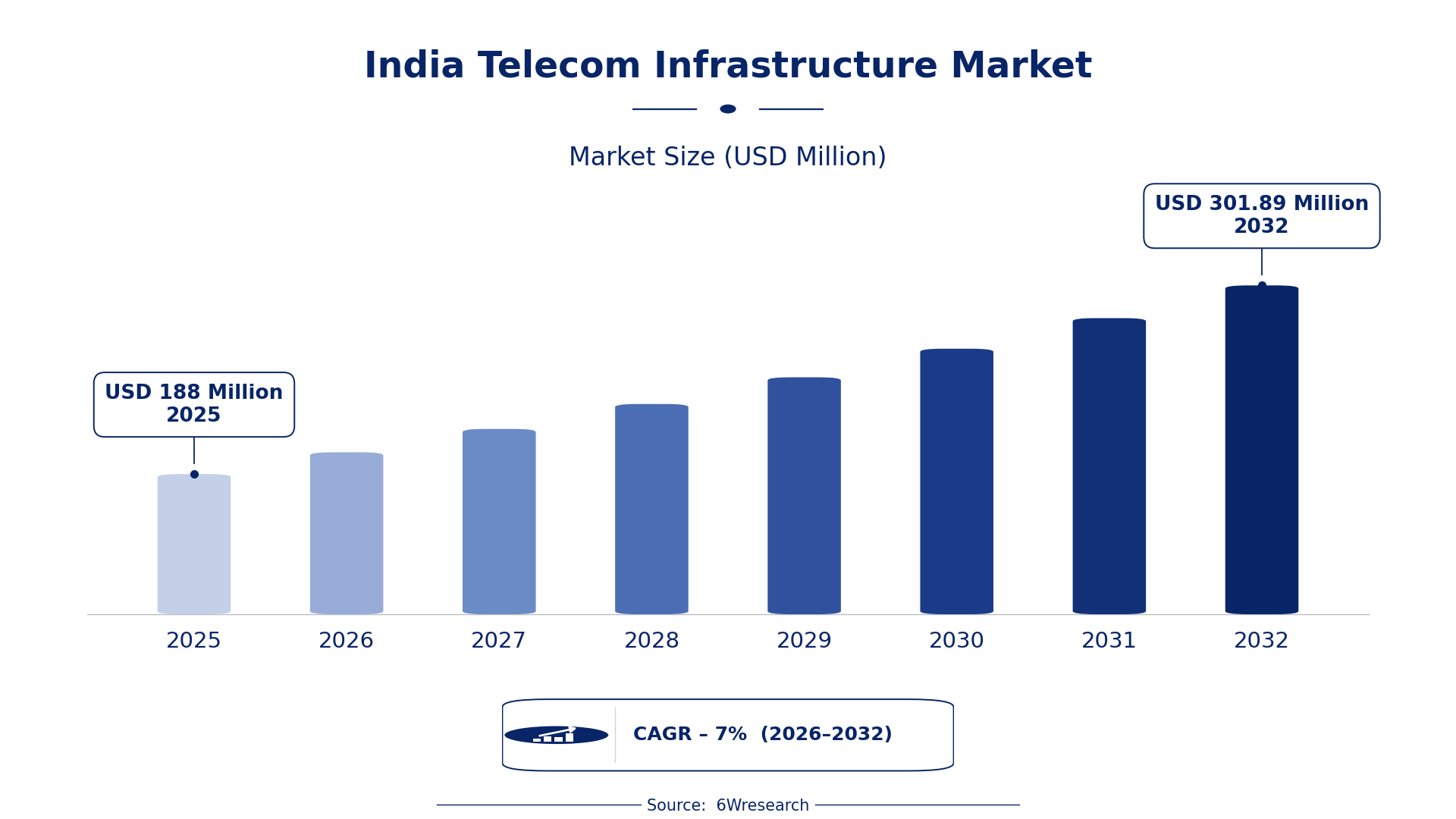
According to 6Wresearch internal database and industry insights, the India Telecom Infrastructure Market was valued at USD 188.0 million in 2025 and is projected to reach USD 301.89 million by 2032, growing at a CAGR of approximately 7% during 2026–2032.
India Telecom Infrastructure Market Highlights
| Report Metric | Details |
| Report Name | India Telecom Infrastructure Market |
| Market Size 2025 | USD 188.0 million |
| Market Size 2032 | USD 301.89 million |
| Absolute Growth 2025–2032 | USD 113.89 million |
| CAGR 2026–2032 | 7% |
| Peak Annual Growth | 9.1% in 2028 |
| Forecast Period | 2026–2032 |
| Historical Data | 2022–2025 |
| Base Year | 2025 |
| Leading Telecom Infrastructure, 2025 | Mobile Infrastructure (35% share) |
| Leading Product Type, 2025 | Towers (43% share) |
| Leading Technology Layer, 2025 | 5G (34% share) |
| Leading Distribution Channel, 2025 | Infra Developers (40% share) |
| Leading End User Industry, 2025 | Mobile Network Operators (45% share) |
| Fastest-Growing Telecom Infrastructure | Data Center Infrastructure (9.0% CAGR) |
| Fastest-Growing Product Type | Cloud/Edge Facilities (9.6% CAGR) |
| Fastest-Growing Distribution Channel | System Integrators (9.7% CAGR) |
| Fastest-Growing End User Industry | Internet Providers (9.8% CAGR) |
| Growing Sector | Internet Providers |
| Key End Users | Mobile Network Operators, Internet Providers, Telco Enterprises, OTT and CDNs |
India Telecom Infrastructure Market Year-wise Growth Rate and Key Drivers (2022–2032)
This graph illustrates the annual growth rates of the market from 2022 to 2032, highlighting a steady upward trajectory and projected market expansion over the forecast period.
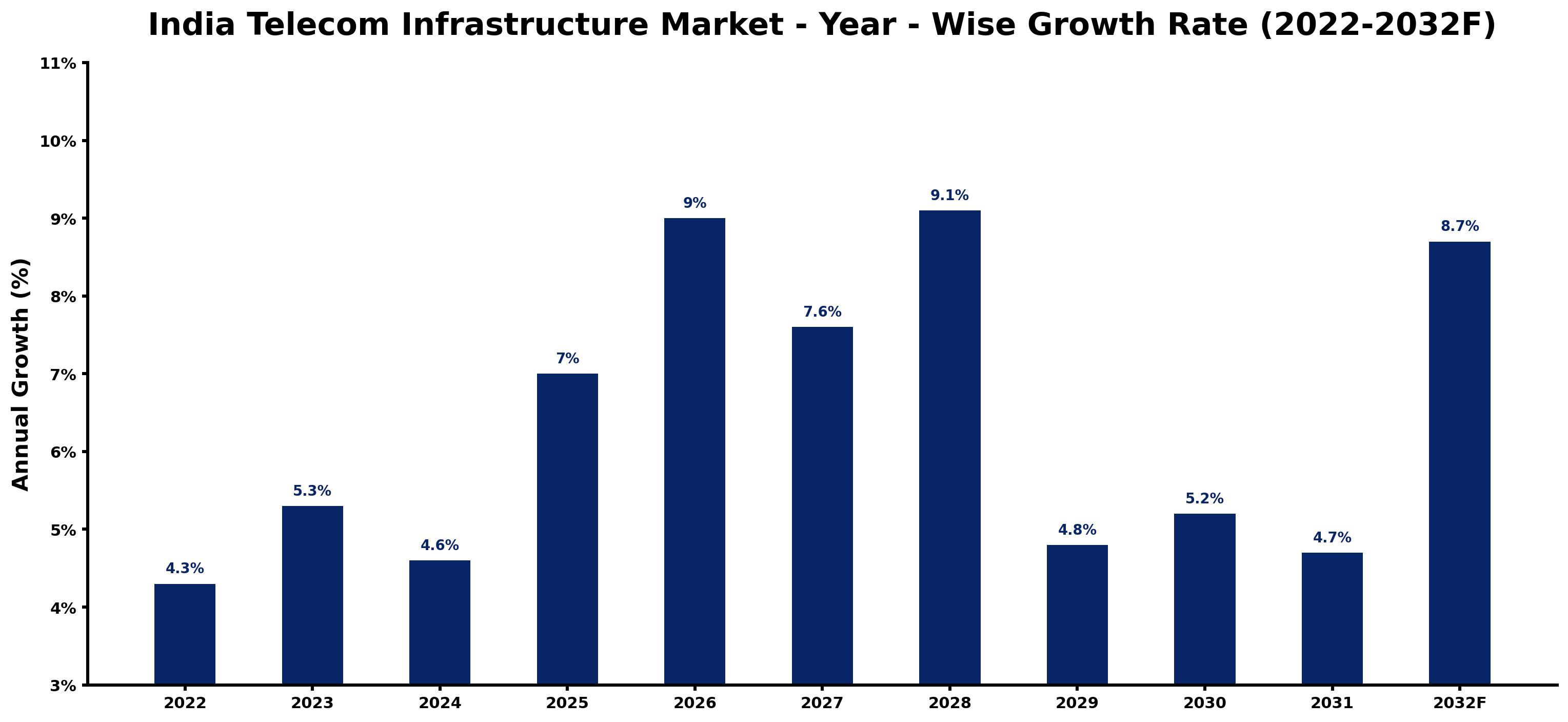
The table below sets out the estimated growth rate for each year and the main factor behind it.
| Year | Estimated Annual Growth (%) | Market Rationale |
| 2022 | 4.3 | The market experienced steady growth as mobile connectivity demands increased. |
| 2023 | 5.3 | Growth accelerated due to a surge in mobile subscribers reaching 1.2 billion. |
| 2024 | 4.6 | Growth slowed slightly as the market adjusted to increased infrastructure demands. |
| 2025 | 7.0 | A faster growth rate was driven by substantial investments in telecom infrastructure. |
| 2026 | 9.0 | Continued demand for 5G technology spurred a significant rise in investment. |
| 2027 | 7.6 | Growth slowed as the market stabilised following previous rapid expansions. |
| 2028 | 9.1 | The peak growth rate was achieved with heightened investments in urban areas. |
| 2029 | 4.8 | A slowdown occurred as the market began to adjust to new technologies. |
| 2030 | 5.2 | Growth resumed as infrastructure projects gained momentum in various regions. |
| 2031 | 4.7 | A slight slowdown reflected the market's maturation and stabilisation. |
| 2032 | 8.7 | Growth accelerated again as demand for advanced telecom services surged. |
Note: Market size estimations and growth projections presented in this report are based on 6Wresearch's proprietary forecasting methodology, utilizing the latest available industry data, government publications, and primary research inputs.
India Telecom Infrastructure Market Synopsis
Telecom Infrastructure in India includes the physical and virtual systems that enable communication networks, such as towers, fiber optics, and data centers. It underpins mobile and internet connectivity, facilitating data transfer and cloud services. The India Telecom Infrastructure Market is growing due to rising demand from mobile subscribers and infrastructure investment. The mobile subscriber base reached 1.2 billion in 2023, while the National Digital Communications Policy aims for broadband access for all by 2025. This combination of elements propels substantial growth in the sector.
Market Dynamics Impact Analysis (2026–2032)
| Factor | Type | Impact | Primary Segment Affected |
| Increasing mobile subscriber base drives demand for infrastructure development. | Driver | High | Mobile Infrastructure |
| Investment in data centers supports the growing need for cloud services. | Driver | High | Data Center Infrastructure |
| Expansion of fiber optic networks presents opportunities for connectivity providers. | Opportunity | High | Wireline Infrastructure |
| Government initiatives like the PM-WANI scheme enhance public Wi-Fi access. | Opportunity | High | Mobile Infrastructure |
| High costs of infrastructure development can limit growth potential. | Restraint | High | Mobile Infrastructure |
| Regulatory challenges may delay project approvals and implementations. | Restraint | Medium | Mobile Infrastructure |
| The Telecom Infrastructure market in India faces significant regulatory hurdles. | Challenge | High | Mobile Infrastructure |
| Competition among service providers can lead to price pressures. | Challenge | Medium | Mobile Infrastructure |
Evaluation of Drivers in India Telecom Infrastructure Market (2026–2032)
The factors lifting demand, and the evidence behind each, are summarised below.
| Drivers | Primary Segment Affected | Why It Matters (Evidence) |
| Rising mobile subscriber base necessitates additional infrastructure investment. | Mobile Infrastructure | With over 1.2 billion subscribers, mobile network operators require more towers and systems. |
| Increased demand for cloud services drives data center expansion. | Data Center Infrastructure | India has over 1,000 data centers as of 2023, reflecting the need for better cloud services. |
| Government initiatives promote broadband connectivity across rural areas. | Wireline Infrastructure | The National Broadband Mission aims to connect all villages by 2024, boosting infrastructure needs. |
| 5G technology rollout accelerates infrastructure upgrades. | Core Network Infrastructure | The expected 40% urban coverage of 5G by 2024 requires significant infrastructure investment. |
| Investment in fiber optic networks enhances data transmission capabilities. | Fiber Backbone | India's fiber optic network spans over 1.5 million kilometers, supporting increased connectivity. |
Growth in the Telecom Infrastructure market in India comes from rising mobile subscriber numbers, which necessitate additional infrastructure investment. With over 1.2 billion subscribers, mobile network operators are expanding their tower networks to meet demand. The presence of over 1,000 data centers reflects the increasing need for cloud services, driving further expansion in data center infrastructure. The rollout of 5G technology is expected to accelerate infrastructure upgrades, with urban coverage projected to reach 40% by 2024. Investment in fiber optic networks is improving data transmission capabilities, supporting the growing demand for high-speed internet access.
Evaluation of Restraints in India Telecom Infrastructure Market
The table below lists the restraints and the evidence behind each.
| Market Restraint | Primary Segment Affected | Why It Matters (Evidence) |
| High costs associated with infrastructure investment limit expansion capabilities. | Mobile Infrastructure | Infrastructure investment in India was estimated at $10 billion in 2022, constraining service expansion for providers. |
| Skills shortages in advanced telecom technologies hinder efficient infrastructure development. | Data Center Infrastructure | A lack of skilled workers delays project timelines, impacting service delivery and operational efficiency. |
| Rapid advancements in technology necessitate constant upgrades to existing infrastructure. | Core Network Infrastructure | Over 700,000 telecom towers require regular updates to meet evolving communication standards. |
| Intense competition among telecom providers pressures profit margins. | Wireline Infrastructure | Many players vie for market share, resulting in reduced profitability for companies unable to differentiate their services. |
| Regulatory challenges can delay infrastructure project approvals. | Fiber Backbone | Bureaucratic hurdles can extend timelines for necessary permits, impacting project initiation and completion. |
India Telecom Infrastructure Market Challenges
India's telecom infrastructure market faces a considerable technology challenge, as over 700,000 telecom towers require regular upgrades to support the mobile subscriber base of 1.2 billion. This issue arises from the rapid pace of technological evolution, resulting in delays in service improvements for producers. Intense competition among numerous players leads to reduced profit margins for suppliers, complicating their ability to differentiate offerings. Skills shortages in advanced telecom technologies impede effective infrastructure development, costing companies valuable time and resources. High infrastructure investment costs, estimated at $10 billion in 2022, restrict buyers' ability to expand services effectively.
Trends in the India Telecom Infrastructure Market
Several trends are reshaping the India Telecom Infrastructure Market; the most important are set out below.
- Shift towards 5G Technology Deployment: India is swiftly moving towards 5G technology, with urban coverage projected to reach 40% by 2024. This transition is driven by the rollout of the National Digital Communications Policy, which seeks to improve connectivity nationwide.
- Expansion of Data Center Infrastructure: The number of data centers in India is on the rise, driven by the demand for cloud services. With over 1,000 data centers as of 2023, this trend underscores the growing need for robust digital infrastructure.
- Growth in Fiber Optic Network: India's fiber optic network extends over 1.5 million kilometers, supporting high-speed internet access. This expansion is crucial for addressing the increasing connectivity needs of both urban and rural areas.
- Enhanced Public Wi-Fi Access: The PM-WANI scheme initiated in 2020 aims to boost public Wi-Fi access across urban and rural regions. This initiative is expected to improve connectivity and support the rising demand for internet services.
Investment Opportunities in the India Telecom Infrastructure Market
The following opportunities in the India Telecom Infrastructure Market pair current demand with a clear way in.
- Investment in Urban Telecom Infrastructure: Major urban areas in India offer substantial opportunities for telecom infrastructure investment, with a projected market size of USD 188 million by 2025. Collaborating with local Infra Developers can improve service delivery and market penetration.
- Supply of Advanced Data Center Solutions: The growing demand for cloud services presents opportunities for suppliers of advanced data center solutions. Targeting urban regions with high internet usage can yield considerable returns on investment.
- Expansion of Fiber Optic Networks: With India's fiber optic network spanning over 1.5 million kilometers, there is an urgent need for further expansion. Partnering with government initiatives can facilitate access to funding and approvals.
- Enhancing Public Wi-Fi Infrastructure: The PM-WANI scheme aims to improve public Wi-Fi access, creating opportunities for investment in infrastructure development. Engaging with local government bodies can streamline project approvals and implementation.
Government Initiatives in the India Telecom Infrastructure Market
The National Digital Communications Policy 2020 seeks to attract $100 billion in investments by 2024, improving telecom infrastructure and services throughout India. This policy builds on earlier frameworks, such as the Digital India programme, which focuses on enhancing digital infrastructure and increasing internet penetration in rural areas.
The Department of Telecommunications supervises the implementation of various initiatives, including the 5G Test Bed initiative launched in 2021 to promote research and development in 5G technologies. This agency also manages the National Broadband Mission, which aims to provide broadband connectivity to all villages by 2024, ensuring thorough infrastructure development.
Future Insight of the India Telecom Infrastructure Market
The telecom infrastructure market in India is poised for substantial changes by 2032, driven by the National Digital Communications Policy aiming for universal broadband access. As the rollout of 5G progresses, buyers will experience improved connectivity and increased internet speeds. The National Broadband Mission's objective to connect 300 million rural citizens will create new opportunities for suppliers. The growing emphasis on cloud services will require the establishment of additional data centers, enabling producers to meet the rising demands of consumers.
Market Segmentation Analysis
The analysis below covers each segmentation, its leading category in 2025 and its fastest-growing category through 2032.
By Telecom Infrastructure – Mobile Infrastructure Dominated, Data Center Infrastructure Expected to Grow Fastest
According to Sumit Sagar, AM at 6Wresearch, Mobile Infrastructure took a 35% share of telecom infrastructure in 2025, more than any other category. Mobile Infrastructure holds the largest share due to its critical role in supporting India's vast mobile subscriber base of 1.2 billion. This segment is essential for ensuring reliable communication across both urban and rural areas, where connectivity is increasingly important. Data Center Infrastructure is set to record the highest CAGR in this split, 9.0% over 2026–2032. Data Center Infrastructure is witnessing rapid growth driven by the surging demand for cloud services, with over 1,000 data centers operational in India as of 2023. This growing reliance on data hosting solutions is expected to further accelerate the segment's expansion. Suppliers should focus on enhancing data center capabilities to meet the increasing demand for cloud services.
By Product Type – Towers Dominated, Cloud/Edge Facilities Expected to Grow Fastest
In 2025, Towers led the product type split with a 43% share. Towers dominate the market share as they are indispensable for mobile signal transmission and coverage, essential for servicing 1.2 billion mobile subscribers. Their strategic placement in urban and rural areas ensures widespread connectivity, making them vital for telecom operations. Cloud/Edge Facilities are projected to grow fastest, at a CAGR of 9.6% during 2026–2032. Cloud/Edge Facilities are the fastest-growing segment, driven by the increasing demand for cloud computing and edge services that optimise data management. The shift towards digitalisation across industries is propelling this segment's rapid growth. Buyers should invest in cloud and edge facilities to maintain competitiveness in a digital-first environment.
By Technology Layer – 5G Dominated and Is Expected to Record the Fastest Growth
5G accounted for a 34% market share by technology layer in 2025. 5G technology leads the market share as it signifies the next generation of mobile connectivity, offering faster speeds and reduced latency for users. Its anticipated rollout will significantly transform the telecom infrastructure landscape in India. 5G is also forecast to expand faster than any other category, at a CAGR of 8.6% over 2026–2032. 5G is also the fastest-growing technology layer, with deployment efforts aimed at covering 40% of urban areas by 2024. This accelerated adoption is likely to solidify its dominant market position. Suppliers must prioritise 5G solutions to address the increasing demand for advanced mobile connectivity.
By Distribution Channel – Infra Developers Dominated, System Integrators Expected to Grow Fastest
The largest distribution channel category in 2025 was Infra Developers, with a 40% share of total revenue. Infra Developers command the largest share as they play a crucial role in constructing and maintaining the telecom infrastructure required for a growing subscriber base. Their involvement is vital for meeting the escalating connectivity demands across the country. Over 2026–2032, System Integrators are expected to post the fastest growth, at a CAGR of 9.7%. System Integrators are the fastest-growing distribution channel, as they are essential for integrating diverse telecom systems and solutions to improve operational efficiency. Their significance is increasing alongside the complexity of telecom infrastructure. Suppliers should collaborate with system integrators to effectively implement and optimise telecom solutions.
By End User Industry – Mobile Network Operators Dominated, Internet Providers Expected to Grow Fastest
With a 45% revenue share in 2025, Mobile Network Operators was the largest end user industry category. Mobile Network Operators hold the largest share as they are the primary consumers of telecom infrastructure, relying on it to provide services to their extensive customer base. Their need for robust infrastructure is crucial in a competitive market landscape. Internet Providers are set to record the highest CAGR in this split, 9.8% over 2026–2032. Internet Providers are the fastest-growing end user industry, as they depend on telecom infrastructure to deliver reliable internet services, especially with initiatives aimed at expanding broadband access to underserved areas. This demand is projected to rise significantly in the coming years. Buyers should align infrastructure investments with the needs of internet providers to ensure service delivery meets growing consumer expectations.
Key Attractiveness of the Report
- 10 Years of Market Numbers
- Historical Data Starting from 2022 to 2025
- Base Year 2025
- Forecast Data until 2032
- Key Performance Indicators Impacting the Market
- Major Upcoming Developments and Projects
Key Highlights of the Report:
- India Telecom Infrastructure Market Outlook
- Market Size of India Telecom Infrastructure Market, 2025
- Forecast of India Telecom Infrastructure Market, 2032
- Historical Data and Forecast of India Telecom Infrastructure Revenues & Volume for the Period 2022 - 2032F
- India Telecom Infrastructure Market Trend Evolution
- India Telecom Infrastructure Market Drivers and Challenges
- India Telecom Infrastructure Price Trends
- India Telecom Infrastructure Porter's Five Forces
- India Telecom Infrastructure Industry Life Cycle
- Historical Data and Forecast of India Telecom Infrastructure Market Revenues & Volume By Telecom Infrastructure for the Period 2022 - 2032F
- Historical Data and Forecast of India Telecom Infrastructure Market Revenues & Volume By Mobile Infrastructure for the Period 2022 - 2032F
- Historical Data and Forecast of India Telecom Infrastructure Market Revenues & Volume By Wireline Infrastructure for the Period 2022 - 2032F
- Historical Data and Forecast of India Telecom Infrastructure Market Revenues & Volume By Core Network Infrastructure for the Period 2022 - 2032F
- Historical Data and Forecast of India Telecom Infrastructure Market Revenues & Volume By Data Center Infrastructure for the Period 2022 - 2032F
- Historical Data and Forecast of India Telecom Infrastructure Market Revenues & Volume By Product Type for the Period 2022 - 2032F
- Historical Data and Forecast of India Telecom Infrastructure Market Revenues & Volume By Towers, RAN Systems for the Period 2022 - 2032F
- Historical Data and Forecast of India Telecom Infrastructure Market Revenues & Volume By Fiber Backbone for the Period 2022 - 2032F
- Historical Data and Forecast of India Telecom Infrastructure Market Revenues & Volume By EPC, IMS for the Period 2022 - 2032F
- Historical Data and Forecast of India Telecom Infrastructure Market Revenues & Volume By Cloud/Edge Facilities for the Period 2022 - 2032F
- Historical Data and Forecast of India Telecom Infrastructure Market Revenues & Volume By Technology Layer for the Period 2022 - 2032F
- Historical Data and Forecast of India Telecom Infrastructure Market Revenues & Volume By 4G, 5G for the Period 2022 - 2032F
- Historical Data and Forecast of India Telecom Infrastructure Market Revenues & Volume By GPON, Ethernet for the Period 2022 - 2032F
- Historical Data and Forecast of India Telecom Infrastructure Market Revenues & Volume By Virtualized Core for the Period 2022 - 2032F
- Historical Data and Forecast of India Telecom Infrastructure Market Revenues & Volume By Virtual + Physical for the Period 2022 - 2032F
- Historical Data and Forecast of India Telecom Infrastructure Market Revenues & Volume By Distribution Channel for the Period 2022 - 2032F
- Historical Data and Forecast of India Telecom Infrastructure Market Revenues & Volume By Infra Developers for the Period 2022 - 2032F
- Historical Data and Forecast of India Telecom Infrastructure Market Revenues & Volume By Government Bidding for the Period 2022 - 2032F
- Historical Data and Forecast of India Telecom Infrastructure Market Revenues & Volume By System Integrators for the Period 2022 - 2032F
- Historical Data and Forecast of India Telecom Infrastructure Market Revenues & Volume By Colocation Providers for the Period 2022 - 2032F
- Historical Data and Forecast of India Telecom Infrastructure Market Revenues & Volume By End User Industry for the Period 2022 - 2032F
- Historical Data and Forecast of India Telecom Infrastructure Market Revenues & Volume By Mobile Network Operators for the Period 2022 - 2032F
- Historical Data and Forecast of India Telecom Infrastructure Market Revenues & Volume By Internet Providers for the Period 2022 - 2032F
- Historical Data and Forecast of India Telecom Infrastructure Market Revenues & Volume By Telco Enterprises for the Period 2022 - 2032F
- Historical Data and Forecast of India Telecom Infrastructure Market Revenues & Volume By OTT and CDNs for the Period 2022 - 2032F
- India Telecom Infrastructure Import Export Trade Statistics
- Market Opportunity Assessment By Telecom Infrastructure
- Market Opportunity Assessment By Product Type
- Market Opportunity Assessment By Technology Layer
- Market Opportunity Assessment By Distribution Channel
- Market Opportunity Assessment By End User Industry
- India Telecom Infrastructure Top Companies Market Share
- India Telecom Infrastructure Competitive Benchmarking By Technical and Operational Parameters
- India Telecom Infrastructure Company Profiles
- India Telecom Infrastructure Key Strategic Recommendations
Market Covered
The report offers an extensive study of the following market segments.
By Telecom Infrastructure
- Mobile Infrastructure
- Wireline Infrastructure
- Core Network Infrastructure
- Data Center Infrastructure
By Product Type
- Towers
- RAN Systems
- Fiber Backbone
- EPC
- IMS
- Cloud/Edge Facilities
By Technology Layer
- 4G
- 5G
- GPON
- Ethernet
- Virtualized Core
- Virtual + Physical
By Distribution Channel
- Infra Developers
- Government Bidding
- System Integrators
- Colocation Providers
By End User Industry
- Mobile Network Operators
- Internet Providers
- Telco Enterprises
- OTT and CDNs































