India Telecom IT Market Size & Growth Rate
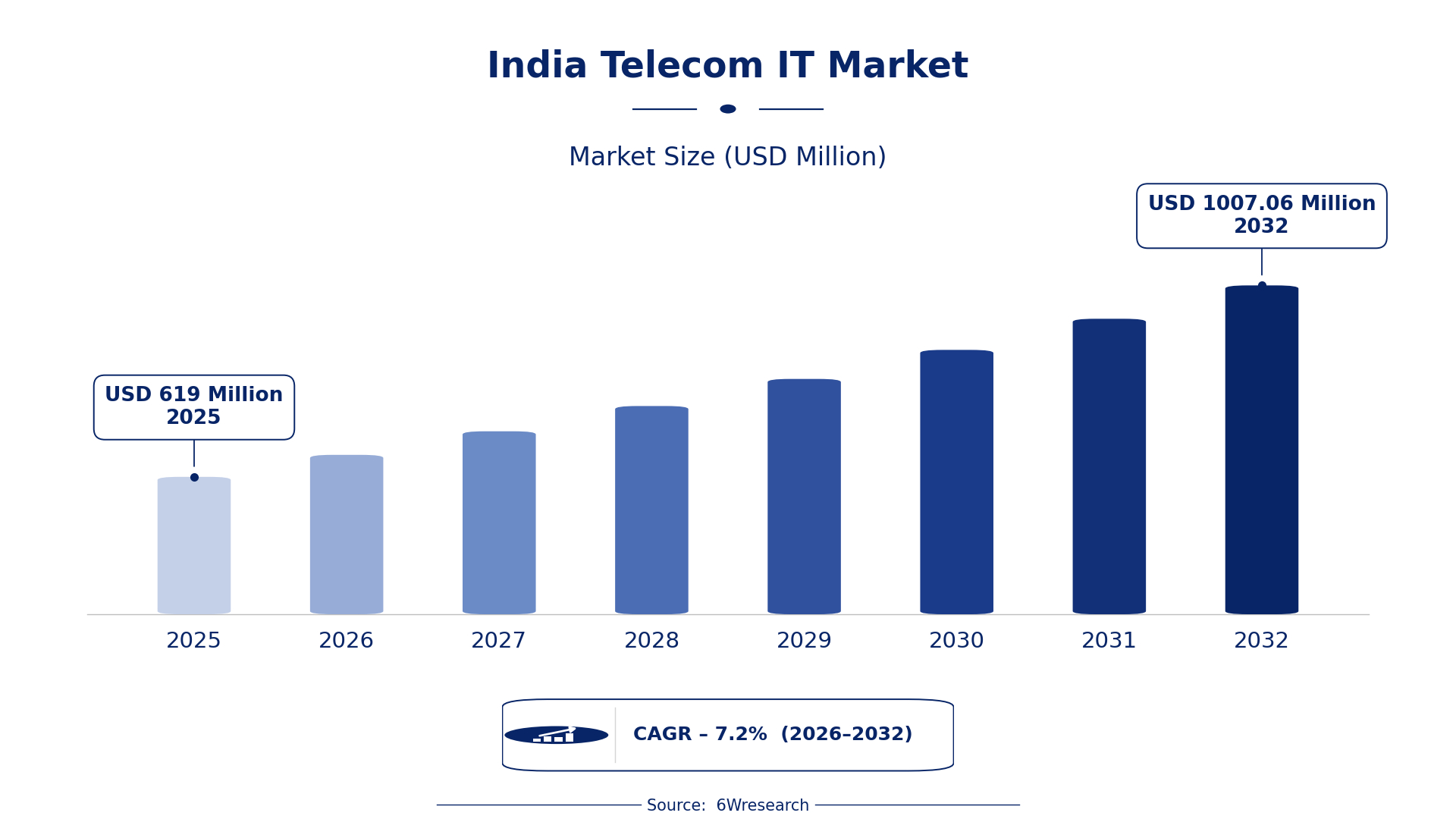
According to 6Wresearch internal database and industry insights, the India Telecom IT Market was valued at USD 619.0 million in 2025 and is projected to reach USD 1,007.06 million by 2032, growing at a CAGR of approximately 7.2% during 2026–2032.
India Telecom IT Market Highlights
| Report Metric | Details |
| Report Name | India Telecom IT Market |
| Market Size 2025 | USD 619.0 million |
| Market Size 2032 | USD 1,007.06 million |
| Absolute Growth 2025–2032 | USD 388.06 million |
| CAGR 2026–2032 | 7.2% |
| Peak Annual Growth | 9.3% in 2029 |
| Forecast Period | 2026–2032 |
| Historical Data | 2022–2025 |
| Base Year | 2025 |
| Leading Telecom IT Type, 2025 | OSS/BSS Systems (43% share) |
| Leading Product Type, 2025 | Operational Software (37% share) |
| Leading Solution Category, 2025 | Billing/Support (49% share) |
| Leading Distribution Channel, 2025 | IT Vendors (47% share) |
| Leading End User Industry, 2025 | CSPs (41% share) |
| Fastest-Growing Telecom IT Type | Network Analytics Software (8.6% CAGR) |
| Fastest-Growing Product Type | Real-time Monitoring (8.2% CAGR) |
| Fastest-Growing Solution Category | Customer Engagement (9.4% CAGR) |
| Fastest-Growing Distribution Channel | SaaS Platforms (8.3% CAGR) |
| Fastest-Growing End User Industry | Telecom Enterprises (8.5% CAGR) |
| Growing Sector | Telecommunications |
| Key End Users | Telecom Service Providers, Telecom Enterprises, IT Vendors |
India Telecom IT Market Year-wise Growth Rate and Key Drivers (2022–2032)
This graph illustrates the annual growth rates of the market from 2022 to 2032, highlighting a steady upward trajectory and projected market expansion over the forecast period.
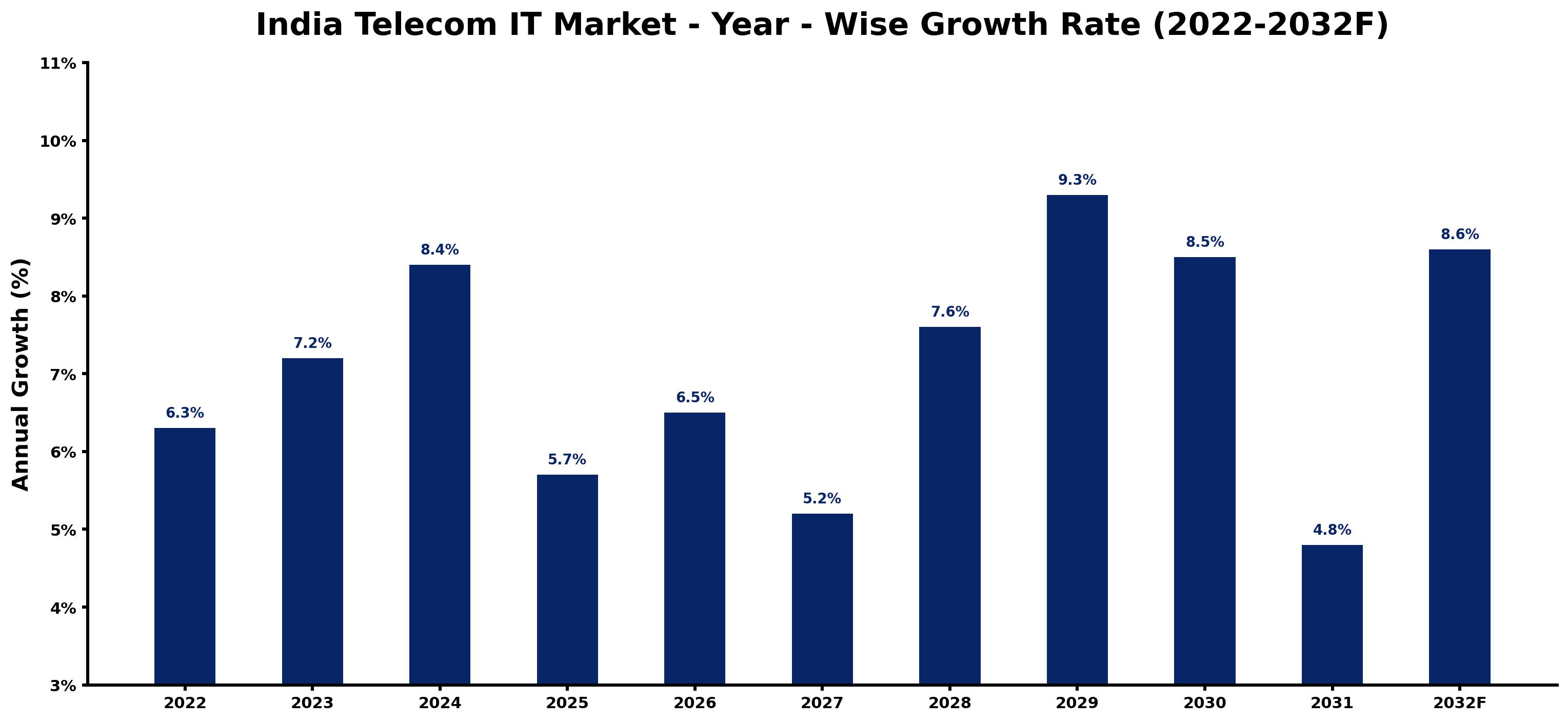
The following table presents the estimated annual growth rate for each year together with the principal factor influencing market performance.
| Year | Estimated Annual Growth (%) | Market Rationale |
| 2022 | 6.3 | The market exhibited steady growth due to ongoing digital transformation initiatives. |
| 2023 | 7.2 | Investment in telecom infrastructure increased as demand for connectivity rose. |
| 2024 | 8.4 | The adoption of advanced technologies propelled market growth significantly. |
| 2025 | 5.7 | Growth slowed as the market adjusted to the saturation of certain segments. |
| 2026 | 6.5 | A resurgence in investment from telecom service providers spurred growth. |
| 2027 | 5.2 | Market growth slowed due to a temporary decline in new project approvals. |
| 2028 | 7.6 | Increased demand for network analytics tools revitalised market momentum. |
| 2029 | 9.3 | A surge in 5G rollout plans led to peak growth in the market. |
| 2030 | 8.5 | Growth slowed as the market began to stabilise after rapid expansion. |
| 2031 | 4.8 | Continued investment in operational software led to further market growth. |
| 2032 | 8.6 | The market is expected to grow as new technologies are adopted. |
Note: Market size estimations and growth projections presented in this report are based on 6Wresearch's proprietary forecasting methodology, utilizing the latest available industry data, government publications, and primary research inputs.
India Telecom IT Market Synopsis
Telecom IT in India includes software and services that support telecommunications operations, such as OSS/BSS systems and network management tools. The market thrives on a base of over 1.2 billion mobile subscribers and an increasing demand for sophisticated IT solutions. The National Digital Communications Policy aims to attract $100 billion in investment by 2025, which will further strengthen infrastructure. Moreover, the anticipated 5G adoption by 2024 will drive a surge in demand for Telecom IT solutions. The market is primed for considerable growth as domestic user requirements evolve.
Market Dynamics Impact Analysis (2026–2032)
| Factor | Type | Impact | Primary Segment Affected |
| Increasing mobile subscriber base drives demand for efficient telecom operations. | Driver | High | OSS/BSS Systems |
| The push for 5G technology adoption necessitates advanced IT solutions. | Driver | High | Operational Software |
| Investment in telecom infrastructure development creates opportunities for IT vendors. | Opportunity | High | IT Vendors |
| The growing need for customer engagement solutions opens new markets. | Opportunity | High | Customer Engagement |
| High competition among service providers pressures pricing strategies. | Restraint | Medium | CSPs |
| Limited skilled workforce hampers the implementation of advanced solutions. | Restraint | Medium | Telecom Enterprises |
| The Telecom IT market faces challenges from rapid technological changes. | Challenge | High | Network Analytics Software |
| Regulatory compliance requirements can delay project timelines. | Challenge | Medium | CRM & ERP Solutions |
Evaluation of Drivers in India Telecom IT Market (2026–2032)
Below mentioned are some major drivers and their influence on market dynamics.
| Drivers | Primary Segment Affected | Why It Matters (Evidence) |
| Rising mobile subscriber numbers create demand for operational software. | OSS/BSS Systems | India has over 1.2 billion mobile subscribers as of 2023, driving telecom service providers to seek efficient management solutions. |
| 5G rollout necessitates advanced IT solutions for service providers. | Operational Software | The Indian telecom market is expected to see 5G adoption by 2024, requiring advanced IT infrastructure to support new technologies. |
| Investment in telecom infrastructure development supports IT solution demand. | IT Vendors | The Indian government allocated $1 billion for telecom infrastructure development in rural areas, increasing demand for IT services and solutions. |
| Growing emphasis on customer engagement boosts demand for CRM solutions. | Customer Engagement | The Digital India initiative aims to transform the digital environment, driving demand for effective customer management tools among service providers. |
| Increased focus on data analytics encourages investment in network optimization. | Network Analytics Software | The Telecom Research and Development Fund supports innovation, boosting demand for analytics solutions to enhance service delivery. |
Market growth in India for Telecom IT rests on rising mobile subscriber numbers, increasing investment in infrastructure, and the push for 5G technology. The telecom sector contributes approximately 6% to India's GDP, indicating a strong economic impact. With over 1.2 billion mobile subscribers as of 2023, telecom service providers are seeking efficient OSS/BSS systems to manage operations.
Evaluation of Restraints in India Telecom IT Market
The table below lists the restraints and the evidence behind each.
| Market Restraint | Primary Segment Affected | Why It Matters (Evidence) |
| High competition among service providers pressures pricing strategies. | CSPs | The telecom sector contributes approximately 6% to India's GDP, creating intense competition that affects profit margins. |
| Limited skilled workforce hampers the implementation of advanced solutions. | Telecom Enterprises | The Telecom Sector Skill Council aims to train 1 million professionals by 2025, addressing workforce shortages in the sector. |
| Rapid technological changes require constant adaptation from service providers. | Network Analytics Software | The fast-paced evolution of technology can lead to increased costs for telecom operators, impacting their budgets. |
| Regulatory compliance requirements can delay project timelines. | CRM & ERP Solutions | The Telecom Regulatory Authority of India oversees standards that can impact project approvals and implementation timelines. |
| Budget constraints limit investment in new technologies for some operators. | Operational Software | Smaller telecom operators may struggle to allocate funds for necessary upgrades, affecting their competitiveness. |
India Telecom IT Market Challenges
Buyers in the India Telecom IT market encounter substantial technology integration challenges, as many telecom service providers struggle to prepare for the 5G rollout anticipated by 2024. This difficulty arises from the high costs tied to upgrading outdated systems, which can postpone critical service improvements for over 700 telecom operators. Heightened competition among these providers complicates matters, compelling them to balance IT investments with the need to maintain affordable services for more than 1.2 billion mobile subscribers. Skills shortages also impede progress, leading to operational inefficiencies that may result in revenue losses of up to 20% for these providers.
Trends in the India Telecom IT Market
Below mentioned are some of the trends shaping the India Telecom IT Market growth.
- Shift to Cloud-Based Solutions: Since 2020, there has been a shift towards cloud-based Telecom IT solutions. The National Digital Communications Policy promotes this transition, with over 700 telecom service providers adopting cloud technologies, improving operational efficiency.
- Increased Focus on Customer Engagement: The Digital India initiative has led to a heightened focus on customer engagement solutions. With a projected 9.4% growth in customer engagement tools, service providers are investing heavily in these technologies to improve user satisfaction.
- Adoption of Real-Time Monitoring Tools: Real-time monitoring tools are gaining traction in the telecom sector, driven by the need for network reliability. The increasing demand for these tools is reflected in an 8.2% growth rate projected for the next few years.
- Growth in Network Analytics Software: The market for network analytics software is expanding rapidly, with an expected CAGR of 8.6%. This growth is driven by the need for telecom operators to optimize network performance and improve service delivery.
Investment Opportunities in the India Telecom IT Market
Several openings in the India Telecom IT Market merit attention from investors.
- Supply of Advanced OSS/BSS Systems: With the expected 5G rollout, there is an opportunity to supply advanced OSS/BSS systems. The market gap is clear as telecom service providers seek efficient management solutions to handle increased demand for connectivity.
- Investment in Customer Engagement Technologies: Now is an opportune time to invest in customer engagement technologies, as demand is projected to grow significantly. Telecom service providers are actively seeking solutions to improve customer satisfaction and loyalty in a competitive market.
- Partnerships for Cloud Integration: There is a growing opportunity for partnerships in cloud integration services. With the Digital India initiative driving cloud adoption, local partnerships can facilitate entry into this expanding market for telecom IT solutions.
- Development of Network Analytics Tools: The demand for network analytics tools is on the rise, with a projected growth rate of 8.6%. Investing in this area can yield substantial returns as telecom operators seek to optimize their networks and improve service delivery.
Government Initiatives in the India Telecom IT Market
The National Digital Communications Policy 2020 aims to attract $100 billion in investment by 2025, improving telecom infrastructure and services. This policy encourages telecom operators to modernize their systems and adopt new technologies. Additionally, the Telecom Infrastructure Policy 2021 promotes shared infrastructure among operators to reduce costs and improve service delivery, fostering collaboration among service providers and enhancing service quality.
Telecom service providers benefit from various schemes administered by the Department of Telecommunications. The Telecom Sector Skill Council focuses on training professionals, aiming to develop skills in the sector. This initiative targets training for 1 million professionals by 2025, ensuring a skilled workforce to support industry growth. Furthermore, the National Broadband Mission, overseen by the Department of Telecommunications, aims to provide broadband access to all citizens by 2022, improving connectivity across the country.
Future Insight of the India Telecom IT Market
The India Telecom IT market is set to evolve dramatically by 2032, driven by initiatives such as the National Digital Communications Policy and the National Broadband Mission, which aim to improve connectivity nationwide. With the expected mainstream adoption of 5G technology, telecom service providers will increasingly require advanced IT solutions for efficient network management. The Telecom Sector Skill Council will play a vital role in addressing workforce gaps, ensuring that over 4 million professionals are equipped with the necessary skills for this changing environment. Government funding for rural telecom infrastructure will also enhance access, creating new opportunities for telecom IT solutions.
Market Segmentation Analysis
The analysis below covers each segmentation, its leading category in 2025 and its fastest-growing category through 2032.
By Telecom IT Type – OSS/BSS Systems Dominated, Network Analytics Software Expected to Grow Fastest
According to Sumit Sagar, AM at 6Wresearch, OSS/BSS Systems accounted for a 43% market share by telecom it type in 2025. OSS/BSS systems command the largest market share as they are indispensable for managing operations for over 700 telecom service providers in India. Their role in streamlining processes ensures efficient service delivery, making them a foundational component of telecom IT solutions. The quickest growth will come from Network Analytics Software, forecast to expand at a CAGR of 8.6% between 2026 and 2032. The surge in network analytics software is propelled by the anticipated 5G rollout in 2024, which necessitates improved network performance management. This software is vital for optimising operations and ensuring seamless connectivity as demand escalates. Suppliers should focus on developing advanced OSS/BSS solutions to meet the increasing demands of service providers.
By Product Type – Operational Software Dominated, Real-time Monitoring Expected to Grow Fastest
Operational Software held a 37% share of the India Telecom IT Market by product type in 2025. Operational software leads the market share because it is crucial for the daily operations of telecom companies, ensuring smooth functioning and service delivery. Its integration into various processes establishes it as a core element in the telecom IT sector. Real-time Monitoring is projected to grow fastest, at a CAGR of 8.2% during 2026–2032. Real-time monitoring is growing rapidly due to the rising need for network reliability and performance, especially with the expected increase in mobile subscribers. This demand is essential for maintaining service quality in a competitive landscape. Buyers will benefit from investing in real-time monitoring solutions to enhance operational efficiency and customer satisfaction.
By Solution Category – Billing/Support Dominated, Customer Engagement Expected to Grow Fastest
With a 49% revenue share in 2025, Billing/Support was the largest solution category category. Billing/support solutions hold the largest market share as they are vital for revenue management in the telecom sector, directly impacting financial health. Their importance is underscored by the necessity for accurate billing and effective customer support services. Customer Engagement is set to record the highest CAGR in this split, 9.4% over 2026–2032. Customer engagement solutions are expanding quickly as telecom companies aim to improve customer satisfaction and retention in a competitive market. This trend indicates a shift towards prioritising customer experience in service delivery. Suppliers should concentrate on innovating customer engagement solutions to meet the rising expectations of telecom users.
By Distribution Channel – IT Vendors Dominated, SaaS Platforms Expected to Grow Fastest
The largest distribution channel category in 2025 was IT Vendors, with a 47% share of total revenue. IT vendors capture the largest market share by providing essential tools and services that support telecom operations across various sectors. Their established relationships with service providers ensure a consistent demand for their offerings. Over 2026–2032, SaaS Platforms are expected to post the fastest growth, at a CAGR of 8.3%. SaaS platforms are the fastest-growing distribution channel, driven by their increasing popularity for delivering telecom solutions in a cost-effective manner. This trend signifies a shift towards more flexible and scalable service models. Buyers should consider SaaS solutions for their operational needs to leverage cost savings and scalability.
By End User Industry – CSPs Dominated, Telecom Enterprises Expected to Grow Fastest
In 2025, CSPs led the end user industry split with a 41% share. CSPs are the primary users of telecom IT solutions, holding the largest market share due to their extensive operational requirements. Their reliance on these solutions for service delivery makes them a critical segment in the industry. The quickest growth will come from Telecom Enterprises, forecast to expand at a CAGR of 8.5% between 2026 and 2032. Telecom enterprises are experiencing the fastest growth as they increasingly adopt telecom IT services to enhance their operational capabilities. This trend highlights the expanding role of IT in supporting enterprise-level telecom functions. Suppliers should tailor their offerings to address the specific needs of telecom enterprises to capture this growing segment.
Key Attractiveness of the Report
- 10 Years of Market Numbers
- Historical Data Starting from 2022 to 2025
- Base Year 2025
- Forecast Data until 2032
- Key Performance Indicators Impacting the Market
- Major Upcoming Developments and Projects
Key Highlights of the Report:
- India Telecom IT Market Outlook
- Market Size of India Telecom IT Market, 2025
- Forecast of India Telecom IT Market, 2032
- Historical Data and Forecast of India Telecom IT Revenues & Volume for the Period 2022 - 2032F
- India Telecom IT Market Trend Evolution
- India Telecom IT Market Drivers and Challenges
- India Telecom IT Price Trends
- India Telecom IT Porter's Five Forces
- India Telecom IT Industry Life Cycle
- Historical Data and Forecast of India Telecom IT Market Revenues & Volume By Telecom IT Type for the Period 2022 - 2032F
- Historical Data and Forecast of India Telecom IT Market Revenues & Volume By OSS/BSS Systems for the Period 2022 - 2032F
- Historical Data and Forecast of India Telecom IT Market Revenues & Volume By CRM & ERP Solutions for the Period 2022 - 2032F
- Historical Data and Forecast of India Telecom IT Market Revenues & Volume By Network Analytics Software for the Period 2022 - 2032F
- Historical Data and Forecast of India Telecom IT Market Revenues & Volume By Data Center Management for the Period 2022 - 2032F
- Historical Data and Forecast of India Telecom IT Market Revenues & Volume By Product Type for the Period 2022 - 2032F
- Historical Data and Forecast of India Telecom IT Market Revenues & Volume By Operational Software for the Period 2022 - 2032F
- Historical Data and Forecast of India Telecom IT Market Revenues & Volume By Business Apps for the Period 2022 - 2032F
- Historical Data and Forecast of India Telecom IT Market Revenues & Volume By Real-time Monitoring for the Period 2022 - 2032F
- Historical Data and Forecast of India Telecom IT Market Revenues & Volume By Orchestration Tools for the Period 2022 - 2032F
- Historical Data and Forecast of India Telecom IT Market Revenues & Volume By Solution Category for the Period 2022 - 2032F
- Historical Data and Forecast of India Telecom IT Market Revenues & Volume By Billing/Support for the Period 2022 - 2032F
- Historical Data and Forecast of India Telecom IT Market Revenues & Volume By Customer Engagement for the Period 2022 - 2032F
- Historical Data and Forecast of India Telecom IT Market Revenues & Volume By Predictive Analytics for the Period 2022 - 2032F
- Historical Data and Forecast of India Telecom IT Market Revenues & Volume By Hybrid Cloud for the Period 2022 - 2032F
- Historical Data and Forecast of India Telecom IT Market Revenues & Volume By Distribution Channel for the Period 2022 - 2032F
- Historical Data and Forecast of India Telecom IT Market Revenues & Volume By IT Vendors for the Period 2022 - 2032F
- Historical Data and Forecast of India Telecom IT Market Revenues & Volume By Direct Sales for the Period 2022 - 2032F
- Historical Data and Forecast of India Telecom IT Market Revenues & Volume By SaaS Platforms for the Period 2022 - 2032F
- Historical Data and Forecast of India Telecom IT Market Revenues & Volume By Cloud Integrators for the Period 2022 - 2032F
- Historical Data and Forecast of India Telecom IT Market Revenues & Volume By End User Industry for the Period 2022 - 2032F
- Historical Data and Forecast of India Telecom IT Market Revenues & Volume By CSPs for the Period 2022 - 2032F
- Historical Data and Forecast of India Telecom IT Market Revenues & Volume By Telecom Enterprises for the Period 2022 - 2032F
- Historical Data and Forecast of India Telecom IT Market Revenues & Volume By Managed Services for the Period 2022 - 2032F
- Historical Data and Forecast of India Telecom IT Market Revenues & Volume By Telco Cloud Providers for the Period 2022 - 2032F
- India Telecom IT Import Export Trade Statistics
- Market Opportunity Assessment By Telecom IT Type
- Market Opportunity Assessment By Product Type
- Market Opportunity Assessment By Solution Category
- Market Opportunity Assessment By Distribution Channel
- Market Opportunity Assessment By End User Industry
- India Telecom IT Top Companies Market Share
- India Telecom IT Competitive Benchmarking By Technical and Operational Parameters
- India Telecom IT Company Profiles
- India Telecom IT Key Strategic Recommendations
Market Covered
Segments analysed in this report are listed below.
By Telecom IT Type
- OSS/BSS Systems
- CRM & ERP Solutions
- Network Analytics Software
- Data Center Management
By Product Type
- Operational Software
- Business Apps
- Real-time Monitoring
- Orchestration Tools
By Solution Category
- Billing/Support
- Customer Engagement
- Predictive Analytics
- Hybrid Cloud
By Distribution Channel
- IT Vendors
- Direct Sales
- SaaS Platforms
- Cloud Integrators
By End User Industry
- CSPs
- Telecom Enterprises
- Managed Services
- Telco Cloud Providers































