China Telecom IT Market Size & Growth Rate
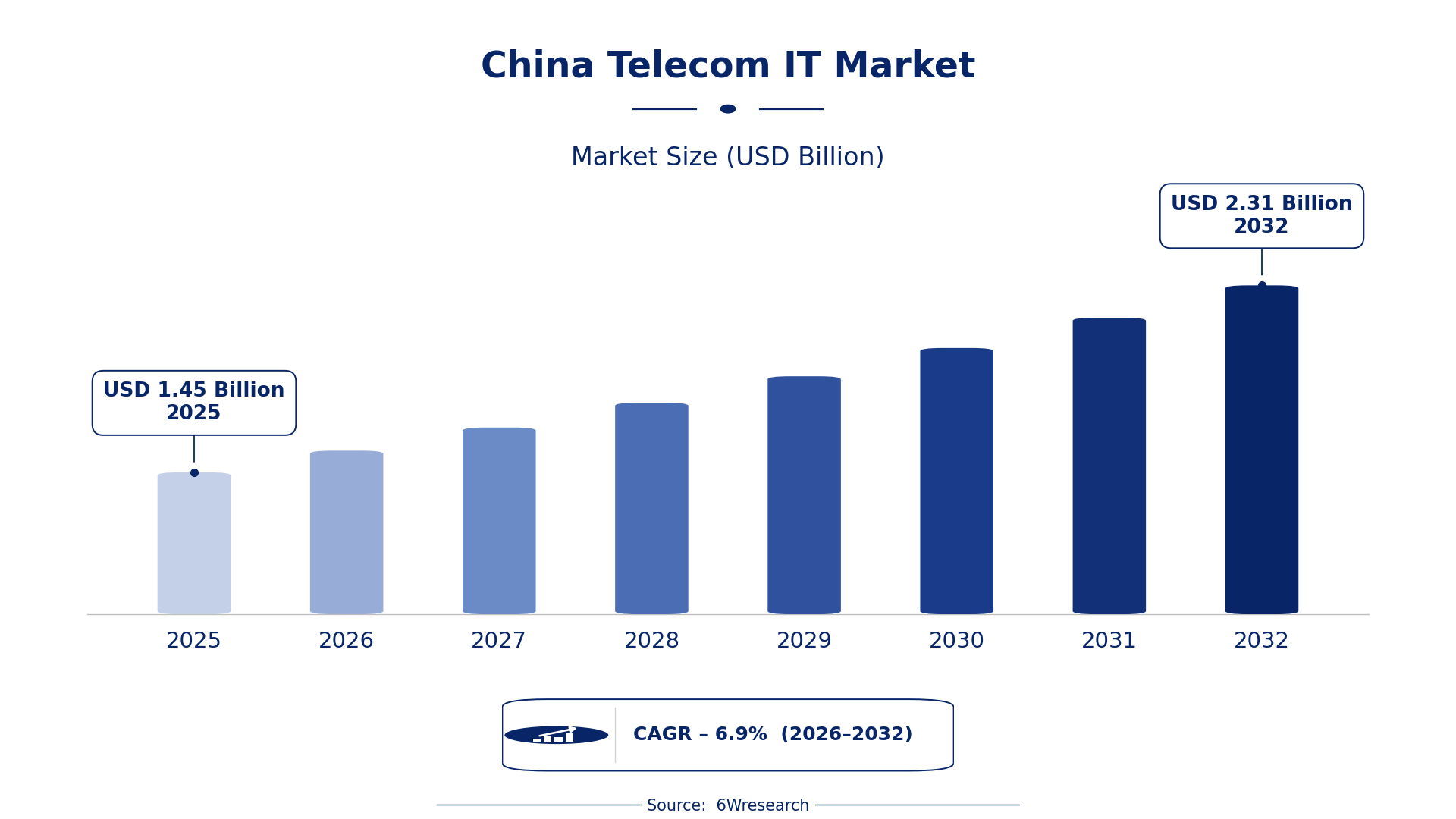
According to 6Wresearch internal database and industry insights, the China Telecom IT Market was valued at USD 1.45 billion in 2025 and is projected to reach USD 2.31 billion by 2032, growing at a CAGR of approximately 6.9% during 2026–2032.
China Telecom IT Market Highlights
| Report Metric | Details |
| Report Name | China Telecom IT Market |
| Market Size 2025 | USD 1.45 billion |
| Market Size 2032 | USD 2.31 billion |
| Absolute Growth 2025–2032 | USD 0.86 billion |
| CAGR 2026–2032 | 6.9% |
| Peak Annual Growth | 9.3% in 2028 |
| Forecast Period | 2026–2032 |
| Historical Data | 2022–2025 |
| Base Year | 2025 |
| Leading Telecom IT Type, 2025 | OSS/BSS Systems (38% share) |
| Leading Product Type, 2025 | Operational Software (41% share) |
| Leading Solution Category, 2025 | Billing/Support (35% share) |
| Leading Distribution Channel, 2025 | IT Vendors (48% share) |
| Leading End User Industry, 2025 | CSPs (46% share) |
| Fastest-Growing Telecom IT Type | Network Analytics Software (9.6% CAGR) |
| Fastest-Growing Product Type | Real-time Monitoring (8.4% CAGR) |
| Fastest-Growing Solution Category | Predictive Analytics (8.2% CAGR) |
| Fastest-Growing Distribution Channel | SaaS Platforms (8.0% CAGR) |
| Fastest-Growing End User Industry | Telco Cloud Providers (9.3% CAGR) |
| Growing Sector | Telco Cloud Providers |
| Key End Users | CSPs, Telecom Enterprises, Telco Cloud Providers, Managed Services |
China Telecom IT Market Year-wise Growth Rate and Key Drivers (2022–2032)
This graph illustrates the annual growth rates of the market from 2022 to 2032, highlighting a steady upward trajectory and projected market expansion over the forecast period.
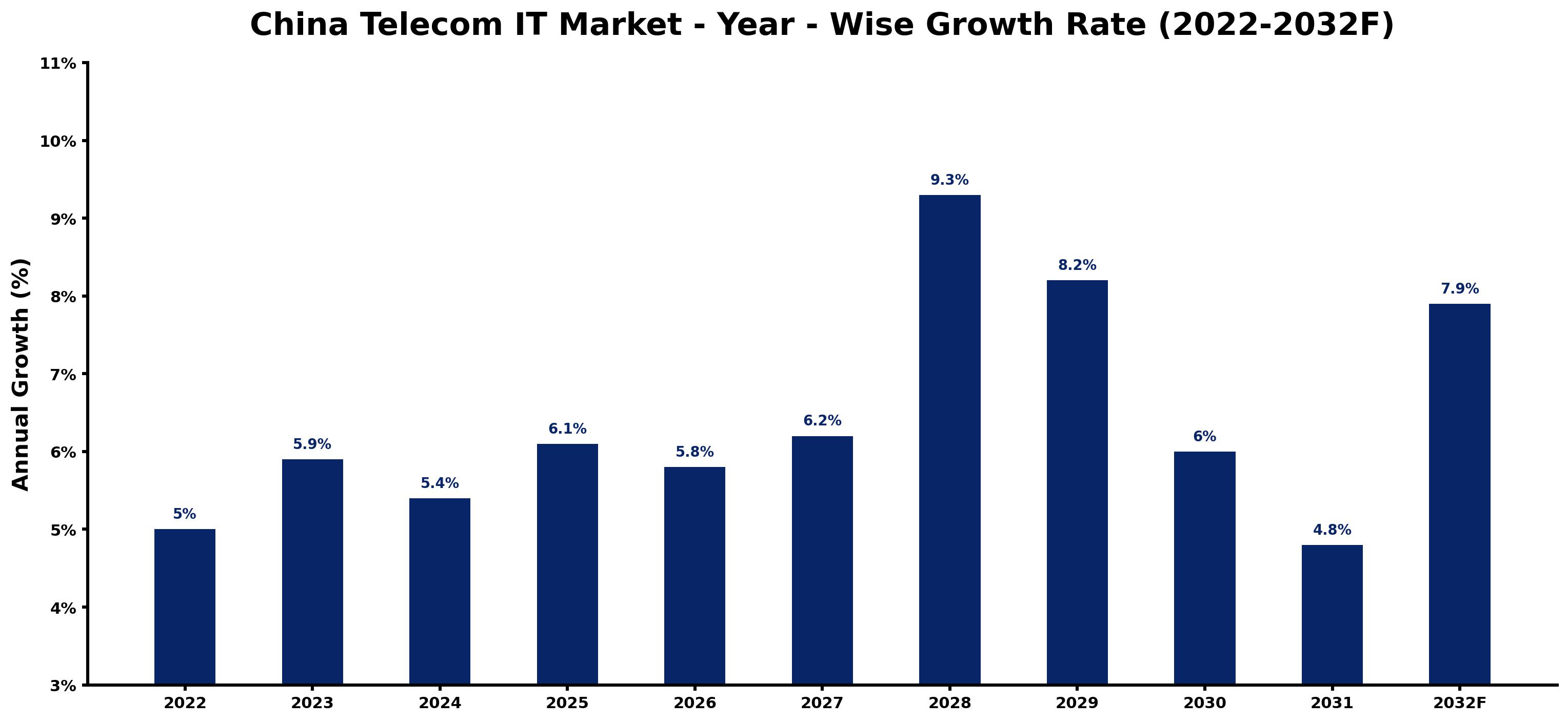
Below, each year's estimated growth is shown next to the factor that most influenced it.
| Year | Estimated Annual Growth (%) | Market Rationale |
| 2022 | 5.0 | The market experienced steady growth due to increasing telecom operations. |
| 2023 | 5.9 | Demand accelerated as mobile subscriptions surpassed 1.6 billion in the country. |
| 2024 | 5.4 | Growth slowed as the market adjusted to previous rapid expansions. |
| 2025 | 6.1 | A surge in investments led to faster growth compared to the previous year. |
| 2026 | 5.8 | The market experienced a slowdown as companies recalibrated their strategies. |
| 2027 | 6.2 | Increased network demands spurred growth as operators expanded capabilities. |
| 2028 | 9.3 | Peak growth was driven by significant investments in 5G infrastructure. |
| 2029 | 8.2 | A slight slowdown occurred as the market began to stabilise post-peak. |
| 2030 | 6.0 | Growth continued to slow as companies focused on operational efficiency. |
| 2031 | 4.8 | The market saw further deceleration as competition intensified. |
| 2032 | 7.9 | A resurgence in investment is expected to boost growth in telecom IT. |
Note: Market size estimations and growth projections presented in this report are based on 6Wresearch's proprietary forecasting methodology, utilizing the latest available industry data, government publications, and primary research inputs.
China Telecom IT Market Synopsis
Telecom IT in China includes software and technology solutions that support telecommunications operations. This sector manages network operations, customer relationships, and data analytics. With the telecom sector generating around 1 trillion CNY in revenue in 2022, demand is propelled by service providers and domestic users seeking advanced solutions.
Market Dynamics Impact Analysis (2026–2032)
| Factor | Type | Impact | Primary Segment Affected |
| Increasing mobile subscriptions driving demand for operational software. | Driver | High | Operational Software |
| Growing investments in 5G infrastructure enhancing network capabilities. | Driver | High | Network Analytics Software |
| Rising demand for predictive analytics solutions in telecom operations. | Opportunity | High | Predictive Analytics |
| The push for 100% fiber-optic coverage by 2025 creates investment avenues. | Opportunity | High | Data Center Management |
| Compliance requirements from updated telecommunications regulations. | Restraint | High | OSS/BSS Systems |
| Challenges in integrating new technologies into existing systems. | Restraint | Medium | CRM & ERP Solutions |
| Talent shortages in telecom IT development and management. | Challenge | High | Operational Software |
| High competition among telecom IT providers affecting pricing strategies. | Challenge | Medium | IT Vendors |
Evaluation of Drivers in China Telecom IT Market (2026–2032)
The table below links each growth driver to the segment it affects and the evidence for it.
| Drivers | Primary Segment Affected | Why It Matters (Evidence) |
| Increased mobile subscriptions drive demand for operational software. | Operational Software | With over 1.6 billion mobile subscribers, telecom operators require software to manage operations effectively. |
| Growing investments in 5G infrastructure improve network capabilities. | Network Analytics Software | The expansion of 5G networks necessitates advanced analytics tools for performance optimisation, covering over 90% of urban areas. |
| Rising demand for predictive analytics solutions in telecom operations. | Predictive Analytics | Telecom operators need predictive tools to forecast network demands and customer behaviour, enhancing service delivery. |
| The push for 100% fiber-optic coverage creates investment opportunities. | Data Center Management | As operators aim for complete fiber-optic coverage, demand for data center management solutions increases significantly. |
| Telecom IT solutions are essential for managing over 1 billion internet users. | OSS/BSS Systems | The management of vast internet user data drives the need for comprehensive OSS/BSS systems to maintain service quality. |
Growth across the Telecom IT market in China is anchored in rising end-use demand and a responsive supply chain. With over 1.6 billion mobile subscribers, telecom operators are investing heavily in operational software to manage their networks effectively. The expansion of 5G infrastructure, which covers over 90% of urban areas, drives demand for network analytics software, essential for optimising performance. The push for 100% fiber-optic coverage by 2025 creates opportunities in data center management solutions. As a result, telecom IT solutions are vital for managing over 1 billion internet users, prompting increased investments in OSS/BSS systems to ensure service reliability.
Evaluation of Restraints in China Telecom IT Market
The table below lists the restraints and the evidence behind each.
| Market Restraint | Primary Segment Affected | Why It Matters (Evidence) |
| Compliance requirements from updated telecommunications regulations. | OSS/BSS Systems | New regulations require telecom IT providers to meet compliance standards, increasing operational costs. |
| Challenges in integrating new technologies into existing systems. | CRM & ERP Solutions | Integration difficulties hinder the adoption of advanced customer management solutions, delaying implementation. |
| Limited availability of skilled professionals in telecom IT. | Operational Software | Talent shortages create delays in project implementation and operational efficiency, affecting service delivery. |
| High competition among telecom IT providers affecting pricing strategies. | IT Vendors | Intense competition pressures pricing, impacting profitability for vendors and limiting investment capacity. |
| Slow adoption of cloud-based solutions among traditional telecom operators. | SaaS Platforms | Resistance to change limits the uptake of innovative SaaS offerings, slowing market growth. |
China Telecom IT Market Challenges
Rapid technological advancements lead to compatibility issues, delaying implementation for service providers and affecting service quality for over 1.6 billion mobile subscribers. High costs associated with telecom IT solutions can discourage smaller operators, with initial investments often surpassing 10 million CNY, limiting their competitive edge. Supply chain disruptions also pose risks, particularly due to reliance on specific technology vendors, which can jeopardise service continuity for over 1 billion internet users. Navigating complex standards set by the Ministry of Industry and Information Technology adds another layer of difficulty, potentially extending project timelines for telecom operators.
Trends in the China Telecom IT Market
Several trends are reshaping the China Telecom IT Market; the most important are set out below.
- Shift towards Cloud-Based Solutions: Telecom operators are increasingly embracing cloud-based solutions to enhance flexibility and scalability. The National Broadband Network Construction Plan aims to improve digital infrastructure, particularly in rural areas, positively impacting service delivery for millions.
- Transition to Predictive Analytics: Telecom companies are focusing on predictive analytics to better anticipate customer behaviour and network demands. The implementation of the 5G Application Promotion Plan in 2022 has stimulated investments in predictive analytics tools, boosting operational efficiency.
- Emergence of Real-time Monitoring Tools: Real-time monitoring tools are becoming more popular as operators aim to elevate service quality. The growing complexity of networks, driven by 5G deployment, necessitates these tools for effective performance tracking.
- Focus on Data Protection Standards: Telecom IT providers are prioritising data protection standards to comply with new regulations. The National Information Technology Standardization Technical Committee's 2022 standards enhance data security protocols, ensuring better protection for user data.
Investment Opportunities in the China Telecom IT Market
The following opportunities in the China Telecom IT Market pair current demand with a clear way in.
- Timing for Investment in 5G Solutions: With a projected 20% increase in telecom IT investments by 2025, now presents an ideal opportunity to invest in 5G solutions. Service providers are actively pursuing advanced technologies to support network expansion.
- Supply of Advanced Network Analytics Software: The demand for network analytics software is surging due to the growth of 5G networks. Companies can penetrate this market by collaborating with local telecom operators to deliver customised analytics solutions.
- Entry into Data Center Management: The push for 100% fibre-optic coverage by 2025 creates a gap in data centre management services. Targeting telecom enterprises for partnerships can facilitate entry into this expanding sector.
- Investment in Predictive Analytics Tools: The increasing demand for predictive analytics solutions presents a promising opportunity. Telecom service providers are seeking advanced tools to enhance customer engagement and operational efficiency.
Government Initiatives in the China Telecom IT Market
The '14th Five-Year Plan for Digital Economy Development' launched by the National Development and Reform Commission in 2021 aims to boost telecom IT investments by 20% by 2025. This plan encourages companies to improve their digital infrastructure, driving demand for advanced telecom IT solutions. The '5G Application Promotion Plan' established in 2022 by the Ministry of Industry and Information Technology targets key industries for telecom IT integration, facilitating growth in this sector. These initiatives create a supportive environment for telecom IT providers and users alike.
In 2023, the State Council approved the 'National Broadband Network Construction Plan' to enhance digital infrastructure across rural areas. This plan aims to improve connectivity and service delivery for underserved communities, increasing demand for telecom IT solutions. The Ministry of Industry and Information Technology oversees compliance with updated telecommunications regulations, ensuring that providers meet necessary standards for service delivery. These measures are vital for maintaining quality and reliability in the telecom IT market.
Future Insight of the China Telecom IT Market
This transition will enhance service delivery and generate increased demand for advanced telecom IT solutions. The National Development and Reform Commission's ongoing investment in digital infrastructure is likely to stimulate telecom IT investments, which already rose by 15% in 2023. As 5G networks expand into rural areas, suppliers will need to adapt their offerings to cater to a growing user base.
Market Segmentation Analysis
The report offers a comprehensive study of the following market segments and their leading categories in the market.
By Telecom IT Type – OSS/BSS Systems Dominated, Network Analytics Software Expected to Grow Fastest
According to Sumit Sagar, AM at 6Wresearch, OSS/BSS Systems took a 38% share of telecom it type in 2025, more than any other category. OSS/BSS Systems dominate the market due to their critical role in managing telecom operations and billing processes. With over 1.6 billion mobile subscribers in China, these systems are vital for ensuring efficient service delivery across a vast user base. Over 2026–2032, Network Analytics Software is expected to post the fastest growth, at a CAGR of 9.6%. Network Analytics Software is rapidly gaining traction as telecom operators increasingly prioritise optimising network performance and troubleshooting. The reported 15% increase in telecom IT investments in 2023 underscores the urgent demand for advanced analytics solutions in a competitive landscape. This trend indicates that suppliers should enhance their OSS/BSS offerings while investing in analytics capabilities to align with customer needs.
By Product Type – Operational Software Dominated, Real-time Monitoring Expected to Grow Fastest
Operational Software accounted for a 41% market share by product type in 2025. Operational Software holds the largest share as it is vital for the day-to-day operations and service delivery in the telecom sector. The extensive use of operational software among telecom providers ensures efficient management of their vast networks and customer bases. Real-time Monitoring is projected to grow fastest, at a CAGR of 8.4% during 2026–2032. Real-time Monitoring is growing swiftly, driven by the increasing need to track network performance and service quality in real-time. As the average internet speed in China reaches 200 Mbps, the demand for effective monitoring solutions becomes even more critical. Suppliers should prioritise the development of real-time monitoring tools to capitalise on the growing emphasis on network performance and customer satisfaction.
By Solution Category – Billing/Support Dominated, Predictive Analytics Expected to Grow Fastest
In 2025, Billing/Support led the solution category split with a 35% share. Billing/Support solutions lead the market because they are essential for managing customer billing and support services within the telecom sector. The telecom industry's revenue of approximately 1 trillion CNY highlights the critical need for effective billing systems to ensure financial stability. Predictive Analytics is set to record the highest CAGR in this split, 8.2% over 2026–2032. Predictive Analytics is witnessing rapid growth due to its ability to forecast network demands and customer behaviour, which is crucial for telecom operators. The ongoing push for enhanced digital infrastructure emphasises the necessity for advanced analytics to maintain a competitive edge. This growth suggests that suppliers should focus on enhancing their predictive analytics offerings to assist clients in anticipating market trends and customer needs.
By Distribution Channel – IT Vendors Dominated, SaaS Platforms Expected to Grow Fastest
IT Vendors held a 48% share of the China Telecom IT Market by distribution channel in 2025. IT Vendors command the largest share as they provide essential technology solutions to telecom operators, ensuring smooth operations and service delivery. Their established relationships with telecom companies facilitate the widespread adoption of IT solutions across the sector. The quickest growth will come from SaaS Platforms, forecast to expand at a CAGR of 8.0% between 2026 and 2032. SaaS Platforms are rapidly gaining traction as they offer flexible telecom solutions that also cater to other sectors. The increasing demand for cloud-based services is driving this segment's growth, reflecting a shift towards more adaptable technology solutions. Suppliers should consider expanding their SaaS offerings to meet the growing demand for versatile and scalable telecom solutions.
By End User Industry – CSPs Dominated, Telco Cloud Providers Expected to Grow Fastest
The largest end user industry category in 2025 was CSPs, with a 46% share of total revenue. CSPs are the primary users of telecom IT solutions, holding the largest market share as they rely on these technologies for efficient service delivery. Their extensive operations and large customer bases necessitate robust IT solutions to manage services effectively. Over 2026–2032, Telco Cloud Providers are expected to post the fastest growth, at a CAGR of 9.3%. Telco Cloud Providers are experiencing the fastest growth as they offer cloud-based telecom services that align with the industry's digital transformation efforts. The target for 100% fibre-optic coverage by 2025 further accelerates demand for cloud services in the sector. This indicates that suppliers should develop tailored solutions for telco cloud providers to capitalise on the expanding opportunities in this segment.
Key Attractiveness of the Report
- 10 Years of Market Numbers
- Historical Data Starting from 2022 to 2025
- Base Year 2025
- Forecast Data until 2032
- Key Performance Indicators Impacting the Market
- Major Upcoming Developments and Projects
Key Highlights of the Report:
- China Telecom IT Market Outlook
- Market Size of China Telecom IT Market, 2025
- Forecast of China Telecom IT Market, 2032
- Historical Data and Forecast of China Telecom IT Revenues & Volume for the Period 2022 - 2032F
- China Telecom IT Market Trend Evolution
- China Telecom IT Market Drivers and Challenges
- China Telecom IT Price Trends
- China Telecom IT Porter's Five Forces
- China Telecom IT Industry Life Cycle
- Historical Data and Forecast of China Telecom IT Market Revenues & Volume By Telecom IT Type for the Period 2022 - 2032F
- Historical Data and Forecast of China Telecom IT Market Revenues & Volume By OSS/BSS Systems for the Period 2022 - 2032F
- Historical Data and Forecast of China Telecom IT Market Revenues & Volume By CRM & ERP Solutions for the Period 2022 - 2032F
- Historical Data and Forecast of China Telecom IT Market Revenues & Volume By Network Analytics Software for the Period 2022 - 2032F
- Historical Data and Forecast of China Telecom IT Market Revenues & Volume By Data Center Management for the Period 2022 - 2032F
- Historical Data and Forecast of China Telecom IT Market Revenues & Volume By Product Type for the Period 2022 - 2032F
- Historical Data and Forecast of China Telecom IT Market Revenues & Volume By Operational Software for the Period 2022 - 2032F
- Historical Data and Forecast of China Telecom IT Market Revenues & Volume By Business Apps for the Period 2022 - 2032F
- Historical Data and Forecast of China Telecom IT Market Revenues & Volume By Real-time Monitoring for the Period 2022 - 2032F
- Historical Data and Forecast of China Telecom IT Market Revenues & Volume By Orchestration Tools for the Period 2022 - 2032F
- Historical Data and Forecast of China Telecom IT Market Revenues & Volume By Solution Category for the Period 2022 - 2032F
- Historical Data and Forecast of China Telecom IT Market Revenues & Volume By Billing/Support for the Period 2022 - 2032F
- Historical Data and Forecast of China Telecom IT Market Revenues & Volume By Customer Engagement for the Period 2022 - 2032F
- Historical Data and Forecast of China Telecom IT Market Revenues & Volume By Predictive Analytics for the Period 2022 - 2032F
- Historical Data and Forecast of China Telecom IT Market Revenues & Volume By Hybrid Cloud for the Period 2022 - 2032F
- Historical Data and Forecast of China Telecom IT Market Revenues & Volume By Distribution Channel for the Period 2022 - 2032F
- Historical Data and Forecast of China Telecom IT Market Revenues & Volume By IT Vendors for the Period 2022 - 2032F
- Historical Data and Forecast of China Telecom IT Market Revenues & Volume By Direct Sales for the Period 2022 - 2032F
- Historical Data and Forecast of China Telecom IT Market Revenues & Volume By SaaS Platforms for the Period 2022 - 2032F
- Historical Data and Forecast of China Telecom IT Market Revenues & Volume By Cloud Integrators for the Period 2022 - 2032F
- Historical Data and Forecast of China Telecom IT Market Revenues & Volume By End User Industry for the Period 2022 - 2032F
- Historical Data and Forecast of China Telecom IT Market Revenues & Volume By CSPs for the Period 2022 - 2032F
- Historical Data and Forecast of China Telecom IT Market Revenues & Volume By Telecom Enterprises for the Period 2022 - 2032F
- Historical Data and Forecast of China Telecom IT Market Revenues & Volume By Managed Services for the Period 2022 - 2032F
- Historical Data and Forecast of China Telecom IT Market Revenues & Volume By Telco Cloud Providers for the Period 2022 - 2032F
- China Telecom IT Import Export Trade Statistics
- Market Opportunity Assessment By Telecom IT Type
- Market Opportunity Assessment By Product Type
- Market Opportunity Assessment By Solution Category
- Market Opportunity Assessment By Distribution Channel
- Market Opportunity Assessment By End User Industry
- China Telecom IT Top Companies Market Share
- China Telecom IT Competitive Benchmarking By Technical and Operational Parameters
- China Telecom IT Company Profiles
- China Telecom IT Key Strategic Recommendations
Market Covered
Segments analysed in this report are listed below.
By Telecom IT Type
- OSS/BSS Systems
- CRM & ERP Solutions
- Network Analytics Software
- Data Center Management
By Product Type
- Operational Software
- Business Apps
- Real-time Monitoring
- Orchestration Tools
By Solution Category
- Billing/Support
- Customer Engagement
- Predictive Analytics
- Hybrid Cloud
By Distribution Channel
- IT Vendors
- Direct Sales
- SaaS Platforms
- Cloud Integrators
By End User Industry
- CSPs
- Telecom Enterprises
- Managed Services
- Telco Cloud Providers































