India Telecommunication Satellite Market Size & Growth Rate
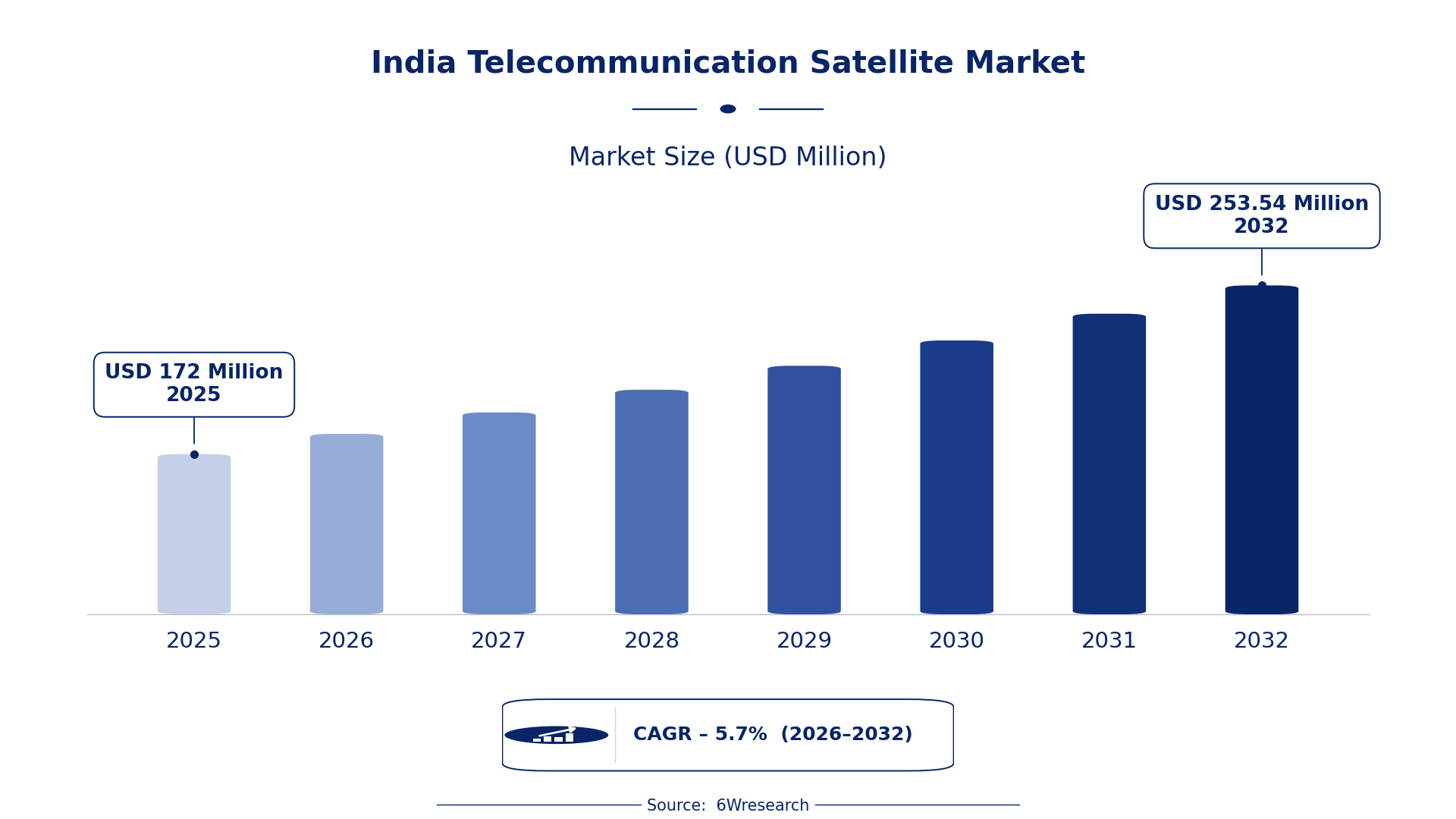
According to 6Wresearch internal database and industry insights, the India Telecommunication Satellite Market was valued at USD 172.0 million in 2025 and is projected to reach USD 253.54 million by 2032, growing at a CAGR of approximately 5.7% during 2026–2032.
India Telecommunication Satellite Market Highlights
| Report Metric | Details |
| Report Name | India Telecommunication Satellite Market |
| Market Size 2025 | USD 172.0 million |
| Market Size 2032 | USD 253.54 million |
| Absolute Growth 2025–2032 | USD 81.54 million |
| CAGR 2026–2032 | 5.7% |
| Peak Annual Growth | 8.2% in 2032 |
| Forecast Period | 2026–2032 |
| Historical Data | 2022–2025 |
| Base Year | 2025 |
| Leading Satellite Type, 2025 | Geostationary Satellites (36% share) |
| Leading Product Type, 2025 | Fixed Communication (45% share) |
| Leading Orbit Class, 2025 | GEO (52% share) |
| Leading Distribution Channel, 2025 | Satellite Builders (42% share) |
| Leading End User Industry, 2025 | National Carriers (52% share) |
| Fastest-Growing Satellite Type | LEO Satellites (7.3% CAGR) |
| Fastest-Growing Product Type | Internet Constellations (6.9% CAGR) |
| Fastest-Growing Orbit Class | LEO (7.0% CAGR) |
| Fastest-Growing Distribution Channel | Satellite Operators (8.2% CAGR) |
| Fastest-Growing End User Industry | Broadband Providers (8.0% CAGR) |
| Growing Sector | Broadband Providers |
| Key End Users | National Carriers, Broadband Providers, Government Services, Military & Airlines |
India Telecommunication Satellite Market Year-wise Growth Rate and Key Drivers (2022–2032)
This graph illustrates the annual growth rates of the market from 2022 to 2032, highlighting a steady upward trajectory and projected market expansion over the forecast period.
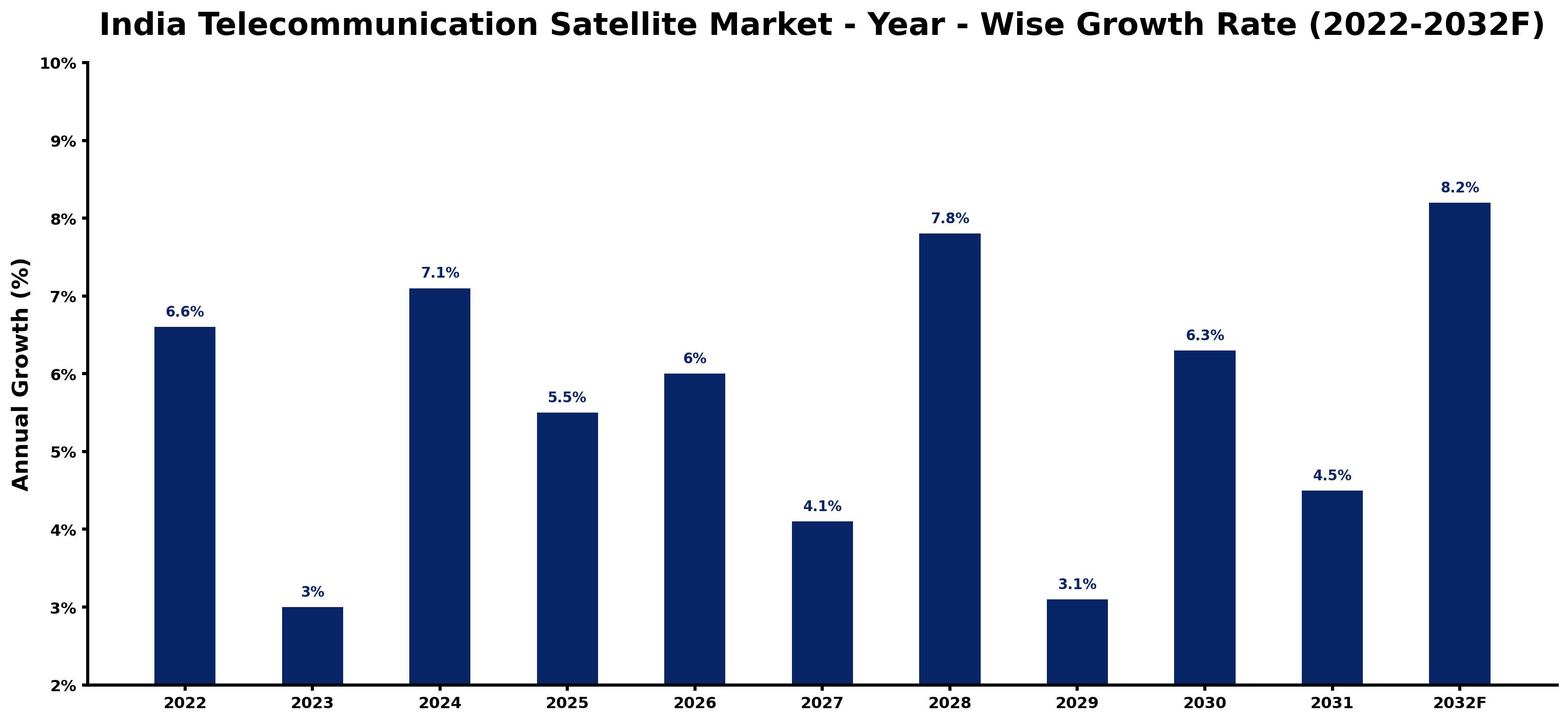
The following table presents the estimated annual growth rate for each year together with the principal factor influencing market performance.
| Year | Estimated Annual Growth (%) | Market Rationale |
| 2022 | 6.6 | The market showed strong demand due to existing satellite operations and services. |
| 2023 | 3.0 | Growth slowed as the market adjusted to new regulatory frameworks and investment timelines. |
| 2024 | 7.1 | Demand accelerated with the launch of new geostationary satellites enhancing communication capabilities. |
| 2025 | 5.5 | Growth decelerated as the market faced saturation in certain service areas. |
| 2026 | 6.0 | Demand increased as broadband providers expanded their satellite-based services for remote areas. |
| 2027 | 4.1 | Growth slowed due to delays in satellite launches affecting service availability. |
| 2028 | 7.8 | Demand surged as new LEO satellites entered the market, improving internet access. |
| 2029 | 3.1 | Growth slowed as competition intensified among satellite service providers. |
| 2030 | 6.3 | Demand increased with further advancements in satellite technology and applications. |
| 2031 | 4.5 | Growth slowed as the market matured, leading to stabilisation in service offerings. |
| 2032 | 8.2 | Demand peaked as the market capitalised on the government's investment in satellite technology. |
Note: Market size estimations and growth projections presented in this report are based on 6Wresearch's proprietary forecasting methodology, utilizing the latest available industry data, government publications, and primary research inputs.
India Telecommunication Satellite Market Synopsis
The Telecommunication Satellite Market in India includes advanced satellite systems that enable long-distance communication. These satellites, developed through aerospace engineering, are crucial for broadcasting, internet connectivity, and secure communications. The market is set for robust growth, driven by the expansion of the broadband sector, which is expected to reach 900 million users by 2025. Government initiatives, such as the National Digital Communications Policy 2022, are improving connectivity and driving demand for satellite technology. With over 50 operational satellites, the market is ready for substantial growth in the upcoming years.
Market Dynamics Impact Analysis (2026–2032)
| Factor | Type | Impact | Primary Segment Affected |
| Expansion of broadband services is increasing demand for satellite connectivity. | Driver | High | National Carriers |
| Investment in satellite technology development creates opportunities for new entrants. | Opportunity | High | Satellite Builders |
| Regulatory hurdles can delay satellite launches and service rollouts. | Restraint | High | Satellite Operators |
| High costs associated with satellite manufacturing limit market access for new players. | Restraint | Medium | Satellite Builders |
| Technological advancements in LEO satellites are reshaping market dynamics. | Driver | Medium | LEO Satellites |
| Growing demand for secure military communications presents new opportunities. | Opportunity | Medium | Defense Integrators |
| Supply chain disruptions can affect the timely delivery of satellite components. | Challenge | High | Satellite Builders |
| Competition from alternative communication technologies poses a challenge. | Challenge | Medium | Broadband Providers |
Evaluation of Drivers in India Telecommunication Satellite Market (2026–2032)
The main growth drivers and the segments they affect most are set out below.
| Drivers | Primary Segment Affected | Why It Matters (Evidence) |
| Increasing broadband penetration drives demand for satellite services. | National Carriers | With the broadband sector projected to reach 900 million users by 2025, carriers are investing in satellite technology to improve service delivery. |
| Government investments in satellite technology spur market growth. | Satellite Builders | The Indian government plans to invest $1 billion in satellite technology development by 2025, encouraging innovation and production. |
| Launch of new geostationary satellites improves service offerings. | Fixed Communication | The GSAT series, including GSAT-30 launched in 2020, supports stable communication links, driving demand for fixed communication services. |
| Expansion of internet constellations increases satellite demand. | Internet Constellations | The growing need for global internet coverage is pushing the development of LEO satellites, with a CAGR of 7.3% expected from 2026 to 2032. |
| Regulatory support for satellite operations facilitates market entry. | Satellite Operators | The Satellite Communication Policy initiated by the Department of Telecommunications streamlines operations, enabling easier access for new players. |
The expansion of the Telecommunication Satellite market in India is supported by rising broadband penetration, government investments, and the launch of new satellites. The broadband sector is anticipated to reach 900 million users by 2025, boosting demand for satellite services. The Indian government plans to invest $1 billion in satellite technology development by 2025, stimulating growth. The GSAT series, including GSAT-30 launched in 2020, enhances communication capabilities, encouraging carriers to invest in satellite infrastructure. The Satellite Communication Policy simplifies operations, facilitating market entry for new operators.
Evaluation of Restraints in India Telecommunication Satellite Market
The key brakes on demand, and where they bite hardest, are shown below.
| Market Restraint | Primary Segment Affected | Why It Matters (Evidence) |
| Technological delays due to outdated infrastructure | Satellite Operators | These delays can lead to project overruns of up to 20%, impacting service delivery. |
| Supply chain disruptions from limited domestic manufacturing | Satellite Builders | Such disruptions can delay satellite launches, resulting in millions in lost revenue for broadband providers. |
| Shortage of skilled aerospace engineers | Satellite Operators | This shortage increases project costs by around 15%, affecting the development of advanced systems. |
| Regulatory complexities surrounding the Space Activities Bill | Satellite Builders | These complexities can prolong approval processes, delaying market access for new services. |
| Limited investment in R&D for satellite technology | Satellite Operators | Insufficient R&D hampers innovation, affecting the competitiveness of satellite services. |
India Telecommunication Satellite Market Challenges
The India telecommunication satellite market encounters technological delays due to outdated infrastructure, costing producers up to 20% in project overruns. Importers face supply chain disruptions from limited domestic manufacturing capabilities, which can delay satellite launches and lead to millions in lost revenue for broadband providers. A shortage of skilled aerospace engineers hampers the development of advanced systems, increasing project costs for producers by around 15%. Regulatory complexities surrounding the Space Activities Bill can prolong approval processes, impacting buyers' access to timely communication solutions and potentially delaying service rollouts.
Trends in the India Telecommunication Satellite Market
Buyers and suppliers in the India Telecommunication Satellite Market are adjusting to the following trends.
- Launch of GSAT Series Enhancing Communication: The GSAT series, including GSAT-30 launched in 2020, plays a key role in improving communication infrastructure across India. With over 50 operational satellites, this series supports various communication needs, facilitating growth in the telecommunication sector.
- Shift Towards LEO Satellites for Internet Coverage: India is increasingly adopting LEO satellites for global internet coverage, driven by the demand for low-latency applications. This shift is reflected in the expected CAGR of 7.3% for LEO satellites from 2026 to 2032.
- Government Investment Boosting Satellite Technology: The Indian government has allocated $1 billion for satellite technology development by 2025, enhancing communication capabilities. This investment is set to accelerate the growth of satellite services and infrastructure.
- Expansion of Broadband Providers Utilizing Satellite Technology: Broadband providers are increasingly relying on satellite technology to improve service offerings, with a projected 900 million users by 2025. This trend highlights the growing importance of satellite communication in expanding internet access.
Investment Opportunities in the India Telecommunication Satellite Market
Several openings in the India Telecommunication Satellite Market merit attention from investors.
- National Carriers Expanding Satellite Services: National carriers are looking to enhance their satellite services to meet the rising demand for broadband. With the broadband sector projected to reach 900 million users by 2025, there is an opportunity for investment in satellite technology.
- Investment in Satellite Technology Development: The Indian government's $1 billion investment in satellite technology development creates opportunities for satellite builders. This funding can be realised through partnerships with local firms to improve production capabilities.
- Broadband Providers Seeking Satellite Solutions: Broadband providers are increasingly seeking satellite solutions to expand their service coverage. With a projected 900 million users by 2025, this presents a promising opportunity for satellite operators and builders.
- Growing Demand for Secure Military Communications: The defense sector is increasingly investing in secure satellite communications. With military applications expanding, there is an opportunity for defense integrators to provide advanced satellite solutions.
Government Initiatives in the India Telecommunication Satellite Market
The National Digital Communications Policy 2022, launched by the Department of Telecommunications, aims to improve satellite communication infrastructure and connectivity across the country. This policy encourages the development of satellite services, ensuring that communication needs are met efficiently. By promoting private sector participation, the policy seeks to improve service delivery and expand access to satellite technology. Additionally, the policy sets targets for broadband penetration, utilising satellite systems to achieve these goals. The government's commitment to this policy reflects its focus on advancing communication capabilities nationwide.
The Indian Space Promotion and Authorization Center (IN-SPACe), established in 2020, plays a significant role in approving satellite launches and operations. This agency facilitates private sector participation in satellite activities, streamlining the approval process for new projects. By providing a regulatory framework, IN-SPACe enables companies to navigate the complexities of satellite operations more effectively. Furthermore, the Department of Telecommunications initiated the Satellite Communication Policy in 2021, which aims to improve service delivery and operational efficiency for satellite service providers.
Future Insight of the India Telecommunication Satellite Market
By 2032, buyers and suppliers in the India telecommunication satellite market can expect improved connectivity driven by the National Digital Communications Policy aiming for 100% broadband penetration. The government's investment in satellite technology development will strengthen production capabilities. The establishment of the National Space Promotion and Authorization Center will streamline regulatory processes, facilitating quicker market entry for new services. Increased private sector participation in satellite launches will diversify offerings and encourage competition, ultimately benefiting both buyers and suppliers.
Market Segmentation Analysis
The report offers a comprehensive study of the following market segments and their leading categories in the market.
By Satellite Type – Geostationary Satellites Dominated, LEO Satellites Expected to Grow Fastest
According to Sumit Sagar, AM at 6Wresearch, Geostationary Satellites accounted for a 36% market share by satellite type in 2025. Geostationary satellites hold the largest market share in India due to their critical role in providing stable communication services across fixed areas. With over 50 operational satellites, they are essential for broadcasting and other telecommunication needs. Over 2026–2032, LEO Satellites are expected to post the fastest growth, at a CAGR of 7.3%. LEO satellites are experiencing rapid growth as they are increasingly deployed for global internet coverage and low-latency applications, catering to the expanding broadband sector projected to reach 900 million users by 2025. This trend indicates a shift towards more versatile communication solutions. Suppliers should focus on developing LEO satellite technologies to meet the growing demand for global connectivity.
By Product Type – Fixed Communication Dominated, Internet Constellations Expected to Grow Fastest
Fixed Communication took a 45% share of product type in 2025, more than any other category. Fixed communication systems hold the largest market share due to their critical role in providing stable communication links for broadcasting and military applications. Their established presence, particularly in government services, makes them indispensable for users requiring consistent connectivity. Internet Constellations are projected to grow fastest, at a CAGR of 6.9% during 2026–2032. Internet constellations are experiencing rapid growth as they address the need for expanded internet access in remote areas, aligning with the government's goal of achieving 100% broadband penetration by 2025. This demand highlights a shift towards more advanced communication solutions. Buyers should prioritise investment in internet constellation technologies to improve service offerings in underserved regions.
By Orbit Class – GEO Dominated, LEO Expected to Grow Fastest
In 2025, GEO led the orbit class split with a 52% share. GEO satellites hold the largest market share due to their role as the primary orbit class for traditional communication satellites, providing essential services for various applications. Their established infrastructure and reliability make them indispensable for users across commercial and governmental sectors. LEO is set to record the highest CAGR in this split, 7.0% over 2026–2032. LEO satellites are experiencing rapid growth as they cater to modern communication needs with lower latency and wider coverage, attracting a growing user base. This shift highlights a transformative approach to delivering communication services, which will likely continue to expand. Suppliers must adapt to the increasing demand for LEO satellites to remain competitive in the evolving market.
By Distribution Channel – Satellite Builders Dominated, Satellite Operators Expected to Grow Fastest
Satellite Builders held a 42% share of the India Telecommunication Satellite Market by distribution channel in 2025. Satellite builders capture the largest market share as they are responsible for manufacturing satellites, ensuring the availability of essential communication technology. Their pivotal role in the supply chain is crucial for maintaining the operational capabilities of the telecommunication satellite market. The quickest growth will come from Satellite Operators, forecast to expand at a CAGR of 8.2% between 2026 and 2032. Satellite operators represent the fastest-growing segment, as they manage and operate satellites for communication services, responding to the surging demand for satellite-based connectivity. This trend indicates a significant shift towards service-oriented business models within the industry. Buyers should engage with satellite operators to leverage their expertise in managing satellite communication services effectively.
By End User Industry – National Carriers Dominated, Broadband Providers Expected to Grow Fastest
With a 52% revenue share in 2025, National Carriers was the largest end user industry category. National carriers dominate the market share as key players in the telecommunication sector, utilising satellites to provide comprehensive communication services throughout India. Their extensive networks and established infrastructure are vital to the satellite communication ecosystem. Over 2026–2032, Broadband Providers are expected to post the fastest growth, at a CAGR of 8.0%. Broadband providers are the fastest-growing segment, increasingly relying on satellites to enhance internet service offerings, particularly in underserved areas. This trend highlights the pressing need for improved connectivity solutions as the broadband market continues to expand. Suppliers should focus on building partnerships with broadband providers to capitalise on the rising demand for satellite-enhanced internet services.
Key Attractiveness of the Report
- 10 Years of Market Numbers
- Historical Data Starting from 2022 to 2025
- Base Year 2025
- Forecast Data until 2032
- Key Performance Indicators Impacting the Market
- Major Upcoming Developments and Projects
Key Highlights of the Report:
- India Telecommunication Satellite Market Outlook
- Market Size of India Telecommunication Satellite Market, 2025
- Forecast of India Telecommunication Satellite Market, 2032
- Historical Data and Forecast of India Telecommunication Satellite Revenues & Volume for the Period 2022 - 2032F
- India Telecommunication Satellite Market Trend Evolution
- India Telecommunication Satellite Market Drivers and Challenges
- India Telecommunication Satellite Price Trends
- India Telecommunication Satellite Porter's Five Forces
- India Telecommunication Satellite Industry Life Cycle
- Historical Data and Forecast of India Telecommunication Satellite Market Revenues & Volume By Satellite Type for the Period 2022 - 2032F
- Historical Data and Forecast of India Telecommunication Satellite Market Revenues & Volume By Geostationary Satellites for the Period 2022 - 2032F
- Historical Data and Forecast of India Telecommunication Satellite Market Revenues & Volume By LEO Satellites for the Period 2022 - 2032F
- Historical Data and Forecast of India Telecommunication Satellite Market Revenues & Volume By MEO Satellites for the Period 2022 - 2032F
- Historical Data and Forecast of India Telecommunication Satellite Market Revenues & Volume By SATCOM Equipment for the Period 2022 - 2032F
- Historical Data and Forecast of India Telecommunication Satellite Market Revenues & Volume By Product Type for the Period 2022 - 2032F
- Historical Data and Forecast of India Telecommunication Satellite Market Revenues & Volume By Fixed Communication for the Period 2022 - 2032F
- Historical Data and Forecast of India Telecommunication Satellite Market Revenues & Volume By Internet Constellations for the Period 2022 - 2032F
- Historical Data and Forecast of India Telecommunication Satellite Market Revenues & Volume By Navigation Systems for the Period 2022 - 2032F
- Historical Data and Forecast of India Telecommunication Satellite Market Revenues & Volume By Terminals & Dishes for the Period 2022 - 2032F
- Historical Data and Forecast of India Telecommunication Satellite Market Revenues & Volume By Orbit Class for the Period 2022 - 2032F
- Historical Data and Forecast of India Telecommunication Satellite Market Revenues & Volume By GEO for the Period 2022 - 2032F
- Historical Data and Forecast of India Telecommunication Satellite Market Revenues & Volume By LEO for the Period 2022 - 2032F
- Historical Data and Forecast of India Telecommunication Satellite Market Revenues & Volume By MEO for the Period 2022 - 2032F
- Historical Data and Forecast of India Telecommunication Satellite Market Revenues & Volume By Ground Segment for the Period 2022 - 2032F
- Historical Data and Forecast of India Telecommunication Satellite Market Revenues & Volume By Distribution Channel for the Period 2022 - 2032F
- Historical Data and Forecast of India Telecommunication Satellite Market Revenues & Volume By Satellite Builders for the Period 2022 - 2032F
- Historical Data and Forecast of India Telecommunication Satellite Market Revenues & Volume By Space Launch Partners for the Period 2022 - 2032F
- Historical Data and Forecast of India Telecommunication Satellite Market Revenues & Volume By Satellite Operators for the Period 2022 - 2032F
- Historical Data and Forecast of India Telecommunication Satellite Market Revenues & Volume By Defense Integrators for the Period 2022 - 2032F
- Historical Data and Forecast of India Telecommunication Satellite Market Revenues & Volume By End User Industry for the Period 2022 - 2032F
- Historical Data and Forecast of India Telecommunication Satellite Market Revenues & Volume By National Carriers for the Period 2022 - 2032F
- Historical Data and Forecast of India Telecommunication Satellite Market Revenues & Volume By Broadband Providers for the Period 2022 - 2032F
- Historical Data and Forecast of India Telecommunication Satellite Market Revenues & Volume By Government Services for the Period 2022 - 2032F
- Historical Data and Forecast of India Telecommunication Satellite Market Revenues & Volume By Military & Airlines for the Period 2022 - 2032F
- India Telecommunication Satellite Import Export Trade Statistics
- Market Opportunity Assessment By Satellite Type
- Market Opportunity Assessment By Product Type
- Market Opportunity Assessment By Orbit Class
- Market Opportunity Assessment By Distribution Channel
- Market Opportunity Assessment By End User Industry
- India Telecommunication Satellite Top Companies Market Share
- India Telecommunication Satellite Competitive Benchmarking By Technical and Operational Parameters
- India Telecommunication Satellite Company Profiles
- India Telecommunication Satellite Key Strategic Recommendations
Market Covered
This report examines the market across the segments below.
By Satellite Type
- Geostationary Satellites
- LEO Satellites
- MEO Satellites
- SATCOM Equipment
By Product Type
- Fixed Communication
- Internet Constellations
- Navigation Systems
- Terminals & Dishes
By Orbit Class
- GEO
- LEO
- MEO
- Ground Segment
By Distribution Channel
- Satellite Builders
- Space Launch Partners
- Satellite Operators
- Defense Integrators
By End User Industry
- National Carriers
- Broadband Providers
- Government Services
- Military & Airlines































