India Telemedicine Integration Market Size & Growth Rate
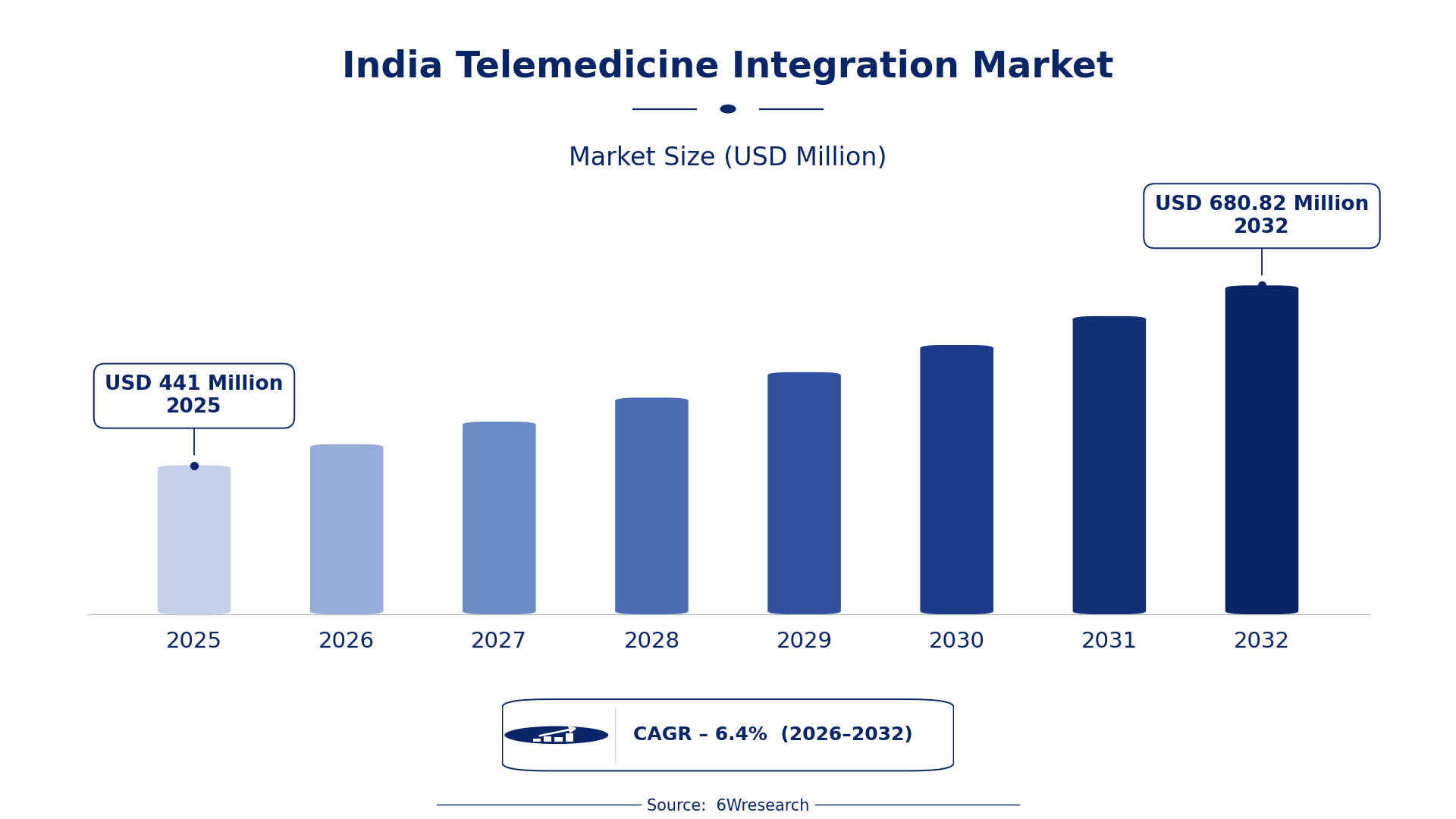
According to 6Wresearch internal database and industry insights, the India Telemedicine Integration Market was valued at USD 441.0 million in 2025 and is projected to reach USD 680.82 million by 2032, growing at a CAGR of approximately 6.4% during 2026–2032.
India Telemedicine Integration Market Highlights
| Report Metric | Details |
| Report Name | India Telemedicine Integration Market |
| Market Size 2025 | USD 441.0 million |
| Market Size 2032 | USD 680.82 million |
| Absolute Growth 2025–2032 | USD 239.82 million |
| CAGR 2026–2032 | 6.4% |
| Peak Annual Growth | 8.2% in 2030 |
| Forecast Period | 2026–2032 |
| Historical Data | 2022–2025 |
| Base Year | 2025 |
| Leading Integration Type, 2025 | EHR/EMR Integration (42% share) |
| Leading System Interface, 2025 | API-Based (46% share) |
| Leading Workflow Automation, 2025 | Patient History Access (38% share) |
| Leading End User, 2025 | Hospitals (37% share) |
| Fastest-Growing Integration Type | Lab System Integration (7.8% CAGR) |
| Fastest-Growing System Interface | eRx Modules (7.7% CAGR) |
| Fastest-Growing Workflow Automation | Diagnostic Coordination (8.8% CAGR) |
| Fastest-Growing End User | Specialty Clinics (8.8% CAGR) |
| Growing Sector | Healthcare |
| Key End Users | Hospitals, Diagnostic Labs, Specialty Clinics, Retail Pharmacies |
India Telemedicine Integration Market Year-wise Growth Rate and Key Drivers (2022–2032)
This graph illustrates the annual growth rates of the market from 2022 to 2032, highlighting a steady upward trajectory and projected market expansion over the forecast period.
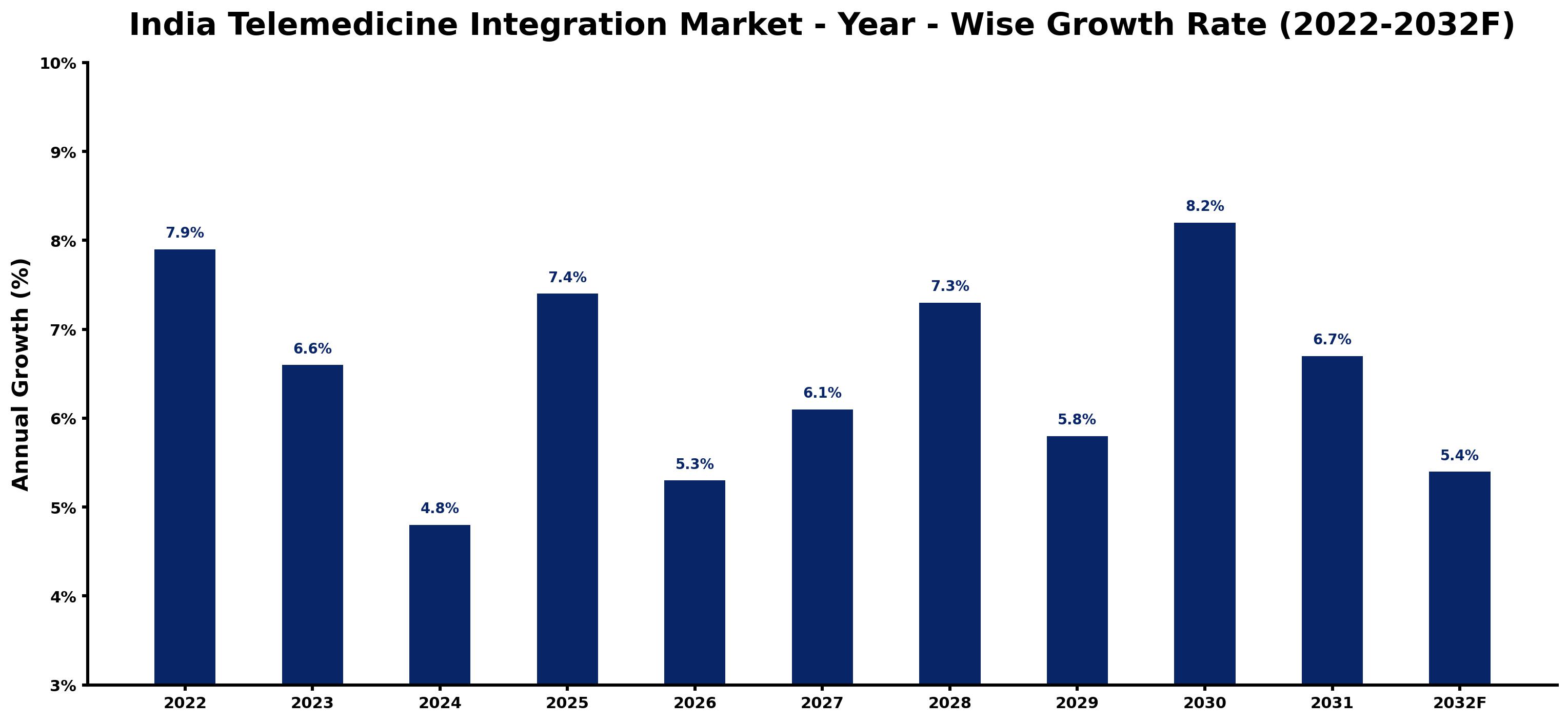
Below, each year's estimated growth is shown next to the factor that most influenced it.
| Year | Estimated Annual Growth (%) | Market Rationale |
| 2022 | 7.9 | Telemedicine adoption reached 60%, reflecting strong demand for remote healthcare solutions. |
| 2023 | 6.6 | Usage growth slowed as the market adjusted to increased telemedicine service providers, now over 1,500. |
| 2024 | 4.8 | Continued expansion of telemedicine services faced challenges in rural implementation despite existing demand. |
| 2025 | 7.4 | Growth accelerated due to the National Digital Health Mission's initiatives to integrate telemedicine. |
| 2026 | 5.3 | Market growth is expected to moderate as the focus shifts to improving existing telemedicine infrastructure. |
| 2027 | 6.1 | Investment in telemedicine technology is projected to spur demand from healthcare providers and patients. |
| 2028 | 7.3 | Rising patient awareness and acceptance of telemedicine services will contribute to market growth. |
| 2029 | 5.8 | The market is expected to experience a slowdown as providers adapt to new regulations and standards. |
| 2030 | 8.2 | Growth will be driven by the Ayushman Bharat Digital Mission's enhancements to telemedicine services. |
| 2031 | 6.7 | As the market matures, growth is projected to slow due to intensified competition among service providers. |
| 2032 | 5.4 | Demand is expected to continue rising as telemedicine becomes a standard part of healthcare delivery. |
Note: Market size estimations and growth projections presented in this report are based on 6Wresearch's proprietary forecasting methodology, utilizing the latest available industry data, government publications, and primary research inputs.
India Telemedicine Integration Market Synopsis
Telemedicine Integration in India encompasses the use of technology to connect healthcare providers and patients remotely. It involves software solutions that link healthcare systems for services such as remote consultations and patient monitoring. The India Telemedicine Integration Market is growing due to the increasing demand for accessible healthcare, particularly in rural areas. The National Digital Health Mission aims to integrate telemedicine by 2025, further propelling this growth. With over 1,500 service providers, the market is seeing a remarkable surge in usage, which rose by 300% in 2023.
Market Dynamics Impact Analysis (2026–2032)
| Factor | Type | Impact | Primary Segment Affected |
| Increased investment in digital health technologies | Driver | High | EHR/EMR Integration |
| Growing demand for remote healthcare services | Driver | High | EHR/EMR Integration |
| Expansion of telemedicine services in rural areas | Opportunity | High | Pharmacy Integration |
| Integration of telemedicine into existing healthcare systems | Opportunity | Medium | Lab System Integration |
| Challenges in regulatory compliance for telemedicine providers | Restraint | High | API-Based |
| Limited internet access in rural regions affecting service delivery | Restraint | Medium | Imaging System Linkage |
| Buyers face difficulties in navigating telemedicine regulations | Challenge | High | Diagnostic Coordination |
| Suppliers encounter delays in technology adoption due to infrastructure issues | Challenge | Medium | Radiology Consults |
Evaluation of Drivers in India Telemedicine Integration Market (2026–2032)
The table below links each growth driver to the segment it affects and the evidence for it.
| Drivers | Primary Segment Affected | Why It Matters (Evidence) |
| Investment in digital health infrastructure | EHR/EMR Integration | This investment supports the integration of patient data management, with a projected market size of USD 441.0 million by 2025. |
| Rising patient demand for remote consultations | EHR/EMR Integration | This demand drives healthcare providers to adopt telemedicine solutions to meet patient needs effectively, contributing to a 300% increase in usage in 2023. |
| Government initiatives promoting telemedicine | Pharmacy Integration | These initiatives encourage pharmacies to adopt electronic prescription systems, improving medication management and increasing access for rural patients. |
| Increased collaboration among healthcare providers | Lab System Integration | Collaboration streamlines lab test ordering and results sharing, improving service delivery and patient care. |
| Adoption of quality management standards | API-Based | Standards like ISO 9001:2015 ensure telemedicine providers maintain high service quality, boosting consumer trust. |
Expansion of the Telemedicine Integration market in India is backed by increased investment in digital health infrastructure, which supports the integration of patient data management. The rising patient demand for remote consultations drives healthcare providers to adopt telemedicine solutions, improving service delivery. Collaboration among healthcare providers streamlines lab test ordering and results sharing, further improving patient care. The adoption of quality management standards like ISO 9001:2015 ensures telemedicine providers maintain high service quality, boosting consumer trust and satisfaction.
Evaluation of Restraints in India Telemedicine Integration Market
Below mentioned are some major restraints and their influence on market dynamics.
| Market Restraint | Primary Segment Affected | Why It Matters (Evidence) |
| Regulatory compliance challenges for telemedicine providers | API-Based | These challenges create delays in service implementation, affecting patient access to telemedicine services, with potential revenue losses of up to 40%.},{ |
| Limited internet access in rural areas | Imaging System Linkage | This limitation restricts the ability to provide remote access to imaging data, hindering service delivery and affecting patient outcomes. |
| High initial investment costs for telemedicine technology | EHR/EMR Integration | These costs deter smaller healthcare providers from adopting necessary telemedicine solutions, limiting overall market growth. |
| Inconsistent quality of telemedicine services | Pharmacy Integration | Quality inconsistencies can lead to patient distrust and lower adoption rates of telemedicine services, affecting overall market acceptance. |
| Insufficient training for healthcare providers | Diagnostic Coordination | This insufficiency results in ineffective use of telemedicine technologies, limiting their potential benefits and impacting service quality. |
India Telemedicine Integration Market Challenges
Buyers and suppliers in the India Telemedicine Integration Market face notable supply chain delays due to insufficient technology infrastructure. This challenge stems from unreliable internet connectivity in rural areas, potentially leading to revenue losses of up to 40% for healthcare providers. Regulatory hurdles also pose challenges, as compliance with guidelines from the Indian Medical Association can inflate operational costs and extend approval timelines, delaying service launches by several months. High integration costs burden buyers, consuming over 20% of their annual budgets and limiting their ability to adopt telemedicine solutions. Furthermore, uneven technology adoption results in only 30% of the rural population being covered, restricting access to essential healthcare services.
Trends in the India Telemedicine Integration Market
Four trends stand out in the India Telemedicine Integration Market.
- National Digital Health Mission Enhancing Telemedicine: The National Digital Health Mission is advancing telemedicine integration in India, aiming for a fully digital health framework by 2025. In 2023, telemedicine adoption reached 60%, indicating substantial progress in healthcare delivery.
- Shift Towards Remote Patient Monitoring: India is experiencing a shift towards remote patient monitoring solutions, driven by increased demand for accessible healthcare. In 2023, telemedicine services experienced a 300% increase in usage, highlighting this trend.
- Growing Adoption of Quality Standards: Telemedicine providers are increasingly adopting ISO 9001:2015 standards for quality management. This trend is important for ensuring high service quality, with many providers implementing these standards in 2023.
- Expansion of Telemedicine in Rural Areas: Telemedicine services are expanding significantly in rural areas, supported by the Digital India initiative. Approximately 30% of the rural population now has access to telemedicine services, improving healthcare accessibility.
Investment Opportunities in the India Telemedicine Integration Market
Several openings in the India Telemedicine Integration Market merit attention from investors.
- Investment in Telemedicine Technology: There is a rising need for advanced telemedicine technology solutions, with the market projected to reach USD 441.0 million by 2025. Hospitals are actively seeking effective solutions to improve patient care and streamline operations.
- Supply of Remote Monitoring Devices: The demand for remote monitoring devices is on the rise, with telemedicine services experiencing a 300% usage increase in 2023. Specialty clinics are in search of reliable devices to enhance patient monitoring capabilities.
- Development of EHR Integration Solutions: The EHR/EMR Integration segment is anticipated to grow due to increasing demand for patient data management. Diagnostic labs are actively pursuing solutions that improve data sharing and management efficiency.
- Expansion of Telemedicine Training Programs: There is an opportunity to create training programs for healthcare providers, with the market expected to grow as telemedicine becomes mainstream. Hospitals are seeking comprehensive training solutions to improve service delivery.
Government Initiatives in the India Telemedicine Integration Market
The Ayushman Bharat Digital Mission, launched in 2023, aims to establish a digital health framework in India, including telemedicine services. This initiative will enhance access to healthcare, particularly in underserved areas, and is projected to significantly improve patient outcomes. The National Digital Health Mission, initiated in 2020, supports telemedicine integration, ensuring that healthcare providers can connect with patients remotely. These measures collectively improve healthcare delivery and are expected to boost telemedicine adoption across the country.
The National Health Authority oversees the implementation of the Telemedicine Practice Guidelines established in 2020, which standardise telehealth practices in India. Additionally, the Health ID system, introduced in 2023, facilitates better telemedicine integration by enabling healthcare providers to access patient information efficiently. The Digital India initiative, ongoing since 2015, also supports telemedicine through various digital health initiatives, ensuring that patients receive timely and effective care.
Future Insight of the India Telemedicine Integration Market
The India Telemedicine Integration Market is set to undergo transformative changes by 2032, driven by the National Digital Health Mission aiming for full integration by 2025. This initiative will greatly enhance patient connectivity and accessibility, particularly in underserved regions. The Digital India initiative is projected to enable a 500% increase in service usage by 2032. The adoption of ISO 9001:2015 standards will elevate service quality among providers, ensuring better outcomes for both buyers and suppliers. These developments will establish a more robust telemedicine framework, improving healthcare delivery across the country.
Market Segmentation Analysis
Each segment group is reviewed below, with the leader by share and the fastest grower by CAGR.
By Integration Type – EHR/EMR Integration Dominated, Lab System Integration Expected to Grow Fastest
According to Sumit Sagar, AM at 6Wresearch, EHR/EMR Integration took a 42% share of integration type in 2025, more than any other category. EHR/EMR Integration holds the largest share due to its essential role in managing patient data across healthcare systems. This integration is particularly vital in urban hospitals where timely access to patient information significantly enhances care quality. Lab System Integration is set to record the highest CAGR in this split, 7.8% over 2026–2032. Lab System Integration is rapidly growing as it improves the efficiency of lab test ordering and results sharing, which has become increasingly important with the surge in telemedicine usage. The notable increase in telemedicine adoption has prompted healthcare facilities to enhance their lab integration capabilities. Suppliers should focus on developing robust lab integration solutions to meet the rising demand in the market.
By System Interface – API-Based Dominated, eRx Modules Expected to Grow Fastest
The largest system interface category in 2025 was API-Based, with a 46% share of total revenue. API-Based systems dominate the market share as they facilitate seamless connections between various healthcare applications, making them indispensable for providers. Their flexibility and compatibility with existing systems have established them as the preferred choice among healthcare organisations. eRx Modules are projected to grow fastest, at a CAGR of 7.7% during 2026–2032. eRx Modules are witnessing rapid growth driven by the rising demand for electronic prescription services, which streamline medication management and minimise errors. The broader adoption of digital health technologies is further accelerating this segment's expansion. Buyers should invest in eRx solutions to enhance prescription accuracy and improve operational efficiency.
By Workflow Automation – Patient History Access Dominated, Diagnostic Coordination Expected to Grow Fastest
Patient History Access accounted for a 38% market share by workflow automation in 2025. Patient History Access leads the market share as it is critical for informed clinical decision-making, enabling healthcare providers to enhance patient outcomes. The increasing complexity of patient cases necessitates comprehensive access to historical data for effective treatment planning. Over 2026–2032, Diagnostic Coordination is expected to post the fastest growth, at a CAGR of 8.8%. Diagnostic Coordination is growing swiftly as it promotes better collaboration among healthcare providers, which is essential for effective patient management. The ongoing shift towards integrated care models is driving demand for improved diagnostic workflows. Suppliers should concentrate on solutions that enhance diagnostic coordination to align with the needs of a collaborative healthcare environment.
By End User – Hospitals Dominated, Specialty Clinics Expected to Grow Fastest
With a 37% revenue share in 2025, Hospitals was the largest end user category. Hospitals command the largest market share as they are the primary users of telemedicine services for comprehensive patient care, especially in urban areas. Their established infrastructure and high patient volumes position them as key players in the telemedicine integration market. The quickest growth will come from Specialty Clinics, forecast to expand at a CAGR of 8.8% between 2026 and 2032. Specialty Clinics are experiencing the fastest growth as they increasingly adopt telemedicine for specialised consultations, addressing specific patient needs. This trend is driven by the rising demand for convenient access to specialist care. Providers should tailor their telemedicine solutions to meet the unique requirements of specialty clinics to capture this expanding market.
Key Attractiveness of the Report
- 10 Years of Market Numbers
- Historical Data Starting from 2022 to 2025
- Base Year 2025
- Forecast Data until 2032
- Key Performance Indicators Impacting the Market
- Major Upcoming Developments and Projects
Key Highlights of the Report:
- India Telemedicine Integration Market Outlook
- Market Size of India Telemedicine Integration Market, 2025
- Forecast of India Telemedicine Integration Market, 2032
- Historical Data and Forecast of India Telemedicine Integration Revenues & Volume for the Period 2022 - 2032F
- India Telemedicine Integration Market Trend Evolution
- India Telemedicine Integration Market Drivers and Challenges
- India Telemedicine Integration Price Trends
- India Telemedicine Integration Porter's Five Forces
- India Telemedicine Integration Industry Life Cycle
- Historical Data and Forecast of India Telemedicine Integration Market Revenues & Volume By Integration Type for the Period 2022 - 2032F
- Historical Data and Forecast of India Telemedicine Integration Market Revenues & Volume By EHR/EMR Integration for the Period 2022 - 2032F
- Historical Data and Forecast of India Telemedicine Integration Market Revenues & Volume By Lab System Integration for the Period 2022 - 2032F
- Historical Data and Forecast of India Telemedicine Integration Market Revenues & Volume By Imaging System Linkage for the Period 2022 - 2032F
- Historical Data and Forecast of India Telemedicine Integration Market Revenues & Volume By Pharmacy Integration for the Period 2022 - 2032F
- Historical Data and Forecast of India Telemedicine Integration Market Revenues & Volume By System Interface for the Period 2022 - 2032F
- Historical Data and Forecast of India Telemedicine Integration Market Revenues & Volume By API-Based for the Period 2022 - 2032F
- Historical Data and Forecast of India Telemedicine Integration Market Revenues & Volume By HL7 Interface for the Period 2022 - 2032F
- Historical Data and Forecast of India Telemedicine Integration Market Revenues & Volume By DICOM/PACS for the Period 2022 - 2032F
- Historical Data and Forecast of India Telemedicine Integration Market Revenues & Volume By eRx Modules for the Period 2022 - 2032F
- Historical Data and Forecast of India Telemedicine Integration Market Revenues & Volume By Workflow Automation for the Period 2022 - 2032F
- Historical Data and Forecast of India Telemedicine Integration Market Revenues & Volume By Patient History Access for the Period 2022 - 2032F
- Historical Data and Forecast of India Telemedicine Integration Market Revenues & Volume By Diagnostic Coordination for the Period 2022 - 2032F
- Historical Data and Forecast of India Telemedicine Integration Market Revenues & Volume By Radiology Consults for the Period 2022 - 2032F
- Historical Data and Forecast of India Telemedicine Integration Market Revenues & Volume By ePrescription Fulfillment for the Period 2022 - 2032F
- Historical Data and Forecast of India Telemedicine Integration Market Revenues & Volume By End User for the Period 2022 - 2032F
- Historical Data and Forecast of India Telemedicine Integration Market Revenues & Volume By Hospitals for the Period 2022 - 2032F
- Historical Data and Forecast of India Telemedicine Integration Market Revenues & Volume By Diagnostic Labs for the Period 2022 - 2032F
- Historical Data and Forecast of India Telemedicine Integration Market Revenues & Volume By Specialty Clinics for the Period 2022 - 2032F
- Historical Data and Forecast of India Telemedicine Integration Market Revenues & Volume By Retail Pharmacies for the Period 2022 - 2032F
- India Telemedicine Integration Import Export Trade Statistics
- Market Opportunity Assessment By Integration Type
- Market Opportunity Assessment By System Interface
- Market Opportunity Assessment By Workflow Automation
- Market Opportunity Assessment By End User
- India Telemedicine Integration Top Companies Market Share
- India Telemedicine Integration Competitive Benchmarking By Technical and Operational Parameters
- India Telemedicine Integration Company Profiles
- India Telemedicine Integration Key Strategic Recommendations
Market Covered
This report examines the market across the segments below.
By Integration Type
- EHR/EMR Integration
- Lab System Integration
- Imaging System Linkage
- Pharmacy Integration
By System Interface
- API-Based
- HL7 Interface
- DICOM/PACS
- eRx Modules
By Workflow Automation
- Patient History Access
- Diagnostic Coordination
- Radiology Consults
- ePrescription Fulfillment
By End User
- Hospitals
- Diagnostic Labs
- Specialty Clinics
- Retail Pharmacies































