China Telemedicine Integration Market Size & Growth Rate
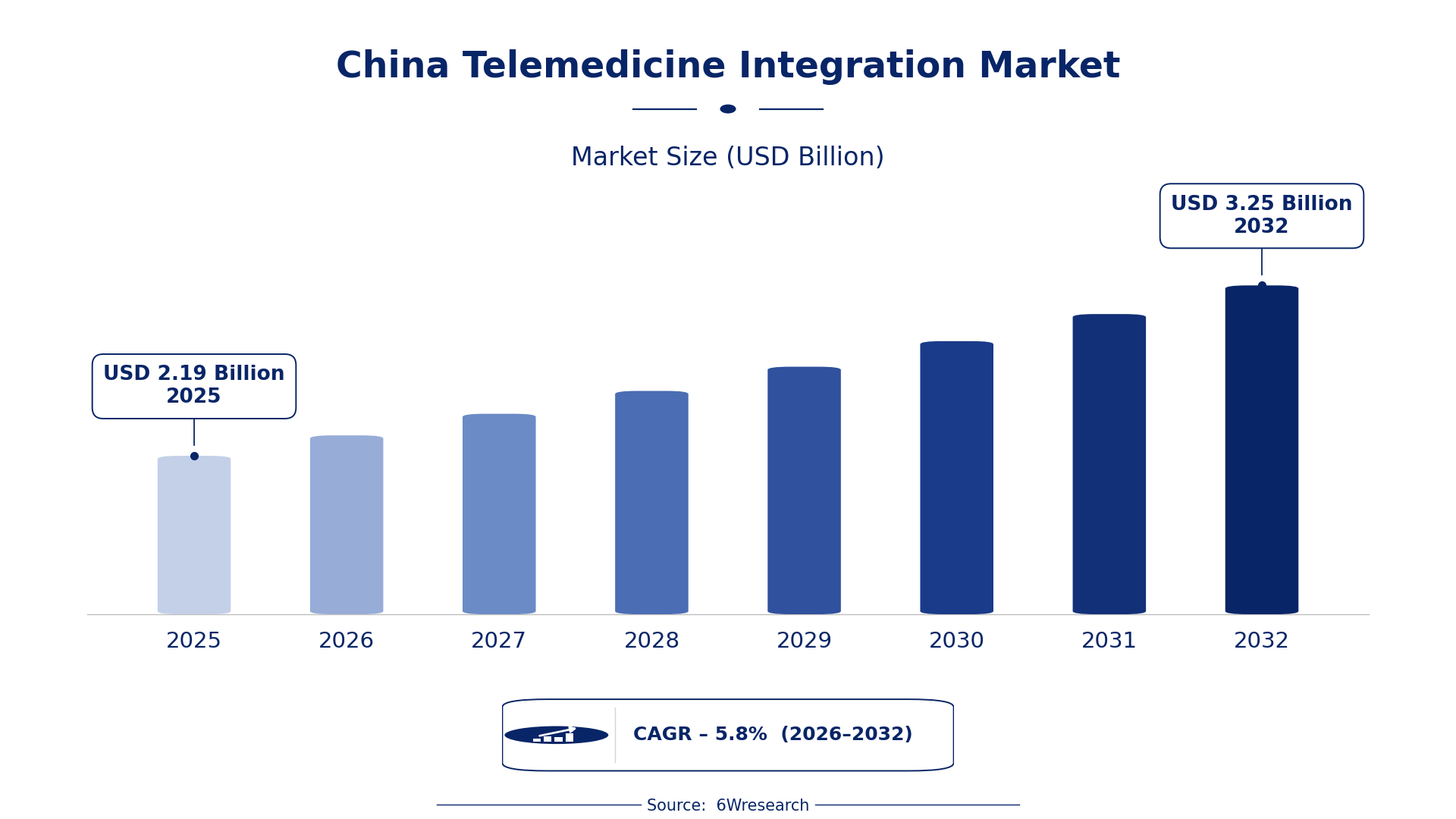
According to 6Wresearch internal database and industry insights, the China Telemedicine Integration Market was valued at USD 2.19 billion in 2025 and is projected to reach USD 3.25 billion by 2032, growing at a CAGR of approximately 5.8% during 2026–2032.
China Telemedicine Integration Market Highlights
| Report Metric | Details |
| Report Name | China Telemedicine Integration Market |
| Market Size 2025 | USD 2.19 billion |
| Market Size 2032 | USD 3.25 billion |
| Absolute Growth 2025–2032 | USD 1.06 billion |
| CAGR 2026–2032 | 5.8% |
| Peak Annual Growth | 7.9% in 2031 |
| Forecast Period | 2026–2032 |
| Historical Data | 2022–2025 |
| Base Year | 2025 |
| Leading Integration Type, 2025 | EHR/EMR Integration (41% share) |
| Leading System Interface, 2025 | API-Based (38% share) |
| Leading Workflow Automation, 2025 | Patient History Access (45% share) |
| Leading End User, 2025 | Hospitals (41% share) |
| Fastest-Growing Integration Type | Lab System Integration (7.3% CAGR) |
| Fastest-Growing System Interface | HL7 Interface (7.0% CAGR) |
| Fastest-Growing Workflow Automation | Diagnostic Coordination (7.5% CAGR) |
| Fastest-Growing End User | Diagnostic Labs (6.8% CAGR) |
| Growing Sector | Healthcare |
| Key End Users | Hospitals, Specialty Clinics, Diagnostic Labs, Retail Pharmacies |
China Telemedicine Integration Market Year-wise Growth Rate and Key Drivers (2022–2032)
This graph illustrates the annual growth rates of the market from 2022 to 2032, highlighting a steady upward trajectory and projected market expansion over the forecast period.
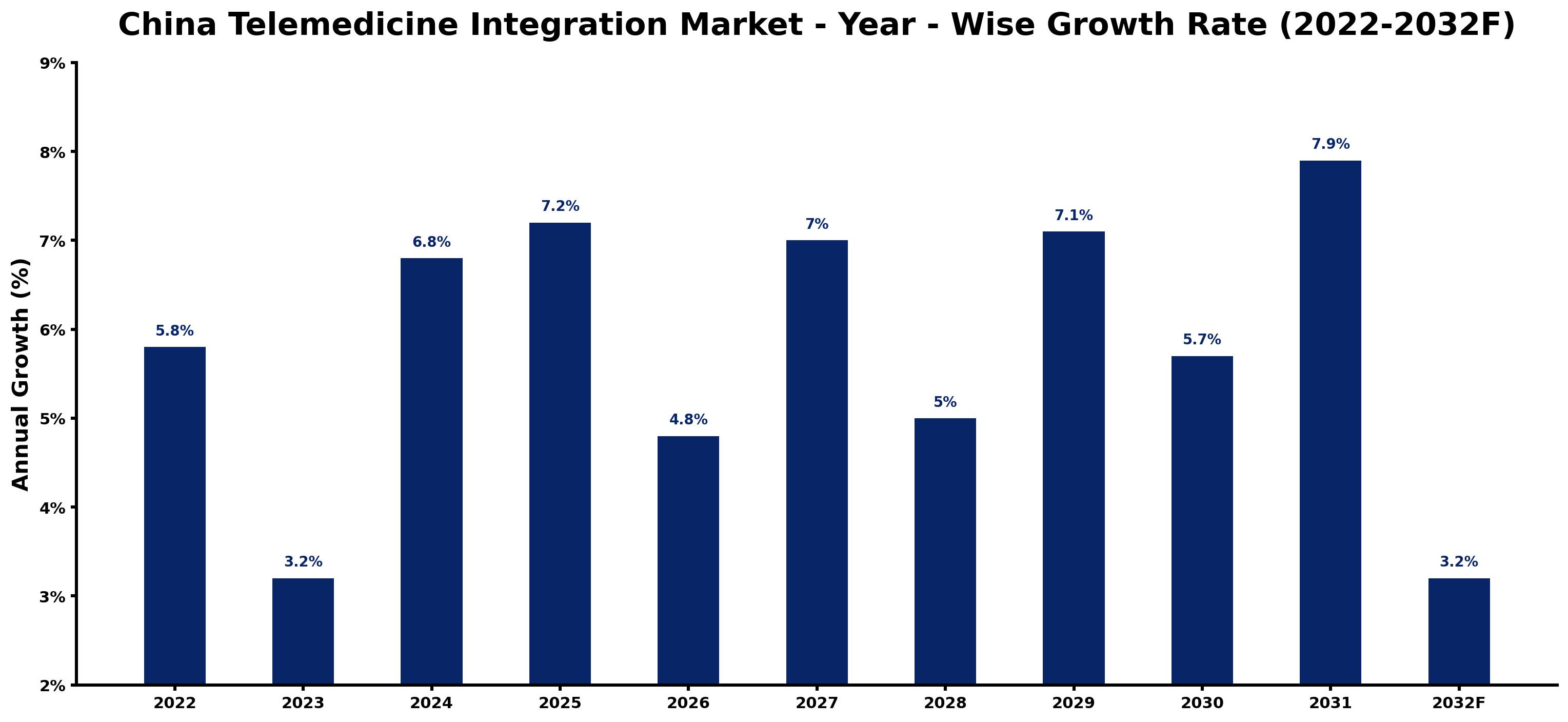
Each row of the following table gives one year's estimated growth and the event or demand shift that explains it.
| Year | Estimated Annual Growth (%) | Market Rationale |
| 2022 | 5.8 | The market showed steady growth, reflecting increasing adoption of telemedicine solutions driven by the Digital Health Initiative. |
| 2023 | 3.2 | The slowdown in growth was attributed to limited awareness among providers regarding telemedicine benefits, impacting consultations. |
| 2024 | 6.8 | Demand increased as healthcare providers expanded telemedicine services and patient access improved through the 'Health China 2030' plan. |
| 2025 | 7.2 | The market peaked with a surge in telemedicine consultations and integration across hospitals, supported by the 'Telemedicine Development Plan'. |
| 2026 | 4.8 | Growth is expected to slow as the market faces challenges in effectively scaling integration solutions, particularly in rural areas. |
| 2027 | 7.0 | Demand is projected to rise again as hospitals enhance their telemedicine capabilities and patient engagement strategies. |
| 2028 | 5.0 | Growth is expected to slow due to market saturation in urban areas and increased competition among providers. |
| 2029 | 7.1 | The market is anticipated to rebound with increased adoption of telemedicine in specialty clinics and diagnostics, aided by the 'Smart Healthcare' initiative. |
| 2030 | 5.7 | Growth is expected to slow as the integration of telemedicine reaches a more mature phase, impacting new investments. |
| 2031 | 7.9 | The market is projected to peak again with rising investments in telemedicine technology and infrastructure, driven by ongoing digital health initiatives. |
| 2032 | 3.2 | Growth is expected to slow as the market stabilises, reflecting a more mature telemedicine environment with established standards. |
Note: Market size estimations and growth projections presented in this report are based on 6Wresearch's proprietary forecasting methodology, utilizing the latest available industry data, government publications, and primary research inputs.
China Telemedicine Integration Market Synopsis
Telemedicine Integration in China involves the use of technology to connect healthcare systems, enabling remote patient monitoring and consultation. It includes software solutions that link various healthcare data systems, enhancing diagnostic accuracy and streamlining workflows. The China Telemedicine Integration Market is growing due to rising demand from healthcare providers and the increasing adoption of digital health solutions. In 2023, over 70% of hospitals in urban areas utilised telemedicine integration, driven by initiatives like the Digital Health Initiative launched in 2021.
Market Dynamics Impact Analysis (2026–2032)
| Factor | Type | Impact | Primary Segment Affected |
| Increasing adoption of telemedicine solutions among healthcare providers | Driver | High | EHR/EMR Integration |
| Rising patient demand for remote healthcare services | Driver | High | Lab System Integration |
| Growing need for efficient healthcare delivery systems | Opportunity | Medium | Imaging System Linkage |
| Expansion of telemedicine services in rural areas | Opportunity | Medium | Pharmacy Integration |
| Challenges in integrating existing healthcare systems | Restraint | High | API-Based |
| Limited awareness among healthcare providers about telemedicine benefits | Restraint | Medium | HL7 Interface |
| The China Telemedicine Integration Market faces regulatory hurdles | Challenge | High | DICOM/PACS |
| Technological limitations in rural healthcare settings | Challenge | Medium | eRx Modules |
Evaluation of Drivers in China Telemedicine Integration Market (2026–2032)
The factors lifting demand, and the evidence behind each, are summarised below.
| Drivers | Primary Segment Affected | Why It Matters (Evidence) |
| Rising telemedicine consultations driven by urban hospital adoption | EHR/EMR Integration | In 2023, over 70% of urban hospitals utilized telemedicine, increasing demand for integration solutions. |
| Increased patient access to healthcare services | Lab System Integration | The National Health Commission reported a 30% increase in telemedicine consultations in 2023. |
| Enhanced diagnostic capabilities through remote access to imaging data | Imaging System Linkage | The installed base of telemedicine devices in hospitals reached 1 million units in 2023. |
| Support for e-prescribing and medication management | Pharmacy Integration | Over 10,000 retail pharmacies are integrating telemedicine solutions for prescriptions. |
| Seamless data exchange between healthcare systems | API-Based | The 'Internet Plus' strategy introduced in 2015 supports telemedicine integration. |
Growth across the Telemedicine Integration market in China is anchored in rising patient demand for remote healthcare services, alongside increased adoption of telemedicine solutions by healthcare providers. In 2023, over 70% of urban hospitals utilised telemedicine integration, boosting demand for integration solutions. The installed base of telemedicine devices in hospitals reached 1 million units, improving diagnostic capabilities and patient access. The National Health Commission reported a 30% increase in telemedicine consultations, reflecting the growing acceptance of these services across various healthcare settings.
Evaluation of Restraints in China Telemedicine Integration Market
The following restraints limit how fast demand can grow.
| Market Restraint | Primary Segment Affected | Why It Matters (Evidence) |
| Integration challenges with existing healthcare systems | EHR/EMR Integration | Many healthcare providers lack the necessary infrastructure for effective telemedicine integration, limiting its use. |
| Limited awareness of telemedicine benefits among providers | Pharmacy Integration | A large number of retail pharmacies remain unaware of the potential advantages of telemedicine services. |
| Regulatory hurdles affecting service delivery | eRx Modules | Strict regulatory guidelines complicate the integration of e-prescribing systems, hindering implementation. |
| Technological limitations in rural healthcare settings | Diagnostic Coordination | Limited internet connectivity in rural regions hampers the effectiveness of telemedicine services, affecting patient access. |
| Inconsistent patient engagement in telemedicine services | ePrescription Fulfillment | Many patients do not fully utilise telemedicine services due to a lack of understanding and awareness. |
China Telemedicine Integration Market Challenges
In 2023, over 70% of urban hospitals in China encounter a skills shortage in telemedicine integration, hindering their ability to implement remote consultations effectively. This challenge arises from insufficient training programs, which delays the adoption of crucial technologies for healthcare providers. The average cost of integrating telemedicine systems can exceed 500,000 yuan per hospital, straining budgets and discouraging many buyers from pursuing these solutions. Furthermore, strict regulations from the National Medical Products Administration create additional obstacles, causing delays in service rollout for clinics and hospitals aiming to improve their telemedicine capabilities.
Trends in the China Telemedicine Integration Market
Buyers and suppliers in the China Telemedicine Integration Market are adjusting to the following trends.
- Urban Hospitals Adopting Remote Patient Monitoring: In urban areas, hospitals are increasingly adopting remote patient monitoring technologies, with over 1 million telemedicine devices installed by 2023. This trend improves patient care and accessibility in urban healthcare settings.
- Telemedicine Consultations on the Rise: In 2023, telemedicine consultations increased by 30%, reflecting a shift towards digital healthcare solutions. This trend is driven by the Digital Health Initiative launched in 2021, improving access to care.
- Rural Areas Embracing Telemedicine: The 'Health China 2030' plan aims to improve healthcare access in rural regions, driving telemedicine adoption. As of 2023, many rural clinics are beginning to implement these solutions, addressing healthcare disparities.
- Pharmacies Integrating Telemedicine Solutions: Retail pharmacies are rapidly integrating telemedicine solutions for prescription management, with over 10,000 pharmacies adopting these technologies by 2023. This integration streamlines the prescription process for patients.
Investment Opportunities in the China Telemedicine Integration Market
Investors looking at the China Telemedicine Integration Market should consider the following areas.
- Hospitals Seeking Telemedicine Solutions: Hospitals are increasingly seeking telemedicine solutions to improve patient care, with over 70% of urban hospitals already utilising these services. This presents a strong investment opportunity for technology providers.
- Demand for Digital Health Solutions: The timing is favourable for investments in telemedicine integration, as the market is projected to reach USD 3.25 billion by 2032. Providers can capitalise on this growth by offering tailored solutions that meet healthcare needs.
- Partnerships with Healthcare Providers: Establishing joint ventures with healthcare providers can facilitate market entry, as many hospitals are looking for reliable telemedicine integration solutions. This approach is crucial for capturing market share in a growing sector.
- Gap in Rural Telemedicine Services: With a notable gap in telemedicine services in rural areas, there is an opportunity to invest in solutions tailored for these regions, where access to healthcare is limited and demand is increasing.
Government Initiatives in the China Telemedicine Integration Market
The 'Telemedicine Development Plan' approved in 2022 improves service quality and access for telemedicine providers, streamlining processes and ensuring compliance with national standards. This measure benefits both producers and users of telemedicine services by creating a more efficient regulatory environment. Additionally, the 'Digital Health Initiative' launched in 2021 aims to promote the adoption of telemedicine technologies, providing funding for infrastructure improvements and training programs to support healthcare providers.
The National Health Administration oversees telemedicine service regulations, approving new telemedicine technologies and funding initiatives that enhance service delivery. This agency plays a key role in ensuring that telemedicine solutions meet safety and efficacy standards, allowing healthcare providers to offer reliable services to patients. By facilitating approvals and funding, the agency supports the growth of telemedicine integration across the country.
Future Insight of the China Telemedicine Integration Market
The telemedicine integration market in China is set to evolve significantly by 2032, driven by initiatives such as the 'Digital Health Initiative' and the 'Health China 2030' plan, which aim to improve healthcare access through technology. By then, the installed base of telemedicine devices in hospitals will reach 2 million units, facilitating better patient care. Increased collaboration among healthcare providers will streamline workflows and improve patient outcomes. The establishment of national standards for telemedicine services will enhance service quality and access for all stakeholders.
Market Segmentation Analysis
The analysis below covers each segmentation, its leading category in 2025 and its fastest-growing category through 2032.
By Integration Type – EHR/EMR Integration Dominated, Lab System Integration Expected to Grow Fastest
According to Sumit Sagar, AM at 6Wresearch, EHR/EMR Integration accounted for a 41% market share by integration type in 2025. EHR/EMR Integration commands the largest market share as it is vital for healthcare providers to access patient records remotely, ensuring timely clinical decisions. The presence of over 1,000 telemedicine platforms operating highlights the critical need for robust integration solutions in the healthcare sector. Over 2026–2032, Lab System Integration is expected to post the fastest growth, at a CAGR of 7.3%. Lab System Integration is witnessing rapid growth due to the increasing demand for efficient sharing of lab results among healthcare providers, which is essential for accurate diagnoses. The reported 30% increase in telemedicine consultations in 2023 reflects the urgency for improved integration capabilities. This trend suggests that suppliers should focus on enhancing EHR/EMR Integration capabilities to meet the rising demand in the telemedicine integration market.
By System Interface – API-Based Dominated, HL7 Interface Expected to Grow Fastest
With a 38% revenue share in 2025, API-Based was the largest system interface category. API-Based systems hold the largest market share as they enable seamless data exchange between various healthcare systems, which is crucial for effective telemedicine operations. The adoption of APIs in over 70% of urban hospitals underscores their importance in the integration framework. The quickest growth will come from HL7 Interface, forecast to expand at a CAGR of 7.0% between 2026 and 2032. HL7 Interface is the fastest-growing segment, propelled by its role as a standard protocol for healthcare data exchange, simplifying interoperability. The increasing regulatory emphasis on data standardisation accelerates its adoption within the telemedicine landscape. Suppliers should prioritise API-Based solutions while also investing in HL7 Interface capabilities to capture emerging growth opportunities in the market.
By Workflow Automation – Patient History Access Dominated, Diagnostic Coordination Expected to Grow Fastest
Patient History Access held a 45% share of the China Telemedicine Integration Market by workflow automation in 2025. Patient History Access leads the market, as it is essential for informed clinical decision-making, enabling healthcare providers to deliver timely care. The impressive average patient satisfaction rate of 85% illustrates the necessity of having comprehensive patient histories readily available for effective treatment. Diagnostic Coordination is set to record the highest CAGR in this split, 7.5% over 2026–2032. Diagnostic Coordination is expanding rapidly as it enhances collaboration among healthcare providers, streamlining the diagnostic process. The rising number of telemedicine consultations drives this segment's growth, particularly as hospitals seek integrated workflows. This indicates that suppliers should enhance their offerings in Patient History Access while also developing solutions for Diagnostic Coordination to meet market demands.
By End User – Hospitals Dominated, Diagnostic Labs Expected to Grow Fastest
In 2025, Hospitals led the end user split with a 41% share. Hospitals account for the largest market share as they are the primary users of telemedicine integration solutions, facilitating remote patient monitoring and consultations. The installed base of over 1 million telemedicine devices in hospitals clearly demonstrates their reliance on these solutions for effective healthcare delivery. Diagnostic Labs are projected to grow fastest, at a CAGR of 6.8% during 2026–2032. Diagnostic Labs are the fastest-growing end user segment, leveraging telemedicine integration for efficient lab result management, which is increasingly vital in a digital health environment. The surge in telemedicine consultations propels the demand for timely lab results, driving this segment's growth. This indicates that suppliers should tailor their solutions to meet the specific needs of hospitals while also addressing the growing requirements of Diagnostic Labs.
Key Attractiveness of the Report
- 10 Years of Market Numbers
- Historical Data Starting from 2022 to 2025
- Base Year 2025
- Forecast Data until 2032
- Key Performance Indicators Impacting the Market
- Major Upcoming Developments and Projects
Key Highlights of the Report:
- China Telemedicine Integration Market Outlook
- Market Size of China Telemedicine Integration Market, 2025
- Forecast of China Telemedicine Integration Market, 2032
- Historical Data and Forecast of China Telemedicine Integration Revenues & Volume for the Period 2022 - 2032F
- China Telemedicine Integration Market Trend Evolution
- China Telemedicine Integration Market Drivers and Challenges
- China Telemedicine Integration Price Trends
- China Telemedicine Integration Porter's Five Forces
- China Telemedicine Integration Industry Life Cycle
- Historical Data and Forecast of China Telemedicine Integration Market Revenues & Volume By Integration Type for the Period 2022 - 2032F
- Historical Data and Forecast of China Telemedicine Integration Market Revenues & Volume By EHR/EMR Integration for the Period 2022 - 2032F
- Historical Data and Forecast of China Telemedicine Integration Market Revenues & Volume By Lab System Integration for the Period 2022 - 2032F
- Historical Data and Forecast of China Telemedicine Integration Market Revenues & Volume By Imaging System Linkage for the Period 2022 - 2032F
- Historical Data and Forecast of China Telemedicine Integration Market Revenues & Volume By Pharmacy Integration for the Period 2022 - 2032F
- Historical Data and Forecast of China Telemedicine Integration Market Revenues & Volume By System Interface for the Period 2022 - 2032F
- Historical Data and Forecast of China Telemedicine Integration Market Revenues & Volume By API-Based for the Period 2022 - 2032F
- Historical Data and Forecast of China Telemedicine Integration Market Revenues & Volume By HL7 Interface for the Period 2022 - 2032F
- Historical Data and Forecast of China Telemedicine Integration Market Revenues & Volume By DICOM/PACS for the Period 2022 - 2032F
- Historical Data and Forecast of China Telemedicine Integration Market Revenues & Volume By eRx Modules for the Period 2022 - 2032F
- Historical Data and Forecast of China Telemedicine Integration Market Revenues & Volume By Workflow Automation for the Period 2022 - 2032F
- Historical Data and Forecast of China Telemedicine Integration Market Revenues & Volume By Patient History Access for the Period 2022 - 2032F
- Historical Data and Forecast of China Telemedicine Integration Market Revenues & Volume By Diagnostic Coordination for the Period 2022 - 2032F
- Historical Data and Forecast of China Telemedicine Integration Market Revenues & Volume By Radiology Consults for the Period 2022 - 2032F
- Historical Data and Forecast of China Telemedicine Integration Market Revenues & Volume By ePrescription Fulfillment for the Period 2022 - 2032F
- Historical Data and Forecast of China Telemedicine Integration Market Revenues & Volume By End User for the Period 2022 - 2032F
- Historical Data and Forecast of China Telemedicine Integration Market Revenues & Volume By Hospitals for the Period 2022 - 2032F
- Historical Data and Forecast of China Telemedicine Integration Market Revenues & Volume By Diagnostic Labs for the Period 2022 - 2032F
- Historical Data and Forecast of China Telemedicine Integration Market Revenues & Volume By Specialty Clinics for the Period 2022 - 2032F
- Historical Data and Forecast of China Telemedicine Integration Market Revenues & Volume By Retail Pharmacies for the Period 2022 - 2032F
- China Telemedicine Integration Import Export Trade Statistics
- Market Opportunity Assessment By Integration Type
- Market Opportunity Assessment By System Interface
- Market Opportunity Assessment By Workflow Automation
- Market Opportunity Assessment By End User
- China Telemedicine Integration Top Companies Market Share
- China Telemedicine Integration Competitive Benchmarking By Technical and Operational Parameters
- China Telemedicine Integration Company Profiles
- China Telemedicine Integration Key Strategic Recommendations
Market Covered
The report offers an extensive study of the following market segments.
By Integration Type
- EHR/EMR Integration
- Lab System Integration
- Imaging System Linkage
- Pharmacy Integration
By System Interface
- API-Based
- HL7 Interface
- DICOM/PACS
- eRx Modules
By Workflow Automation
- Patient History Access
- Diagnostic Coordination
- Radiology Consults
- ePrescription Fulfillment
By End User
- Hospitals
- Diagnostic Labs
- Specialty Clinics
- Retail Pharmacies































