India Thermal Apparel Market Size & Growth Rate
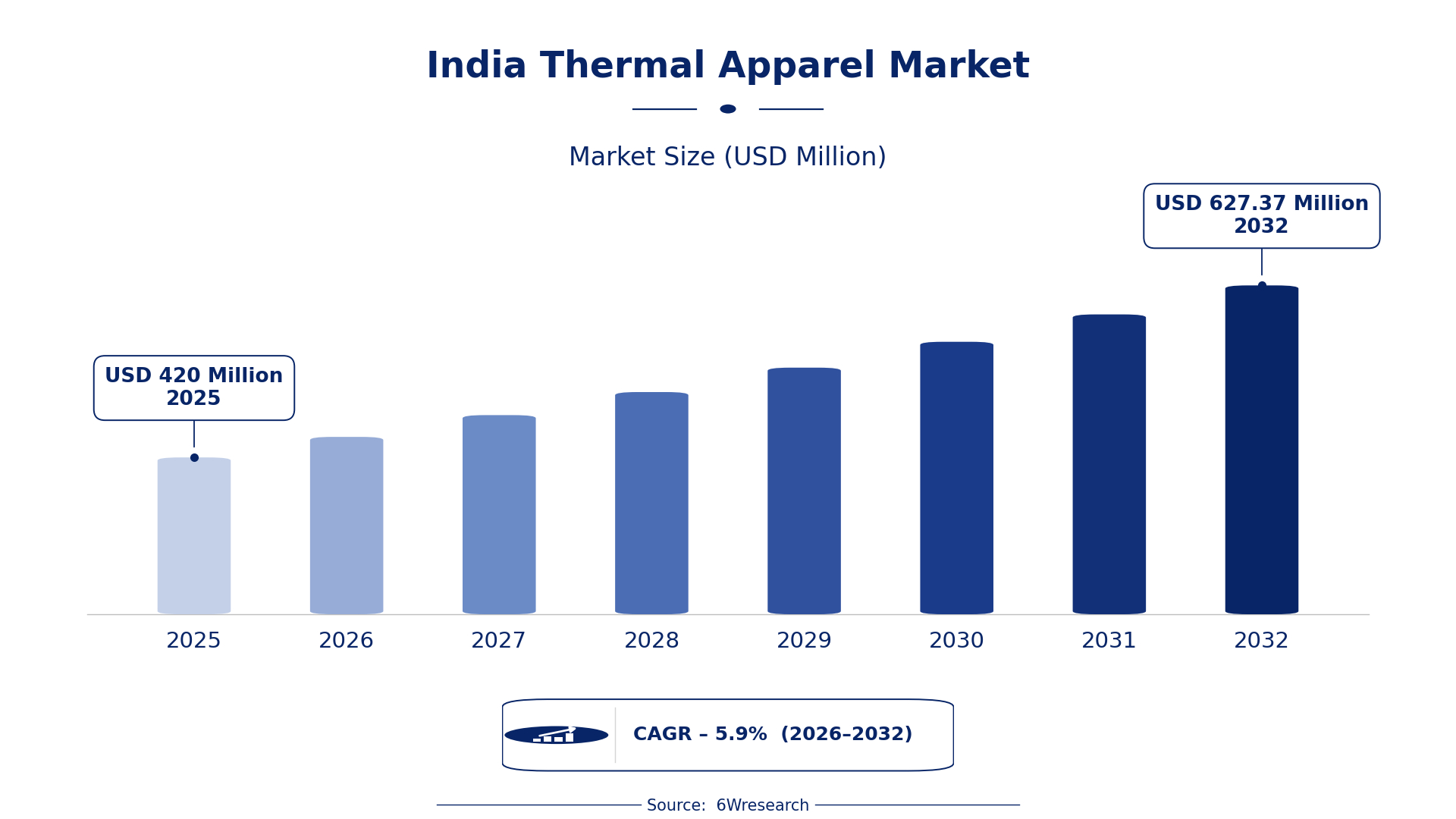
According to 6Wresearch internal database and industry insights, the India Thermal Apparel Market was valued at USD 420.0 million in 2025 and is projected to reach USD 627.37 million by 2032, growing at a CAGR of approximately 5.9% during 2026–2032.
India Thermal Apparel Market Highlights
| Report Metric | Details |
| Report Name | India Thermal Apparel Market |
| Market Size 2025 | USD 420.0 million |
| Market Size 2032 | USD 627.37 million |
| Absolute Growth 2025–2032 | USD 207.37 million |
| CAGR 2026–2032 | 5.9% |
| Peak Annual Growth | 7.8% in 2028 |
| Forecast Period | 2026–2032 |
| Historical Data | 2022–2025 |
| Base Year | 2025 |
| Leading Apparel Type, 2025 | Thermal Base Layers (39% share) |
| Leading Insulation Type, 2025 | Merino Wool/Synthetic (43% share) |
| Leading User Segment, 2025 | Outdoor Enthusiasts (55% share) |
| Leading End User, 2025 | Retail Brands (43% share) |
| Fastest-Growing Apparel Type | Insulated Jackets (7.7% CAGR) |
| Fastest-Growing Insulation Type | Down/Polyfill (8.4% CAGR) |
| Fastest-Growing User Segment | Extreme Weather (8.3% CAGR) |
| Fastest-Growing End User | Winterwear Companies (7.9% CAGR) |
| Growing Sector | Outdoor Apparel |
| Key End Users | Outdoor Enthusiasts, Retail Brands, Industrial Workers, E-commerce Channels |
India Thermal Apparel Market Year-wise Growth Rate and Key Drivers (2022–2032)
This graph illustrates the annual growth rates of the market from 2022 to 2032, highlighting a steady upward trajectory and projected market expansion over the forecast period.
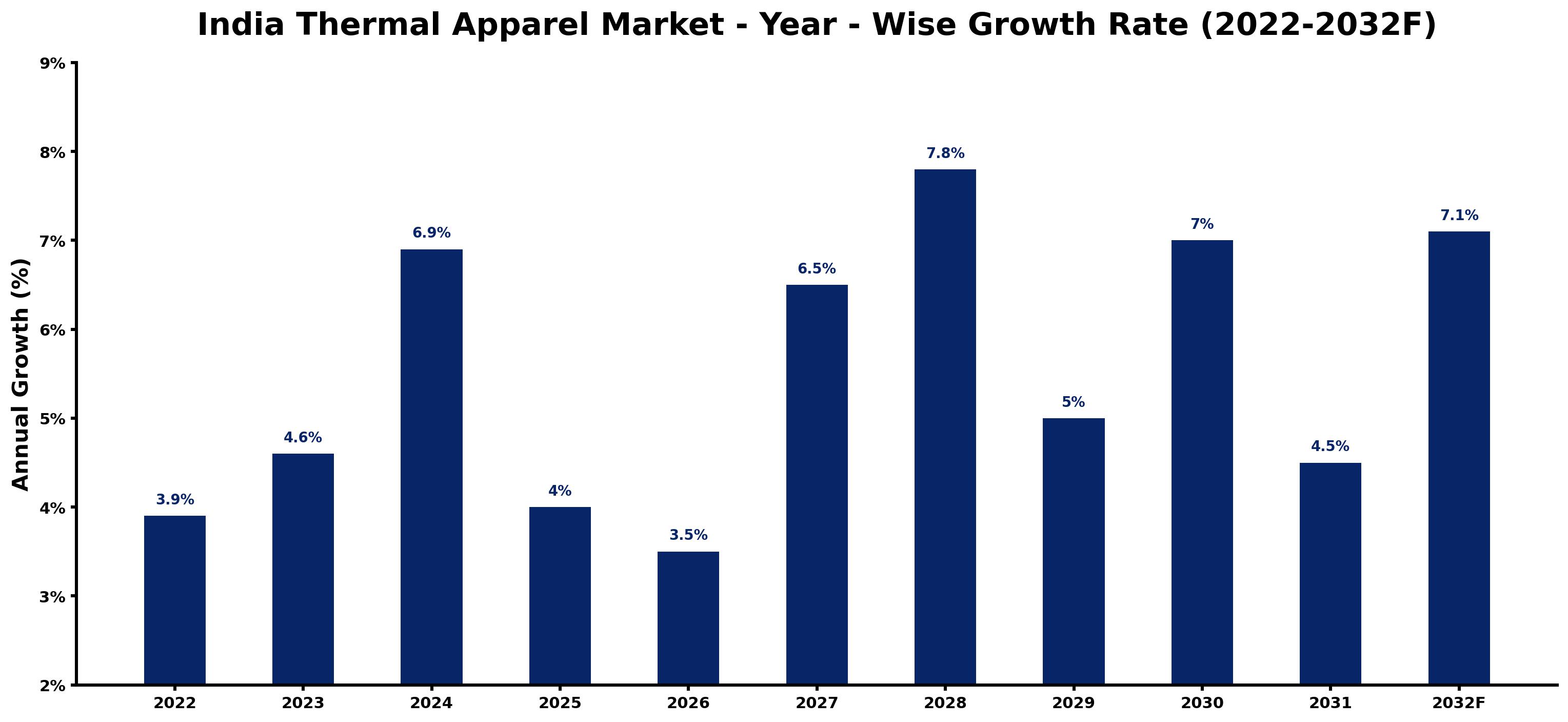
Each row of the following table gives one year's estimated growth and the event or demand shift that explains it.
| Year | Estimated Annual Growth (%) | Market Rationale |
| 2022 | 3.9 | Demand from outdoor enthusiasts remained strong, with cold weather driving purchases of thermal apparel. |
| 2023 | 4.6 | Retail brands expanded their offerings, increasing accessibility for consumers across regions, particularly in northern states. |
| 2024 | 6.9 | The growing popularity of insulated jackets boosted market interest among buyers, especially in colder climates. |
| 2025 | 4.0 | A slowdown in growth occurred as consumers adjusted to previous purchases and stock levels, impacting sales. |
| 2026 | 3.5 | Market growth is expected to slow as the 'Production Linked Incentive Scheme' supports local production, increasing competition. |
| 2027 | 6.5 | Demand surged as outdoor activities resumed, leading to higher sales of thermal apparel among outdoor enthusiasts. |
| 2028 | 7.8 | Peak growth is projected to be driven by heightened interest in winter sports and outdoor adventures, boosting sales. |
| 2029 | 5.0 | Growth is expected to slow as consumer spending stabilises after a period of rapid increase in thermal apparel purchases. |
| 2030 | 7.0 | Increased awareness of thermal apparel benefits will lead to renewed interest among buyers, particularly in colder regions. |
| 2031 | 4.5 | A slowdown is anticipated as the market matures, with consumers becoming more selective in their purchases. |
| 2032 | 7.1 | Growth is expected to accelerate again as winter conditions prompt renewed purchases of thermal wear. |
Note: Market size estimations and growth projections presented in this report are based on 6Wresearch's proprietary forecasting methodology, utilizing the latest available industry data, government publications, and primary research inputs.
India Thermal Apparel Market Synopsis
The India Thermal Apparel Market includes clothing designed to retain body heat in cold conditions, primarily made from materials like wool and synthetic fibres. This apparel serves outdoor enthusiasts and industrial workers, with e-commerce channels contributing 40% of sales. Valued at approximately INR 15,000 crore, the market benefits from the rising popularity of outdoor activities and advancements in thermal wear. The 'Make in India' initiative has boosted local production, creating opportunities to satisfy growing consumer demand.
Market Dynamics Impact Analysis (2026–2032)
| Factor | Type | Impact | Primary Segment Affected |
| Rising demand from outdoor enthusiasts for high-quality thermal wear | Driver | High | Thermal Base Layers |
| Increased sales through e-commerce channels, accounting for 40% of total sales | Driver | High | Retail Brands |
| The market gap for insulated jackets presents an investment opportunity | Opportunity | High | Insulated Jackets |
| Growing interest in sustainable thermal materials creates room for innovation | Opportunity | Medium | Merino Wool/Synthetic |
| High competition among brands may lead to price wars affecting margins | Restraint | High | Thermal Base Layers |
| Consumer awareness regarding quality standards impacts purchasing decisions | Restraint | Medium | Retail Brands |
| The Thermal Apparel Market faces challenges from fluctuating raw material prices | Challenge | High | Insulated Jackets |
| Limited consumer knowledge about thermal apparel benefits restricts growth | Challenge | Medium | Thermal Base Layers |
Evaluation of Drivers in India Thermal Apparel Market (2026–2032)
Below mentioned are some major drivers and their influence on market dynamics.
| Drivers | Primary Segment Affected | Why It Matters (Evidence) |
| Increasing outdoor activities among consumers | Thermal Base Layers | 30% of outdoor enthusiasts prefer thermal base layers for comfort during winter sports, driving demand. |
| Growth in online retailing for thermal apparel | Retail Brands | E-commerce channels accounted for 40% of thermal apparel sales, expanding market reach and accessibility. |
| Rising temperatures in northern India drive demand for effective insulation | Insulated Jackets | The average winter temperature in northern India can drop to 0°C, necessitating warm clothing for consumers. |
| Government initiatives promoting local manufacturing | Merino Wool/Synthetic | The 'Make in India' initiative encourages local production, boosting supply chains and reducing dependency on imports. |
| Consumer preference for moisture-wicking materials | Down/Polyfill | Merino wool is increasingly preferred for its moisture-wicking properties, improving comfort and performance in cold weather. |
Approximately 30% of outdoor enthusiasts prefer thermal base layers for winter sports, which drives demand. E-commerce channels account for 40% of thermal apparel sales, expanding market reach. The average winter temperature in northern India can drop to 0°C, necessitating effective insulation for consumers. The 'Production Linked Incentive Scheme' encourages local production, further boosting supply chains and meeting rising demand.
Evaluation of Restraints in India Thermal Apparel Market
Below mentioned are some major restraints and their influence on market dynamics.
| Market Restraint | Primary Segment Affected | Why It Matters (Evidence) |
| Fluctuating raw material prices impacting production costs | Insulated Jackets | Rising costs of wool and synthetic fibers can lead to higher retail prices, affecting sales and profitability. |
| Consumer awareness regarding quality standards limits market growth | Retail Brands | Increased scrutiny on product quality may deter purchases from less-known brands, impacting overall sales. |
| High competition leading to aggressive pricing strategies | Thermal Base Layers | Price wars among brands can reduce profit margins and affect sustainability for manufacturers in the market. |
| Seasonal demand fluctuations impacting inventory management | Insulated Jackets | Retailers may struggle with stock levels during off-peak seasons, affecting cash flow and operational efficiency. |
| Limited consumer knowledge about the benefits of thermal apparel | Thermal Base Layers | A lack of understanding may lead to lower sales, particularly among new buyers unfamiliar with thermal products. |
India Thermal Apparel Market Challenges
The India Thermal Apparel Market struggles with outdated manufacturing technology, which hampers production efficiency and product quality. Suppliers often lack the financial resources for necessary upgrades, resulting in delays that frustrate outdoor enthusiasts and industrial workers seeking timely access to thermal wear. Buyers face dissatisfaction as the limited availability of advanced thermal materials leads to subpar performance in temperatures that can drop to 0°C, impacting their purchasing decisions. Volatile raw material prices, particularly for Merino wool, can inflate costs for manufacturers, compelling them to increase prices for consumers who typically spend around INR 2,000 on thermal apparel during winter months.
Trends in the India Thermal Apparel Market
Four trends stand out in the India Thermal Apparel Market.
- Outdoor Enthusiasts Embracing Thermal Apparel: Outdoor enthusiasts in India are increasingly adopting thermal apparel for winter sports, with 30% preferring thermal base layers. This trend reflects a growing awareness of the benefits of thermal wear, particularly in colder regions.
- Northern India Driving Demand for Insulated Jackets: Himachal Pradesh and Uttarakhand are seeing rising demand for insulated jackets, particularly as temperatures drop to 0°C. This regional focus highlights the importance of climate in shaping consumer preferences for thermal wear.
- Support for Local Production Under 'Make in India' Initiative: The 'Make in India' initiative continues to promote local thermal apparel manufacturing, with a budget of INR 1,000 crore. This backing is essential for driving innovation and meeting domestic demand for thermal products.
- Shift Towards Sustainable Thermal Materials: There is a notable shift towards sustainable materials in thermal apparel, particularly Merino wool. This trend is influenced by consumer preferences for eco-friendly options, aligning with global sustainability goals and market demands.
Investment Opportunities in the India Thermal Apparel Market
Below are the investment opportunities with the strongest case in the India Thermal Apparel Market.
- Gap in Insulated Jacket Production: The insulated jacket segment presents a gap in the market, with significant demand from outdoor enthusiasts. Investing in local production can meet this need, particularly in northern states where demand is high.
- Growing E-commerce Demand for Thermal Apparel: E-commerce channels are projected to grow, accounting for a larger share of sales. Retail brands can invest in online platforms to effectively capture this expanding market segment and reach more consumers.
- Need for Sustainable Thermal Apparel: With increasing consumer preference for sustainable materials, there is an opportunity to invest in eco-friendly thermal apparel production. Collaborating with local manufacturers can facilitate entry into this growing market segment.
- Investment in Training for Thermal Apparel Workers: The 'Skill India Mission' targets training for 1 million workers in the thermal apparel sector by 2025. This initiative presents an opportunity for companies to enhance workforce capabilities and improve production quality.
Government Initiatives in the India Thermal Apparel Market
In 2021, the Ministry of Textiles launched the 'Textile Technology Mission' with a budget of INR 1,000 crore to promote innovation in thermal apparel manufacturing. This initiative builds on the 'Make in India' programme, which supports local production and provides incentives for manufacturers. The focus on technology and innovation is expected to improve product quality and competitiveness in the market, benefiting both producers and consumers.
The 'Skill India Mission' aims to train 1 million workers in the thermal wear sector by 2025, enhancing workforce skills. This initiative ensures that manufacturers have access to skilled labour, essential for maintaining quality standards. Additionally, the Bureau of Indian Standards (BIS) revised the standards for thermal clothing in 2023, ensuring safety and quality for consumers, which helps build trust in thermal apparel products.
Future Insight of the India Thermal Apparel Market
The India Thermal Apparel Market is poised for significant evolution by 2032, driven by advancements in manufacturing technology and material innovation. The 'Make in India' initiative will strengthen local production capabilities, enabling suppliers to better meet consumer demands. Research from the National Institute of Fashion Technology is expected to yield new materials that improve thermal efficiency and comfort. Additionally, the government's focus on sustainable practices will encourage eco-friendly manufacturing methods, appealing to environmentally-conscious buyers and influencing future market trends.
Market Segmentation Analysis
The analysis below covers each segmentation, its leading category in 2025 and its fastest-growing category through 2032.
By Apparel Type – Thermal Base Layers Dominated, Insulated Jackets Expected to Grow Fastest
According to Vasudha, AM at 6Wresearch, the largest apparel type category in 2025 was Thermal Base Layers, with a 39% share of total revenue. Thermal base layers dominate the market due to their essential role in layering for cold weather, especially among outdoor enthusiasts. Their significance is highlighted by the fact that 30% of these users specifically prefer thermal base layers for their activities. Over 2026–2032, Insulated Jackets are expected to post the fastest growth, at a CAGR of 7.7%. Insulated jackets are experiencing rapid growth because they provide crucial warmth in extreme conditions, which is increasingly sought after during harsh winters. Their lightweight design and effective insulation make them a top choice, contributing to their swift market expansion. Suppliers should focus on enhancing their thermal base layer offerings while also expanding insulated jacket lines to meet growing consumer preferences.
By Insulation Type – Merino Wool/Synthetic Dominated, Down/Polyfill Expected to Grow Fastest
With a 43% revenue share in 2025, Merino Wool/Synthetic was the largest insulation type category. Merino wool and synthetic materials hold the largest share in the market as they are preferred for their moisture-wicking properties and effectiveness in thermal base layers. These materials are increasingly sought after by consumers looking for comfort and functionality in cold weather apparel. Down/Polyfill is projected to grow fastest, at a CAGR of 8.4% during 2026–2032. Down and polyfill insulation types are gaining traction due to their widespread use in jackets, which are critical for warmth in colder climates. The growing preference for lightweight yet effective insulation is propelling this segment's rapid growth. Suppliers should prioritise the development of down and polyfill products to capitalise on this increasing consumer preference for efficient insulation.
By User Segment – Outdoor Enthusiasts Dominated, Extreme Weather Expected to Grow Fastest
In 2025, Outdoor Enthusiasts led the user segment split with a 55% share. Outdoor enthusiasts represent the largest user segment for thermal apparel, as they require dependable clothing for various outdoor activities in cold climates. This demand is particularly pronounced in northern states where winter temperatures can plummet to 0°C, driving substantial market share. The quickest growth will come from Extreme Weather, forecast to expand at a CAGR of 8.3% between 2026 and 2032. The extreme weather user segment is growing rapidly, as individuals in severe climates depend on thermal apparel for both survival and comfort. Heightened awareness of the need for suitable clothing in harsh conditions is expected to further fuel this segment's growth. Suppliers should adapt their marketing strategies to meet the specific needs of extreme weather users while continuing to serve the outdoor enthusiast segment.
By End User – Retail Brands Dominated, Winterwear Companies Expected to Grow Fastest
Retail Brands took a 43% share of end user in 2025, more than any other category. Retail brands dominate the end user segment as they are the primary distributors of thermal apparel, effectively reaching a wide consumer base. Their established market presence allows them to capture a substantial share of sales, especially during the winter months when demand peaks. Winterwear Companies are set to record the highest CAGR in this split, 7.9% over 2026–2032. Winterwear companies are rapidly expanding their offerings, focusing on cold-weather clothing to meet the increasing consumer demand for effective thermal apparel. This growth is driven by the seasonal nature of thermal apparel sales, particularly during winter sales events. Suppliers should strengthen partnerships with winterwear companies to ensure their products are prominently featured in the growing market for cold-weather clothing.
Key Attractiveness of the Report
- 10 Years of Market Numbers
- Historical Data Starting from 2022 to 2025
- Base Year 2025
- Forecast Data until 2032
- Key Performance Indicators Impacting the Market
- Major Upcoming Developments and Projects
Key Highlights of the Report:
- India Thermal Apparel Market Outlook
- Market Size of India Thermal Apparel Market, 2025
- Forecast of India Thermal Apparel Market, 2032
- Historical Data and Forecast of India Thermal Apparel Revenues & Volume for the Period 2022 - 2032F
- India Thermal Apparel Market Trend Evolution
- India Thermal Apparel Market Drivers and Challenges
- India Thermal Apparel Price Trends
- India Thermal Apparel Porter's Five Forces
- India Thermal Apparel Industry Life Cycle
- Historical Data and Forecast of India Thermal Apparel Market Revenues & Volume By Apparel Type for the Period 2022 - 2032F
- Historical Data and Forecast of India Thermal Apparel Market Revenues & Volume By Thermal Base Layers for the Period 2022 - 2032F
- Historical Data and Forecast of India Thermal Apparel Market Revenues & Volume By Insulated Jackets for the Period 2022 - 2032F
- Historical Data and Forecast of India Thermal Apparel Market Revenues & Volume By Heated Gloves for the Period 2022 - 2032F
- Historical Data and Forecast of India Thermal Apparel Market Revenues & Volume By Full Body Suits for the Period 2022 - 2032F
- Historical Data and Forecast of India Thermal Apparel Market Revenues & Volume By Insulation Type for the Period 2022 - 2032F
- Historical Data and Forecast of India Thermal Apparel Market Revenues & Volume By Merino Wool/Synthetic for the Period 2022 - 2032F
- Historical Data and Forecast of India Thermal Apparel Market Revenues & Volume By Down/Polyfill for the Period 2022 - 2032F
- Historical Data and Forecast of India Thermal Apparel Market Revenues & Volume By Battery-Powered for the Period 2022 - 2032F
- Historical Data and Forecast of India Thermal Apparel Market Revenues & Volume By Fleece-Lined for the Period 2022 - 2032F
- Historical Data and Forecast of India Thermal Apparel Market Revenues & Volume By User Segment for the Period 2022 - 2032F
- Historical Data and Forecast of India Thermal Apparel Market Revenues & Volume By Outdoor Enthusiasts for the Period 2022 - 2032F
- Historical Data and Forecast of India Thermal Apparel Market Revenues & Volume By Extreme Weather for the Period 2022 - 2032F
- Historical Data and Forecast of India Thermal Apparel Market Revenues & Volume By Sports/Outdoor for the Period 2022 - 2032F
- Historical Data and Forecast of India Thermal Apparel Market Revenues & Volume By Industrial Workers for the Period 2022 - 2032F
- Historical Data and Forecast of India Thermal Apparel Market Revenues & Volume By End User for the Period 2022 - 2032F
- Historical Data and Forecast of India Thermal Apparel Market Revenues & Volume By Retail Brands for the Period 2022 - 2032F
- Historical Data and Forecast of India Thermal Apparel Market Revenues & Volume By Winterwear Companies for the Period 2022 - 2032F
- Historical Data and Forecast of India Thermal Apparel Market Revenues & Volume By E-commerce Channels for the Period 2022 - 2032F
- Historical Data and Forecast of India Thermal Apparel Market Revenues & Volume By Safety Apparel Firms for the Period 2022 - 2032F
- India Thermal Apparel Import Export Trade Statistics
- Market Opportunity Assessment By Apparel Type
- Market Opportunity Assessment By Insulation Type
- Market Opportunity Assessment By User Segment
- Market Opportunity Assessment By End User
- India Thermal Apparel Top Companies Market Share
- India Thermal Apparel Competitive Benchmarking By Technical and Operational Parameters
- India Thermal Apparel Company Profiles
- India Thermal Apparel Key Strategic Recommendations
Market Covered
Segments analysed in this report are listed below.
By Apparel Type
- Thermal Base Layers
- Insulated Jackets
- Heated Gloves
- Full Body Suits
By Insulation Type
- Merino Wool/Synthetic
- Down/Polyfill
- Battery-Powered
- Fleece-Lined
By User Segment
- Outdoor Enthusiasts
- Extreme Weather
- Sports/Outdoor
- Industrial Workers
By End User
- Retail Brands
- Winterwear Companies
- E-commerce Channels
- Safety Apparel Firms































