India Thermal Break Component Market Size & Growth Rate
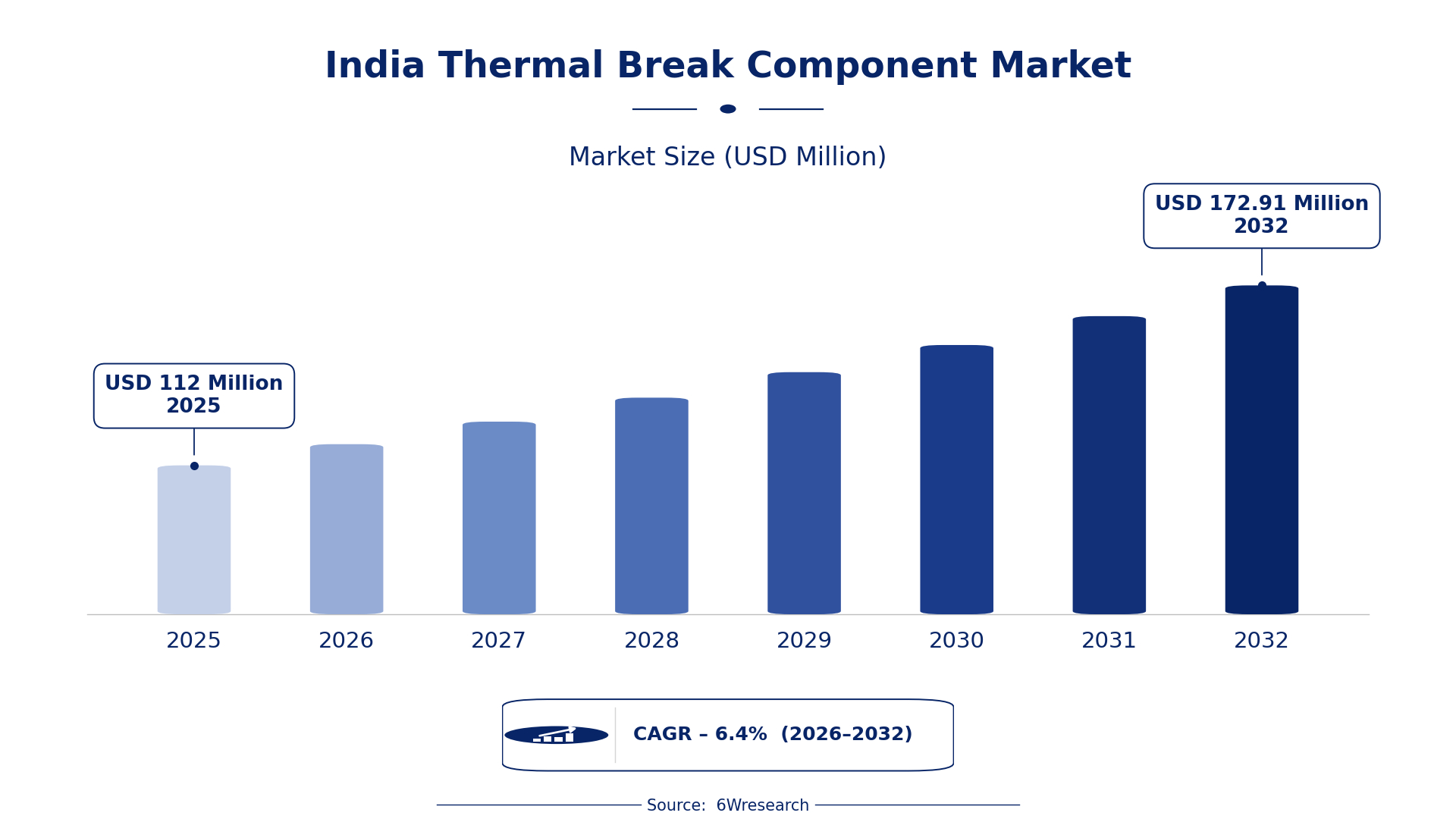
According to 6Wresearch internal database and industry insights, the India Thermal Break Component Market was valued at USD 112.0 million in 2025 and is projected to reach USD 172.91 million by 2032, growing at a CAGR of approximately 6.4% during 2026–2032.
India Thermal Break Component Market Highlights
| Report Metric | Details |
| Report Name | India Thermal Break Component Market |
| Market Size 2025 | USD 112.0 million |
| Market Size 2032 | USD 172.91 million |
| Absolute Growth 2025–2032 | USD 60.91 million |
| CAGR 2026–2032 | 6.4% |
| Peak Annual Growth | 8.6% in 2026 |
| Forecast Period | 2026–2032 |
| Historical Data | 2022–2025 |
| Base Year | 2025 |
| Leading Component Type, 2025 | Thermal Break Pads (47% share) |
| Leading Material Used, 2025 | Rubber/Polymer (46% share) |
| Leading Application Area, 2025 | Energy-Efficient Windows (41% share) |
| Leading End User, 2025 | Construction Firms (42% share) |
| Fastest-Growing Component Type | Structural Thermal Breaks (7.6% CAGR) |
| Fastest-Growing Material Used | Insulated Composite (8.3% CAGR) |
| Fastest-Growing Application Area | Façade Insulation (8.4% CAGR) |
| Fastest-Growing End User | Real Estate Developers (8.8% CAGR) |
| Growing Sector | Construction |
| Key End Users | Construction Firms, Real Estate Developers, Architects, Window Manufacturers |
India Thermal Break Component Market Year-wise Growth Rate and Key Drivers (2022–2032)
This graph illustrates the annual growth rates of the market from 2022 to 2032, highlighting a steady upward trajectory and projected market expansion over the forecast period.
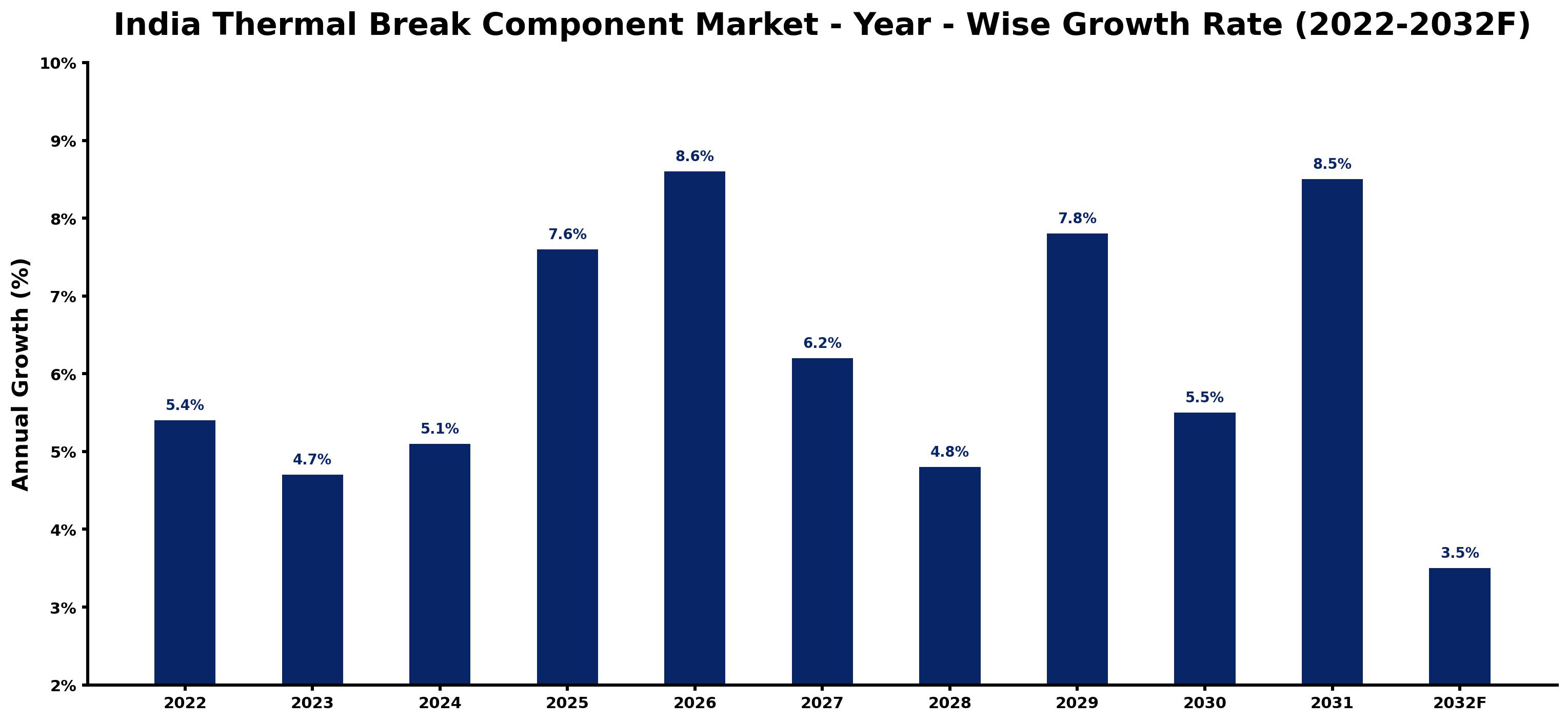
The table below sets out the estimated growth rate for each year and the main factor behind it.
| Year | Estimated Annual Growth (%) | Market Rationale |
| 2022 | 5.4 | The market experienced steady growth due to ongoing construction projects across urban areas. |
| 2023 | 4.7 | Growth slowed as inflationary pressures affected construction costs and timelines. |
| 2024 | 5.1 | The market rebounded as energy-efficient building practices gained traction among developers. |
| 2025 | 7.6 | Demand surged with the implementation of new energy efficiency standards in the National Building Code. |
| 2026 | 8.6 | The peak growth is expected as the construction industry expands rapidly, driven by urbanisation. |
| 2027 | 6.2 | Growth is projected to slow as the market adjusts to the peak demand levels of the previous year. |
| 2028 | 4.8 | A further slowdown is anticipated as projects face delays due to supply chain issues. |
| 2029 | 7.8 | Demand is expected to increase again as metropolitan areas focus on high-rise developments requiring thermal breaks. |
| 2030 | 5.5 | The market will see slower growth as competition intensifies among suppliers and manufacturers. |
| 2031 | 8.5 | Growth is projected to accelerate again with the rise of green building certifications among developers. |
| 2032 | 3.5 | A slowdown is expected as the market stabilises after years of rapid expansion. |
Note: Market size estimations and growth projections presented in this report are based on 6Wresearch's proprietary forecasting methodology, utilizing the latest available industry data, government publications, and primary research inputs.
India Thermal Break Component Market Synopsis
The Thermal Break Component in India consists of materials designed to minimise heat transfer in buildings. These components, crafted from rubber, polymer, or insulated composites, improve energy efficiency and thermal insulation in windows and facades. The India Thermal Break Component Market is expanding, driven by the booming construction industry, which is projected to reach a size of $1 trillion by 2025, alongside a growing emphasis on energy-efficient building practices. Initiatives like the Energy Conservation Building Code and the Gati Shakti National Master Plan are increasing demand for thermal break components, particularly among construction firms and real estate developers.
Market Dynamics Impact Analysis (2026–2032)
| Factor | Type | Impact | Primary Segment Affected |
| Growing urbanisation and increasing energy efficiency regulations drive demand for thermal break components. | Driver | High | Energy-Efficient Windows |
| Rising construction activities in metropolitan areas create opportunities for thermal break applications. | Driver | High | Commercial Buildings |
| Increased investment in urban infrastructure development opens avenues for thermal break suppliers. | Opportunity | High | Construction Firms |
| The push for LEED certification among builders creates demand for high-quality thermal breaks. | Opportunity | High | Real Estate Developers |
| Rising raw material costs can limit profit margins for thermal break manufacturers. | Restraint | High | Thermal Break Pads |
| Supply chain disruptions can delay project timelines and impact component availability. | Restraint | Medium | Structural Thermal Breaks |
| Regulatory compliance can lead to increased costs for manufacturers and slow down production. | Challenge | High | Window Spacer Breaks |
| The need for skilled labour in manufacturing thermal break components can hinder production capacity. | Challenge | Medium | Door Threshold Breaks |
Evaluation of Drivers in India Thermal Break Component Market (2026–2032)
The factors lifting demand, and the evidence behind each, are summarised below.
| Drivers | Primary Segment Affected | Why It Matters (Evidence) |
| Urbanisation is driving demand for energy-efficient buildings, increasing the need for thermal break components. | Energy-Efficient Windows | India's urban population is projected to reach 600 million by 2031, boosting construction activities. |
| The implementation of the Energy Conservation Building Code increases demand for thermal breaks in commercial buildings. | Commercial Buildings | This code mandates energy efficiency measures, compelling builders to integrate thermal insulation solutions. |
| The Gati Shakti National Master Plan promotes infrastructure development, increasing the need for thermal break components. | Construction Firms | This initiative aims to streamline project execution, leading to more construction activities. |
| The rise of high-rise buildings in metropolitan areas necessitates the use of structural thermal breaks. | Structural Thermal Breaks | As urban populations grow, developers are focusing on high-density housing solutions. |
| The growing emphasis on sustainable building practices is increasing the adoption of thermal break components. | Real Estate Developers | Developers are increasingly seeking LEED certification, which requires effective thermal insulation. |
The Thermal Break Component market in India is expanding as end-use demand from the construction sector rises alongside supply responses from manufacturers. Urbanisation is increasing the need for energy-efficient buildings, with India's urban population projected to reach 600 million by 2031. The implementation of the Energy Conservation Building Code increases demand for thermal breaks in commercial buildings, compelling builders to integrate thermal insulation solutions. The growing emphasis on sustainable building practices is driving real estate developers to adopt these components, enhancing overall market demand.
Evaluation of Restraints in India Thermal Break Component Market
The key brakes on demand, and where they bite hardest, are shown below.
| Market Restraint | Primary Segment Affected | Why It Matters (Evidence) |
| Rising raw material costs can limit profit margins for manufacturers, affecting pricing strategies. | Thermal Break Pads | The increasing costs of rubber and polymer materials impact overall production expenses. |
| Supply chain disruptions can delay project timelines and impact component availability for builders. | Structural Thermal Breaks | Global supply chain issues have affected the timely delivery of essential materials. |
| Regulatory compliance can lead to increased costs for manufacturers and slow down production processes. | Window Spacer Breaks | Manufacturers must invest in testing and certifications to meet stringent standards. |
| Competition among suppliers can drive down prices, affecting profitability in the thermal break market. | Door Threshold Breaks | An influx of new entrants has intensified price competition in the market. |
| Limited awareness of thermal break benefits among smaller construction firms can hinder market growth. | Energy-Efficient Windows | Smaller firms may not fully understand the long-term savings associated with thermal breaks. |
India Thermal Break Component Market Challenges
The India Thermal Break Component Market faces a skills shortage that limits the pool of qualified workers, resulting in production delays for suppliers. High costs present another challenge, as thermal break components can raise overall construction expenses by 15%, making projects less feasible for developers. Regulatory compliance with the National Building Code adds further hurdles, prolonging approval times for new materials and frustrating suppliers. Competition from lower-cost alternatives pressures producers to reduce prices, which can erode profit margins and compromise the quality of thermal break solutions available to buyers.
Trends in the India Thermal Break Component Market
Four trends stand out in the India Thermal Break Component Market.
- Shift towards Energy-Efficient Building Designs: The emphasis on energy-efficient building designs has intensified, particularly following the revision of the National Building Code in 2021. This has led to a surge in demand for thermal break components among construction firms, with the market expected to grow substantially.
- Transition from Traditional to Insulated Materials: Since 2020, there has been a clear shift from traditional materials to insulated composites in thermal break applications. This transition is reflected in the increased use of insulated composites in new projects, indicating changing industry standards.
- Emergence of Smart Cities: The Smart Cities Mission, launched in 2021, is advancing sustainable urban development. This initiative has led to a notable rise in demand for thermal break components in urban infrastructure projects, with funding allocated for energy-efficient designs.
- Growing Popularity of High-Rise Buildings: The trend towards high-rise buildings in metropolitan areas has accelerated since 2021, highlighting the need for improved insulation in vertical constructions. This movement is supported by urban planning initiatives that prioritise high-density housing.
Investment Opportunities in the India Thermal Break Component Market
Some of the investment opportunities in the India Thermal Break Component Market are mentioned below.
- Supply of Thermal Break Components: With India's construction market projected to reach $1 trillion by 2025, there is an opportunity to supply thermal break components. Construction firms are increasingly prioritising energy efficiency, driving demand for these products.
- Investment in Green Building Practices: Now is an opportune time to invest in thermal break solutions as the push for LEED certification grows. Real estate developers are actively seeking partners to enhance their project sustainability, presenting a lucrative market entry opportunity.
- Expansion into Urban Infrastructure Projects: The Smart Cities Mission creates a demand for thermal break components in urban infrastructure. Suppliers can enter this market by collaborating with local authorities or urban development agencies, ensuring alignment with sustainability goals.
- Focus on High-Rise Construction: The increasing focus on high-rise buildings offers a chance to supply advanced thermal break solutions. Targeting metropolitan areas where urbanisation is rapid can yield substantial returns, capitalising on the growing demand for insulation.
Government Initiatives in the India Thermal Break Component Market
The National Building Code of India, revised in 2021, establishes new standards for energy efficiency in buildings. This regulation mandates that all new constructions comply with thermal insulation requirements, driving demand for thermal break components. The Energy Conservation Building Code was updated in 2020 to enhance energy performance standards, further supporting the integration of thermal breaks in commercial buildings. Additionally, the Pradhan Mantri Awas Yojana, initiated in 2015, promotes affordable housing with energy-efficient designs, significantly impacting thermal break component demand.
The Bureau of Energy Efficiency oversees the implementation of the Energy Conservation Building Code, ensuring compliance among builders. The Ministry of Housing and Urban Affairs funds various schemes, including the Smart Cities Mission, which encourages sustainable urban development. This mission boosts demand for thermal break components by incentivising energy-efficient designs in urban infrastructure projects. Furthermore, the Atal Mission for Rejuvenation and Urban Transformation aims to improve urban infrastructure, increasing the need for thermal insulation solutions.
Future Insight of the India Thermal Break Component Market
By 2032, buyers and suppliers in the India Thermal Break Component Market can anticipate notable changes driven by the Gati Shakti National Master Plan, which focuses on infrastructure development. The Energy Conservation Building Code will promote energy-efficient materials, encouraging a shift towards sustainable building practices. Urbanisation will propel demand for energy-efficient buildings, with India's urban population projected to reach 600 million by 2031, creating a robust market for thermal insulation. The expected growth of the Indian window market will further heighten the demand for high-quality thermal break components.
Market Segmentation Analysis
The analysis below covers each segmentation, its leading category in 2025 and its fastest-growing category through 2032.
By Component Type – Thermal Break Pads Dominated, Structural Thermal Breaks Expected to Grow Fastest
According to Vasudha, AM at 6Wresearch, in 2025, Thermal Break Pads led the component type split with a 47% share. Thermal break pads hold the largest market share as they are integral to residential and commercial window applications, essential for enhancing insulation. Their extensive usage is supported by the National Building Code of India, which emphasises energy efficiency in construction. Over 2026–2032, Structural Thermal Breaks are expected to post the fastest growth, at a CAGR of 7.6%. Structural thermal breaks are rapidly gaining traction due to their critical role in energy-efficient building designs, especially in high-rise developments. The demand for these components is particularly strong in metropolitan areas, where energy conservation is increasingly prioritised. Suppliers should focus on developing advanced thermal break solutions to cater to the rising demand for energy efficiency in construction.
By Material Used – Rubber/Polymer Dominated, Insulated Composite Expected to Grow Fastest
Rubber/Polymer held a 46% share of the India Thermal Break Component Market by material used in 2025. Rubber and polymer materials dominate the market because of their effective insulating properties, making them the preferred choice for thermal break components in construction. Their reliability and versatility significantly contribute to their substantial market share. Insulated Composite is projected to grow fastest, at a CAGR of 8.3% during 2026–2032. Insulated composites are witnessing rapid growth as they offer superior thermal performance, which is increasingly desired in modern building designs. This trend is largely driven by the need for enhanced energy efficiency to comply with regulatory standards. Buyers should consider insulated composites for their projects to meet energy efficiency standards and improve overall building performance.
By Application Area – Energy-Efficient Windows Dominated, Façade Insulation Expected to Grow Fastest
Energy-Efficient Windows accounted for a 41% market share by application area in 2025. Energy-efficient windows represent the largest application area for thermal break components, as they are vital for reducing heat transfer in buildings. The growing focus on energy conservation within the construction sector significantly boosts their market share. Façade Insulation is set to record the highest CAGR in this split, 8.4% over 2026–2032. Façade insulation is the fastest-growing application area, propelled by the increasing demand for energy-efficient building designs that comply with the Energy Conservation Building Code. This trend reflects a broader commitment to sustainability in urban development. Suppliers should concentrate on innovations in façade insulation to capitalise on the expanding market for energy-efficient building solutions.
By End User – Construction Firms Dominated, Real Estate Developers Expected to Grow Fastest
The largest end user category in 2025 was Construction Firms, with a 42% share of total revenue. Construction firms are the primary users of thermal break components, employing them extensively in various projects to enhance energy efficiency. Their significant participation in India's thriving construction industry reinforces their leading market share. The quickest growth will come from Real Estate Developers, forecast to expand at a CAGR of 8.8% between 2026 and 2032. Real estate developers are the fastest-growing end user segment, stimulating demand through numerous new projects aimed at accommodating India's expanding urban population. This trend underscores their pivotal role in promoting energy-efficient building practices. Suppliers must engage with real estate developers to align their offerings with the increasing emphasis on energy efficiency in new developments.
Key Attractiveness of the Report
- 10 Years of Market Numbers
- Historical Data Starting from 2022 to 2025
- Base Year 2025
- Forecast Data until 2032
- Key Performance Indicators Impacting the Market
- Major Upcoming Developments and Projects
Key Highlights of the Report:
- India Thermal Break Component Market Outlook
- Market Size of India Thermal Break Component Market, 2025
- Forecast of India Thermal Break Component Market, 2032
- Historical Data and Forecast of India Thermal Break Component Revenues & Volume for the Period 2022 - 2032F
- India Thermal Break Component Market Trend Evolution
- India Thermal Break Component Market Drivers and Challenges
- India Thermal Break Component Price Trends
- India Thermal Break Component Porter's Five Forces
- India Thermal Break Component Industry Life Cycle
- Historical Data and Forecast of India Thermal Break Component Market Revenues & Volume By Component Type for the Period 2022 - 2032F
- Historical Data and Forecast of India Thermal Break Component Market Revenues & Volume By Thermal Break Pads for the Period 2022 - 2032F
- Historical Data and Forecast of India Thermal Break Component Market Revenues & Volume By Structural Thermal Breaks for the Period 2022 - 2032F
- Historical Data and Forecast of India Thermal Break Component Market Revenues & Volume By Door Threshold Breaks for the Period 2022 - 2032F
- Historical Data and Forecast of India Thermal Break Component Market Revenues & Volume By Window Spacer Breaks for the Period 2022 - 2032F
- Historical Data and Forecast of India Thermal Break Component Market Revenues & Volume By Material Used for the Period 2022 - 2032F
- Historical Data and Forecast of India Thermal Break Component Market Revenues & Volume By Rubber/Polymer for the Period 2022 - 2032F
- Historical Data and Forecast of India Thermal Break Component Market Revenues & Volume By Resin/Steel Core for the Period 2022 - 2032F
- Historical Data and Forecast of India Thermal Break Component Market Revenues & Volume By Insulated Composite for the Period 2022 - 2032F
- Historical Data and Forecast of India Thermal Break Component Market Revenues & Volume By Polyamide for the Period 2022 - 2032F
- Historical Data and Forecast of India Thermal Break Component Market Revenues & Volume By Application Area for the Period 2022 - 2032F
- Historical Data and Forecast of India Thermal Break Component Market Revenues & Volume By Curtain Walls for the Period 2022 - 2032F
- Historical Data and Forecast of India Thermal Break Component Market Revenues & Volume By Fa ade Insulation for the Period 2022 - 2032F
- Historical Data and Forecast of India Thermal Break Component Market Revenues & Volume By Commercial Buildings for the Period 2022 - 2032F
- Historical Data and Forecast of India Thermal Break Component Market Revenues & Volume By Energy-Efficient Windows for the Period 2022 - 2032F
- Historical Data and Forecast of India Thermal Break Component Market Revenues & Volume By End User for the Period 2022 - 2032F
- Historical Data and Forecast of India Thermal Break Component Market Revenues & Volume By Construction Firms for the Period 2022 - 2032F
- Historical Data and Forecast of India Thermal Break Component Market Revenues & Volume By Architects for the Period 2022 - 2032F
- Historical Data and Forecast of India Thermal Break Component Market Revenues & Volume By Real Estate Developers for the Period 2022 - 2032F
- Historical Data and Forecast of India Thermal Break Component Market Revenues & Volume By Window Manufacturers for the Period 2022 - 2032F
- India Thermal Break Component Import Export Trade Statistics
- Market Opportunity Assessment By Component Type
- Market Opportunity Assessment By Material Used
- Market Opportunity Assessment By Application Area
- Market Opportunity Assessment By End User
- India Thermal Break Component Top Companies Market Share
- India Thermal Break Component Competitive Benchmarking By Technical and Operational Parameters
- India Thermal Break Component Company Profiles
- India Thermal Break Component Key Strategic Recommendations
Market Covered
Segments analysed in this report are listed below.
By Component Type
- Thermal Break Pads
- Structural Thermal Breaks
- Door Threshold Breaks
- Window Spacer Breaks
By Material Used
- Rubber/Polymer
- Resin/Steel Core
- Insulated Composite
- Polyamide
By Application Area
- Curtain Walls
- Façade Insulation
- Commercial Buildings
- Energy-Efficient Windows
By End User
- Construction Firms
- Architects
- Real Estate Developers
- Window Manufacturers































