India Thermal Comfort System Market Size & Growth Rate
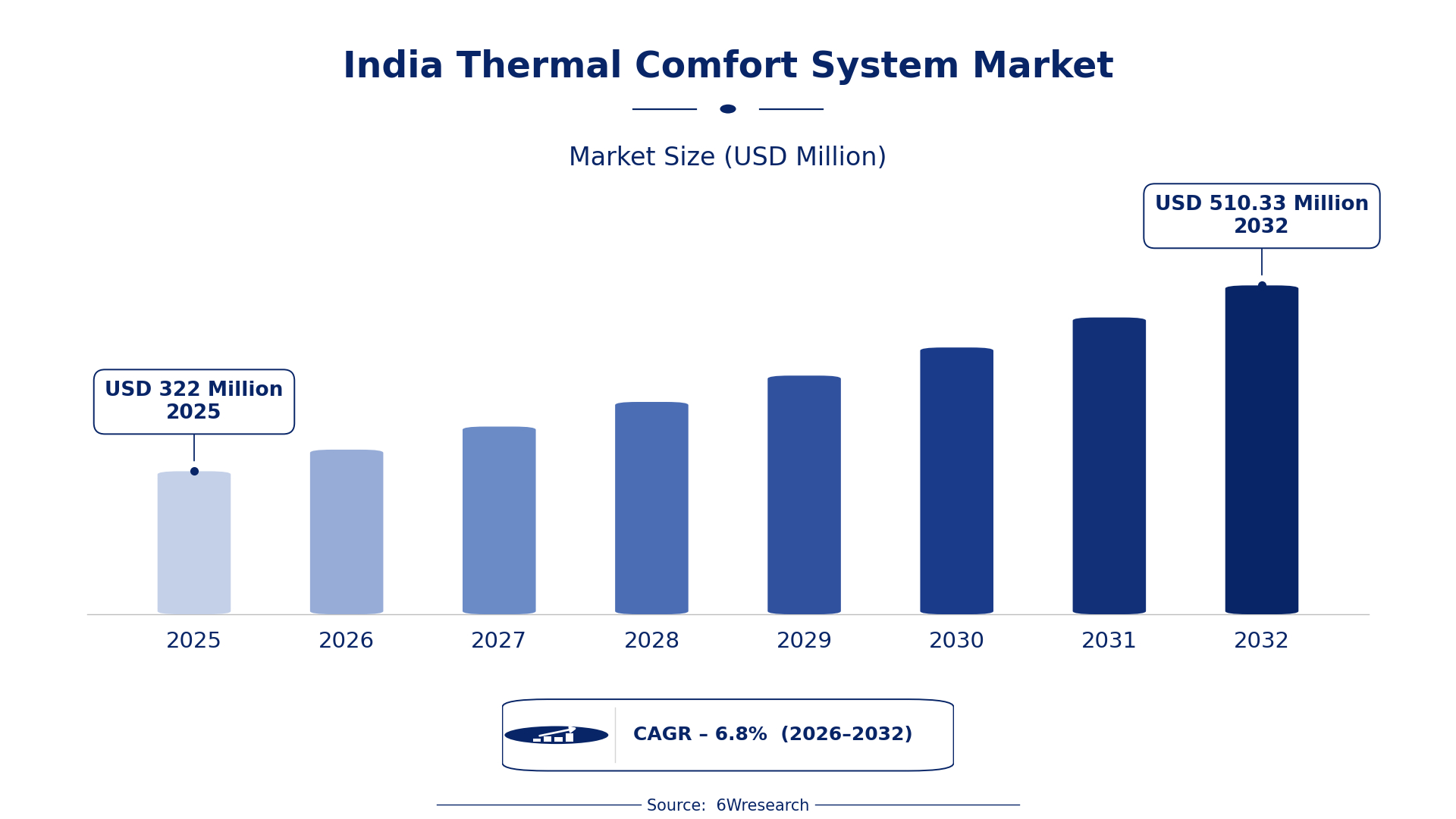
According to 6Wresearch internal database and industry insights, the India Thermal Comfort System Market was valued at USD 322.0 million in 2025 and is projected to reach USD 510.33 million by 2032, growing at a CAGR of approximately 6.8% during 2026–2032.
India Thermal Comfort System Market Highlights
| Report Metric | Details |
| Report Name | India Thermal Comfort System Market |
| Market Size 2025 | USD 322.0 million |
| Market Size 2032 | USD 510.33 million |
| Absolute Growth 2025–2032 | USD 188.33 million |
| CAGR 2026–2032 | 6.8% |
| Peak Annual Growth | 8.5% in 2030 |
| Forecast Period | 2026–2032 |
| Historical Data | 2022–2025 |
| Base Year | 2025 |
| Leading System Type, 2025 | Dual-Zone HVAC (39% share) |
| Leading Comfort Function, 2025 | Temperature Control (36% share) |
| Leading Vehicle Class, 2025 | SUVs/Vans (48% share) |
| Leading End User, 2025 | Car Manufacturers (48% share) |
| Fastest-Growing System Type | Climate-Controlled Seats (8.9% CAGR) |
| Fastest-Growing Comfort Function | Extended Comfort (9.1% CAGR) |
| Fastest-Growing Vehicle Class | EVs (7.9% CAGR) |
| Fastest-Growing End User | Smart Mobility Firms (9.4% CAGR) |
| Growing Sector | automotive industry |
| Key End Users | Car Manufacturers, Automotive Suppliers, OEMs, Smart Mobility Firms |
India Thermal Comfort System Market Year-wise Growth Rate and Key Drivers (2022–2032)
This graph illustrates the annual growth rates of the market from 2022 to 2032, highlighting a steady upward trajectory and projected market expansion over the forecast period.
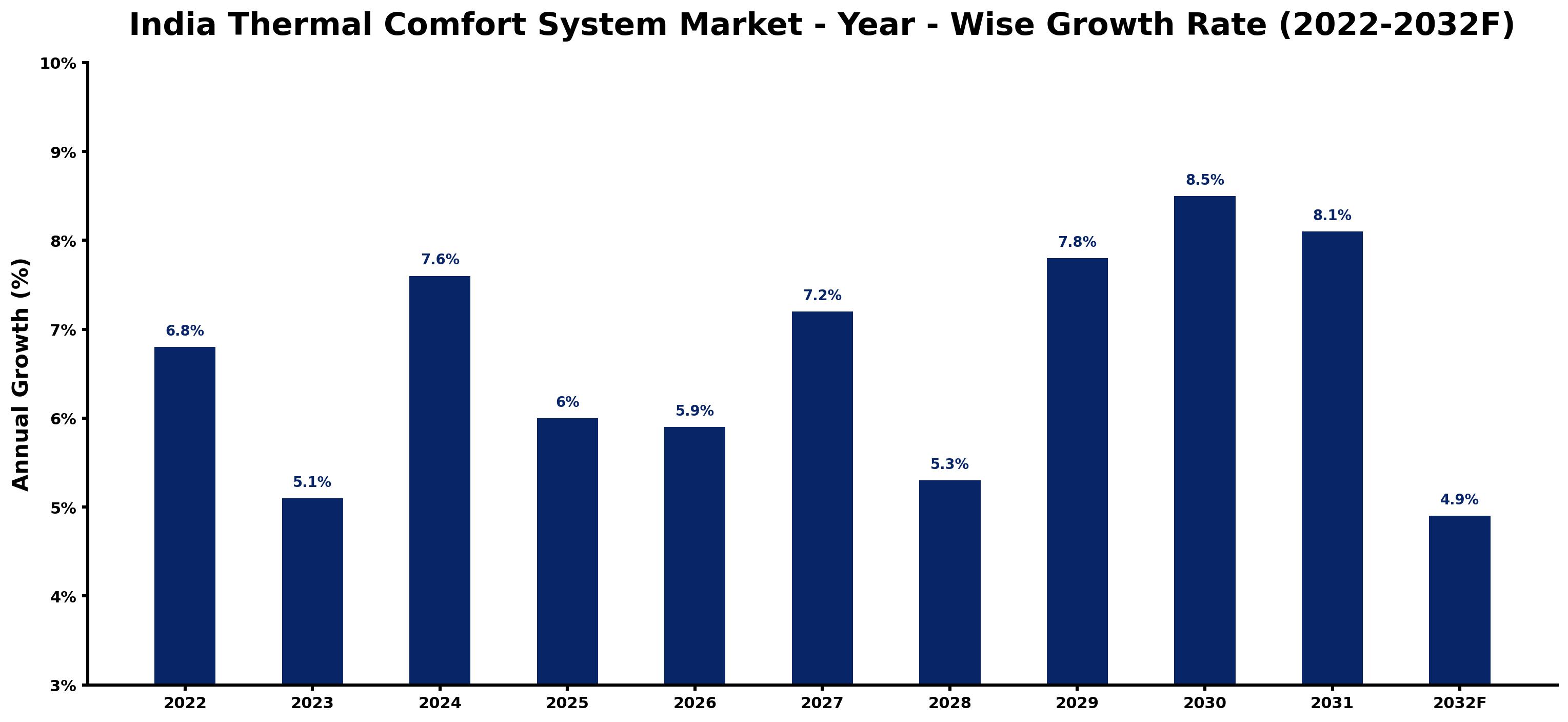
Each row of the following table gives one year's estimated growth and the event or demand shift that explains it.
| Year | Estimated Annual Growth (%) | Market Rationale |
| 2022 | 6.8 | The market experienced solid growth, reflecting strong demand from the automotive sector. |
| 2023 | 5.1 | Growth slowed due to market adjustments and a temporary dip in luxury vehicle sales. |
| 2024 | 7.6 | Demand surged as luxury vehicle sales rebounded significantly, driving higher thermal comfort system adoption. |
| 2025 | 6.0 | Growth slowed again as market conditions stabilised after a peak in luxury vehicle demand. |
| 2026 | 5.9 | Market growth moderated due to a slight decline in luxury vehicle sales and ongoing adjustments. |
| 2027 | 7.2 | A resurgence in demand was driven by increased SUV sales and the introduction of new models. |
| 2028 | 5.3 | Growth decelerated as the market adjusted to previous high sales levels and consumer preferences. |
| 2029 | 7.8 | Demand accelerated again, supported by rising SUV sales and the introduction of advanced features. |
| 2030 | 8.5 | The market peaked with strong demand for dual-zone HVAC systems in luxury vehicles. |
| 2031 | 8.1 | Growth slowed slightly as the market stabilised after reaching a peak in the previous year. |
| 2032 | 4.9 | Demand continues to grow, albeit at a slower pace, as electric vehicle adoption increases. |
Note: Market size estimations and growth projections presented in this report are based on 6Wresearch's proprietary forecasting methodology, utilizing the latest available industry data, government publications, and primary research inputs.
India Thermal Comfort System Market Synopsis
The Thermal Comfort System Market in India includes technologies that manage temperature and improve comfort in vehicles. These systems find their primary application in luxury and mid-segment vehicles, leveraging advanced HVAC technology. The market is expanding due to a 20% increase in luxury vehicle sales in 2023 and the ongoing transition towards electric vehicles. The National Electric Mobility Mission Plan 2020 is also boosting demand for climate-controlled features, as manufacturers respond to changing consumer preferences.
Market Dynamics Impact Analysis (2026–2032)
| Factor | Type | Impact | Primary Segment Affected |
| Increasing luxury vehicle sales driving demand for advanced comfort features | Driver | High | Luxury Vehicles |
| Growing adoption of electric vehicles necessitating improved thermal comfort solutions | Driver | High | EVs |
| Significant investments in automotive technology and infrastructure | Opportunity | High | Automotive Suppliers |
| Rising consumer expectations for comfort in mid-segment cars | Opportunity | High | Mid-Segment Cars |
| High production costs for advanced HVAC components limiting affordability | Restraint | Medium | Dual-Zone HVAC |
| Regulatory compliance costs associated with new standards impacting manufacturers | Restraint | Medium | Dual-Zone HVAC |
| Challenges in integrating new technologies into existing vehicle designs | Challenge | High | Car Manufacturers |
| Competition from alternative comfort solutions affecting market share | Challenge | Medium | Dual-Zone HVAC |
Evaluation of Drivers in India Thermal Comfort System Market (2026–2032)
The table below links each growth driver to the segment it affects and the evidence for it.
| Drivers | Primary Segment Affected | Why It Matters (Evidence) |
| Rising luxury vehicle sales | Luxury Vehicles | Luxury vehicle sales increased by 20% in 2023, leading to higher demand for advanced thermal comfort systems. |
| Growth in electric vehicle adoption | EVs | The Indian electric vehicle market is expected to grow to 6 million units by 2025, driving demand for climate-controlled seats. |
| Increased production of HVAC components | Dual-Zone HVAC | A 15% increase in HVAC component production in 2023 indicates rising demand for thermal comfort systems. |
| Expansion of dual-zone HVAC systems | Dual-Zone HVAC | The average luxury vehicle is projected to feature dual-zone capabilities by 2025, enhancing passenger comfort. |
| Rising demand for rear cabin climate units | Rear Cabin Climate Units | A 10% increase in SUV sales in 2023 boosts the need for rear cabin climate units in family vehicles. |
Growth across the Thermal Comfort System market in India is anchored in rising luxury vehicle sales, increasing electric vehicle adoption, and expanded production of HVAC components. Luxury vehicle sales surged by 20% in 2023, boosting demand for advanced thermal comfort systems. The Indian electric vehicle market is set to grow to 6 million units by 2025, creating a strong demand for climate-controlled seats. A reported 15% increase in HVAC component production in 2023 reflects the growing need for these systems. The average luxury vehicle is likely to feature dual-zone capabilities by 2025, improving passenger comfort and driving further purchases.
Evaluation of Restraints in India Thermal Comfort System Market
Below mentioned are some major restraints and their influence on market dynamics.
| Market Restraint | Primary Segment Affected | Why It Matters (Evidence) |
| High production costs for advanced HVAC components | Dual-Zone HVAC | The rising costs of advanced HVAC components can limit affordability for manufacturers, affecting pricing strategies and market competitiveness. |
| Regulatory compliance costs impacting manufacturers | Dual-Zone HVAC | Compliance with updated standards, such as IS 14861, increases operational costs for manufacturers, affecting their profit margins. |
| Integration challenges of new technologies into existing designs | Car Manufacturers | Car manufacturers face difficulties in adapting new thermal comfort technologies to existing vehicle models, delaying product launches. |
| Competition from alternative comfort solutions | Dual-Zone HVAC | The emergence of alternative solutions can affect market share and pricing strategies for thermal comfort systems, pressuring local producers. |
| Supply chain disruptions impacting component availability | Dual-Zone HVAC | Supply chain issues can delay production schedules, affecting the timely delivery of thermal comfort systems and increasing costs. |
India Thermal Comfort System Market Challenges
Producers of thermal comfort systems in India encounter technological challenges, as many still depend on outdated HVAC technologies that limit efficiency, potentially delaying product launches by up to six months. A lack of skilled technicians proficient in advanced HVAC systems results in production slowdowns, increasing costs for manufacturers by around 15%. Supply chain issues frequently arise, particularly in sourcing high-quality materials, which can extend lead times by 20% for producers. Competition from imported systems with advanced features pressures local manufacturers to lower prices, squeezing profit margins significantly for those unable to adapt quickly.
Trends in the India Thermal Comfort System Market
Buyers and suppliers in the India Thermal Comfort System Market are adjusting to the following trends.
- Shift towards Climate-Controlled Seats in Luxury Vehicles: Car manufacturers are increasingly integrating climate-controlled seats in luxury models, with a projected adoption rate of 70% by 2025. This trend mirrors rising consumer expectations for comfort and personalisation in the automotive sector.
- Transition to Dual-Zone HVAC Systems: The automotive industry is moving towards dual-zone HVAC systems, greatly improving passenger comfort. By 2025, the average luxury vehicle is expected to feature these systems, catering to varying passenger preferences.
- Emergence of Advanced Comfort Features in Mid-Segment Cars: Mid-segment cars are progressively adopting advanced thermal comfort features to stay competitive. This shift is driven by rising consumer expectations and a growing market for comfort-enhancing technologies.
- Growing Demand for Rear Cabin Climate Units: The demand for rear cabin climate units is increasing, particularly in SUVs, with a reported 10% rise in SUV sales in 2023. This trend underscores the importance of passenger comfort in family-oriented vehicles.
Investment Opportunities in the India Thermal Comfort System Market
Below are the investment opportunities with the strongest case in the India Thermal Comfort System Market.
- Investment in Electric Vehicle Charging Infrastructure: With the Indian electric vehicle market expected to grow to 6 million units by 2025, there is a strong opportunity for investment in charging infrastructure. Collaborating with local governments can facilitate entry into this market.
- Expansion of HVAC Component Manufacturing Facilities: The projected $8 billion investment in the automotive sector by 2025 creates opportunities for establishing new HVAC component manufacturing facilities. Partnering with local automotive suppliers can enhance market access.
- Development of Smart Mobility Solutions: The rise of smart mobility firms presents opportunities for innovative thermal comfort solutions. Investing in partnerships with these firms can lead to the integration of advanced comfort systems in new transport solutions.
- Enhancement of Training Programs for HVAC Technologies: The Automotive Skill Development Council's training programs create opportunities for enhancing skills in HVAC technologies. Investing in training facilities can support the growing need for skilled professionals in this sector.
Government Initiatives in the India Thermal Comfort System Market
The Automotive Mission Plan 2026, initiated by the Ministry of Heavy Industries, sets targets for enhancing vehicle comfort features and technology advancements. This initiative encourages manufacturers to innovate and adapt their products to meet evolving consumer preferences. Additionally, the Bureau of Indian Standards updated IS 14861 for automotive HVAC systems in 2021, improving energy efficiency and performance, which directly impacts thermal comfort system designs. The National Electric Mobility Mission Plan 2020 promotes electric vehicles and their supporting technologies, including thermal comfort systems, fostering innovation in the sector.
The Ministry of Heavy Industries oversees the implementation of several key initiatives, including funding for the National Automotive Testing and R&D Infrastructure Project. This project aims to enhance automotive technologies, including HVAC systems, by providing financial support for research and development. The Automotive Skill Development Council also plays a significant role by launching training programs to improve skills in HVAC and thermal comfort technologies. These initiatives ensure that the workforce is equipped with the necessary skills to support the demand for advanced thermal comfort systems in vehicles.
Future Insight of the India Thermal Comfort System Market
Several forward-looking factors are expected to support the thermal comfort system market in India in the coming years. The National Automotive Testing and R&D Infrastructure Project will improve HVAC technology, resulting in better product offerings. By 2025, the average temperature control system in luxury vehicles is anticipated to feature dual-zone capabilities, raising consumer expectations. The Indian electric vehicle market is expected to grow, driving demand for climate-controlled seats as they become standard. Investments in the automotive sector are projected to reach $8 billion by 2025, enabling further advancements in thermal comfort technologies.
Market Segmentation Analysis
The report offers a comprehensive study of the following market segments and their leading categories in the market.
By System Type – Dual-Zone HVAC Dominated, Climate-Controlled Seats Expected to Grow Fastest
According to Vasudha, AM at 6Wresearch, with a 39% revenue share in 2025, Dual-Zone HVAC was the largest system type category. The Dual-Zone HVAC system holds the largest market share as it allows personalised temperature settings for different vehicle zones, catering to diverse passenger preferences. This system is particularly favoured in luxury vehicles, where comfort is paramount, leading to its widespread adoption. The quickest growth will come from Climate-Controlled Seats, forecast to expand at a CAGR of 8.9% between 2026 and 2032. Climate-Controlled Seats are witnessing rapid growth because they enhance comfort through adjustable temperature settings, driven by the increasing demand for luxury features in new vehicle models. With a projected adoption rate of 70% by 2025, this segment is set for significant expansion. Suppliers should focus on developing advanced features in climate-controlled seats to meet rising consumer expectations.
By Comfort Function – Temperature Control Dominated, Extended Comfort Expected to Grow Fastest
Temperature Control held a 36% share of the India Thermal Comfort System Market by comfort function in 2025. Temperature Control leads the market as it is vital for maintaining a comfortable environment inside vehicles, especially in India's diverse climate. This essential feature is a key consideration for consumers when selecting thermal comfort systems, solidifying its dominant position. Over 2026–2032, Extended Comfort is expected to post the fastest growth, at a CAGR of 9.1%. Extended Comfort is growing quickly as it improves the overall user experience, fuelled by rising consumer expectations for additional comfort features in vehicles. This trend highlights a shift towards prioritising passenger satisfaction in automotive design. Manufacturers need to integrate extended comfort features to remain competitive in the evolving market.
By Vehicle Class – SUVs/Vans Dominated, EVs Expected to Grow Fastest
The largest vehicle class category in 2025 was SUVs/Vans, with a 48% share of total revenue. SUVs and Vans capture the largest market share due to the increasing preference for comfort systems in family-oriented vehicles, where space and comfort are crucial. This segment benefits from strong demand, particularly in urban areas where larger vehicles are becoming more popular. EVs are set to record the highest CAGR in this split, 7.9% over 2026–2032. Electric Vehicles are experiencing the fastest growth, as thermal comfort systems are essential for optimising battery performance and ensuring passenger comfort. With the Indian EV market expected to reach 6 million units by 2025, this segment's growth is inevitable. Suppliers should invest in developing tailored thermal comfort solutions for electric vehicles to capitalise on emerging market opportunities.
By End User – Car Manufacturers Dominated, Smart Mobility Firms Expected to Grow Fastest
Car Manufacturers took a 48% share of end user in 2025, more than any other category. Car Manufacturers dominate the market share as they directly incorporate thermal comfort systems into their vehicle offerings, ensuring that comfort features align with consumer demands. This integration is crucial for maintaining competitiveness in the automotive industry. Smart Mobility Firms are projected to grow fastest, at a CAGR of 9.4% during 2026–2032. Smart Mobility Firms are rapidly adopting thermal comfort technologies in modern transport solutions, reflecting the industry's shift towards innovative mobility. Their focus on enhancing user experience is driving demand for advanced comfort systems. Suppliers should seek partnerships with smart mobility firms to leverage new opportunities in the changing transportation landscape.
Key Attractiveness of the Report
- 10 Years of Market Numbers
- Historical Data Starting from 2022 to 2025
- Base Year 2025
- Forecast Data until 2032
- Key Performance Indicators Impacting the Market
- Major Upcoming Developments and Projects
Key Highlights of the Report:
- India Thermal Comfort System Market Outlook
- Market Size of India Thermal Comfort System Market, 2025
- Forecast of India Thermal Comfort System Market, 2032
- Historical Data and Forecast of India Thermal Comfort System Revenues & Volume for the Period 2022 - 2032F
- India Thermal Comfort System Market Trend Evolution
- India Thermal Comfort System Market Drivers and Challenges
- India Thermal Comfort System Price Trends
- India Thermal Comfort System Porter's Five Forces
- India Thermal Comfort System Industry Life Cycle
- Historical Data and Forecast of India Thermal Comfort System Market Revenues & Volume By System Type for the Period 2022 - 2032F
- Historical Data and Forecast of India Thermal Comfort System Market Revenues & Volume By Seat Heating for the Period 2022 - 2032F
- Historical Data and Forecast of India Thermal Comfort System Market Revenues & Volume By Dual-Zone HVAC for the Period 2022 - 2032F
- Historical Data and Forecast of India Thermal Comfort System Market Revenues & Volume By Rear Cabin Climate Units for the Period 2022 - 2032F
- Historical Data and Forecast of India Thermal Comfort System Market Revenues & Volume By Climate-Controlled Seats for the Period 2022 - 2032F
- Historical Data and Forecast of India Thermal Comfort System Market Revenues & Volume By Comfort Function for the Period 2022 - 2032F
- Historical Data and Forecast of India Thermal Comfort System Market Revenues & Volume By Warmth Control for the Period 2022 - 2032F
- Historical Data and Forecast of India Thermal Comfort System Market Revenues & Volume By Temperature Control for the Period 2022 - 2032F
- Historical Data and Forecast of India Thermal Comfort System Market Revenues & Volume By Extended Comfort for the Period 2022 - 2032F
- Historical Data and Forecast of India Thermal Comfort System Market Revenues & Volume By Cooling + Heating for the Period 2022 - 2032F
- Historical Data and Forecast of India Thermal Comfort System Market Revenues & Volume By Vehicle Class for the Period 2022 - 2032F
- Historical Data and Forecast of India Thermal Comfort System Market Revenues & Volume By Luxury Vehicles for the Period 2022 - 2032F
- Historical Data and Forecast of India Thermal Comfort System Market Revenues & Volume By Mid-Segment Cars for the Period 2022 - 2032F
- Historical Data and Forecast of India Thermal Comfort System Market Revenues & Volume By SUVs/Vans for the Period 2022 - 2032F
- Historical Data and Forecast of India Thermal Comfort System Market Revenues & Volume By EVs for the Period 2022 - 2032F
- Historical Data and Forecast of India Thermal Comfort System Market Revenues & Volume By End User for the Period 2022 - 2032F
- Historical Data and Forecast of India Thermal Comfort System Market Revenues & Volume By OEMs for the Period 2022 - 2032F
- Historical Data and Forecast of India Thermal Comfort System Market Revenues & Volume By Car Manufacturers for the Period 2022 - 2032F
- Historical Data and Forecast of India Thermal Comfort System Market Revenues & Volume By Automotive Suppliers for the Period 2022 - 2032F
- Historical Data and Forecast of India Thermal Comfort System Market Revenues & Volume By Smart Mobility Firms for the Period 2022 - 2032F
- India Thermal Comfort System Import Export Trade Statistics
- Market Opportunity Assessment By System Type
- Market Opportunity Assessment By Comfort Function
- Market Opportunity Assessment By Vehicle Class
- Market Opportunity Assessment By End User
- India Thermal Comfort System Top Companies Market Share
- India Thermal Comfort System Competitive Benchmarking By Technical and Operational Parameters
- India Thermal Comfort System Company Profiles
- India Thermal Comfort System Key Strategic Recommendations
Market Covered
The report offers an extensive study of the following market segments.
By System Type
- Seat Heating
- Dual-Zone HVAC
- Rear Cabin Climate Units
- Climate-Controlled Seats
By Comfort Function
- Warmth Control
- Temperature Control
- Extended Comfort
- Cooling + Heating
By Vehicle Class
- Luxury Vehicles
- Mid-Segment Cars
- SUVs/Vans
- EVs
By End User
- OEMs
- Car Manufacturers
- Automotive Suppliers
- Smart Mobility Firms































