India Thermal Control Components Market Size & Growth Rate
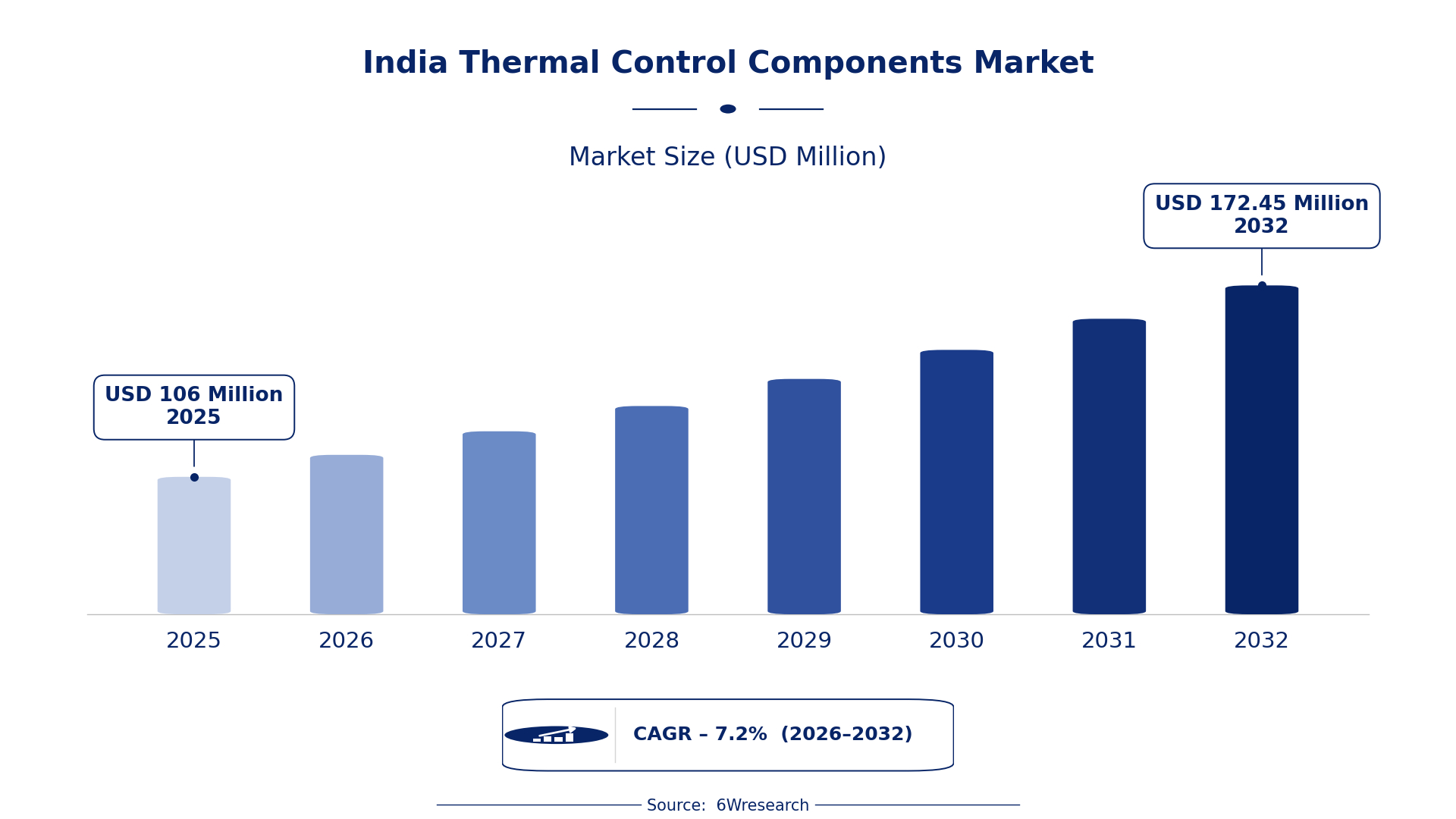
According to 6Wresearch internal database and industry insights, the India Thermal Control Components Market was valued at USD 106.0 million in 2025 and is projected to reach USD 172.45 million by 2032, growing at a CAGR of approximately 7.2% during 2026–2032.
India Thermal Control Components Market Highlights
| Report Metric | Details |
| Report Name | India Thermal Control Components Market |
| Market Size 2025 | USD 106.0 million |
| Market Size 2032 | USD 172.45 million |
| Absolute Growth 2025–2032 | USD 66.45 million |
| CAGR 2026–2032 | 7.2% |
| Peak Annual Growth | 9.0% in 2028 |
| Forecast Period | 2026–2032 |
| Historical Data | 2022–2025 |
| Base Year | 2025 |
| Leading Component Type, 2025 | Heat Pipes (50% share) |
| Leading Control Mechanism, 2025 | Passive Heat Transfer (38% share) |
| Leading Application Segment, 2025 | Satellites (49% share) |
| Leading End User, 2025 | Space Agencies (49% share) |
| Fastest-Growing Component Type | Thermal Straps (9.0% CAGR) |
| Fastest-Growing Control Mechanism | Active Dissipation (9.8% CAGR) |
| Fastest-Growing Application Segment | Planetary Missions (9.9% CAGR) |
| Fastest-Growing End User | Space Companies (10.0% CAGR) |
| Growing Sector | Planetary Missions |
| Key End Users | Satellites, Spacecraft, Avionics Systems, Planetary Missions |
India Thermal Control Components Market Year-wise Growth Rate and Key Drivers (2022–2032)
This graph illustrates the annual growth rates of the market from 2022 to 2032, highlighting a steady upward trajectory and projected market expansion over the forecast period.
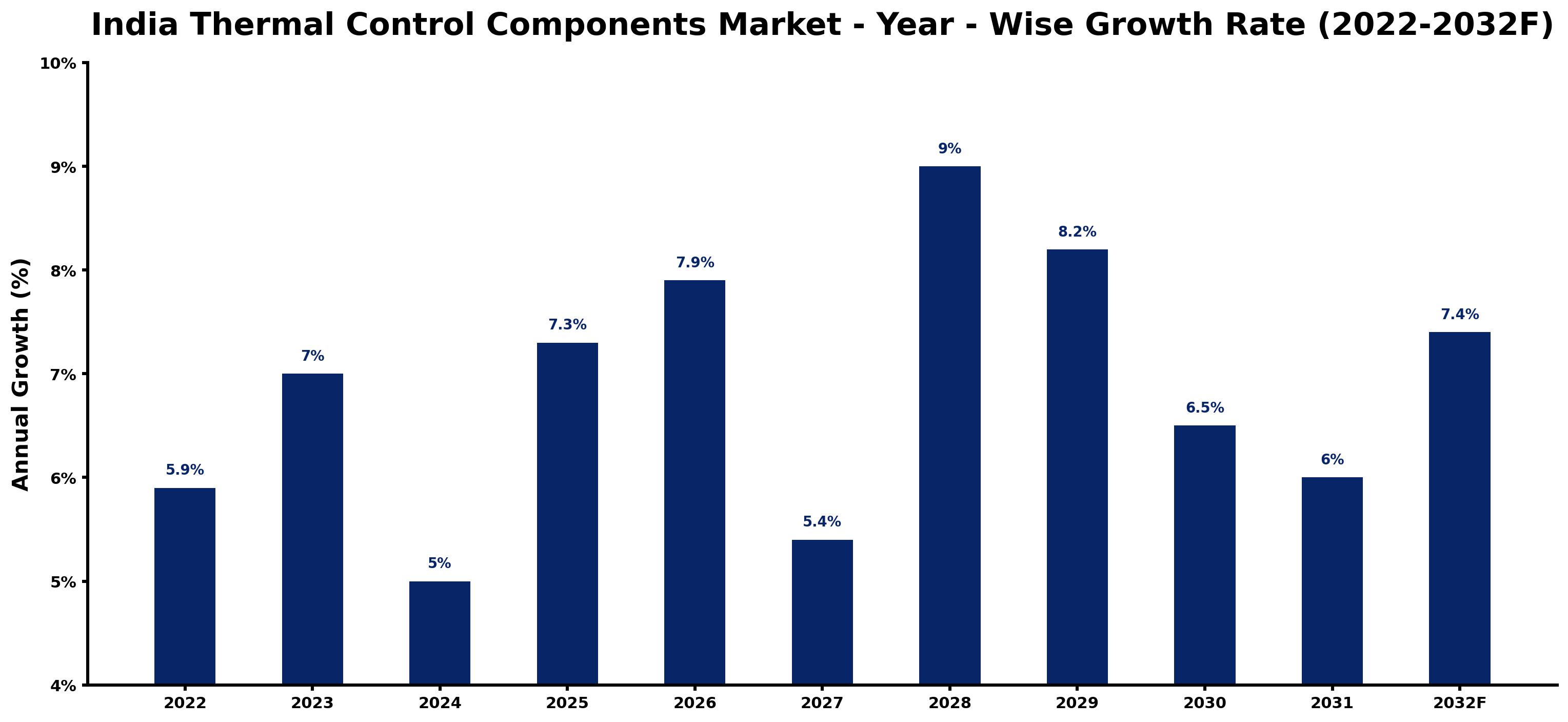
The following table presents the estimated annual growth rate for each year together with the principal factor influencing market performance.
| Year | Estimated Annual Growth (%) | Market Rationale |
| 2022 | 5.9 | The market saw steady demand from space agencies and aerospace companies. |
| 2023 | 7.0 | Growth accelerated due to increased investments in aerospace technology development. |
| 2024 | 5.0 | A slowdown occurred as projects faced delays in approvals and funding. |
| 2025 | 7.3 | Demand surged with the successful Chandrayaan-3 lunar mission boosting component needs. |
| 2026 | 7.9 | Growth continued as the defense budget increased allocations for aerospace technologies. |
| 2027 | 5.4 | A slowdown was noted as the Aerospace and Defense Sector Skill Council's training initiative began. |
| 2028 | 9.0 | The market peaked as new planetary missions drove demand for thermal components. |
| 2029 | 8.2 | Growth slowed slightly as the market adjusted to new production capabilities. |
| 2030 | 6.5 | A further slowdown occurred as projects faced resource allocation challenges. |
| 2031 | 6.0 | The market continued to grow, supported by ongoing investments in aerospace. |
| 2032 | 7.4 | Demand is expected to rise as new technologies and missions are launched. |
Note: Market size estimations and growth projections presented in this report are based on 6Wresearch's proprietary forecasting methodology, utilizing the latest available industry data, government publications, and primary research inputs.
India Thermal Control Components Market Synopsis
Thermal Control Components in India are crucial for managing heat in aerospace applications. Constructed from materials with high thermal conductivity, these components are primarily utilised in satellites and spacecraft. The India Thermal Control Components Market is expanding due to robust demand from domestic space agencies and private aerospace firms. The Satcom industry is projected to reach $15 billion by 2025, which will further drive the need for thermal management solutions. The government's commitment to boosting indigenous production underpins this growth.
Market Dynamics Impact Analysis (2026–2032)
| Factor | Type | Impact | Primary Segment Affected |
| Increased investments in aerospace technology development | Driver | High | Heat Pipes |
| Growing demand from space agencies for reliable thermal management | Driver | High | Satellites |
| Expansion of the aerospace sector due to government initiatives | Opportunity | High | Spacecraft |
| Rising interest in planetary missions creating new demand | Opportunity | High | Planetary Missions |
| Challenges in meeting international standards for production | Restraint | Medium | Radiators |
| Limited skilled workforce in advanced thermal management technologies | Restraint | Medium | Thermal Straps |
| High costs associated with advanced manufacturing processes | Challenge | Medium | Active Dissipation |
| Delays in project approvals affecting timely production | Challenge | Medium | Passive Heat Transfer |
Evaluation of Drivers in India Thermal Control Components Market (2026–2032)
Key forces behind demand, with the segment each one moves most, are listed below.
| Drivers | Primary Segment Affected | Why It Matters (Evidence) |
| Increased defense budget allocations for aerospace technology | Heat Pipes | India's defense budget for 2023-24 includes $1.5 billion for aerospace technology development, boosting demand for thermal components. |
| Growing Satcom industry driving thermal management needs | Satellites | The Satcom industry in India is projected to grow to $15 billion by 2025, increasing the need for thermal control components. |
| Focus on indigenous production of aerospace components | Thermal Straps | The Aerospace and Defense Manufacturing Policy 2021 aims to boost local production capabilities, driving demand for thermal management solutions. |
| Expansion of planetary missions requiring advanced thermal solutions | Planetary Missions | The 2023 Chandrayaan-3 lunar mission highlighted the need for effective thermal management in space exploration. |
| Training initiatives improving workforce capabilities in aerospace | Active Dissipation | The Aerospace and Defense Sector Skill Council aims to train 1 million professionals by 2025, enhancing production capabilities. |
Growth in the Thermal Control Components market in India stems from increased defence budget allocations, the expanding Satcom industry, and a commitment to indigenous production. The defence budget for 2023-24 includes $1.5 billion for aerospace technology development, which enhances demand for thermal components. The Satcom industry is expected to reach $15 billion by 2025, raising the need for thermal control solutions.
Evaluation of Restraints in India Thermal Control Components Market
The following restraints limit how fast demand can grow.
| Market Restraint | Primary Segment Affected | Why It Matters (Evidence) |
| Challenges in meeting international production standards | Radiators | Compliance with ISO 14644 standards for cleanroom environments increases production costs for manufacturers. |
| Limited skilled workforce in advanced thermal management technologies | Thermal Straps | The need for specialized skills in thermal management is not met, delaying production timelines. |
| High costs associated with advanced manufacturing processes | Active Dissipation | Investment in advanced technologies raises the overall production costs, impacting pricing. |
| Delays in project approvals affecting timely production | Passive Heat Transfer | Prolonged approval processes for aerospace projects slow down the introduction of new thermal solutions. |
| Competition from international suppliers with established capabilities | Heat Pipes | Local manufacturers struggle to compete with established international suppliers, affecting market share. |
India Thermal Control Components Market Challenges
The India Thermal Control Components Market faces several challenges, beginning with the high cost of production. This is largely due to the reliance on advanced materials, which can inflate expenses for producers by up to 30%, ultimately raising prices for buyers. Additionally, competition from international suppliers pressures local manufacturers to reduce prices, potentially cutting profit margins by as much as 15%. Continuous investment in R&D, driven by rapid technological advancements, costs producers around $200 million annually, which can delay product launches. Compliance with ISO 14644 standards requires investments in cleanroom facilities, costing upwards of $5 million, which may hinder swift scaling of operations.
Trends in the India Thermal Control Components Market
Below mentioned are some of the trends shaping the India Thermal Control Components Market growth.
- Shift towards Advanced Thermal Management Solutions: India is increasingly adopting advanced thermal management technologies to improve the reliability of aerospace systems. The National Aerospace Policy 2022 highlights thermal management technologies as critical for sustainable development, with a $1 billion allocation for space technology advancements.
- Growing Focus on Indigenous Production: The Aerospace and Defense Manufacturing Policy 2021 promotes local production of thermal control components. This initiative aims to reduce dependency on imports, with a target of increasing indigenous manufacturing capabilities by 2025.
- Increased Investment in Space Exploration: The Indian government has significantly increased its investment in space exploration, with $1 billion allocated for space technology advancements in 2023. This funding is expected to drive demand for thermal control components in upcoming missions.
- Emergence of New Space Companies: The rise of new space companies in India is reshaping the aerospace sector. With the Satcom industry projected to grow to $15 billion by 2025, these companies are driving demand for innovative thermal management solutions.
Investment Opportunities in the India Thermal Control Components Market
Some of the investment opportunities in the India Thermal Control Components Market are mentioned below.
- Partnerships with Local Startups: Now is an ideal time to pursue partnerships with local startups developing thermal management solutions, as the Space Technology Promotion and Application Development Fund supports innovation in this sector with substantial funding.
- Investment in Training Programs: With the Aerospace and Defense Sector Skill Council aiming to train 1 million professionals by 2025, investing in training programs can address the skills gap in thermal management technologies.
- Supply of Advanced Thermal Components: The increasing focus on planetary missions presents a unique opportunity to supply advanced thermal components, with the potential for substantial contracts from space agencies.
- Joint Ventures for Local Manufacturing: Forming joint ventures with local manufacturers can facilitate entry into the growing market, especially as the government encourages indigenous production through various initiatives.
Government Initiatives in the India Thermal Control Components Market
The National Aerospace Policy 2022, launched by the Ministry of Defence, promotes indigenous capabilities in aerospace manufacturing, including thermal control components. This policy aims to streamline regulations and provide support for local manufacturers, ensuring they meet international standards. The policy allocates funding for research and development in thermal management technologies, encouraging innovation in the sector. The Space Technology Promotion and Application Development Fund, established in 2021, supports startups developing thermal management solutions for space applications. This fund provides financial assistance and resources to encourage the growth of new technologies and solutions in the aerospace industry.
The Aerospace and Defense Sector Skill Council's initiative in 2022 aims to train 1 million individuals in aerospace technologies, including thermal control systems. This initiative is expected to enhance workforce capabilities in thermal management, ensuring that local manufacturers have access to skilled professionals. The funding allocated for this training program will help bridge the skills gap in the industry, allowing for more efficient production processes and improved product quality.
Future Insight of the India Thermal Control Components Market
The India Thermal Control Components Market is expected to evolve by 2032, driven by several key factors. The Satcom industry is set to reach $15 billion by 2025, significantly increasing demand for thermal management solutions. The government's $1 billion investment in space technology advancements will stimulate innovation in this sector. The Aerospace and Defense Sector Skill Council's initiative to train a million professionals by 2025 will ensure a skilled labour pool for producers. The Aerospace and Defense Manufacturing Policy 2021 will promote indigenous production, strengthening local manufacturing capabilities.
Market Segmentation Analysis
The report offers a comprehensive study of the following market segments and their leading categories in the market.
By Component Type – Heat Pipes Dominated, Thermal Straps Expected to Grow Fastest
According to Vasudha, AM at 6Wresearch, in 2025, Heat Pipes led the component type split with a 50% share. Heat pipes dominate the market share because they are vital for efficient thermal management in spacecraft, ensuring optimal performance under extreme conditions. Their essential function in missions like the recent lunar exploration underscores their significance in the aerospace sector. Thermal Straps are projected to grow fastest, at a CAGR of 9.0% during 2026–2032. Thermal straps are witnessing rapid growth as they effectively facilitate heat transfer between components in space applications, reflecting the increasing complexity of modern aerospace systems. The projected expansion of the satellite industry, expected to reach $15 billion by 2025, is a primary driver of this growth. Suppliers should focus on boosting the production capabilities of thermal straps to meet the rising demand in the aerospace industry.
By Control Mechanism – Passive Heat Transfer Dominated, Active Dissipation Expected to Grow Fastest
With a 38% revenue share in 2025, Passive Heat Transfer was the largest control mechanism category. Passive heat transfer holds the largest market share due to its extensive use in thermal management systems for satellites, ensuring reliable temperature regulation. Its established role across various aerospace applications highlights its importance in maintaining system reliability. Over 2026–2032, Active Dissipation is expected to post the fastest growth, at a CAGR of 9.8%. Active dissipation is growing rapidly as it is essential for managing excess heat in advanced avionics systems. The increasing need for sophisticated thermal management solutions in defence technology is a significant factor driving this segment's growth. Buyers should invest in active dissipation technologies to ensure the reliability of their avionics systems in high-performance environments.
By Application Segment – Satellites Dominated, Planetary Missions Expected to Grow Fastest
Satellites took a 49% share of application segment in 2025, more than any other category. Satellites represent the largest share of the market as they are the primary application for thermal control components in India, driven by the country's expanding space initiatives. The increasing number of satellite launches underscores their critical importance in aerospace operations. The quickest growth will come from Planetary Missions, forecast to expand at a CAGR of 9.9% between 2026 and 2032. Planetary missions are the fastest-growing segment, reflecting the heightened interest in future exploration efforts and the need for advanced thermal management solutions. The recent success of lunar missions has sparked further investment and innovation in this area. Suppliers should align their product offerings with the growing focus on planetary missions to capture emerging opportunities in the aerospace market.
By End User – Space Agencies Dominated, Space Companies Expected to Grow Fastest
Space Agencies accounted for a 49% market share by end user in 2025. Space agencies command the largest market share as they are the primary users of thermal control components in missions, ensuring the success of critical space exploration activities. Their established procurement processes and funding allocations support consistent demand for these technologies. Space Companies are set to record the highest CAGR in this split, 10.0% over 2026–2032. Space companies are the fastest-growing end user segment, driven by the increasing number of private sector initiatives in aerospace. The allocation of substantial budgets for aerospace technology development is fueling this growth. Suppliers must adapt their strategies to cater to the evolving needs of space companies, which are becoming key players in the thermal control components market.
Key Attractiveness of the Report
- 10 Years of Market Numbers
- Historical Data Starting from 2022 to 2025
- Base Year 2025
- Forecast Data until 2032
- Key Performance Indicators Impacting the Market
- Major Upcoming Developments and Projects
Key Highlights of the Report:
- India Thermal Control Components Market Outlook
- Market Size of India Thermal Control Components Market, 2025
- Forecast of India Thermal Control Components Market, 2032
- Historical Data and Forecast of India Thermal Control Components Revenues & Volume for the Period 2022 - 2032F
- India Thermal Control Components Market Trend Evolution
- India Thermal Control Components Market Drivers and Challenges
- India Thermal Control Components Price Trends
- India Thermal Control Components Porter's Five Forces
- India Thermal Control Components Industry Life Cycle
- Historical Data and Forecast of India Thermal Control Components Market Revenues & Volume By Component Type for the Period 2022 - 2032F
- Historical Data and Forecast of India Thermal Control Components Market Revenues & Volume By Heat Pipes for the Period 2022 - 2032F
- Historical Data and Forecast of India Thermal Control Components Market Revenues & Volume By Radiators for the Period 2022 - 2032F
- Historical Data and Forecast of India Thermal Control Components Market Revenues & Volume By Thermal Straps for the Period 2022 - 2032F
- Historical Data and Forecast of India Thermal Control Components Market Revenues & Volume By Louvers and Coatings for the Period 2022 - 2032F
- Historical Data and Forecast of India Thermal Control Components Market Revenues & Volume By Control Mechanism for the Period 2022 - 2032F
- Historical Data and Forecast of India Thermal Control Components Market Revenues & Volume By Passive Heat Transfer for the Period 2022 - 2032F
- Historical Data and Forecast of India Thermal Control Components Market Revenues & Volume By Active Dissipation for the Period 2022 - 2032F
- Historical Data and Forecast of India Thermal Control Components Market Revenues & Volume By Flexible Conduction for the Period 2022 - 2032F
- Historical Data and Forecast of India Thermal Control Components Market Revenues & Volume By Radiation Control for the Period 2022 - 2032F
- Historical Data and Forecast of India Thermal Control Components Market Revenues & Volume By Application Segment for the Period 2022 - 2032F
- Historical Data and Forecast of India Thermal Control Components Market Revenues & Volume By Satellites for the Period 2022 - 2032F
- Historical Data and Forecast of India Thermal Control Components Market Revenues & Volume By Spacecraft for the Period 2022 - 2032F
- Historical Data and Forecast of India Thermal Control Components Market Revenues & Volume By Avionics Systems for the Period 2022 - 2032F
- Historical Data and Forecast of India Thermal Control Components Market Revenues & Volume By Planetary Missions for the Period 2022 - 2032F
- Historical Data and Forecast of India Thermal Control Components Market Revenues & Volume By End User for the Period 2022 - 2032F
- Historical Data and Forecast of India Thermal Control Components Market Revenues & Volume By Space Companies for the Period 2022 - 2032F
- Historical Data and Forecast of India Thermal Control Components Market Revenues & Volume By Aerospace OEMs for the Period 2022 - 2032F
- Historical Data and Forecast of India Thermal Control Components Market Revenues & Volume By Defense Integrators for the Period 2022 - 2032F
- Historical Data and Forecast of India Thermal Control Components Market Revenues & Volume By Space Agencies for the Period 2022 - 2032F
- India Thermal Control Components Import Export Trade Statistics
- Market Opportunity Assessment By Component Type
- Market Opportunity Assessment By Control Mechanism
- Market Opportunity Assessment By Application Segment
- Market Opportunity Assessment By End User
- India Thermal Control Components Top Companies Market Share
- India Thermal Control Components Competitive Benchmarking By Technical and Operational Parameters
- India Thermal Control Components Company Profiles
- India Thermal Control Components Key Strategic Recommendations
Market Covered
This report examines the market across the segments below.
By Component Type
- Heat Pipes
- Radiators
- Thermal Straps
- Louvers and Coatings
By Control Mechanism
- Passive Heat Transfer
- Active Dissipation
- Flexible Conduction
- Radiation Control
By Application Segment
- Satellites
- Spacecraft
- Avionics Systems
- Planetary Missions
By End User
- Space Companies
- Aerospace OEMs
- Defense Integrators
- Space Agencies































