India Thermal Food Processing Market Size & Growth Rate
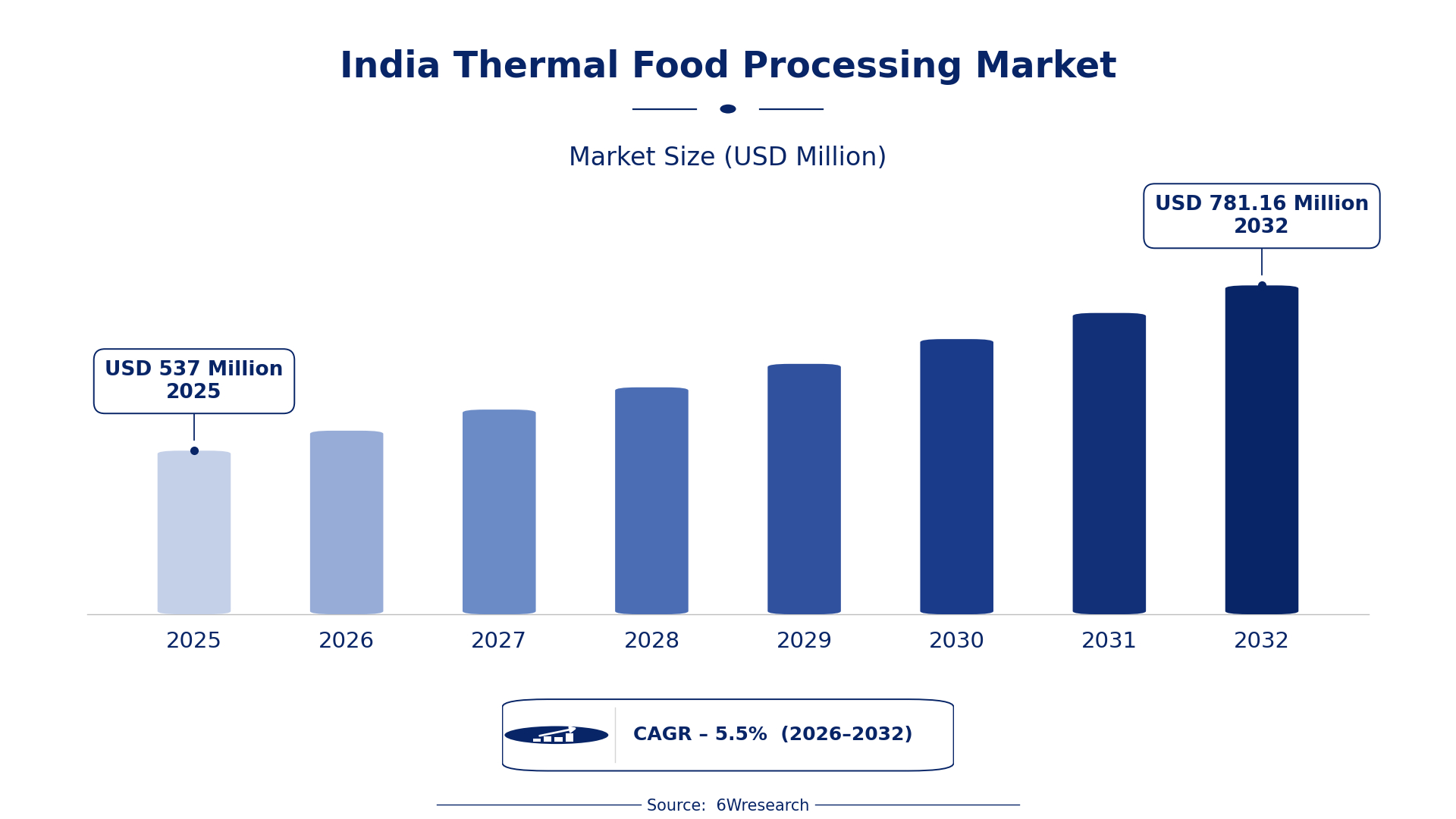
According to 6Wresearch internal database and industry insights, the India Thermal Food Processing Market was valued at USD 537.0 million in 2025 and is projected to reach USD 781.16 million by 2032, growing at a CAGR of approximately 5.5% during 2026–2032.
India Thermal Food Processing Market Highlights
| Report Metric | Details |
| Report Name | India Thermal Food Processing Market |
| Market Size 2025 | USD 537.0 million |
| Market Size 2032 | USD 781.16 million |
| Absolute Growth 2025–2032 | USD 244.16 million |
| CAGR 2026–2032 | 5.5% |
| Peak Annual Growth | 8.1% in 2030 |
| Forecast Period | 2026–2032 |
| Historical Data | 2022–2025 |
| Base Year | 2025 |
| Leading Processing Method, 2025 | Sterilization (46% share) |
| Leading Temperature Range, 2025 | >100°C (36% share) |
| Leading Food Type, 2025 | Canned Goods (52% share) |
| Leading End User, 2025 | Food Processors (43% share) |
| Fastest-Growing Processing Method | Blanching (8.0% CAGR) |
| Fastest-Growing Temperature Range | 80–100°C (7.2% CAGR) |
| Fastest-Growing Food Type | Vegetables (7.5% CAGR) |
| Growing Sector | Food Processing |
| Key End Users | Food Processors, Beverage Plants, Frozen Food Producers, Canned Goods Manufacturers |
India Thermal Food Processing Market Year-wise Growth Rate and Key Drivers (2022–2032)
This graph illustrates the annual growth rates of the market from 2022 to 2032, highlighting a steady upward trajectory and projected market expansion over the forecast period.
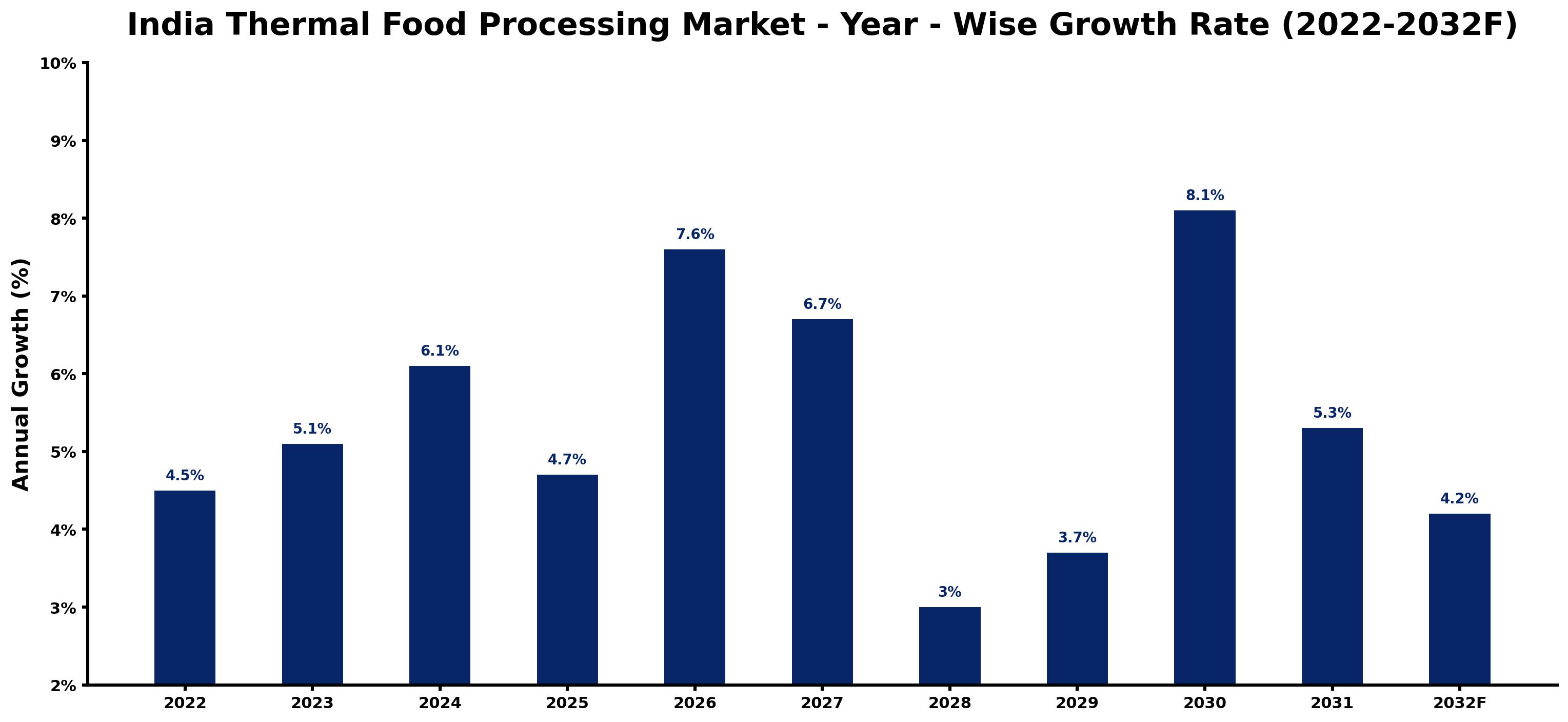
Annual growth estimates for each year appear below with the principal reason behind them, explaining the shifts that set the pace of the market.
| Year | Estimated Annual Growth (%) | Market Rationale |
| 2022 | 4.5 | The market experienced steady growth due to increased domestic consumption of processed foods driven by the Pradhan Mantri Kisan Sampada Yojana. |
| 2023 | 5.1 | Demand rose as food processors expanded capacity to meet consumer preferences influenced by the National Food Processing Policy. |
| 2024 | 6.1 | Growth accelerated with the implementation of updated food safety standards by the Food Safety and Standards Authority of India. |
| 2025 | 4.7 | A slowdown occurred as market adjustments took place following rapid growth in previous years. |
| 2026 | 7.6 | The market is expected to rebound as investments in thermal processing equipment increase due to rising consumer demand. |
| 2027 | 6.7 | Growth is projected to slow as some food processors face operational challenges in scaling up their production. |
| 2028 | 3.0 | The market will continue to grow, albeit at a slower pace due to evolving consumer trends and preferences. |
| 2029 | 3.7 | Demand is expected to pick up again as new processing technologies gain traction in the industry. |
| 2030 | 8.1 | A peak in growth will be reached as major investments in food processing infrastructure are realised under government initiatives. |
| 2031 | 5.3 | The market is projected to see slower growth as competition intensifies among food processors in the sector. |
| 2032 | 4.2 | A further slowdown is expected as the market stabilises after rapid expansions in previous years. |
Note: Market size estimations and growth projections presented in this report are based on 6Wresearch's proprietary forecasting methodology, utilizing the latest available industry data, government publications, and primary research inputs.
India Thermal Food Processing Market Synopsis
The India Thermal Food Processing Market encompasses techniques such as pasteurization and sterilization to ensure food safety and extend shelf life. These controlled heating processes are vital for preserving beverages, canned goods, and various food products. The market is expanding due to rising domestic consumption and export demands, with the food processing sector contributing 14% to the overall GDP. Over 2,000 registered food processing units in Maharashtra highlight the sector's growth potential. Initiatives like the National Food Processing Policy aim to increase the sector's contribution to GDP by 20% by 2025.
Market Dynamics Impact Analysis (2026–2032)
| Factor | Type | Impact | Primary Segment Affected |
| Increasing domestic consumption of processed foods drives demand for thermal processing techniques. | Driver | High | Pasteurization |
| The growing focus on food safety standards encourages investments in thermal processing equipment. | Driver | High | Sterilization |
| The expansion of food processing units presents opportunities for suppliers of thermal equipment. | Opportunity | High | Food Processors |
| Rising exports of processed foods create demand for advanced thermal processing solutions. | Opportunity | Medium | Canned Goods |
| The high initial investment costs for thermal processing equipment can deter new entrants. | Restraint | High | Sterilization |
| Compliance with stringent food safety regulations can increase operational costs for processors. | Restraint | Medium | Sterilization |
| This market still has to solve a few problems, including equipment affordability and regulatory compliance. | Challenge | High | Sterilization |
| Technological advancements in processing methods require continuous investment, posing challenges for smaller processors. | Challenge | Medium | Sterilization |
Evaluation of Drivers in India Thermal Food Processing Market (2026–2032)
Below mentioned are some major drivers and their influence on market dynamics.
| Drivers | Primary Segment Affected | Why It Matters (Evidence) |
| Rising domestic consumption of processed foods drives demand for pasteurization techniques. | Pasteurization | In India, the average annual consumption of processed foods is projected to reach 30 million tons by 2025. |
| The emphasis on food safety standards increases the need for sterilization processes in canned goods. | Sterilization | The Food Safety and Standards Authority of India regulates thermal processing standards, ensuring safety. |
| Investment in thermal processing equipment is spurred by the National Food Processing Policy's initiatives. | Sterilization | The policy aims to increase the sector's growth to 20% by 2025, encouraging infrastructure development. |
| The growth of the frozen food market drives demand for thermal processing in beverage plants. | Beverage Plants | In 2022, the frozen food market in India was valued at ₹1,500 crore, driving processing needs. |
| The expansion of food processing units creates a larger market for thermal processing technologies. | Food Processors | India has over 2,000 registered food processing units, indicating a strong processing industry. |
Market growth in India for Thermal Food Processing rests on rising domestic consumption of processed foods, increasing focus on food safety standards, and investments in thermal processing infrastructure. The average annual consumption of processed foods is projected to reach 30 million tons by 2025, prompting food processors to improve their capabilities. The frozen food market, valued at ₹1,500 crore in 2022, is driving demand for thermal processing in beverage plants. As food processors expand their operations, the need for advanced thermal processing technologies continues to grow.
Evaluation of Restraints in India Thermal Food Processing Market
The table below lists the restraints and the evidence behind each.
| Market Restraint | Primary Segment Affected | Why It Matters (Evidence) |
| High initial investment costs for thermal processing equipment can deter new market entrants. | Sterilization | In 2021, the installed capacity for thermal processing equipment was estimated at 1,500 units, limiting growth. |
| Compliance with stringent food safety regulations increases operational costs for processors. | Sterilization | The Food Safety and Standards Authority of India updated regulations in 2022, requiring additional investments. |
| Limited awareness among small processors about thermal processing benefits hampers market growth. | Food Processors | Many small food processors lack access to training and resources on thermal techniques. |
| Market competition can lead to price wars, affecting profitability for thermal processing equipment suppliers. | Sterilization | As more players enter the market, price competition intensifies, impacting margins. |
| Technological advancements require continuous investment, posing challenges for smaller processors. | Sterilization | Smaller processors may struggle to keep up with the latest processing technologies. |
India Thermal Food Processing Market Challenges
The India Thermal Food Processing Market still faces several challenges, with a primary issue being the lack of skilled workers. This shortage arises from insufficient training programmes, which delays production for food processing units and increases hiring costs by up to 20%. Next, supply chain disruptions limit the availability of thermal processing equipment, leading to project delays for producers and potential revenue losses estimated at ₹1,500 crore. Regulatory compliance presents another challenge, as the Food Safety and Standards Authority of India mandates strict standards that can prolong production timelines for manufacturers. Lastly, buyers encounter fluctuating prices for processed foods, resulting in a 15% increase in costs for consumers and affecting their purchasing decisions.
Trends in the India Thermal Food Processing Market
The trends below show where the India Thermal Food Processing Market is heading.
- Shift towards Enhanced Food Safety Standards: The Food Safety and Standards Authority of India updated regulations in 2022, promoting better thermal processing practices. This change is expected to improve food safety across the sector, benefiting consumers and processors alike.
- Growing Demand for Canned Goods: Food processors are increasingly focusing on canned goods, which accounted for 52% of the market share in 2025. This trend reflects changing consumer preferences for convenient and long-lasting food options.
- Increase in Energy-Efficient Processing Equipment: The government announced subsidies for energy-efficient thermal processing equipment in 2023, encouraging processors to adopt greener technologies. This shift aims to reduce energy consumption and operational costs.
- Expansion of Food Processing Units in Maharashtra: Maharashtra is experiencing notable growth in food processing units, with over 2,000 registered facilities. This concentration enhances the region's capacity to meet rising demand for processed foods.
Investment Opportunities in the India Thermal Food Processing Market
Several openings in the India Thermal Food Processing Market merit attention from investors.
- Investment in Thermal Processing Equipment: With the food processing sector projected to grow, there is a gap in advanced thermal processing equipment. Food processors in Maharashtra are seeking efficient solutions to improve production capacity.
- Supply of Energy-Efficient Technologies: The government's push for energy-efficient thermal processing equipment creates opportunities for suppliers. The Pradhan Mantri Kisan Sampada Yojana allocates ₹6,000 crore to enhance food processing infrastructure.
- Expansion of Frozen Food Production: The frozen food market's valuation at ₹1,500 crore in 2022 indicates a promising opportunity for thermal processing suppliers. Food processors are looking for partnerships to improve their frozen food offerings.
- Collaboration with Local Food Processors: Now is the time for suppliers to engage with local food processors in Punjab, a major hub for food processing. Establishing joint ventures can facilitate market entry and growth.
Government Initiatives in the India Thermal Food Processing Market
The National Food Processing Policy, launched in 2021, aims to increase the sector's contribution to GDP by 20% by 2025. This policy encourages investments in thermal processing technologies and infrastructure, directly benefiting food processors by improving their operational capabilities. The policy also promotes research and development in food processing technologies, supporting innovation within the sector.
The Pradhan Mantri Kisan Sampada Yojana, administered by the Ministry of Food Processing Industries, allocates ₹6,000 crore to enhance food processing infrastructure. This scheme supports food processors in upgrading their facilities and adopting modern thermal processing techniques. By providing financial assistance, the initiative enables processors to improve their production efficiency and product quality. Additionally, the National Institute of Food Technology Entrepreneurship and Management conducts research to support advancements in food processing technologies, further benefiting the industry.
Future Insight of the India Thermal Food Processing Market
Several forward-looking factors should support the India Thermal Food Processing Market in the coming years. The National Food Processing Policy aims to boost the sector's growth to 20% by 2025, driving investment in modern processing technologies. The Pradhan Mantri Kisan Sampada Yojana will facilitate new projects and enhance production capabilities, creating opportunities for suppliers. The government's initiative for energy-efficient thermal processing equipment, announced in 2023, is expected to lower operational costs for producers. These developments will likely lead to an increase in the average annual consumption of processed foods, projected to reach 30 million tons by 2025.
Market Segmentation Analysis
The analysis below covers each segmentation, its leading category in 2025 and its fastest-growing category through 2032.
By Processing Method – Sterilization Dominated, Blanching Expected to Grow Fastest
According to Vasudha, AM at 6Wresearch, Sterilization accounted for a 46% market share by processing method in 2025. Sterilization holds the largest share in the India Thermal Food Processing Market as it is essential for preserving canned goods, preventing spoilage and ensuring safety. The installed capacity of over 1,500 thermal processing units underscores its critical role in maintaining food quality. Over 2026–2032, Blanching is expected to post the fastest growth, at a CAGR of 8.0%. Blanching is experiencing rapid growth due to its increasing application in preparing vegetables before freezing, which is vital for maintaining their nutritional value. The rising demand for frozen vegetables in India is propelling this segment forward, making it a key player in the market. Suppliers should focus on enhancing sterilization technologies while also investing in blanching processes to meet the evolving market demands.
By Temperature Range – >100°C Dominated, 80–100°C Expected to Grow Fastest
>100°C took a 36% share of temperature range in 2025, more than any other category. The temperature range above 100°C dominates the market as it is critical for sterilization processes that ensure the safety of preserved foods. This range is directly linked to the production of canned goods, which are a staple in the food processing sector. 80–100°C is projected to grow fastest, at a CAGR of 7.2% during 2026–2032. The temperature range of 80–100°C is growing swiftly, primarily due to its application in pasteurization for beverages, which is becoming increasingly popular among consumers. As the demand for safe and quality beverages rises, this segment is set to expand significantly. Manufacturers should consider investing in technologies that operate efficiently within the 80–100°C range to capture the growing beverage market.
By Food Type – Canned Goods Dominated, Vegetables Expected to Grow Fastest
In 2025, Canned Goods led the food type split with a 52% share. Canned goods lead the market as they are heavily reliant on sterilization processes, ensuring long shelf life and safety for consumers. With the average annual consumption projected to reach 30 million tons by 2025, this segment is vital for the food processing industry. Vegetables are set to record the highest CAGR in this split, 7.5% over 2026–2032. Vegetables are rapidly gaining traction as blanching becomes more common in preparation before freezing, driven by the increasing consumer preference for frozen produce. This trend is expected to continue as health-conscious consumers seek convenient and nutritious options. Food processors should enhance their capabilities in canned goods while also expanding into the vegetable segment to meet consumer preferences.
By End User – Food Processors Dominated and Is Expected to Record the Fastest Growth
Food Processors held a 43% share of the India Thermal Food Processing Market by end user in 2025. Food Processors account for the largest share in the market as thermal methods are integral to their operations, ensuring food safety and quality. With over 10 million people employed in the food processing industry, this segment is foundational to India's food supply chain. The same category are also set to grow fastest, at a CAGR of 6.6% during 2026–2032. Food Processors are also the fastest-growing segment, as the increasing focus on food safety and quality drives the adoption of thermal processing methods across the industry. Their sustained growth indicates a strong demand for advanced processing technologies. Suppliers should prioritise developing tailored solutions for food processors to support their growth and ensure compliance with safety standards.
Key Attractiveness of the Report
- 10 Years of Market Numbers
- Historical Data Starting from 2022 to 2025
- Base Year 2025
- Forecast Data until 2032
- Key Performance Indicators Impacting the Market
- Major Upcoming Developments and Projects
Key Highlights of the Report:
- India Thermal Food Processing Market Outlook
- Market Size of India Thermal Food Processing Market, 2025
- Forecast of India Thermal Food Processing Market, 2032
- Historical Data and Forecast of India Thermal Food Processing Revenues & Volume for the Period 2022 - 2032F
- India Thermal Food Processing Market Trend Evolution
- India Thermal Food Processing Market Drivers and Challenges
- India Thermal Food Processing Price Trends
- India Thermal Food Processing Porter's Five Forces
- India Thermal Food Processing Industry Life Cycle
- Historical Data and Forecast of India Thermal Food Processing Market Revenues & Volume By Processing Method for the Period 2022 - 2032F
- Historical Data and Forecast of India Thermal Food Processing Market Revenues & Volume By Pasteurization for the Period 2022 - 2032F
- Historical Data and Forecast of India Thermal Food Processing Market Revenues & Volume By Sterilization for the Period 2022 - 2032F
- Historical Data and Forecast of India Thermal Food Processing Market Revenues & Volume By Blanching for the Period 2022 - 2032F
- Historical Data and Forecast of India Thermal Food Processing Market Revenues & Volume By Roasting/Baking for the Period 2022 - 2032F
- Historical Data and Forecast of India Thermal Food Processing Market Revenues & Volume By Temperature Range for the Period 2022 - 2032F
- Historical Data and Forecast of India Thermal Food Processing Market Revenues & Volume By 70 C for the Period 2022 - 2032F
- Historical Data and Forecast of India Thermal Food Processing Market Revenues & Volume By 100 C for the Period 2022 - 2032F
- Historical Data and Forecast of India Thermal Food Processing Market Revenues & Volume By 80 100 C for the Period 2022 - 2032F
- Historical Data and Forecast of India Thermal Food Processing Market Revenues & Volume By Variable for the Period 2022 - 2032F
- Historical Data and Forecast of India Thermal Food Processing Market Revenues & Volume By Food Type for the Period 2022 - 2032F
- Historical Data and Forecast of India Thermal Food Processing Market Revenues & Volume By Milk & Juices for the Period 2022 - 2032F
- Historical Data and Forecast of India Thermal Food Processing Market Revenues & Volume By Canned Goods for the Period 2022 - 2032F
- Historical Data and Forecast of India Thermal Food Processing Market Revenues & Volume By Vegetables for the Period 2022 - 2032F
- Historical Data and Forecast of India Thermal Food Processing Market Revenues & Volume By Bakery, Nuts for the Period 2022 - 2032F
- Historical Data and Forecast of India Thermal Food Processing Market Revenues & Volume By End User for the Period 2022 - 2032F
- Historical Data and Forecast of India Thermal Food Processing Market Revenues & Volume By Beverage Plants for the Period 2022 - 2032F
- Historical Data and Forecast of India Thermal Food Processing Market Revenues & Volume By Food Processors for the Period 2022 - 2032F
- Historical Data and Forecast of India Thermal Food Processing Market Revenues & Volume By Frozen Food Producers for the Period 2022 - 2032F
- Historical Data and Forecast of India Thermal Food Processing Market Revenues & Volume By Snack Manufacturers for the Period 2022 - 2032F
- India Thermal Food Processing Import Export Trade Statistics
- Market Opportunity Assessment By Processing Method
- Market Opportunity Assessment By Temperature Range
- Market Opportunity Assessment By Food Type
- Market Opportunity Assessment By End User
- India Thermal Food Processing Top Companies Market Share
- India Thermal Food Processing Competitive Benchmarking By Technical and Operational Parameters
- India Thermal Food Processing Company Profiles
- India Thermal Food Processing Key Strategic Recommendations
Market Covered
The report offers an extensive study of the following market segments.
By Processing Method
- Pasteurization
- Sterilization
- Blanching
- Roasting/Baking
By Temperature Range
- ~70°C
- >100°C
- 80–100°C
- Variable
By Food Type
- Milk & Juices
- Canned Goods
- Vegetables
- Bakery
- Nuts
By End User
- Beverage Plants
- Food Processors
- Frozen Food Producers
- Snack Manufacturers































