India Thermal Insulation Fabric Market Size & Growth Rate
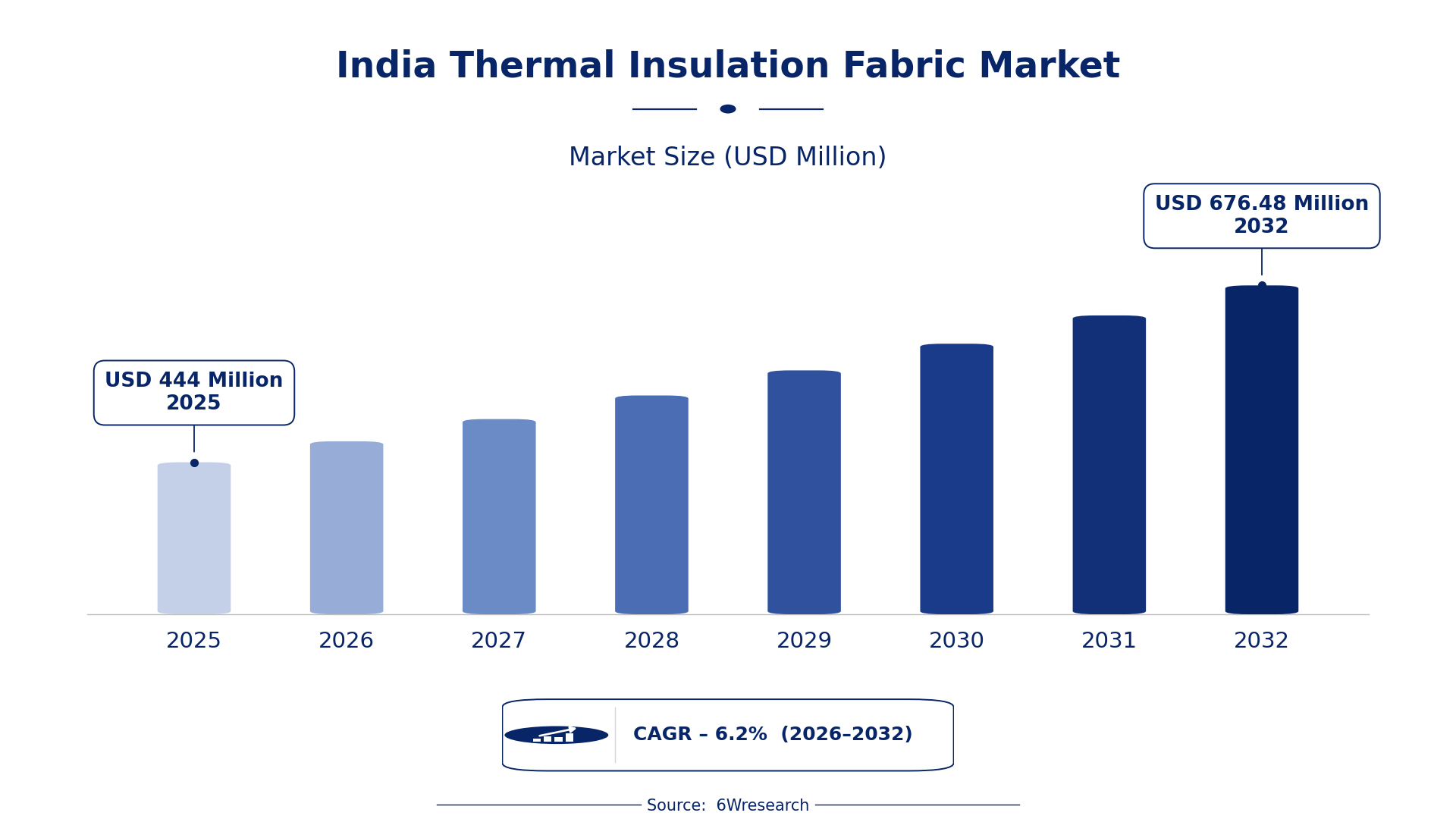
According to 6Wresearch internal database and industry insights, the India Thermal Insulation Fabric Market was valued at USD 444.0 million in 2025 and is projected to reach USD 676.48 million by 2032, growing at a CAGR of approximately 6.2% during 2026–2032.
India Thermal Insulation Fabric Market Highlights
| Report Metric | Details |
| Report Name | India Thermal Insulation Fabric Market |
| Market Size 2025 | USD 444.0 million |
| Market Size 2032 | USD 676.48 million |
| Absolute Growth 2025–2032 | USD 232.48 million |
| CAGR 2026–2032 | 6.2% |
| Peak Annual Growth | 8.6% in 2031 |
| Forecast Period | 2026–2032 |
| Historical Data | 2022–2025 |
| Base Year | 2025 |
| Leading Fabric Type, 2025 | Aramid-Based Fabrics (47% share) |
| Leading Base Material, 2025 | Nomex/Kevlar (44% share) |
| Leading End Use, 2025 | Protective Clothing (36% share) |
| Leading End User, 2025 | PPE Manufacturers (41% share) |
| Fastest-Growing Fabric Type | Silica-Based Fabrics (8.0% CAGR) |
| Fastest-Growing Base Material | Woven Silica (8.5% CAGR) |
| Fastest-Growing End Use | Welding Blankets (7.8% CAGR) |
| Fastest-Growing End User | Industrial Users (7.8% CAGR) |
| Growing Sector | Protective Clothing |
| Key End Users | PPE Manufacturers, Industrial Users, Safety Suppliers, Foundry Operators |
India Thermal Insulation Fabric Market Year-wise Growth Rate and Key Drivers (2022–2032)
This graph illustrates the annual growth rates of the market from 2022 to 2032, highlighting a steady upward trajectory and projected market expansion over the forecast period.
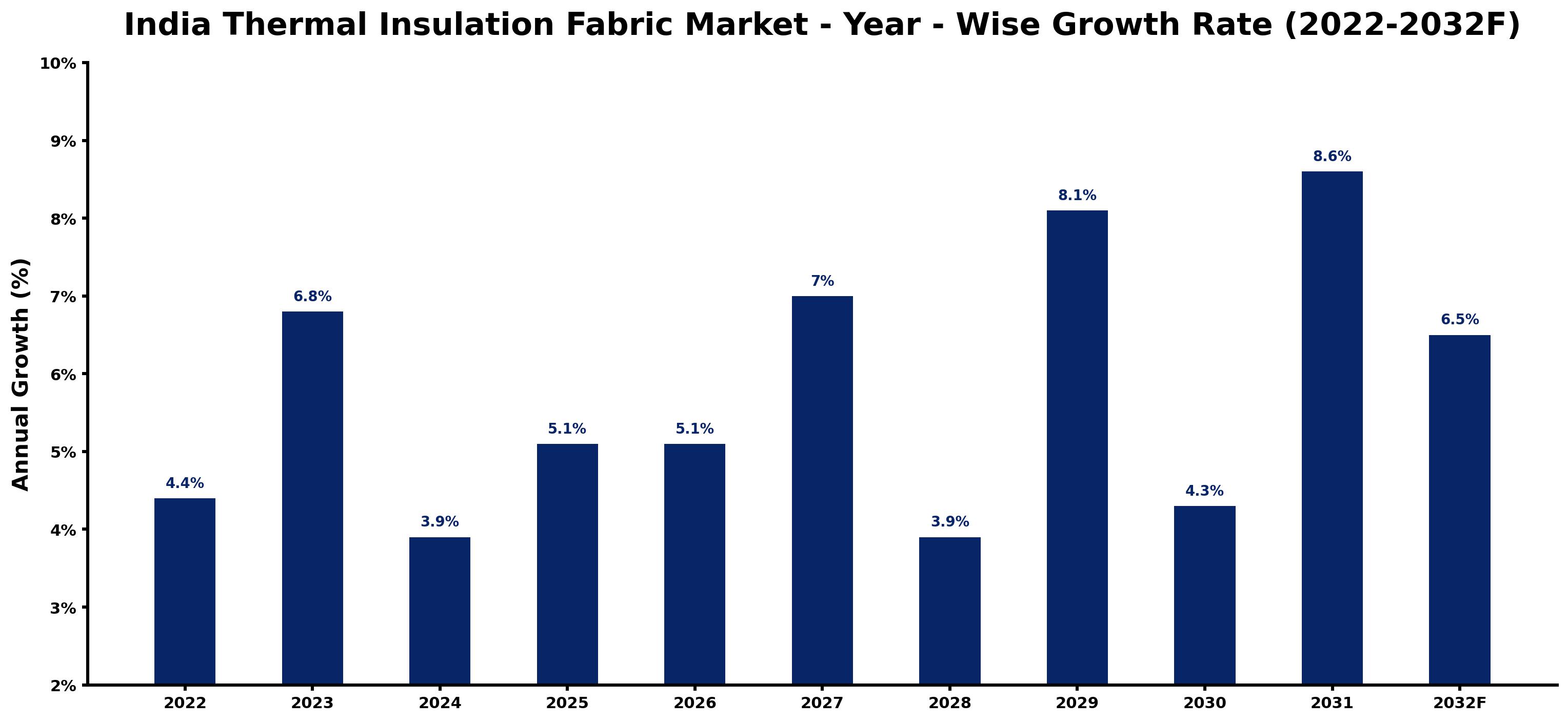
Each row of the following table gives one year's estimated growth and the event or demand shift that explains it.
| Year | Estimated Annual Growth (%) | Market Rationale |
| 2022 | 4.4 | The market experienced stable demand from the manufacturing sector, particularly for protective clothing. |
| 2023 | 6.8 | Growth accelerated due to increased investments in workplace safety initiatives and standards. |
| 2024 | 3.9 | A slowdown occurred as demand stabilised after the previous year's surge in protective clothing. |
| 2025 | 5.1 | Demand picked up again as construction activities increased, driving the need for thermal insulation fabrics. |
| 2026 | 5.1 | Growth slowed as the market adjusted to previous high levels of demand for insulation solutions. |
| 2027 | 7.0 | The market rebounded with increased industrial activity, particularly in manufacturing and construction. |
| 2028 | 3.9 | A slowdown was noted as demand normalised after the rapid growth in previous years. |
| 2029 | 8.1 | Growth surged again, driven by heightened safety regulations in industrial settings. |
| 2030 | 4.3 | The market experienced a slowdown as growth rates stabilised following previous peaks. |
| 2031 | 8.6 | Demand peaked due to significant investments in safety equipment and protective clothing. |
| 2032 | 6.5 | Growth slowed as the market reached a more mature phase, reflecting steady demand. |
Note: Market size estimations and growth projections presented in this report are based on 6Wresearch's proprietary forecasting methodology, utilizing the latest available industry data, government publications, and primary research inputs.
India Thermal Insulation Fabric Market Synopsis
The Thermal Insulation Fabric Market in India includes specialized materials designed to minimise heat transfer, such as aramid, silica, glass, and ceramic fabrics. These materials are important for applications like protective clothing, welding blankets, and fire curtains. The market is growing due to increased demand from the manufacturing sector, which employs over 250 million people, along with ongoing safety initiatives like the 'Safety at Work' initiative. Furthermore, the National Safety Council promotes the use of PPE, further boosting demand for thermal insulation fabrics in industrial applications.
Market Dynamics Impact Analysis (2026–2032)
| Factor | Type | Impact | Primary Segment Affected |
| Rising investments in workplace safety initiatives drive demand for protective clothing. | Driver | High | Protective Clothing |
| Increased construction activities create a higher need for thermal insulation solutions. | Driver | High | Welding Blankets |
| The growing focus on fire safety regulations opens opportunities for fire curtains. | Opportunity | High | Fire Curtains |
| Emerging industrial hubs in Gujarat present new market opportunities for insulation fabric suppliers. | Opportunity | Medium | Ceramic Fiber Cloth |
| Fluctuations in raw material prices can affect production costs for insulation fabrics. | Restraint | High | Aramid-Based Fabrics |
| Strict compliance with safety standards can limit market entry for new producers. | Restraint | Medium | Glass Fiber Fabrics |
| The Thermal Insulation Fabric Market in India faces challenges related to fluctuating raw material costs. | Challenge | High | Silica-Based Fabrics |
| Limited awareness among smaller manufacturers about thermal insulation benefits poses a challenge. | Challenge | Medium | Aluminized Coating |
Evaluation of Drivers in India Thermal Insulation Fabric Market (2026–2032)
The table below links each growth driver to the segment it affects and the evidence for it.
| Drivers | Primary Segment Affected | Why It Matters (Evidence) |
| Increased investments in workplace safety initiatives drive demand for protective clothing. | Protective Clothing | The Ministry of Labour and Employment's 'Safety at Work' initiative enhances workplace safety standards, boosting demand for protective gear. |
| Growing construction activities create a higher need for thermal insulation solutions. | Welding Blankets | The construction sector's expansion, particularly in Maharashtra, increases the demand for welding blankets and insulation fabrics. |
| Rising focus on fire safety regulations boosts demand for fire curtains. | Fire Curtains | India's fire safety regulations mandate the use of fire curtains in commercial buildings, increasing market demand. |
| Emerging industrial hubs in Gujarat present new market opportunities for insulation fabric suppliers. | Ceramic Fiber Cloth | Gujarat's growth as a manufacturing hub drives demand for thermal insulation fabrics across various industries. |
| The installed base of industrial furnaces exceeds 10,000 units, requiring effective insulation solutions. | Silica-Based Fabrics | The need for insulation in these furnaces creates a steady demand for silica-based thermal fabrics. |
The Thermal Insulation Fabric market in India is expanding as investments in workplace safety initiatives, increased construction activities, and rising focus on fire safety regulations drive demand. The Ministry of Labour and Employment's 'Safety at Work' initiative enhances safety standards, leading to more purchases of protective clothing. In Maharashtra, the construction sector's growth boosts the need for welding blankets and insulation solutions. Additionally, India's fire safety regulations mandate fire curtains in commercial buildings, further increasing market demand. With over 10,000 industrial furnaces installed, the requirement for effective insulation solutions remains significant.
Evaluation of Restraints in India Thermal Insulation Fabric Market
The table below lists the restraints and the evidence behind each.
| Market Restraint | Primary Segment Affected | Why It Matters (Evidence) |
| Fluctuations in raw material prices can affect production costs for insulation fabrics. | Aramid-Based Fabrics | The volatility in prices of aramid fibers can lead to increased production costs, impacting profitability by up to 20%. |
| Strict compliance with safety standards can limit market entry for new producers. | Glass Fiber Fabrics | New entrants face challenges in meeting the Bureau of Indian Standards for thermal insulation materials, which can delay market entry. |
| Limited awareness among smaller manufacturers about thermal insulation benefits hinders market growth. | Aluminized Coating | Many smaller manufacturers are unaware of the advantages of using thermal insulation fabrics, restricting market participation. |
| Competition from alternative insulation materials can constrain market growth. | Ceramic Fiber Cloth | The availability of cheaper alternatives may deter potential buyers from choosing ceramic fiber cloth, limiting market expansion. |
| High production costs associated with advanced insulation technologies can limit accessibility. | Silica-Based Fabrics | The investment required for advanced production techniques can restrict market participation, especially for smaller firms. |
India Thermal Insulation Fabric Market Challenges
The India Thermal Insulation Fabric Market faces several practical problems, beginning with regulatory compliance. The Bureau of Indian Standards mandates strict quality standards, which can delay product launches for suppliers and increase costs by up to 15%. Next, the cost of raw materials such as aramid and glass fibers has surged by 20% due to global supply chain disruptions, impacting buyers who must adjust their budgets. Technological limitations in manufacturing processes hinder the production of advanced thermal fabrics, forcing suppliers to invest heavily in upgrades that can take years to implement. Skills shortages in the workforce, worsened by insufficient training programs, lead to inefficiencies, costing manufacturers around 10% in productivity losses.
Trends in the India Thermal Insulation Fabric Market
Buyers and suppliers in the India Thermal Insulation Fabric Market are adjusting to the following trends.
- Shift from Traditional to Advanced Insulation Materials: Since 2022, manufacturers have increasingly adopted advanced thermal insulation materials to comply with safety standards. The Bureau of Indian Standards promotes these new materials, resulting in a 15% rise in adoption among industrial users.
- Emergence of Smart Fabrics in Thermal Insulation: In 2023, the introduction of smart fabrics that adapt to temperature changes began to gain traction. This innovation is expected to boost efficiency in protective clothing applications by 20%.
- Focus on Sustainable Materials in Insulation Fabric Production: Beginning in 2024, there has been a notable shift towards sustainable materials in the production of thermal insulation fabrics. This change aligns with the 'Make in India' initiative, which has allocated INR 500 crore for safety equipment development.
- Increased Integration of Automation in Manufacturing: Since 2025, automation in the manufacturing of thermal insulation fabrics has been on the rise. This shift is projected to improve production efficiency by 30%, particularly in high-demand regions like Gujarat.
Investment Opportunities in the India Thermal Insulation Fabric Market
Some of the investment opportunities in the India Thermal Insulation Fabric Market are mentioned below.
- Growing Demand for Protective Clothing: With the manufacturing sector employing over 250 million people, there is an opportunity to supply protective clothing. This demand is expected to rise as safety regulations tighten, especially in Maharashtra.
- Expansion of the Construction Sector: The ongoing growth in the construction sector, projected to reach $223 billion, creates a need for thermal insulation solutions. Suppliers can enter this market by collaborating with construction firms in Gujarat.
- Investment in Fire Safety Equipment: The Indian government's allocation of INR 500 crore for safety equipment development under the 'Make in India' initiative presents a significant opportunity. Suppliers can target PPE manufacturers to meet the rising demand.
- Emerging Industrial Hubs: As Gujarat emerges as a hub for thermal insulation fabric manufacturing, there is an opportunity for suppliers to establish partnerships with local manufacturers to meet growing demand.
Government Initiatives in the India Thermal Insulation Fabric Market
The Bureau of Indian Standards (BIS) sets quality standards for thermal insulation materials, ensuring that producers comply with safety requirements. This regulation builds buyer confidence in the quality of insulation fabrics available in the market. The implementation of ISO 11612, a key standard for protective clothing, further supports the industry by establishing uniform safety criteria for manufacturers. In 2022, the Ministry of Labour and Employment allocated INR 500 crore to enhance workplace safety, which directly benefits producers and buyers of thermal insulation fabrics. This funding aims to improve safety standards across various sectors, promoting the adoption of protective gear.
The Ministry of Labour and Employment funds initiatives that promote workplace safety, including the 'Safety at Work' programme. This initiative encourages the use of PPE, including thermal insulation fabrics, in industrial settings. The National Safety Council of India also plays a key role in approving safety standards and guidelines that affect the production and use of thermal insulation fabrics. In 2023, the Council approved new guidelines that enhance the safety of workers in high-temperature environments, further driving demand for insulation materials.
Future Insight of the India Thermal Insulation Fabric Market
The Thermal Insulation Fabric Market in India will undergo significant changes by 2032, primarily driven by advancements in manufacturing technology. The 'Make in India' initiative will improve local production capabilities, allowing suppliers to meet increasing demand more effectively. The implementation of ISO 11612 standards will ensure higher quality and safety in protective clothing, benefiting both buyers and suppliers. The focus on workplace safety, supported by the 'Safety at Work' initiative, will lead to greater adoption of thermal insulation fabrics across various industries, including automotive and aerospace.
Market Segmentation Analysis
The report offers a comprehensive study of the following market segments and their leading categories in the market.
By Fabric Type – Aramid-Based Fabrics Dominated, Silica-Based Fabrics Expected to Grow Fastest
According to Vasudha, AM at 6Wresearch, Aramid-Based Fabrics held a 47% share of the India Thermal Insulation Fabric Market by fabric type in 2025. Aramid-based fabrics dominate the market because they are essential for protective clothing in high-temperature environments, particularly within the manufacturing industry. Their established reliability in safety gear contributes to a strong market share in India. The quickest growth will come from Silica-Based Fabrics, forecast to expand at a CAGR of 8.0% between 2026 and 2032. Silica-based fabrics are experiencing rapid growth, largely driven by their rising application in industrial insulation and fire protection, which aligns with the increasing focus on safety standards. As industries adopt stricter safety measures, this trend is expected to accelerate further. Suppliers must ensure a steady supply of silica-based fabrics to cater to the growing demand for enhanced safety measures in industrial applications.
By Base Material – Nomex/Kevlar Dominated, Woven Silica Expected to Grow Fastest
Nomex/Kevlar took a 44% share of base material in 2025, more than any other category. Nomex/Kevlar leads the base material segment as they are integral in manufacturing protective clothing for hazardous environments, ensuring worker safety across various industries. Their proven effectiveness in high-risk settings solidifies their market share. Over 2026–2032, Woven Silica is expected to post the fastest growth, at a CAGR of 8.5%. Woven silica is the fastest-growing base material, primarily due to its critical role in insulation for industrial equipment and processes, which is increasingly vital as industries modernise. This growth reflects the heightened focus on efficiency and safety in manufacturing. Manufacturers should prioritise the development of woven silica products to meet the rising demand from modern industrial applications.
By End Use – Protective Clothing Dominated, Welding Blankets Expected to Grow Fastest
The largest end use category in 2025 was Protective Clothing, with a 36% share of total revenue. Protective clothing commands the largest market share as it is vital for ensuring the safety of workers in high-temperature industries, aligning with regulatory compliance. The heightened focus on workplace safety standards further reinforces its dominant position. Welding Blankets are projected to grow fastest, at a CAGR of 7.8% during 2026–2032. Welding blankets are experiencing the fastest growth, driven by heightened safety requirements during welding operations, especially in the expanding construction and manufacturing sectors. This shift indicates a broader commitment to safety in these industries. Suppliers need to scale up production of welding blankets to address the increasing safety demands in construction and manufacturing.
By End User – PPE Manufacturers Dominated, Industrial Users Expected to Grow Fastest
In 2025, PPE Manufacturers led the end user split with a 41% share. PPE manufacturers hold the largest market share as they are the primary users of thermal insulation fabrics for safety equipment across various sectors. Their continuous demand for reliable protective gear solidifies their position in the market. Industrial Users are set to record the highest CAGR in this split, 7.8% over 2026–2032. Industrial users represent the fastest-growing segment, significantly consuming thermal insulation fabrics in manufacturing and processing sectors, which reflects the overall growth of these industries. This trend indicates a heightened need for effective insulation solutions in operational environments. Suppliers should tailor their offerings to meet the specific needs of industrial users, ensuring they provide effective insulation solutions that align with industry requirements.
Key Attractiveness of the Report
- 10 Years of Market Numbers
- Historical Data Starting from 2022 to 2025
- Base Year 2025
- Forecast Data until 2032
- Key Performance Indicators Impacting the Market
- Major Upcoming Developments and Projects
Key Highlights of the Report:
- India Thermal Insulation Fabric Market Outlook
- Market Size of India Thermal Insulation Fabric Market, 2025
- Forecast of India Thermal Insulation Fabric Market, 2032
- Historical Data and Forecast of India Thermal Insulation Fabric Revenues & Volume for the Period 2022 - 2032F
- India Thermal Insulation Fabric Market Trend Evolution
- India Thermal Insulation Fabric Market Drivers and Challenges
- India Thermal Insulation Fabric Price Trends
- India Thermal Insulation Fabric Porter's Five Forces
- India Thermal Insulation Fabric Industry Life Cycle
- Historical Data and Forecast of India Thermal Insulation Fabric Market Revenues & Volume By Fabric Type for the Period 2022 - 2032F
- Historical Data and Forecast of India Thermal Insulation Fabric Market Revenues & Volume By Aramid-Based Fabrics for the Period 2022 - 2032F
- Historical Data and Forecast of India Thermal Insulation Fabric Market Revenues & Volume By Silica-Based Fabrics for the Period 2022 - 2032F
- Historical Data and Forecast of India Thermal Insulation Fabric Market Revenues & Volume By Glass Fiber Fabrics for the Period 2022 - 2032F
- Historical Data and Forecast of India Thermal Insulation Fabric Market Revenues & Volume By Ceramic Fiber Cloth for the Period 2022 - 2032F
- Historical Data and Forecast of India Thermal Insulation Fabric Market Revenues & Volume By Base Material for the Period 2022 - 2032F
- Historical Data and Forecast of India Thermal Insulation Fabric Market Revenues & Volume By Nomex/Kevlar for the Period 2022 - 2032F
- Historical Data and Forecast of India Thermal Insulation Fabric Market Revenues & Volume By Woven Silica for the Period 2022 - 2032F
- Historical Data and Forecast of India Thermal Insulation Fabric Market Revenues & Volume By Aluminized Coating for the Period 2022 - 2032F
- Historical Data and Forecast of India Thermal Insulation Fabric Market Revenues & Volume By Heat Shields for the Period 2022 - 2032F
- Historical Data and Forecast of India Thermal Insulation Fabric Market Revenues & Volume By End Use for the Period 2022 - 2032F
- Historical Data and Forecast of India Thermal Insulation Fabric Market Revenues & Volume By Protective Clothing for the Period 2022 - 2032F
- Historical Data and Forecast of India Thermal Insulation Fabric Market Revenues & Volume By Welding Blankets for the Period 2022 - 2032F
- Historical Data and Forecast of India Thermal Insulation Fabric Market Revenues & Volume By Fire Curtains for the Period 2022 - 2032F
- Historical Data and Forecast of India Thermal Insulation Fabric Market Revenues & Volume By Furnace Sealing for the Period 2022 - 2032F
- Historical Data and Forecast of India Thermal Insulation Fabric Market Revenues & Volume By End User for the Period 2022 - 2032F
- Historical Data and Forecast of India Thermal Insulation Fabric Market Revenues & Volume By PPE Manufacturers for the Period 2022 - 2032F
- Historical Data and Forecast of India Thermal Insulation Fabric Market Revenues & Volume By Industrial Users for the Period 2022 - 2032F
- Historical Data and Forecast of India Thermal Insulation Fabric Market Revenues & Volume By Safety Suppliers for the Period 2022 - 2032F
- Historical Data and Forecast of India Thermal Insulation Fabric Market Revenues & Volume By Foundry Operators for the Period 2022 - 2032F
- India Thermal Insulation Fabric Import Export Trade Statistics
- Market Opportunity Assessment By Fabric Type
- Market Opportunity Assessment By Base Material
- Market Opportunity Assessment By End Use
- Market Opportunity Assessment By End User
- India Thermal Insulation Fabric Top Companies Market Share
- India Thermal Insulation Fabric Competitive Benchmarking By Technical and Operational Parameters
- India Thermal Insulation Fabric Company Profiles
- India Thermal Insulation Fabric Key Strategic Recommendations
Market Covered
The report offers an extensive study of the following market segments.
By Fabric Type
- Aramid-Based Fabrics
- Silica-Based Fabrics
- Glass Fiber Fabrics
- Ceramic Fiber Cloth
By Base Material
- Nomex/Kevlar
- Woven Silica
- Aluminized Coating
- Heat Shields
By End Use
- Protective Clothing
- Welding Blankets
- Fire Curtains
- Furnace Sealing
By End User
- PPE Manufacturers
- Industrial Users
- Safety Suppliers
- Foundry Operators































