India Thermal Management Control Unit Market Size & Growth Rate
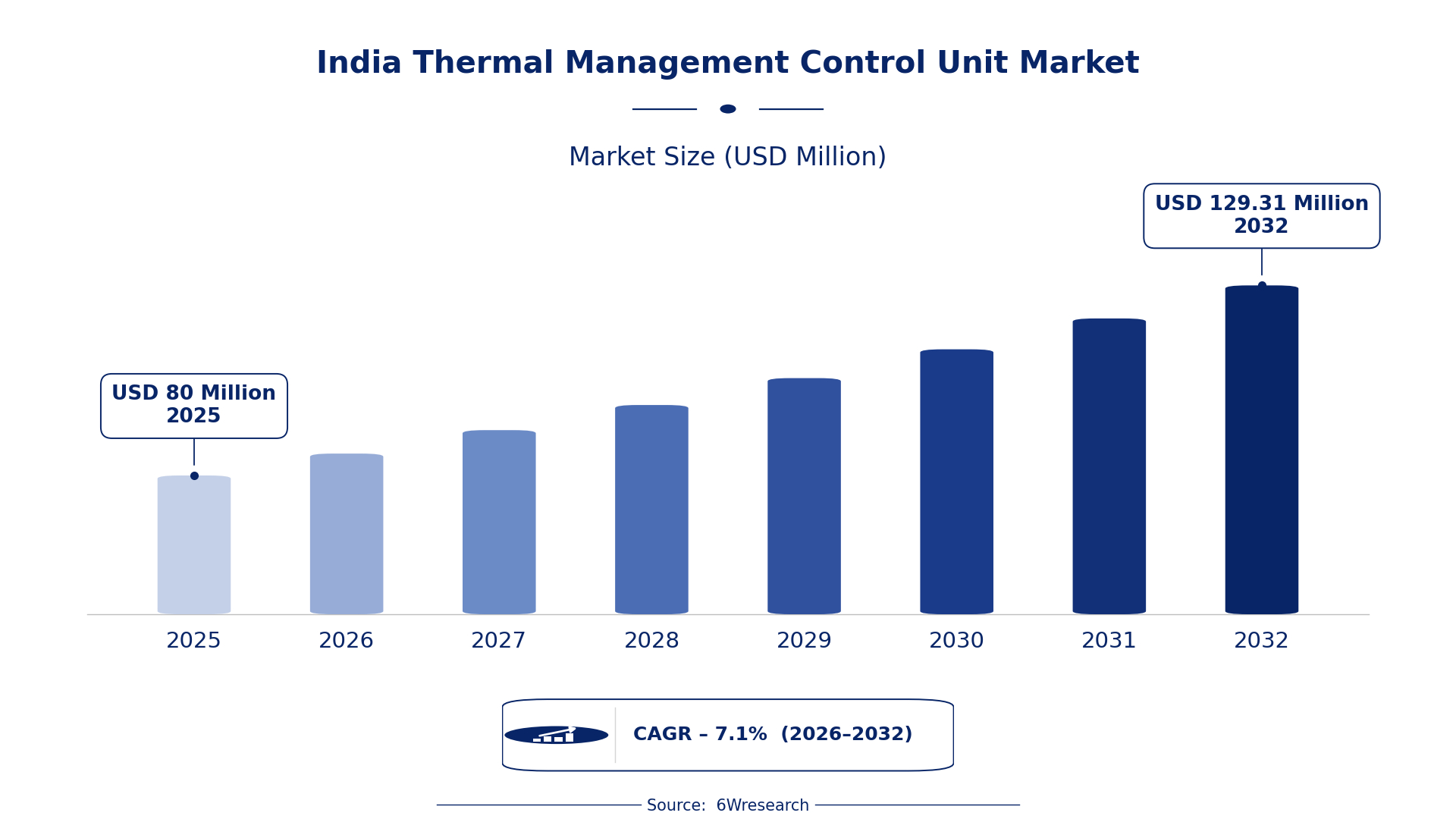
According to 6Wresearch internal database and industry insights, the India Thermal Management Control Unit Market was valued at USD 80.0 million in 2025 and is projected to reach USD 129.31 million by 2032, growing at a CAGR of approximately 7.1% during 2026–2032.
India Thermal Management Control Unit Market Highlights
| Report Metric | Details |
| Report Name | India Thermal Management Control Unit Market |
| Market Size 2025 | USD 80.0 million |
| Market Size 2032 | USD 129.31 million |
| Absolute Growth 2025–2032 | USD 49.31 million |
| CAGR 2026–2032 | 7.1% |
| Peak Annual Growth | 9.7% in 2027 |
| Forecast Period | 2026–2032 |
| Historical Data | 2022–2025 |
| Base Year | 2025 |
| Leading Thermal Management Control Unit, 2025 | Engine Heat Management (43% share) |
| Leading Product Type, 2025 | Thermostat Units (44% share) |
| Leading Control Method, 2025 | On-Board Control (52% share) |
| Leading Distribution Channel, 2025 | OEM Suppliers (50% share) |
| Leading End User Industry, 2025 | Passenger Vehicles (41% share) |
| Fastest-Growing Thermal Management Control Unit | HVAC Climate Control (9.3% CAGR) |
| Fastest-Growing Product Type | BMS Heat Controllers (8.8% CAGR) |
| Fastest-Growing Distribution Channel | Aftermarket Dealers (9.3% CAGR) |
| Fastest-Growing End User Industry | EV Manufacturers (9.0% CAGR) |
| Growing Sector | Electric Vehicles |
| Key End Users | Automotive manufacturers, Data center operators, Electric vehicle manufacturers, IT service providers |
India Thermal Management Control Unit Market Year-wise Growth Rate and Key Drivers (2022–2032)
This graph illustrates the annual growth rates of the market from 2022 to 2032, highlighting a steady upward trajectory and projected market expansion over the forecast period.
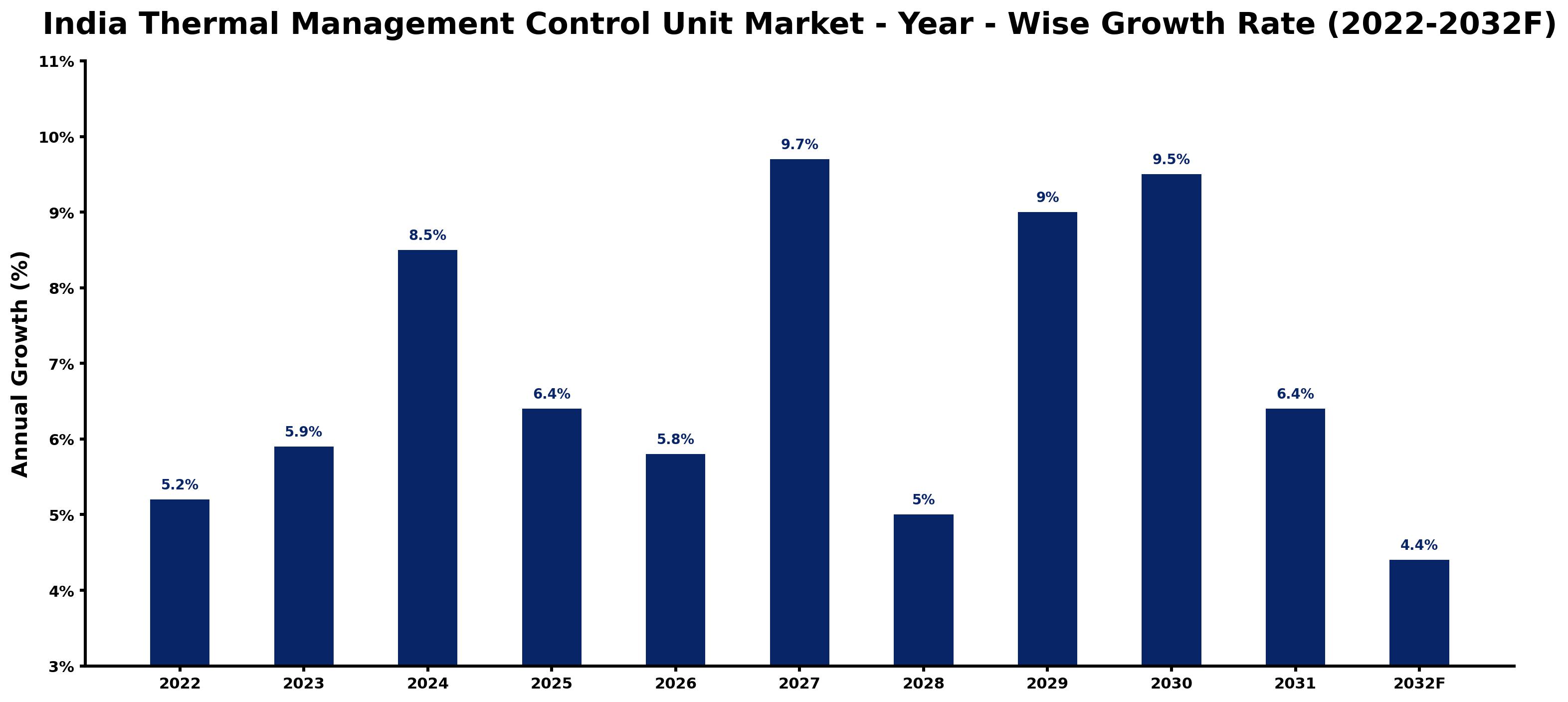
Year by year, the estimates below pair each growth rate with the development that shaped it.
| Year | Estimated Annual Growth (%) | Market Rationale |
| 2022 | 5.2 | The market showed steady demand from the automotive sector, particularly for engine heat management solutions. |
| 2023 | 5.9 | Growth accelerated due to increased vehicle production and rising interest in electric vehicles. |
| 2024 | 8.5 | The market experienced strong demand driven by the adoption of advanced thermal management technologies. |
| 2025 | 6.4 | Growth slowed as manufacturers adjusted to evolving standards in thermal management systems. |
| 2026 | 5.8 | Demand is expected to rise, supported by the Faster Adoption and Manufacturing of Hybrid and Electric Vehicles (FAME II) scheme. |
| 2027 | 9.7 | The market is projected to peak with heightened investments in battery thermal control technologies for electric vehicles. |
| 2028 | 5.0 | Growth is expected to moderate as the Bureau of Energy Efficiency's Energy Conservation Building Code 2022 stabilises the market. |
| 2029 | 9.0 | Demand is projected to surge again, driven by the expanding electric vehicle market and data center cooling needs. |
| 2030 | 9.5 | The market will maintain momentum with ongoing investments in thermal management technologies across sectors. |
| 2031 | 6.4 | Growth is expected to slow as the market begins to normalise after several years of rapid expansion. |
| 2032 | 4.4 | The market is projected to grow at a reduced rate as competition and technology developments balance out. |
Note: Market size estimations and growth projections presented in this report are based on 6Wresearch's proprietary forecasting methodology, utilizing the latest available industry data, government publications, and primary research inputs.
India Thermal Management Control Unit Market Synopsis
The Thermal Management Control Unit in India regulates temperature in automotive and data center applications. This technology includes managing engine temperatures and ensuring optimal climate control in vehicles. The India Thermal Management Control Unit Market is expanding due to increasing vehicle production, with over 4.4 million vehicles manufactured in 2022, and the National Electric Mobility Mission Plan promoting electric vehicle adoption. The IT sector is projected to grow to $350 billion by 2025, driving demand for cooling solutions in data centers.
Market Dynamics Impact Analysis (2026–2032)
| Factor | Type | Impact | Primary Segment Affected |
| Increasing vehicle production and the rise of electric vehicles drive demand for thermal management solutions. | Driver | High | Engine Heat Management |
| The growing number of data centers necessitates advanced cooling technologies to prevent overheating. | Driver | High | Data Center Cooling Units |
| The gap in energy-efficient thermal management solutions presents a significant investment opportunity. | Opportunity | High | HVAC Climate Control |
| The rising demand for electric vehicles creates a need for advanced battery thermal control units. | Opportunity | High | Battery Thermal Control |
| High costs associated with advanced thermal management technologies may limit adoption among smaller manufacturers. | Restraint | High | Engine Heat Management |
| The complexity of integrating new thermal management systems can delay implementation in existing vehicles. | Restraint | Medium | Engine Heat Management |
| The Thermal Management Control Unit market in India faces challenges related to high production costs. | Challenge | High | Engine Heat Management |
| Competition from international suppliers can hinder local manufacturers' market share. | Challenge | Medium | Engine Heat Management |
Evaluation of Drivers in India Thermal Management Control Unit Market (2026–2032)
Key forces behind demand, with the segment each one moves most, are listed below.
| Drivers | Primary Segment Affected | Why It Matters (Evidence) |
| Rising vehicle production in India fuels demand for engine heat management solutions. | Engine Heat Management | India's automotive sector produced over 4.4 million vehicles in 2022, increasing the need for efficient thermal management. |
| The expansion of the IT sector drives demand for advanced cooling technologies in data centers. | Data Center Cooling Units | With over 1,000 data centers operational, the need for effective cooling solutions has surged. |
| The National Electric Mobility Mission Plan promotes electric vehicle adoption, increasing battery thermal control needs. | Battery Thermal Control | This initiative aims to support EV infrastructure, boosting demand for thermal management technologies. |
| The Bureau of Energy Efficiency's standards for cooling systems impact thermal management practices. | HVAC Climate Control | Compliance with energy-efficient standards encourages manufacturers to adopt advanced thermal management solutions. |
| The Automotive Mission Plan 2026 aims to position India as a global automotive hub, driving innovation. | Engine Heat Management | This plan emphasises the importance of thermal management in improving vehicle performance. |
The Thermal Management Control Unit market in India is growing due to rising vehicle production, expanding data center operations, and the push for electric vehicles. India's automotive sector produced over 4.4 million vehicles in 2022, driving demand for efficient thermal management solutions. Additionally, over 1,000 data centers are operational, necessitating advanced cooling technologies to prevent overheating. The National Electric Mobility Mission Plan is expected to boost demand for battery thermal control units. Compliance with energy-efficient standards is prompting manufacturers to adopt new solutions to meet requirements.
Evaluation of Restraints in India Thermal Management Control Unit Market
The main factors holding the market back are set out below.
| Market Restraint | Primary Segment Affected | Why It Matters (Evidence) |
| High costs associated with advanced thermal management technologies may limit adoption among smaller manufacturers. | Engine Heat Management | The initial investment for advanced systems can be prohibitive for many local manufacturers. |
| The complexity of integrating new thermal management systems can delay implementation in existing vehicles. | Engine Heat Management | Manufacturers face challenges in retrofitting existing vehicles with new technologies. |
| Competition from international suppliers can hinder local manufacturers' market share. | Engine Heat Management | Local manufacturers struggle to compete with established international brands offering advanced solutions. |
| Regulatory compliance can increase operational costs for manufacturers. | Engine Heat Management | Meeting stringent standards requires investment in testing and certification processes. |
| Limited awareness among smaller manufacturers about the benefits of thermal management technologies. | Engine Heat Management | This lack of awareness can slow the adoption of advanced thermal management solutions. |
India Thermal Management Control Unit Market Challenges
The India Thermal Management Control Unit market faces practical problems, starting with supply chain disruptions. Many producers rely on imported components, which can delay production timelines for automotive manufacturers and data centers, leading to project overruns. Competition is intense as local manufacturers struggle to match the quality and pricing of imported units, resulting in a potential loss of market share for domestic suppliers. Rising raw material costs, driven by global fluctuations, are forcing buyers to reconsider budgets, with some reporting increases of up to 15% in procurement expenses. Regulatory standards like ISO 50001 necessitate compliance that can slow down the adoption of new technologies, impacting timelines for both automotive and IT sectors.
Trends in the India Thermal Management Control Unit Market
Four trends stand out in the India Thermal Management Control Unit Market.
- Shift towards Energy-Efficient Cooling Standards: The Bureau of Energy Efficiency's Energy Conservation Building Code 2022 mandates energy-efficient cooling systems in commercial buildings. This shift impacts thermal management standards across the industry, with many companies adopting ISO 50001 for energy management.
- Increased Focus on Electric Vehicle Thermal Management: The National Electric Mobility Mission Plan is driving the need for advanced battery thermal control units in electric vehicles. This is reflected in the growing demand, with projections indicating a rise in EV production by 2025.
- Expansion of Data Center Operations: India's IT sector is expected to grow to $350 billion by 2025, leading to increased demand for data center cooling solutions. This trend necessitates the adoption of advanced thermal management technologies to ensure operational efficiency.
- Rising Demand for Smart Thermal Management Solutions: The automotive industry is increasingly adopting smart thermal management technologies for improved performance. This trend is reflected in the growing focus on integrating advanced sensors and controls in vehicles.
Investment Opportunities in the India Thermal Management Control Unit Market
Investors looking at the India Thermal Management Control Unit Market should consider the following areas.
- Gap in Energy-Efficient Thermal Management Solutions: With the Bureau of Energy Efficiency's standards driving demand, there is a gap for energy-efficient thermal management solutions. Suppliers can target OEMs and aftermarket dealers to meet this need, particularly in the automotive sector.
- Investment in Battery Thermal Control Technologies: The National Electric Mobility Mission Plan is creating opportunities for investment in battery thermal control technologies. EV manufacturers are seeking advanced solutions, presenting a chance for local suppliers to partner with them.
- Growing Demand for Data Center Cooling Solutions: The expansion of the IT sector, projected to reach $350 billion by 2025, creates a need for advanced cooling technologies. Suppliers can enter this market by collaborating with data center operators to provide tailored solutions.
- Emerging Market for Smart Thermal Management Systems: As the automotive industry shifts towards smart technologies, there is a demand for advanced thermal management systems. Suppliers can invest in R&D to develop solutions that cater to this emerging market.
Government Initiatives in the India Thermal Management Control Unit Market
The National Electric Mobility Mission Plan 2021 aims to promote electric vehicle adoption with a budget of ₹10,000 crores, driving the need for battery thermal control units. This initiative supports the growth of the electric vehicle market in India, increasing demand for efficient thermal management solutions. The Automotive Mission Plan 2026 emphasises the importance of thermal management in vehicles, positioning India as a global automotive hub. This plan encourages investment in advanced thermal management technologies, further boosting market growth.
The Bureau of Energy Efficiency oversees the implementation of energy-efficient standards for cooling systems. Their Energy Conservation Building Code 2022 mandates compliance for commercial buildings, impacting thermal management practices across sectors. The Ministry of Electronics and Information Technology promotes thermal management technologies through the National Policy on Electronics 2020, which supports innovation in IT manufacturing. These measures collectively increase the demand for advanced thermal management solutions, ensuring compliance and efficiency in various applications.
Future Insight of the India Thermal Management Control Unit Market
Several forward-looking factors should support the India Thermal Management Control Unit market over the coming years. The National Electric Mobility Mission Plan will increase demand for advanced cooling solutions as electric vehicle adoption accelerates. The IT sector is set to expand, necessitating enhanced cooling technologies for data centers. The Bureau of Energy Efficiency's standards for energy-efficient cooling systems will stimulate innovation among suppliers, while the Faster Adoption and Manufacturing of Hybrid and Electric Vehicles scheme will strengthen infrastructure for thermal management in vehicles.
Market Segmentation Analysis
The analysis below covers each segmentation, its leading category in 2025 and its fastest-growing category through 2032.
By Thermal Management Control Unit – Engine Heat Management Dominated, HVAC Climate Control Expected to Grow Fastest
According to Vasudha, AM at 6Wresearch, with a 43% revenue share in 2025, Engine Heat Management was the largest thermal management control unit category. Engine heat management holds the largest share as it is crucial for maintaining optimal engine performance and efficiency in vehicles. With over 4.4 million vehicles produced in India in 2022, the demand for effective thermal solutions is vital for automotive manufacturers. The quickest growth will come from HVAC Climate Control, forecast to expand at a CAGR of 9.3% between 2026 and 2032. HVAC climate control is experiencing rapid growth due to its essential role in ensuring passenger comfort, especially with the rise of electric vehicles. The National Electric Mobility Mission Plan is significantly increasing the demand for advanced climate control solutions in this sector. Suppliers should focus on developing advanced HVAC solutions to meet the rising demand in the automotive sector.
By Product Type – Thermostat Units Dominated, BMS Heat Controllers Expected to Grow Fastest
Thermostat Units held a 44% share of the India Thermal Management Control Unit Market by product type in 2025. Thermostat units hold the largest market share as they are fundamental for temperature regulation in various systems, including automotive and data centers. Their critical role in maintaining operational efficiency drives consistent demand from manufacturers across multiple sectors. Over 2026–2032, BMS Heat Controllers are expected to post the fastest growth, at a CAGR of 8.8%. BMS heat controllers are experiencing rapid growth due to their essential function in battery management systems for electric vehicles. As the EV sector expands, the urgency for effective thermal management in batteries is becoming increasingly pronounced. Manufacturers must focus on developing BMS heat controllers to take advantage of the growing electric vehicle market.
By Control Method – On-Board Control Dominated and Is Expected to Record the Fastest Growth
The largest control method category in 2025 was On-Board Control, with a 52% share of total revenue. On-board control leads the market as it is essential for real-time temperature management in vehicles, ensuring optimal performance and safety. This method is widely adopted across various automotive applications, solidifying its dominant position in the market. Its lead should widen, with a projected CAGR of 8.9% during 2026–2032, the highest in this split. On-board control is also the fastest-growing method, as its efficiency in managing temperatures aligns with the increasing complexity of modern vehicles. As automotive technology advances, the demand for real-time control will intensify, further widening its lead. Suppliers should invest in enhancing on-board control technologies to stay competitive in the automotive market.
By Distribution Channel – OEM Suppliers Dominated, Aftermarket Dealers Expected to Grow Fastest
OEM Suppliers accounted for a 50% market share by distribution channel in 2025. OEM suppliers capture the largest market share as they are the primary source for manufacturers seeking thermal management solutions. Their established relationships with automotive producers ensure a steady demand for thermal management control units. Aftermarket Dealers are projected to grow fastest, at a CAGR of 9.3% during 2026–2032. Aftermarket dealers are experiencing the fastest growth as vehicle owners increasingly seek replacements and upgrades for thermal management systems. This trend is driven by the growing awareness of the importance of effective thermal management in vehicle performance. Suppliers should consider strengthening partnerships with aftermarket dealers to tap into this expanding market segment.
By End User Industry – Passenger Vehicles Dominated, EV Manufacturers Expected to Grow Fastest
In 2025, Passenger Vehicles led the end user industry split with a 41% share. Passenger vehicles account for the largest share of the market, being the primary application area for thermal management technologies. The significant volume of vehicle production and the ongoing need for efficient thermal solutions in this sector drive substantial demand. The quickest growth will come from EV Manufacturers, forecast to expand at a CAGR of 9.0% between 2026 and 2032. EV manufacturers are the fastest-growing segment due to the surge in electric vehicle adoption and their specific thermal management needs. As the automotive industry transitions towards electrification, this segment's growth will accelerate, further boosting its market share. Suppliers should concentrate on developing tailored thermal management solutions for EV manufacturers to capitalise on this growth opportunity.
Key Attractiveness of the Report
- 10 Years of Market Numbers
- Historical Data Starting from 2022 to 2025
- Base Year 2025
- Forecast Data until 2032
- Key Performance Indicators Impacting the Market
- Major Upcoming Developments and Projects
Key Highlights of the Report:
- India Thermal Management Control Unit Market Outlook
- Market Size of India Thermal Management Control Unit Market, 2025
- Forecast of India Thermal Management Control Unit Market, 2032
- Historical Data and Forecast of India Thermal Management Control Unit Revenues & Volume for the Period 2022 - 2032F
- India Thermal Management Control Unit Market Trend Evolution
- India Thermal Management Control Unit Market Drivers and Challenges
- India Thermal Management Control Unit Price Trends
- India Thermal Management Control Unit Porter's Five Forces
- India Thermal Management Control Unit Industry Life Cycle
- Historical Data and Forecast of India Thermal Management Control Unit Market Revenues & Volume By Thermal Management Control Unit for the Period 2022 - 2032F
- Historical Data and Forecast of India Thermal Management Control Unit Market Revenues & Volume By Engine Heat Management for the Period 2022 - 2032F
- Historical Data and Forecast of India Thermal Management Control Unit Market Revenues & Volume By HVAC Climate Control for the Period 2022 - 2032F
- Historical Data and Forecast of India Thermal Management Control Unit Market Revenues & Volume By Battery Thermal Control for the Period 2022 - 2032F
- Historical Data and Forecast of India Thermal Management Control Unit Market Revenues & Volume By Data Center Cooling Units for the Period 2022 - 2032F
- Historical Data and Forecast of India Thermal Management Control Unit Market Revenues & Volume By Product Type for the Period 2022 - 2032F
- Historical Data and Forecast of India Thermal Management Control Unit Market Revenues & Volume By Thermostat Units for the Period 2022 - 2032F
- Historical Data and Forecast of India Thermal Management Control Unit Market Revenues & Volume By Climate Units for the Period 2022 - 2032F
- Historical Data and Forecast of India Thermal Management Control Unit Market Revenues & Volume By BMS Heat Controllers for the Period 2022 - 2032F
- Historical Data and Forecast of India Thermal Management Control Unit Market Revenues & Volume By Rack-Based Cooling for the Period 2022 - 2032F
- Historical Data and Forecast of India Thermal Management Control Unit Market Revenues & Volume By Control Method for the Period 2022 - 2032F
- Historical Data and Forecast of India Thermal Management Control Unit Market Revenues & Volume By On-Board Control for the Period 2022 - 2032F
- Historical Data and Forecast of India Thermal Management Control Unit Market Revenues & Volume By Electro-Thermal for the Period 2022 - 2032F
- Historical Data and Forecast of India Thermal Management Control Unit Market Revenues & Volume By Coolant Recirculation for the Period 2022 - 2032F
- Historical Data and Forecast of India Thermal Management Control Unit Market Revenues & Volume By Active Module Cooling for the Period 2022 - 2032F
- Historical Data and Forecast of India Thermal Management Control Unit Market Revenues & Volume By Distribution Channel for the Period 2022 - 2032F
- Historical Data and Forecast of India Thermal Management Control Unit Market Revenues & Volume By OEM Suppliers for the Period 2022 - 2032F
- Historical Data and Forecast of India Thermal Management Control Unit Market Revenues & Volume By Aftermarket Dealers for the Period 2022 - 2032F
- Historical Data and Forecast of India Thermal Management Control Unit Market Revenues & Volume By Direct Integration for the Period 2022 - 2032F
- Historical Data and Forecast of India Thermal Management Control Unit Market Revenues & Volume By IT Equipment Vendors for the Period 2022 - 2032F
- Historical Data and Forecast of India Thermal Management Control Unit Market Revenues & Volume By End User Industry for the Period 2022 - 2032F
- Historical Data and Forecast of India Thermal Management Control Unit Market Revenues & Volume By Passenger Vehicles for the Period 2022 - 2032F
- Historical Data and Forecast of India Thermal Management Control Unit Market Revenues & Volume By Commercial Vehicles for the Period 2022 - 2032F
- Historical Data and Forecast of India Thermal Management Control Unit Market Revenues & Volume By EV Manufacturers for the Period 2022 - 2032F
- Historical Data and Forecast of India Thermal Management Control Unit Market Revenues & Volume By Server/Data Centers for the Period 2022 - 2032F
- India Thermal Management Control Unit Import Export Trade Statistics
- Market Opportunity Assessment By Thermal Management Control Unit
- Market Opportunity Assessment By Product Type
- Market Opportunity Assessment By Control Method
- Market Opportunity Assessment By Distribution Channel
- Market Opportunity Assessment By End User Industry
- India Thermal Management Control Unit Top Companies Market Share
- India Thermal Management Control Unit Competitive Benchmarking By Technical and Operational Parameters
- India Thermal Management Control Unit Company Profiles
- India Thermal Management Control Unit Key Strategic Recommendations
Market Covered
Segments analysed in this report are listed below.
By Thermal Management Control Unit
- Engine Heat Management
- HVAC Climate Control
- Battery Thermal Control
- Data Center Cooling Units
By Product Type
- Thermostat Units
- Climate Units
- BMS Heat Controllers
- Rack-Based Cooling
By Control Method
- On-Board Control
- Electro-Thermal
- Coolant Recirculation
- Active Module Cooling
By Distribution Channel
- OEM Suppliers
- Aftermarket Dealers
- Direct Integration
- IT Equipment Vendors
By End User Industry
- Passenger Vehicles
- Commercial Vehicles
- EV Manufacturers
- Server/Data Centers































