India Thermosetting Resins Market Size & Growth Rate
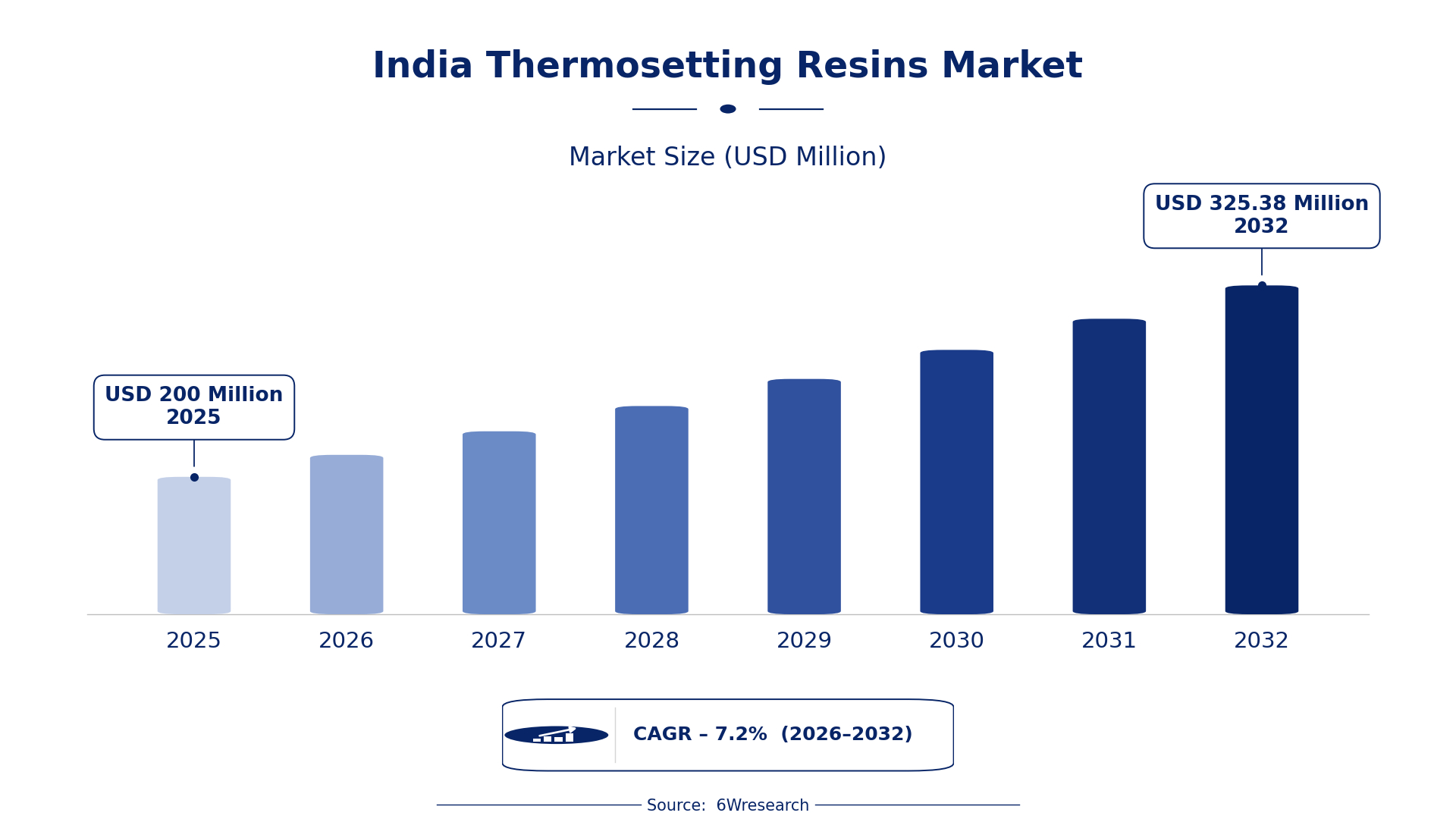
According to 6Wresearch internal database and industry insights, the India Thermosetting Resins Market was valued at USD 200.0 million in 2025 and is projected to reach USD 325.38 million by 2032, growing at a CAGR of approximately 7.2% during 2026–2032.
India Thermosetting Resins Market Highlights
| Report Metric | Details |
| Report Name | India Thermosetting Resins Market |
| Market Size 2025 | USD 200.0 million |
| Market Size 2032 | USD 325.38 million |
| Absolute Growth 2025–2032 | USD 125.38 million |
| CAGR 2026–2032 | 7.2% |
| Peak Annual Growth | 9.6% in 2026 |
| Forecast Period | 2026–2032 |
| Historical Data | 2022–2025 |
| Base Year | 2025 |
| Leading Resin Type, 2025 | Urea Formaldehyde (38% share) |
| Leading Curing Method, 2025 | Heat-Cured (36% share) |
| Leading Application, 2025 | Laminates & Coatings (45% share) |
| Leading End User, 2025 | Furniture Manufacturers (48% share) |
| Fastest-Growing Resin Type | Epoxy (9.5% CAGR) |
| Fastest-Growing Curing Method | Catalyst-Based (9.8% CAGR) |
| Fastest-Growing Application | Structural Composites (9.4% CAGR) |
| Fastest-Growing End User | Aerospace OEMs (9.4% CAGR) |
| Growing Sector | Structural Composites |
| Key End Users | Laminates & Coatings, Plywood & MDF, Structural Composites, Electronics Encapsulation |
India Thermosetting Resins Market Year-wise Growth Rate and Key Drivers (2022–2032)
This graph illustrates the annual growth rates of the market from 2022 to 2032, highlighting a steady upward trajectory and projected market expansion over the forecast period.
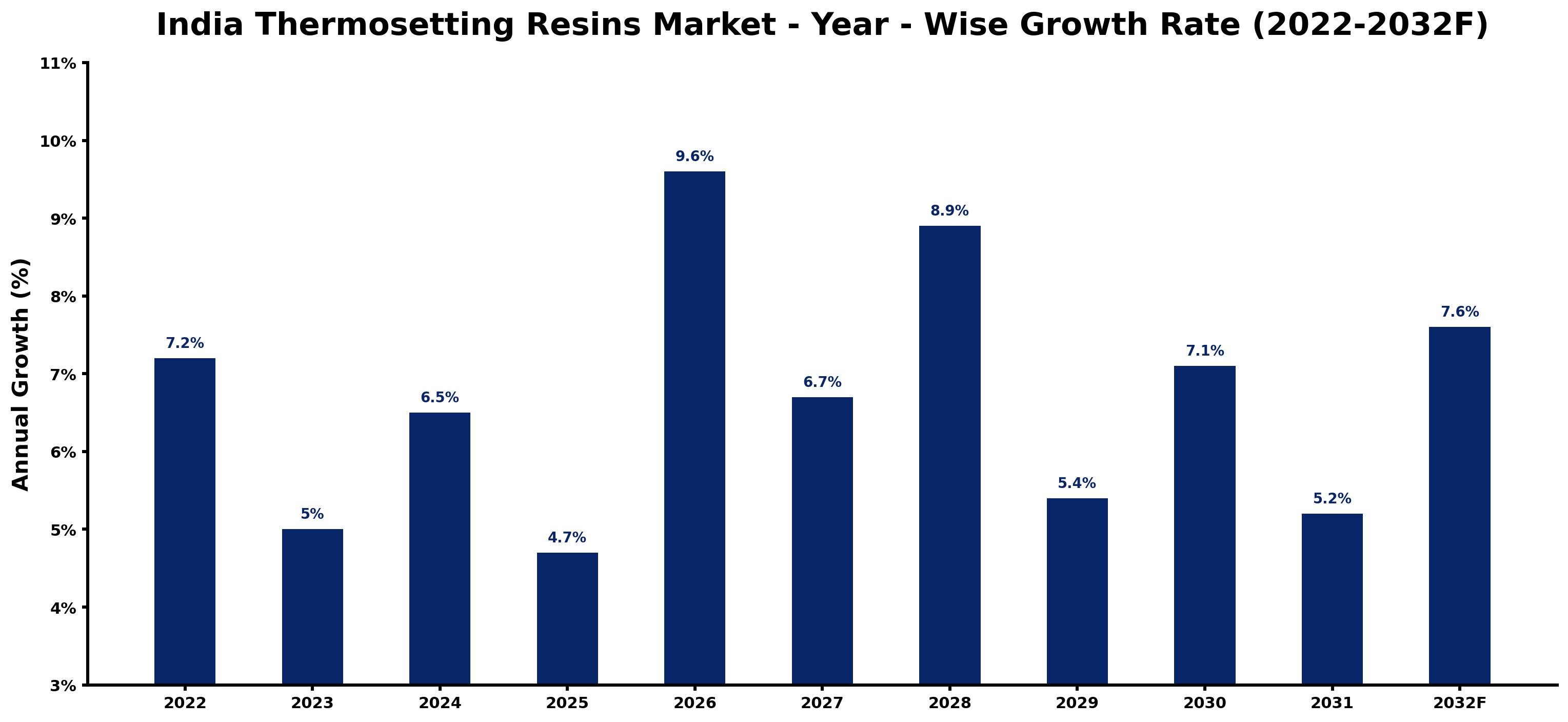
The table below sets out the estimated growth rate for each year and the main factor behind it.
| Year | Estimated Annual Growth (%) | Market Rationale |
| 2022 | 7.2 | The market experienced steady growth, driven by strong demand from the furniture industry. |
| 2023 | 5.0 | Growth slowed due to changing consumer preferences in the furniture sector. |
| 2024 | 6.5 | Demand increased as furniture manufacturers expanded their production capabilities. |
| 2025 | 4.7 | A slowdown occurred as the construction sector faced temporary challenges in project approvals. |
| 2026 | 9.6 | The market surged as the aerospace sector began investing heavily in structural composites. |
| 2027 | 6.7 | Growth slowed as the resin supply chain faced disruptions from global events. |
| 2028 | 8.9 | Demand rose again as the construction sector rebounded with new housing projects. |
| 2029 | 5.4 | A slowdown was noted as the market adjusted to increased production capacities. |
| 2030 | 7.1 | Growth accelerated as the electronics sector expanded its semiconductor manufacturing. |
| 2031 | 5.2 | The market experienced a slowdown as competition intensified among resin producers. |
| 2032 | 7.6 | Demand increased as new standards improved product quality and safety. |
Note: Market size estimations and growth projections presented in this report are based on 6Wresearch's proprietary forecasting methodology, utilizing the latest available industry data, government publications, and primary research inputs.
India Thermosetting Resins Market Synopsis
The India Thermosetting Resins Market encompasses polymers that cure to form infusible solids, primarily used in coatings, adhesives, and composite materials. The market is growing, driven by the furniture industry valued at approximately 1.5 trillion INR. The construction sector also contributes to demand, particularly for coatings and adhesives. The aerospace sector is expected to increase its use of structural composites, further boosting market growth.
Market Dynamics Impact Analysis (2026–2032)
| Factor | Type | Impact | Primary Segment Affected |
| Growth in the furniture industry fuels demand for thermosetting resins. | Driver | High | Laminates & Coatings |
| The aerospace sector's expansion increases the need for structural composites. | Driver | High | Structural Composites |
| The rising demand for affordable housing creates opportunities in resin applications. | Opportunity | High | Laminates & Coatings |
| The growth of the semiconductor industry presents a chance for resin producers. | Opportunity | High | Electronics Encapsulation |
| Quality control challenges can hinder production efficiency. | Restraint | High | Urea Formaldehyde |
| Supply chain disruptions can delay resin availability for manufacturers. | Restraint | High | Urea Formaldehyde |
| Regulatory compliance can increase production costs for manufacturers. | Challenge | Medium | Urea Formaldehyde |
| Technological advancements may outpace current production capabilities. | Challenge | Medium | Urea Formaldehyde |
Evaluation of Drivers in India Thermosetting Resins Market (2026–2032)
The main growth drivers and the segments they affect most are set out below.
| Drivers | Primary Segment Affected | Why It Matters (Evidence) |
| Increased production in the furniture sector drives resin demand. | Laminates & Coatings | The furniture industry, valued at approximately 1.5 trillion INR, boosts demand for thermosetting resins. |
| The aerospace sector's growth increases the need for structural composites. | Structural Composites | The aerospace sector is expected to grow, leading to higher demand for epoxy resins. |
| The National Policy on Electronics boosts local semiconductor production. | Electronics Encapsulation | This policy aims to strengthen domestic semiconductor manufacturing, impacting resin demand. |
| The Make in India initiative supports local resin manufacturing. | Urea Formaldehyde | This initiative encourages domestic production, increasing the availability of thermosetting resins. |
| Rising construction activities drive demand for coatings and adhesives. | Laminates & Coatings | The construction sector is a major consumer of thermosetting resins, particularly in coatings. |
Market growth in India for Thermosetting Resins rests on increasing production in the furniture sector, which is valued at approximately 1.5 trillion INR. The aerospace sector's expansion will drive demand for structural composites made from thermosetting resins. Rising construction activities are boosting demand for coatings and adhesives, creating a strong market environment for thermosetting resins.
Evaluation of Restraints in India Thermosetting Resins Market
The table below lists the restraints and the evidence behind each.
| Market Restraint | Primary Segment Affected | Why It Matters (Evidence) |
| Quality control issues can lead to production inefficiencies. | Urea Formaldehyde | Manufacturers face challenges in maintaining consistent quality, which can affect output. |
| Supply chain disruptions can impact resin availability. | Urea Formaldehyde | Global events have caused delays in resin supply, affecting production schedules. |
| Regulatory compliance can increase costs for manufacturers. | Urea Formaldehyde | Producers must invest in meeting updated standards, impacting profitability. |
| Technological advancements may require substantial investment. | Urea Formaldehyde | Staying competitive necessitates investment in new technologies, which can strain budgets. |
| Market fluctuations can affect pricing stability. | Urea Formaldehyde | Volatile raw material prices can lead to unpredictable costs for manufacturers. |
India Thermosetting Resins Market Challenges
The India thermosetting resins market still has to solve a few problems, beginning with high input costs for buyers in the furniture industry, which is valued at approximately 1.5 trillion INR. Inefficient curing technologies lead to production delays for manufacturers, preventing timely delivery and reducing competitiveness. Compliance with regulatory standards from the Bureau of Indian Standards imposes additional costs, which can shrink profit margins for producers by up to 15%. Unpredictable demand in the construction sector creates uncertainty for suppliers, resulting in potential overstock and increased holding costs that can strain their cash flow.
Trends in the India Thermosetting Resins Market
The trends below show where the India Thermosetting Resins Market is heading.
- Shift towards Eco-Friendly Resins: The Indian market is increasingly embracing eco-friendly thermosetting resins, reflecting growing sustainability concerns. In 2023, demand for bio-based resins rose by 15%, indicating a shift in consumer preferences.
- Rise in Demand for Structural Composites: The National Policy on Electronics has driven growth in the semiconductor industry, resulting in a 25% increase in resin demand for encapsulation since its implementation in 2020.
- Increased Adoption of Thermal/UV Curing Methods: Thermal/UV curing methods have gained popularity in the coatings industry, with a 10% increase in usage since 2021. This trend is enhancing efficiency in production processes.
- Expansion of the Electronics Sector: The National Policy on Electronics has stimulated growth in the semiconductor industry, resulting in a 25% increase in resin demand for encapsulation since its implementation in 2020.
Investment Opportunities in the India Thermosetting Resins Market
Some of the investment opportunities in the India Thermosetting Resins Market are mentioned below.
- Partnerships with Local Manufacturers: Now is an opportune time to form joint ventures with local manufacturers, as the market is set to grow. Collaborating with furniture manufacturers can facilitate market entry.
- Investment in Resin Production Facilities: Investing in resin production facilities in regions like Maharashtra can yield high returns, given the expected 15% growth in the wood panel industry by 2028.
- Supply of Eco-Friendly Resins: With sustainability becoming a priority, supplying eco-friendly thermosetting resins is a promising opportunity. The construction sector is increasingly seeking greener alternatives.
- Certification for New Standards: Obtaining BIS certification for thermosetting resins is essential now, as compliance with updated standards will improve marketability and consumer trust.
Government Initiatives in the India Thermosetting Resins Market
The Chemical Policy 2020 aims to promote sustainable growth in the chemical sector, including resins, benefiting producers by encouraging environmentally friendly practices. The National Policy on Electronics 2020 enhances domestic semiconductor production, impacting resin demand for electronics encapsulation. This policy encourages local manufacturing capabilities, which is important for the growth of the thermosetting resins market. Additionally, the Make in India initiative, reinforced in 2021, supports domestic manufacturing across various sectors, including thermosetting resins, promoting local production and reducing dependency on imports.
The Ministry of Chemicals and Fertilizers oversees the implementation of updated standards for thermosetting resins, improving quality and safety in manufacturing. The Pradhan Mantri Awas Yojana continues to support affordable housing, increasing demand for thermosetting resins in construction materials. Furthermore, the Bureau of Indian Standards (BIS) launched initiatives to enhance compliance and quality assurance, benefiting manufacturers and buyers alike. These measures ensure that products meet safety and quality standards, building consumer trust in the market.
Future Insight of the India Thermosetting Resins Market
The thermosetting resins market in India is set for notable changes by 2032, driven by several key factors. The aerospace sector's growth will boost demand for advanced composite materials, while government initiatives like the Make in India programme will enhance local manufacturing capabilities. By 2025, demand for thermosetting resins is projected to reach 200,000 tons, reflecting the increasing requirements across various industries. Advancements in thermal and UV curing methods will improve production efficiency, creating substantial opportunities for both buyers and suppliers.
Market Segmentation Analysis
The report offers a comprehensive study of the following market segments and their leading categories in the market.
By Resin Type – Urea Formaldehyde Dominated, Epoxy Expected to Grow Fastest
According to Vasudha, AM at 6Wresearch, the largest resin type category in 2025 was Urea Formaldehyde, with a 38% share of total revenue. Urea Formaldehyde commands the largest share in the Indian thermosetting resins market due to its prevalent use in wood panel production, a vital aspect of the booming furniture industry valued at approximately 1.5 trillion INR. This strong reliance on Urea Formaldehyde from furniture manufacturers solidifies its position as the preferred resin type. Epoxy is projected to grow fastest, at a CAGR of 9.5% during 2026–2032. The epoxy resin segment is on a rapid growth trajectory, primarily due to its critical role in structural composites, especially within the expanding aerospace sector. The projected demand of 200,000 tons by 2025 indicates that epoxy will continue to strengthen its market share. Suppliers should focus on increasing production of epoxy resins to effectively respond to the escalating demand from the aerospace and construction sectors.
By Curing Method – Heat-Cured Dominated, Catalyst-Based Expected to Grow Fastest
With a 36% revenue share in 2025, Heat-Cured was the largest curing method category. Heat-Cured methods hold the largest share in the market as they are widely regarded for their reliability and effectiveness in high-performance applications. This established preference among manufacturers ensures that Heat-Cured methods remain a dominant choice for thermosetting resins. Over 2026–2032, Catalyst-Based is expected to post the fastest growth, at a CAGR of 9.8%. Catalyst-Based curing methods are rapidly gaining popularity due to their ability to provide faster curing times, a crucial factor in the competitive resin market. This trend is particularly prominent in various resin formulations that cater to industry requirements. Buyers should explore the benefits of catalyst-based methods to enhance production efficiency and minimise lead times in resin applications.
By Application – Laminates & Coatings Dominated, Structural Composites Expected to Grow Fastest
Laminates & Coatings took a 45% share of application in 2025, more than any other category. Laminates & Coatings represent the largest application area for thermosetting resins, driven by their extensive use in the furniture and construction sectors. This broad application ensures a substantial market share, as these products are essential for both durability and aesthetic appeal. Structural Composites are set to record the highest CAGR in this split, 9.4% over 2026–2032. Structural Composites are experiencing the fastest growth, largely due to their essential role in the aerospace and automotive industries, where the demand for lightweight materials is surging. This trend is expected to persist as these sectors increasingly adopt advanced materials. Suppliers should prioritise advancements in structural composite applications to leverage the growing demand from aerospace and automotive manufacturers.
By End User – Furniture Manufacturers Dominated, Aerospace OEMs Expected to Grow Fastest
In 2025, Furniture Manufacturers led the end user split with a 48% share. Furniture Manufacturers are the primary end-users of thermosetting resins, extensively utilising them in the production of diverse furniture products. This strong demand from the furniture sector significantly enhances the overall market share of thermosetting resins in India. The quickest growth will come from Aerospace OEMs, forecast to expand at a CAGR of 9.4% between 2026 and 2032. Aerospace OEMs represent the fastest-growing end-user segment, driven by the rising need for lightweight structures made from epoxy resins. This growth reflects the expansion of the aerospace sector, which is anticipated to further elevate the demand for thermosetting resins. Manufacturers should align their strategies to address the specific requirements of aerospace OEMs, ensuring they can meet the increasing demand for advanced materials.
Key Attractiveness of the Report
- 10 Years of Market Numbers
- Historical Data Starting from 2022 to 2025
- Base Year 2025
- Forecast Data until 2032
- Key Performance Indicators Impacting the Market
- Major Upcoming Developments and Projects
Key Highlights of the Report:
- India Thermosetting Resins Market Outlook
- Market Size of India Thermosetting Resins Market, 2025
- Forecast of India Thermosetting Resins Market, 2032
- Historical Data and Forecast of India Thermosetting Resins Revenues & Volume for the Period 2022 - 2032F
- India Thermosetting Resins Market Trend Evolution
- India Thermosetting Resins Market Drivers and Challenges
- India Thermosetting Resins Price Trends
- India Thermosetting Resins Porter's Five Forces
- India Thermosetting Resins Industry Life Cycle
- Historical Data and Forecast of India Thermosetting Resins Market Revenues & Volume By Resin Type for the Period 2022 - 2032F
- Historical Data and Forecast of India Thermosetting Resins Market Revenues & Volume By Melamine for the Period 2022 - 2032F
- Historical Data and Forecast of India Thermosetting Resins Market Revenues & Volume By Urea Formaldehyde for the Period 2022 - 2032F
- Historical Data and Forecast of India Thermosetting Resins Market Revenues & Volume By Epoxy for the Period 2022 - 2032F
- Historical Data and Forecast of India Thermosetting Resins Market Revenues & Volume By Silicone Resin for the Period 2022 - 2032F
- Historical Data and Forecast of India Thermosetting Resins Market Revenues & Volume By Curing Method for the Period 2022 - 2032F
- Historical Data and Forecast of India Thermosetting Resins Market Revenues & Volume By Heat-Cured for the Period 2022 - 2032F
- Historical Data and Forecast of India Thermosetting Resins Market Revenues & Volume By Catalyst-Based for the Period 2022 - 2032F
- Historical Data and Forecast of India Thermosetting Resins Market Revenues & Volume By Thermal/UV Cure for the Period 2022 - 2032F
- Historical Data and Forecast of India Thermosetting Resins Market Revenues & Volume By Cold Cure for the Period 2022 - 2032F
- Historical Data and Forecast of India Thermosetting Resins Market Revenues & Volume By Application for the Period 2022 - 2032F
- Historical Data and Forecast of India Thermosetting Resins Market Revenues & Volume By Laminates & Coatings for the Period 2022 - 2032F
- Historical Data and Forecast of India Thermosetting Resins Market Revenues & Volume By Plywood & MDF for the Period 2022 - 2032F
- Historical Data and Forecast of India Thermosetting Resins Market Revenues & Volume By Structural Composites for the Period 2022 - 2032F
- Historical Data and Forecast of India Thermosetting Resins Market Revenues & Volume By Electronics Encapsulation for the Period 2022 - 2032F
- Historical Data and Forecast of India Thermosetting Resins Market Revenues & Volume By End User for the Period 2022 - 2032F
- Historical Data and Forecast of India Thermosetting Resins Market Revenues & Volume By Furniture Manufacturers for the Period 2022 - 2032F
- Historical Data and Forecast of India Thermosetting Resins Market Revenues & Volume By Wood Panel Producers for the Period 2022 - 2032F
- Historical Data and Forecast of India Thermosetting Resins Market Revenues & Volume By Aerospace OEMs for the Period 2022 - 2032F
- Historical Data and Forecast of India Thermosetting Resins Market Revenues & Volume By Semiconductor Firms for the Period 2022 - 2032F
- India Thermosetting Resins Import Export Trade Statistics
- Market Opportunity Assessment By Resin Type
- Market Opportunity Assessment By Curing Method
- Market Opportunity Assessment By Application
- Market Opportunity Assessment By End User
- India Thermosetting Resins Top Companies Market Share
- India Thermosetting Resins Competitive Benchmarking By Technical and Operational Parameters
- India Thermosetting Resins Company Profiles
- India Thermosetting Resins Key Strategic Recommendations
Market Covered
This report examines the market across the segments below.
By Resin Type
- Melamine
- Urea Formaldehyde
- Epoxy
- Silicone Resin
By Curing Method
- Heat-Cured
- Catalyst-Based
- Thermal/UV Cure
- Cold Cure
By Application
- Laminates & Coatings
- Plywood & MDF
- Structural Composites
- Electronics Encapsulation
By End User
- Furniture Manufacturers
- Wood Panel Producers
- Aerospace OEMs
- Semiconductor Firms































