India Tick‑Borne Disease Treatment Market Size & Growth Rate
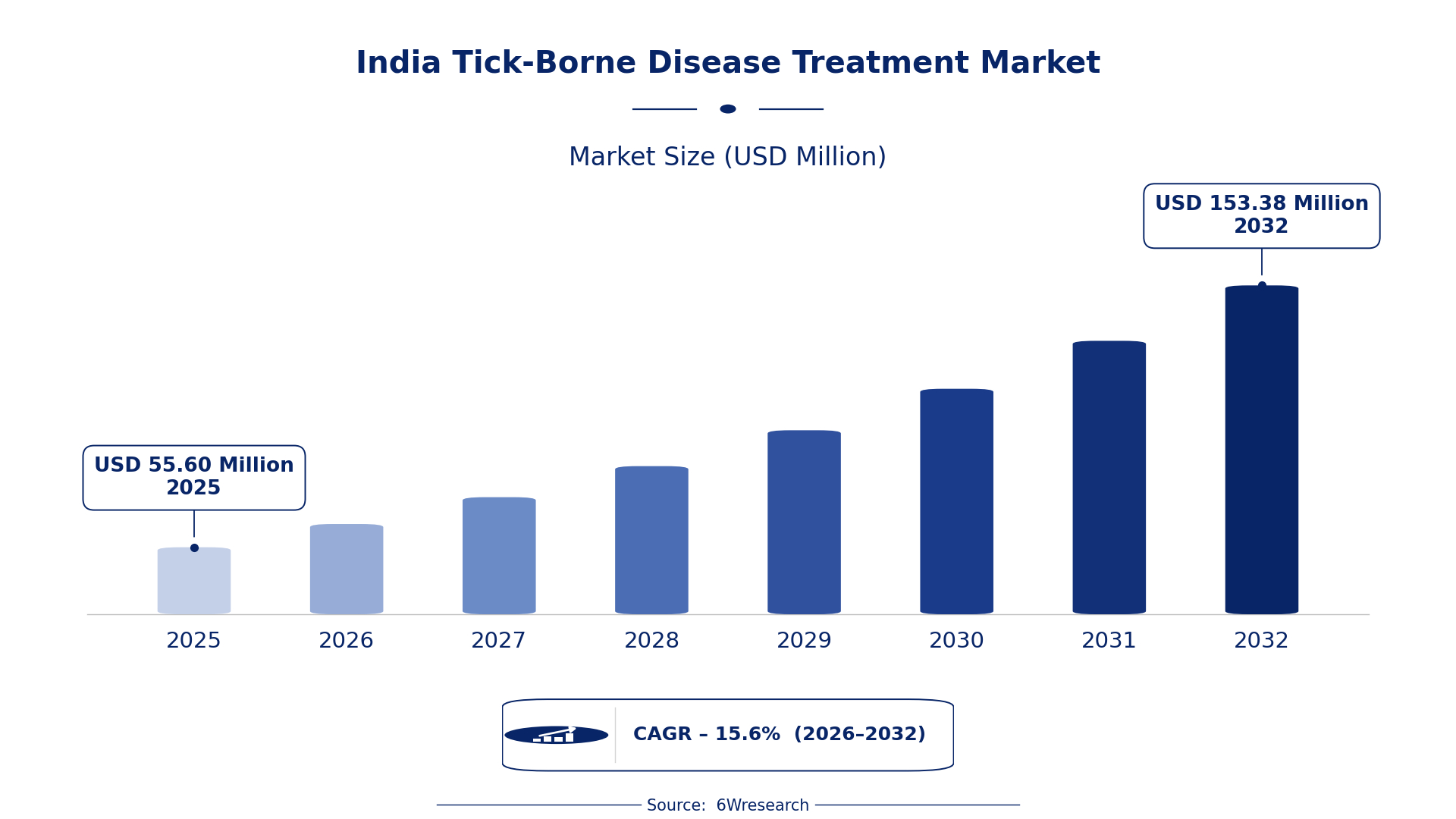
According to 6Wresearch internal database and industry insights, the India Tick‑Borne Disease Treatment Market was valued at USD 55.6 million in 2025 and is projected to reach USD 153.38 million by 2032, growing at a CAGR of approximately 15.6% during 2026–2032.
India Tick‑Borne Disease Treatment Market Highlights
| Report Metric | Details |
| Report Name | India Tick‑Borne Disease Treatment Market |
| Market Size 2025 | USD 55.6 million |
| Market Size 2032 | USD 153.38 million |
| Absolute Growth 2025–2032 | USD 97.78 million |
| CAGR 2026–2032 | 15.6% |
| Peak Annual Growth | 17.9% in 2029 |
| Forecast Period | 2026–2032 |
| Historical Data | 2022–2025 |
| Base Year | 2025 |
| Leading Tick‑Borne Disease Treatment, 2025 | Antibiotics Treatments (43% share) |
| Leading Product Type, 2025 | Doxycycline (47% share) |
| Leading Therapy Type, 2025 | Oral Antibiotics (52% share) |
| Leading Distribution Channel, 2025 | Clinics & Pharmacies (40% share) |
| Leading End User Industry, 2025 | Infectious Disease (39% share) |
| Fastest-Growing Tick‑Borne Disease Treatment | Vaccine Development (16.6% CAGR) |
| Fastest-Growing Product Type | Experimental Vaccines (17.7% CAGR) |
| Fastest-Growing Therapy Type | Immunotherapy (17.4% CAGR) |
| Fastest-Growing Distribution Channel | Research Institutions (17.8% CAGR) |
| Fastest-Growing End User Industry | Biotech Firms (17.3% CAGR) |
| Growing Sector | Infectious Disease |
| Key End Users | Healthcare providers, Research institutions, Primary care centers, Public health agencies |
India Tick‑Borne Disease Treatment Market Year-wise Growth Rate and Key Drivers (2022–2032)
This graph illustrates the annual growth rates of the market from 2022 to 2032, highlighting a steady upward trajectory and projected market expansion over the forecast period.
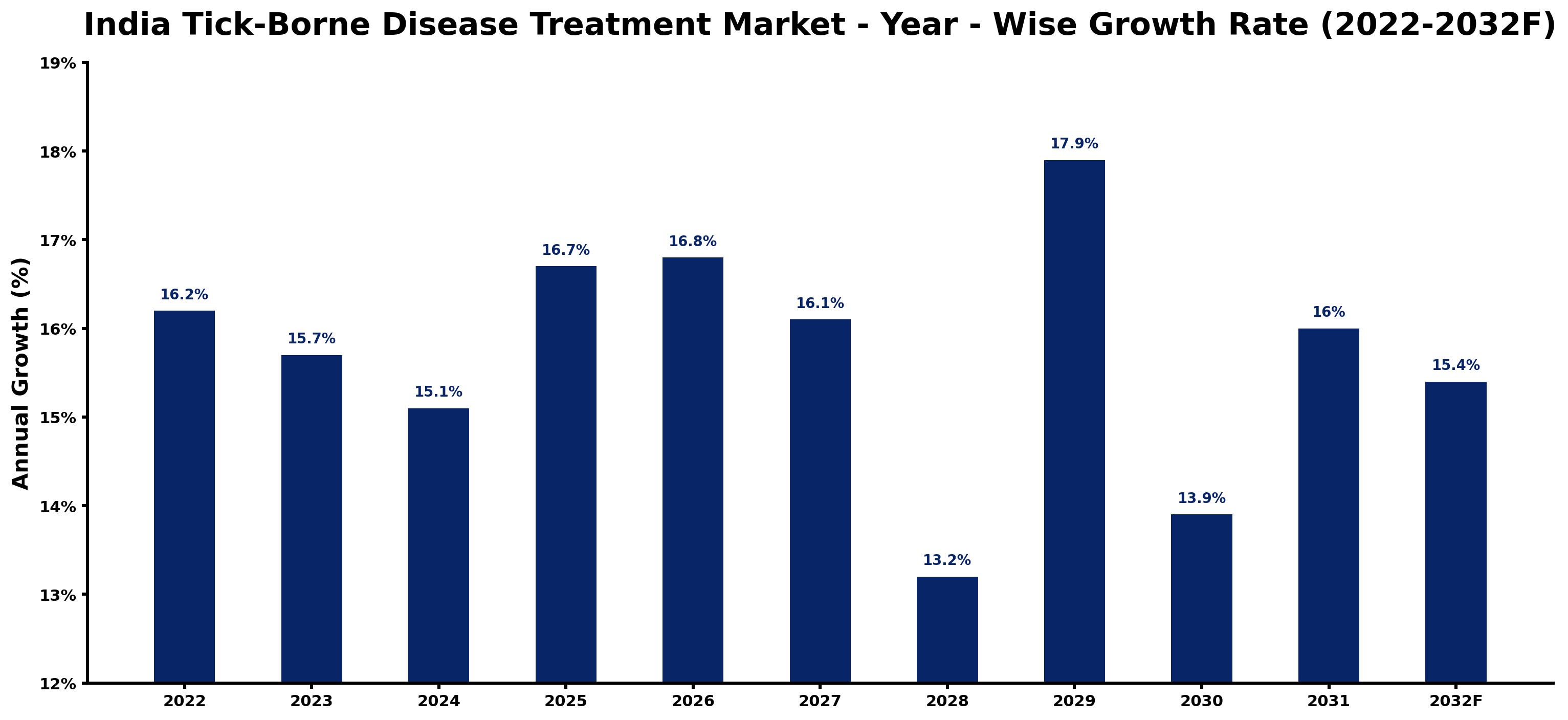
Below, each year's estimated growth is shown next to the factor that most influenced it.
| Year | Estimated Annual Growth (%) | Market Rationale |
| 2022 | 16.2 | The market exhibited strong demand due to high incidence rates of tick-borne diseases. |
| 2023 | 15.7 | Growth slowed as awareness programs were implemented to educate rural populations. |
| 2024 | 15.1 | Public health initiatives contributed to a gradual slowdown in growth rate. |
| 2025 | 16.7 | The market experienced a resurgence driven by increased healthcare investments. |
| 2026 | 16.8 | Demand rose as new treatment guidelines were approved for tick-borne diseases. |
| 2027 | 16.1 | Growth slowed as the market adjusted to recent treatment protocols. |
| 2028 | 13.2 | A slowdown in growth was noted due to limited access in rural areas. |
| 2029 | 17.9 | The market peaked as awareness campaigns led to increased treatment uptake. |
| 2030 | 13.9 | Growth slowed as the market stabilised after peak demand in 2029. |
| 2031 | 16.0 | The market rebounded with new research initiatives in tick-borne disease treatment. |
| 2032 | 15.4 | Growth slowed as the market matured and treatment options expanded. |
Note: Market size estimations and growth projections presented in this report are based on 6Wresearch's proprietary forecasting methodology, utilizing the latest available industry data, government publications, and primary research inputs.
India Tick‑Borne Disease Treatment Market Synopsis
Tick‑Borne Disease Treatment in India includes various therapeutic approaches for managing diseases transmitted by ticks, such as Lyme disease. Treatments consist of antibiotics, antiparasitics, and supportive care, primarily delivered in healthcare settings. The India Tick‑Borne Disease Treatment Market is growing due to an increase in tick-borne disease cases, especially in rural regions. The National Vector Borne Disease Control Programme prioritises these diseases, while healthcare providers are increasingly meeting treatment demands. As a result, the market is set to expand in the coming years.
Market Dynamics Impact Analysis (2026–2032)
| Factor | Type | Impact | Primary Segment Affected |
| Rising incidence of tick-borne diseases drives demand for effective treatments. | Driver | High | Antibiotics Treatments |
| Increased healthcare investments enhance treatment availability in rural areas. | Driver | High | Supportive Care |
| Growing awareness of tick-borne diseases creates demand for treatments. | Opportunity | High | Infectious Disease |
| Research institutions developing new vaccines present investment opportunities. | Opportunity | Medium | Vaccine Development |
| Limited access to healthcare facilities in rural areas restricts treatment availability. | Restraint | High | Antibiotics Treatments |
| High treatment costs may deter patients from seeking timely care. | Restraint | Medium | Supportive Care |
| Challenges in vaccine development slow down market expansion. | Challenge | High | Vaccine Development |
| Inadequate public awareness hampers treatment uptake in rural populations. | Challenge | Medium | Infectious Disease |
Evaluation of Drivers in India Tick‑Borne Disease Treatment Market (2026–2032)
Below mentioned are some major drivers and their influence on market dynamics.
| Drivers | Primary Segment Affected | Why It Matters (Evidence) |
| Increased government funding for vector control initiatives. | Antibiotics Treatments | The government allocated ₹500 million for vector control, boosting treatment availability. |
| Rising number of reported tick-borne disease cases. | Supportive Care | Over 20,000 cases annually prompt healthcare providers to improve treatment protocols. |
| Public health campaigns raise awareness about tick-borne diseases. | Infectious Disease | Awareness programs encourage early intervention among patients. |
| Research grants for developing new treatment options. | Vaccine Development | The Indian Council of Medical Research initiated a research grant program with a budget of ₹200 million. |
| Updated clinical guidelines improve patient outcomes. | Antibiotics Treatments | New treatment protocols standardise care across healthcare facilities. |
The growth of the Tick‑Borne Disease Treatment market in India is supported by increased healthcare funding, rising disease incidence, and public health campaigns. The government has allocated ₹500 million for vector control initiatives, enhancing treatment availability. With over 20,000 cases of tick-borne diseases reported annually, healthcare providers are motivated to improve treatment protocols. Awareness programs promote early intervention, resulting in higher treatment uptake. Research grants also facilitate the development of new treatment options, driving demand for effective therapies.
Evaluation of Restraints in India Tick‑Borne Disease Treatment Market
The table below lists the restraints and the evidence behind each.
| Market Restraint | Primary Segment Affected | Why It Matters (Evidence) |
| Limited access to healthcare facilities in rural areas restricts treatment availability. | Antibiotics Treatments | Over 70% of primary care centers report treating tick-borne diseases, yet many rural areas lack access. |
| High treatment costs may deter patients from seeking timely care. | Supportive Care | The financial burden associated with treatments can lead to delayed interventions for patients. |
| Challenges in vaccine development slow down market expansion. | Vaccine Development | Experimental vaccines are still under research, limiting their availability in the market. |
| Inadequate public awareness hampers treatment uptake in rural populations. | Infectious Disease | Despite awareness programs, many rural residents remain uninformed about tick-borne diseases. |
| Limited availability of experimental treatments restricts options for patients. | Supportive Care | Research institutions are still developing new treatments, which are not yet widely accessible. |
India Tick‑Borne Disease Treatment Market Challenges
The India Tick-Borne Disease Treatment market encounters several practical issues, starting with supply chain disruptions that hinder access to essential treatments. Inadequate infrastructure in rural areas affects clinics and hospitals, which struggle to obtain timely access to antibiotics and antiparasitics. Technological limitations hinder effective disease management, as many healthcare providers lack advanced diagnostic tools, leading to misdiagnosis and inadequate care for patients seeking prompt treatment. Rising costs associated with the standard 14-21 day antibiotic course strain budgets for over 70% of primary care centres, limiting patient access to necessary therapies.
Trends in the India Tick‑Borne Disease Treatment Market
Four trends stand out in the India Tick‑Borne Disease Treatment Market.
- Shift towards Enhanced Vector Control Measures: The National Vector Borne Disease Control Programme, launched in 2020, aims to reduce vector-borne diseases by 50% by 2025. This initiative has led to increased funding and resources for tick management, encouraging healthcare providers to adopt new treatment protocols.
- Growing Focus on Research for Vaccine Development: Research institutions in India are prioritising the development of vaccines against tick-borne diseases. With a budget of ₹200 million allocated in 2022 for research grants, this trend is expected to improve treatment options in the future.
- Increased Awareness Campaigns in Rural Areas: The National Health Mission's campaign launched in 2021 aims to educate rural populations about tick-borne diseases. This initiative addresses the high prevalence of these diseases in rural regions, leading to improved treatment rates.
- Standardisation of Treatment Protocols: In 2023, the Ministry of Health approved new treatment guidelines for tick-borne diseases. This standardisation is essential for ensuring consistent care across healthcare facilities, improving patient outcomes.
Investment Opportunities in the India Tick‑Borne Disease Treatment Market
The following opportunities in the India Tick‑Borne Disease Treatment Market pair current demand with a clear way in.
- Investment in Research for New Treatments: With ₹200 million allocated for research grants, there is an opportunity to invest in the development of new treatments for tick-borne diseases. Research institutions are key players in this area, and partnerships can enhance treatment options.
- Expansion of Healthcare Facilities in Rural Areas: Over 70% of primary care centres treat tick-borne diseases, indicating a demand for expanded healthcare services. Investing in rural healthcare facilities can improve access to treatments for underserved populations.
- Supply of Vaccines as Development Advances: As research progresses, the potential for supplying vaccines against tick-borne diseases is increasing. Collaborating with research institutions can facilitate entry into this emerging market segment.
- Enhancing Public Awareness Programs: With ongoing campaigns to educate rural populations, there is an opportunity to invest in awareness programs. Supporting initiatives by the National Health Mission can lead to higher treatment uptake and improved public health.
Government Initiatives in the India Tick‑Borne Disease Treatment Market
The National Vector Borne Disease Control Programme, initiated by the Ministry of Health in 2020, aims to reduce vector-borne diseases by 50% by 2025 through improved surveillance and control measures. This programme has led to increased funding for tick management, encouraging healthcare providers to enhance treatment protocols. Additionally, the Ministry of Health approved new treatment guidelines for tick-borne diseases in 2023, standardising care across healthcare facilities, which is vital for ensuring consistent patient outcomes.
The National Health Mission's campaign launched in 2021 educates rural populations about tick-borne diseases and their prevention, thereby increasing awareness and encouraging early intervention among patients. The Indian Council of Medical Research supports research institutions in developing new treatment options, with a budget of ₹200 million allocated for studies on tick-borne diseases.
Future Insight of the India Tick‑Borne Disease Treatment Market
The India Tick-Borne Disease Treatment market will evolve by 2032, driven by several key factors. The National Vector Borne Disease Control Programme will prioritise public health initiatives, improving awareness and prevention strategies in rural communities. Research institutions are developing experimental vaccines, which could transform treatment options and reduce disease prevalence. The Indian Council of Medical Research's ongoing studies will likely lead to improved treatment protocols, ensuring better outcomes for patients. By 2025, the government plans to allocate an additional ₹500 million towards vector control, further supporting healthcare providers in managing tick-borne diseases.
Market Segmentation Analysis
Each segment group is reviewed below, with the leader by share and the fastest grower by CAGR.
By Tick‑Borne Disease Treatment – Antibiotics Treatments Dominated, Vaccine Development Expected to Grow Fastest
According to Vasudha, AM at 6Wresearch, Antibiotics Treatments took a 43% share of tick‑borne disease treatment in 2025, more than any other category. Antibiotics treatments dominate the market share due to their essential role in managing bacterial infections caused by ticks, particularly in healthcare settings like clinics and hospitals. The reliance on antibiotics, exemplified by the widespread prescription of Doxycycline, underscores their critical importance in addressing the high incidence of tick-borne diseases. The quickest growth will come from Vaccine Development, forecast to expand at a CAGR of 16.6% between 2026 and 2032. The growth of vaccine development is propelled by ongoing research initiatives, with institutions actively working on experimental vaccines for tick-borne diseases. As awareness and funding for tick management rise, particularly with the ₹500 million allocated for vector control initiatives in 2022, this segment is poised for expansion. Suppliers must focus on ensuring a steady supply of antibiotics while staying informed about advancements in vaccine development to effectively meet future market demands.
By Product Type – Doxycycline Dominated, Experimental Vaccines Expected to Grow Fastest
With a 47% revenue share in 2025, Doxycycline was the largest product type category. Doxycycline holds the largest market share as it is the most prescribed antibiotic for treating tick-borne diseases, particularly Lyme disease, in India. Its established efficacy and widespread use in healthcare settings contribute to its leading position. Experimental Vaccines are projected to grow fastest, at a CAGR of 17.7% during 2026–2032. Experimental vaccines are anticipated to grow rapidly as research progresses, with institutions developing new solutions to combat tick-borne diseases. As these vaccines move closer to market readiness, they may reshape treatment protocols in the future. Buyers should stay informed about advancements in vaccine research while ensuring access to established treatments like Doxycycline.
By Therapy Type – Oral Antibiotics Dominated, Immunotherapy Expected to Grow Fastest
The largest therapy type category in 2025 was Oral Antibiotics, with a 52% share of total revenue. Oral antibiotics represent the largest share in the market as they are the primary method for treating infections caused by tick bites, widely used in clinics and hospitals. The standard treatment protocol for Lyme disease, which includes a course of oral antibiotics, reinforces their importance. Immunotherapy is set to record the highest CAGR in this split, 17.4% over 2026–2032. Immunotherapy is gaining attention as an emerging treatment option, with ongoing research exploring its potential effectiveness against tick-borne diseases. As clinical guidelines evolve, immunotherapy may become a more prominent choice in the coming years. Healthcare providers should consider integrating emerging therapies like immunotherapy into their treatment plans as they become available.
By Distribution Channel – Clinics & Pharmacies Dominated, Research Institutions Expected to Grow Fastest
In 2025, Clinics & Pharmacies led the distribution channel split with a 40% share. Clinics and pharmacies capture the largest market share as they serve as the main distribution points for tick-borne disease treatments. Their accessibility is crucial for providing timely care and necessary medications, especially in rural areas where the prevalence of these diseases is significant. Over 2026–2032, Research Institutions are expected to post the fastest growth, at a CAGR of 17.8%. Research institutions are becoming increasingly important as they engage in the development and trials of new treatments, potentially leading to innovative solutions for tick-borne diseases. Their activities may accelerate the introduction of new therapies into the market, thereby enhancing treatment options. Suppliers should strengthen their relationships with clinics and pharmacies while also collaborating with research institutions to stay competitive in the evolving treatment landscape.
By End User Industry – Infectious Disease Dominated, Biotech Firms Expected to Grow Fastest
Infectious Disease held a 39% share of the India Tick‑Borne Disease Treatment Market by end user industry in 2025. The infectious disease sector holds the largest market share, primarily focusing on the treatment of tick-borne diseases. This sector's commitment to addressing public health challenges, particularly in rural regions, drives the demand for effective treatments. The quickest growth will come from Biotech Firms, forecast to expand at a CAGR of 17.3% between 2026 and 2032. Biotech firms are positioned for rapid growth as they engage in research and development of new treatments for tick-borne diseases, despite not being the primary users of these treatments. Their focus on innovative solutions may lead to significant breakthroughs in the market. Stakeholders should monitor the biotech sector for potential collaborations that could enhance the range of treatment options available for tick-borne diseases.
Key Attractiveness of the Report
- 10 Years of Market Numbers
- Historical Data Starting from 2022 to 2025
- Base Year 2025
- Forecast Data until 2032
- Key Performance Indicators Impacting the Market
- Major Upcoming Developments and Projects
Key Highlights of the Report:
- India Tick Borne Disease Treatment Market Outlook
- Market Size of India Tick Borne Disease Treatment Market, 2025
- Forecast of India Tick Borne Disease Treatment Market, 2032
- Historical Data and Forecast of India Tick Borne Disease Treatment Revenues & Volume for the Period 2022 - 2032F
- India Tick Borne Disease Treatment Market Trend Evolution
- India Tick Borne Disease Treatment Market Drivers and Challenges
- India Tick Borne Disease Treatment Price Trends
- India Tick Borne Disease Treatment Porter's Five Forces
- India Tick Borne Disease Treatment Industry Life Cycle
- Historical Data and Forecast of India Tick Borne Disease Treatment Market Revenues & Volume By Tick Borne Disease Treatment for the Period 2022 - 2032F
- Historical Data and Forecast of India Tick Borne Disease Treatment Market Revenues & Volume By Antibiotics Treatments for the Period 2022 - 2032F
- Historical Data and Forecast of India Tick Borne Disease Treatment Market Revenues & Volume By Antiparasitics for the Period 2022 - 2032F
- Historical Data and Forecast of India Tick Borne Disease Treatment Market Revenues & Volume By Supportive Care for the Period 2022 - 2032F
- Historical Data and Forecast of India Tick Borne Disease Treatment Market Revenues & Volume By Vaccine Development for the Period 2022 - 2032F
- Historical Data and Forecast of India Tick Borne Disease Treatment Market Revenues & Volume By Product Type for the Period 2022 - 2032F
- Historical Data and Forecast of India Tick Borne Disease Treatment Market Revenues & Volume By Doxycycline for the Period 2022 - 2032F
- Historical Data and Forecast of India Tick Borne Disease Treatment Market Revenues & Volume By Amlodipine for the Period 2022 - 2032F
- Historical Data and Forecast of India Tick Borne Disease Treatment Market Revenues & Volume By Anti inflammatory for the Period 2022 - 2032F
- Historical Data and Forecast of India Tick Borne Disease Treatment Market Revenues & Volume By Experimental Vaccines for the Period 2022 - 2032F
- Historical Data and Forecast of India Tick Borne Disease Treatment Market Revenues & Volume By Therapy Type for the Period 2022 - 2032F
- Historical Data and Forecast of India Tick Borne Disease Treatment Market Revenues & Volume By Oral Antibiotics for the Period 2022 - 2032F
- Historical Data and Forecast of India Tick Borne Disease Treatment Market Revenues & Volume By Anti-Borrelia for the Period 2022 - 2032F
- Historical Data and Forecast of India Tick Borne Disease Treatment Market Revenues & Volume By Symptom Management for the Period 2022 - 2032F
- Historical Data and Forecast of India Tick Borne Disease Treatment Market Revenues & Volume By Immunotherapy for the Period 2022 - 2032F
- Historical Data and Forecast of India Tick Borne Disease Treatment Market Revenues & Volume By Distribution Channel for the Period 2022 - 2032F
- Historical Data and Forecast of India Tick Borne Disease Treatment Market Revenues & Volume By Clinics & Pharmacies for the Period 2022 - 2032F
- Historical Data and Forecast of India Tick Borne Disease Treatment Market Revenues & Volume By Direct Healthcare for the Period 2022 - 2032F
- Historical Data and Forecast of India Tick Borne Disease Treatment Market Revenues & Volume By Over-the-Counter for the Period 2022 - 2032F
- Historical Data and Forecast of India Tick Borne Disease Treatment Market Revenues & Volume By Research Institutions for the Period 2022 - 2032F
- Historical Data and Forecast of India Tick Borne Disease Treatment Market Revenues & Volume By End User Industry for the Period 2022 - 2032F
- Historical Data and Forecast of India Tick Borne Disease Treatment Market Revenues & Volume By Infectious Disease for the Period 2022 - 2032F
- Historical Data and Forecast of India Tick Borne Disease Treatment Market Revenues & Volume By Primary Care Centers for the Period 2022 - 2032F
- Historical Data and Forecast of India Tick Borne Disease Treatment Market Revenues & Volume By Home Care Providers for the Period 2022 - 2032F
- Historical Data and Forecast of India Tick Borne Disease Treatment Market Revenues & Volume By Biotech Firms for the Period 2022 - 2032F
- India Tick Borne Disease Treatment Import Export Trade Statistics
- Market Opportunity Assessment By Tick Borne Disease Treatment
- Market Opportunity Assessment By Product Type
- Market Opportunity Assessment By Therapy Type
- Market Opportunity Assessment By Distribution Channel
- Market Opportunity Assessment By End User Industry
- India Tick Borne Disease Treatment Top Companies Market Share
- India Tick Borne Disease Treatment Competitive Benchmarking By Technical and Operational Parameters
- India Tick Borne Disease Treatment Company Profiles
- India Tick Borne Disease Treatment Key Strategic Recommendations
Market Covered
Segments analysed in this report are listed below.
By Tick‑Borne Disease Treatment
- Antibiotics Treatments
- Antiparasitics
- Supportive Care
- Vaccine Development
By Product Type
- Doxycycline
- Amlodipine
- Anti‑inflammatory
- Experimental Vaccines
By Therapy Type
- Oral Antibiotics
- Anti-Borrelia
- Symptom Management
- Immunotherapy
By Distribution Channel
- Clinics & Pharmacies
- Direct Healthcare
- Over-the-Counter
- Research Institutions
By End User Industry
- Infectious Disease
- Primary Care Centers
- Home Care Providers
- Biotech Firms































