India Toxic Bait Products Market Size & Growth Rate
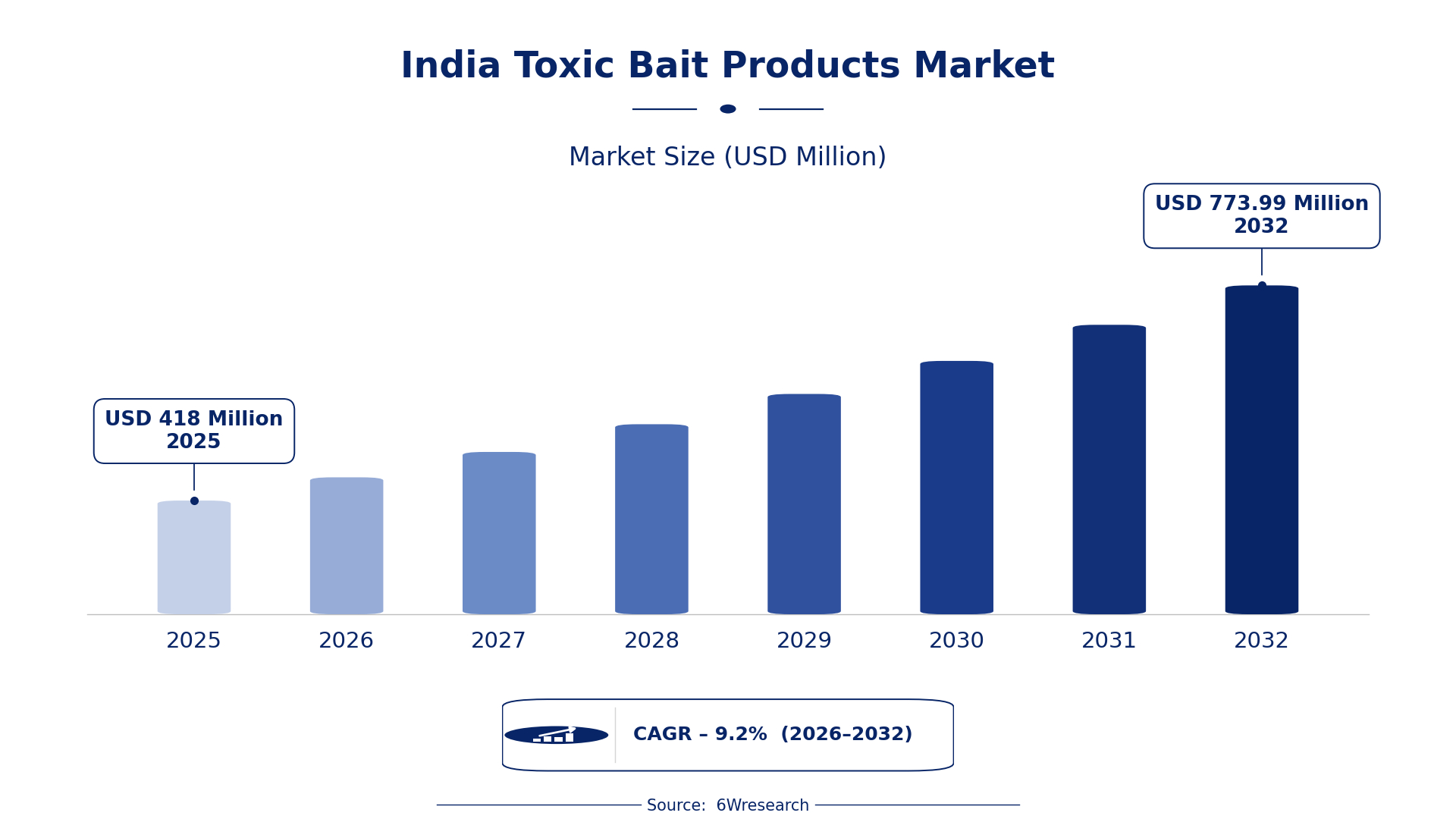
According to 6Wresearch internal database and industry insights, the India Toxic Bait Products Market was valued at USD 418.0 million in 2025 and is projected to reach USD 773.99 million by 2032, growing at a CAGR of approximately 9.2% during 2026–2032.
India Toxic Bait Products Market Highlights
| Report Metric | Details |
| Report Name | India Toxic Bait Products Market |
| Market Size 2025 | USD 418.0 million |
| Market Size 2032 | USD 773.99 million |
| Absolute Growth 2025–2032 | USD 355.99 million |
| CAGR 2026–2032 | 9.2% |
| Peak Annual Growth | 11.5% in 2027 |
| Forecast Period | 2026–2032 |
| Historical Data | 2022–2025 |
| Base Year | 2025 |
| Leading Bait Type, 2025 | Rodent Baits (52% share) |
| Leading Active Ingredient, 2025 | Bromadiolone (49% share) |
| Leading Target Pest, 2025 | Rats & Mice (38% share) |
| Leading End User, 2025 | Pest Control Agencies (50% share) |
| Fastest-Growing Bait Type | Insect Baits (10.3% CAGR) |
| Fastest-Growing Active Ingredient | Fipronil/Gel Form (10.4% CAGR) |
| Fastest-Growing Target Pest | Ants (11.5% CAGR) |
| Fastest-Growing End User | Agricultural Users (11.5% CAGR) |
| Growing Sector | A leading supplier Services |
| Key End Users | A leading supplier Agencies, Agricultural Users, Restaurants/Hotels |
India Toxic Bait Products Market Year-wise Growth Rate and Key Drivers (2022–2032)
This graph illustrates the annual growth rates of the market from 2022 to 2032, highlighting a steady upward trajectory and projected market expansion over the forecast period.
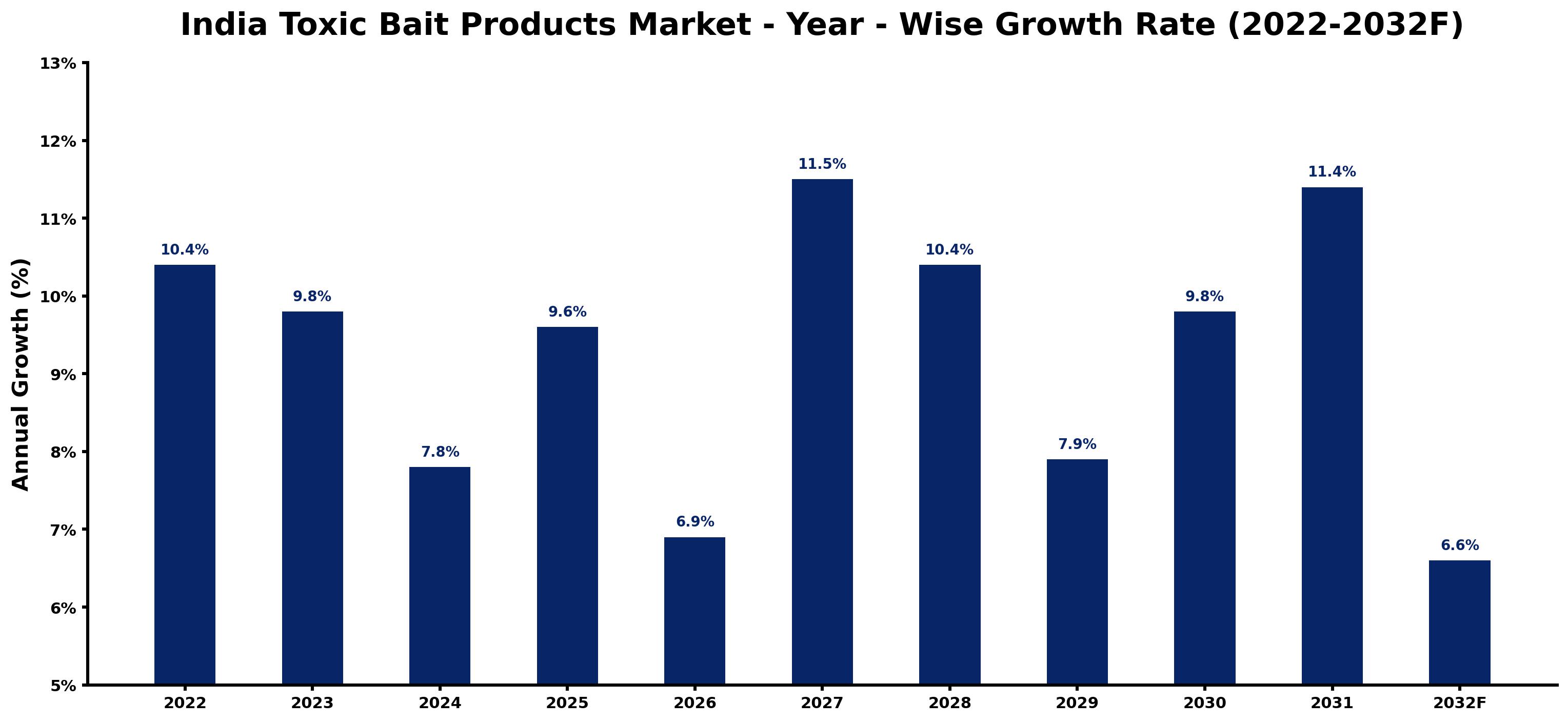
The table below sets out the estimated growth rate for each year and the main factor behind it.
| Year | Estimated Annual Growth (%) | Market Rationale |
| 2022 | 10.4 | The pest control market was active, driven by urban rodent infestations and agricultural needs. |
| 2023 | 9.8 | Demand for toxic bait products slowed slightly due to the Integrated Pest Management Programme's implementation. |
| 2024 | 7.8 | The market continued to grow, supported by increasing awareness of pest management practices. |
| 2025 | 9.6 | Urban pest control agencies increased their purchases, responding to rising pest populations in cities. |
| 2026 | 6.9 | Growth slowed as pest control companies faced challenges in sourcing effective active ingredients. |
| 2027 | 11.5 | The market rebounded with heightened demand for rodent baits following increased urbanisation. |
| 2028 | 10.4 | Growth moderated as pest control standards became more stringent, impacting product availability. |
| 2029 | 7.9 | Demand for insect baits decreased slightly as pest control agencies adapted to new regulations. |
| 2030 | 9.8 | Growth accelerated again as agricultural users expanded their pest management efforts. |
| 2031 | 11.4 | The market saw renewed interest in termite baits due to rising awareness of structural damage. |
| 2032 | 6.6 | Growth slowed as the market stabilised, focusing on the National Pest Management Plan's sustainable practices. |
Note: Market size estimations and growth projections presented in this report are based on 6Wresearch's proprietary forecasting methodology, utilizing the latest available industry data, government publications, and primary research inputs.
India Toxic Bait Products Market Synopsis
Toxic Bait Products in India are chemical formulations designed to eliminate pests such as rodents and insects. These products are essential for pest control in residential, commercial, and agricultural settings. The India Toxic Bait Products Market is expanding due to high pest control demand driven by urbanisation and agricultural needs. Urban areas, particularly Delhi and Mumbai, represent major markets, while the Ministry of Agriculture promotes integrated pest management strategies.
Market Dynamics Impact Analysis (2026–2032)
| Factor | Type | Impact | Primary Segment Affected |
| High urban pest infestation rates drive demand for effective rodent baits. | Driver | High | Rodent Baits |
| Increased agricultural pest management needs boost insect bait consumption. | Driver | High | Insect Baits |
| Growing urban populations create opportunities for pest control agencies. | Opportunity | High | Pest Control Agencies |
| Rising awareness of sustainable pest management opens markets for eco-friendly products. | Opportunity | High | Agricultural Users |
| Regulatory updates may restrict the use of certain active ingredients. | Restraint | High | Rodent Baits |
| Market fluctuations can affect the availability of toxic bait products. | Restraint | Medium | Rodent Baits |
| High compliance costs for pest control companies can limit market entry. | Challenge | High | Rodent Baits |
| Delays in product approvals can hinder timely market supply. | Challenge | Medium | Rodent Baits |
Evaluation of Drivers in India Toxic Bait Products Market (2026–2032)
The table below links each growth driver to the segment it affects and the evidence for it.
| Drivers | Primary Segment Affected | Why It Matters (Evidence) |
| Urbanisation leads to higher rodent populations, increasing demand for rodent baits. | Rodent Baits | In urban areas, rodent infestations are a major concern, driving pest control purchases. |
| Agricultural expansion increases the need for effective insect baits. | Insect Baits | With agricultural users accounting for a significant portion of toxic bait consumption, demand rises. |
| Integrated pest management strategies promote the use of diverse pest control methods. | Agricultural Users | The National Pest Management Plan encourages the adoption of various pest management solutions. |
| Rising consumer awareness of pest control practices boosts market growth. | Agricultural Users | Awareness campaigns conducted by government initiatives enhance the demand for effective pest solutions. |
| Regulatory compliance drives innovation in product formulations. | Rodent Baits | The Central Insecticides Board's regulations encourage the development of safer and more effective baits. |
Growth in the Toxic Bait Products market in India comes from rising urban pest infestations, prompting pest control agencies to increase their purchases. Urban areas, with populations exceeding 20 million, experience considerable rodent issues, leading to a surge in demand for effective rodent baits. Agricultural users are expanding their pest management efforts, supported by government initiatives promoting integrated pest management strategies. The pest control industry employs thousands, which drives the need for effective solutions. Regulatory compliance encourages innovation, as the Central Insecticides Board's guidelines push for safer active ingredients in products.
Evaluation of Restraints in India Toxic Bait Products Market
The following restraints limit how fast demand can grow.
| Market Restraint | Primary Segment Affected | Why It Matters (Evidence) |
| Regulatory compliance costs can be high for pest control companies, limiting market access. | Rodent Baits | Compliance with the Central Insecticides Board's updated regulations increases operational costs. |
| Market fluctuations can lead to supply chain disruptions for toxic bait products. | Rodent Baits | Variability in ingredient availability affects production schedules and product launches. |
| Limited awareness of sustainable pest management practices can hinder market growth. | Agricultural Users | Some agricultural users remain reliant on traditional methods, slowing the adoption of new products. |
| High competition among pest control agencies can pressure pricing strategies. | Pest Control Agencies | Intense competition in urban markets forces agencies to lower prices, impacting profitability. |
| Delays in product approvals can hinder timely market supply. | Rodent Baits | Lengthy approval processes for new formulations can disrupt product availability. |
India Toxic Bait Products Market Challenges
The India Toxic Bait Products Market faces a shortage of skilled pest control professionals, which leads to poor service quality and repeat treatments, ultimately increasing costs for buyers. Regulatory hurdles imposed by the Central Insecticides Board slow down product approvals, causing delays for producers and limiting the availability of effective toxic bait products. Many producers struggle to adopt modern pest control technologies, forcing buyers to rely on outdated methods that can raise management costs by up to 20%. Competition from unregulated vendors offering cheaper alternatives pressures legitimate producers, squeezing profit margins and impacting product quality.
Trends in the India Toxic Bait Products Market
Buyers and suppliers in the India Toxic Bait Products Market are adjusting to the following trends.
- Shift towards Biopesticides: Since 2021, there has been a notable shift towards biopesticides in pest control. The Indian government approved new guidelines for biopesticide registration, encouraging eco-friendly solutions. This trend is set to reshape the market, with a projected 20% increase in biopesticide usage by 2025.
- Increase in Integrated Pest Management Practices: In 2020, the Integrated Pest Management Programme was initiated, promoting sustainable pest control methods. This shift is leading to a 15% rise in the adoption of alternative pest management strategies among agricultural users.
- Growing Demand for Eco-Friendly Products: Awareness campaigns on sustainable pest management have gained traction since 2021, influencing consumer preferences. This trend is reflected in a 30% increase in demand for eco-friendly pest control solutions among urban pest control agencies.
- Expansion of a leading supplier Services in Urban Areas: Urban pest control services have expanded significantly since 2022, particularly in metropolitan regions. The market for pest control services is projected to grow by 25% annually, driven by rising urbanisation.
Investment Opportunities in the India Toxic Bait Products Market
The following opportunities in the India Toxic Bait Products Market pair current demand with a clear way in.
- Market Gap for Eco-Friendly Baits: With a growing demand for sustainable products, there is an opportunity to supply eco-friendly toxic baits. Agricultural users are increasingly seeking alternatives, and this segment is expected to grow by 20% by 2025.
- Investment in Urban a leading supplier Services: Urban areas are experiencing a surge in pest control needs, creating opportunities for investment in pest control services. Agencies in cities like Mumbai are expanding their offerings to meet rising demand.
- Rising Demand for Termite Control Solutions: With termite infestations posing a risk to wooden structures, there is a pressing need for effective termite baits. The market for termite control solutions is projected to grow by 15% annually, driven by increased awareness.
- Growth in Agricultural Pest Management Solutions: The agricultural sector is increasingly focused on pest management, creating opportunities for suppliers of toxic bait products. With agricultural users accounting for a significant portion of consumption, this segment is expected to grow.
Government Initiatives in the India Toxic Bait Products Market
The Central Insecticides Board's updated regulations in 2022 ensure safer use of toxic baits, requiring producers to adhere to strict guidelines that meet safety standards. Additionally, the National Pest Management Plan launched by the Ministry of Agriculture in 2021 focuses on sustainable pest control practices, promoting alternatives to chemical pesticides. This initiative aims to reduce reliance on harmful chemicals, benefiting both producers and consumers by ensuring safer pest management solutions.
Agencies benefit from the Integrated Pest Management Programme initiated by the Ministry of Agriculture in 2020, which supports the development of sustainable pest management strategies, providing funding for research and implementation. Agencies can access resources to improve their pest control practices while adhering to new regulations. Furthermore, the National Pest Management Association of India advocates for safe pest control practices, offering guidance and support to industry stakeholders.
Future Insight of the India Toxic Bait Products Market
The India Toxic Bait Products Market will evolve by 2032, driven by a shift towards sustainable pest management practices supported by government initiatives. Urban areas will increasingly adopt advanced pest control technologies, improving safety and effectiveness for buyers. The demand for ISO 9001 certification will rise among pest control companies, ensuring higher product quality and boosting consumer confidence. By 2025, the pest control market is projected to grow significantly, with urban users turning to toxic baits for reliable pest elimination.
Market Segmentation Analysis
The analysis below covers each segmentation, its leading category in 2025 and its fastest-growing category through 2032.
By Bait Type – Rodent Baits Dominated, Insect Baits Expected to Grow Fastest
According to Vasudha, AM at 6Wresearch, in 2025, Rodent Baits led the bait type split with a 52% share. Rodent baits dominate the market share due to their extensive use in urban areas, where rodent populations are a pressing issue. Major cities like Delhi and Mumbai exemplify the high demand for these products, making them crucial for effective pest management. Insect Baits are set to record the highest CAGR in this split, 10.3% over 2026–2032. Insect baits are experiencing rapid growth as pest control efforts increasingly target insect infestations across various settings. The effectiveness of active ingredients, particularly Fipronil, is driving this surge, especially in urban environments. This indicates that suppliers should focus on developing insect bait products to meet the rising demand in the market.
By Active Ingredient – Bromadiolone Dominated, Fipronil/Gel Form Expected to Grow Fastest
The largest active ingredient category in 2025 was Bromadiolone, with a 49% share of total revenue. Bromadiolone holds the largest share as it is a key ingredient in many rodent baits, known for its effectiveness in eliminating rodent populations. Its widespread acceptance in urban pest control further solidifies its leading position in the market. The quickest growth will come from Fipronil/Gel Form, forecast to expand at a CAGR of 10.4% between 2026 and 2032. Fipronil, particularly in gel form, is rapidly gaining traction due to its targeted action against insects, making it a preferred choice for pest control agencies. This growing preference indicates a shift towards more effective pest management solutions. Suppliers should consider investing in Fipronil-based products to capitalise on the increasing demand for effective insect control.
By Target Pest – Rats & Mice Dominated, Ants Expected to Grow Fastest
Rats & Mice took a 38% share of target pest in 2025, more than any other category. Rats and mice are the primary targets for toxic bait products, as urban regions face persistent rodent challenges. The high population density in cities necessitates effective control measures, reinforcing this segment's leading market share. Ants are projected to grow fastest, at a CAGR of 11.5% during 2026–2032. Ants are rapidly becoming the fastest-growing target pest, driven by rising infestations in both residential and commercial environments. Increased awareness of pest management strategies is significantly elevating the demand for ant control solutions. This trend highlights the need for suppliers to enhance their product offerings to effectively address the growing demand for ant control.
By End User – Pest Control Agencies Dominated, Agricultural Users Expected to Grow Fastest
With a 50% revenue share in 2025, Pest Control Agencies was the largest end user category. Pest control agencies are the main users of toxic baits, utilising them for various applications across urban and agricultural settings. Their central role in pest management solidifies their leading share in the market. Over 2026–2032, Agricultural Users are expected to post the fastest growth, at a CAGR of 11.5%. Agricultural users are rapidly increasing their consumption of toxic baits to protect crops from pests, driven by the need for sustainable pest management solutions. This growth reflects a broader trend towards integrated pest management in agriculture. Suppliers should tailor their products to meet the specific needs of agricultural users, ensuring effective pest control in crop protection.
Key Attractiveness of the Report
- 10 Years of Market Numbers
- Historical Data Starting from 2022 to 2025
- Base Year 2025
- Forecast Data until 2032
- Key Performance Indicators Impacting the Market
- Major Upcoming Developments and Projects
Key Highlights of the Report:
- India Toxic Bait Products Market Outlook
- Market Size of India Toxic Bait Products Market, 2025
- Forecast of India Toxic Bait Products Market, 2032
- Historical Data and Forecast of India Toxic Bait Products Revenues & Volume for the Period 2022 - 2032F
- India Toxic Bait Products Market Trend Evolution
- India Toxic Bait Products Market Drivers and Challenges
- India Toxic Bait Products Price Trends
- India Toxic Bait Products Porter's Five Forces
- India Toxic Bait Products Industry Life Cycle
- Historical Data and Forecast of India Toxic Bait Products Market Revenues & Volume By Bait Type for the Period 2022 - 2032F
- Historical Data and Forecast of India Toxic Bait Products Market Revenues & Volume By Rodent Baits for the Period 2022 - 2032F
- Historical Data and Forecast of India Toxic Bait Products Market Revenues & Volume By Insect Baits for the Period 2022 - 2032F
- Historical Data and Forecast of India Toxic Bait Products Market Revenues & Volume By Termite Baits for the Period 2022 - 2032F
- Historical Data and Forecast of India Toxic Bait Products Market Revenues & Volume By Grain-Based Baits for the Period 2022 - 2032F
- Historical Data and Forecast of India Toxic Bait Products Market Revenues & Volume By Active Ingredient for the Period 2022 - 2032F
- Historical Data and Forecast of India Toxic Bait Products Market Revenues & Volume By Bromadiolone for the Period 2022 - 2032F
- Historical Data and Forecast of India Toxic Bait Products Market Revenues & Volume By Fipronil/Gel Form for the Period 2022 - 2032F
- Historical Data and Forecast of India Toxic Bait Products Market Revenues & Volume By Hexaflumuron for the Period 2022 - 2032F
- Historical Data and Forecast of India Toxic Bait Products Market Revenues & Volume By Warfarin/Anticoagulant for the Period 2022 - 2032F
- Historical Data and Forecast of India Toxic Bait Products Market Revenues & Volume By Target Pest for the Period 2022 - 2032F
- Historical Data and Forecast of India Toxic Bait Products Market Revenues & Volume By Rats & Mice for the Period 2022 - 2032F
- Historical Data and Forecast of India Toxic Bait Products Market Revenues & Volume By Ants, Roaches for the Period 2022 - 2032F
- Historical Data and Forecast of India Toxic Bait Products Market Revenues & Volume By Termite Colonies for the Period 2022 - 2032F
- Historical Data and Forecast of India Toxic Bait Products Market Revenues & Volume By Outdoor Rodents for the Period 2022 - 2032F
- Historical Data and Forecast of India Toxic Bait Products Market Revenues & Volume By End User for the Period 2022 - 2032F
- Historical Data and Forecast of India Toxic Bait Products Market Revenues & Volume By Pest Control Agencies for the Period 2022 - 2032F
- Historical Data and Forecast of India Toxic Bait Products Market Revenues & Volume By Restaurants/Hotels for the Period 2022 - 2032F
- Historical Data and Forecast of India Toxic Bait Products Market Revenues & Volume By Construction Sites for the Period 2022 - 2032F
- Historical Data and Forecast of India Toxic Bait Products Market Revenues & Volume By Agricultural Users for the Period 2022 - 2032F
- India Toxic Bait Products Import Export Trade Statistics
- Market Opportunity Assessment By Bait Type
- Market Opportunity Assessment By Active Ingredient
- Market Opportunity Assessment By Target Pest
- Market Opportunity Assessment By End User
- India Toxic Bait Products Top Companies Market Share
- India Toxic Bait Products Competitive Benchmarking By Technical and Operational Parameters
- India Toxic Bait Products Company Profiles
- India Toxic Bait Products Key Strategic Recommendations
Market Covered
The report offers an extensive study of the following market segments.
By Bait Type
- Rodent Baits
- Insect Baits
- Termite Baits
- Grain-Based Baits
By Active Ingredient
- Bromadiolone
- Fipronil/Gel Form
- Hexaflumuron
- Warfarin/Anticoagulant
By Target Pest
- Rats & Mice
- Ants
- Roaches
- Termite Colonies
- Outdoor Rodents
By End User
- Pest Control Agencies
- Restaurants/Hotels
- Construction Sites
- Agricultural Users































