India Toy Vehicle Market Size & Growth Rate
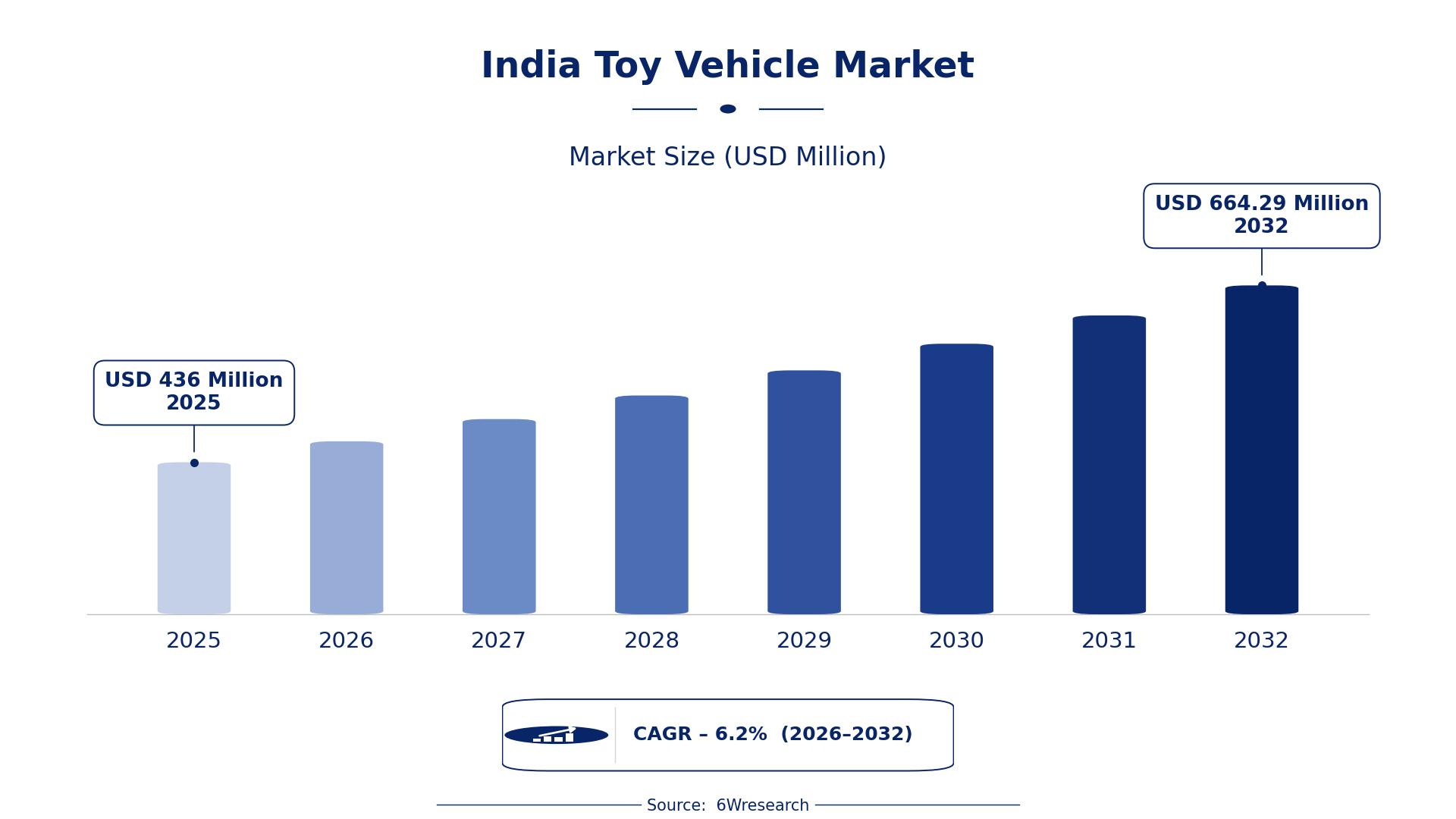
According to 6Wresearch internal database and industry insights, the India Toy Vehicle Market was valued at USD 436.0 million in 2025 and is projected to reach USD 664.29 million by 2032, growing at a CAGR of approximately 6.2% during 2026–2032.
India Toy Vehicle Market Highlights
| Report Metric | Details |
| Report Name | India Toy Vehicle Market |
| Market Size 2025 | USD 436.0 million |
| Market Size 2032 | USD 664.29 million |
| Absolute Growth 2025–2032 | USD 228.29 million |
| CAGR 2026–2032 | 6.2% |
| Peak Annual Growth | 8.7% in 2026 |
| Forecast Period | 2026–2032 |
| Historical Data | 2022–2025 |
| Base Year | 2025 |
| Leading Vehicle Type, 2025 | Die-Cast Vehicles (36% share) |
| Leading Power Type, 2025 | Battery Operated (42% share) |
| Leading Age Group, 2025 | 3–8 Years (44% share) |
| Leading End User, 2025 | Toy Stores (43% share) |
| Fastest-Growing Vehicle Type | Remote-Control Cars (8.0% CAGR) |
| Fastest-Growing Power Type | Rechargeable (8.7% CAGR) |
| Fastest-Growing End User | Online Platforms (7.5% CAGR) |
| Growing Sector | Toy Vehicles |
| Key End Users | Parents, Toy Stores, Online Retailers, Educational Institutions |
India Toy Vehicle Market Year-wise Growth Rate and Key Drivers (2022–2032)
This graph illustrates the annual growth rates of the market from 2022 to 2032, highlighting a steady upward trajectory and projected market expansion over the forecast period.
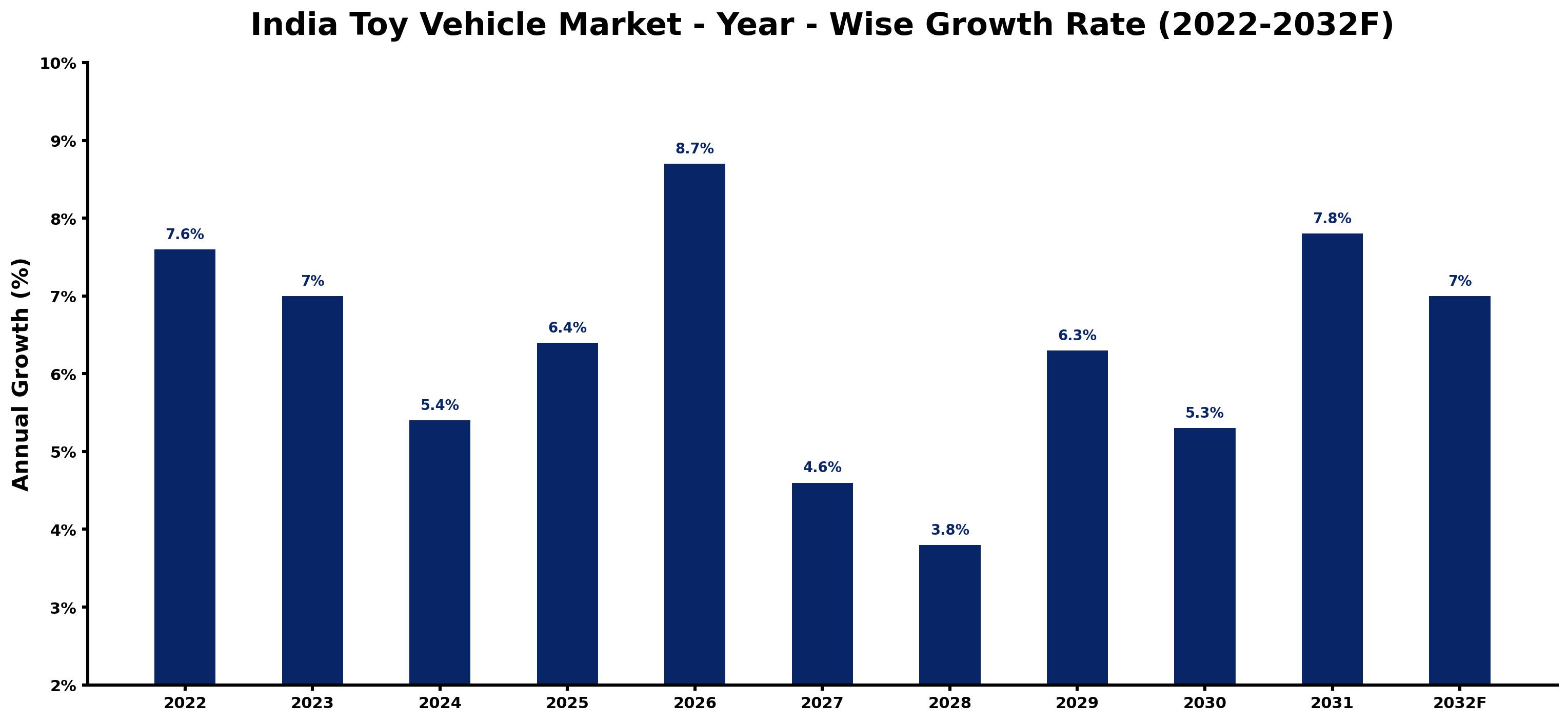
The table below sets out the estimated growth rate for each year and the main factor behind it.
| Year | Estimated Annual Growth (%) | Market Rationale |
| 2022 | 7.6 | The market experienced solid demand, driven by a growing population and increased spending on toys. |
| 2023 | 7.0 | Growth slowed as consumers adjusted spending patterns amid economic fluctuations and inflation concerns. |
| 2024 | 5.4 | Demand continued to slow, reflecting a cautious consumer approach and competition from alternative entertainment options. |
| 2025 | 6.4 | Growth picked up as the 'Toycathon' initiative spurred innovation and creativity in toy design. |
| 2026 | 8.7 | The market peaked as online sales surged by 30%, reflecting changing consumer purchasing habits. |
| 2027 | 4.6 | A slowdown occurred as competition intensified among local manufacturers and pricing pressures emerged. |
| 2028 | 3.8 | Growth further slowed due to market saturation and limited new product introductions. |
| 2029 | 6.3 | Demand rose again as the average household spending on toys increased to 2,500 INR annually. |
| 2030 | 5.3 | Growth slowed as economic uncertainties led to cautious consumer spending on non-essential items. |
| 2031 | 7.8 | An uptick in growth was driven by the National Toy Policy's support for local manufacturing initiatives. |
| 2032 | 7.0 | The market experienced another slowdown as buyers faced rising costs and shifting preferences. |
Note: Market size estimations and growth projections presented in this report are based on 6Wresearch's proprietary forecasting methodology, utilizing the latest available industry data, government publications, and primary research inputs.
India Toy Vehicle Market Synopsis
The Toy Vehicle Market in India encompasses a diverse array of toy vehicles crafted mainly from plastic, metal, and rubber. These products serve both entertainment and educational purposes, aiding children in developing their motor skills. The market is expanding, fuelled by a population of over 1.4 billion, with a substantial segment under the age of 14. Initiatives such as the 'Make in India' programme and the 'Toycathon' have further boosted demand, while online sales channels are growing swiftly. The market is projected to exceed 1,500 crore INR in 2023, indicating robust consumer interest.
Market Dynamics Impact Analysis (2026–2032)
| Factor | Type | Impact | Primary Segment Affected |
| Rising disposable incomes and urbanisation are driving demand for premium toy vehicles. | Driver | High | Battery Operated |
| The increasing popularity of online shopping is creating new sales channels for toy vehicles. | Driver | High | Online Platforms |
| The growing emphasis on educational toys presents opportunities for innovative toy manufacturers. | Opportunity | High | Construction Vehicles |
| The rise in children's festivals and fairs boosts the visibility and sales of toy vehicles. | Opportunity | Medium | Die-Cast Vehicles |
| Competition from international brands may pressure local manufacturers on pricing and quality. | Restraint | High | Remote-Control Cars |
| Safety concerns regarding toy quality can deter parents from purchasing certain products. | Restraint | Medium | Ride-On Toys |
| The market still has to solve a few problems, including fluctuating raw material costs. | Challenge | High | Battery Operated |
| Supply chain disruptions continue to impact the availability of toy vehicles in the market. | Challenge | Medium | Construction Vehicles |
Evaluation of Drivers in India Toy Vehicle Market (2026–2032)
Key forces behind demand, with the segment each one moves most, are listed below.
| Drivers | Primary Segment Affected | Why It Matters (Evidence) |
| Increasing urbanisation leads to higher disposable incomes, enabling families to spend more on toys. | Battery Operated | The average spending on toys in urban households is around 2,500 INR annually. |
| The rise of e-commerce platforms improves accessibility and convenience for toy buyers. | Online Platforms | Online sales of toy vehicles increased by 30% in 2023 compared to the previous year. |
| The 'Make in India' programme encourages local manufacturing, boosting production capacity. | Die-Cast Vehicles | This programme supports local manufacturers with incentives and subsidies, increasing competitiveness. |
| Growing interest in educational toys drives demand for innovative designs and features. | Construction Vehicles | The National Toy Policy aims to boost domestic toy manufacturing and exports by 2025. |
| Children's festivals and fairs create seasonal spikes in toy vehicle sales. | Ride-On Toys | Toy vehicles are often featured in children's festivals across the country. |
Growth in the Toy Vehicle market in India comes from rising disposable incomes, urbanisation, and increased online shopping. The average spending on toys in urban households is around 2,500 INR annually, enabling families to invest in higher-quality products. Online sales of toy vehicles surged by 30% in 2023, reflecting a shift in consumer purchasing habits. Seasonal demand spikes are driven by children's festivals and fairs, promoting toy vehicles. These factors contribute to the market's expansion.
Evaluation of Restraints in India Toy Vehicle Market
The following restraints limit how fast demand can grow.
| Market Restraint | Primary Segment Affected | Why It Matters (Evidence) |
| Fluctuating raw material costs can impact production budgets for manufacturers. | Battery Operated | Rising prices of plastics and metals affect overall production costs, limiting profit margins. |
| Safety concerns regarding toy quality can deter parents from purchasing certain products. | Ride-On Toys | Parents are increasingly cautious about toy safety standards, affecting buying decisions. |
| Competition from international brands may pressure local manufacturers on pricing and quality. | Remote-Control Cars | Local brands struggle to compete with established international players offering diverse products. |
| Supply chain disruptions continue to impact the availability of toy vehicles in the market. | Construction Vehicles | Logistical challenges hinder timely delivery of products to retailers and consumers. |
| Market saturation limits opportunities for new entrants and innovation in toy designs. | Die-Cast Vehicles | An oversupply of similar products makes differentiation difficult for new manufacturers. |
India Toy Vehicle Market Challenges
The India Toy Vehicle Market still has to solve a few problems, starting with a skills gap in manufacturing. Many local producers struggle to find skilled workers, which can delay production timelines and increase costs by up to 15% for manufacturers. Buyers face challenges with safety compliance, as the Bureau of Indian Standards mandates strict regulations, leading to potential product recalls that can cost retailers around 2,500 INR per unit. Competition from imported toy vehicles is intensifying, as foreign brands often offer lower prices, forcing local suppliers to reduce margins and impacting their profitability. Regulatory changes can create uncertainty; for instance, new standards may require additional testing, which can add weeks to product launches for producers.
Trends in the India Toy Vehicle Market
Below mentioned are some of the trends shaping the India Toy Vehicle Market growth.
- Shift to Online Purchasing: Toy stores are increasingly focusing on online sales channels, supported by the Digital India campaign. In 2023, online sales of toy vehicles increased by 30%, reflecting changing consumer preferences. This shift allows buyers to access a wider variety of products conveniently.
- Growing Interest in Educational Toys: The emphasis on educational toys has gained traction since the launch of the National Toy Policy in 2021. With a target to boost domestic manufacturing by 2025, the market for educational toy vehicles is expanding. This trend encourages manufacturers to innovate and develop new products.
- Rise of Eco-Friendly Toys: The demand for sustainable toy vehicles has been increasing since 2022, as consumers become more environmentally conscious. The focus on eco-friendly materials aligns with global trends, prompting manufacturers to adapt their production processes. This shift is reshaping product offerings in the market.
- Increased Participation in Toy Design Competitions: The 'Toycathon' initiative, launched in 2022, has encouraged innovation in toy design. With over 1,000 participants, this competition highlights the growing interest in unique and creative toy vehicles. The trend promotes a culture of innovation among manufacturers.
Investment Opportunities in the India Toy Vehicle Market
Below are the investment opportunities with the strongest case in the India Toy Vehicle Market.
- Growing Demand for Educational Toys: With the focus on educational toys, manufacturers can concentrate on designs that facilitate learning. The National Toy Policy aims to enhance domestic manufacturing by 2025, presenting an opportunity for local producers to invest in educational toy vehicles.
- Expansion of Online Sales Channels: The rise of online shopping offers a promising opportunity, with online sales of toy vehicles increasing by 30% in 2023. Toy stores can strengthen their online presence to attract more customers and boost sales.
- Investment in Eco-Friendly Toy Production: The increasing consumer preference for sustainable products generates a demand for eco-friendly toy vehicles. Manufacturers can invest in sustainable materials and processes to tap into this emerging market segment.
- Participation in Children's Festivals: The growing number of children's festivals and fairs provides opportunities for toy manufacturers to showcase their products. Engaging in these events can enhance brand visibility and drive sales among families.
Government Initiatives in the India Toy Vehicle Market
The Bureau of Indian Standards (BIS) manages the enforcement of safety standards for toys, ensuring compliance among manufacturers. The agency conducts regular inspections and approvals, promoting high-quality toy vehicles in the market. The 'Digital India' campaign finances initiatives that improve online sales platforms, enhancing accessibility for consumers. This campaign encourages local manufacturers to adopt digital transformation, broadening their reach to a wider audience.
The Ministry of Consumer Affairs revised the 'Toy Quality Control Order' in 2020 to uphold safety standards for toy vehicles sold in India. This measure mandates manufacturers to comply with rigorous quality checks, ensuring that products meet safety requirements before reaching consumers. The initiative aims to protect children and build trust among buyers, ultimately benefiting the toy vehicle market.
Future Insight of the India Toy Vehicle Market
Several forward-looking factors should support the India Toy Vehicle Market over the coming years. The 'Make in India' initiative will likely strengthen local manufacturing capabilities, improving supply chain resilience. By 2025, the National Toy Policy aims to boost domestic production and exports, benefiting both buyers and suppliers. Online sales are expected to continue rising, contributing to the market's growth, with a notable 30% increase already recorded in 2023. The 'Toycathon' initiative is set to promote innovation in toy design, encouraging a new wave of creative toy vehicles.
Market Segmentation Analysis
The analysis below covers each segmentation, its leading category in 2025 and its fastest-growing category through 2032.
By Vehicle Type – Die-Cast Vehicles Dominated, Remote-Control Cars Expected to Grow Fastest
According to Vasudha, AM at 6Wresearch, in 2025, Die-Cast Vehicles led the vehicle type split with a 36% share. Die-Cast Vehicles hold the largest share in the India Toy Vehicle Market as they are highly collectible and popular among children and adults alike. Their extensive availability in toy stores and online platforms ensures they remain a preferred choice for many buyers. The quickest growth will come from Remote-Control Cars, forecast to expand at a CAGR of 8.0% between 2026 and 2032. Remote-Control Cars are experiencing rapid growth due to their ability to engage children in interactive play, which enhances their coordination skills. The increasing trend towards technology-driven toys is significantly boosting demand for these exciting products. Suppliers should focus on expanding their remote-control offerings to capture the growing interest among consumers.
By Power Type – Battery Operated Dominated, Rechargeable Expected to Grow Fastest
Battery Operated accounted for a 42% market share by power type in 2025. Battery Operated toys dominate the market share as they provide interactive and engaging play experiences that captivate children. Their widespread availability and ability to deliver fun make them a preferred choice for parents seeking entertaining options for their kids. Rechargeable is projected to grow fastest, at a CAGR of 8.7% during 2026–2032. Rechargeable toys are gaining popularity due to their convenience and sustainability, appealing to parents who prioritise eco-friendly products. The rising consumer preference for sustainable options is propelling this segment's rapid growth. Suppliers should consider enhancing their rechargeable toy lines to meet the rising demand for sustainable options.
By Age Group – 3–8 Years Dominated and Is Expected to Record the Fastest Growth
The largest age group category in 2025 was 3–8 Years, with a 44% share of total revenue. The 3–8 Years age group commands the largest share of the toy vehicle market, as it is the primary target for most toy vehicles designed to foster development. This demographic's significant size in India ensures a consistent demand for products tailored to their needs. Its lead should widen, with a projected CAGR of 8.8% during 2026–2032, the highest in this split. With the 3–8 Years segment also being the fastest growing, the sustained interest in developmental toys will likely widen its lead. The focus on educational and skill-building toys within this age group ensures ongoing growth. Suppliers should prioritise product development for this age group to capitalise on the growing market potential.
By End User – Toy Stores Dominated, Online Platforms Expected to Grow Fastest
With a 43% revenue share in 2025, Toy Stores was the largest end user category. Toy Stores are the leading end user in the India Toy Vehicle Market, serving as the primary retail channel that offers a wide variety of toy vehicles. Their established presence and customer trust contribute to their dominant market share. Online Platforms are set to record the highest CAGR in this split, 7.5% over 2026–2032. Online Platforms are rapidly becoming the fastest growing channel due to their convenience and extensive product variety. The surge in online shopping, particularly following the pandemic, is significantly driving this growth. Suppliers should strengthen their online presence to leverage the increasing trend of online sales in the toy vehicle market.
Key Attractiveness of the Report
- 10 Years of Market Numbers
- Historical Data Starting from 2022 to 2025
- Base Year 2025
- Forecast Data until 2032
- Key Performance Indicators Impacting the Market
- Major Upcoming Developments and Projects
Key Highlights of the Report:
- India Toy Vehicle Market Outlook
- Market Size of India Toy Vehicle Market, 2025
- Forecast of India Toy Vehicle Market, 2032
- Historical Data and Forecast of India Toy Vehicle Revenues & Volume for the Period 2022 - 2032F
- India Toy Vehicle Market Trend Evolution
- India Toy Vehicle Market Drivers and Challenges
- India Toy Vehicle Price Trends
- India Toy Vehicle Porter's Five Forces
- India Toy Vehicle Industry Life Cycle
- Historical Data and Forecast of India Toy Vehicle Market Revenues & Volume By Vehicle Type for the Period 2022 - 2032F
- Historical Data and Forecast of India Toy Vehicle Market Revenues & Volume By Die-Cast Vehicles for the Period 2022 - 2032F
- Historical Data and Forecast of India Toy Vehicle Market Revenues & Volume By Remote-Control Cars for the Period 2022 - 2032F
- Historical Data and Forecast of India Toy Vehicle Market Revenues & Volume By Ride-On Toys for the Period 2022 - 2032F
- Historical Data and Forecast of India Toy Vehicle Market Revenues & Volume By Construction Vehicles for the Period 2022 - 2032F
- Historical Data and Forecast of India Toy Vehicle Market Revenues & Volume By Power Type for the Period 2022 - 2032F
- Historical Data and Forecast of India Toy Vehicle Market Revenues & Volume By Manual Push for the Period 2022 - 2032F
- Historical Data and Forecast of India Toy Vehicle Market Revenues & Volume By Battery Operated for the Period 2022 - 2032F
- Historical Data and Forecast of India Toy Vehicle Market Revenues & Volume By Rechargeable for the Period 2022 - 2032F
- Historical Data and Forecast of India Toy Vehicle Market Revenues & Volume By Mechanical for the Period 2022 - 2032F
- Historical Data and Forecast of India Toy Vehicle Market Revenues & Volume By Age Group for the Period 2022 - 2032F
- Historical Data and Forecast of India Toy Vehicle Market Revenues & Volume By 3 8 Years for the Period 2022 - 2032F
- Historical Data and Forecast of India Toy Vehicle Market Revenues & Volume By 6 14 Years for the Period 2022 - 2032F
- Historical Data and Forecast of India Toy Vehicle Market Revenues & Volume By 2 6 Years for the Period 2022 - 2032F
- Historical Data and Forecast of India Toy Vehicle Market Revenues & Volume By 4 10 Years for the Period 2022 - 2032F
- Historical Data and Forecast of India Toy Vehicle Market Revenues & Volume By End User for the Period 2022 - 2032F
- Historical Data and Forecast of India Toy Vehicle Market Revenues & Volume By Toy Stores for the Period 2022 - 2032F
- Historical Data and Forecast of India Toy Vehicle Market Revenues & Volume By Electronics Retailers for the Period 2022 - 2032F
- Historical Data and Forecast of India Toy Vehicle Market Revenues & Volume By Department Stores for the Period 2022 - 2032F
- Historical Data and Forecast of India Toy Vehicle Market Revenues & Volume By Online Platforms for the Period 2022 - 2032F
- India Toy Vehicle Import Export Trade Statistics
- Market Opportunity Assessment By Vehicle Type
- Market Opportunity Assessment By Power Type
- Market Opportunity Assessment By Age Group
- Market Opportunity Assessment By End User
- India Toy Vehicle Top Companies Market Share
- India Toy Vehicle Competitive Benchmarking By Technical and Operational Parameters
- India Toy Vehicle Company Profiles
- India Toy Vehicle Key Strategic Recommendations
Market Covered
The report offers an extensive study of the following market segments.
By Vehicle Type
- Die-Cast Vehicles
- Remote-Control Cars
- Ride-On Toys
- Construction Vehicles
By Power Type
- Manual Push
- Battery Operated
- Rechargeable
- Mechanical
By Age Group
- 3–8 Years
- 6–14 Years
- 2–6 Years
- 4–10 Years
By End User
- Toy Stores
- Electronics Retailers
- Department Stores
- Online Platforms































