India Traffic Management AI Market Size & Growth Rate
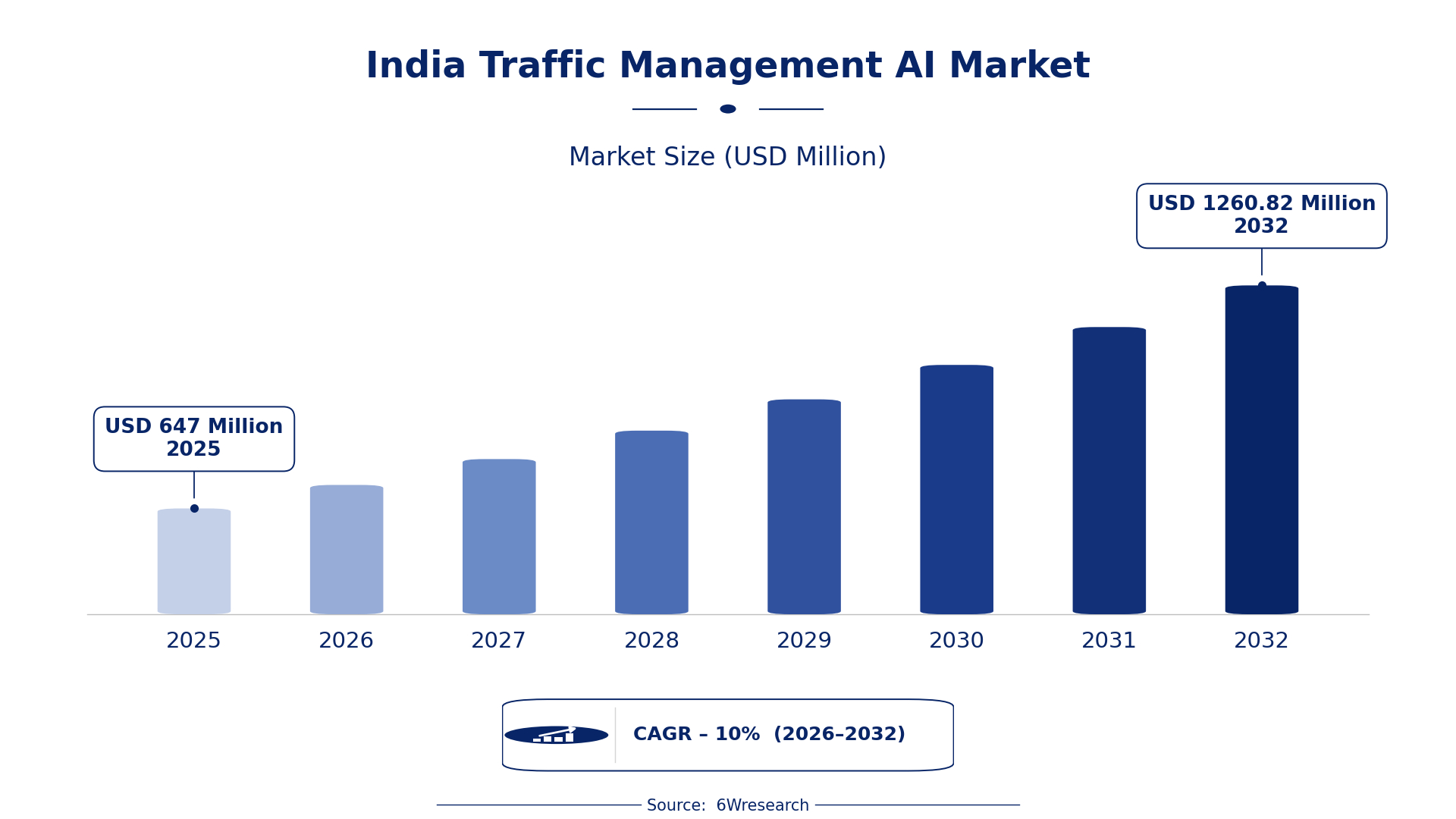
According to 6Wresearch internal database and industry insights, the India Traffic Management AI Market was valued at USD 647.0 million in 2025 and is projected to reach USD 1,260.82 million by 2032, growing at a CAGR of approximately 10% during 2026–2032.
India Traffic Management AI Market Highlights
| Report Metric | Details |
| Report Name | India Traffic Management AI Market |
| Market Size 2025 | USD 647.0 million |
| Market Size 2032 | USD 1,260.82 million |
| Absolute Growth 2025–2032 | USD 613.82 million |
| CAGR 2026–2032 | 10% |
| Peak Annual Growth | 12.9% in 2032 |
| Forecast Period | 2026–2032 |
| Historical Data | 2022–2025 |
| Base Year | 2025 |
| Leading Traffic Management AI, 2025 | Predictive Traffic Tools (51% share) |
| Leading Solution Type, 2025 | Traffic Flow AI (39% share) |
| Leading AI Capability, 2025 | Real-Time Forecasting (38% share) |
| Leading Distribution Channel, 2025 | SaaS Vendors (43% share) |
| Leading End User Industry, 2025 | City Traffic Control (44% share) |
| Fastest-Growing Traffic Management AI | Incident Detection AI (12.4% CAGR) |
| Fastest-Growing Solution Type | Adaptive Signals (11.8% CAGR) |
| Fastest-Growing AI Capability | ML-Based Optimization (12.4% CAGR) |
| Fastest-Growing End User Industry | Urban Transport Bureaus (12.7% CAGR) |
| Growing Sector | City Traffic Control |
| Key End Users | Municipal Agencies, Urban Transport Bureaus, City Traffic Control Departments |
India Traffic Management AI Market Year-wise Growth Rate and Key Drivers (2022–2032)
This graph illustrates the annual growth rates of the market from 2022 to 2032, highlighting a steady upward trajectory and projected market expansion over the forecast period.
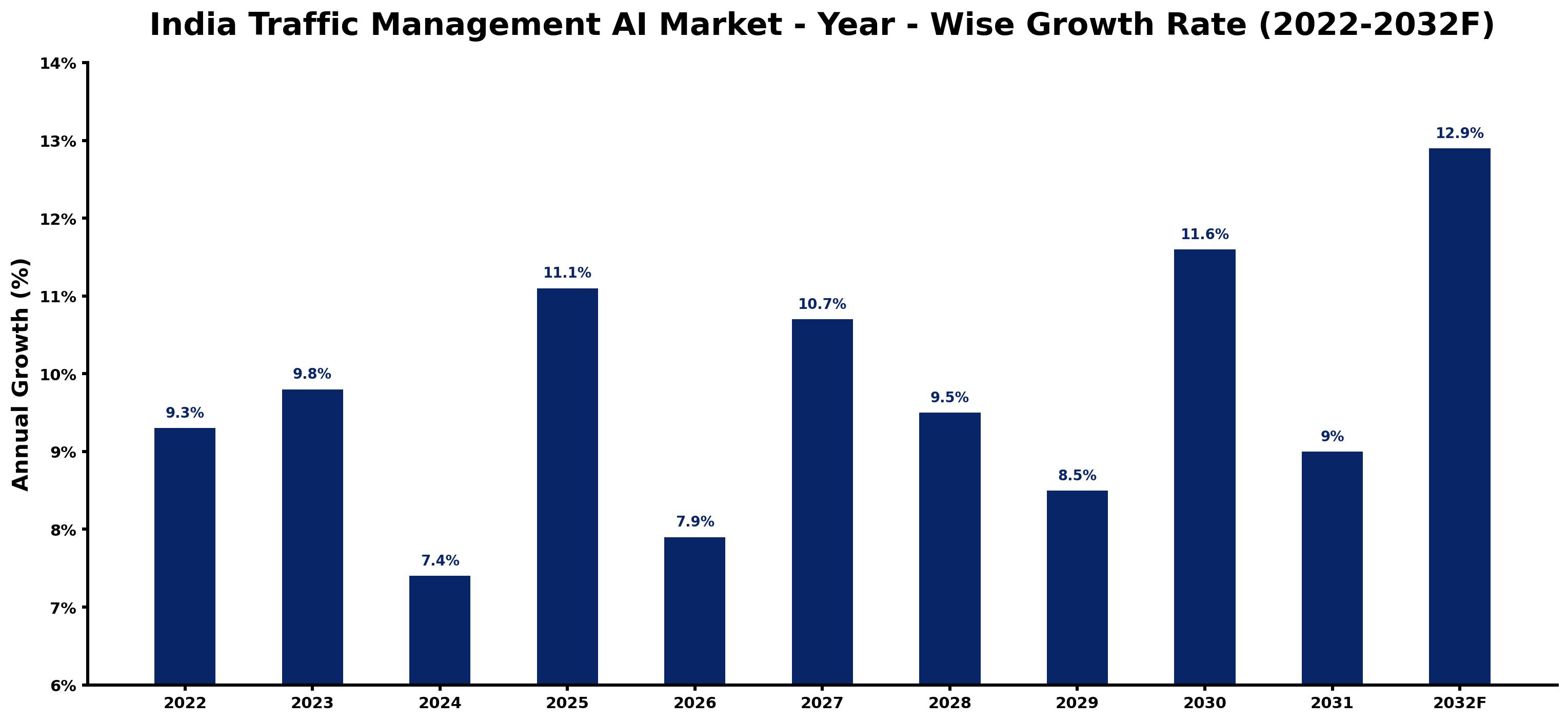
Below, each year's estimated growth is shown next to the factor that most influenced it.
| Year | Estimated Annual Growth (%) | Market Rationale |
| 2022 | 9.3 | The market experienced steady growth due to the implementation of the Smart Cities Mission. |
| 2023 | 9.8 | Demand rose as urban transport bureaus adopted AI solutions for traffic management. |
| 2024 | 7.4 | Growth slowed as some cities faced budget constraints on technology investments. |
| 2025 | 11.1 | The implementation of the Intelligent Transport System programme boosted market expansion. |
| 2026 | 7.9 | A slight slowdown occurred as cities adjusted to new AI technologies. |
| 2027 | 10.7 | Demand increased with the rise of smart city initiatives across urban areas. |
| 2028 | 9.5 | Growth decelerated as some regions faced infrastructure challenges. |
| 2029 | 8.5 | The market continued to grow due to ongoing urbanisation trends. |
| 2030 | 11.6 | Demand surged as urban transport bureaus adopted advanced AI solutions. |
| 2031 | 9.0 | Growth slowed as cities focused on integrating existing systems. |
| 2032 | 12.9 | The market peaked as AI-based solutions became standard in traffic management. |
Note: Market size estimations and growth projections presented in this report are based on 6Wresearch's proprietary forecasting methodology, utilizing the latest available industry data, government publications, and primary research inputs.
India Traffic Management AI Market Synopsis
Traffic Management AI in India encompasses advanced technologies that optimise traffic flow and improve urban mobility. These systems utilise data collection, machine learning, and real-time analytics for predictive traffic management and incident detection. The India Traffic Management AI Market is expanding due to urban population growth and initiatives like the Smart Cities Mission. By 2031, India's urban population is projected to reach 600 million, significantly increasing the demand for efficient traffic management solutions. Municipal agencies and urban transport departments are key buyers, driving the adoption of these technologies.
Market Dynamics Impact Analysis (2026–2032)
| Factor | Type | Impact | Primary Segment Affected |
| Increasing urban population leads to higher traffic management needs. | Driver | High | City Traffic Control |
| Investment in smart traffic technologies enhances operational efficiency. | Driver | High | Traffic Flow AI |
| Growing demand for smart city solutions creates opportunities for AI integration. | Opportunity | High | Urban Transport Bureaus |
| Expansion of the Intelligent Transport System programme supports new projects. | Opportunity | Medium | Municipal Agencies |
| Budget constraints limit technology adoption in some regions. | Restraint | High | Incident Detection AI |
| Traffic congestion costs the economy significantly, affecting investments. | Restraint | Medium | Parking & Congestion AI |
| The Traffic Management AI market faces integration challenges with existing systems. | Challenge | High | Smart Signaling Systems |
| Limited awareness of AI benefits among smaller municipalities hinders growth. | Challenge | Medium | Predictive Traffic Tools |
Evaluation of Drivers in India Traffic Management AI Market (2026–2032)
The factors lifting demand, and the evidence behind each, are summarised below.
| Drivers | Primary Segment Affected | Why It Matters (Evidence) |
| Urban population growth drives demand for traffic management solutions. | City Traffic Control | India's urban population is projected to reach 600 million by 2031, increasing traffic management needs. |
| Investment in smart technologies boosts traffic management efficiency. | Traffic Flow AI | The National Urban Transport Policy promotes sustainable urban transport solutions since 2014. |
| The Smart Cities Mission supports the development of advanced traffic systems. | Municipal Agencies | The Smart Cities Mission aims to develop 100 smart cities, enhancing traffic management systems. |
| AI-based solutions improve traffic flow and reduce congestion. | Incident Detection AI | AI-based traffic management systems can reduce travel time by up to 30% in urban areas. |
| Government funding supports the implementation of smart traffic solutions. | Parking & Congestion AI | The Ministry of Road Transport and Highways launched the Intelligent Transport System programme in 2021. |
Growth across the Traffic Management AI market in India is anchored in rising urban population, increasing investments in smart technologies, and the Smart Cities Mission. The projected urban population of 600 million by 2031 boosts demand for effective traffic management solutions. As urban transport bureaus seek efficient systems, the demand for advanced traffic management technologies continues to rise.
Evaluation of Restraints in India Traffic Management AI Market
The table below lists the restraints and the evidence behind each.
| Market Restraint | Primary Segment Affected | Why It Matters (Evidence) |
| Budget constraints limit the adoption of advanced technologies. | Incident Detection AI | Some municipalities struggle to allocate funds for new AI systems amidst competing priorities. |
| Traffic congestion costs the economy, affecting investments. | Parking & Congestion AI | Traffic congestion in major cities costs India approximately $22 billion annually in lost productivity. |
| Integration challenges with existing systems hinder market growth. | Smart Signaling Systems | Many cities face difficulties in integrating new AI solutions with outdated infrastructure. |
| Limited awareness of AI benefits among smaller municipalities. | Predictive Traffic Tools | Smaller municipalities often lack the resources to understand and implement AI technologies. |
| Regulatory hurdles slow down the deployment of new technologies. | Traffic Flow AI | Bureau of Indian Standards guidelines can delay the approval of new traffic management systems. |
India Traffic Management AI Market Challenges
Traffic congestion in major cities costs India approximately $22 billion annually in lost productivity, creating fierce competition among municipalities to implement effective traffic management AI solutions. This competition results in fragmented initiatives, which delay the integration of cohesive systems for urban transport departments. Producers encounter supply chain disruptions due to reliance on imported technology components, extending project timelines by up to six months for suppliers. Regulatory compliance with the Bureau of Indian Standards complicates operations, often leading to increased costs for suppliers striving to meet quality and safety benchmarks.
Trends in the India Traffic Management AI Market
Buyers and suppliers in the India Traffic Management AI Market are adjusting to the following trends.
- Shift towards AI-Driven Traffic Solutions: More than 50% of urban areas in India have embraced some form of AI for traffic management as of 2023, indicating a shift towards technology-driven solutions. This trend is bolstered by the Smart Cities Mission, which seeks to enhance urban infrastructure.
- Increase in Real-Time Traffic Monitoring: The adoption of AI-based traffic management systems has resulted in improved real-time traffic monitoring capabilities. For example, the Delhi Traffic Police implemented AI solutions in 2022 to manage congestion effectively, enhancing response times.
- Expansion of Intelligent Transport Systems: The National Intelligent Transport System Policy, initiated in 2021, encourages the integration of smart traffic solutions throughout India. This policy aims to improve traffic management efficiency, with a budget allocation of $1.2 billion.
- Growing Demand for Predictive Traffic Management: Municipal agencies are increasingly pursuing predictive traffic management tools to optimise flow. The National Institute of Urban Affairs is researching AI applications, reflecting a shift towards data-driven decision-making.
Investment Opportunities in the India Traffic Management AI Market
Several openings in the India Traffic Management AI Market merit attention from investors.
- Investment in AI-Based Traffic Solutions: The demand for AI-based traffic management solutions is growing, with urban transport bureaus seeking efficient systems. Investing in predictive traffic tools can capture this market, especially in rapidly urbanising regions.
- Supply of Smart Signaling Systems: City traffic control departments require advanced signalling systems to improve traffic flow. Providing adaptive signals can meet this need, particularly in metropolitan areas with high congestion levels.
- Development of Real-Time Traffic Analytics Tools: There is a rising need for real-time traffic analytics tools among municipal agencies. Entering this market through partnerships with local governments can facilitate access to urban projects.
- Provision of Parking Management Solutions: With increasing vehicle numbers, effective parking management solutions are essential. Focusing on parking prediction systems can help urban areas manage resources better and reduce congestion.
Government Initiatives in the India Traffic Management AI Market
The National Intelligent Transport System (ITS) Policy, initiated in 2021, enhances the previous National Urban Transport Policy by promoting smart traffic solutions across India. This policy aims to integrate AI technologies into urban transport planning, ensuring efficient traffic management. The government allocated significant funding to support the implementation of these systems, which is vital for modernising traffic infrastructure. The policy is designed to streamline operations and improve overall traffic efficiency for urban transport departments.
The Ministry of Housing and Urban Affairs oversees the Smart Cities Mission, which funds the development of urban infrastructure, including traffic management systems. This initiative supports municipalities in implementing AI technologies, improving urban mobility. Additionally, the Ministry of Road Transport and Highways approves projects under the Intelligent Transport System programme, ensuring compliance with national standards. This approval process facilitates the adoption of advanced traffic management solutions.
Future Insight of the India Traffic Management AI Market
The Traffic Management AI market in India is set for transformation by 2032, driven by urban population growth and the Smart Cities Mission, which aims to establish 100 smart cities. The Intelligent Transport System programme will boost operational efficiency and promote sustainable transport solutions. Research from the National Institute of Urban Affairs will spur innovation in AI applications, while the adoption of AI in over 50% of urban areas will significantly enhance traffic flow and reduce travel times, benefiting both buyers and suppliers.
Market Segmentation Analysis
The analysis below covers each segmentation, its leading category in 2025 and its fastest-growing category through 2032.
By Traffic Management AI – Predictive Traffic Tools Dominated, Incident Detection AI Expected to Grow Fastest
According to Vasudha, AM at 6Wresearch, Predictive Traffic Tools held a 51% share of the India Traffic Management AI Market by traffic management ai in 2025. Predictive Traffic Tools hold the largest share in the India Traffic Management AI Market as they are essential for forecasting traffic patterns, particularly in rapidly urbanising areas. With over 50% of urban areas adopting these tools, their importance in optimising traffic flow cannot be overstated. The quickest growth will come from Incident Detection AI, forecast to expand at a CAGR of 12.4% between 2026 and 2032. Incident Detection AI is experiencing rapid growth due to the pressing need for systems that automatically identify accidents and alert authorities, especially considering the $22 billion annual cost of traffic congestion. As cities increasingly invest in comprehensive traffic solutions, this segment's expansion will further solidify the dominance of Predictive Traffic Tools. Suppliers should enhance predictive capabilities to meet the growing demands from urban planners and transport authorities.
By Solution Type – Traffic Flow AI Dominated, Adaptive Signals Expected to Grow Fastest
With a 39% revenue share in 2025, Traffic Flow AI was the largest solution type category. Traffic Flow AI commands the largest share as it effectively optimizes traffic movement using real-time data, addressing the urgent need for efficient urban mobility solutions. This is especially critical as major cities contend with rising vehicle numbers and congestion challenges. Adaptive Signals are set to record the highest CAGR in this split, 11.8% over 2026–2032. Adaptive Signals are experiencing rapid growth as they dynamically adjust signal timings based on current traffic conditions, providing a responsive approach to urban congestion. The alignment of this technology with the Smart Cities Mission's objectives will further accelerate its adoption. Buyers should invest in adaptive solutions to improve traffic management efficiency and mitigate congestion.
By AI Capability – Real-Time Forecasting Dominated, ML-Based Optimization Expected to Grow Fastest
Real-Time Forecasting accounted for a 38% market share by ai capability in 2025. Real-Time Forecasting leads the market by providing immediate traffic predictions that are crucial for users navigating congested urban environments. This capability is increasingly sought after as cities strive to improve travel times and overall traffic management. ML-Based Optimization is projected to grow fastest, at a CAGR of 12.4% during 2026–2032. ML-Based Optimization is advancing swiftly as it applies machine learning techniques to enhance traffic systems, making them more efficient. The complexity of urban traffic patterns necessitates such sophisticated solutions, propelling this segment's growth. Suppliers must focus on machine learning capabilities to stay competitive in the traffic management market.
By Distribution Channel – SaaS Vendors Dominated and Is Expected to Record the Fastest Growth
SaaS Vendors took a 43% share of distribution channel in 2025, more than any other category. SaaS Vendors dominate the distribution channel by delivering scalable software solutions that are essential for effective traffic management. Their flexibility and accessibility make them the preferred choice for numerous municipal agencies and urban transport departments. SaaS Vendors are also forecast to expand faster than any other category, at a CAGR of 11.3% over 2026–2032. SaaS Vendors are also the fastest-growing segment, as their solutions can be rapidly deployed and updated to address the immediate needs of urban traffic systems. The increasing reliance on cloud-based solutions is a significant factor in this growth. Suppliers should prioritise the development of robust SaaS offerings to capture the rising demand in the traffic management sector.
By End User Industry – City Traffic Control Dominated, Urban Transport Bureaus Expected to Grow Fastest
The largest end user industry category in 2025 was City Traffic Control, with a 44% share of total revenue. City Traffic Control is the leading end user industry due to its critical role in managing urban traffic systems effectively. As urban areas expand, the need for efficient traffic control mechanisms becomes increasingly vital. The quickest growth will come from Urban Transport Bureaus, forecast to expand at a CAGR of 12.7% between 2026 and 2032. Urban Transport Bureaus are growing quickly as they focus on improving urban transportation systems, responding to the challenges posed by rising urban populations. Their initiatives align with national policies promoting sustainable transport solutions. Buyers should engage with urban transport bureaus to align their solutions with emerging urban mobility initiatives.
Key Attractiveness of the Report
- 10 Years of Market Numbers
- Historical Data Starting from 2022 to 2025
- Base Year 2025
- Forecast Data until 2032
- Key Performance Indicators Impacting the Market
- Major Upcoming Developments and Projects
Key Highlights of the Report:
- India Traffic Management AI Market Outlook
- Market Size of India Traffic Management AI Market, 2025
- Forecast of India Traffic Management AI Market, 2032
- Historical Data and Forecast of India Traffic Management AI Revenues & Volume for the Period 2022 - 2032F
- India Traffic Management AI Market Trend Evolution
- India Traffic Management AI Market Drivers and Challenges
- India Traffic Management AI Price Trends
- India Traffic Management AI Porter's Five Forces
- India Traffic Management AI Industry Life Cycle
- Historical Data and Forecast of India Traffic Management AI Market Revenues & Volume By Traffic Management AI for the Period 2022 - 2032F
- Historical Data and Forecast of India Traffic Management AI Market Revenues & Volume By Predictive Traffic Tools for the Period 2022 - 2032F
- Historical Data and Forecast of India Traffic Management AI Market Revenues & Volume By Smart Signaling Systems for the Period 2022 - 2032F
- Historical Data and Forecast of India Traffic Management AI Market Revenues & Volume By Incident Detection AI for the Period 2022 - 2032F
- Historical Data and Forecast of India Traffic Management AI Market Revenues & Volume By Parking & Congestion AI for the Period 2022 - 2032F
- Historical Data and Forecast of India Traffic Management AI Market Revenues & Volume By Solution Type for the Period 2022 - 2032F
- Historical Data and Forecast of India Traffic Management AI Market Revenues & Volume By Traffic Flow AI for the Period 2022 - 2032F
- Historical Data and Forecast of India Traffic Management AI Market Revenues & Volume By Adaptive Signals for the Period 2022 - 2032F
- Historical Data and Forecast of India Traffic Management AI Market Revenues & Volume By Video Analytics for the Period 2022 - 2032F
- Historical Data and Forecast of India Traffic Management AI Market Revenues & Volume By Parking Prediction for the Period 2022 - 2032F
- Historical Data and Forecast of India Traffic Management AI Market Revenues & Volume By AI Capability for the Period 2022 - 2032F
- Historical Data and Forecast of India Traffic Management AI Market Revenues & Volume By Real-Time Forecasting for the Period 2022 - 2032F
- Historical Data and Forecast of India Traffic Management AI Market Revenues & Volume By ML-Based Optimization for the Period 2022 - 2032F
- Historical Data and Forecast of India Traffic Management AI Market Revenues & Volume By Deep Learning Vision for the Period 2022 - 2032F
- Historical Data and Forecast of India Traffic Management AI Market Revenues & Volume By IoT + AI Integration for the Period 2022 - 2032F
- Historical Data and Forecast of India Traffic Management AI Market Revenues & Volume By Distribution Channel for the Period 2022 - 2032F
- Historical Data and Forecast of India Traffic Management AI Market Revenues & Volume By SaaS Vendors for the Period 2022 - 2032F
- Historical Data and Forecast of India Traffic Management AI Market Revenues & Volume By ITS Integrators for the Period 2022 - 2032F
- Historical Data and Forecast of India Traffic Management AI Market Revenues & Volume By AV System Vendors for the Period 2022 - 2032F
- Historical Data and Forecast of India Traffic Management AI Market Revenues & Volume By Cloud Platform Vendors for the Period 2022 - 2032F
- Historical Data and Forecast of India Traffic Management AI Market Revenues & Volume By End User Industry for the Period 2022 - 2032F
- Historical Data and Forecast of India Traffic Management AI Market Revenues & Volume By City Traffic Control for the Period 2022 - 2032F
- Historical Data and Forecast of India Traffic Management AI Market Revenues & Volume By Municipal Agencies for the Period 2022 - 2032F
- Historical Data and Forecast of India Traffic Management AI Market Revenues & Volume By Highway Authorities for the Period 2022 - 2032F
- Historical Data and Forecast of India Traffic Management AI Market Revenues & Volume By Urban Transport Bureaus for the Period 2022 - 2032F
- India Traffic Management AI Import Export Trade Statistics
- Market Opportunity Assessment By Traffic Management AI
- Market Opportunity Assessment By Solution Type
- Market Opportunity Assessment By AI Capability
- Market Opportunity Assessment By Distribution Channel
- Market Opportunity Assessment By End User Industry
- India Traffic Management AI Top Companies Market Share
- India Traffic Management AI Competitive Benchmarking By Technical and Operational Parameters
- India Traffic Management AI Company Profiles
- India Traffic Management AI Key Strategic Recommendations
Market Covered
The report offers an extensive study of the following market segments.
By Traffic Management AI
- Predictive Traffic Tools
- Smart Signaling Systems
- Incident Detection AI
- Parking & Congestion AI
By Solution Type
- Traffic Flow AI
- Adaptive Signals
- Video Analytics
- Parking Prediction
By AI Capability
- Real-Time Forecasting
- ML-Based Optimization
- Deep Learning Vision
- IoT + AI Integration
By Distribution Channel
- SaaS Vendors
- ITS Integrators
- AV System Vendors
- Cloud Platform Vendors
By End User Industry
- City Traffic Control
- Municipal Agencies
- Highway Authorities
- Urban Transport Bureaus































