India Transformer Core Materials Market Size & Growth Rate
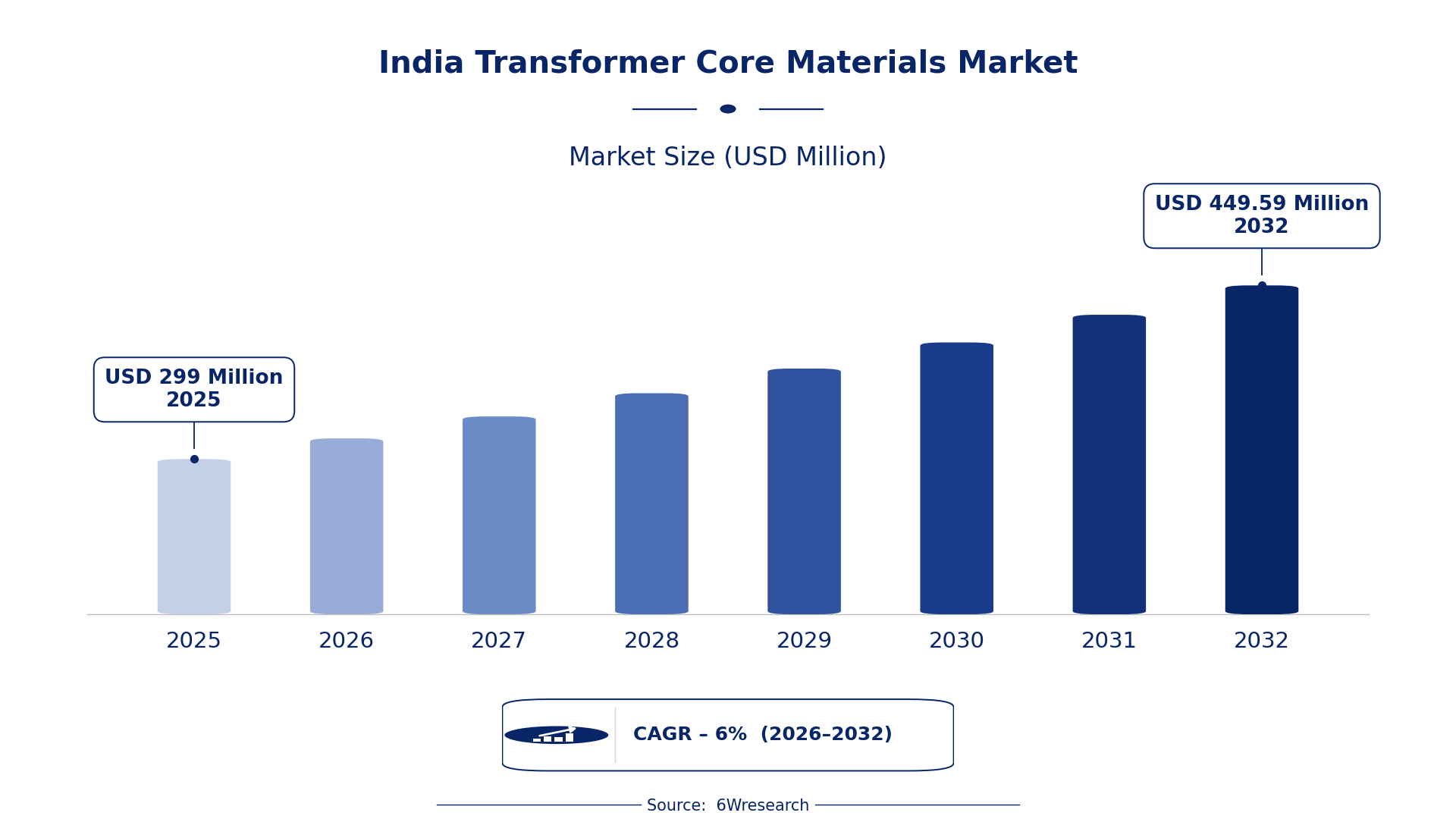
According to 6Wresearch internal database and industry insights, the India Transformer Core Materials Market was valued at USD 299.0 million in 2025 and is projected to reach USD 449.59 million by 2032, growing at a CAGR of approximately 6% during 2026–2032.
India Transformer Core Materials Market Highlights
| Report Metric | Details |
| Report Name | India Transformer Core Materials Market |
| Market Size 2025 | USD 299.0 million |
| Market Size 2032 | USD 449.59 million |
| Absolute Growth 2025–2032 | USD 150.59 million |
| CAGR 2026–2032 | 6% |
| Peak Annual Growth | 8.1% in 2030 |
| Forecast Period | 2026–2032 |
| Historical Data | 2022–2025 |
| Base Year | 2025 |
| Leading Material Type, 2025 | Silicon Steel (43% share) |
| Leading Magnetic Properties, 2025 | High Permeability (42% share) |
| Leading Application Type, 2025 | Distribution Transformers (39% share) |
| Leading End User, 2025 | Power Utilities (35% share) |
| Fastest-Growing Material Type | Amorphous Steel (8.7% CAGR) |
| Fastest-Growing Magnetic Properties | Low Core Loss (8.8% CAGR) |
| Fastest-Growing Application Type | Energy-Efficient Models (7.7% CAGR) |
| Fastest-Growing End User | Transformer OEMs (7.4% CAGR) |
| Growing Sector | Power Utilities |
| Key End Users | Power Utilities, Transformer OEMs, Smart Grid Developers |
India Transformer Core Materials Market Year-wise Growth Rate and Key Drivers (2022–2032)
This graph illustrates the annual growth rates of the market from 2022 to 2032, highlighting a steady upward trajectory and projected market expansion over the forecast period.
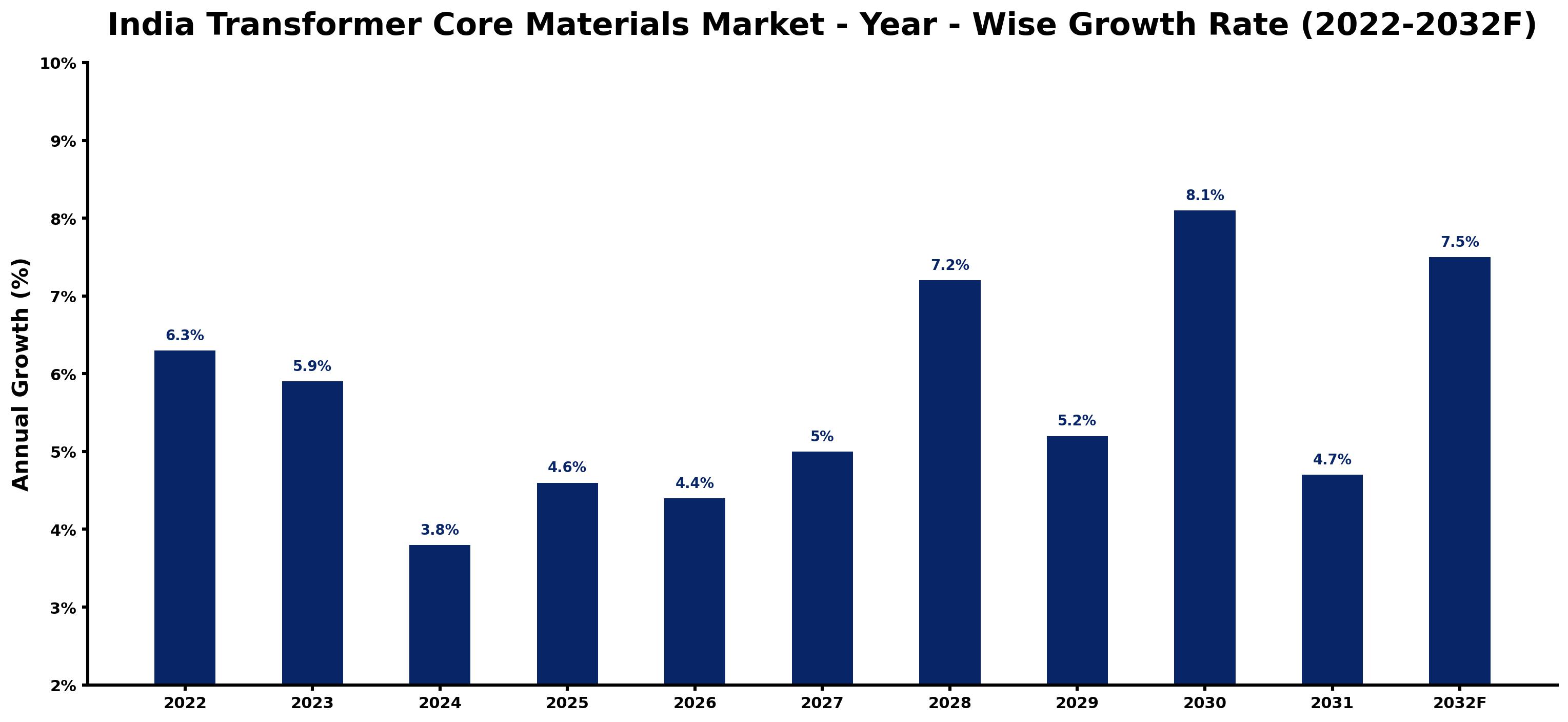
Annual growth estimates for each year appear below with the principal reason behind them, explaining the shifts that set the pace of the market.
| Year | Estimated Annual Growth (%) | Market Rationale |
| 2022 | 6.3 | The market experienced strong demand from power utilities and transformer OEMs. |
| 2023 | 5.9 | Growth slowed slightly due to a temporary dip in infrastructure projects. |
| 2024 | 3.8 | The market continued to grow as energy-efficient models gained traction under the Perform, Achieve and Trade scheme. |
| 2025 | 4.6 | Demand increased with urbanization driving the need for distribution transformers. |
| 2026 | 4.4 | Growth is expected to slow as the market adjusts to new material standards set by IS 302-1. |
| 2027 | 5.0 | Investment in smart grid technologies will boost demand for transformer materials, particularly amorphous steel. |
| 2028 | 7.2 | The growing emphasis on energy efficiency is projected to lead to higher purchases of amorphous steel. |
| 2029 | 5.2 | Demand is expected to slow as the market faces supply chain challenges affecting material availability. |
| 2030 | 8.1 | The peak growth year will see increased investments in renewable energy infrastructure. |
| 2031 | 4.7 | Growth is projected to slow as competition among suppliers intensifies. |
| 2032 | 7.5 | The market is expected to benefit from ongoing government initiatives for energy efficiency and smart grid projects. |
Note: Market size estimations and growth projections presented in this report are based on 6Wresearch's proprietary forecasting methodology, utilizing the latest available industry data, government publications, and primary research inputs.
India Transformer Core Materials Market Synopsis
Transformer Core Materials in India are essential components used in transformers, primarily made from silicon steel and amorphous steel. These materials improve magnetic properties and reduce energy losses, vital for applications like distribution transformers and energy-efficient models. The India Transformer Core Materials Market is growing due to rising demand from power utilities and transformer OEMs, driven by urbanization and infrastructure development. Initiatives such as the National Smart Grid Mission further support this growth by promoting energy-efficient technologies.
Market Dynamics Impact Analysis (2026–2032)
| Factor | Type | Impact | Primary Segment Affected |
| Increasing investments in renewable energy projects | Driver | High | Silicon Steel |
| Rising adoption of energy-efficient transformers | Driver | High | Amorphous Steel |
| Growing demand for energy-efficient models | Opportunity | High | Energy-Efficient Models |
| Expansion of urban infrastructure | Opportunity | High | Distribution Transformers |
| Supply chain disruptions affecting material availability | Restraint | High | Silicon Steel |
| High production costs impacting pricing strategies | Restraint | Medium | Amorphous Steel |
| Competition from alternative materials | Challenge | Medium | Ferrite Cores |
| Technological advancements requiring continuous investment | Challenge | High | Nanocrystalline Cores |
Evaluation of Drivers in India Transformer Core Materials Market (2026–2032)
The main growth drivers and the segments they affect most are set out below.
| Drivers | Primary Segment Affected | Why It Matters (Evidence) |
| Increased investments in renewable energy projects | Silicon Steel | These projects increase the demand for transformers, which drives higher purchases of silicon steel, accounting for over 60% of transformer cores. |
| Growing adoption of energy-efficient transformers | Amorphous Steel | Energy-efficient transformers can reduce energy losses by up to 30%, driving demand for amorphous steel in the market. |
| Urbanization leading to infrastructure development | Distribution Transformers | Urban expansion necessitates more distribution transformers, thus boosting demand for core materials used in their production. |
| Government initiatives promoting smart grid technologies | Energy-Efficient Models | The National Smart Grid Mission enhances grid efficiency, raising the need for energy-efficient transformer materials in manufacturing. |
| Rising consumption from power utilities | Transformer OEMs | Power utilities are the largest consumers of transformer core materials, ensuring consistent demand and driving market growth. |
Market growth in India for Transformer Core Materials rests on increased investments in renewable energy projects and the growing adoption of energy-efficient transformers. The installed capacity of power generation in India exceeds 400 GW, creating strong demand for transformers. The market for energy-efficient transformers is projected to grow by 15% annually until 2025, driven by the need for lower energy losses. Urban infrastructure development is increasing the need for distribution transformers, which boosts purchases of core materials. Additionally, power utilities, as the largest consumers, significantly influence demand for transformer core materials.
Evaluation of Restraints in India Transformer Core Materials Market
The following restraints limit how fast demand can grow.
| Market Restraint | Primary Segment Affected | Why It Matters (Evidence) |
| Supply chain disruptions affecting material availability | Silicon Steel | Recent global supply chain issues have led to material shortages, impacting transformer production timelines and delaying projects. |
| High production costs impacting pricing strategies | Amorphous Steel | Increased costs of raw materials have forced manufacturers to reconsider pricing, affecting competitiveness and profit margins. |
| Competition from alternative materials | Ferrite Cores | The use of ferrite cores in smaller transformers poses a challenge to traditional core materials, reducing market share for silicon and amorphous steel. |
| Technological advancements requiring continuous investment | Nanocrystalline Cores | The need for ongoing investment in technology can strain smaller manufacturers' resources, limiting their ability to innovate. |
| Regulatory compliance costs | Energy-Efficient Models | Compliance with standards like IS 302-1 can increase operational costs for manufacturers, impacting their pricing strategies. |
India Transformer Core Materials Market Challenges
The India Transformer Core Materials market encounters several practical challenges, starting with high production costs. Producers face rising prices for silicon steel, which makes up over 60% of transformer cores, resulting in increased manufacturing expenses that compress profit margins. Technological challenges also arise; many manufacturers struggle to adopt advanced nanocrystalline cores, hindering the production of high-frequency transformers and diminishing their competitiveness. Skills shortages in the workforce compound these issues, as the industry lacks the specialised expertise needed for effective implementation of new technologies. Intense competition from imported materials compels local producers to lower prices, adversely affecting their profitability.
Trends in the India Transformer Core Materials Market
Four trends stand out in the India Transformer Core Materials Market.
- Shift from Traditional to Energy-Efficient Transformers: Since 2020, there has been a shift towards energy-efficient transformers, with demand projected to grow by 15% annually until 2025. This change is influenced by government initiatives promoting energy efficiency, prompting suppliers to adapt their offerings accordingly.
- Transition from Silicon Steel to Amorphous Steel: Amorphous steel is gaining traction due to its lower core losses, with a projected CAGR of 8.7% from 2026 to 2032. This transition is essential for meeting the demand for more energy-efficient transformers in the market.
- Emergence of Smart Grid Technologies: The National Smart Grid Mission, launched in 2020, is improving grid efficiency and driving demand for advanced transformer materials. The Ministry of Power has allocated INR 1,000 crore for related projects in 2023, further supporting industry growth.
- Growing Urbanization Driving Distribution Transformer Demand: Urbanization is increasing the demand for distribution transformers, particularly in regions like Maharashtra. The market for distribution transformers is projected to grow as urban infrastructure develops, highlighting the need for core materials.
Investment Opportunities in the India Transformer Core Materials Market
Several openings in the India Transformer Core Materials Market merit attention from investors.
- Partnerships with Local Manufacturers: Now is an ideal time for foreign suppliers to partner with local manufacturers in Maharashtra, where transformer production is strong. This collaboration can help navigate regulatory requirements and facilitate market entry for new products.
- Investment in Energy-Efficient Technologies: With the demand for energy-efficient transformers expected to grow by 15% annually, investing in production capabilities for amorphous steel is essential for suppliers looking to capture market share in this growing segment.
- Expansion into Smart Grid Projects: Smart grid developers are increasingly seeking advanced transformer materials to improve grid efficiency. Suppliers can enter this market by aligning with government initiatives and securing necessary approvals for their products.
- Focus on Distribution Transformers: The ongoing urbanization in India presents a significant opportunity for manufacturers of distribution transformers. By establishing production facilities in key urban areas, suppliers can effectively meet the rising demand for these essential components.
Government Initiatives in the India Transformer Core Materials Market
The Bureau of Indian Standards has established IS 302-1 for safety in transformers, ensuring that manufacturers comply with safety protocols. This regulation, introduced in 2020, mandates rigorous testing and certification processes for transformer core materials, influencing production standards. The National Smart Grid Mission, also launched in 2020, aims to enhance grid efficiency, encouraging the adoption of energy-efficient technologies in transformer manufacturing. The Ministry of Power has allocated INR 1,000 crore for smart grid projects in 2023, further supporting the industry by funding initiatives that improve infrastructure and technology adoption.
Power utilities benefit from the National Smart Grid Mission, which funds projects aimed at enhancing grid efficiency. The Ministry of Power oversees the allocation of funds and approvals for smart grid initiatives, ensuring that power utilities receive the necessary support for implementing advanced technologies. The Indian Electrical and Electronics Manufacturers' Association also plays a role in promoting industry standards and facilitating collaboration among manufacturers. These initiatives create a favourable environment for buyers to invest in energy-efficient transformer solutions.
Future Insight of the India Transformer Core Materials Market
By 2032, buyers and suppliers in the India Transformer Core Materials market can anticipate substantial changes driven by several key factors. The National Smart Grid Mission will significantly increase demand for energy-efficient transformers, aligning with the government's commitment to achieving 175 GW of renewable energy capacity. Investments of INR 1,000 crore in smart grid projects will enhance infrastructure and innovation capabilities. Additionally, the growing adoption of advanced technologies will enable manufacturers to produce transformers with reduced energy losses, creating a more competitive environment for local producers.
Market Segmentation Analysis
Each segment group is reviewed below, with the leader by share and the fastest grower by CAGR.
By Material Type – Silicon Steel Dominated, Amorphous Steel Expected to Grow Fastest
According to Vasudha, AM at 6Wresearch, with a 43% revenue share in 2025, Silicon Steel was the largest material type category. Silicon steel is the most widely used material in transformer cores, particularly valued for its efficiency in energy transfer. Its application in distribution transformers, which are crucial for power distribution, ensures its dominant share in the market. Over 2026–2032, Amorphous Steel is expected to post the fastest growth, at a CAGR of 8.7%. Amorphous steel is gaining popularity due to its ability to reduce energy losses by up to 30%, appealing to manufacturers focused on energy efficiency. The anticipated growth in demand for energy-efficient transformers, projected at 15% annually until 2025, will further accelerate its adoption. Suppliers should prioritise silicon steel while also exploring amorphous steel opportunities to meet the rising demand for energy-efficient transformer solutions.
By Magnetic Properties – High Permeability Dominated, Low Core Loss Expected to Grow Fastest
The largest magnetic properties category in 2025 was High Permeability, with a 42% share of total revenue. High permeability is essential for enhancing magnetic flux in transformers, making it the leading sub-segment in the market. This characteristic is particularly critical for power utilities that rely on efficient energy transfer to fulfil operational requirements. Low Core Loss is projected to grow fastest, at a CAGR of 8.8% during 2026–2032. Low core loss is witnessing rapid growth as manufacturers increasingly focus on improving energy efficiency in transformers. The rising emphasis on energy-efficient models drives the demand for materials that minimise core losses, ensuring sustained expansion in this segment. Manufacturers must focus on developing materials with low core loss properties to stay competitive in the energy-efficient transformer market.
By Application Type – Distribution Transformers Dominated, Energy-Efficient Models Expected to Grow Fastest
Distribution Transformers held a 39% share of the India Transformer Core Materials Market by application type in 2025. Distribution transformers are extensively used in power distribution networks throughout India, effectively addressing the country's increasing energy demands. Their widespread deployment in urban areas significantly contributes to their leading market share. The quickest growth will come from Energy-Efficient Models, forecast to expand at a CAGR of 7.7% between 2026 and 2032. Energy-efficient models are the fastest-growing application type, propelled by a shift towards reducing energy losses in line with government initiatives. The heightened focus on sustainability and efficiency in transformer design underpins this growth trajectory. Suppliers should align their product offerings with the rising demand for energy-efficient models to capitalise on emerging market opportunities.
By End User – Power Utilities Dominated, Transformer OEMs Expected to Grow Fastest
Power Utilities accounted for a 35% market share by end user in 2025. Power utilities are the largest consumers of transformer core materials, necessitating reliable transformers for effective energy distribution. Their substantial installed base of over 10 million units reinforces their dominant share in the market. Transformer OEMs are set to record the highest CAGR in this split, 7.4% over 2026–2032. Transformer OEMs are the fastest-growing end user segment as they increasingly adopt advanced materials to enhance transformer performance. This trend aligns with the growing demand for high-frequency applications in the market. Suppliers must engage with transformer OEMs to ensure their materials meet the evolving technological demands and performance standards.
Key Attractiveness of the Report
- 10 Years of Market Numbers
- Historical Data Starting from 2022 to 2025
- Base Year 2025
- Forecast Data until 2032
- Key Performance Indicators Impacting the Market
- Major Upcoming Developments and Projects
Key Highlights of the Report:
- India Transformer Core Materials Market Outlook
- Market Size of India Transformer Core Materials Market, 2025
- Forecast of India Transformer Core Materials Market, 2032
- Historical Data and Forecast of India Transformer Core Materials Revenues & Volume for the Period 2022 - 2032F
- India Transformer Core Materials Market Trend Evolution
- India Transformer Core Materials Market Drivers and Challenges
- India Transformer Core Materials Price Trends
- India Transformer Core Materials Porter's Five Forces
- India Transformer Core Materials Industry Life Cycle
- Historical Data and Forecast of India Transformer Core Materials Market Revenues & Volume By Material Type for the Period 2022 - 2032F
- Historical Data and Forecast of India Transformer Core Materials Market Revenues & Volume By Silicon Steel for the Period 2022 - 2032F
- Historical Data and Forecast of India Transformer Core Materials Market Revenues & Volume By Amorphous Steel for the Period 2022 - 2032F
- Historical Data and Forecast of India Transformer Core Materials Market Revenues & Volume By Ferrite Cores for the Period 2022 - 2032F
- Historical Data and Forecast of India Transformer Core Materials Market Revenues & Volume By Nanocrystalline Cores for the Period 2022 - 2032F
- Historical Data and Forecast of India Transformer Core Materials Market Revenues & Volume By Magnetic Properties for the Period 2022 - 2032F
- Historical Data and Forecast of India Transformer Core Materials Market Revenues & Volume By High Permeability for the Period 2022 - 2032F
- Historical Data and Forecast of India Transformer Core Materials Market Revenues & Volume By Low Core Loss for the Period 2022 - 2032F
- Historical Data and Forecast of India Transformer Core Materials Market Revenues & Volume By High Frequency for the Period 2022 - 2032F
- Historical Data and Forecast of India Transformer Core Materials Market Revenues & Volume By Compact Size for the Period 2022 - 2032F
- Historical Data and Forecast of India Transformer Core Materials Market Revenues & Volume By Application Type for the Period 2022 - 2032F
- Historical Data and Forecast of India Transformer Core Materials Market Revenues & Volume By Distribution Transformers for the Period 2022 - 2032F
- Historical Data and Forecast of India Transformer Core Materials Market Revenues & Volume By Energy-Efficient Models for the Period 2022 - 2032F
- Historical Data and Forecast of India Transformer Core Materials Market Revenues & Volume By Electronics Transformers for the Period 2022 - 2032F
- Historical Data and Forecast of India Transformer Core Materials Market Revenues & Volume By Compact Grid Systems for the Period 2022 - 2032F
- Historical Data and Forecast of India Transformer Core Materials Market Revenues & Volume By End User for the Period 2022 - 2032F
- Historical Data and Forecast of India Transformer Core Materials Market Revenues & Volume By Power Utilities for the Period 2022 - 2032F
- Historical Data and Forecast of India Transformer Core Materials Market Revenues & Volume By Transformer OEMs for the Period 2022 - 2032F
- Historical Data and Forecast of India Transformer Core Materials Market Revenues & Volume By Industrial Suppliers for the Period 2022 - 2032F
- Historical Data and Forecast of India Transformer Core Materials Market Revenues & Volume By Smart Grid Developers for the Period 2022 - 2032F
- India Transformer Core Materials Import Export Trade Statistics
- Market Opportunity Assessment By Material Type
- Market Opportunity Assessment By Magnetic Properties
- Market Opportunity Assessment By Application Type
- Market Opportunity Assessment By End User
- India Transformer Core Materials Top Companies Market Share
- India Transformer Core Materials Competitive Benchmarking By Technical and Operational Parameters
- India Transformer Core Materials Company Profiles
- India Transformer Core Materials Key Strategic Recommendations
Market Covered
This report examines the market across the segments below.
By Material Type
- Silicon Steel
- Amorphous Steel
- Ferrite Cores
- Nanocrystalline Cores
By Magnetic Properties
- High Permeability
- Low Core Loss
- High Frequency
- Compact Size
By Application Type
- Distribution Transformers
- Energy-Efficient Models
- Electronics Transformers
- Compact Grid Systems
By End User
- Power Utilities
- Transformer OEMs
- Industrial Suppliers
- Smart Grid Developers































